After I returned from a shift at the home, farm and auto supply store I scrubbed and cut up potatoes to roast for dinner. Roasted potatoes, a burger patty and frozen peas made a dinner — comfort food as winter approaches.
The Thanksgiving leftovers are gone, our pantry and ice box are full. There was no need to grocery shop after my shift comme d’habitude.
In eight weeks it will be time to start onions, leeks, and shallots inside, then begin soil blocking at the farm a week or two later. For now there’s indoors work of reading, writing, cooking and cleaning.
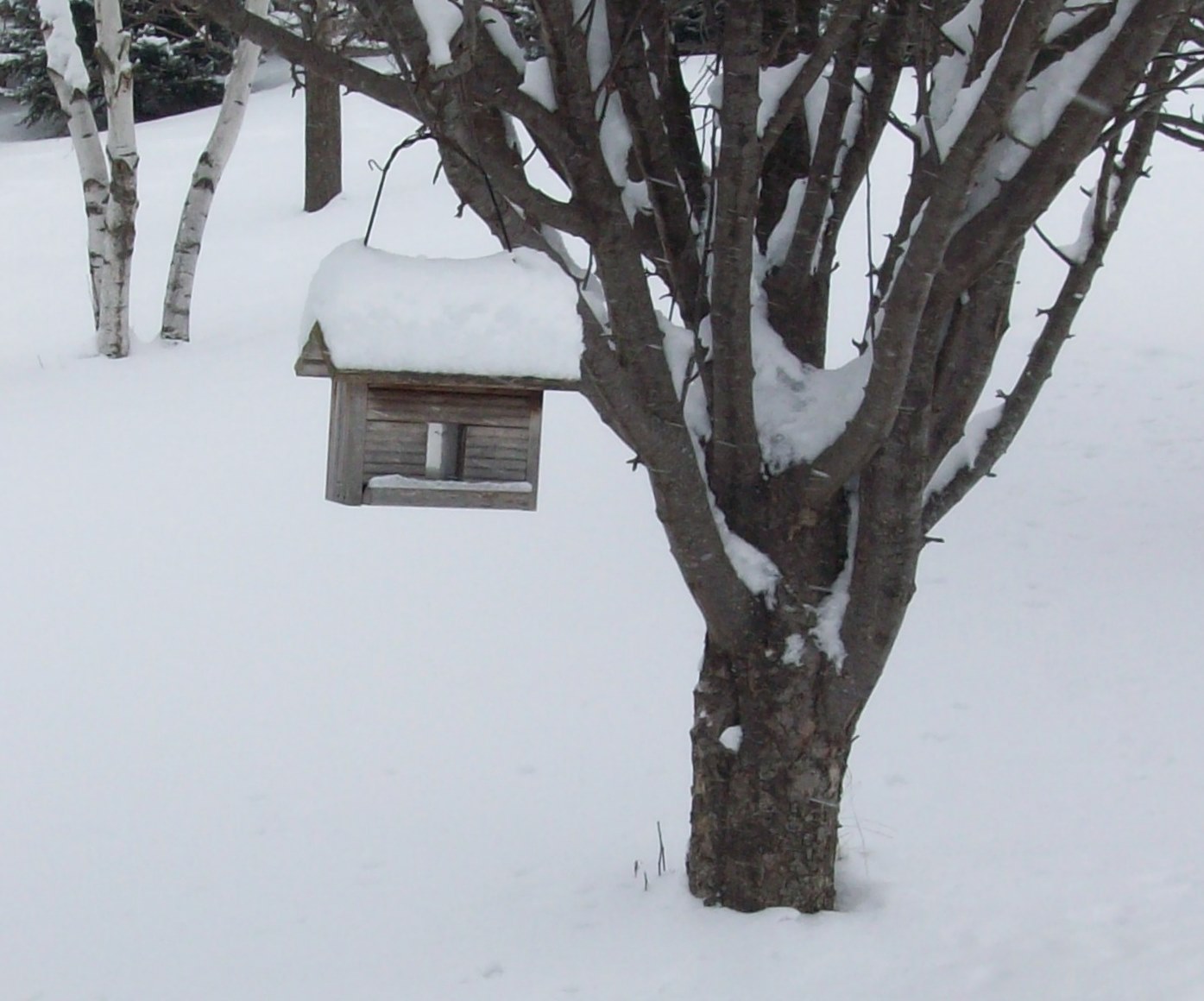
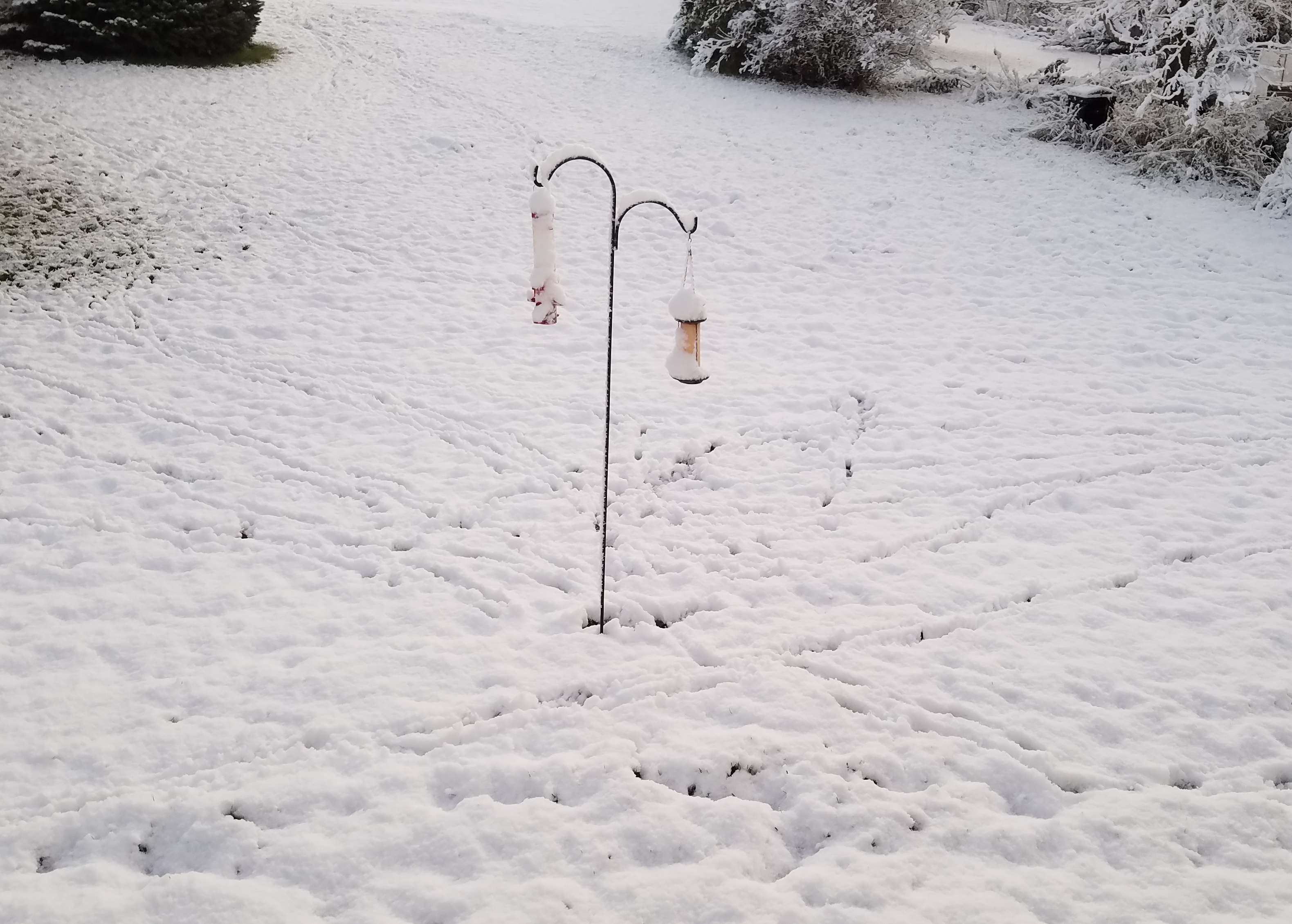
A neighbor put out bird feeders to attract birds, then expressed concern that cats were hanging around, chasing the birds away and prompting her dogs to bark at them. I wrote a response.
This is an interesting topic. Although I don’t have any solution to the issue of dogs barking at wandering cats, by putting out bird seed, like I have, a person attracts a variety of animals to the yard, which includes not only birds but mice, voles, chipmunks, squirrels, raccoons, deer, and maybe others.
Because of our proximity to the state park, we see almost every species native to Iowa here.
The bird feeder also brings predators of small animals, including cats, but also hawks, owls, and foxes. Then there are the scavengers like possums, turkey vultures and crows.
My point is when we decide to place a bird feeder out we are creating an ecosystem, especially if we fill feeders year-around. If members have pets, they should be kept on a leash or indoors, that’s long been our policy. However, there is a bigger ecosystem that will continue, even in the event pets can be controlled.
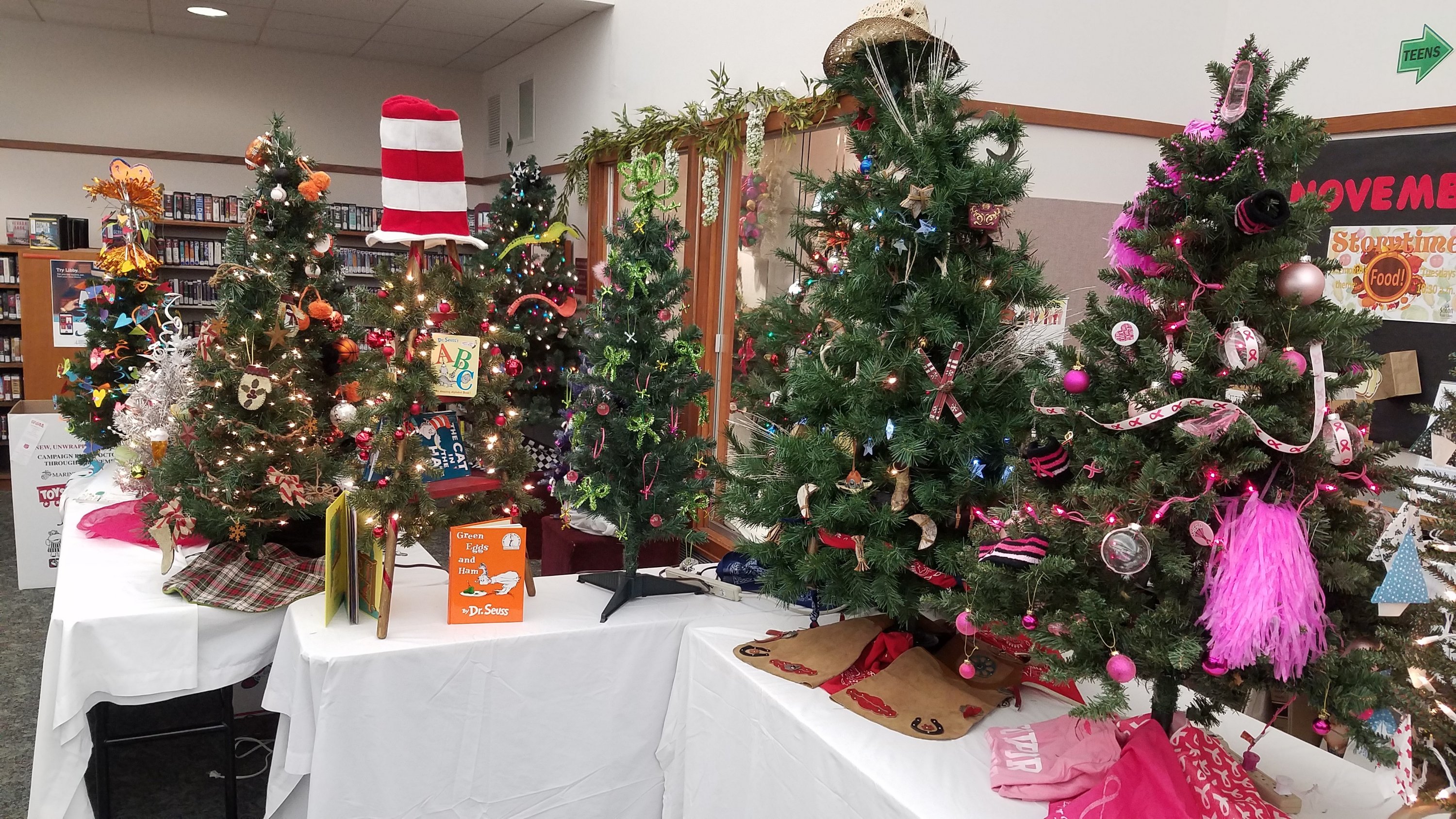
Tree Decorating Contest the the Solon Public Library
Happy Thanksgiving readers!
Thanksgiving week continues to be a special time. There is a certain something in the air. As a writer I should do a better job describing that. Doing so would reduce what’s special to mundane. Let’s not go there.
We all need time to recharge after this long year. The days find me planning next year’s garden, determining how to improve our community in the months ahead, and budgeting. Those are markers along the way that don’t get to what’s special this week.
It seems unlikely we will decorate our home for year-end holidays. We’re in the middle of down-sizing, organizing, and re-arranging for coming years. Translation: stuff is pulled out everywhere. The library in town displayed the results of a competition to decorate Christmas trees. We took it in last night and gained a bit of holiday spirit without the work it would have caused us at home. That will have to do.
Thanksgiving is a quiet time for us. With our daughter a thousand miles away and all four of our parents deceased, there is little reason to get too carried away. We will celebrate with a special meal that includes home made baked beans, wild rice, baked sweet potatoes, a relish tray, sweet apple cider from the orchard and an apple crisp made with backyard apples. It will be good, filling and with some calculated adjustments and portion control, nutritionally balanced.
According to the American Farm Bureau, the cost of a Thanksgiving dinner for 10 people is $48.91 this year. Ours would feed the same number at a fraction of the cost, due to no meat products on the table and producing and sourcing items from our garden or from the local food projects where I work. When most food is produced close to home, eating well is not expensive.
There’s more to the special feeling of Thanksgiving than food. Describing it escapes me. I’m better off not knowing what it is and basking in the glow of its exceptional character. At least for this year.
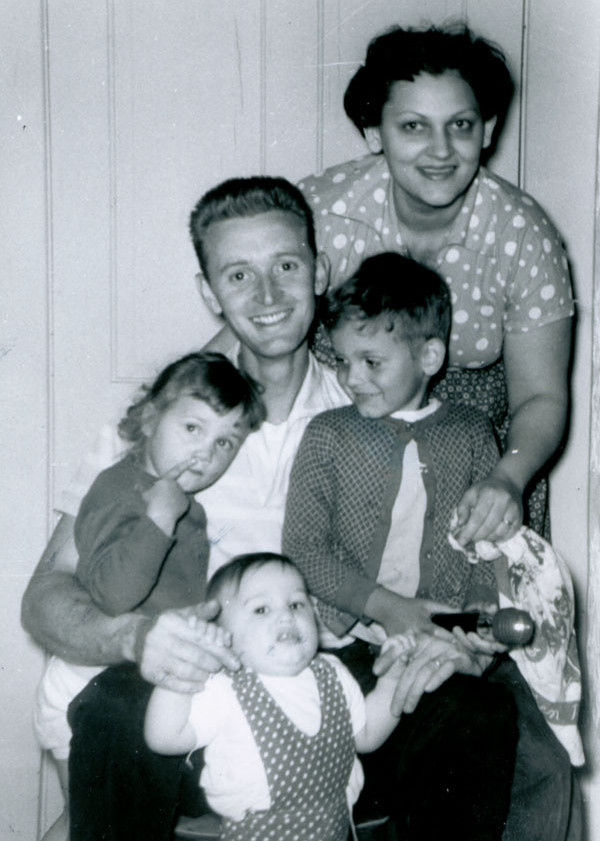
On a bleak, drizzly Sunday morning I visited our parents’ grave with my sister. Cemetery workers had piled sod on top of Mom’s grave with a carve-out for the foot stone designed to look like Father’s. We are waiting for delivery.
I was glad to visit before winter.
We met our brother at an Italian restaurant in the dying mall. We all had salads with iced water to drink, a sign of dietary requirements of the times. The food was good in a way Italian restaurants can be. The conversation started on Democratic politics. We don’t agree on who should be the next presidential nominee so we moved on to the topic of our family history.
Of our parents’ generation, aunts in Florida and Virginia are the only ones remaining. Sister contacts them every so often. I heard from both in the last five years via email or snail mail. Last time I visited my aunt in Virginia was in 1983. I haven’t seen the one in Florida for longer than that. Word is the family kept Cox Hollow when my great aunt died, and we didn’t discuss who owns the home place in the Appalachian hills where one branch of the family is buried. None of us have seen the family cemetery where ancestors who fought for both the Union and the Confederacy are buried. The stories we share as siblings are common ones, although each time we retell them some new nuance emerges. The luncheon was okay.
Suffering a cold for the last two weeks, I continued to make a life. I also cancelled a lot of plans.
Tonight I’m scheduled to attend a house party for the U.S. Senate candidate Michael Franken in Marion. We’ll see how I feel after work. The local Elizabeth Warren organizer arranged a Democratic debate watch party in town, which because it is so close, I also plan to attend. The debate starts at 8 p.m. local time and that is pretty late to be out for me. Organizing for the caucus doesn’t happen on its own and I hope to recover from my illness soon to help the effort.
The ambient temperature warmed and we are getting respite from wintry weather. We are in a dank, in-between time of hoping for relief from what ails us, and from the emotional burdens life presents. Thankfully today is another day to live.
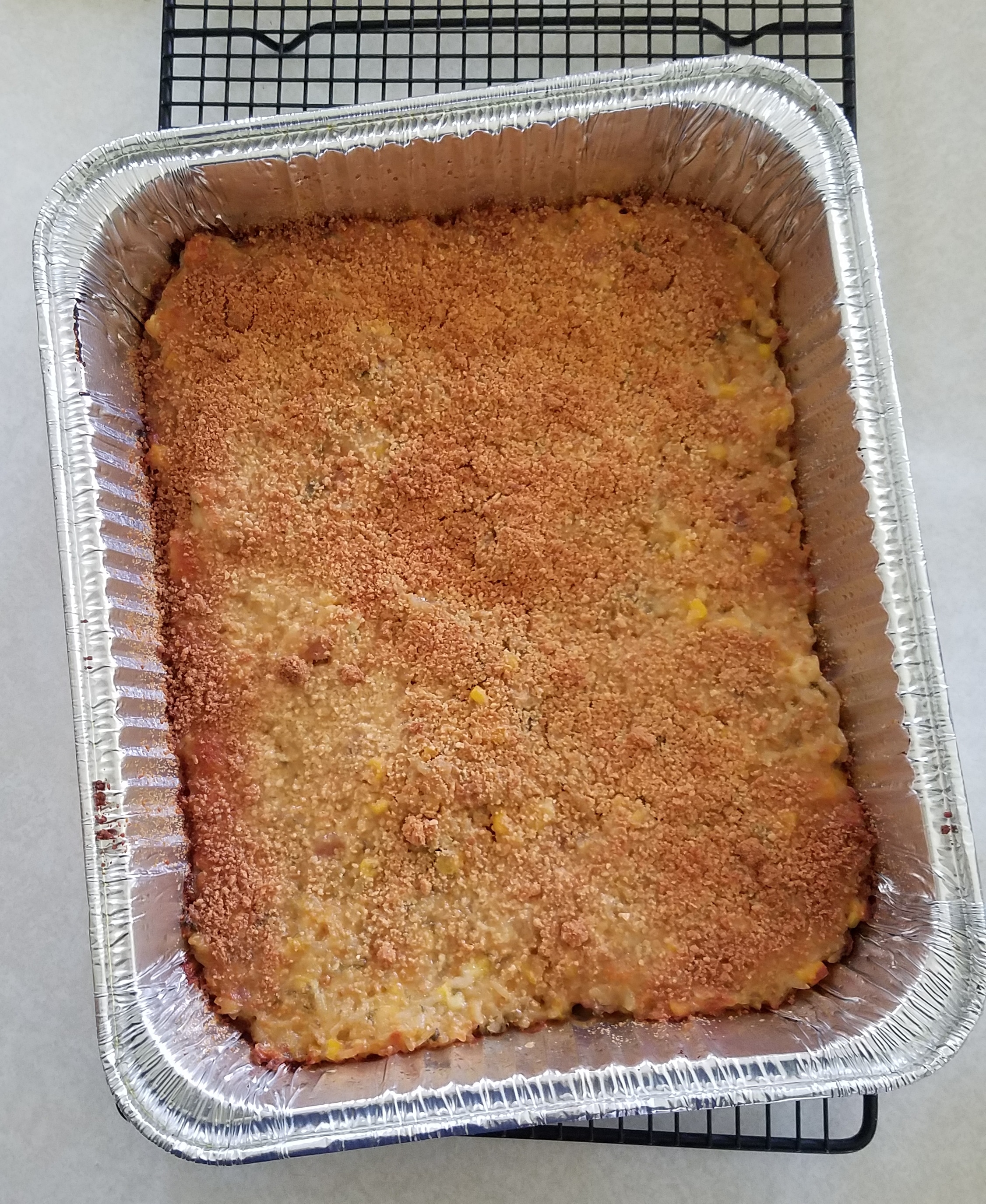
Corn-rice casserole for the annual orchard potluck dinner.
A hard break from autumn accompanied last week’s snowfall.
Outdoors there is garden clean up, raking leaves, and another mowing to be done, however, we’ve turned mostly inside.
A main issue has been determining how to get exercise without an active garden and walks along the lake. Yesterday I cleaned and set up the NordicTrack ski machine. This morning I tried it. It will serve for a while and, in any case, seems more focused than walks along the lake and yard work.
As orchard season ended I took an eleven day hiatus from carb counting. The point was to see the impact formal training and weeks of habit had on daily food consumption. Some things were easy: eating only one slice of bread at a meal, portion control, and selecting snacks that had less than 15 carbs in them. What was harder was dealing with cravings. I was mostly, but not always able to do so. At the end my average weight remained unchanged at a 15 percent loss. Clothes still fit and if I exercise daily indoors, I may have to get pants a size smaller. I went back to carb counting this morning and return to the clinic for more tests in three weeks.
The time between harvest and year’s end has been for reflection and for making plans. After a struggle when I retired in 2009 our situation stabilized with adequate income to meet short term needs and engaging work in the community. I feel fortunate to be approaching my 68th birthday with an ability to think beyond it.
I expect to continue to write short posts, although a format change at On Our Own is overdue. Before changing the look of the blog I want to print out past years for the book shelf. Financial constraints held me back from making a paper archive every year so I’m behind.
There is other writing to do. I recently ran into a former editor at the Iowa City Press Citizen and we discussed freelancing. It would take a compelling reason for me to seek publication more than I get in letters to the editor of the Solon Economist or an occasional guest opinion in the Cedar Rapids Gazette. If anything, the next period will be one of working on an autobiographical work. Whether that has import beyond family and close friends seems doubtful. It’s what an educated person does or at least that’s the paradigm through which I view it. Our daughter might appreciate the effort of culling old papers and artifacts so there is less for her to deal with when we’re gone. I don’t plan to be gone anytime soon.
Perhaps a few more autumn days lie ahead. The forecast looks dry through the end of this week. I took a vacation day from the home, farm and auto supply store to clean up the garden. If all goes well we’ll be able to turn inside when winter arrives in earnest.
What should we make of Tuesday’s October snowfall? Not much, I guess.
It was another day in the neighborhood, where melting snow delayed yard and garden work, and a final mowing with grass clipping collection.
It’s unclear whether further mowing will occur.
Weather has me turning inward. A technician is schedule to inspect our furnace, a pack of 9-volt batteries is ready to install in smoke detectors, and I bought a new snow shovel to replace the aluminum one that proved too flimsy.
I’m also prioritizing November reading.
October has been a great month for this blog with the most monthly views since I began blogging in 2007.
It’s time to take a breather before the rush to year’s end. After today’s shift at the home, farm and auto supply store, that what I plan.
Daylight remained as I drove into the driveway after a shift at the orchard.
If the garden appeared scorched by the previous night’s first frost, some tomato plants survived and the kale looked resilient.
The weather forecast is a couple of days without rain. I scheduled garlic planting for Tuesday when the ground should be dry enough. Fingers crossed I get a crop in this year.
I picked another bushel of fully ripened Red Delicious apples yesterday morning. This morning I used apples knocked down and damaged during the picking process to make an apple crisp for the county party’s fall fundraiser. In September I bought 30 aluminum food service trays for potlucks. This was the fifth one used.
We were busy at the orchard Saturday. Because of rainy weekends there is a pent up demand for the u-pick apple experience. I was tired at the end of my shift. I fixed eggplant Parmesan for dinner and could go no further. I was so tired I left the dishes to clean this morning. If there was any doubt, autumn has definitely arrived.
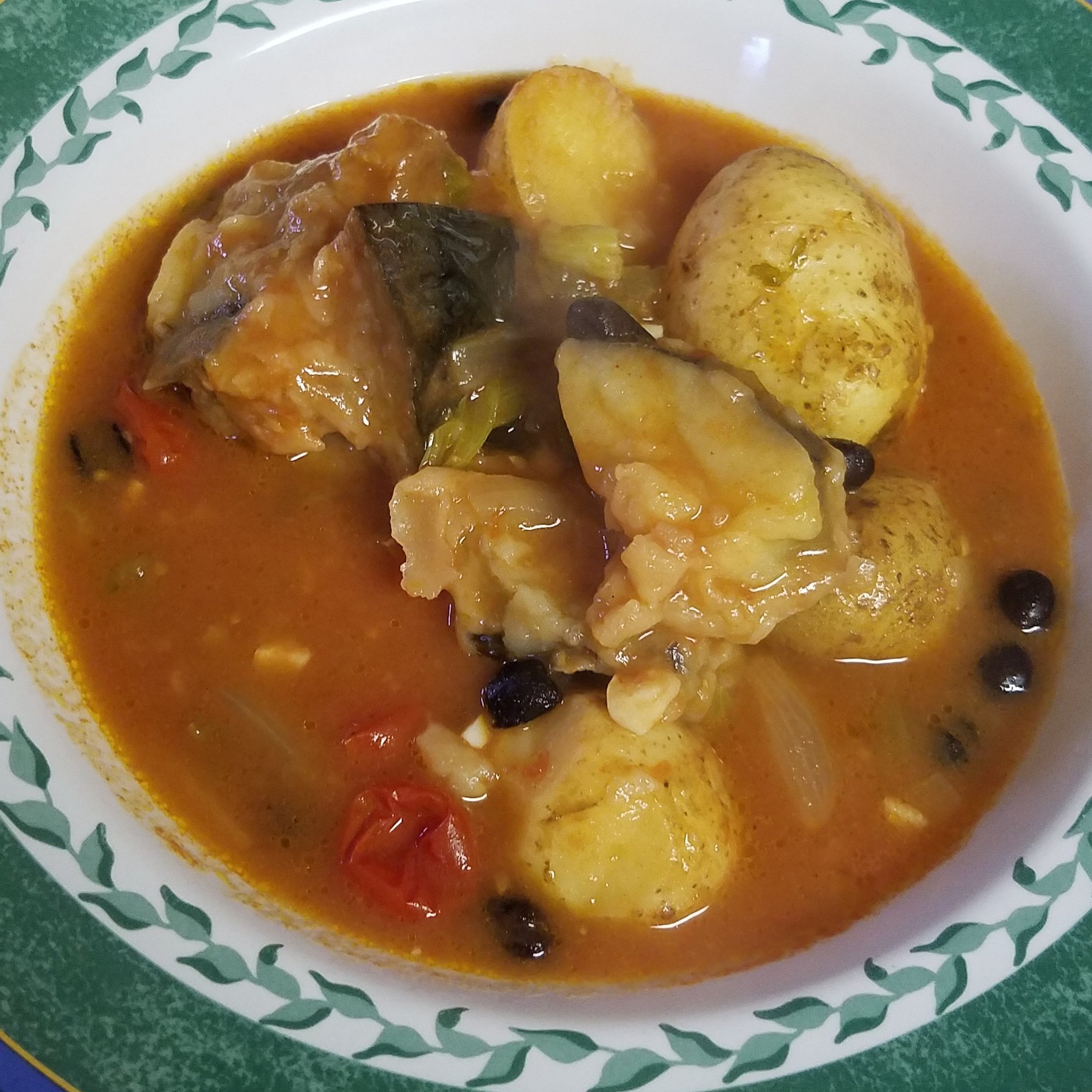
Stew of potatoes, eggplant, tomato, black beans and vegetables.
Who wants to reinvent home cooking every time they enter the kitchen?
Here’s a better question, how can I work to be present in the kitchen and produce tasty, nutritious food for our family?
While I have a strong memory of Mother’s cooking, I don’t recall many of the dishes. For me, home food begins in 1959 when we moved to Northwest Davenport where I lived at home until going to university in 1970. During those years Mom cooked what I believed was standard fare for working class people. If there was a typical dinner, it included beef or chicken as a main course, potatoes or rice, and a vegetable. Sometimes there was dessert. Dad got a discount at the butcher shop co-located at the meat packing plant where he worked. He brought home mostly beef and pork products, and we had plenty. Memorable tastes include liver and onions, beef vegetable soup served on white rice, and usual fare of hamburgers, grilled cheese and meat loaf. It was a staple cuisine that tasted good and provided nourishment.
When I became mostly ovo-lacto vegetarian in 1982, traditions associated with Mom’s cooking went out the window except when we visited her. I started cooking while I was in college and like most beginning home cooks was not very good at it. I recall serving Mother tuna and noodle casserole during the visit she made to my small apartment. I used her recipe, which included canned tuna and condensed mushroom soup. We got through the meal, one of the few during my life where she came to my place for dinner. I liked the dish with its savory richness. Today, I wouldn’t use tuna because of my mostly vegetarianism, but also because of over fishing of the species combined with the use of slave labor to harvest it in waters off Asia.
There is a utopian impulse in American society in which groups of people separate from social traditions and strike out anew. In that sense, a cook has a choice. Should we learn and perpetuate cooking traditions in our kitchen or improvise new meal solutions against a perceived and newly created blank slate? My choice is to make a cuisine from an ecology of food I identified and help create that borrows from everywhere to create new dishes. I may write a cook book to record the journey, but have little interest in creating traditions. A tasty, nutritious meal is enough.
In retirement for 16 months, I’ve found we have become increasingly isolated from society. Even though we rarely use the television set, I now understand the archetypal image of retired man yelling at the TV from a chair. It is harder than imagined to get out of the house for anything other than my part time jobs. The new paradigm has been good for our marriage and provides a natural break for utopian culinary endeavors.
The meal began with weighing out a pound of small potatoes from my barter arrangement with Farmer Kate. When I brought them to the kitchen, I didn’t know what I would do with them.
While looking through the weedy, end of season garden, I found three large Galine eggplants behind the foliage. I picked them and brought them inside.
On the counter was a good supply of garlic and cherry tomatoes. In the ice box was half a Vidalia onion, the last of the fresh garden celery, part of a bell pepper, some leftover black beans, and jars of thick tomato juice.
There was a meal in these ingredients.
After cleaning and trimming the potatoes I put them in a large sauce pan and covered them with tomato juice. My tomato juice is very thick due to a process I developed to use excess tomato water while canning. I brought the mixture to a boil then turned it down to simmer until the potatoes were fork tender.
I cut the eggplant with skin on into large chunks, soaked the pieces in room temperature tap water for 30 minutes, dredged them in flour, then fried them in two tablespoons extra virgin olive oil until browned on all sides.
In the Dutch oven I cooked the onion, bell pepper, celery and garlic in a tablespoon of extra virgin olive oil on high heat until tender. The only seasoning used was sea salt.
When the potatoes were done, I dumped the whole pan into the Dutch Oven, added the black beans and some cherry tomatoes, then added the eggplant. I scraped the bottom of the frying pan into the Dutch oven with a spatula to get all the flour and oil mixture and thicken the sauce.
I turned the heat to medium low and warmed until everything was evenly heated and the sauce thickened.
In retrospect, I could have added some frozen okra and seasoned it with red or green hot peppers. We keep the spicy dial turned to low in shared meals. It made four servings and was satisfying.
Humans consume only so many vegetables. 20 percent of an estimated 20,000 species of edible plants represent 90 percent of our food. Others may have made dishes similar to this potato eggplant stew. Each ingredient, each technique and each vegetable has its own detailed and unique history. There are a finite number of ways to pull them together into a tasty, nutritious dish. Improvisational cooking need not be unique, just as utopian living works to meet the same human needs as the rest of society. As a seasoned home cook, I no longer have to reinvent things. At the same time, improvising based on available ingredients renews our interest in cuisine.
My Saturday and Sunday shifts at the orchard were cancelled because of almost continuous thunderstorms during the weekend.
I’ll miss the income, although will get by.
Saturday I canned the next batch of tomatoes. With the pantry containing 24 quarts of whole and diced, 24 quarts of tomato water and 48 pints of whole and diced, there should be enough to last all of 2020 and then some. I didn’t mention the quart bags of tomato sauce in the freezer… or the four dozen fresh on the counter… or the next wave ready for harvest. We’re good on tomatoes.
Sunday was a punk day. To get out of the house and take my daily exercise I returned to the orchard and picked the apples in the photo… in the rain… wearing the wax jacket I bought in Stratford, Ontario during one of our summer trips when our daughter was in high school. The wax jacket worked as far as keeping the rain off goes. The plastic lining made it too hot for humans by the time I returned to the sales barn to pay for my apples. I lost count of how many varieties of apples I tried thus far this season, maybe two dozen. The Robinette and Alvin Gilliam’s Seedling were astoundingly flavorful. It would be tough for me to return to supermarket apples.
Every once in a while we are reminded of how little we actually know about our daily lives. While it rained I made it halfway through Michael W. Twitty’s book The Cooking Gene: A Journey Through African American Culinary History in the Old South. It is one of few books I know like it. Twitty presents expository words about his genetic history and how that influenced the culture of slavery from a culinary perspective. He brings together something worth studying if interested at all in the local food movement.
There is a lot in the book. Although I don’t consume much meat and no fish or seafood, I’ve been thinking about my approach to growing and cooking since I started the book. Twitty provides new insight into the idea of a kitchen garden and using food that’s found or produced locally. There is a lot of discussion of greens, the liquid they are cooked in, and staples like corn, rice and root vegetables. I consider my own culinary practices and it’s a hodge-podge of dishes, techniques and ingredients rather than something coherent as Twitty recounts.
Culinary times have changed since the 17th and 18th century through increased urbanization. If everyone that lives in the nearby cities of Cedar Rapids and Iowa City trekked out to the country to forage nuts, wild plants, fish and game on a subsistence basis, the land would soon be stripped clean. That’s not to mention land in private ownership with prime foraging areas and posted no trespassing signs. In that sense, only a small percentage of the population can return to that lifestyle. When the oceans are over-fished, and marine ecosystems are collapsing there is no reason to consume more fish and seafood. When poring over a menu that contains sushi, I shake my head and end up explaining to diners at my table why it shouldn’t be consumed. It doesn’t always go over well.
At the same time there is an ecology of food. If the cultural elements have changed, the instinctual behavior hasn’t. There’s a lot to learn and think about in The Cooking Gene. That’s part of why we read books.
Next I need another walk near the lake or through the orchard to let the ideas ferment. Only then will I see whether it is fleeting enthusiasm or something from which to make structural changes in my kitchen garden.
A main feature of the vacant lot we bought in 1993 was its proximity to Lake Macbride State Park.
When we need exercise, or just want to get away from the house, it’s a short walk to the trail that runs five miles from our nearby city to the main park entrance. In August the park is filled with wildflowers, insects and other flora and fauna of living in Iowa. There is as much to observe as there is to escape in quotidian life.
A trail walk can reset our lives each time we venture out.
Two weekends into my seventh season at an apple orchard I continue to enjoy the work and its customer engagement.
A family drove over from Chicago, one stopped on their way back to Rochester, Minn., and regulars return with the micro-seasons within a procession of a hundred apple varieties. Every chance we have to converse is a window into lives where with at least one common interest. It is the beginning of something positive.
A trail walk can get us centered and ready for such engagement.
I took five sessions with a nutritionist and wellness professional, once individually and four times as part of a group. I email her questions and she quickly emails answers back.
Based mostly on blood test results, the clinic diagnosed me with Type II diabetes in May and like many, I immediately went into denial.
Listening to the professional — a person with lots of letters following her name on the business card she handed me — I’ve been able to lose 10 percent of body weight, exercise more, and feel better. Monday is a reality check as I have blood drawn for another test and a meeting with my care-giving team the following week.
Whether my diabetes can be controlled through lifestyle changes is an open question, the answer to which is I hope to avoid diabetes’s advancement and physiological deterioration. By finding it early, the diagnosis may be beaten back. Included in this sentiment is a bit of lingering denial that I have it, but I am less worried about that than other things.
When my then septuagenarian grandmother was diagnosed with diabetes I was in the U.S. Army, stationed in Mainz, Germany. One day without warning I received a large box from her with all of the instant pudding and gelatin desserts from her cupboard. She accumulated a trove of these small boxes during her food stamps shopping trips and felt she could no longer eat it and I could. Cookery was not my specialty then. I made and ate some of it, favoring the pudding. I don’t remember how much. I am about ten years younger than she was when she had her diagnosis.
The physician’s assistant made a short list of things I should do. I followed them as best I was able: a diabetes screening from an ophthalmologist, the nutrition classes, more exercise, and regular checkups. I avoided taking regular self-administered blood tests and medication, except for a daily low-dose aspirin. Based on the nutritionist’s recommendation, I started taking vitamin B-12, which seems to have improved my sleep. As a mostly ovo-lacto vegetarian I probably get enough B-12, but the supplement is inexpensive and the downside of taking it minimal. The nutritionist taught us about the USP label for dietary supplements and what it means.
The focus of counseling has been to count carbs and establish a carbohydrate budget for each meal, snacks, and for each day. Enjoy food more, including things culturally favored, but stay within the budget. That means one ear of sweet corn, two ounces of pasta, smaller portions of rice and noodles for meals. Nearly complete avoidance of simple sugars is recommended. When one of the group asked about something else — BMI, protein, weight loss or whatever — she steadfastly returned to the need to control glucose when diagnosed with diabetes. She acknowledged there were other weight and nutrition aspects to life, but we were there to learn about how to eat with our diagnosis. I’m trying to own “my diagnosis” but am not there yet.
I’m modifying my behavior although I could relapse at any moment. It hasn’t been easy. It may continue to be not-easy. As a gardener I have access to fresh vegetables that can fill my plate as in the photo of Friday morning’s breakfast. When I returned to work at the orchard, I told my supervisor I had to refrain from eating almost everything we make with the exception of apples. What will I do when winter comes? Near yesterday’s anniversary of the atomic bombing of Nagasaki, I’m thinking if it’s a nuclear winter I may not have to worry about it. However, using that as an excuse for denial of my diabetes diagnosis is pretty lame.
I’m pretty sure this won’t be the last impactful lifestyle change I have to make as I age. Big picture? I’m okay with that. It’s better than the alternative.



 Journey Home
You must be logged in to post a comment.