There were political groups, the Republicans came first…
Even though State Representative Brad Sherman is one of the most radical, right wing members of the Iowa legislature, a Democrat would have a heart of stone if they couldn’t empathize with his situation when he announced he would not seek re-election in House District 91.
Sherman wrote, “My Daughter (age 41) died suddenly and unexpectedly at the beginning of the summer, leaving her husband and 4 children (ages 15 to 7). Carole’s father (from SE Missouri) also died a short time later. Both of these events seriously changed our schedules. Then, throw in hip replacement surgery (six weeks ago) for good measure, and that pretty much summarizes our Summer and Fall.” After this boatload of trouble, Sherman decided to move out of district to Algona to be closer to the four grandchildren.
Sherman endorsed Judd Lawler as his replacement when he announced he wouldn’t run in the 2024 election. This is an old political trick, used by both Democrats and Republicans, to stave off competition in a primary. When Sherman ran in 2022, there were six Republicans in the primary, so it may be needed to ensure he influences his replacement.
What do we know about Lawler? Not much. He has been employed by Evelaw since January 2023 as a legal writing coach according to his LinkedIn profile. Here’s a screenshot from the Evelaw website:
I would argue the legislature already has too many lawyers. What matters more is where Judd will land on policy. According to Sherman’s endorsement, “Judd is a man of faith and a life-long conservative. He has a very impressive resume, yet he is a humble man with a sincere desire to serve.” That tells us a little. Lawler established a website which can be found here. Take a look and judge for yourself and judge whom he will serve in the legislature.
Suffice it to say that without Brad Sherman the dynamic of the race for this seat has changed. Now Democrats need a candidate.
I drove my 2019 Chevy Spark due west from North Liberty into gathering darkness between plot after plot of agricultural land. I paid close attention to the road as there was little traffic and light faded to darkness all around, making it difficult to see where the blacktop ended. A combine had its headlights on while harvesting corn.
The trip was an informal get-together of Iowa County Democrats and some friends from Johnson County. The big news of the evening was that extremist state legislator Brad Sherman, who represents us in House District 91, decided not to run for re-election. Republicans already recruited someone else to run for the seat. The only person who knew anything about them was a member of a farm family who saw him occasionally at the Farm Services Agency. The news surprised everyone.
(UPDATE: After this article was posted, Sherman made an announcement via email here).
I haven’t seen much of my Iowa County friends since the 2022 election. I felt I’d better attend to re-establish friendships begun during that campaign. Once we have candidates for the statehouse, I expect to be spending more time with them. It was announced no one decided to run for state senate or the house at this time.
A group from Johnson County was in attendance. My connection to many of them goes back to the 2004 campaign. I had fun chatting with them and getting caught up. We are all getting older. So many people came the restaurant had to call in extra staff to attend to us.
Iowa House Minority Leader Jennifer Konfrst attended. She represents the party well when communicating with media or the public in her leadership role. I told her as much. She said I should run for the House.
My spouse and I discussed me holding public office and it is not in our sweet spot. Who needs the public scrutiny that comes with it? In an Iowa House race, there will be scrutiny. I have been writing in public for so long I’ve taken more than a few extremely liberal positions in newspapers and on my blog. My support, with a small band of clergy, for Iowa City to become a Sanctuary City is sure to come up. I expect most of my controversial writing is easily accessible and would be used against me. Who needs that?
My friend Ed Flaherty, with whom ten of us started the Iowa Chapters of Veterans for Peace, was in attendance, as was his son. Ed and I discussed Saturday’s Armistice Recognition in Iowa City and I said I’d be there. His son Brian was chair of the Johnson County Democrats during the 2008 election cycle when Iowa voted for Barack Obama as president. I recently re-posted my story about closing down the offices here.
One of the people active in local demonstrations after Hamas bombed Israel last month was there. We reviewed the situation and planned actions. We also discussed Newman Abuissa’s Nov. 3 letter to the Cedar Rapids Gazette asking Iowa Democratic Party chair Rita Hart to issue an apology for statements about antisemitism she made regarding a group of university students. Abuissa is chair of the IDP Arab American caucus and friends with James Zogby, founder and president of the Arab-American Institute. In Eastern Iowa we have plenty of connections to what’s happening in the Middle East.
I made it a point to seek out everyone I knew and catch up. By the time I made the rounds of every table, it was past my normal bedtime.I was so busy talking I forgot to order a beverage, which usually is a locally made root beer. To avoid back roads, I took Highway 6 back to the metropolitan area and made it safely home. I am glad I went to the gathering.
We’ve lived through the hottest 12 months since record-keeping began. It’s not just me saying this. It’s likely the hottest it’s been in 125,000 years according to scientists quoted by the Washington Post.
It is not a risky thing to say that our planet will pass the tipping point of climate change. With the increased average temperature of Earth passing 1.5 degrees Celsius (2.7 degrees Fahrenheit) above pre-industrial norms, entire ecosystems could be irreversibly damaged or destroyed by global warming. Things won’t be like we know them now. According to the Post article, “nearly 3 in 4 people experienced more than a month’s worth of heat so extreme, it would have been unusual in the past, but became at least three times more likely because of human-caused climate change.”
It seems very warm here in Big Grove. That’s because it is.
This year’s drought has been a humdinger. Crop reports indicate it hasn’t been as bad as 2012 based on corn and soybean yields, yet unless we get rain soon, farmers will be facing a dry spring again. On my daily walks along the lake shore, the culvert that drain the lake watershed still doesn’t have anything in it except cracking chunks of soil like those in the photo above.
The only thing I know is no one person will be the solution to preventing as much irreversible damage as we can. It is too late for that. We can’t get agreement that children should not be slaughtered in Israel or Gaza, for Pete’s sake. There is necessary work to be done here.
District-wide school board election results from the Johnson County, Iowa Auditor.
Election day was not a big deal in Big Grove Township as only 51 of 1,222 registered voters cast a ballot in the school board races. Locals realized the inevitability of two incumbents running for two positions they held the last term or longer. If people wanted to vote, fine. Most realized a single vote did not make a difference during this election and found other things to do with their time. There are no trends to observe or wisdom to be garnered from the results now known.
Congratulations to Adam Haluska and Jami Wolf for deciding to serve on the school board another four years and then for winning their uncontested race.
The contested races for Solon School Board were in 2019 and 2021 when there were more candidates running against establishment views. Establishment voters beat them all down. Apparently, this same surge of younger people running for the board didn’t see an opportunity this cycle.
Elsewhere in the county progressives mostly won. Of note is that Laura Bergus beat incumbent Pauline Taylor in the District A Iowa City City Council race 5,942 votes to 2,995. Bergus ran an innovative campaign and brought in a number of younger voters. Her victory was a sign that the electorate is turning away from the long-time Johnson County Democratic machine into something more hopeful. It was a shocker when SEIU, the union Taylor helped organize in the county, endorsed Bergus. It was also a sign of the times.
Statewide, the book banners, curriculum white-washers, and so-called pro-parent groups did poorly as their bankrupt ideas indicated they should. Those folks were not an identified presence in Big Grove Township. If anything, the Solon District is built around parents who want a say in how the school operates. That’s why it attracts so many young, Republican people to the area. The conservatism is baked into why the schools are what they are.
In the rest of the country, it was a good night for progressive policies. I usually follow Virginia politics as my father’s family came from coal country in the Southwestern part of the state. This time, Virginia Democrats retained the state senate and flipped the state house to Democratic. Well done, Virginia.
I don’t have anything to say about the Ohio initiative to enshrine in the state constitution the right to make and carry out one’s own reproductive decisions. Scores of articles appeared after the polls closed to examine that issue. Pro choice folks scored a victory, and deserve one minute of celebration. With abortion, there is almost never agreement or a final word. The compromises in Roe vs. Wade are likely the best society could do. The U.S. Supreme Court unleashed chaos when they overturned Roe. Any reasonable person would say the court’s action was intentional, long-planned, and based on what moneyed interests want the court to do.
Here in Big Grove Township we don’t get all drama-queen about elections any longer. We’re just thankful there were two candidates on the ballot for two positions. In the nearby City of Swisher, it was write-in votes only as no one ran for mayor. 104 voters wrote someone in. Let’s hope they take the job, something not always guaranteed.
It was a long time getting to Letters from the Country by Carol Bly. My copy is a discard from the Lake County Indiana Public Library where I picked it up from a used book shelf. We moved back to Iowa in 1993, so the purchase was more than thirty years ago. Attracted by the idea of letters from southwestern Minnesota, where my family bought land from the railroad in 1883, the book failed to stand up to time when I recently read it. If its insights and comments were relevant when it was written in the 1970s, such relevance escapes the reader in a time of internet connections, processed food, sports utility vehicles, and 24/7 right wing talk radio.
There are some truths buried in this time capsule of a book, particularly about how rural people interact with each other. It is a learned protocol of avoiding difficult things in life. Things like problems that have complex solutions that are not obvious, or telling someone “thanks for sharing ” immediately after they spill their guts about something intensely personal that affected them greatly. Away from the distractions of large cities, there is a sense that people have to live with each other and therefore don’t tend to burn any bridge with someone they might see in the neighborhood, or at the convenience store, library, or American Legion. For the most part, this means avoiding talk about politics unless one knows the politics of everyone in the room.
People don’t take well to being told what to do or how to live their lives. Bly’s book is full of that and partly, it’s why it seems outdated. Times have changed. She writes about bringing intellectual pursuits from the city to rural areas, which is a noble idea. Today, folks just get into their SUV and drive to Chicago to see the latest exhibition at the Art Institute. Or they fly to New York to see what’s on Broadway. For the time being, arts and the humanities are taught in rural public schools. The annual cycle of K-12 school musical, dramatic, and literary productions are part of the fabric of rural society. The direction our politics is heading may remove these topics from curricula in the near future to focus on skills needed to get a job, raise children, and get along well enough to not rock the boat of social mores.
Some of the letters mention the frequency with which rural folk write their congressman. Not writing is a sign of a decent level of satisfaction in the community. That’s why, Bly wrote, rural folks don’t write that many letters. If current elected officials seem out of touch with reality, it’s not because they don’t know what’s going on with citizens. They choose to address their concerns while adding a layer of indoctrination in the new ways of a national conservative culture. Why talk about poor air and water quality — real problems in Iowa — when citizens can be scared by tales of bogeymen laden with fentanyl illegally crossing the border with Mexico. The latter pays a political premium.
I didn’t dislike Letters from the Country. I do want to say more than “thanks for sharing” to the author. What I will say is it is good to read Bly’s analysis of what’s wrong with country folk and their way of life. Maybe it just needs updating. That would be a fit project for someone to take as long as it is not me.
“There comes a time maybe every six, eight generations where the world changes in a very short time. We are at that time now, and I think what happens in the next 2-3 years is going to determine what the world looks like for the next five or six decades.” ~Joe Biden, Nov. 2, 2023
In the midst of political turmoil — both at home and abroad — it’s now or never that we rescue our falling democracies. The window to preserve and advance Democratic ideals is closing as authoritarianism envelopes the land. As Biden indicated above, the next couple of years will be pivotal.
I plan to do something in the next year to help Democrats win elections. Even though state legislative races in my districts are likely lost causes for Democrats, there is much good to be done elsewhere. If nothing else, I plan to work to re-elect Joe Biden and push Christina Bohannan further than she could make it last cycle. That’s a starting point. The problems we Democrats face are deeper than that.
People don’t have common sense. Common sense itself has flown to warmer climates leaving a settled landscape where industrial methods of crop production yield fuel and food hardly palatable for humans without feeding it to some food processor or biological intermediary like hogs, chicken, sheep or cattle. We have become proselytes of the party of “what’s in it for me.” As long as our interests are protected in politics, we are satisfied to turn our heads to avoid what else we might see.
We may well be at the point where traditional methods of winning votes are no longer relevant. When I knocked doors during the 2020 election, to a person, everyone had made up their mind whether they were voting, and for whom. They also had decided how they would spend their political time during the campaign. Everyone was influenced before I got there, and it wasn’t by another person like me who knocked on their door previously. More than any time I recall, broader influences are at work in society and they impact our elections. In 2020, Donald J. Trump beat Joe Biden by 128,611 votes in Iowa. I look around my neighborhood — dominated by Republicans I know — and this margin of victory just doesn’t make sense. Without understanding the forces at work in society, it’s difficult to know what we should do to bring common sense back to Iowa voters.
I’m on the county party’s central committee mostly because no one else in my precinct will take the seat. The second seat from our precinct was not filled for lack of a volunteer at the last caucus. I missed the last two central committee meetings, mostly because even though they were on my calendar, I spaced them off. I used to be diligent about keeping appointments, yet when it comes to a political organization that lost relevance to common voters like me, attending meetings is not a high priority. The organizational structure is not going away, yet it needs to gain relevance and soon. There is less than a year until we vote in the 2024 General Election.
What is it possible to do to save Democracy from the authoritarians? I don’t know yet intend to find out.
My spouse went vegan a while back and I didn’t. I’m having to re-learn how to cook for both of us and I’m okay with that. It’s more work than expected, but I shouldn’t just kick back and grow old according to my former ways. This vegan bent in cooking, combined with other dietary restrictions we follow, led to a long list of food we don’t buy or seldom eat. Long-time readers may be familiar with some of them.
A pox on avocados because popular demand leads to deforestation with avocados being planted beneath the canopies of tropical rain forests before the rain forests are cut down. Either we are serious about preserving rain forests or we are not. That means no guacamole or avocado toast in our household.
Coconut oil? It’s a saturated fat people! Don’t be eating it when other, healthier options are available. I read the summaries pertaining to lauric acid. Still don’t eat it.
I forget why we don’t like mushrooms, yet there hasn’t been one of those in the kitchen for decades.
We never bothered being pescatarian enroute to vegetarianism. Folks should lay off fish for the sake of maintaining our fisheries. If unchecked, humans would take every fish that swims in the seas. If you missed it, sushi is usually some kind of fish, so avoid it.
Don’t get me started on jackfruit. Leave that one in Mexico or Guatemala. See the first item about deforestation.
Seitan is fine unless one has a sensitivity to wheat. We don’t eat it regularly.
After a long search for a recipe to make vegan pumpkin bread with my wealth of frozen Casper pumpkin flesh, I developed this one, which was good.
Vegan Pumpkin Bread
Dry ingredients:
2 cups all purpose flour
1/2 cup granulated sugar
1 teaspoon baking soda
1 teaspoon baking powder
1 scant teaspoon pumpkin pie spice plus extra cinnamon to taste
Pinch of sea salt
Wet ingredients
2 teaspoons vanilla extract
1/3 cup water at room temperature
1/3 cup apple sauce
1-1/2 cups pumpkin puree (or 15-ounce can prepared pumpkin)
Preheat convection oven to 350 degrees Fahrenheit.
Mix dry and wet ingredients separately then add wet to dry. Mix thoroughly, although not too much. Pour into a loaf pan greased and lined with parchment paper. Bake 55 minutes or until a toothpick comes out clean. Remove to a rack and let sit for 10 minutes. Makes 8-10 slices.
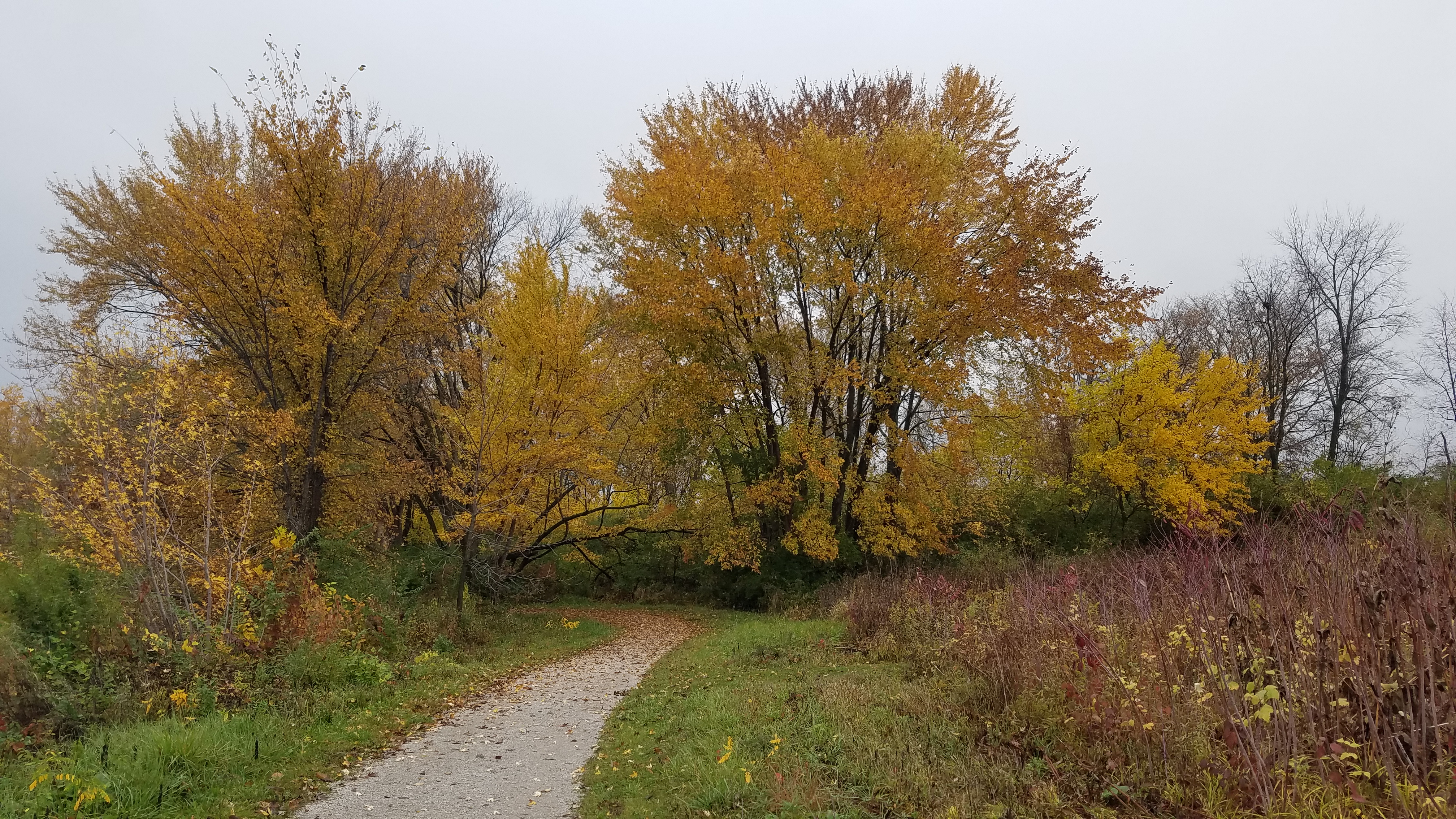
Trail walking on the state park trail on Oct. 30, 2023.
Content creator is an upcoming profession that employs many according to a Washington Post article titled, “Millions work as content creators. In official records, they barely exist.” Authors Drew Harwell and Taylor Lorenz assert, “Millions have ditched traditional career paths to work as online creators and content-makers, using their computers and phones to amass followers and build businesses whose influence now rivals the biggest names in entertainment, news and politics.” Goldman Sachs forecasts this sector of the economy could generate half a trillion dollars annually by 2027. It is a thing!
Not so fast! I don’t see many financially stable folk living on revenues generated from content they create for a website, streaming service, substack, or podcast. Roughly 12 percent of participants in a recent survey of content creators indicated annual earnings of more that $50,000, according to Harwell and Lorenz. 46 percent said they made less than $1,000. It may be true some are earning a living as content creators, and some earn a lot, but rivaling the biggest names in entertainment, news and politics? Please.
Cutting the cord from a single employer job and venturing on our own is possible. I did it more than once in 55 years in the workforce. To me, breaking loose is mostly about developing a sustainable lifestyle without working a “big job.” It is individualistic and empowering. It relies on others much differently from working for a large company. It will drain your personal bank accounts more quickly than you can log into Twitch. It is something of a dream.
When I retired from a transportation and logistics career I started a small consulting firm with me as the only employee. The idea was to take contracts to do work in the peace and justice movement that would help pay bills and become a platform for bigger, better things. To supplement my income, I took any kind of transactional work, including newspaper freelancing, farm work, jobs through a temporary service, and others. While I had the organization, I found it nearly impossible to have enough jobs in the pipeline to stay busy and generate needed income. In the end, I retired on my Social Security pension with Medicare as my health coverage and do my content creation on that financial platform.
A piece of advice I gave someone pursuing a content creator career was to get 10 years in with a company or companies that paid/withheld Social Security taxes. With a potential worklife of 50+ years, spending ten of them in a company that participates in Social Security seems very doable without infringing on creativity. I also said they should wait until full retirement age before filing to collect benefits so as to maximize the monthly pension payment. The response was predictable: “Is Social Security even going to be around?” Who knows if Social Security will change from it’s current process? There is not enough money to pay full benefits after 2033 without Congress changing something. Medicare begins to run out of money in 2031. So many people rely on these programs, it’s hard not to image the Congress doing something to secure them for the future.
At our core we seek a way of living that meets our needs. While we don’t seek to join a cult, we do have an impulse to gravitate toward support groups that are not necessarily just family. Utopian movements of the 19th Century were communal in nature. (The Library of Congress lists some). I think of Brook Farm, the Shaker Community, Rappites (a.k.a. The Harmony Society), and the Amana Colonies when I think of utopian communities. They followed the impulse to break away from broader American culture and join together to better meet common needs. Longer term they were all unsustainable, yet people seek this form of community today in different ways.
My experiences with the millennial generation revealed a different kind of pursuit of being part of a community. Large group activities were commonplace when millennials were in their 20s. They persisted through the years. While members found what today seems like traditional jobs with a commute, workplace, payroll, and benefits, they bonded together in a way that had a separate trajectory from a single person-single job career. It was antithetical to the rugged individualism of myth and legend, especially after 1981. With good employment being harder to find, it is no wonder people cut loose and become individualistic entrepreneurs in the context of a larger group. Being a content creator can be attractive in a society that has comparatively few outlets for creative impulses. Like my small consulting firm, content creator is an umbrella organization to do many different things.
Being a content creator is viable for some. The challenge is to develop enough income streams so as to have a financial base to pay quotidian bills like rent, groceries, transportation and utilities. The temptation is to take a big job to accomplish this. At the same time, if done well, a big job demands a full share of one’s daily energy. I wrote about this in my unpublished autobiography.
We had a discussion with a friend of hers about how she had to give up her artwork after taking a job at John Deere. She was tired after work, raising a child, and found little time or desire to make art. I knew if I took a full time job, I might find myself in the same situation.
An Iowa Life, unpublished manuscript by Paul Deaton
I found myself in this situation several times, notably when in 1984 I began my career in transportation and logistics. Being creative and managing creative content that generates income are both difficult when working as an exempt employee in a management position. One makes a choice to live this way. I’m not sure being an effective content creator is possible in this type of work environment.
I think of the 46 percent of content creators who in the survey earned less than $1,000 per year. It is impossible for an American to live on this amount of money without significant support from others and other institutions. Some books have been written explaining how to do this. Yet what seems evident is turning the dream of freedom from economic needs to pursuit of content creation in a transactional society is possible only with more boilerplate opportunities to earn income than there are. Finding and developing such a community is the necessary first step many content creators stumble into. Recognizing it up front would save time and provide a better path to success.
What I’m describing is utopian, although not the way the 19th Century utopian movements were. Maybe a better descriptor is “communal.” Whatever one calls it, it is a dream until proven viable and sustainable in a transactional society. If it were easy, we’d all be content creators.
One last shot before the deciduous tree leaves have fallen. Oct. 27, 2023.
The first hard frost is a couple weeks late. The forecast is Sunday night with ambient temperatures in the 20s. I’m ready. Perishables are harvested from the garden, the garden hose rolled up in the garage. I plan to mow one more time. With any luck it will be before the Trick or Treaters come Tuesday evening.
Kale harvest before the first hard frost, Oct. 27, 2023.
The wheat straw covering my garlic patch sprouted. I assume frost will kill it. I’ve never had that much seed in my straw. Buying it from a different vendor makes a difference. If wheat survives the cold, I’ll have to turn the straw and kill it myself. I am reluctant to add the descriptor “wheat murderer” to my resume. Garlic takes precedence over making a few wheat biscuits.
Golf carts of Halloween.
Halloween trick or treat night is an occasion for parents of young children to get out the golf cart and run with their neighborhood peers. I get around the neighborhood by walking, but I’m old school.
Short post today. It’s turning out to be a busy Sunday. Thanks for reading.
There is a frost warning tonight and that means one more garden gleaning before sundown. I expect to get kale, parsley, and maybe some tomatoes. I also expect this will be a hard frost, unlike previous nights that turned deciduous trees into paintbrushes full of color. Evolving what used to be cooking into a kitchen garden has been engaging and fulfilling. It changed — in a substantial way — how I cook meals with what grows on our property.
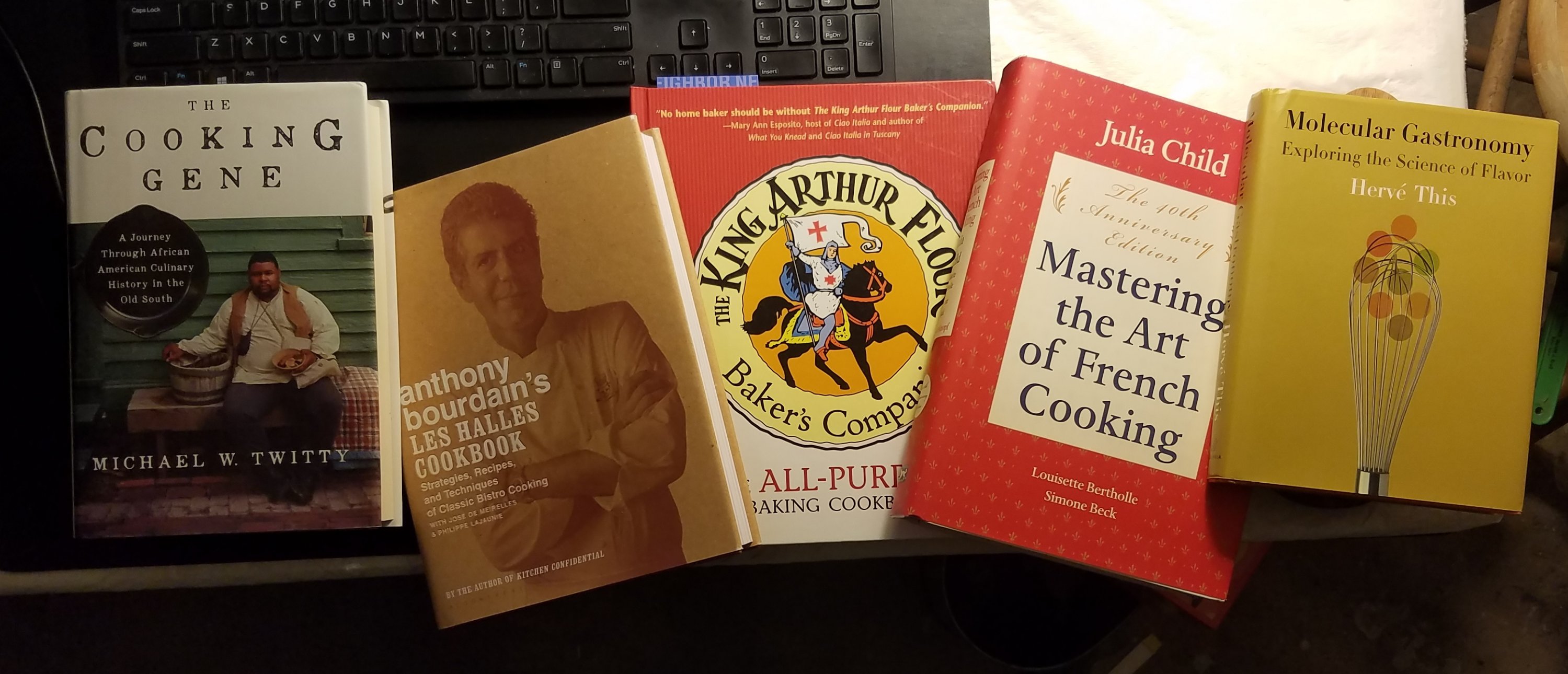
I have been a collector of cookbooks yet no more. These days I cook for weeks without opening one or consulting a recipe. When I make something sensational it is often unlikely the dish can be repeated. The reasons are many, whether it be living in the moment, freshness of ingredients, temperature and distribution of cooking heat, or how seasonings blend together. We bought a new range in May. It cooks differently from the previous one and continues to take time to understand settings, temperatures, and uses of the five cook top burners and oven.
A couple of posts ago I wrote about cooking grits and posted the photo on social media. People replied with variations I could make to improve the recipe. Thing is, the bowl of grits is rooted in ingredients already in my pantry and refrigerator. It is also rooted in my cooking process, which in this moment was to stand over the pot stirring constantly. The boiling liquid I used was half made by me vegetable broth and half two percent cow’s milk. I used Cabot’s extra sharp cheddar cheese I keep as a staple in the refrigerator. This particular bowl of grits was also rooted in that moment of creation and it seems unlikely I will get the same results the next time I make it.
Canned salmon was a big deal back when we had five digits in our private (as compared to party line) telephone numbers. In our 1950s and ’60s household, salmon patties were a once in a while treat on Fridays when we fasted from eating meat. The school I attended published a cookbook that lists multiple dishes to be made with this innovation found in the canned goods aisle at large grocery stores. Then, large grocery stores were also an innovation. Salmon salad, moist salmon loaf, salmon and vegetables in a dish, salmon custard, salmon in rice nests, salmon loaf, and other recipes were listed on the pages of the Holy Family School P.T.A. Cook Book. These days there is an abundance of fresh salmon available so the idea of using canned salmon is outdated. In 2010, when I was in Montana visiting friends, we went to the store and bought salmon steaks for a family meal. The meal was memorable. Canned salmon was revolutionary, as are the modern industrial salmon fisheries and farms. As a mostly ovo-lacto vegetarian, salmon wouldn’t be a part of any meal we prepared at home today.
People I know use recipes as a jump point in meal preparation. They search the internet, use a single purpose recipe application, or look through magazines and cookbooks to find something for dinner. They then modify the recipe to match personal preferences or ingredients on hand. I think most home cooks follow one of these methods.
I use internet searches when I have an abundance from the garden. For example, I recently searched garlic, tomatillos and chili peppers and came up with several ideas about how to preserve them as a condiment until the next crop is available. My home made apple cider vinegar is used as a preservative, making the dish ultra local. There are currently about a dozen jars of chili sauce in the refrigerator and pantry, no two of which are the same. It keeps things interesting while also using the harvest.
Another spontaneous aspect of cooking is using “my recipes,” meaning personally developed dishes, the recipe for which resides in memory or is written down in a notebook, 3 x 5 index card, or in the margins of cook books. We all have dishes like this. In our case, they form the framework of a weekly menu. Stir fried tofu with vegetables and rice is a complicated undertaking and we do that every week or two. Big batches of home made soup and chili stored in quart jars in the refrigerator are go-to meals when we don’t feel like cooking. Tacos are another mainstay. We use uncooked flour tortillas from the wholesale store and on hand ingredients from the garden and pantry for filling. The ingredients follow the seasons year-around with fresh tomatoes when they are available and frozen greens in winter. When we cook like this, there are few reasons to consult with a cookbook or recipe unless we’re understanding how to cook a new dish.
Morning has turned to afternoon and I haven’t been to the garden yet. I’d better get going. Thanks for reading.










 Journey Home
You must be logged in to post a comment.