We live each moment in a march of time weighed down by our past.
Cognizant of what we experienced and hopeful for a future, we live lives drenched in the culture that engendered us and provided what sensibilities we have.
Living is not perfect and who knows what God sees when she looks down on us from the heavens?
Today and tomorrow I’m scheduled to work at the home, farm and auto supply store, then I’m off work until my shift at the orchard Aug. 4. Eight days to finish up summer projects (I hope) and prepare for the rush toward year end.
We carry our past with us — a rucksack of memories to help us live each day better. Sometime it becomes becomes a millstone. It draws our attention and delays us.
The past is the raw material of creativity when naivety serves no useful purpose in the matrix society has become.
It is okay to set the rucksack down on our way — to rest, drink water, and pick it up again. We are unwilling to leave it behind until the final curtain falls and that’s our humanity.
It’s no secret Rep. Bobby Kaufmann follows the Republican Party line on most major votes.
He voted like an automaton for one egregious bill after another during the 87th Iowa General Assembly. Once Republicans held majorities in the Iowa House and Senate, in addition to the Governor’s office, they had their way with legislative output. Kaufmann was right there in the gang. He is and has been a partisan Republican since being first elected.
In 2013, as soon as Kaufmann joined the legislature, he co-sponsored HJR 1, a bill to amend the Iowa Constitution to incorporate existing right to work law.
Right to work is part of who we are as Iowans. Even Governor Chet Culver couldn’t reverse right to work when he had Democratic majorities in both chambers of the legislature. We don’t need a constitutional amendment for right to work to exist in Iowa. Kaufmann and the gang went one further in the bill, prohibiting collection of union dues or deduction of union dues from a person’s pay as a prerequisite for employment. HJR 1 didn’t pass. It continued a divide between Iowa Democrats and Republicans, one that prevents bipartisanship and continues today.
Over the years, Kaufmann has seen few Republican bills he didn’t like. He voted with Republicans on radical Chapter 20 revisions regarding collective bargaining, for the embryonic heartbeat bill, and more.
This year he’s running for a fourth term. Kaufmann downplays his extremism in newspaper articles and community forums by omitting his conformance with the Republican playbook.
Last winter Kaufmann held a town hall-style meeting in Solon, Iowa. His mislead by omission approach became evident.
At the meeting he was surprisingly focused on the House, not Republicans in general. For example, a Republican asked a question about Senate passage of the embryonic heartbeat bill. It was news to Kaufmann. His take was the heartbeat bill was unlikely to get 50 votes in the House because Republican members believe when it is struck down by the courts it will be done in a way that makes it difficult to appeal to the U.S. Supreme Court, which was their endgame. As we now know, through the sausage-making process of legislating, House Republicans were able to get 51 votes including Kaufmann’s.
Kaufmann meets with city councils, boards of supervisors, and a host of community organizations each year, such talks enabled by incumbency. He appears on the fund raising circuit with the two Republican U.S. Senators. No doubt he learned these tricks from his father, Jeff Kaufmann, the 45th president’s most devout Iowa believer.
Faced with increased Democratic activism, Kaufmann is shoring up support in precincts that went for Trump in 2016. For example, Big Grove Precinct went for Trump by four points (46 votes). A significant issue there is the ban on Lake Macbride of boat motors over 10 horse power during the summer boating season. During the 2018 session Kaufmann was able to kill the perennial bill to lift the ban. In late June, the Lake Macbride Conservancy announced Rep. Kaufmann will be touring the lake with members. It’s partly for information and experience, but also to develop relationships with key influencers in the group.
As the campaign continues through summer it is important to remind friends and neighbors Bobby Kaufmann is a Republican. Period.
~ First published in the Summer 2018 edition of The Prairie Progressive
I bought sweet corn from a roadside stand and we had it for dinner with tomatoes and cucumbers from the garden, and thin slices of cheddar cheese from Vermont.
At some point after our return to Iowa in 1993, I decided to outsource corn growing. It takes up too much space and what space could be devoted to it produced a small crop. It was a good decision.
I cooked and froze the remainder of three dozen ears in two-cup portions in zip top bags.
We revisited stories of our lives during and after dinner.
How our cat would lick the cobs cleaned of corn kernels.
How putting up corn had been a long tradition — a family project.
How simple and good this year’s corn tasted compared to the past.
The trick to eating sweet corn is knowing how much to eat without getting a belly ache. The first ear was buttered, then sprinkled with lemon pepper seasoning and a little salt. Three ears is a usual portion. I ate four and went light on the salt. There were no ill effects.
Tomatoes
The arrival of sweet corn and tomatoes is the arrival of high summer. A short window — a couple of weeks max — when summer is good and we get a chance to be human again.
That’s something we need in this turbulent world.
In Iowa we also have the Register’s Annual Great Bike Ride Across Iowa, more commonly known as RAGBRAI, which began yesterday. Donald Kaul and John Karras were two Des Moines Register reporters behind the annual event. It was expected this year, and Kaul died of prostate cancer Sunday morning.
“On January 11, 2018, Kaul, an agnostic, revealed that the cancer in his prostrate has spread to his skeleton and that he will no longer take treatments,” wrote Des Moines Register columnist Kyle Munson. “He was in the end stages of his battle with cancer and didn’t expect to live beyond the year.”
The end came at 11:50 a.m., according to a local radio station.
The narrative of this year’s RAGBRAI seems already written, and it doesn’t include Kaul. There is time for some show of recognition on the seven-day tour. We’ll see what happens.
For me RAGBRAI was about the summer of 1973 when it started. An artist I met in Davenport invited me to her family’s home near the Catholic orphanage to meet her parents. Her brother was out in the garage when I met him too. He was talking about riding his bicycle across the state with the Des Moines Register. Over the Coffee, Kaul’s column, was popular in this household.
Today people prepare for months for the long endurance test the annual ride has become. Specialized, lightweight bicycles, meal plans, and training. Not in 1973 when the sequence of events was 1. figure out how to get to the Missouri River with the bike; 2. tighten up the hub axle nuts; and 3. air up the tires. I can’t recall, but I don’t believe he even had a derailleur gear on his bike. It was pretty simple then and proved to be enduring.
Kaul’s death on the beginning day of the 46th RAGBRAI is likely coincidence. In any case, he is memorable for his writing more than his promotion of bicycle riding.
In high summer, after our dinner of sweet corn and tomatoes, my wife and I discussed our interactions with Donald Kaul. She got his autograph in a bookstore in Iowa City, and I corresponded with him when he was a Washington, D.C. correspondent for the Register. He was a constant part of our Iowa lives. That will still be true now he succumbed to cancer.
What color do you see? Photo Credit – Wikimedia Commons
People are excited by the prospect of flipping the Iowa House and governorship in November. I share the excitement, and note such voters are engaged in politics more than most who will show up at the polls.
I’ll be convinced a blue wave is coming when I hear people other than candidates, those hired to work in politics, or activists tell me about it. Right now it seems a big blue bubble, especially when I talk to people I’ve known for years.
Time will tell and many of us will be working it because, as Fred Hubbell suggested, “blue waves must be created.” Democrats are not there yet.
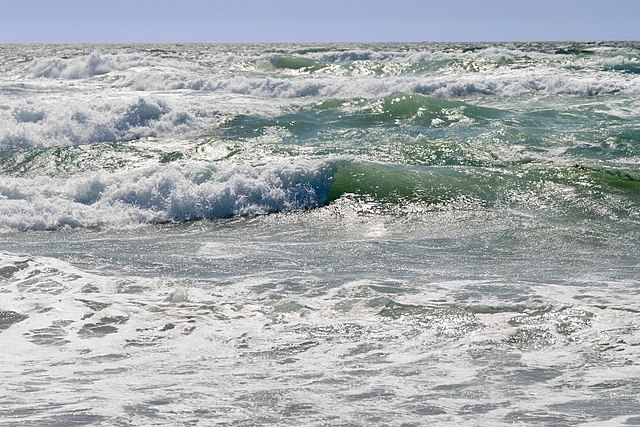
Ocean waves look pretty green to me.
“The ocean looks blue because red, orange and yellow (long wavelength light) are absorbed more strongly by water than is blue (short wavelength light),” according to Scientific American. “So when white light from the sun enters the ocean, it is mostly the blue that gets returned. Same reason the sky is blue.”
Are we Democrats seeing blue because of what we can’t see?
Media outlets glom onto the obvious. A replacement to fill Associate Justice Anthony Kennedy’s U.S. Supreme Court seat when he retires; activities of “the resistance;” the perennial non-debate over immigration reform; active discussion about overturning Roe v. Wade; and yes, new developments about Hillary Clinton’s emails.
What’s going on in the ocean of voters?
Democrats are choosing more female candidates for the U.S. Congress and down ticket.
“In many respects, the Democratic tilt toward female candidates is the logical culmination of the political dynamics since Trump’s election,” Ronald Brownstein wrote at CNN. “Coming after he bragged about sexually assaulting women in the 2005 ‘Access Hollywood’ tape, Trump’s election provoked its greatest backlash among Democratic-leaning women. That intensity was immediately apparent in the unprecedented women-led protest marches the weekend of Trump’s inauguration. The emergence of the #metoo movement and the proliferation of sexual harassment allegations against powerful men in other arenas has only added fuel to that fire.”
Democrats, men and women, are fired up about this. Will it win over non-college educated white women who favored Trump in 2016? Probably not. Will it fire up the Democratic base? It already has. The base is far from enough to win in November.
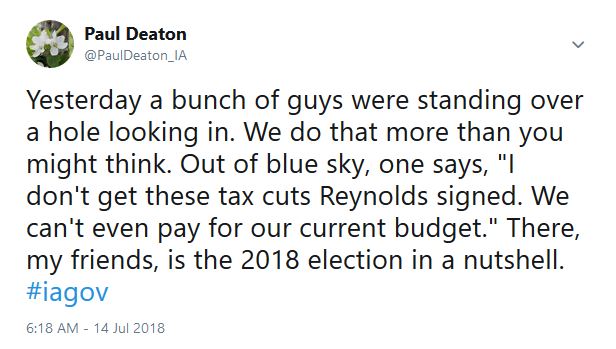
This talk has a secondary impact on voters. More influential are statements like the one made at a recent gathering of men in our neighborhood.
Regardless of the ocean of pixels spilled about a Democratic blue wave, the election will reduce itself to small gatherings of voters doing work that must be done in the community. The community water main was leaking in that hole in the ground. We had gathered, not to talk politics, but to fix the leak. So it is with many non-politically active voters, men and women.
The grunt work of winning elections is not fun. Knocking on doors, making phone calls, and networking with friends, family and neighbors to promote candidates, are part of activating voters. Cecile Richards was in Des Moines last week and captured the challenge of midterm elections.
“Millions of women who even voted in the presidential election won’t go vote this November,” Richards said. “Thousands of them here in Iowa will stay home. Thousands would be enough to determine the governor’s race or a congressional seat or taking back state house and state senate seats. But we can change that… the single most important reason people said they didn’t go out to vote is that no one asked them.”
The campaigns for which I work plan to ask men and women to make a plan to vote.
The notion of a Democratic blue wave can be a place holder for people to do nothing to influence an election outcome, even in the time of Trump. Rather than get involved in politics, people hear there’s a blue wave coming and kick back into already challenging lives, intending to ride the wave.
There is no blue wave. There will only be one if we make it between now and election day.
Photo Credit – Pressenza International Press Agency
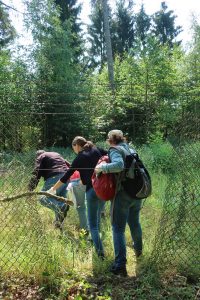
Last week, a group of peace activists gained access to a site on a German Air Force Base where 20 U.S. nuclear weapons are stored.
“The peace activists cut through razor wire and some other fences and several made it to the runway; three activists walked to a nuclear weapons bunker, and climbed up to the top where they were undetected for an hour,” according to the International Press Agency. “All 18 were eventually found by soldiers, handed over to the civil police, ID checked, and released from the base after 4-½ hours.”
This was personal.
One of the many jobs I had while serving in the Cold War Army was to standby in the event a nearby nuclear weapons storage facility suffered a break in or terrorist attack.
I was there when the Baader-Meinhof Gang, later known as the Red Army Faction, rose to prominence. I was stationed at a kaserne on the Rhine River during the “German Autumn” when Baader Meinhof and others committed murder, kidnapping, hijacking and more. Here’s a taste of what it was like where I lived from Wikipedia:
The German Autumn (German: Deutscher Herbst) was a set of events in late 1977, associated with the kidnapping and murder of industrialist Hanns Martin Schleyer, president of the Confederation of German Employers’ Associations (BDA) and the Federation of German Industries (BDI), by the Red Army Faction (RAF) insurgent group, and the hijacking of the Lufthansa airplane Landshut by the Popular Front for the Liberation of Palestine (PFLP). They demanded the release of ten RAF members detained at the Stammheim Prison plus two Palestinian compatriots held in Turkey and $15 million in exchange for the hostages. The assassination of Siegfried Buback, the attorney-general of West Germany on April 7, 1977, and the failed kidnapping and murder of the banker Jürgen Ponto on July 30, 1977, marked the beginning of the German Autumn. It ended on Oct. 18, with the liberation of the Landshut, the death of the leading figures of the first generation of the RAF in their prison cells, and the death of Schleyer.
Those were tense times. I remember German police cars on every corner and at every Autobahn exit during key moments in the drama that fall. Our unit was often on alert for potential response to an incident.
We were never called to secure a terrorist attack site. However, yesterday’s incident raises some questions about our deployment of nuclear weapons in Germany.
Why isn’t the United States working toward fulfilling our agreement in the Nuclear Non-proliferation Treaty (NPT) to eliminate nuclear weapons? Not only do we have a legal obligation, there is a moral imperative to do so.
Is Germany permitted to deliver U.S. nuclear weapons with their aircraft as part of NATO? Quoting from the article, “On this air force base, German pilots stand ready to fly Tornado fighter jets with U.S. B-61 nuclear bombs and could even drop them, on orders from U.S. President Donald Trump on targets in or near Europe.” Since Germany is not a nuclear state recognized in the NPT, it may be illegal for them to do so.
The incident at Air Force Base Büchel is not getting much press in the wake of today’s Donald Trump – Vladimir Putin meeting in Helsinki. Maybe it should.
The change in our local food ecosystem from last summer to this is hard to fathom.
We let go of the summer share from the Community Supported Agriculture projects to rely on our garden.
It was a big step and I feel much less stress from over abundance. Some days I’d like more lettuce, and some of the specialty crops, but there is plenty from our garden to fill the gap. Now that tomatoes, cucumbers, eggplant and peppers are beginning to come in, I don’t forecast any gaps.
What is hard to fathom is why the transition has been so easy. Maybe I’m getting to be a better gardener. Maybe I was due to go on my own.
Tornadoes tore through Marshalltown, Pella and Bondurant yesterday as I got off work at the home, farm and auto supply store. It doesn’t appear anyone was seriously injured or died, although damage to the communities was substantial. Photos and video posted on social media depicted a horrible scene. The Marshalltown Times-Republican newspaper got an issue out the next day despite the storm — practicing journalists they are.
Are these storms due to climate change? I don’t know. What I do know is the seasons are out of wack. A late spring, early high ambient temperatures, and more frequent storms make our climate exceedingly weird. We adjust, accommodate, but something’s different.
Ben Santer, an atmospheric scientist at the Lawrence Livermore National Laboratory, led a study of four decades of climate data that concluded human activity is disrupting our seasonal balance. That is, the seasons don’t proceed through time the way they did. It may be confirmation bias, but I doubt it. Eric Roston at Bloomberg wrote a more accessible article about the study here.
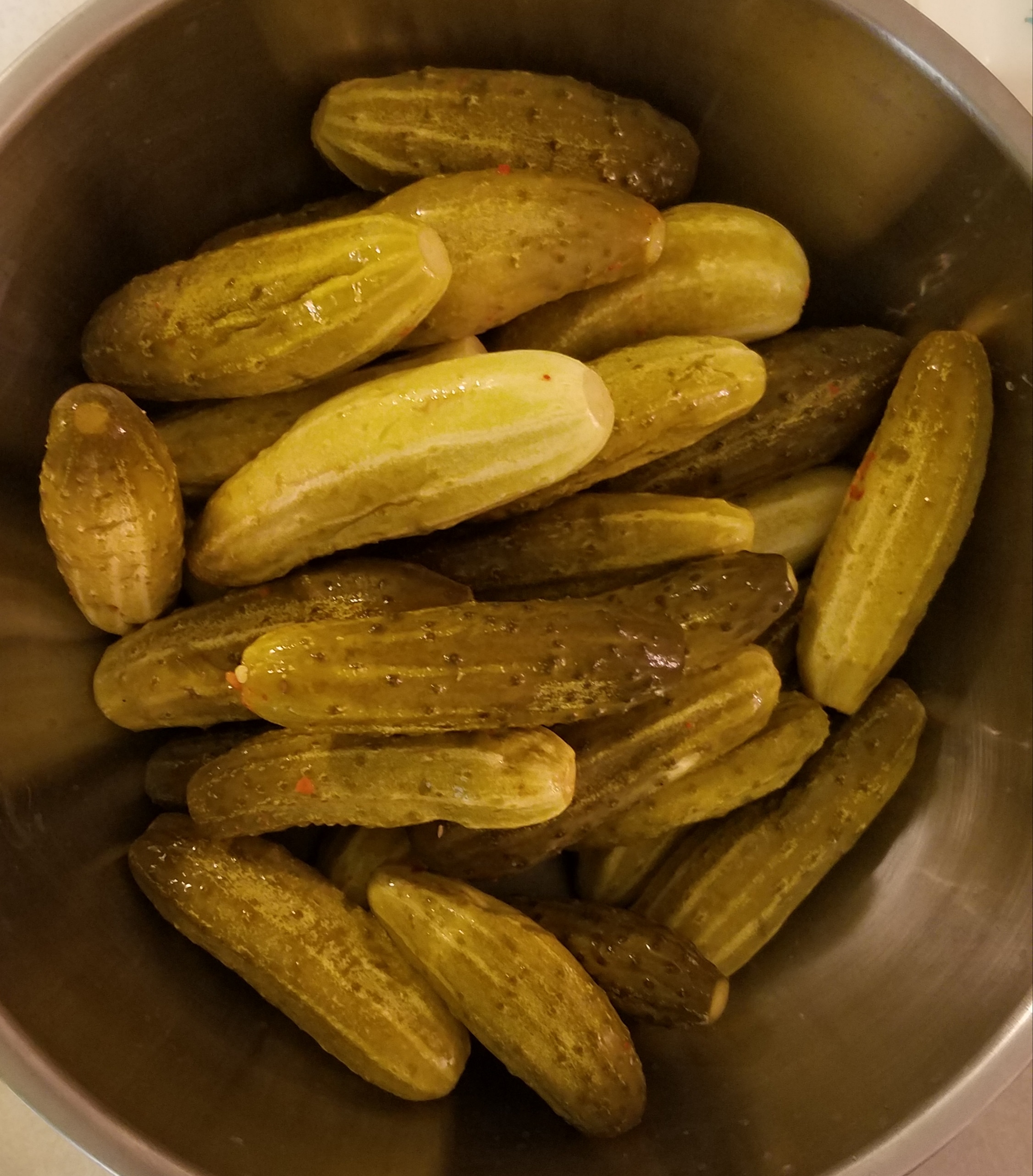
In the kitchen it’s cucumber day! A batch is sweating over a bowl and the crock is full of sweet pickles to be water bath processed tomorrow. The dill pickles in the photo took 13 days to ferment. It was worth every minute.
Coyote Natural Bridge, Grand Staircase-Escalante National Monument, Utah. Photo Credit – Wikimedia Commons
The Trump administration is giving away access to our public lands for discovery and exploitation of minerals and fossil fuel reserves. Conservatives and mining interests are setting a place at the table to get their share.
“Trump signed a pair of proclamations late last year reducing the size of the 1.35-million-acre Bears Ears National Monument by 85 percent and the 1.87-million-acre Grand Staircase-Escalante National Monument by roughly 50 percent,” according to Huffington Post. “It was the largest reduction of national monuments in history, with more than 2 million acres losing protections. Prohibitions on new hard-rock mining claims in those now-unprotected areas were lifted in early February.”
The administration’s assault on national monuments is upsetting on a number of levels. It is the culmination of an effort by conservatives to divest government control over national parks and monuments, something most of us thought was long settled.
It’s not settled at all.
A Canadian mining firm, Glacier Lake Resources, Inc., has staked a claim on land that was, until recently, part of Grand Staircase-Escalante National Monument in Utah. The Vancouver-based company said in a press release it plans to mine copper, cobalt, zinc, and other minerals from the Colt Mesa deposit about 35 miles southeast of Boulder, Utah.
On Feb. 2, four members of the Lamoreaux family, which owns a small mineral company called Alpine Gems LLC, staked an 80-acre claim near Butler Valley, southeast of Cannonville. On May 9, Alpine Gems staked three 20-acre claims in that same area.
Last week, Utah Senator Mike Lee introduced the Protecting Utah’s Rural Economy Act in the Congress. He explained in an opinion piece he wrote for the Deseret News. Here are two excerpts that provide the gist of it:
The looming danger for Utah’s rural communities comes from the Antiquities Act of 1906, which was originally intended to protect objects of historic and cultural interest, such as artifacts and religious sites.
Unfortunately, what was once a narrowly targeted tool for preventing looting on federal lands has become a weapon of faraway elites to use against hardworking rural Americans.
That is why I am introducing the Protect Utah’s Rural Economy, or PURE, Act. This bill would protect Utah from future abuses under the Antiquities Act by prohibiting the president from establishing or expanding a national monument in Utah unless the proposed monument has been authorized by an act of Congress and the state Legislature.
Rural Americans want what all Americans want: a dignified, decent-paying job, a family to love and support and a healthy community whose future is determined by local residents — not their self-styled betters thousands of miles away.
Lee’s argument is a genome away from political theorist and the seventh vice president of the United States John C. Calhoun’s arguments in support of slavery and state’s rights. Calhoun is remembered for defending slavery and for advancing the concept of minority rights in politics, which he did in the context of defending white Southern interests from perceived Northern threats, according to Wikipedia.
The Wilderness Society is challenging Trump’s proclamations in court and monitoring the progress of the companies seeking to extract minerals. It may not be enough.
Read more about The Wilderness Society’s efforts to protect our wild areas and fight back against the anti-conservationist movement at wilderness.org. If you are in a position to help financially, here is a link to donate to the Wilderness Society.
My supervisor at the orchard called yesterday to ask me to work this weekend. I said yes.
We’ll be selling blueberries from Michigan for a few hours on Saturday and we’ll discuss plans for the upcoming season.
It is my earliest start in six seasons. It’s also a sign the year is on the back slope. Fall will soon arrive.
Being home more has helped make the garden our best ever. Just an hour a day after planting has been enough time. Some of the new techniques: using composted chicken manure for fertilizer, mulching pepper and cucumber plants immediately after planting, using a fence to grow cucumbers, and putting a deer fence around the tomatoes have facilitated Mother Nature’s growth. I still haven’t had to buy a single onion or head of garlic at the store this year. We are eating something fresh from the garden daily.
I’m used to having events to which to look forward. That means I’m not used to the five-day weekends semi-retirement and completion of spring farm work brought this July. I’ve been doing a lot of resting in between activities. I’ve made a conscious effort to reduce the number of activities. So resting outranks doing for the time being.
Based on more than 50 years in the workforce, I’m used to a scheduled shift being the focal point of each day. In retirement, that changes and will take accommodation.The idea is not to replace work shifts with other, different kinds of events. Rather focus on awareness of tasks being required and doing them as needs rise to the surface of our new lives together.
For example, I planted 48 celery plants. Yesterday I harvested five to see how they were growing. I trimmed the heads of bad stalks and used what was salvageable in a stir fry for lunch. The five cores, or what grocery stores call “hearts” I bagged and refrigerated for later. What I learned was celery is about ready for harvest and that means a big project of cleaning, trimming, slicing and freezing for winter use in soup and stir fry. That task is lingering and will rise up soon.
The point of retirement is to perform tasks like this in time, but when fancy deems best. It would be a waste not to get this done, but I’m reluctant to write it on my calendar. I’d rather wait for the right intersection of seasonable temperatures, personal energy and peak vegetable readiness. That time will reveal itself outside the unforgiving tyranny of a calendar.
Milkweed Pods Growing
Even the milkweed plants are doing well this year. I did little other than weed around them and cut away the vines wanting to grow up the stem. Several plants are forming seed pods. I’ll learn a little bit about them and harvest the seeds to grow more in a different spot. Someday I hope to see a butterfly caterpillar on one of them.
It looks like as I’m writing the presser in Helsinki, Finland with Vladimir Putin and Donald Trump is about to begin. A reporter claiming to be from The Nation has been forcibly removed. Neither leader is a fan of a free press, although both use it to their advantage when they can. We also know about the many journalists who “disappeared” under Putin. I’d rather look at butterflies than think about U.S. – Russian relations. It’s hard to avoid, just like it’s hard to stop thinking about my next work shift.
If we’re to change habits, we have to work at it. That may be why I continue to write these posts, work at the orchard, and at the home, farm and auto supply store… for now. My life would be worse without it.
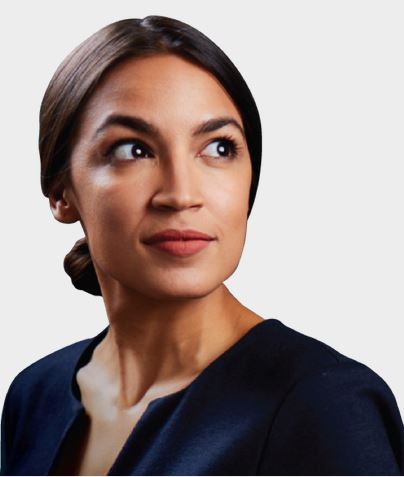
Regardless of the methods of her election or her platform — or the buzz around beating 10-term incumbent Joe Crowley in New York’s 14th Congressional District — if she wins in November she will be one of 435 members of the House of Representatives.
To get anything done, she will need help from other legislators as she attempts to carry the momentum from her district to the Congress. What help can she expect?
Establishment Democrats
“Establishment Democrats” is shorthand that rose to common usage during the 2016 primary season to serve as the whipping boy for all that was perceived to be wrong with the Democratic Party. Think of Congresswoman Debbie Wasserman Schultz or maybe John Podesta. To the extent members of congress have been categorized as part of the establishment, I believe Ocasio-Cortez will find more common ground with them than not. In any case, she could take a lesson from establishment pol in chief Hillary Clinton when it comes to legislating. Become less a personality in the Congress and more someone willing to work hard to find common ground on issues that matter as Hillary did when she was elected to the U.S. Senate from New York. If she does this, such establishment Democrats as there are will reciprocate.
Hispanic Caucus
The Hispanic caucus has been welcoming despite being more conservative than Ocasio-Cortez. One of her signature policies is abolishing ICE and she outlined a process within the caucus to legislate it.
“What we can do is — I’m unafraid to champion a really bold and strong stance in the sand, and what that does is give us an anchor, a negotiating point,” she said. “I think the abolishment of ICE makes a lot of sense, and I’m willing to have those conversations and figure out how we get that done as a caucus.”
Abolishing ICE is a lightning rod that could diminish Ocasio-Cortez’ influence. I predict regardless of the outcome of abolishing ICE, media (and not just FOX News) will paint her as either a hero or the goat soon after the 116th Congress convenes based on this sole issue. A competent legislator will find there are a lot of ways to shave ice. The Congress has been unwilling to address immigration and naturalization since the Reagan administration. If the time has come, I believe Ocasio-Cortez and the Hispanic caucus will be part of it, bringing new energy and ideas to the stale debate.
Democratic Leader
More than anyone in the U.S. House of Representatives, Democratic Leader Nancy Pelosi knows how to count votes. While Ocasio-Cortez indicated she may vote for someone else as speaker/leader if elected, unseating Pelosi seems unlikely in the 116th Congress. That means Ocasio-Cortez will have to develop a relationship with her to get anything done. She would be foolish not to.
For Iowa Democrats who worked on many campaigns, it was great to see someone use the skills and techniques in the progressive activists kit bag to win big against an entrenched incumbent. Winning in November looks like a cake walk in Ocasio-Cortez’ heavily Democratic district. Assuming she wins, her real work will begin in the 116th Congress. She will find plenty of Democratic help among liberals, centrists, conservatives and everyone in between.
Adrian Carrasquillo wrote about Ocasio-Cortez’ potential relationship with the Hispanic Caucus at The Intercept here.
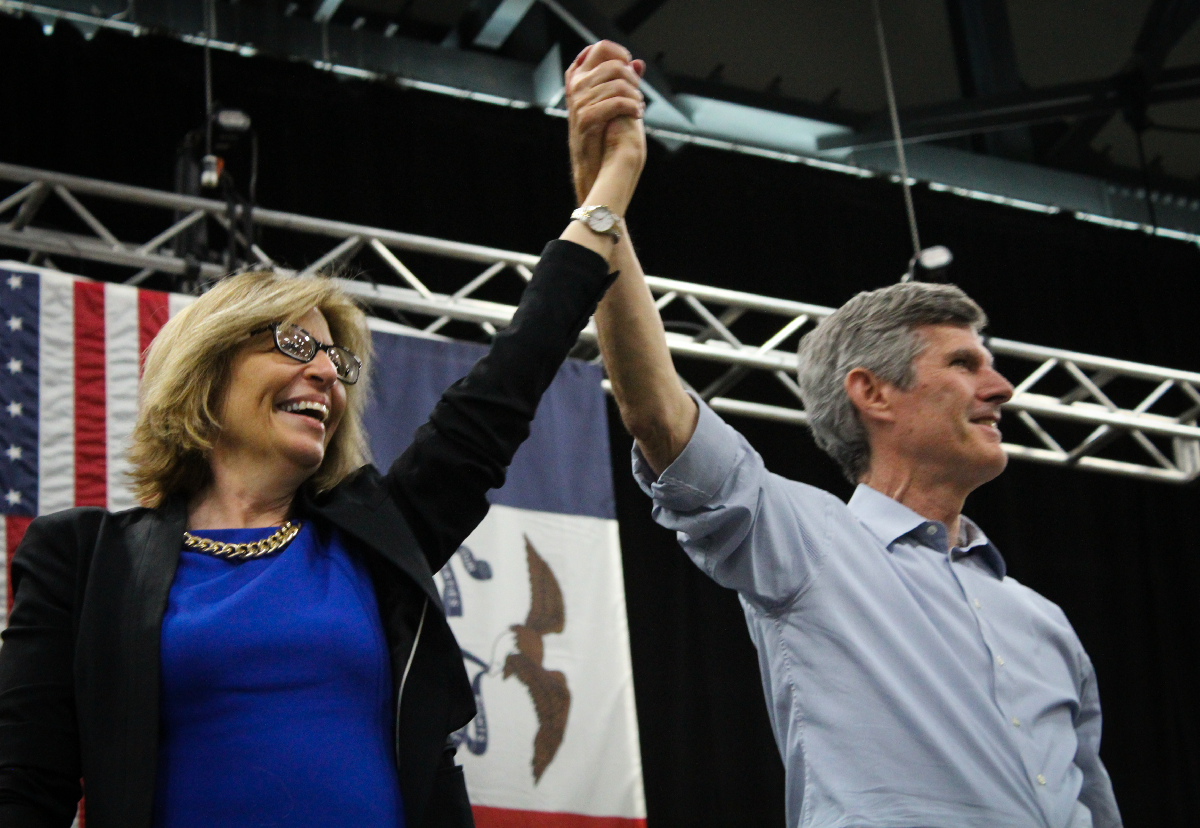
Rita Hart and Fred Hubbell Photo Credit Hubbell Campaign
Since Iowa Democrats picked Fred Hubbell as their nominee for governor he’s honed his message to a few major issues. In a recent letter Hubbell wrote,
I want to be clear about one thing: I’m not just running against Governor Reynolds and her failed record. I’m running for the people of Iowa. All of Iowa. I’m running on a vision to get Iowa growing the right way and a record of bringing people together to get things done. We’ve got to turn this state around and we don’t have time to waste.
We are all Iowans and we stand united by a simple vision — that if we invest in the future, the people of our great state will benefit.
Hubbell’s priorities are straight forward: make Iowa first in education again; get incomes rising across our state; restore funding to Planned Parenthood; improve our health care system, including mental health; invest in renewable energy; preserve our topsoil; address water and air quality concerns; and restore workers’ rights.
“Blue waves are not automatic; they must be created,” Hubbell said. “It’s on us to make sure every voter has the opportunity to engage with our campaign and hear our vision for Iowa.”
Consider this an invitation to get involved with the Hubbell-Hart campaign.
“I know we can take back Terrace Hill, but we can’t take it for granted,” Hubbell said. “Can we count on you to join the team today? With your help we can win in November.”





 Journey Home
You must be logged in to post a comment.