Categories
Living in Society

Public Dollars and Private Education

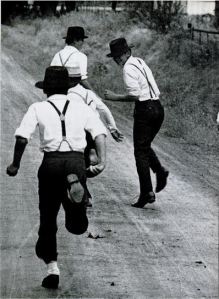
Amish Boys Near Kalona by John Zielinski. Photo Credit – Life Magazine Oct. 24, 1969

The Iowa Republican argument for spending $53 million dollars to support private schools and home schooling programs during the 2017-2018 school year is giving parents options.

“There’s been a trend to slowly put some dollars towards people who are choosing different options,” state Rep. Walt Rogers (R-Cedar Falls) said in a July 18 article in the Iowa City Press Citizen. “I would say that’s a good thing. We want to give as many options for parents and students as we possibly can.”

Rogers is chair of the Iowa House education committee which has overseen spending half a billion state dollars for private schooling since 2008.

This annual expenditure should be on the budgetary chopping block.

It is important that children are not left behind in society. For a long time state government helped private education efforts with tuition and textbook tax credits, busing, teaching assistance, and access to extra-curricular activities for home schooled children. Some of that should continue, although $53 million per year seems like too much given the lean fiscal diet forced on public schools.

When I attended parochial grade and high schools I believed the Catholic parish to which our family belonged made the contributions that paid all school expenses. I came up in the late 1950s and 1960s and contributing to the schools was a regular topic at Sunday Mass. The main way I recall government contributing was in donating surplus food to our school lunch program. There may have been other contributions, but we felt we were on our own. That’s a reality of starting and running a private school.

When I think of home schooling I recall the conflict between Iowa officials and the Amish community near Kalona over children attending public schools. National news outlets covered the story in the 1960s, and eventually the Amish community retained control over the process. Home schooling has changed since then and a lot more people and communities want to home school or encourage it.

This budget debate is not about options. Generating options is not state government’s role. The financial assistance to private and home schools by government has been on autopilot since the 1960s and created a process that obscures the lines between public and private education when it comes to public financial contributions to private schools and home schools. While contributing more state dollars to education than ever, government is under funding public schools, not even keeping up with the cost of inflation. Something’s got to give. It should be private schools rather than forcing public school teacher layoffs and school consolidation.

I don’t presume to have the answer, except to elect a Democratic Iowa House to buffer against the worst parts of the Republican agenda regarding private and home schooling. What we are doing now isn’t working. It is time for change.

~ First posted on Blog for Iowa

Categories
Environment

Irony About Climate Change in New Orleans

Image of Earth 7-6-15 from DSCOVR (Deep Space Climate Observatory)

It is no surprise the Heartland Institute hosted a conference called “The America First Energy Conference” for climate change deniers on Aug. 7 in New Orleans.

Heartland is the libertarian think tank that teamed up with Philip Morris to deny the health impacts of tobacco use. Climate change denial is high on their priority list.

“The day-long conference reflected the political rise of global warming skeptics in Donald Trump’s America that is occurring despite mounting scientific evidence, including from U.S. government agencies,” Reuters correspondent Collin Eaton wrote, “that burning oil, coal, and natural gas is heating the planet and leading to drought, floods, wildfires, and more frequent powerful storms.”

“The leftist claims about sea level rise are overblown, overstated or frankly just wrong,” Heartland president and CEO Tim Huelskamp said in an interview with Reuters. Regarding the United Nations’ findings on climate change, he said it was “fake science” motivated by a desire for “power and control.”

An irony is the conference is being held in the American city most impacted by extreme weather made worse by climate change. New Orleans has not recovered and may never recover from the August 2005 Hurricane Katrina.

“One of the country’s largest credit rating agencies has put New Orleans and other coastal cities on notice: prepare for the effects of climate change or risk a hit on your credit score,” according to Tristan Baurick at the New Orleans Times-Picayune. When the risk analysis community says it, it must be real.

Climate change is real, it’s happening now, and human activity is a primary contributor to extreme weather events like New Orleans experienced.

The rise of a conference like this is attributable almost entirely to the rise in prominence of libertarian billionaires with a long range plans to re-make American society to their liking. They believe their liberties have been infringed upon by government regulations and the Trump administration has been removing barriers to the practice of unfettered capitalism. That’s not good for you, me, or the people of New Orleans.

It is shocking how much the Trump administration has deregulated government in less than two years. The fact the Environmental Protection Agency is deregulating asbestos, a known carcinogen banned in 55 countries, is a sign of how far they will go. The only check on such behavior is for Democrats to win a majority in at least one chamber of the next Congress during the 2018 midterm elections, or to vote Trump out in the 2020 general election. Much damage has already been done. Some of it can’t be reversed.

I met a nine-year-old from Saudi Arabia recently. He lives with his extended family on the Arabian Peninsula and has come to Iowa the last couple of years to visit his mother before school starts in September. We talked about the weather.

“It sure is hot,” I said.

“Yes, but I don’t believe it is climate change,” he replied.

“No, probably not,” I said. “It’s August in Iowa.”

It is one thing for children to learn the difference between weather and climate change. When adults in the room deny the science of climate change, it’s something else. It’s clear there were few adults at the conference in New Orleans.

~ First posted on Blog for Iowa

Categories
Environment Kitchen Garden

A Difficult And Strange Season Of Weather

Carmen Black at Sundog Farm

By Carmen Black

(Editor’s Note: Iowa Farmers deal with an existential reality that is the weather. Regardless of increasingly polarized discussions about climate change, weather affects real people in tangible ways. Carmen recently wrote this piece to members of her Community Supported Agriculture project Local Harvest.)

The weather has been consistently challenging from the late spring to immediately hot May, from lots of rain to this current dry spell. There hasn’t been a catastrophic weather event, but all these different difficult weather conditions create more work to keep everything growing well.

I’ve been thinking more about it as we’ve been observing its impacts while harvesting more of the summer crops. I’ve talked to many other farmers (including folks that grow other types of crops) about the challenges of this season, and anecdotally it seems like the conditions have been hard on many types of crops and livestock alike. One of things that has struck me about this year is that it hasn’t been just one way like really hot or really wet, but every month has brought a different extreme to contend with. It’s made me wonder if it’s all this erraticness that’s been stressful to the plants and animals rather than just the heat or just the late spring.

I was curious to find out if the weather has just felt difficult to us or if it really has been extreme in the grand scheme of things, so I did a little internet research for weather data. What I found was interesting, and did seem to affirm my feeling that this year really has been weird. This was the coldest April on record (since records began in 1895), and was on average 10 degrees colder than normal. It was also somehow both the 5th snowiest April and the 13th driest April, which seemed a little ironic. 2018 tied for the 6th warmest May with 1887, and the average temperature was about seven degrees warmer than normal. Des Moines had three consecutive daily record highs from May 26-28. I was surprised that in Cedar Rapids the daily record highs for the end of May were all held by 1931 or 1934, and then I realized that was the dust bowl! June was the 10th warmest and 10th wettest June on record. July seems to have been pretty average after all those top 20 finishes for the previous months, as it was the 54th coolest July and the 47th driest July on record. Which I think kind of puts the extremeness of the previous months in perspective. Kind of nice to have an average month finally.

Anyhow, my main takeaway is that this year really does seem to be remarkably erratic when you look at the numbers, and it makes sense that plants and animals would respond unpredictably to all of these changes in the weather. I feel both good that I wasn’t making up that the weather has been extreme in many different ways this season, and kind of bad that it really has been historically weird this year. The fact that it took the dust bowl to beat this year out for daily heat records in May felt kind of grim.

Some crops like onions seem to have really suffered from this weather. You may have noticed that they’ve been smaller than normal this year, and after getting most of onion harvest done last week I’m sorry to report that many of the longer season onions are even smaller. This was especially disappointing to me after such a bountiful onion harvest of really giant ones last summer, but I think makes sense considering what we were up against. We planted more than 3 weeks later than we did last year because it kept snowing, and then had to irrigate the onions (which we hardly ever have to do) because it was so dry. We struggled to keep the weeds under control in the onion field in June when it was so wet, and spent almost a week wallowing in the mud trying to hand weed. All in all I’m glad we have some onions to show for all of it, and have a few ideas of things to try in case this ever happens again.

I also have to say that some crops seem to have really thrived in this weather. We’ve never had such a good cucumber or spring carrot crop before, both of which are crops that we have historically struggled to produce large quantities of for several weeks in a row. The combination of having plenty of carrots and cucumbers has felt like a great accomplishment, and I hope that we’re able to replicate it in a better weather year as well!

~ Carmen Black farms in Cedar Township in Johnson County, Iowa.

Categories
Living in Society Social Commentary

Public Health Approach to Gun Violence

Polish Carpentry Crew in Chicago

On page A5 of Tuesday’s Cedar Rapids Gazette was the headline “75 shot in Chicago last weekend.”

From 3 p.m. Friday until 6 a.m. Monday 12 people were killed and 63 wounded, mostly on the south and west sides of the city.

It seems like a lot, even for a large city. Shootings in Cedar Rapids are frequent, but not like this. Is the headline a call to do something about gun violence?

Chicago law enforcement attributed the shootings to gangs who shoot into summer crowds at night, according to the news story. The shootings appear to be random, and ongoing. At least 1,700 people have been shot in Chicago this year. It is one tough city.

In the early 1990s I attended a session of arraignment court near the Washington Park neighborhood on the south side. It was an eye opener. Case after case came before the judge: shootings, domestic violence, assault, petty theft, sexual assault — plaintiffs were bandaged and bruised by incidents that provoked the court appearance. The public defender would lose track of his clients and which case was being heard. It was a chaotic meat grinder.

Experiences like these lead me somewhere besides lack of gun control as the core problem regarding social violence. The lightning rod has been the National Rifle Association.

Progressives found a certain amount of glee in the recent story in Rolling Stone titled “The NRA Says It’s in Deep Financial Trouble, May Be ‘Unable to Exist.’” The NRA is the poster child for what’s wrong about gun culture in the United States.

“The National Rifle Association uses its enormous lobbying power to stymie legislative debate and block most constructive gun legislation,” Ralph Scharnau recently wrote. “Thus even very moderate provisions fail to pass or even get out of committee.”

As a society Americans are not good at controlling violence. That includes our elected officials.

Chicago stands as an example the solution to gun violence is not only gun control. I’m not alone in believing that. The World Health Organization proposes violence be treated as a public health problem, outlining four basic approaches:

  1. Uncovering as much basic knowledge as possible about all the aspects of violence through systematically collecting data on the magnitude, scope, characteristics and consequences of violence at local, national and international levels.
  2. Investigating why violence occurs – that is, conducting research to determine the causes and correlates of violence; the factors that increase or decrease the risk for violence; and the factors that might be modifiable through interventions.
  3. Exploring ways to prevent violence, using the information from the above, by designing, implementing, monitoring and evaluating interventions.
  4. Implementing interventions that appear promising, widely disseminating information and determining the cost-effectiveness of programs.

Hasn’t this work been done? Yes it has. WHO produced a list of ten evidence-based strategies for preventing violence.

  1. Increase safe, stable, and nurturing relationships between children and their parents and caretakers;
  2. Reduce availability and misuse of alcohol;
  3. Reduce access to lethal means, such as guns, knives,and pesticides (often used to commit suicide, especially in low-and middle-income countries);
  4. Improve life skills and enhance opportunities for children and youth;
  5. Promote gender equality and empower women;
  6. Change cultural norms that support violence;
  7. Improve criminal justice systems;
  8. Improve social welfare systems;
  9. Reduce social distance between conflicting groups;
  10. Reduce economic inequality and concentrated poverty.

Will a public health approach to preventing gun violence work? I don’t know, but what we are doing now — hammering the NRA and elected officials — isn’t. It’s time to try something else.

~ First posted at Blog for Iowa

Categories
Living in Society Writing

Outside The Comfort Zone

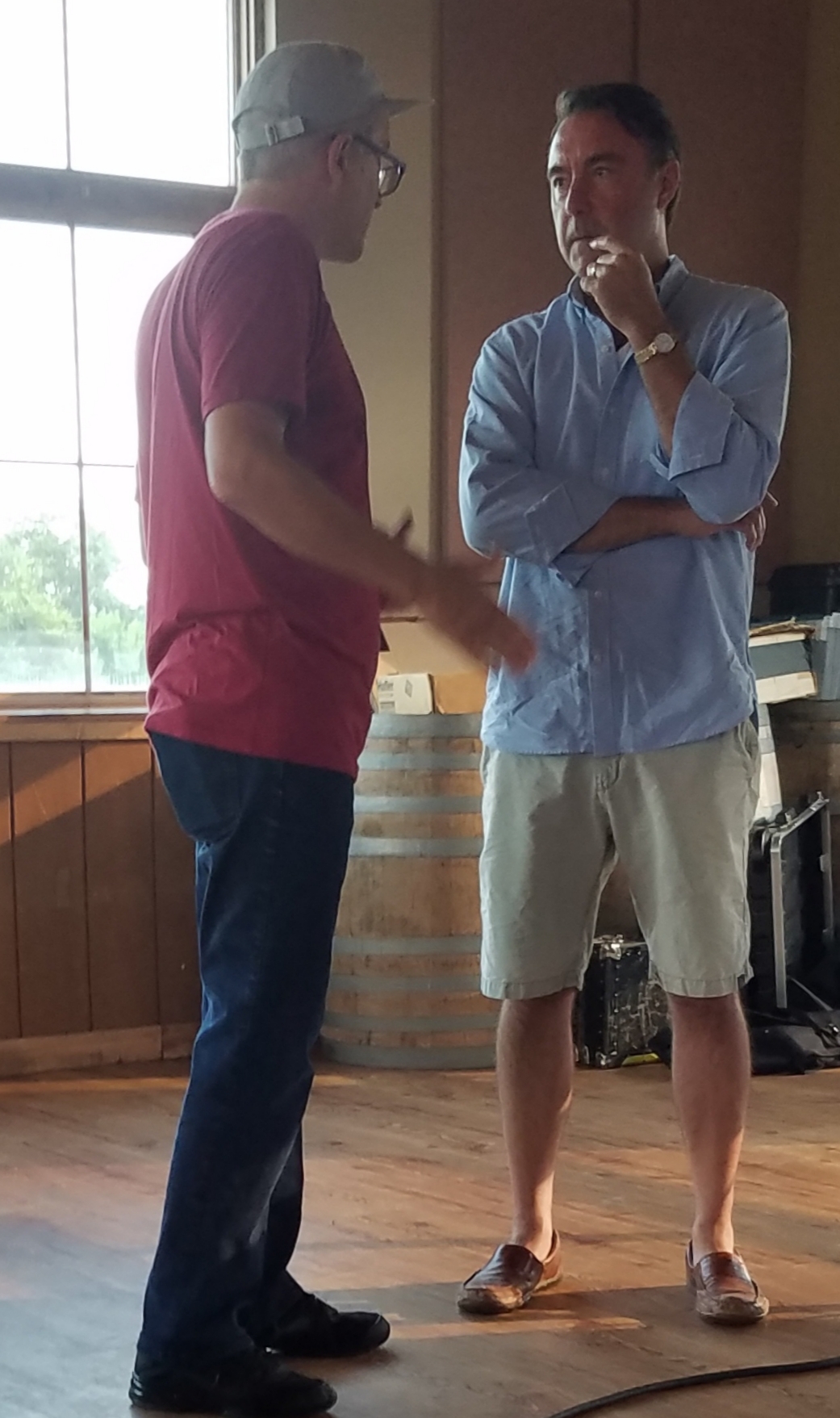
Ben Keiffer (L) and Dr. Christopher Peters chatting at Pints and Politics event, Thursday, Aug. 9, 2018

In an effort to get outside my comfort zone I tried something new. I went to a media event called “Pints and Politics” at the Cedar Ridge Winery and Distillery in Swisher Thursday after my shift at the home, farm and auto supply store.

The Cedar Rapids Gazette hosts Pints and Politics in which their columnists and reporters form a panel and answer audience questions. People drink alcoholic beverages and talk about politics. That is, most people. I drank about two pints of water before the show started and discussed a case with a lawyer I know who was there. I felt uncomfortable among the crowd of people mostly in my cohort of sixty somethings. Many seemed like they had retired with not enough to do. One presumes they read newspapers and listen to the radio. More than 200 people arrived for the forum.

Iowa Public Radio glommed on to Pints and Politics and makes an edition from the raw materials for their weekday program River to River with Ben Keiffer. Keiffer drank a beer and handed out a few Post-It pads with the Iowa Public Radio logo on them. These will be handy for dispatches to my spouse to be left on the refrigerator with information about our ongoing conflict with the spiders assuming control of our house. The Gazette, being a newspaper under duress in an on line world, had no such useful perquisites.

I attended the event Thursday and listened to the edited version on the radio Friday.

The panelists were Todd Dorman and Adam Sullivan, both columnists for the Gazette, and Joyce Russell, statehouse reporter for Iowa Public Radio. The two people I know best, Lynda Waddington and James Q. Lynch of the Gazette, while in adverts for the event, were both absent. I follow the work of the panelists. While Russell is a journalist, I’m not sure what one calls columnists. The word “pundit” was used several times during the event and the appellation will serve.

The event was rigged from the git-go to serve existing media narratives. Audience members submitted written questions to the panel and many more than could be asked were collected. This made the question editing process the driver in how the panel proceeded. The topics Keiffer chose were what’s already in the news: the Iowa Supreme Court hearing oral arguments on the state’s voter suppression law that day; President Trump’s recent visit to Peosta; and others. The radio version should be posted soon here. 2020 presidential candidate John Delaney announced completion of visits to all 99 Iowa Counties. Dorman suggested as a reward that his likeness be carved in butter and displayed at the Iowa State Fair.

I’m not sure what I expected and maybe that’s the point of trying something new. I did not know many attendees, and most of those I did were conservatives. Democratic Rep. Amy Nielsen was there. Cedar Ridge Winery and Distillery is in her district. Republican congressional candidate Dr. Christopher Peters was present working the crowd. Once Peters found out Rep. Rod Blum declined an opportunity to appear on River to River he made clear to Keiffer he had no reservations about appearing on the program. There was a table full of Libertarians, about proportional in number to the percentage of the general population. The rest of the audience leaned Democratic.

Adam Sullivan stood out on the panel simply because he talked so much. He served as a useful foil for more Democratic audience members to express their belief in status quo politics driven by media narratives. Russell is a professional, as are they all. The three of them all tried to get along. In the background I might have heard a “both sides” or two, but maybe that is confirmation bias whispering in my ear.

The most significant media narrative related to how elections are decided. I posted this on twitter Friday while listening to the radio.

Panelists agreed with Dorman we are in an election where issues not that important. “Persuasion stuff is kind of dead,” he said. Rile up the base on both sides. Get who you can of whoever is left. I’m not sure that’s the case, although here’s an example of media that believe it.

I want to emphasize 1. I’ve heard this before during recent election cycles, and 2. based on my experience this cycle, I don’t believe for one minute this is how the 2018 midterms are rolling out. Repeating this narrative is not as important as the fact people believe it. Based on reports I get from the field, the narrative is bankrupt and the panelists didn’t seem to be aware. That disconnect is important.

While attendees passed a pleasant two hours, I was decidedly unsettled by the experience. As I drove east along 120th Street in my 21 year old vehicle, the sun was moving toward the horizon. I turned north at the Ely Blacktop to get an ice cream at Dan and Debbie’s Creamery before heading south and home. What unsettled me was not the media personalities, or the people in Swisher. It was knowledge of the amount of work to overcome the tainted media narratives which were promulgated.

I get it that news writers need a hook and consumers of news need to understand it. A lot of fish were caught during Pints and Politics but the pool wasn’t very deep. I’m thankful for a new experience, but I doubt I’ll be returning to a media event like this.

Categories
Living in Society

After Dave Loebsack

Congressman Dave Loebsack in the Solon Beef Days parade

You don’t need to be a political insider to understand Dave Loebsack’s days in the U.S. House of Representatives are getting numbered.

Loebsack seems likely to dispatch with power his second time opponent, Chris Peters from Coralville, this year. He could continue to run for Congress for several more terms. I think he should continue to run and would be willing to chip in to buy a wheelchair to get him to the floor to vote should he become infirm as he ages. It’s not about me.

What about when Dave decides to put away his running shoes? He reaches the Social Security Administration’s “full retirement age” later this year.

Will he start a third career? Will he run for the U.S. Senate? Will he continue to serve in the U.S. House? Will he kick back with his retirement packages from Cornell College and the House and take it easy? Any of those is possible and only Dave knows. I don’t care to speculate about his plans.

The risk Second District voters face when Dave moves on is an open seat becomes more vulnerable to a Republican takeover. Dave created a trove of institutional political knowledge about the district since first being elected in 2006. Presumably he will be willing and able to help a potential successor learn what he’s learned. As we saw in 2014, Tom Harkin’s departure from the U.S. Senate did not go well for Democrats. Harkin knew the political landscape of the state as well as anyone and that didn’t help Democrats win his seat.

Loebsack’s first election to the House was a reaction to the incumbency of Jim Leach, and a repudiation of President George W. Bush. When Bush was reelected in 2004, Democratic voters were activated for change. Leach, partly through his participation as House Banking Committee chair during the Whitewater investigation of the Clintons, caught shrapnel from the wave election that was 2006. Those of us making political telephone calls at the time heard voters ready for a change. There were enough of them to tip the scales to a Loebsack win. Those dynamics don’t exist today.

Loebsack has been able to survive the Republican resurgence during the last four cycles. That doesn’t mean a potential successor will get elected. Voters don’t change that much but political dynamics get reset in an open race. I expect the first election once Dave announces retirement will be a barn burner.

Who could replace Dave Loebsack? A few names have been suggested, but it’s been scuttlebutt, gossip and wishful thinking thus far. It makes sense for a potential candidate to have deep grassroots political experience as Loebsack did, or significant service in the Iowa legislature. However, the electorate seems to be moving out of the age of reason into darker territory. Presently, that’s not a question on the minds of many Democrats I know. We just feel Dave will always be available, regardless of reality, reason and logic.

Loebsack reaches full retirement age on Dec. 23. He may not be ready to retire from the House, and many Democrats, including the author, would like to see him seek another term in 2020. However, the day is coming and preparation to find a successor should begin if it hasn’t already. What is that process? I don’t know. If it’s an open race, anyone could run, and several probably will.

For now, the work is to reelect Dave Loebsack in 2018 and give him some help in the other Iowa Congressional Districts. That’s what many of us will be doing over the next three months with an eye toward the future.

~ First posted at Blog for Iowa

Categories
Environment

On the Comeback Trail – Asbestos

Earthrise by Bill Anders, Dec. 24, 1968

The Environmental Protection Agency is not what it once was as the Trump administration finishes year two.

In addition to public renunciation of the words “climate change,” combined with promotion of fossil fuels which contribute to global warming, Trump’s minions are eating away at the foundation of protections the agency created since President Nixon formed it on Dec. 2, 1970. Like a swarm of termites, they follow an agenda crafted by conservative think tanks to deregulate what is perceived as infringement on the liberties of corporations to practice unfettered capitalism.

A national environmental movement influenced Nixon’s decision to create the EPA, and only a similar movement will stop the current administration from dismantling it. Thus far, nothing has proved egregious enough to precipitate a movement like the one that rose in the 1960s. Will the last straw be reintroducing asbestos into our consumer society?

You’ve got to be kidding me. Asbestos?

Asbestos may be coming back to your neighborhood, according to Aileen Kwun who posted an article about it on Fast Company July 31.

“Asbestos, a dangerous carcinogen outlawed in more than 55 countries, could make a comeback in the United States, under Trump’s Environmental Protection Agency,” Kwun wrote. “The EPA has even made it easier for companies to introduce new uses of asbestos-containing products in America — many of which could end up in common products in your home, as well as the materials used to build it.”

“Trump has been outward in his views on the asbestos industry,” she said. “His 1997 book Art of the Comeback explicitly stated that asbestos bans are a conspiracy ‘led by the mob, because it was often mob-related companies that would do the asbestos removal.’”

On June 1, the EPA enacted a Significant New Use Rule (SNUR) allowing the manufacture of new asbestos-containing products to be petitioned and approved by the federal government on a case-by-case basis, according to Kwun.

Ask a public health official and they will say EPA should continue to regulate asbestos as they have.

Asbestos? Making a comeback? Good grief! Read Kwun’s entire article here.

George Carlin famously said, “Environmentalists don’t give a shit about the planet, they don’t care about the planet… You know what they’re interested in? A clean place to live. Their own habitat. They’re worried that some day in the future they might be personally inconvenienced.”

There is little about the modern environmental movement and its reaction to changes at the EPA to prove Carlin wrong. In the meanwhile, termites continue to consume the regulatory foundation for a safe environment built up over decades.

~ First posted on Blog for Iowa

Categories
Kitchen Garden

Bowl of Summer – Cucumber Salad

Cucumber Salad

Cucumber salad is not even a recipe.

Peel them, slice and put them in a bowl. Add thinly sliced onions, extra virgin olive oil and your favorite vinegar, then salt and pepper to taste.

Mix gently then serve. It’s summer in a bowl.

When the garden produces them, we eat a lot of cucumber salads. This year I mastered the art of cucumber growing with a couple of simple things. First, I mulched as soon as I planted the seedlings. Then, I made sure deer had no access to the plants. I also put up cages and a fence for the vines to grow upward. The result has been abundant.

Other than in pickles, cucumbers don’t preserve well. They must be enjoyed in the moment, and sometimes that’s as good as it gets.

Categories
Kitchen Garden Living in Society

Why Don’t Iowa Farmers Export More to Europe?

Sundog Farm

During a brief appearance at Northeast Iowa Community College in Peosta on July 26, President Trump claimed a trade breakthrough with European allies.

“We just opened up Europe for you,” he said.

Not so fast!

On Saturday, European Union Commission President Jean-Claude Juncker, who met with Trump, said trade talks almost collapsed over U.S. agricultural demands.

Agricultural trade will remain off the table in any trade talks between the U.S. and EU, Juncker said, according to Deutsche Welle. A European commitment to buy more U.S. soybeans is driven by market conditions.

Europe is the second largest importer of soybeans after China and prices are low because of the U.S. trade war with China. In other words, after market conditions driven by the president beat the price of soybeans down, Europe sees a bargain. It is hard to fathom how Trump sees Europe “opened up” under these conditions. Granted Iowa farmers planted more acres in soybeans this year, but the president’s statement can only be seen as political posturing in advance of the 2018 midterm elections and everyone should know it.

There is a more significant problem with “opening up” Europe for agricultural trade — the issue of genetically modified organisms.

There are very few genetically modified crops grown in Europe compared to the U.S., according to a July 27 New York Times article. The reason is in 2001, the EU issued a directive about GMOs. From the early stages of research to the marketplace, these products would have to pass a series of tests for environmental risks and human safety. The consequence of the directive in Europe is few farmers produce GMO crops.

In the U.S., neither the USDA nor the National Academy of Sciences is concerned that GMO crops have any impact on consumers different from non-GMO crops, despite a slate of regulations. Driven by science, farmers embrace GMO crops because of their acceptance in the U.S. marketplace combined with the attributes of genetically modified seeds. Regardless of science, increasing the amount of GMO crops exported to Europe seems unlikely given the fact many European countries have banned GMOs.

Shorter version of Trump’s statement, “Farmers, here’s a bone.”

It’s hard to see how help for Iowa farmers will materialize from current discussions with Europe. The irony of increased soybean sales to Europe after Trump’s trade war beat down prices as something positive seems lost on his true believers. They may swallow this hook, line and sinker, but other sentient beings should not. It is another deception from a president with an unending supply of deceit.

~ First posted on Blog for Iowa

Categories
Sustainability

Helsinki and New START

B-61 Nuclear Bombs

I don’t know one person, acquaintance or public figure who thought the July 16 meeting between Donald Trump and Vladimir Putin in Helsinki went well.

The only people who found a ray of hope in the awkward encounter are those in the arms control community who pointed out some positives, not the least of which is an easing of tensions between the two nuclear powers evidenced in the meeting.

“It looks like Trump and Putin may have agreed in Helsinki to resume strategic stability talks.” Daryl Kimball, director of the Arms Control Association, posted on twitter. “One key issue: New START, which can be extended without complex negotiation, without further approval by Senate or Duma, and without Trump making unwise concessions.”

Such a move makes sense and would be an easy win for Trump. It may not be well received among Trump’s base supporters because, after all, the Obama administration negotiated New START. The 44th president called in his markers to get the U.S. Senate to ratify the treaty. Some of us felt he gave away too much with a complex offering of perquisites to Republican hawks led by Jon Kyl. Not the least of these was an expensive, unneeded modernization of the U.S. nuclear complex. The Trump crowd won’t like it, regardless of the efficacy of an extension, because of the association with President Barack Obama.

Republicans have expressed disappointment with Trump’s foreign policy, such as it exists. They may (publicly or privately) attempt to reign in the president. At some point the U.S. wants to address perceived Russian violations of the INF treaty negotiated between Presidents Ronald Reagan and Mikhail Gorbachev, signed in 1987. Russia has threatened to withdraw from the INF treaty for many years, according to the Bulletin of the Atomic Scientists.

As we look forward with trepidation to the next meeting between the two heads of state, the arms control community will be working to advance the causes of nuclear disarmament and abolition. It is something they do regardless which party has majorities in the Congress or who is president.

~ First posted on Blog for Iowa