It’s been tense the first days of 2020 as Iowa voters prepare for the upcoming election cycle.
I’m temporary chair of our precinct caucus and there is a lot to pull together before Feb. 3, including finding a new location after one was cancelled last week. There are 23 days left until the caucus yet that’s just the beginning of what is expected to be an absorbing political year.
Politics will dominate social discourse if we let it. The U.S. Senate trial of the president, the remainder of the current session of the U.S. Supreme Court, the June primary elections, the Democratic National Convention, and then the November general election will make the time pass quickly. In the middle of that, our country’s foreign policy appears non-existent, creating tension in the Middle East, South Asia, and with China and Russia. It is the second session of the 88th Iowa General Assembly where Republicans hold majorities in both chambers of the legislature. They convene on Monday and are expected to further their conservative agenda. That’s only politics. I haven’t forgotten about climate change.
I also have a life with a to-do list filled with many items that are not optional. If 2020 has been tense at the beginning, it will continue to be so throughout the year.
That’s not to say we should all freak out!
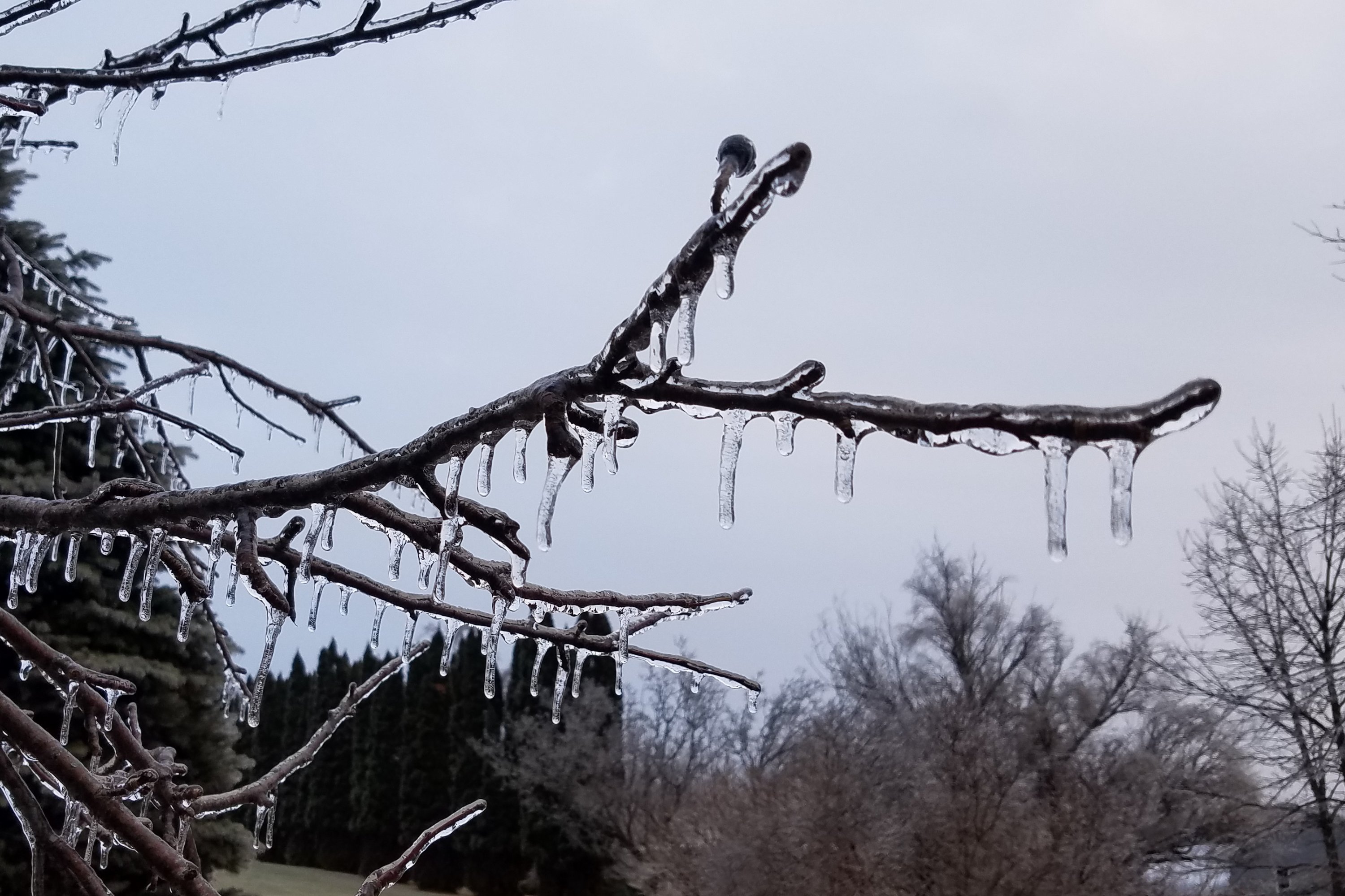
The tips of long evergreen boughs touched the ground near the lane leading to the highway. Because of immeasurable leaf surface, they collected more weight in freezing rain than they could handle. Some broke from the trunks of trees and were scattered along the lane.
It’s expected to warm above freezing again so the count toward fruit tree dormancy will have to be reset before pruning. Maybe by the end of this rapidly filling month.
When I left a 25-year career in transportation and logistics, food occupied part of my attention. Over the years my blood pressure and cholesterol levels had increased, and when I left transportation they quickly returned to normal, mostly by eating more regular food as opposed to restaurant food.
When we moved back to Iowa in 1993, growing a large garden was part of what I wanted to do with the land. We couldn’t afford an acreage, but managed to find 0.62 of an acre not far from the trail around the north shore of Lake Macbride.
I was ready to produce some of our own food, more than we had in Indiana, but not really ready to embrace local food as anything other than a kitchen garden.
The local food movement was a growing group of individual operators struggling to make a living and an impact in a turbulent world. It remains a nascent system directly tied to our consumer culture, dependent upon disposable income and open mindedness in meeting humankind’s most basic need.
I spent seven years working and living in our local food culture and can say food we consume is not all local and needn’t be. At the same time there are benefits of a local food system beyond living within the season, better taste, and knowing the farmer who produced what we eat.
In our home fall canning leads to a pantry full of soup, tomatoes, hot peppers, sauerkraut, vinegar, apple sauce, pickles and sundry items from the garden and farm. The freezer gets filled with bell peppers, kale, sweet corn, apples, broccoli, blueberries and raspberries. It is food – as local as it gets – driven by what is fresh, abundant and on hand.
Along with home processed goods our pantry has bits and pieces from all over the globe, with each serving a purpose in our culinary lives. Combining ingredients and recipes in a personalized cuisine is where the local food movement lives or dies.
More people seek processed or precooked food because of a perception there is too little time for cooking. If adding kale to a smoothie seems easy, making a stir fry using it is less so. Contemporary consumers want a quick and easy path to making meals and snacks, and don’t have the patience it requires to add many new recipes to their repertoire. Cuisine as an expression of local culture has been tossed out the window by many.
Having worked in the food system, whether at home, on a farm, or in a retail store, has been an important part of my life since retiring in 2009. I found it is a way of life to grow food for direct consumption or sales. It also became clear the local food system is a jumble, even if farmers and consumers want it to be more organized.
One operator runs a community supported agriculture project where members pay in the spring, then share in the luck of the farm, good or bad. Another sells chits to be used to buy farm goods at a local outlet framed as a “store.” Another grows specific crops to sell to restaurants, absorbing any financial risk. All of this and more leads us to a point where an onion isn’t only an onion anymore. In the end it’s not about the onion but the culture.
If someone could organize a local food system, they might make a living. That would miss the point. Local food systems are intended to cut out the middlemen in the food supply chain. At the same time, faced with a need for scalability and the tick tock of the growing season, operators might use the help of an intermediary for marketing and sales.
While some of the trail blazers of a sustainable, local food movement are well known – Alice Waters, Joel Salatin, Fred Kirschenmann, and others – a sense of coherence or agreement on basic terms seems missing among local producers. It is as if operators would rather work inside the bubble of what works for them personally as long as the farm to market system seems to work generally. In a way that is not much different from how corn, soybean, egg and livestock producers view their operations.
Where we go from here is uncertain, although I have some ideas about that based on my experience in our food system.
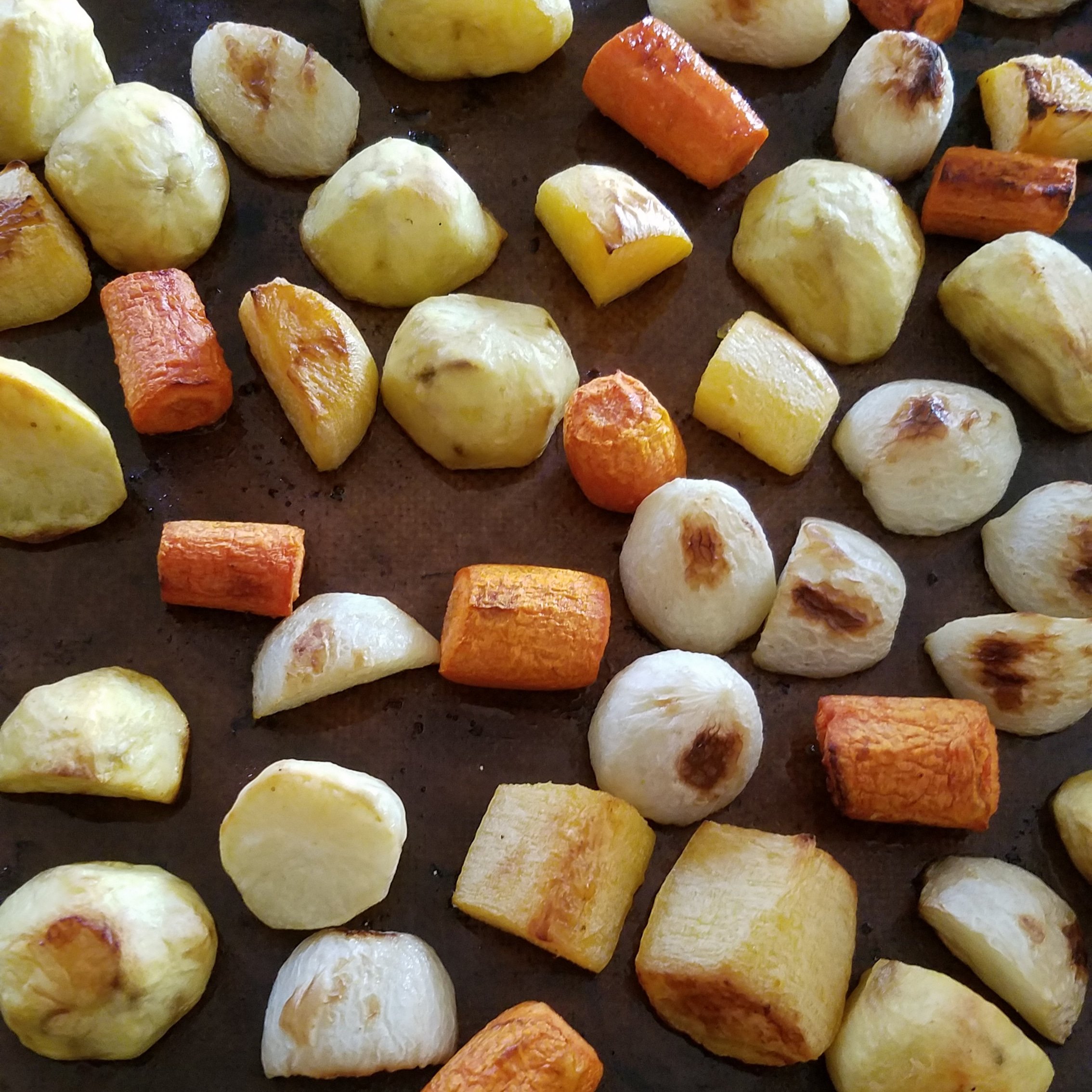
Roasted Root Vegetables: potatoes, rutabaga, turnips and carrots.
On Wednesday morning the ambient temperature is in the teens. By tomorrow at this time it will be in the mid-forties. I’m looking forward to a week of freezing temperatures so I can get tree pruning done.
Not yet.
What gripes me is there is limited work to do outside yet it feels like I should be spending more time there. Instead I write, cook, read, and do chores. It’s a winter life without the winter part of it.
I spent time Tuesday night following events in the Middle East. The Islamic Republic of Iran retaliated for the U.S. assassination of Qasem Soleimani by firing a 15 or so missiles in two volleys into Iraq where U.S. forces were staying. After the launches an Iranian government spokesman said they were done unless the U.S. retaliated with additional military action. They threatened to destroy the Israeli city of Haifa as well as Dubai where thousands of U.S. troops are stationed if we retaliated. It appears the president and his key leadership team stood down after the two volleys and neither Iraqis, U.S. troops, nor coalition forces suffered any casualties. Unrelated to the missile attack, a Ukrainian airliner crashed in Tehran last night killing all 176 people on board.
The Middle East action is a distraction from the president’s Dec. 18 impeachment. Senate Majority Leader McConnell announced yesterday he would proceed with the constitutionally mandated impeachment trail without an agreement to call witnesses. At present he has the votes to support his position although that could change.
Donald Trump is the 13th president in my lifetime and I don’t recall any predecessor who appeared so disorganized and superficial in their approach to international affairs. The conventional wisdom is he won’t be impeached, despite clear evidence of high crimes and misdemeanors, because his supporters in the U.S. Senate hold the majority. Based on everything we know, the two articles of impeachment, abuse of power and obstruction of Congress, are rightly promulgated. I was surprised other articles were not drafted, particularly one related to the emoluments clause of the constitution. My position is the president is as guilty as hell of the two articles of impeachment and I would like to see him removed from office even though from a policy standpoint, Vice President Pence could be a worse president.
The Republican Party has become the party of Trump and that’s not good for regular people like us. The corruption from money in politics has become overwhelming and it’s hard to see an end to it. Moneyed interests have a well-developed infrastructure to support what they want to achieve. Democrats have no equivalent response to it. If we can’t slow their progress by winning the presidency in November, it will be generations before a progressive agenda can be advanced.
What stood out to me over the weekend is about 100 people gathered in the county seat to protest the U.S. slaying of Soleimani. At the same time, that number and half again gathered for a nearby event with author Marianne Williamson who laid off her presidential campaign staff a few days previously. That tells me the populace is not engaged in the Middle East or in Trump’s incompetence.
Alice Walker wrote, “The most common way people give up their power is by thinking they don’t have any.” In a scenario like yesterday, where Iranians seem like reasonable people, it seems like we’ve given the president a blank check to have his way with the Middle East. I’d feel better about that if there was any shred of evidence he or his staff knew what they are doing.
It’s winter in America, but not really. Without it it’s an open question whether we will make it until spring with necessary chores completed. We will do the best we can.
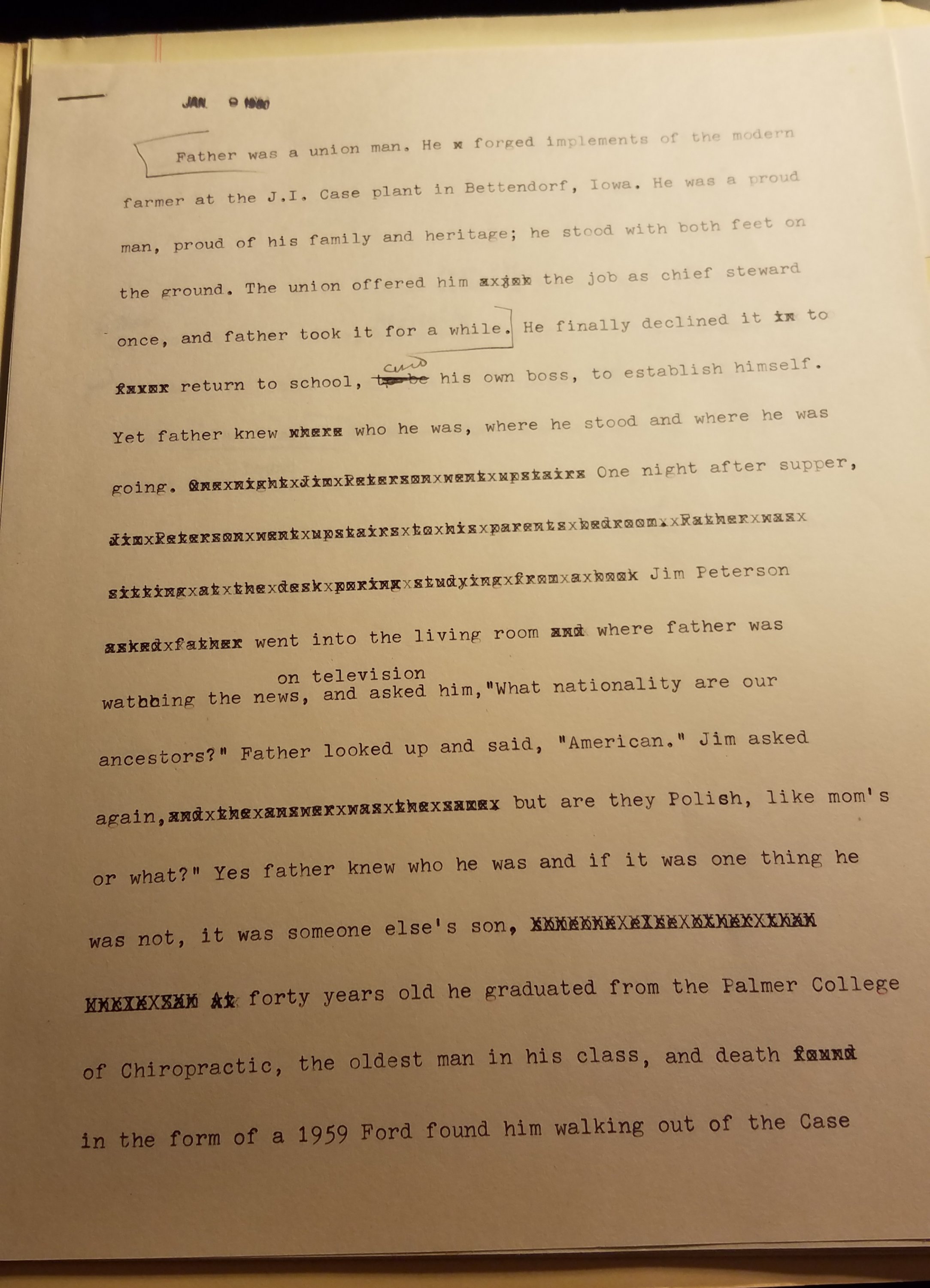
(Editor’s Note: Robert Caro instructs us to turn every page when writing biography. I don’t remember writing these fragments found in a folder with multiple typewritten drafts of each. Today they make me groan a bit. They are fiction with one foot in reality).
Fragment 1 – Jan. 9, 1980
Father was a union man. He forged implements of the modern farmer at the J.I. Case plant in Bettendorf, Iowa. He was a proud man, proud of his family and heritage; he stood with both feet on the ground.
The union offered him a job as chief steward once. He took it for a while, but ultimately declined it. He went back to school to get out of the plant and be his own boss, to establish himself.
He graduated in 1968, but death in the form of a 1959 Ford struck him as he walked out of the plant after his shift.
Those were hard years, but Jim Peterson was convinced his father knew who he was, and where he was going.
Fragment 2 – 1974
Danny Dziabas shut the door of his upstairs apartment and began walking to the sound of night creatures chirping near the house.Walking under the starlight of Orion rising. Walking from his apartment on Walling Court, near where Bix Beiderbecke had lived. Walking toward Locust Street where revving of car engines and laughter of young people muffled the night sounds. Where headlights and streetlights dimmed the rising hunter. Danny Dziabas walked to the Deep Rock Station and placed a call while a Corvette and a G.T.O. lined up at the intersection for a drag race.
As he finished his call, the traffic light changed to green and the two cars squealed away from the corner.In hot air, smelling of burnt rubber, Danny Dziabas began walking, away from the noise and light of Locust Street toward his nearly empty apartment on Walling Court near where Bix Beiderbecke had lived.
Fragment 3 – Dec. 25, 1974
When the time came Danny began looking up his friends. The first was Milton Murphy who was in possession of Danny’s books and record albums.
Danny and Milton had played together in a band called the Milton Murphy Moose Manglers. It lasted about nine months. Just as they were about to collect their pay from a party on a farm near the Wapsi River, a band mate carried the P.A. head 100 yards and threw it over the bluff into the river, ending both the evening and the band.
Remembering this and other episodes in the Manglers’ history, Danny questioned the sanity of leaving his possessions in Milton’s care in the first place. He knew it would be alright when he heard the dull beat of the base coming through the floor above the entrance hall.
Fragment 4 – Iowa City, 1973-4
In act of simultaneous co-creation Danny Dziabas skied the snow-covered slopes of Washington Street, mountainous mathematics to the left, his just crashed 1965 Volkswagen cavernous time away and in a ditch. Pirouetting on Madison Street, his toe reveals a greenery hidden by newly fallen snow.
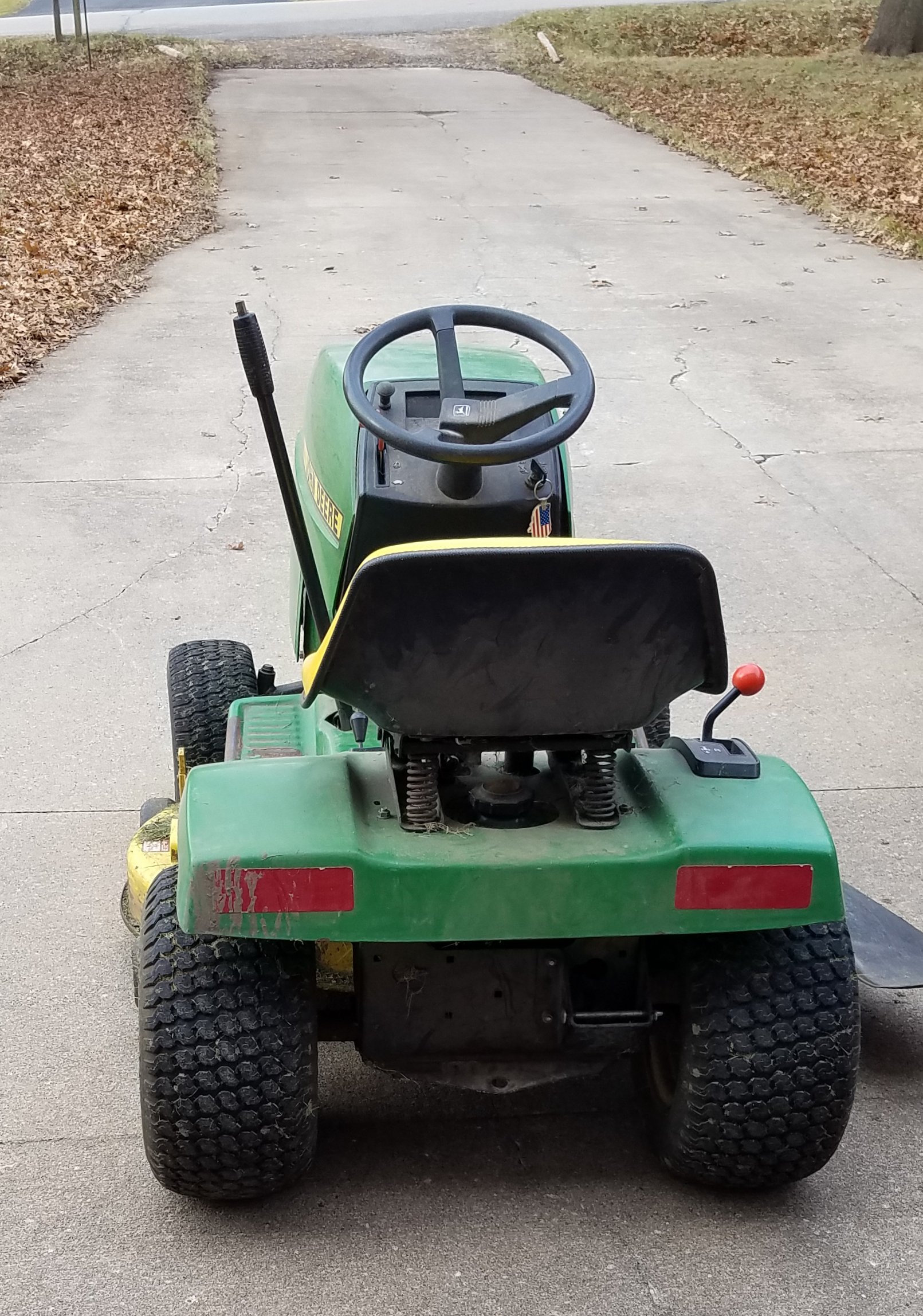
Yard tractor waiting to go to the shop for winter maintenance.
Yesterday a political canvasser rang our doorbell and was halfway down the street before I made it to the door. I can hardly hear the doorbell from my writing table. She came back to talk.
“I noticed your Elizabeth Warren bumper sticker,” she said hopefully.
I asked her to whom she had talked and reviewed the status of a few neighbors with her. We live in a bedroom community for larger urban areas surrounding Cedar Rapids, Iowa City and Coralville. More weren’t home than were on a Monday. Those who were are retired or work from home.
“There are some Trump supporters in this neighborhood registered as Democrats,” she exclaimed.
No surprise. It’s a free country and in this white enclave in rural Iowa we get separated from labels like party preference that seem more relevant in urban areas. I didn’t ask her who it was.
There is no guarantee Democrats will win key federal offices in the 2020 general election. Even if we do, the rips in society seem beyond mending.
At a local level, regardless of party, voters can find common ground and get things done to improve our governance. Once we get beyond our rural school district borders, finding common ground becomes more difficult. The divisions and animosity that culminated in the election of this president seem likely to continue for years after the next general election regardless of who wins in November.
On Dec. 9, a white, 42-year old woman went on a crime spree near Des Moines, striking two people with her vehicle in separate incidents, and allegedly shoplifting and displaying public intoxication afterward at a local convenience store. She drove her vehicle on the sidewalk to hit a 14-year old girl walking to see a basketball game. The woman did it because the girl was Hispanic, she told police. Earlier in the day she struck a 12-year old black boy. The woman is charged with attempted murder.
Maybe this is an isolated incident. Justice will take its course as we expect in a society with laws. Yet maybe it isn’t isolated, but a sign of what’s to come, especially if President Trump loses the 2020 election. The steady escalation of tension in the Middle East by our government is sure to divide Americans even as it served to unite the people of the Islamic Republic of Iran.
I admire people who persist in political organizing in our current social environment. They haven’t given up. They inspire hope. Although I signed up for six shifts of door knocking and am the temporary chair of our precinct caucus, I want to do more. At the same time I know my limits and want political work to be meaningful to our community. I want it to endure beyond the Feb. 3 precinct caucuses.That makes me a rough gear in the machinery of precinct-level political organizing.
I asked our local organizer what they were doing after the caucuses. They are sworn to secrecy. To be honest, they may not know what’s next other than brief respite before New Hampshire, South Carolina, Nevada, and then Super Tuesday on March 3. By then the Democratic presidential candidate field will be winnowed to a couple of candidates. There is little doubt who will be the Republican nominee.
The challenge is the broad context of the society in which we seek to live. Presidential politics is part of it. Yet as Barack Obama’s administration demonstrated there is little permanency unless the electorate hands the new president an enduring mandate. As divided as we are, that seems unlikely. Somehow we must navigate our lives out of the tar pits in which we find them. It will be sticky and messy. It will take generations to clean up. All the same, we must persist. If we don’t, what would be the point?
For a recipe I got out my copy of the Holy Family School PTA cookbook. I like this book for the familiar names of the recipe authors, some of whom I knew. Monsignor T.V. Lawlor served as the church’s second pastor from 1943 until 1961 and his photograph is printed inside the front cover of the book. This dates the cookbook in the 1950s most likely, after the school moved to the location I attended a couple of blocks south of the church on Fillmore Street.
I chose a banana bread recipe contributed by Mrs. H.A. Tholen. It called for shortening, although I substituted butter and kept everything else the same. Here are the ingredients as written:
1/2 cup sugar, 1/2 cup shortening, 2 eggs, 3 bananas mashed, 1 teaspoon baking powder, 1/2 teaspoon soda, 1-3/4 cup flour, and a pinch of salt.
Instructions are, “Mix in the order given and bake in a slow oven.”
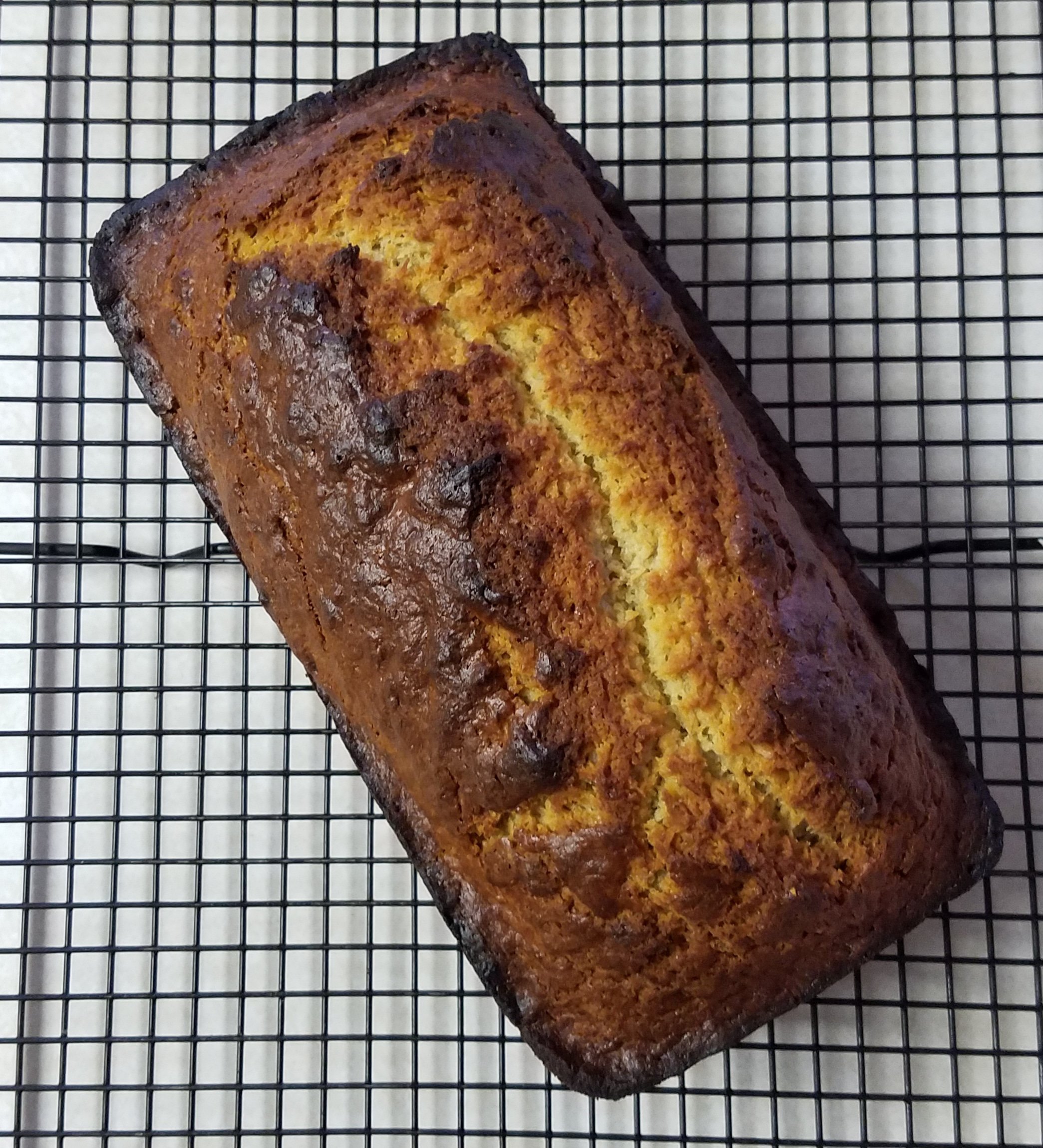
Well that won’t do. Looking at other sweet breads in the book I decided on a 350 degree oven for 50 minutes. It turned out great as you can see in the image.
Making banana bread from overly ripe bananas is a cultural inheritance not only from my mother and maternal grandmother, but from a broader society where fruit like the Cavendish banana is readily and cheaply available. However, like most mass marketed fruit and vegetables it is subject to change from climate and from other pressures, forcing old habits and patterns to change.
There was something positive in yesterday’s bakery. It was a warning too, that life is fragile and ever changing. We seek comfort in what we know, delaying the embrace of what is coming. I don’t just mean what’s coming for Cavendish bananas.
I’ve been using the free, on line service FamilySearch to research parts of my family history. It is funded by the Church of Jesus Christ of Latter-Day Saints.
I call it, in a respectful way, the Book of Mormon.
My reference library has a copy of the actual Book of Mormon, replete with a photo of the prophet Joseph Smith from whose translations it was made in 1830. I’ve already opened FamilySearch many more times than the worn copy of the religious text.
Stories about early gatherings of my paternal ancestors include one about the funeral for “Aunt Stella.” I have a photograph of Stella in her coffin with someone identified as “Granny Reed” nearby. Stella was my grandfather’s sister. Oral history is no one knew anything about Granny Reed except that’s what they called her. According to FamilySearch, in the 1920 U.S. Census she is listed living in the household of my great grandfather as his mother-in-law, with an estimated birth year of 1864. Her complete name was Josephine Reed. It has bothered me we didn’t know more. Now thanks to the Mormons there is a better narrative of who she was.
When I write “better narrative” I mean the story is and continues to be a human creation. While there are “facts” to support it, there are vagaries in the U.S. Census data and oral tradition that went unrecorded. The temptation is to take a fact like a U.S. Census entry and make more of it than it actually is. As I wrote this post I found myself rewriting that paragraph time and again to refine my understanding of who was Granny Reed. I’m not sure how much more this discovery changes things.
I love the name Josephine and had we known about it when our daughter was born, it may have been entered into the pool of family names from which we selected hers. Granny Reed was our daughter’s great, great, great grandmother. It’s a fun fact yet not that relevant to our daily lives.
Somewhere in box-storage is a trove of genealogy documents collected from a man named Howard Deaton during a trip to Saint Louis. His focus was on our surname, Some of his work is relevant to our line and some isn’t. Robert Caro advises us to turn every page when researching biography. I don’t know I will have time to go through documents I have, let alone the entire Book of Mormon.
These are decisions one makes in compressing the story of a life into a hundred thousand words. If anything, the challenges of crafting a story come into high relief. What I’m writing will by its nature be a story built today with a perspective of right now. I don’t see how any biography or historical work can be anything else. There is a politics of history, a minefield of historian’s fallacies. There is also a poetry of history. What we hope to do is create a narrative grounded in something real that transcends the lived life upon which it was based.
At age 68 there is an urgency to get something down, edited and finished.
Dr. Maureen McCue speaking for the Iran Deal at Rep. Dave Loebsack’s Office Aug. 31, 2015
The politics of Iran has been on my radar since the Iranian Revolution when Mohammad Reza Pahlavi was overthrown in 1979 and an Islamic republic replaced the monarchy.
I lived in Mainz, Germany that year. I was a mechanized infantry battalion adjutant in the Eighth Infantry Division, which, as part of V Corps, was training for a war in the Middle East over oil. Across the Rhine river from us was Wiesbaden, the evacuation point for American citizens fleeing Iran in the wake of the revolution. Our unit provided support to the Wiesbaden operation during the evacuation.
One of the choices I made during that time was which of my peers in the battalion would be sent to Iran during the aftermath of the Shah’s overthrow. I picked someone whose family wasn’t with him in Germany. My friend was never deployed to Iran and we were all grateful for that.
In this context it is natural that the United States assassination of Iranian Major-General Qassem Soleimani, head of the Iranian Revolutionary Guard Corps Quds Force would catch my attention. What I wasn’t prepared for was spending so much time following developments. When I write “developments” what I really mean is the slow, uneven release of information about what happened and what it means. Yesterday’s post is a list of the main questions raised early on in the discovery process. Answers have proven complicated and elusive.
I was reading the news right when I wrote Soleimani was a target of opportunity. That means the U.S. intelligence community had long been tracking his movements and after President Trump gave the order to slay him, when his movements at the Baghdad airport exposed him and his entourage, there was an opportunity to take action and our military did. While our president seems impulsive, in this case there was a developed plan to assassinate Soleimani.
Two things make this different. First, Soleimani was revered in Shia Muslim culture. His death by unmanned drone attack elevated him to martyrdom and could bring a ruptured Iranian society together in opposition to the United States. Second, he was part of the Iranian government the way Chairman of the U.S. Joint Chiefs of Staff, Army General Mark Milley is. It is important to note Soleimani’s status was distinct from a figure like Osama bin Laden who was a rogue, non-state actor. People who make a proportional comparison between Soleimani and bin Laden are wrong to do so.
The politics of this have been predictable as Heather Cox Richardson pointed out in her daily Letters from an American:
Last night’s news about the assassination of Iran’s military leader Qassem Soleimani has today turned into a predictable split. Defenders of the president insist that Soleimani was an evildoer and the United States absolutely should have taken him out. They have no patience for anyone questioning Trump’s decision, suggesting that those questioners are anti-American and pro-terrorist if they do not support the killing of a man they insist has been one of our key enemies for years.
Those questioning the president’s decision to assassinate a member of a foreign government as a terrorist freely acknowledge that Soleimani was a dangerous man. But they are concerned that Trump appears to have ordered the man assassinated illegally and has, in the process, ignited a firestorm.
If you are reading this post, you should consider subscribing to Richardson’s daily emails.
Whether President Trump had constitutional or legal authority to assassinate a member of the Iranian government without consulting the Congress remains an open question. The administration claimed it was free to act under the 2002 Authority for the Use of Military Force enacted by congress in the wake of the 911 terrorist attacks. The U.S. named the Islamic Revolutionary Guard Corps, of which Quds Force is a part, a terrorist organization. Friends Committee on National Legislation has been lobbying the Congress to repeal the 2002 AUMF. The incident yesterday in Baghdad highlights the pressing nature of Congress reasserting its authority over the executive branch of government in matters of war and peace.
In today’s Iowa City Press Citizen, Zachary Oren Smith posted the reactions of three people running for congress. Smith’s framing was “early reactions to the U.S. military strike that killed Iranian Gen. Qassem Soleimani fell along party lines in Iowa’s 2nd Congressional District.“
Democrat Newman Abuissa, a native of Damascus, Syria, reacted to the assassination, “If the goal of the U.S. is a regime change or to negotiate a better deal, this attack makes both goals impossible to achieve. It strengthens the government of Iran and makes it impossible for them to sit down with the U.S. president.”
Both Republicans supported the president and Schilling was quoted at length, parroting long-debunked talking points.
What makes easy media narratives like Smith’s difficult is the decades-long context in which Thursday’s assassination took place. Simple comparisons serve little purpose and push a struggling news outlet closer to irrelevance.
My questions from yesterday aren’t answered. After spending too much time following the news, my work on other projects lagged behind. I need to keep moving. 2020 is here and there is much I want to accomplish.
I did make time to visit a friend whose spouse died Wednesday. She said of him, “at least he got out of here before all this shit happened.” It remains for those of us living to deal with it and carry on.
At 3:15 a.m. CST my phone rang. It was an international call from Jordan. I don’t know anyone in Jordan and the caller did not leave a message.
I know a few people who travel in the Middle East from time to time. None of them stood out as a person who might be calling the morning our country assassinated Iranian Major-General Qassem Soleimani, head of the Iranian Quds Force, as a target of opportunity at the Baghdad airport.
I had not heard of Soleimani so I found and read Dexter Filkins Sept. 23, 2013 New Yorker profile. However this decision was made, intentionally or not, the U.S. Government kicked the beehive of Shia efforts toward hegemony in the Middle East. We will likely be stung by this extrajudicial exercise of American military force.
There is not enough information despite the rapid response of social media. The vacuum generates questions:
Why didn’t the president inform the gang of eight of the imminent assassination? Given the prominence of the target in Iranian and Middle East society he should have. House Speaker Nancy Pelosi was clear he hadn’t.
Why didn’t the administration seek an authorization for the use of force from the U.S. Congress? According to Pelosi, there is no existing authorization relative to Iran.
When will the president address the public on what he did and why?
Was this assassination retaliation for the recent attack on the U.S. Embassy compound in Baghdad or part of a long-term plan to enter war with Iran?
What will be the consequences for U.S. interests in the region? Iranian officials have already stated publicly there will be revenge for the slaying. We can expect them to act with thoughtful reserve and to think outside the box.
Who will replace Soleimani in the established and future operations for which he was responsible?
What was the benefit to U.S. interests of elevating Soleimani to the status of martyr?
There are a lot of questions, few answers, and a grim pall has been cast over this Friday in Iowa.
My 2013 decision to develop a barter arrangement with my friend Susan Jutz helped resolve a couple of issues.
I needed the cash income plus a share of the vegetables she grew. More importantly than income, I wanted to become a better gardener and needed a mentor.
By almost any measure our relationship was successful and endured even as Susan sold her farm and moved out of state.
On Feb. 1, 2013 I sent this email proposing an arrangement at her Local Harvest CSA:
Susan:
Hope you are staying warm. I have an interest in developing a deeper relationship with producing local foods. While our kitchen garden is doing well, I want to explore the possibility of doing more with local foods to provide a source of income. This is a long range project, and if you offer it, I would like to exchange my labor for a share of your CSA this season.
I think you would find this a cheap and reliable source of farm labor, and what I would get out of it would be a deeper knowledge of how you do your work.
What do you think?
Regards, Paul
We worked through details that lasted not only that season but established a continuing relationship now entering its eighth year. I expect the conversation about local food to continue this month with Carmen, Susan’s successor. Greenhouse work usually begins in February.
The Community Supported Agriculture model is the workhorse of the local food system. Instead of producing a few fungible commodities, CSA farms produce many types of vegetables in many varieties, providing a weekly share for members who buy in at the beginning of the season. They also leverage other producers to provide eggs, meat, bread, jellies, jams, and other items they don’t produce for their customers. On Carmen’s farm she produces grass-fed lambs and goats. The presence of livestock on a farm is an important part of reducing reliance on chemical fertilizers. Some CSA farms are more diverse than others but the salient feature is that the main consumer model is changed to include a share the farmer provides.
Operating a small farm is challenging. It requires hard work and specific knowledge about a wide variety of issues. It seems like more work than people with a big job at a large-sized employer are used to. There is also more risk during a growing season. Most local food farmers I know do something off the farm to supplement farm income. Every one of them has a positive disposition despite the challenges.
There is an ongoing discussion about alternatives to the CSA model.
Chris Newman of Sylvanaqua Farm in Virginia posted an article on Medium in which he wrote, “The romance of neoliberal peasant farming blinds us to our collective power.” Newman’s assertion is small family farms are not competition for, or a sustainable answer to burgeoning consolidation of agriculture. He touched on a number of obvious points, beginning with farmers markets.
Farmers markets are nice for consumers, but expensive to participate in. If some local food farmers produce for the seasonal markets they compromise their flexibility and scalability, he said. I don’t know about the operational advantages of a local food cooperative because many farmers already coordinate activities with each other. A farmer of meat, vegetables, flowers or the like can do better to avoid such markets. At a minimum one requires additional outlets to extend sales beyond the farmers market season.
Newman lays out the challenges small family farms face regarding workforce in a labor intensive business. Putting together a workforce that accomplishes weeding, cultivation, planting, harvesting, pest control, and everything else isn’t easy when the operating assumption is some percentage of workforce will volunteer or work for very low wages. Newman’s idea of forming a cooperative addresses the wage issue but also seems overly idealistic.
In his book The New Farm: Our Ten Years on the Front of the Good Food Revolution, Ontario farmer Brent Preston tells the story about how he and his spouse found sustainability in the local food movement by transitioning away from farmers markets to wholesale production and sales. This book is a must read for people interested in the local food movement.
Michelle Kenyon, executive director of Field to Family, is establishing a food hub in Johnson County. She’s been featured in the local newspaper. The idea is simple from a farmer’s perspective. Got too much basil? Bundle it to specs and sell to the food hub.
Having an outlet for a farm’s produce is important. Few local farmers follow the traditional CSA model of sharing the farm produce exclusively with members. That would mean all of the extra basil in my example would go to members who would presumably become rich in pesto and pasta sauce. Separating food production from CSA membership provides options for additional revenue streams such as selling to a food hub, to restaurants and to retailers.
A smart farm operator won’t put all their eggs and produce in single basket. They manage a portfolio of revenue streams based on farm production, but include variation in how customers are approached. So often, just having an item when others don’t makes a big difference in exploiting some types of “pop-up” marketing opportunities.
I would like to establish independence from the farms on which I’ve worked since 2013. Controlling everything would free me from outside responsibilities and enable re-designing my garden to expand and produce extra crops that could be sold to others. That has always been a small part of my garden operation but as I progress through my transition to “retirement,” any income generated could help supplement our structure of pension, Social Security and savings. For the time being, I look forward to returning to the farm for another spring of soil blocking. Looking back at this email to Susan, it’s clear I was not wrong to pursue the opportunity.


 Journey Home
You must be logged in to post a comment.