One of the roles I play in society is secretary of the Macbride Sanitary Sewer District, a public entity that manages wastewater treatment for our group of about 84 homes. I recently spent time writing a questionnaire about water softener usage and tabulating the results from a user survey. The report I sent to members this month has broader application so I’m publishing it here for my WordPress community. Your feedback would be welcome.
Thanks to the 66 home owners who submitted a survey on home water softener use. Before discussing the survey results, you may be wondering why we are working to reduce chloride in our wastewater. Short answer: the rules changed after our previous NPDES permit expired. Our new one, issued May 1, 2017, has new requirements for chloride and other elements. Here is some information about the new standard from the Iowa Department of Natural Resources which manages NPDES permits for the U.S. Environmental Protection Agency:
Iowa adopted water quality standards for chloride and sulfate in November 2009. These two new standards replaced the previous water quality standard for total dissolved solids. “Total dissolved solids” is a measure of all chemical elements that have become dissolved in water. It includes chloride, sulfate, nitrate, sodium, potassium, and magnesium, among other chemicals. The total dissolved solids standard was designed to protect aquatic life from toxic conditions caused by these chemicals. However, research by DNR showed that in Iowa waters, chloride and sulfate are more accurate predictors of toxicity to aquatic life than the combined measurement of total dissolved solids. DNR thus undertook to replace the water quality standard for total dissolved solids with specific standards for chloride and sulfate.
Of the people who responded to our survey, 31 use a timed-cycle water softener, 30 use on demand-initiated cycling, and 5 didn’t know.
Reported annual salt usage ranged from zero to 2,000 pounds. 20 homes used less than 250 pounds, 21 between 251 and 480, 15 used more than 480 pounds, and ten didn’t know.
A couple of things are clear from the data: 1. Many people don’t think much about their water softener or keep records about how much salt they use. One 40-pound bag per month is 480 per year and several people used that as an estimate; 2. We use a wide variety of brands of water softeners. Kinetico was most popular. There are a half dozen others; 3. Most families installed their softener and seldom had maintenance done on it; 4. The three most popular plumbers were Water Conditioning Systems (Kinetico), Affordable Soft Water, and Neal’s Water Conditioning; and 5. Most homes have a separate line to run untreated water outside for lawn, garden and cleaning.
What should home owners do regarding salt use?
Contact a plumber to have your water tested for hardness and your water softener checked for proper functioning and adjustment. Have the plumber program your softener to a low-salt setting appropriate for the water hardness in your home.
If you plan to replace your water softener, get one that cycles based on demand rather than on a timer. This will ensure all the water used is properly softened and save salt if your usage is lower.
Install high-efficiency water fixtures, like low-flow shower heads, to reduce your home’s soft water use.
Have a plumber disconnect water that doesn’t need to be soft, like toilets and lines to outdoors, from the water softener.
If your household is using more than 480 pounds of salt annually look at replacing your water softener to take advantage of new technology and use less salt. A new Kinetico softener will use about 250 pounds of salt annually for a household with two people.
Water is not an unlimited resource so develop creative ways to conserve water at home, such as taking shorter showers, running only full loads in the dishwasher and clothes washer, and turn the faucet off when taking care of personal hygiene or doing dishes — break the bad habit of letting it run. Consider getting EPA WaterSense-certified toilets which use less water for flushing.
At this time the Macbride Sanitary Sewer District is not considering a mandated salt reduction program. We are to be in compliance with the new chloride standard by April 1, 2022, and if voluntary efforts produce the desired results, that will be that. If we don’t meet standards, the board of trustees will revisit the issue of more specific requirements.
Kale is a money crop in my garden. By that I mean I learned how to grow it and have had success most years since. I distribute a lot of free kale to friends and neighbors. Today was the day to plant it along with broccoli. The varieties are:
Something was weird about the Calabrese seeds from Ferry-Morse. It appeared broccoli seeds were mixed with another kind, rendering the packet pretty useless for predictability. I planted some of each as the main broccoli crop will be Imperial anyway. We’ll see what happens.
Sundays in the greenhouse have become a day to which I look forward. The goats are due to drop kids any day, and of course we are well into lambing season. Our crew of five or six people works well together. I enjoy the conversation with twenty-somethings, although some of them will soon turn thirty.
I’m not sure the onions planted previously will make it. Some of them are tall and spindly. Others haven’t come up. The soil is damp so we’ll see how they come out. At this point if they fail I can get starts elsewhere.
My small, portable greenhouse arrived this week. Instead of keeping flats of seedlings on a short stack of pallets near the garage door and moving them inside at night, I’ll keep them here. I’m not sure how exactly it works, but look forward to learning.
The weather has made this year’s start better than 2019. Let’s hope it continues.
State Senator Liz Mathis (L) and State Representative Molly Donahue at the Ely Public Library, Ely, Iowa. Feb. 29, 2020.
It should be no shocker that I attended a political event on Saturday. How could I miss it? It was six miles from our house.
State Senator Liz Mathis represents the 34th Senate District in the Iowa legislature. Alongside State Representative Molly Donahue, who represents House District 68, they hosted a legislative listening post at the Ely Public Library.
The closer one gets to Cedar Rapids, the more likely we are to encounter kolaches, a traditional semi-sweet roll originating in the Czech heritage of Iowa’s second largest city. Mathis pointed out the box of kolaches in the back of the meeting room soon after my arrival. About 16 people attended.
I was in graduate school in Iowa City when Mathis began her broadcast news career at KWWL at their then new Cedar Rapids bureau. She has been a broadcast anchor, television producer, college professor, and is currently an executive at the non-profit organization Four Oaks Family and Children Services. Donahue has been a teacher for 30 years with a current focus on secondary students in special education or those who have behavior disorders that can affect their learning. They were well qualified to discuss Iowa’s mental health system, school safety, the K-12 education budget, the school bus driver shortage, and related topics. I listened and tried to learn.
News on Friday was Pattison Sand Company of Clayton sought to extract 34 million gallons of water per year over a ten-year period from the Jordan Aquifer, according to Perry Beeman of Iowa Capitol Dispatch. The water would be shipped by rail to arid regions in the American west, potentially to New Mexico, Colorado, Wyoming, Nevada, Utah, Arizona or California. The Jordan Aquifer is also the source of municipal water for the city of Marion which lies within Mathis’ senate district.
Earlier this month Pattison proposed to extract 2 billion gallons per year from the Jordan Aquifer using wells they drilled to support their frack sand mining operation. This proposal was rejected by the Iowa Department of Natural Resources.
The problem with tapping the Jordan Aquifer is it is prehistoric water, in other words, it has been there a long time. The aquifer does not recharge at the same rate as the Silurian Aquifer which lies on top of it. Once the Jordan Aquifer is drained, the water will be gone and communities that currently rely upon it could be left without a reliable water source.
The climate crisis is evident in the American west. Demand for water exceeds the region’s capacity to produce it through rainfall, snow melt, and underground aquifers. Something’s got to give for people who settled there to survive. Mining and shipping water from Eastern Iowa is not a good idea because what may be abundant to meet our current needs will be diminished by the extraction proposed by Pattison and others. It is easy to see how a discussion over water rights could escalate into regional conflict over this basic human need.
If we look at history, humans have continued to exploit natural resources until they are gone, in many cases leading to the collapse of societies. Our brains are not wired to perceive the threat shipping billions of gallons of water from Iowa to the west could have. We have to pay attention, and the role of government is to look out for the common good.
It is hard to image an overall plan to resolve the climate crisis at its root causes. Further exploitation of natural resources doesn’t solve anything and could potentially make matters worse. At least we were discussing it and in doing so raising awareness on a sunny morning in Ely over kolaches.
The driver delivering pallets of yard and landscaping stone, peat moss, and dirt said his spring deliveries are running about two weeks behind last year.
We just finished our annual inventory at the home, farm and auto supply store and are ready for incoming freight of garden supplies, utility trailers, wheelbarrows, fertilizer, three-point farm equipment, and the like. I unloaded a pallet of 50-pound bags of seed potatoes. The greenhouse will be installed in the parking lot next week. Spring seemed late to our suppliers but it’s almost here.
It’s more like we didn’t have a winter.
In a retail warehouse we notice the seasonality of commerce. Shelves fill with mowers, trimmers, blowers, chain saws and tillers. We received two tall pallets of box fans. Large ceramic pots were shipped in crates from Mexico. We have a delightful collection of ceramic and metal rooster art. This entire post could be a repetition of inbound inventory processed during my two days per week part time job. I have something else in mind.
The intersection of commerce, private lives, spirituality and society is where we spend most of our lives. In time, if we are lucky and talented, we create a process of living that ensures our survival. In Eastern Iowa it is pretty straightforward how one secures food, shelter and clothing: seek training and then work as a skilled professional, an entrepreneur, or for someone else. There is no guarantee of success but most people in my circle make it, including those who are forced to live in their cars because they are poor, or who sleep on someone’s couch for a while due to physical abuse at home. We live a privileged life despite the real problems people have.
There is a sense our process of living, for lack of a better description, is built by us, for us, and there is separation from what others do. That’s okay. If we have more in common than we believe, the articulation of a life can be a conscious effort with variations in the use of materials from a mass society. We make something of our selves. Such a process may seem individualistic, bordering on taking care of “me only,” but it is intertwined with the fate of the society which provides context.
I may subscribe to the local newspaper, but so do a thousand other people, our subscriptions and advertising giving life to the enterprise. In a few brilliant moments I find my life has not been consciously nurtured, nor has it been self made. It has been a collaborative undertaking in a social network from which I emerged and in which I remain rooted… kind of like the newspaper.
I read an article about the high cost of prescription drugs. The Congress is working to lower the cost of such medicine, yet to date their work has been an utter failure. People are skipping medically necessary prescriptions because of the cost, Megan Leonhardt of CNBC reported. There is another side to this issue.
Over the years I’ve had several conversations with physicians, and now my nurse practitioner, about taking prescription medicine. Just like finding a good auto mechanic or a reliable technician to work on my yard tractor, it is part of a process for living. Every time a medical practitioner suggested a prescription — either to control cholesterol or prevent Type II diabetes — I pushed back.
I have been able to address each diagnosis through behavioral changes coupled with regular visits to the clinic. These physiological conditions may persist, and at some point I may have to accede to medication. Last year I took a small step and began taking a low-dose aspirin in addition to my daily vitamin B-12 tablet. We’ll see how things go during my follow up appointment later this year. My point is when we focus on the failure of our government to properly regulate the pharmaceutical industry we neglect focus on a process for living. Having a process for living is more important than what our government does or doesn’t do.
I feel life in society all around me. Maybe that is a Cartesian outlook, one rooted in my earliest memories of reading at home before breakfast, after being an altar boy for Catholic Mass at the convent. Despite whatever separation I feel in intellectual outlook our future is inseparable from its context. The fate of our society is complexly intertwined. To separate a single strand of it in the form of an individual life, from the broader organism, would be to our mutual detriment.
I don’t understand how we will manage the many challenges we face — environmental degradation, climate change, economic inequality, the threat of conflict, and diminished natural resources. I do know that without a process for living that recognizes the web of life that engendered us, that brought us to this moment, we may not be up to the challenge. Humanity’s well-being will predictably decline. I’m not ready to say it is inevitable. I don’t believe it is.
Yet so much depends on the observations of truck drivers who pay attention to the variability in our lives — and together try to make them better.
On Saturday, Feb. 22, I met with U.S. Senate candidate Theresa Greenfield at a coffee shop in Coralville, immediately after her appearance at the Linn County Phoenix Club. She arrived on time and was thoughtful in her answers to my questions. She got the job done. The following interview is transcribed from an audio recording. Any mistakes are the author’s. Greenfield began with an opening statement.
THERESA GREENFIELD: I worked my entire career in small business from being a community planner for about fourteen years with neighborhood groups, planning commissions and city councils — helping in that local government office.
I worked for a civil engineering company and was a consultant for either a township that didn’t have staff, or maybe a city that had extra projects they just didn’t have enough staff to get that work done. I loved it.
From there I went into home building and eventually became the president of a small home building company in Iowa. That was fun through the recession, until it wasn’t any more fun. We sold the assets at the end of 2011.
I became unemployed like a lot of people in the recession, then hired on with a commercial real estate company. I most recently was their president. I recently resigned to focus full time on this U.S. Senate race.
I’m pretty excited we just kicked off two things, beginning with our “Hear it from the heartland tour.”
We have been intentional about going places. The number one topic I hear about is health care. We began at Boone County Hospital which is an independent hospital, not part of a big system. We just learned a lot about their challenges, the cool things they are doing too, and how they are integrated into their community. Health care is the number one issue that I hear about and they just reiterated all of that.
We also then just put out the first of what I call our “jobs to get done” agenda. Because I grew up on a farm, and that’s what my parents always said, “No boy jobs, no girl jobs, just jobs to get done.” I think we need to think about some of this work in those kinds of terms.
The first job that needs to get done, for me kind of the root of what’s wrong with Washington and the difference between Senator Ernst and myself, is big money in politics. Our first job to get done is end political corruption and end dark money in politics. Bring some transparency to it, end Citizens United, stop the revolving door of lobbyists. If you’re a senator you can’t sit on a corporate board at the same time. It might seem like natural things that we should be doing as pubic servants, but codify it and try to bring an end to that.
BLOG FOR IOWA: How do you view your prospects for beating Joni Ernst?
GREENFIELD: I view them as really good.
BFIA: Why is that?
GREENFIELD: First off, I grew up rural and I think Iowans want Washington to work like our home towns work. You know, we come together and get something done. There’s a lot of frustration.
Senator Ernst ran to be independent, and different, and she was going to make ‘em squeal, and she’s just taken a real hard turn to the right and votes 90-plus percent of the time with Mitch McConnell and party leaders, really leaving Iowans behind on issues that we care about whether you have an R or a D behind your name, or an N, or you don’t vote.
Things like health care. Voting to end and take away your protections for preexisting conditions. Prescription drug costs haven’t come down. Voting to end the ACA which by the way, allowed Medicaid expansion, which we did here in the state… and that has kept so many of our hospital lights on.
Now I grew up rural and with my parents, we got caught up in the farm crisis. My parents had to sell their hogs and their crop dusting business and never farm again. After that the school closed, grocery store closed, these are stories that we hear around the Midwest, and they drive 20-30 minutes to a grocery store, faith community, hospital, health care. If their little hospital closes they’re going to be going 50 miles, who knows? Or they won’t get the health care they need. These are real issues. You need health care? It doesn’t matter if you’re a Republican or Democrat.
BFIA: Would you say that’s your sharpest contrast with Ernst, on health care? I mean would you really make a difference?
GREENFIELD: Yeah. I will go back to the reason about winning. Her favorable rating is now down to about 39 percent in the state. So for me that just says Iowans aren’t loyal to her, and they are going to take a look at a good, strong Democratic candidate. That tells me Iowans are very open and this race is wide open. She does not have a lock on the race.
You know our differences definitely will (make a difference). I’m a “get ‘er done” person who has gotten things done. I want to focus on the things that most Iowans worry about. Health care is number one. Education. Folks worry about the economy and jobs here in Iowa. With net farm income being down 75 percent since 2013, I’ll tell you what, as I travel around this state, people have concerns. And you put on top of that the 85 ethanol wavers. Our farm economy, our manufacturing, our main street folks are very worried and I hear about that.
BFIA: What is your reaction to the president’s recent announcement that he would create additional subsidies for farmers hurt by trade policy? What are you hearing on the campaign trail from farmers who may have gotten some of that money?
GREENFIELD: Farmers I talk to want their markets back, that’s what they want. They want the future. They don’t want to leave a legacy of liability for their family with high debt. They want to leave a legacy of prosperity. They see continuing to get the markets back and grow those markets is what they want to do, and I get it. I grew up hard-working on the farm and that’s what farmers like to do: get up early, stay late, get the job done, and they want to earn a fair profit to do that.
BFIA: So you don’t see the impact, you see a different picture. What you see is the guarantee by the administration not having the desired effect because people want their markets back, people want to do the work, get paid for the work. Did I get that right?
GREENFIELD: Yes they do. But I’ll tell you what, the situation we’re in: bankruptcy rates are at an eight year high right now. It’s personal for me. When my parents had to sell the crop-dusting business, their hogs, and get out of farming, I went to auctions where families’ contents of the farm were put in boxes on hay racks and auctioned off for a buck or two, and no farm family should have to go through that again. Particularly when we can make a difference. That’s where I’m at.
BFIA: How did you decide to get into politics?
GREENFIELD: That’s a great question. I grew up in a little town, Bricelyn, Minnesota, right on the Minnesota/Iowa border. My parents were DFLers Democratic Farm Labor members. My Mom was the one who always marched in parades, went to county meetings, we door knocked. We didn’t phone call back then though because we had a party line… no robo calling. So it’s always been in my blood to be active in a certain way.
But then I got busy raising a family. I had some hope-stubbing experiences for sure. As my kids got a little older I was able to spent more time phone calling, door knocking. I’ve been a little active.
Remember I spent about 14 years working in community planning at the local legislative level — so planning commissions, neighborhoods, city council meetings, all of that. I saw potholes that needed to be fixed and filled — they aren’t Republican or Democratic — there was a problem that needed to be solved communities come together to do that. I’ll tell you I just decided we need some new leaders.
People talk to me all the time about wanting to end the divisiveness in Washington. We do it by making decisions like we do in our home towns, you know, where we come together. So it’s motivated me.
I really got into this race for hard work and family. I carry their struggles, their heart, and their effort to earn a living wage and provide for their families and have their American dream. For me it comes from being widowed at the age of 24. My first husband was a lineman for the power company. He was an IBEW member… we’re a union family. I will always stand tall with the unions. That’s for sure. They built the middle class and I don’t forget why my lights come on and who delivers my mail. I know those are union jobs.
When Rod died of a work place accident and I became a single mom — a 13-month old and another one on the way — I wouldn’t be here today without Social Security Survivor Benefits and hard-earned union benefits. I didn’t get here by myself. I certainly had family and friends and my home town and community.
Today people are struggling. They need leaders that know and appreciate what hard-working families are going through. That’s not what Senator Ernst does. She stands up and goes in line with her large corporate donors and leaves Iowans behind. So I got in the race.
She also talks about wanting to privatize Social Security and cut Medicare and Medicaid. The current Republican budget is very hard on those programs. I’ll tell you what. I wouldn’t be here without them. So this feisty farm girl, I’m getting in the fight.
BFIA: What were the lessons learned from your race in Iowa’s Third District?
GREENFIELD: What I already knew, but it became clear to me with the campaign for congress, is that there is a moral element to leadership. Voters and Iowans they want leaders who will do it right and they won’t look away from what’s wrong and they won’t put their own political gains first. And that’s what I did. When my campaign manager came to me a told me he had forged signatures on my petitions to be on the ballot I knew what the right thing was to do and we did it. I didn’t get a chance to be on the ballot at the end of the day but I can hold my head high and live in my community and respect and uphold our Democracy and election system. You continue to learn, and doing what is right is always right.
BFIA: Why does your experience best qualify you to win the primary?
GREENFIELD: Well it’s a combination of experience. It’s also a combination of doing the work and being able to build the team. Nobody wins by themselves; I say that every time I’m asked. I am running to do a job which is to represent people. When you bring them into my campaign with me and listen to them, that’s how we’re going to win. We have built an incredibly strong team in house but then have earned the endorsement of many, many of our unions AFSCME, IBEW, and others representing 65,000 union members in the state. We earned the endorsement and partnership of so many elected leaders around the state, including Christie Vilsack, Sally Pederson, Congressman Loebsack, and Congresswoman Finkenauer.
What I’ve done is really kept my head down and focused on building that team. I do it by going out and telling my story. Because I think Iowans want to vote for somebody, they want to see themselves in that person. They want to trust that you’ll do the right thing for them. May not always agree on a policy decision, but they know my character and they know my integrity, and they’re going to vote accordingly. We’re going to go out and compete in every county, in every precinct for every vote.
BFIA: If you lose the primary or the general would you consider a run against Senator Grassley if he runs again?
GREENFIELD: Oh boy! I haven’t even thought about that. Here’s what I can tell you though. If I lose the primary I will do everything I can to get our candidate elected.
(Editor’s note: The interview covered additional issues, including Greenfield’s approach to the climate crisis, auditing the Pentagon, foreign policy, and the 2020 Nuclear Non-Proliferation Treaty Conference. For more information about Greenfield’s views on issues, click here).
Last night and this morning I read Leaves of Grass by Walt Whitman. It has been some time since I last turned those pages, and with the facsimile first edition I have, I felt like the years had turned back.
It is a good book today and I think a large part of my own status is derived from or related to the past readings of this book. I can’t help but say amen to every line.
For what I perceive in Whitman is that life comes only by the individual’s bringing life to otherwise lifeless things. This is what I am about. Nice job Walt.
13 August 1981
Iowa City
First entry after beginning work. This is about right. Two weeks before I get started writing in my journal again. I guess I’m starting to get to where I can do other things besides work a job. I’m beginning to settle in. There’s a ways to go yet.
18 August 1981
Iowa City
The writers I read on writing say that the best time to write is in the morning when I first wake up. That’s not the way it will be. My writing will take place after a day of work in a job with lots of people contact, in a busy part of town, in close contact with a lot of other people, while I am engaged in a myriad of activities. I think all of this is the way it should be, a return to John Donne, perhaps, but a proper state of affairs. For we are always engaged in the world with others. We must be.
It’s time to look to the future. The first step is the publishing and distribution of Institutional Writings. I pick the books up tomorrow after work and will begin writing the passages for the receivers. As I approach thirty years, I make my commitment to life. To people. I consciously leave the past in the recesses of me memory to chart a course over unmarked territory. But I am not a pioneer, in a sense, I cannot be,for I join in my every action with all those who preceeded me. With the rest of humanity. In the most familiar terms, by those who share my culture. But these too are words that belong to the past. Here I go.
On certain days the weight of civilization is crushing.
Despite occasional good news, our steady decline into the abyss seems imminent.
Signs of it are everywhere.
Iowa is a manufactured place. The wilderness that once existed here is gone. It was the first thing to go after the Black Hawk War. A few stands of oak-hickory forest remain but not many. Instead we have endless miles of farm fields fenced neatly on the landscape. With the ancient forests so went our dreams.
It’s an ersatz life we created, lived in a wake of environmental destruction. We do the best we can. Row crop fields look dull, almost gray. It feels like we are in end times.
That’s not to say there is no hope of improving our lot. The political will to do so is in remission, gone like big groves of trees that used to live here. New trees could grow yet someone must plant them. It would take more time than is left in my life to restore what used to be. I wait. For what?
Snow lingers on the ground as I plan the gardening season. We have to eat and what we grow is better than what can be bought in retail outlets. The cycle of gardening and harvest inspires hope that our efforts will produce something. We keep at it.
All the while, the gray, predawn sky reminds us of a new day’s potential. Today comes down to what we will do to make the most of it, to get along with others, to be kind.
I planted our first Big Grove Township garden in Spring 1994. What I grew is lost in memory.
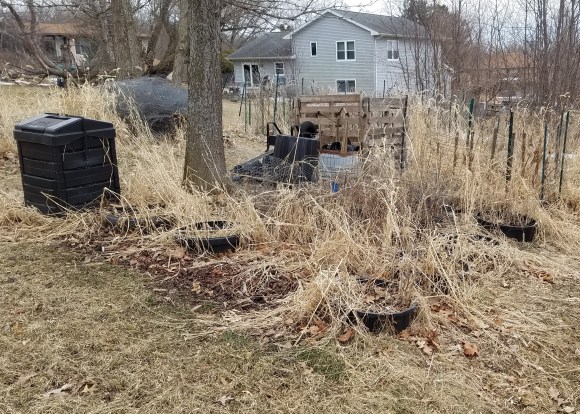
Yesterday the original plot looked a wreck with desiccated weeds and a hodge-podge of sunken containers, fencing, two composters, a wheel barrow, an old wash tub, six-inch pieces of drainage tile resting on a couple of pallets, and a locust tree. The locust tree was intended for transplant but it got away from me.
I don’t know if the locust tree will recover from last winter’s extremely cold temperatures. The tips of branches in the crown did not leaf out last spring. If it doesn’t recover I’ll take the tree out even though the shade it provides protects plants and conserves moisture during our increasingly hot, dry summers. The plot was not meant to be a permanent residence for trees.
A friend in Cedar County gave me black plastic tubs in which feed for their animals was delivered. I cut large holes in the bottom for drainage and buried them to grow potatoes, radishes, lettuce, basil and sundry root crops. Mostly it was for potatoes which when planted in the ground fed small rodents who thrive with us in the garden. The containers worked to keep them away from the roots.
Composters are necessary for a garden to turn organic matter into fertilizer. One is an open air composter made from pallets retrieved from the home, farm and auto supply store. Garden waste goes in there. The other is a sealed, black plastic container for organic household waste such as peelings, fruit cores, and other fruit and vegetable matter generated from the kitchen. That is, it used to be sealed. Over the years something got inside and has been pushing stuff out of the entry point chewed into the plastic. I should fix or replace it. Until I do it remains a place to dump the kitchen compost bucket and produces some usable compost. The next time I move it there will be compost.
If I had a garden shed I would not use the plot for storage. I continue to think about building a shed, but that’s as far as it has gotten. It won’t be this year, or probably next.
Despite all the useful clutter, the plot continues to be productive. Last year I grew broccoli, eggplant, radishes, basil and beets there. The year before I grew cucumbers. The containers are always busy with multiple crops each year. As I plan this year’s garden I see better utilization of this plot.
Ideas about 2020 in plot #1: Belgian lettuce on or about March 2; potatoes in containers on Good Friday; radishes in a container; a crop of something, cucumbers, eggplant, or maybe hot peppers to change from cruciferous vegetables planted here last year. These are ideas, and the beginning of planning. We’ll see how it unfolds, although Belgian lettuce seems certain a week ahead of the date.
I remember digging this plot in 1994, measuring the distance from the property line, a memory of nothing growing in the yard except grasses and a mulberry tree in the Northeast corner. I barely knew how to garden then. In the interim, my views of how to garden have changed for the better.
Based on the 15-day weather forecast, winter is finished. As temperatures climb and the remaining snow melts we had just better accept it we won’t have had much of a winter. It is time to lean into the growing season as soon as Mother Natures enables us. Soon it will be Spring.
I planted leeks in soil blocks at home today. They were,
King Richard, Johnny’s Selected Seeds, 75 days. One row of ten.
Megaton, Johnny’s Selected Seeds, 90 days. Three rows of ten.
American Flag, Ferry-Morse, 150 days. One row of ten.
This is a further experiment in starting plants at home. In the past I hadn’t paid attention to different leek growing times but American Flag is double that of King Richard. I double seeded King Richard and American Flag because they are from previous seasons. If both seeds sprout in each cell I’ll thin them.
Pulling plastic at Wild Woods Farm, Feb. 23, 2020.
Sunday a group of us gathered at Wild Woods Farm to pull plastic over the new greenhouse.
Pulling plastic takes a couple of experienced team leaders and a crew that can follow directions. The idea is to make the plastic covering as taught as possible then secure it with wiggle wire for years of use. The work proceeded as planned on a warm, clear and calm day.
It’s pruning time for grape vines, fruit trees, and any kind of tree. This weekend people were pruning in t-shirts because it was so warm. The concern is sap begins to flow before the cuts heal, creating an entry point for disease. Fingers crossed I got mine pruned in time. Folks are preparing to tap maple tree sap for syrup so we are at the in between time for finishing pruning.
My onions and shallots have sprouted and I moved them to the landing to get more light. They seem feeble at this stage. I’m not sure what else I can do but make sure they have moisture and light. This is the second year I tried starting them myself. The first didn’t produce usable onion sets. This year’s experiment is for the crew at Sundog Farm to start some of my shallot seeds as well to compare results. Eventually I’ll get this right, hopefully this year.
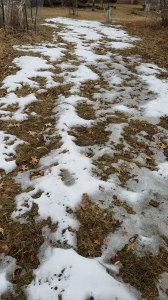
While garden and yard work beckons it is still winter. Piles of snow remain on the ground. Snow is forecast this week. There is hope for spring, but it is a false hope. It’s best to use the time to catch up on indoors work so when true spring arrives we are ready.




 Journey Home
You must be logged in to post a comment.