Estimates of how long the coronavirus pandemic will last vary from a couple of weeks to several months. The best guess is we’ll have a better idea once the number of contagious incidents reaches its peak.
Two and a half months after the virus emerged in China the government is beginning to lift the draconian measures implemented in its wake. Public health officials there remain vigilant for a second or third wave of the disease. The pandemic is not over.
In the U.S. we continue to be on the upward slope of the curve, and in our county the case count ticks upward with no indication we have peaked. News media explain we are a week to ten days behind Italy as the viral course continues to develop.
A friend in town displayed symptoms and was tested. He waits for the test results at home in self-quarantine and shut down public access to his place of business for two weeks. The pandemic is pretty close to home and we are just getting started.
The continued shortage of testing obfuscates the path of the vector. If we were testing more, one believes there would be more reported cases. We aren’t so we don’t know.
Given the expectation of a several month pandemic it’s hard to decide what to do about work at the home, farm and auto supply store. They are okay with people taking off work for any illness, but at some point they will need me to show up. They don’t seem aware of the idea that employees might be infected by going to work. They’ve had no discussion about closing the retail store and for the time being, I want to keep the job. I’ll probably go in today after calling off yesterday, and try to maintain a distance from co-workers and customers. We’ll see how that goes.
I don’t know if the coronavirus will be personally life-changing. My outlook is we can avoid infection, although I’m not sure how I came to that conclusion. It’s likely positive thinking of which the coronavirus is unaware. During my sick day yesterday I considered whether this pandemic would precipitate changes that are coming in my life anyway: leaving the regular job, staying home more, and conserving our income. As it runs its course I’ll consider that more. For now we’re sustaining our lives in a pandemic-stricken world and doing our best to survive and thrive.
Remarks delivered on a community panel
“Citizen Involvement in Local Government.”
Community Leadership Program
City Hall, Coralville, Iowa.
December 9, 2011
I believe a person makes a choice in life, to be part of society and influence what the future will be, or to be a citizen centered on making our way in a challenging world, protecting what we have, and nurturing the advantages of living in the United States. While not mutually exclusive, each can be a lifetime of hard work.
In 2004, after helping manage our rural public water and wastewater systems for almost ten years, I sought additional engagement in society and applied to the county supervisors for appointment to the board of health. Without reservation, and in every respect, my service on the board was good for me personally and I hope it contributed to society.
So what did we do? Besides the regular board meetings, there were other commitments. I tried to consider our life in society from a public health perspective, and work toward doing things that made sense while complying with a host of rules and regulations.
The board of health has oversight of the public health department and the meetings could easily be filled with tasks required by government such as approving the department budget, writing policy and other administrative work. We did do a lot of that while I was on the board.
But there were other things not written in the black and white of legal code. We made a decision about an indigent suspected of having tuberculosis, trying to respect his rights as a citizen, while protecting the public from a contagious disease. When the health department closed a restaurant near where I live, I listened when the owner called me at home and explained the financial strain our action created and the injustice he felt. During an in service day, I found myself responding to an outbreak of norovirus and spent the better part of a day speaking to parents about what their children had for lunch the previous day. All of this work was engaging.
It is hard to list any disadvantages about being on the board of health. When we sign up, there is an understanding that there will be both good and bad things along the way. In a way, it was all good.
I found three things particularly rewarding while I served on the board of health. First, there was the self-fulfilling feeling that I was giving something tangible back to our community. Second, the board provided a vehicle to study and present information about issues that impacted people’s lives. For example, I spoke about arsenic contamination in county water and about the Silurian aquifer. What was best was getting to know people in the community in a way I couldn’t have predicted. A sense of engagement in society was a significant benefit, one that keeps giving and for which I will always be grateful.
It was a mild winter so I expected they would. The actuality of it is what we crave.
The rows were mulched in autumn, although they could use more. Next time I head into town I’ll pick up a couple of bales of straw. I don’t know when that will be.
In the early morning of a normal work day I weighed whether to work my shift. The managers at the home, farm and auto supply store are the main reason I’m still there. They treat me fairly and have been flexible with my schedule. As coronavirus spreads in our county I don’t want to be exposed. In the morning huddle last week the store manager echoed the guidance of the Iowa Department of Public Health in saying if I’m sick, I shouldn’t go to work. Except for a couple of sneezes this morning, I’m not that sick. There’s more to it than that.
I’m more worried about exposure to coronavirus in a public place than in spreading my germs. My age puts me in an at-risk group to contract COVID-19. Likewise, I’m fighting diabetes with which I was diagnosed last year — another risk group. Most deaths from COVID-19 are in people over age 60. No one in my family is encouraging me to work my shift. At this point I was waiting for the early crew to arrive at the store so I can call off.
During this pandemic it’s hard to know what to do. The number of cases statewide is low at 29 as of yesterday. Of those, 18 are in our county. The number could quickly escalate, so the CDC guidance to stay home if we can makes sense for the 15 day recommended period.
The federal government is flailing. They throw hundreds of millions of dollar proposals around like we have it. The current national debt is over $23,475,000,000 with a budget deficit over a trillion dollars. We’ll have to borrow the money, most likely from China. All the jiggering of the economy seems likely to put money in the hands of people who need it least rather than address the pandemic.
As my garlic grows the tumult of national discourse seems remote. I don’t want to die from coronavirus and am doing my best to manage the risks. When I was at Fort Benning a radio station in Alabama would to play a Merle Haggard song in the wee hours of morning. It explains how I feel as well as anything:
I’m only human. I’m just a man.
Help me to believe in what I could be and all that I am.
Show me the stairway that I have to climb.
Lord for my sake, teach me to take, one day at a time.
One day at a time, sweet Jesus, that’s all I’m asking from you.
Give me the strength to do everyday what I have to do.
Yesterday’s gone, sweet Jesus, and tomorrow may never be mine,
So for my sake, teach me to take one day at a time.
A foundational aspect of our lives in Big Grove Township is reliance on others when it comes to food. We use the international supply chain which brings items closer to home so we can buy them at the grocery store.
At the same time, we spend 24 percent of our food dollars on products where we know the face of the farmer. That’s a lot more than most families and it results in a pantry full of staples like potatoes, onions, carrots, canned tomatoes, frozen vegetables, pickles and apple products.
Our regular habits prepare us for a month of quarantine without the coronavirus pandemic. We’d suffer for lack of milk and eggs, yet in a global society where millions go hungry each night, it’s more inconvenience than any kind of deprivation. We’ll get by.
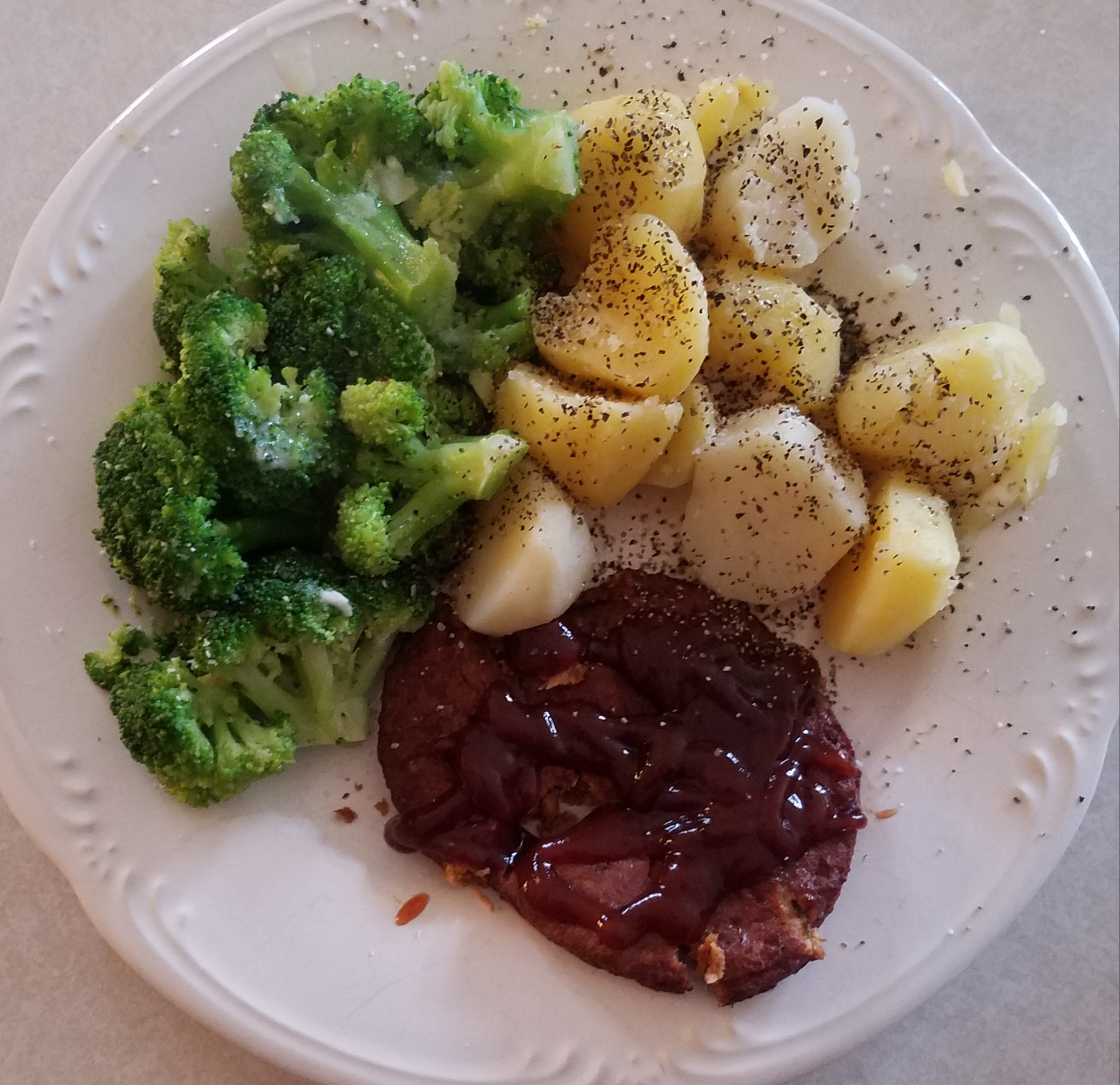
The meal in the photo is our home food story. One third Farmer Kate’s potatoes, one third frozen organic broccoli from the wholesale club, and one third a commercial, mass produced soybean burger from the grocery store. The garden broccoli crop wasn’t so good last year and we’ve depleted the freezer of our own. That’s where the food supply chain comes in handy.
I don’t know if I’ll venture to work at the home, farm and auto supply store tomorrow. After the management team arrives later this morning I’ll phone in and see what protections they offer employees. I work in the warehouse and am isolated from most customer contact. All the same, retail is a people-contact job and there is more risk there than in staying home. If I choose to stay home, there will be no compensation.
I’d feel better about the isolation if it were warm enough to work in the yard. Yesterday morning patches of snow remained on the ground. It should melt today as ambient temperatures are expected in the mid-forties this afternoon. Instead of working outside, I read and wrote in the usual places. About 5 p.m. I started peeling potatoes and making dinner. It wasn’t much, but will sustain us as we ride out the coronavirus pandemic over the coming weeks.
By last Friday traffic in bars, coffee shops and restaurants had slowed considerably. It was hard to determine whether it was because of the coronavirus, spring break at the university, or something else.
It made being a guest at the establishments a positive experience with little perceived danger of the virus being transmitted.
Our county now has the highest number of confirmed cases of COVID-19 in the state, 14 of 18 as of this morning. The high number is attributable to a local bank trip to Egypt where returning travelers were exposed to the coronavirus and contracted COVID-19.
The parking lot was packed at a bar and grill on Friday afternoon. From the look of things, it was a popular watering hole for trades workers. When my friend and I entered, every man was seated on a stool around the U-shaped bar drinking beverages, looking at their mobile devices, and talking with neighbors. The bartender was the only woman present. The rest of the bar was empty.
We ordered drafts of Bud Light so as to fit in and chose a table away from the bar.
What speech I made with a friend was not my normal one. The one I know by rote and by heart. The theme that never changes, come what may, “Radix malorum est cupiditas.”
It’s not that the worn phrase has no currency. Many are the emails from political candidates who say we must overturn Citizen’s United, then, in direct order, request a donation. The old saw still cuts wood. This prologue has never been in abeyance or irrelevant despite the waxing and waning of political candidates and their ilk. What’s hard is to listen.
What did I hear? Murmuration among the tradesmen making sense of their lives in a pandemic they hardly acknowledged. Individuals all. Resolute. Of strict father figure families no doubt. Gathered together around the bar in between a career that requires a pickup truck and a home that remained unseen that afternoon.
When we finished our beers and left, most were still present and would be until either the happy hour ended or home beckoned. It was hard to discern, but I suspect the watering hole was the best part of many of their days. So it was for mine.
Most of the usual seeders were absent from the greenhouse as I made blocks for 3,840 seedlings. Those who did work tried to stay at least six feet away from each other, although it was hard given the confined space.
“You may be the vector,” I said to one.
“No, you are the vector,” they replied.
It was in fun, but a serious note rang heavy in the atmosphere. None of us wants to die from the coronavirus.
I worked mostly alone as the farmers tended sheep in the barn. There are now 45 lambs and they are not ready to be outside all the time. Before she left I reviewed my planting plan with the farmer, made adjustments, and planted the following for my garden:
I noticed the kale and broccoli planted March 1 germinated with a high rate. Some of the seeds planted last week have already sprouted, although it will take celery a couple weeks.
19,920 seedling blocks made during the first five weeks. The crew will begin transplanting to the high tunnel maybe this week.
Los Agaves Mexican Grill, Iowa City, Iowa at lunch time on Friday, March 13, 2020.
When it comes to “social distancing” Iowans know what to do. We tweak our normal behavior. Many of us are not socially close by nature so it’s not a big step.
Epidemiologists are using the term “social distancing” to refer to a conscious effort to reduce close contact between people and hopefully slow community transmission and spread of the coronavirus.
A grade school friend and I met in the county seat on Friday. His nonagenarian mother lives in an assisted care facility which was quarantined after he arrived in Iowa to visit her. He spoke to her on the phone, but couldn’t pay an in-person visit.
It was a tweak.
More tweaks are coming.
Last night Governor Kim Reynolds’ office issued a press release which said, “The Iowa Department of Public Health has determined, based on the new COVID-19 case and the announcement this evening of community spread in Omaha, Neb., there is now community spread in our state.”
The release continued to explain:
Community spread occurs when individuals have been infected with the virus in an area and cannot specifically identify the source of the infection, or do not know how or where they became infected.
Due to the detection of community spread, there are new recommendations for individuals with underlying conditions, and all Iowans should be prepared for cancellations and disruptions in routine activities.
Mitigation measures should be implemented immediately to have the most significant impact on slowing the spread of the virus.
Leaders of institutions and organizers of events should begin to act on their contingency plans related to large gatherings, including church services. Iowans should not hold or attend large gatherings of more than 250 people, and consider making adjustments for smaller gatherings with high risk groups.
It appears the governor is following Centers for Disease Control and Prevention guidelines which include monitoring the progress of community spread and under certain conditions, making recommendations for social behavior. For now, school can continue, but not church where there are large congregations.
There is a political aspect to the coronavirus pandemic and it appears our state is taking reasonable actions if the federal government is lacking in its response. Regular communication and compliance with CDC guidelines should reflect positively on Reynold’s handling of the global pandemic’s mitigation in Iowa. As a former six-year member of our county board of health I don’t see a benefit to criticizing the governor as the state works to understand the progress of the disease and take appropriate action.
For our small family, it doesn’t take much to be socially distant. Yesterday I decided not to attend a legislative forum 10 miles from our home. I went to town to mail a package. On the way home I stopped at the pharmacy to see if I could buy a bottle of 90 percent isopropyl alcohol. They we sold out of all alcohol and sanitizing items. We’ll make do with what we have. Today I’ll go to the farm for our weekly seeding session.
A late winter snow fell, covering everything except the driveway and roads, which were too warm in this meteorological spring. For a day it was still winter by the calendar and by the weather.
There is never a problem staying busy at home. I completed the U.S. Census on my mobile device after reading in social media our state senator did his. It took ten minutes even after I had to re-do it. Between reading, writing, cooking, laundry, and preparing for planting, there was plenty to do. I put some bird seed out on the front door landing but they hadn’t found it by sunrise this morning.
While we were isolated, it didn’t feel that way. Iowans are used to working in isolation and with modern communications it is easy to stay in contact with friends and neighbors.
The news about the coronavirus from Europe, the Middle East and China is pretty startling. We really don’t know how many people are infected, although public health officials seem to be tracking the number of deaths.
Estimates of the impact of the 1918 influenza pandemic range widely yet are relevant. Global population was between 1.8 and 1.9 billion people at the time. The estimated number of deaths ranges between 17 and 50 million, maybe more. In the United States, the death rate was between 0.48 to 0.64 percent of the population or toward 650,000 deaths at the high end.
If we use the lower number in the range (0.48 percent) to determine how many deaths the 1918 pandemic would cause in the 2020 U.S. population, it would be more than 15.8 million. We are nowhere near that and likely to see only a fraction of that number with coronavirus. There is a modernity today that didn’t exist in 1918, with advanced public health and research organizations, better communications, and a resulting ability to coordinate between government and non-governmental agencies.
The phenomenon of social distancing looks to create a positive result. People will die of Covid-19 and the loss will hurt families. It will hurt us all. At the local level, we do our best to understand the pandemic and live our lives accordingly. We not freaking out. We are learning.
We’re sustaining our lives in a turbulent world that’s becoming infected by coronavirus. This may not be the last pandemic in my lifetime, so I hope we learn from it.
Because of the coronavirus, people are stocking up on food and sundries in case they are quarantined. Local retail business is up compared to last year. The wholesale club has been rationing specific items.
The retail outlet where I work twice a week has a large table in the employee break room where we pass the time talking, looking at our mobile devices or yesterday’s newspaper, and eating snacks and lunches. The consensus among this group of employed yet low-wage workers was we could survive a month or more of quarantine without stocking up. It’s how we do.
When my uncle died, Mother found a large number of one-pound boxes of dried pasta in his pantry. A person is in the store, it’s cheap, so why not pick up a package? Years of accumulation like that reflects a certain type of affluence. For those of us with a stable home life the amounts build up. A person has to work at it to use up the pantry and freezer. It’s a form of food security.
If we were quarantined and had no access to new food, the first thing to go would be dairy products. Fresh milk and eggs would be most missed, although cheese and butter would not make it a month. This discussion is hypothetical since there is an ability to receive home-delivery of most grocery items in our community. My next door neighbor owns the grocery store in town so I’m not worried about running out of food if quarantined.
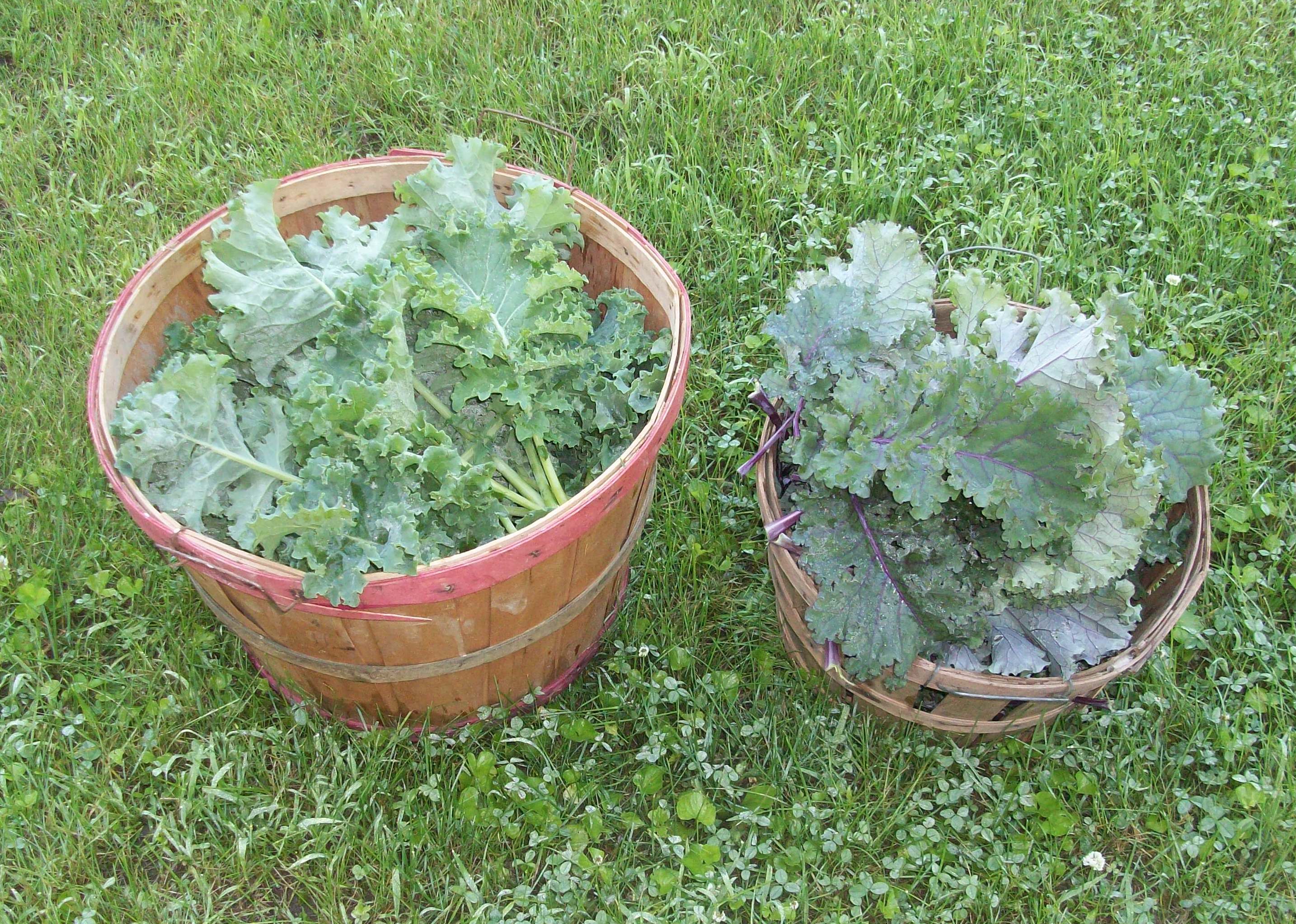
We have plenty of fresh onions, canned tomatoes, dried basil and olive oil to make it through a month of pasta dishes. There is plenty of applesauce and pickles. We have enough apple butter to last more than a year. Kale? there is plenty in the freezer along with other frozen vegetables from the garden.
We’d test how far ten pounds of flour goes. We’d see if the yeast in the ice box is still active. If the yeast isn’t active, there would be biscuits and corn bread made with baking powder as leavening. There would be a big batch of soup made from celery, carrots, onions and potatoes. We have five cases of prepared beans, a large bag of garbanzo beans, and plenty of rice. The freezer has frozen raspberries, aronia berries and blueberries. We’d find out what we have.
As indicated above, this is theoretical as the community would support us on quarantine. As we settle into a weekend spent mostly at home we have no worries about food security. Sustaining our lives on the Iowa prairie is what we do.
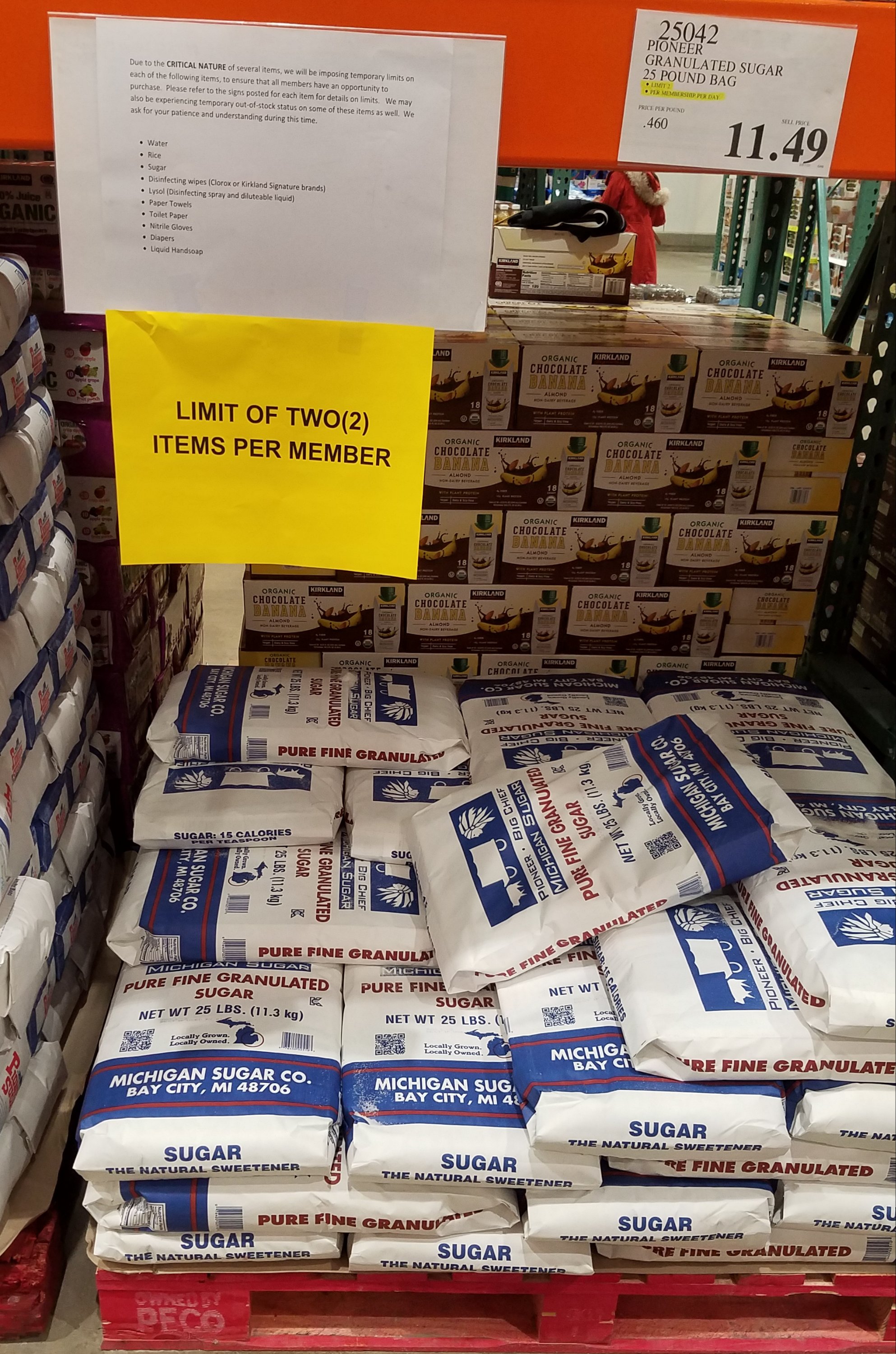
Sugar rationing at Costco Wholesale, Coralville, Iowa, March 11, 2020.
We have a Costco Wholesale Club near the home, farm and auto supply store where I work two days per week.
Wednesday is my day to pick up provisions there on the way home after work. Costco sells a lot of what we use in our kitchen but especially organic frozen vegetables, milk, butter, cheese, eggs, jarred olives, tomato paste, prepared black beans, raw tortillas, flour, sugar and the like. They are a good fit for our semi-veg cuisine and we like the USDA Organic shield on much of what we buy.
Costco was rationing provisions yesterday because of the coronavirus. Rationed items included water, rice, sugar, diapers, paper towels, toilet paper, disinfecting wipes, nitrile gloves and liquid handsoap.
While waiting in the checkout line, the woman behind me commented that I had no water or toilet paper in my cart, referring to a common social media meme about “Costco panic buying.” I replied we manage our own well so we don’t buy bottled water. The person in front of me asked the cashier if this would be a record sales day for the store. The cashier replied decidedly not. One has to wonder if those rationing signs on certain items increase sales more than the social phenomenon of “panic buying.”
A crew inside the entry offered to wipe down carts with hand sanitizer. A few members wore the kind of masks I keep in the garage to prevent breathing sawdust. More than anywhere else I go, Costco is a petri dish of international human interaction, mostly because of the nearby university hospitals and clinics. I declined the sanitizer and kept a comfortable social distance from fellow shoppers. If I die of COVID-19 you’ll know it was a bad call.
News this morning is the president twiddled his thumbs while addressing the pandemic to the nation from the Oval Office last night. Pandemic response seems outside his wheelhouse. The World Health Organization identified the coronavirus as a pandemic about the same time the president was preparing his speech. Also in that time window, actor Tom Hanks and his spouse were diagnosed with COVID-19 in Australia. At least the rich and famous can get a test kit and have results reported.
At the end of the day it was a regular experience, one among many. Our best chance to survive is to listen to health professionals and work to follow their guidance. That can be done. It’s all part of sustaining a life in a turbulent world.
The surface of the ground crunched as I walked the compost bucket out to the bin. The ground was frozen.
Grass has been greening up with the recent rain and ambient temperatures above 70 degrees. The frosty morning wasn’t a permanent setback as green grass was visible through the glaze of frozen rain.
Farmers have produced first batches of maple syrup, so it’s undeniable spring is close by. This in-between time on the margin of winter is unsettling. I want to get going on the garden… but not yet.
The sound of bird songs returned. Voices of children playing outdoors are evident. The trickle of water in the downspout informs us of the spring melt, that despite crunching under my boots it won’t be long.






 Journey Home
You must be logged in to post a comment.