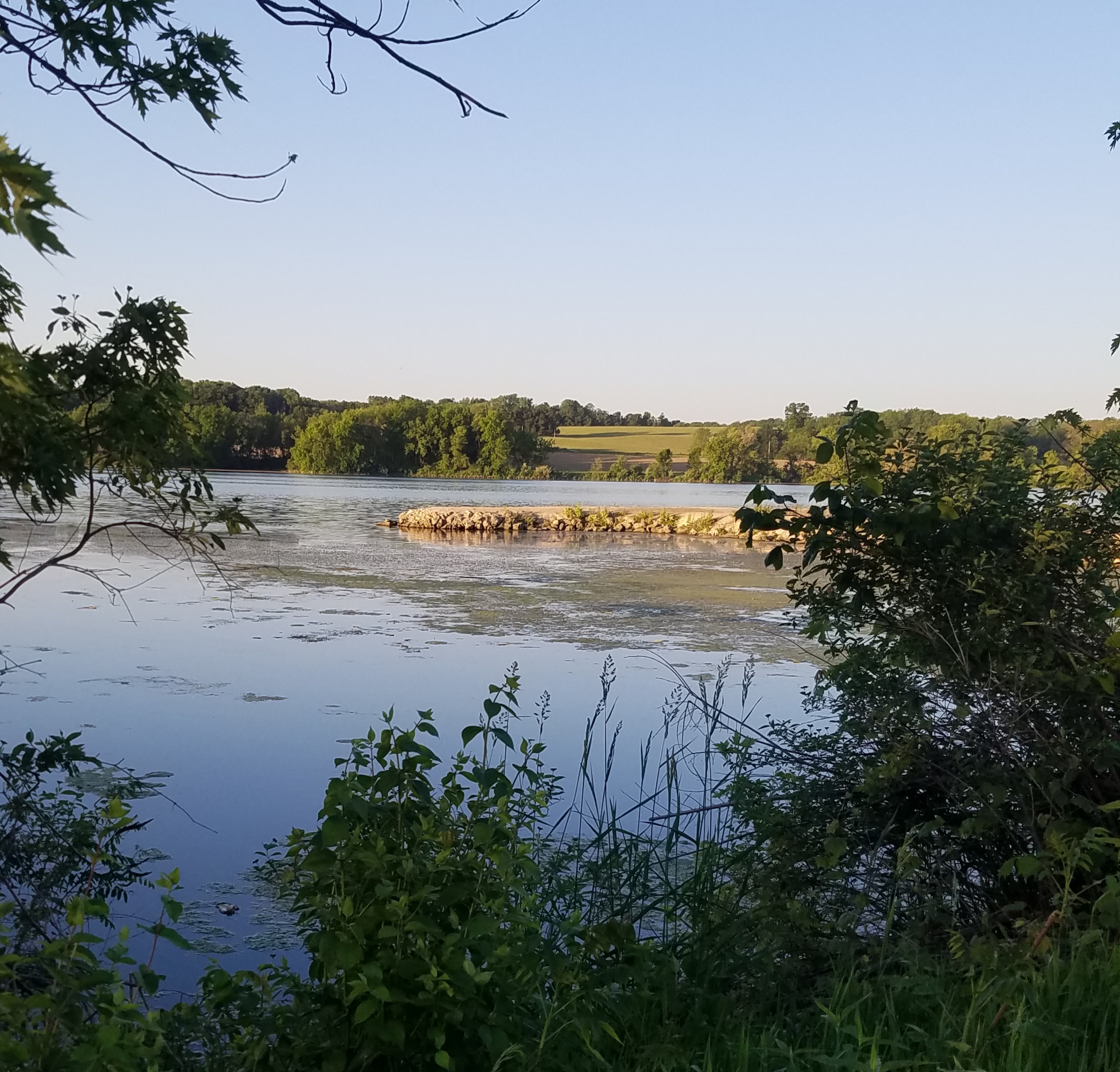
Lake Macbride from the North Shore Trail, May 27, 2023
Morning light illuminated this peninsula on Lake Macbride during my walk. One never knows how a multi-function mobile device will capture a photograph. I’m pleased with the results of this one.
The hard part is breaking away from preoccupations on a trail walk, to be aware of our surroundings enough to notice how light falls on the landscape. The results can be liberating. If the image comes out well, it’s a bonus. Increasingly, I seek the light on excursions off property.
Five of seven garden plots are planted, meaning I am running behind. Reasons have to do with weather, and with the pace at which I work. A five or six-hour shift with breaks every hour is what I can muster. Progress is steady, yet slow. Gardening is a tolerant activity and whatever one can do is better than the alternative. I do what I can.
Already there is a harvest. Leafy green vegetables, lettuce, spring onions, radishes, and herbs. I mixed fresh greens with last year’s frozen ones to make spring vegetable broth for canning. It is time to use up the freezer to make room for the new harvest. Spring broth is always best so I noted the month on the lids.
I forgot potatoes at the wholesale store so I drove to town on Saturday. My neighbor, who owns the grocery store, was there and he thanked me for the San Marzano tomato seedlings I gave him. I had extra. The grocery store wasn’t busy. Organized locals got their Memorial Day weekend shopping done by Friday. We had a good chat about tomatoes, gardening, and people in the community. The value of the trip was no small potatoes, although I got some of those, too.
My spouse is at her sister’s home for the week, so I’m on my own. As I age, I dislike being alone. While freedom to cook how I like is a perquisite of her absence, meal preparation takes only a small part of each day.
Today is the annual firefighters breakfast in town and I plan to open it up then move on to garden and yard tasks before the ambient temperature gets too hot. If all goes well, I’ll mulch tomatoes (which means mowing the lawn), build a brush pile, and trim around the foundation of the home to prepare the spot for the new air conditioner.
The flags are up at Oakland Cemetery, signifying local veterans who died. The Memorial Day service moved to the new veterans memorial in town. I’ll stop by the cemetery on my way to breakfast and see how light falls on the graves and flags. I know many of the names. I was active with many of them when they were living. That, too is part of aging in America.
Maytag Range delivered to our kitchen on May 22, 2023.
We replaced the Kenmore range purchased in 1988 with this new Maytag model. Technicians from the small appliance dealer did a good job delivering, installing, and explaining it. More than once they referred me to manuals dropped on the counter. Although it will take time to understand the features of the range, I will attempt to live up to the promise this technology offers. I expect to prepare many future dishes using the device. The inaugural meal was black beans and rice.
A future is not always assured. I took a spell while tending the covered row of herbs and vegetables, then made a retreat indoors. I have had two conversations about such episodes with my medical practitioner. He said if they were infrequent and do not persist, there was little to be done about them. Easy for him to say. Most days spells recede behind the proscenium arch where the curtain is down more than up on my aging frame. From time to time, spells appear as players to complicate life. We are in act one of what can be expected to be five. Here’s hoping I live to denouement and a final, dignified curtain call and bow.
This is the longest I have been away from posting since I can remember. My spouse will be spending a week with her sister who is moving from a rental to a house in July. There is a lot of packing to be done. While she’s gone, I hope to finish planting the garden, organize for summer, and begin regular writing again. I hope to be done with the intense rasher of friends who died this year. Appliances died in equal numbers, yet it is not the same.
I miss my friends, appliances not so much. Appliance transitions brought discussion with banks, business owners, sales folks, delivery drivers, and technicians. It is a way to go on living whereas my dead friends and family offer little engagement for the future except in memory. As we age, we do the best we can.
On the way home from the grocer I stopped for gasoline. After fueling, I pretended I was in Thomasville, Georgia again and bought a Yoo-hoo chocolate drink and lottery ticket at the gas station. Playing the long game, I bought a Powerball ticket instead of a scratch-off. If we can’t see a future beyond the now, then we will never live a long one. Validating the statistics of lotteries, my ticket was not a winner in Monday night’s drawing. At least we have the new range and the prospect of delicious meals.
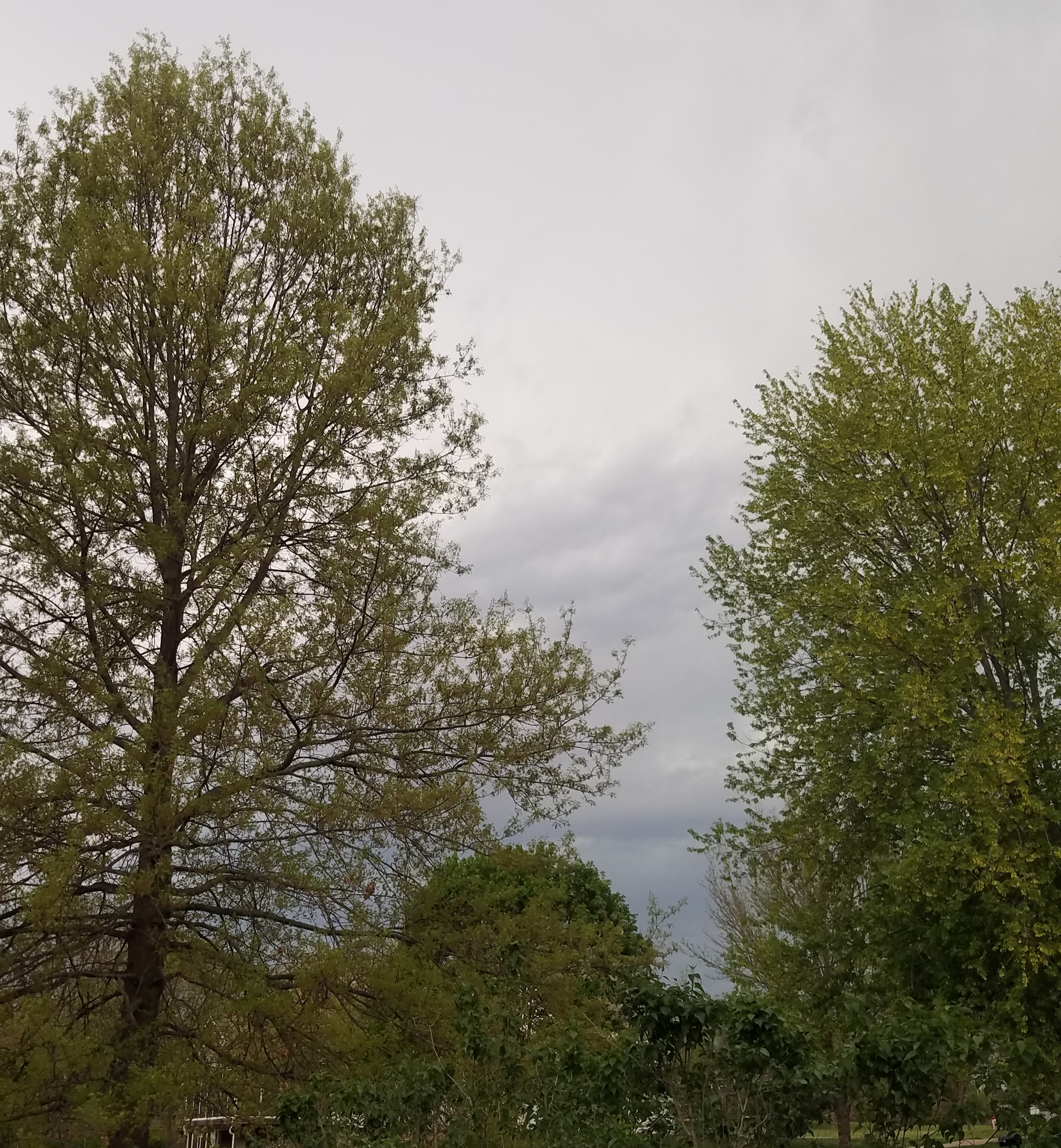
I’ve taken to opening the garage door and watching storm fronts roll in. Probably, I’m carrying baggage from the Aug. 10, 2020 derecho.
Multiple reasons have me running behind, with a short time to get the garden in by Memorial Day. I’ll be taking a break from writing to focus on spring and all. One never knows how many more springs we’ll get. I intend to enjoy this one.
Take care dear readers. Hope to see you again soon. Hope you enjoy what remains of Spring!
In 1820 most countries started out on a relatively equal economic footing. Translation: People and regions were poor around the globe.
Author Jeffrey D. Sachs described this world:
Life expectancy was extremely low; children died in vast numbers in the now rich countries as well as the poor countries. Many waves of disease and epidemics, from the Black Death of Europe to smallpox and measles, regularly washed through society and killed mass numbers of people. Episodes of hunger and extreme weather and climate fluctuations sent societies crashing.
The End of Poverty: Economic Possibilities for Our Time, by Jeffrey D. Sachs.
What changed, according to Sachs, was the onset of the Industrial Revolution. Why did this happen in Britain before China, which had been the technological world leader for a millennium? In part, British society was relatively open after the decline of serfdom, its traditions of free speech and open debate contributed to the implementation of new ideas, and Britain became one of the leading centers of Europe’s scientific revolution. “With Britain’s political openness, speculative scientific thinking was given opportunity to thrive, and the scientific advances on the Continent stimulated an explosion of scientific discovery in England,” he wrote.
The impact of these conditions of intellectual inquiry is old news. Yet today’s Americans should take note as legislatures around the country restrict tenure among university professors, ban books, control school curriculum, regulate who can use which bathroom, and remove funding from projects that contribute to understanding of our most significant problems. Lawmakers are putting a damper on open inquiry. Dumbing down and censorship do not represent a path to create the explosion of new ideas and technological innovation needed to survive and thrive in the years ahead. Who could even have imagined this might become a concern?
The deliberate destruction of knowledge is not new. Libraries and archives have been attacked since ancient times. Today, public libraries fight for their very existence as they are censored, deprived of funding, and subject to pressure from political, religious and cultural forces. Open inquiry in this context is hobbled by real constraints.
The latest hobble here in Iowa is elimination of funding for an important water quality sensor program at the IIHR Hydroscience and Engineering center at the University of Iowa’s College of Engineering. Erin Jordan of the Cedar Rapids Gazette covered the story here. “Iowa deploys about 70 sensors each year on streams and rivers across the state that measure nitrate loads and concentration so observers can tell whether water treatment plant upgrades, wetland improvements and agricultural conservation practices are working to reduce pollution,” Jordan wrote.
“Defunding progress reporting and monitoring is not the direction we should be going in our approach to nutrient pollution in Iowa,” Alicia Vasto, water program director for the Iowa Environmental Council told the Gazette. “Iowa taxpayers deserve accountability for the funding that is being spent on nutrient reduction practices.”
Hypoxia in the Gulf of Mexico, caused by nutrient runoff in Midwestern farming operations, is a problem. Closing down open inquiry into solutions to the problem is exactly the wrong direction.
We Americans are better off today than we were before the Industrial Revolution. The lesson that should be taught in schools is open inquiry into the problems of our day is as important as any curriculum item. Regretfully, my opinion may be viewed as that of just another advocate. In today’s society, the powers that be don’t want the rest of us to do too much thinking. Therein is the problem.
I’ve turned from society to soup. Not sure how I feel about that, yet the soup smells pretty darned good. The leafy green vegetables were harvested the same day, many of the vegetables were grown in the kitchen garden last season then preserved, and lentils and barley came direct from a super market. This soup made a fine dinner with five quarts leftover for the coming week and beyond.
As we age we spend more time alone. Children, if we have them, develop their own lives. In the Midwest, many of us work to age in place and the home becomes a quiet warehouse of memories and too much stuff no one needs or wants any more. To expect something different puts too much burden on our offspring. A key element of successful living after age seventy is learning to live well alone… and to let go of the possessions because you can’t take them with you.
After working a five-hour shift in the garden, I’m pretty tired for the rest of the day. Yesterday I came indoors for lunch and started the pot of soup. Most of the knife work was done before I put up the vegetables last year. All I had to do was peel potatoes and carrots, gather items from the freezer and pantry, and put everything in the pot with salt and a few bay leaves. It simmered all afternoon.
Loneliness is a normal part of aging. Because of connections formed over a lifetime, we live in a galaxy of friendship. From time-to-time we forget about our network, although we shouldn’t. When one makes so much soup, there is plenty to share.
Red Delicious and Earliblaze apple trees in bloom, May 3, 2023.
Four days into the main apple tree bloom it looks to be a banner year. No hint of frost since blossoms opened and plenty of native pollinators work the flowers. Yesterday flower petals began to fall to the ground, indicating successful pollination.
I planted these trees on Earth Day in 1995. It was a roll of the dice because a gardener never knows how they will fare in Iowa. The Red Delicious was a cultivar taken from the original one discovered in Iowa. For $18.75 each in 1995, the trees have returned many times the purchase price. They already exceeded their life expectancy of around 25 years for a semi-dwarf tree, so anything else is a bonus.
The goal this year is to put up at least 24 quarts of apple sauce, a dozen pints of apple butter, Refill the half-gallon jars of apple cider vinegar, make a couple of gallons of sweet cider, and fill the refrigerator drawer with the best of the crop for storage.
A lot can happen between now and harvest, with wind storms representing the biggest threat. The Red Delicious tree lost several major limbs, including the northern half of the tree during the Aug. 10, 2020 derecho. It is blooming today like there is no tomorrow. One never knows if that is a reaction to imminent death, or just another year. In any case, the new Zestar! and Crimson Crisp trees planted in 2020 are coming along. I might get a real crop from them this year.
Yesterday I planted the row of herbs and vegetables with row cover. From time to time, I looked up at the blooming apples trees and what they represent: another year’s spring promise.
Gordon Lightfoot passed on Monday. Early Morning Rain was on my playlist when I performed on the guitar. It is one of my favorite songs of any artist. May he rest in peace.
Should a person be sensible and find a job, or follow their passions? This is a false choice, although one many feel compelled to make. I’m not sure those two options often exist concurrently.
My insight into this choice may be the result of getting a new eyeglasses prescription filled. On Friday they were ready at the warehouse club, the first prescription I filled since before the pandemic. I can see clearly now and it’s a revelation. Well, no. That’s not it. Maybe it’s something else.
At our tenth high school class reunion in 1980, I described myself as a writer. Here’s the entire passage from the booklet the organizing committee issued:
Paul lives in Iowa City and attended U of I, BA 1974, and the United States Army Infantry School. He is a writer. He is also a First Lieutenant in the U.S. Army Reserves. M.A. candidate in American Studies at U of I.
Unpublished journal, Summer 1980.
It was out there. I was a writer. Decision made! Not so fast!!
One of the last nights I spent in Davenport in 1980 was with two friends at a bar called The Mad Hatter. We walked to the Palmer Student Union where another friend was performing with his guitar. We had a discussion about how a person had to give up her artwork after taking a job at John Deere. She was tired after work, raising a child, and found little time or desire to make art. I knew if I took a full time job after graduate school I might find myself in the same situation. I had just declared myself to be a writer! I decided to stick it out at least until I finished graduate school.
I had enough money saved to pay for graduate school with help from the G.I. Bill. After graduation I wanted to remain in Iowa City, so I got an apartment and found a low-level job without benefits working for the university. One thing led to another and I met someone, got married, and together decided we needed more money to afford a house and everything else involved in a long-term relationship. Things happen. I didn’t put my writing on hold.
During that first year after we married I made an earnest attempt to write the book about which I had been talking for so many years. The working title was Going Home, and I summarized it in a journal entry:
Going Home will begin with a descent from high culture – Vienna – to low culture – Davenport – á la William Carlos Williams. Then will come a rebuilding – a putting together of a new life from the pieces. A new ascent, with both feet placed firmly on the ground. So, from Vienna, to Davenport, to Iowa City, to Northeastern Iowa. Descent to the ground, but then both feet planted firmly, beginning a step at a time, making a new beginning.
Personal Journal, Iowa City, June 17, 1983.
I’m not sure today what exactly that meant. The image of “both feet planted on the ground” recurred in my journals. It would also be an argument for a common life, free from external structures. At various times, I called the book the 1969 Novel or Going Home, yet it never became much more than an idea about Iowa contrasted with Europe… or something. I made outlines and wrote passages. I made reading lists and trip itineraries. I made research notes for much of 1983.
In each section of Going Home, I want to provide the reader with two things. First, I want them to be able to relate to the personal experience from which each scene is written, enabling them to say, “I’ve been there.” Second, I want them to be able to see that the given experience functions ideologically in the novel, giving the characters some sort of influence. Too, I want the sections to teach the reader a way of life.
Personal Journal, Iowa City, Iowa, June 27, 1983.
I wrote about the book extensively in my journal without getting anything significant down on paper. I had the idea, likely from Emerson, of turning away from the courtly muses to everyday life. I did extensive reading to form a moral framework for the novel. This is all well and good, yet here’s the issue: I had no clue what it meant to be married.
It is significant that at this crossroads there was no real choice between following my passion to be a writer and doing what was sensible. In seeking to write, I sought realization of who I was regardless of any framework for living. The pent up desire to become a writer compelled me to continue to live as best I could: writing, earning money, having a family life, the whole shebang. It would have been easier if Morpheus had offered me a one-time choice between the blue and red pills.
It is important to refrain from framing life as a choice between options. This seems too simplistic. A dilemma means a choice between disagreeable alternatives, yet devising an arbitrary choice is just that: arbitrary. It would be a false choice.
While we might feel good about defining a choice and making a decision, the results seem unlikely to endure. We owe it to ourselves to accept complexity in life and deal with it outright. We can’t settle for second best when both choices are sub-optimal.
It sometimes helps to get a new pair of glasses, to see clearly, even if they are not responsible for choices we make.




 Journey Home
You must be logged in to post a comment.