Today begins a long stretch of work shifts on weekdays at the home, farm and auto supply store, and on weekends at the apple orchard — 96 days in a row.
I’m not ready but both jobs help pay bills. Work I have been doing on weekends will get shoved to weeknights and early morning. I’ve been here before. There’s nothing else to do but let go and fall into the rush.
The garden is doing reasonably well and my barter agreement will make work canning tomatoes and freezing bell peppers. Last year it was impossible to keep up with the garden and I lost more tomatoes than we harvested. With sunrise getting later, I’m also losing some of my early morning time outdoors. I’m not complaining. Just figuring out the best way to cope. The expectation is this year will be better than last.
At the end of the rush comes winter and a window for retirement. I reach full retirement age in December and my spouse reaches Medicare age in January. If we successfully negotiate these milestones, signing up for Medicare and Social Security, a financial burden will be lifted and we will be able to breathe easier for a while.
For now, it’s a rush toward familiar butunkown times. Hopefully there will be some fun and accomplishment along the way. Here we go!
The campaign to survive after a transportation career turned the bend and is heading into the home stretch.
Economic realities we face as a family continue to exist, but the effort to cope — including 12 lowly paid jobs since 2012 — will find some relief as I reach full retirement age in December and with it eligibility for Social Security benefits.
Independence Day marked the halfway point of the year and I can see the finish line from here.
What does that mean for the future? Less time worrying about how to cover each month’s bills accompanied by more and better writing.
Later this month I return to daily writing for a couple of weeks. I’ll be covering Blog for Iowa weekdays from July 17 to 28. I’ve got something different to say about politics so stay tuned.
Yesterday I made the last 62 trays of soil blocks at Sundog Farm (Local Harvest CSA) and Wild Woods Farm.
Totaling 946 trays or roughly 110,000 individual seedling soil blocks, I made more than in any previous season. Adding Wild Woods Farm this year is the reason for an increase in this specialized work.
Not only did I produce practical farm products, I learned to be a better vegetable grower by observing farm practices and talking to people about grower issues. Sunday was the last day of the season. God willing and the creek don’t rise I’ll do it again next year.
Next is some summer respite before beginning work at Wilson’s Orchard in August. The garden harvest has begun so there will be plenty of work to keep me busy on weekends.
I assumed it was the long day, split between two farms, getting tired after making 57 trays of soil blocks.
As I placed the last tray of 72 blocks on the table for cucumber seeding, I washed my tools and headed for the car. Something was up.
It took three days to winkle it out: I caught some kind of bug that kept me from working at the home, farm and auto supply store.
On Monday morning I was dizzy and nauseous. I brushed my teeth, shaved, showered and dressed, then headed to the car for the drive across Mehaffey Bridge. Just after I crossed the south arm of Lake Macbride I stopped, too nauseous to continue. I called off sick and turned around. Near the old barn north of the lake I stopped again and vomited twice. I spent most of the rest of the day sleeping. I did pick up our vegetable share at the farm — probably not my best decision.
Determined not to take a second of my five annual sick days today, I woke, got dressed and tried it again. I made it to the parking lot, went in and found my supervisor. After preliminary pleasantries told him I felt too sick to work and went home and back to bed.
In all I clocked 25 hours of sleep in a 36 hour period. As the sun moves lower in the western sky I’m on the mend. I don’t recall much about the last 48 hours.
I woke this morning about 9 a.m. just when Governor Terry Branstad’s hearing at the Senate Foreign Relations Committee was beginning. Branstad is President Trump’s nominee to become ambassador to China. The Des Moines Register live-streamed it, so I watched on my phone in bed. He looks to be a shoe-in because of his service as governor of Iowa and his long relationship (since 1985) with Chinese President Xi Jinping. I posted on Twitter, “Branstad seemed present, cognizant, schooled and mannered at his hearing today. Much different from person who nominated him.” It was a sign I was feeling better.
This week is the anniversary of President Nixon’s 1970 invasion of Cambodia and the protests that erupted around the country. At Kent State four students were killed by national guardsmen during the protests. My reaction to the news was to participate in my first-ever protest march. I carried one corner of one of four mocked up coffins to the National Guard Armory on Brady Street in Davenport. I felt participation would raise awareness about the war. When our photo appeared in the local newspaper, it confirmed my belief.
This week’s hope is that the ground will dry. The farming community is waiting for the ground to dry to begin planting. After a Rip Van Winkle style nap, what I winkle out is the need to focus on today because we never know what tomorrow will bring or what may disable us.
After a Saint Patrick’s Day meetup with friends in Iowa City I drove home, parked my car in the garage and haven’t moved it since.
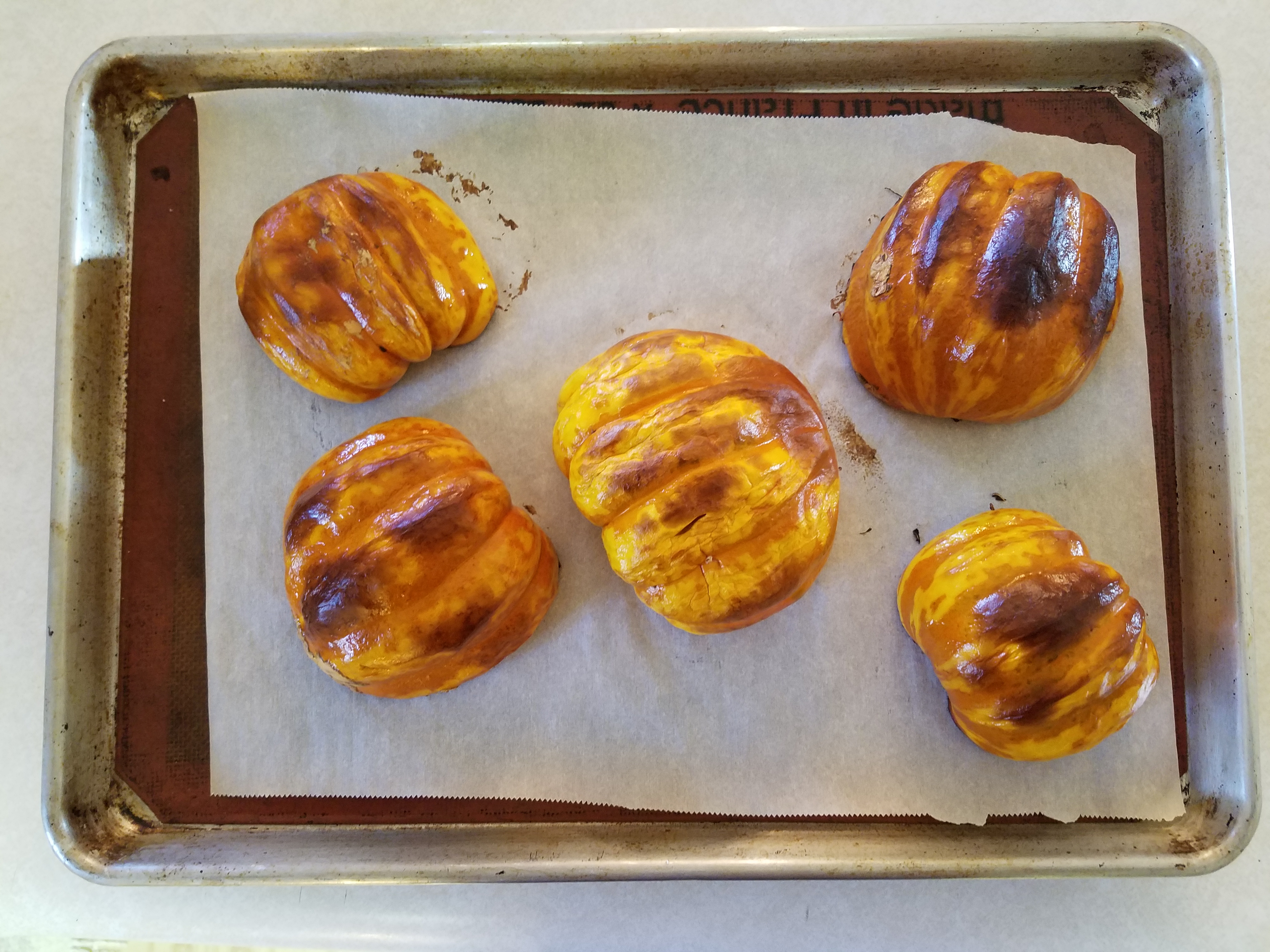
It was too cold for outside work on Saturday so I stayed in, did laundry, cleaned the bird feeder, wrote, read, and cooked dinner of bean soup, Carnival squash and applesauce cake.
The ambient temperature is expected to rise to almost 60 degrees, so I’m planning to work outside after a shift of soil blocking at a community supported agriculture farm.
I read Elizabeth Kolbert’s The Sixth Extinction: An Unnatural History in its entirety this weekend. Her combination of background information with personal stories of field trips is eminently readable. I can’t remember a day so absorbed in a book since leaving transportation. The main takeaway is how uncertain scientists are about changes in earth history over the long term and the consequences of our lifestyle.
Japanese Beetles
The broader meaning of words like “Anthropocene” is not settled, nor agreed. What I know after this immersion, and after reading Sapiens: A Brief History of Humankind by Yuval Noah Haran, I am ready to move forward with something other than narratives of how homo sapiens swarmed over the planet like Japanese beetles.
I buy more bird feed since working at the home, farm and auto supply store. Counting whole kernel corn, I have five different varieties in the garage. Each type attracts a different bird and we enjoy watching them through the French door off the dining area. Some days I feel like picking up a 20-pound bag on sale, and do. I went overboard with 50-pound bags of whole corn and millet, although sparrows seem to really like the millet. There is no science to my purchases.
Bartering is making this year’s garden planning a lot different. Part of the barter system is trading labor for a spring and fall share. Each side of the deal can be defined monetarily. I get a credit of $13 per hour for labor which is applied to retail price of the shares. I use greenhouse space and materials to germinate seeds and care for seedlings until planting in my garden. I will also acquire onion sets and seed garlic through the farms. Where there is a clear financial value, the barter system is simple and easy. This part of the exchange translates into things we can use in our garden or kitchen.
The exchange for specific produce is more complicated.
Canned Tomatoes
Tomatoes are a large part of summer. Last year I planted them in three different garden plots. This year I’ll decrease my plantings to what we’ll use fresh and rely on the farms for canning tomatoes. In 2013 the farmer provided crates of tomatoes which I canned. We split the canned goods 50-50 that year. That was a bit disadvantageous to me considering the amount of work. We haven’t finalized the split, but both farms I work on produce many more tomatoes than needed for their members. One farmer wants lots of canned tomatoes. Something can be worked out.
Bell peppers were a garden failure last year and for many previous years. I’m eliminating them completely. The farms produce bell peppers with a high frequency of imperfect fruit. I plan to trade labor for these seconds and get all of my bell peppers from them. In addition to fresh eating, I seed and freeze them to use throughout the year. We did a 50-50 split on these in 2013, however, this year I’m considering a straight trade of labor hours against a to be determined cost per crate.
There are a number of items we don’t use much in our kitchen but are abundant on the farms. I don’t plan to grow any kohlrabi or cabbage. Should be no problem getting what we need without occupying space in our garden. I’ll barter for some additional broccoli for freezing.
Likewise, I don’t plan to grow lettuce outside my small plot of Belgian lettuce. In between the spring and fall shares that’s coming from bartering.
Summer squash is abundant and available from the farms as are many kinds of greens: collards, chard and “braising greens.” I will grow my own kale and spinach, and everything else will be bartered from the farms.
Eggplant? If Johnny’s Selected Seeds proofs and sends Black Beauty seeds I’ll plant them along with Fairy Tale eggplant. The former can be sliced thick, baked and frozen. The latter are good for the kitchen while in season. There is always an abundance of eggplant at the farms.
Yesterday was the last winter Saturday of staying indoors. Going into the planting season it will also be my day off from the home, farm and auto supply store and the farms. Yesterday was a good day, made better by a feeling of accomplishment. As humans we sometimes need that.
Kansas Wildfire March 2017 Photo Credit: Travis Morisse/The Hutchinson News via AP
Yesterday I loaded pallets of fence posts, barbed wire and bottled water on a trailer pulled by two farmers in a pickup truck.
They were bound for Kansas where wildfires fed by wind gusting at 70 m.p.h. burned 650,000 acres and killed thousands of cattle during calving season.
Tens of thousands of miles of fence need to be replaced. The home, farm and auto supply store where I work donated the items for Kansas ranchers in the aftermath of this month’s record-setting wildfires.
Farmers and ranchers re-earned the state its motto, Ad Astra Per Aspera (To the Stars Through Difficulty).
“We had the perfect storm,” Todd Domer of the Kansas Livestock Association said to CNN. “We had a wet summer and then kind of a dry winter and then you get wind on top of that and then anything that’s flammable will spark.”
The Kansas plains had become a tinderbox.
“It looks like the moonscape,” Domer said. “It just looks like a big sand beach that’s endless.”
I hope our small Iowa contribution will help ranchers recover from the worst wildfires in Kansas history.
My first work day at Local Harvest CSA, was spent organizing for the season and soil blocking for the first seedlings.
I made two trays for myself as part of the barter deal with the farmer.
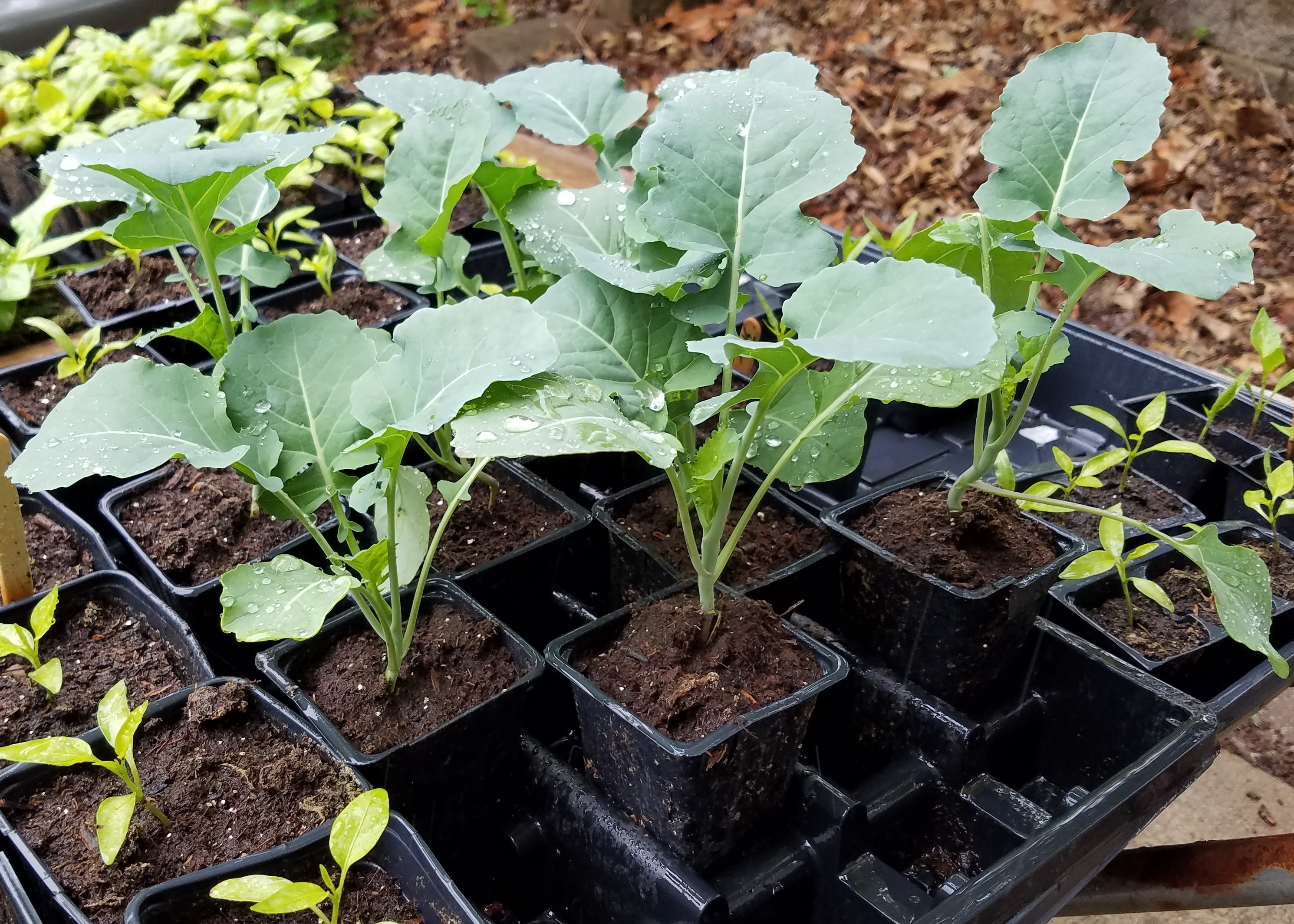
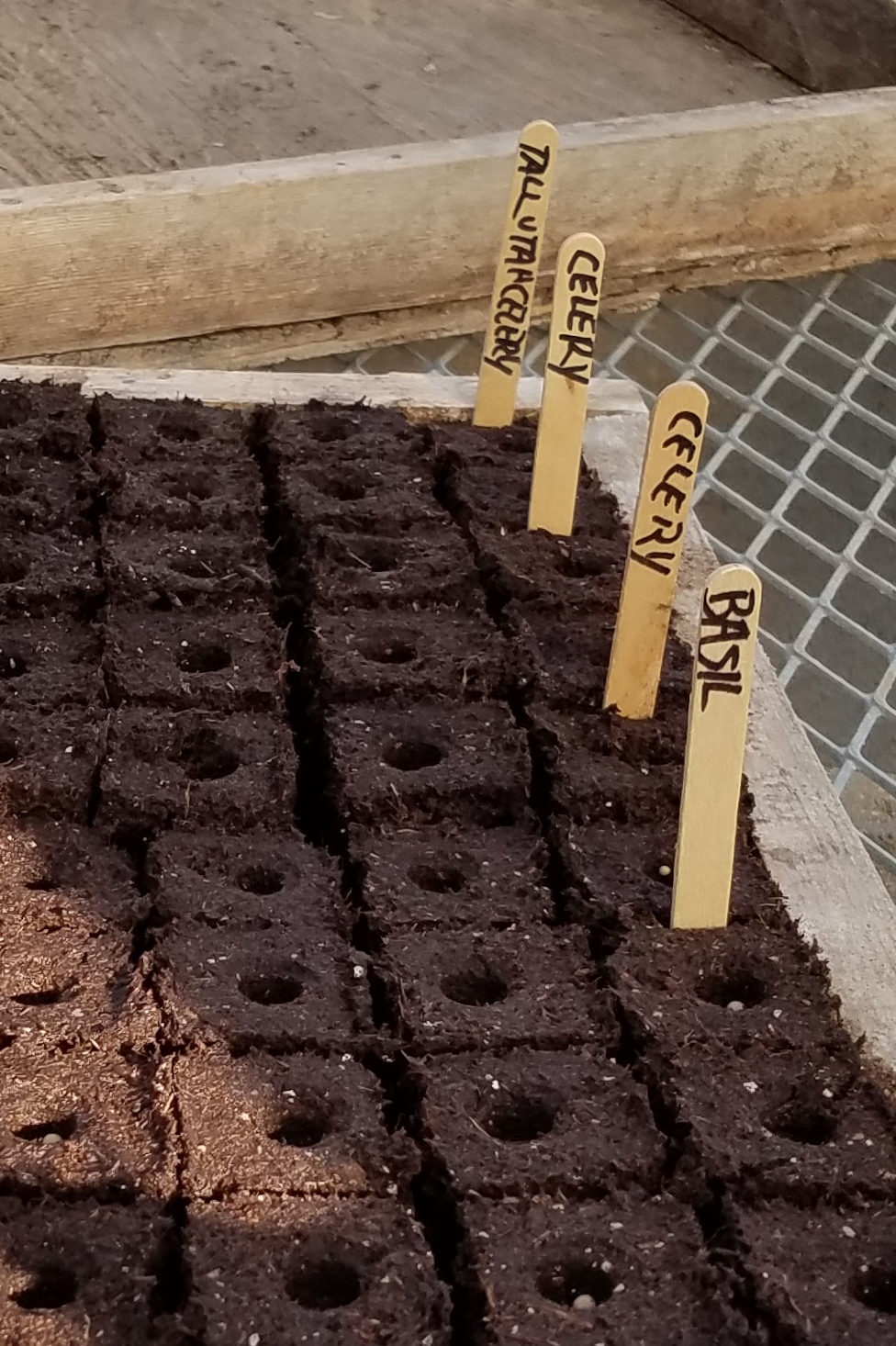
In one I seeded basil, Conquistador celery and Tall Utah celery. In the other was four kinds of kale: Dwarf Vates Blue Curled Scotch, Scarlet, Darkibor and Starbor. The growing season is here.
Basil and Celery
We never know the outcome of gardening. Tall Utah celery seeds are very small. It was difficult to get only one or two into each dibbled cell — I didn’t. I bought them on special from the Seed Savers Exchange in Decorah, Iowa where they don’t pellet seeds. Like with so much about gardening it is another experiment to see what grows well and tastes delicious. The pelleted Conquistador celery seeds from Johnny’s Selected Seeds in Winslow, Maine were easier to plant. A controlled germination house environment should encourage the best from these seeds. We’ll see how it goes.
3,120 Soil Blocks
Soil blocking is endemic to Community Supported Agriculture projects. Like much of our work, it is done by hand. Getting the moisture content of the soil mix right is a constant challenge. It is dry as it comes out of the bag into a tub. Watering is done in stages, testing the moisture content after each round of turning with a transfer shovel. Moisture management continues as the soil blocks are made. The pressure of the soil block tool squeezes moisture from the mixture as the blocks are made. It makes the soil mix wetter. It took 3.83 hours to get organized and produce the first batch of trays. As the season progresses, I’ll get faster.
The farmer went to town to get some supplies for the germination shed leaving me alone with two dogs and partly cloudy skies. I took a moment to breathe the fresh air and look at the sky. Hope springs from days like this. New hope for a successful season.
The month since the inauguration of our 45th president was characterized by sleepless nights, stress and constant weariness.
It’s not sustainable.
With that in mind, I’m planning to reduce the political content on this blog and focus on other, equally important issues.
How do we grow food as global temperatures steadily, predictably increase? What kinds of work will sustain us and contribute to a greater good? How can we contribute to peaceful coexistence in an increasingly torn society?
I don’t know the answers, and these topics are each political in a sense. I expect to write about them and more as I make the final workingman’s lap while eyeing hope beyond the finish line.
I’ll continue to write pieces for publication in friendly blogs and local newspapers and re-post them here… and letters, like this one to state representative Bobby Kaufmann prior to the Iowa legislature’s voting to reform Iowa’s collective bargaining laws this week. Friends said I was too polite, but unlike this bill, soon to be law, that’s no crime.
Bobby,
Every teacher I know is upset about this bill and the uncertainty of it. That includes a teacher in HD73 who doesn’t belong to the union and who voted for Trump because of his position on abortion. As I said Saturday in Lowden, I don’t understand the rush to passage and the lack of explanations to teachers and the general public. The bill dropped a week ago and a final vote is expected this week. That’s not reasonable.
On the other hand, I do understand. Republicans won a majority in the legislature and Governor Branstad has wanted a bill like this, probably since Chapter 20 was adopted. The Republican party has the political power to push the bill through and I expect they will.
Here are my issues:
I appreciate that in this letter you attempt to gain feedback from constituents. There is little evidence your colleagues have done likewise. Some say Speaker Upmeyer hasn’t held a forum like you do yet this session.
Your “listen to both sides” comment fails to take into consideration that the proponents of this bill are way out in left field. There is nothing moderate about the bill. There is not even a pretense of meeting “the other side” between the 40 yard lines to work out a reasonable compromise as was done when Governor Ray signed Chapter 20.
You can’t legitimately tell me this bill doesn’t come directly from the playbook of the American Legislative Exchange Council. We both know Speaker Upmeyer is a board member of ALEC and the governor has been involved with them as well. The fact that there has been virtually no Democratic input, combined with a tacit unwillingness to consider opposing points of view, makes this action a tops down, like it or leave it proposition. That’s not good for our house district or for Iowa.
Iowans don’t like what happened in Wisconsin during the recall election of Governor Walker. You tapped into it in your letter below by invoking “DC union lobbyists.” The photos of the capitol during the public comment time last night resembled those from Wisconsin a lot. If the political class, including union lobbyists, have faulty rhetoric, what’s worse is attention paid to them is a distraction from the employees who will be impacted by the legislation.
Finally, I think you are smarter than to draw false equivalencies about “both sides.” As you may recall from the Lowden forum, people with differing views can respectfully discuss issues that are important in our society. By my count, there were five Democrats, one Republican, one Independent and three people who didn’t indicate their party. Truth is it didn’t matter what political party people belonged to because most of the issues we discussed involve all of us. I believe that is the future of Iowa politics, unlike the zero sum game Republicans put forth in this bill.
Government support for citizens from the state has been significantly diminished since Governor Branstad was re-elected. The mental health consolidation has gone badly and the Medicaid privatization has been disastrous. Tax credits to business are out of control and negatively impact state revenue, requiring budget cuts.
I hope you will work within your caucus to enable stakeholders to have a say in revising Chapter 20. A lot more than union members will be watching to see how you and your Republican colleagues treat our public employees.
Thanks again for your work in the legislature. Thanks for asking for my opinion.
In several ways, 2017 will be my final season as a working person.
That’s not to say I won’t continue to work hard in life. According to the Social Security Administration I have a lot of life to live —19.2 years on average. Longevity’s secret is no secret: as long as life holds, engage in it and don’t stop until the final curtain.
By year’s end, my spouse and I will be in a position to slow down and work on projects better aligned with our interests. We won’t be rich, but that was never a goal.
A constant theme is embedded in the thousands of posts I’ve made over the last ten years: Radix malorum est Cupiditas, money (or greed) is the root of all evil. We managed cash flow well during our lives together with almost never a bounced check. Yet currency has been little more than sunlight, reasonably available if one is willing to join in society. Its value is as part of photosynthesis in the botany of our lives.
On the final workingman’s lap some things are clear.
My work at the home, farm and auto supply store is needed to provide health insurance until we both are on Medicare. Health insurance has been the biggest and most unpredictable expense since leaving my transportation career in 2009. I compare my experience to co-workers from Mexico. When they need significant healthcare, they travel home to take advantage of Mexico’s free clinics. In the United States health insurance is pay to play. Premiums contribute to many jobs: physicians, nurses and lab technicians, of course. But also to corporate entities with their executives, sales representatives, manufacturing staff, actuarial workers and legal counsel. By my calculation, monthly premiums for an individual health insurance policy are roughly ten percent higher than Medicare’s cost of service. My lowly paid work will continue at least one more year.
I hope this year’s growing season will produce in abundance. If last year created one of the best gardens ever, I plan to make this one even better. What I don’t or can’t grow will be acquired from two barter arrangements with Community Supported Agriculture projects. If my execution of garden work isn’t flawless, decades of experience should serve us well. Knowing what to do and when makes a big difference.
Our logistics system needs attention. Downsizing possessions, maintaining the house and its mechanical systems, and ensuring cost-effective transportation enter into this year’s plans. Because of the low cost of storage (i.e. loss of usable space), and the value of having built a new house needing few repairs, these tasks have been delayed.
Writing will continue to be important next year, both here and on social media. Writing has been a way to work through problems and relieve stress. When I write a fixed piece — a guest column for a newspaper — I write with confidence. When I start with a blank Microsoft Word document, ideas rise from a deep well of experience. As I mature as a short-form writer, increasing readership will be important.
I feel a sense of limited opportunity as the final months before great change come into focus. There are only so many days to get things done. The feeling is encouragement to make the most of my time. A sense of hope pervades everything and for that I am thankful.
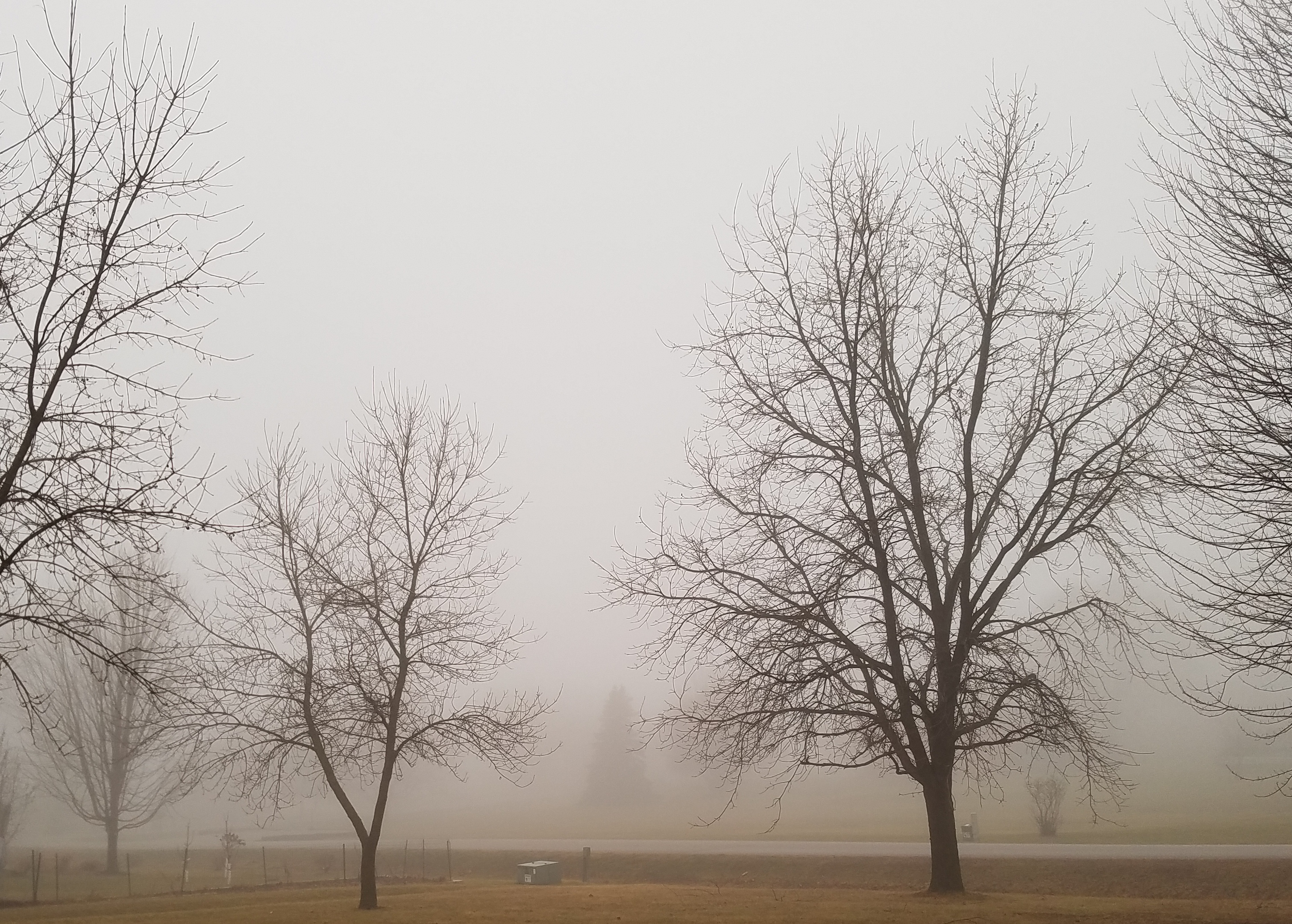
Last Saturday began with a car trip through fog to visit Mother.
Rising from the Cedar River Valley at reduced speed, when I hit Walcott the sun came out.
It was clear this morning. Geese honked overhead, flying to open water where they landed.
The weather is warm and weird. It’s human nature to leverage what we have, so I’ll be working outside part of today and tomorrow.
A week into the new administration things are a bit foggy. Either 45 and his team don’t know what they are doing, or they are doing it so well no one can keep up with him. (It’s the former).
Good news is the sun will eventually burn off the clouds coming from Washington, D.C. enabling us to establish how we best mitigate the damage done by the billionaire in the White House and his associates.
45’s focus will be on jobs because that’s what got people to set aside what they abhorred and vote for him. Jobs was the main topic of his first weekly address.
On Friday the White House announced a manufacturing jobs initiative that includes many companies who took advantage of the Ronald Reagan years to restructure, reduce costs, and outsource jobs in a way that created what 45 described as “American carnage.” He feebly tried to pin the loss of manufacturing jobs on President Obama, whose financial recovery after the 2008 recession has been competent, but not stellar. For those of us who’ve worked for or with some of these companies, it’s a joke to think they have well-paying American jobs at heart when they are the co-creators of the decimation to which 45 referred.
The list includes U.S. Steel and Nucor Steel. The latter benefited from the high costs of the former and took market share with technology that replaced workers. I’ve been to the former U.S. Steel Works in Fairless Hills, Penn., Cleveland, Ohio, and Chicago, Ill. I’ve also been to Nucor plants in Tennessee. It is as if these two companies were predators whose sole purpose was to wreak havoc on union steel jobs. Notably missing from the list are the international steel companies ArcelorMittal, Nippon Steel & Sumitomo Metal Corporation, Hebei Iron and Steel Group, and others that each in its own way contributed to the downfall of U.S. steel companies. ArcelorMittal is the poster child for globalization and its impact on workers. In terms of the initiative’s potential effectiveness, it’s notable that Lakshmi Mittal is absent from the list.
General Electric, Whirlpool and others were participants in the great post-Reagan restructuring of the American workforce. All of the companies on the list, with the exception of two token AFL-CIO representatives, are very large companies. What I expect is corporate leaders will reach consensus about what they need, present it to 45, who will work with the Congress to improve the environment for manufacturing within our borders. Ideas related to reducing environmental regulations, the government picking up cleanup costs, tort reform and removing what little power remains in the private sector unions will be de rigueur.
Job creation is the Achilles heel for 45 because so much of his victory was based on the promise of increased American jobs — manufacturing jobs particularly. It seems doubtful he can pull it off in a sustainable way.
This is one area of the new administration we should follow closely.






 Journey Home
You must be logged in to post a comment.