Farming is more than putting plow to furrow. It is a multitude of experiences, evaluations and decisions made over time.
The same is true for gardeners. Each garden, each plot, has its own micro environment and climate. Not only sun and rain, but wind, topography and history play a role.
This year a friend changed rented land for her community supported agriculture project and stories about her struggles are going around the local food community. The new soil hasn’t been worked for organic vegetables, and is recovering from row cropping. I believe — everyone is confident — she will persevere through the change. Yet it will be a setback in a business that operates on thin margins and more physical labor than mechanization. It’s when the going gets tough that farmers get going.
Over the last 23 years my Big Grove garden expanded from a single plot to six, and I’m looking at adding more. That doesn’t count the five fruit trees which have been a source of produce for a number of years. Yesterday the pear tree burst out in full bloom.
I mistakenly planted a locust tree in one of the garden plots. It has grow to maturity, providing shade for two plots at the same time the frequency and severity of drought has increased. Shade serves to protect cucumbers, herbs and greens from constant, intense sunlight in the absence of precipitation. It took me a while to realize what’s going on and leverage it. Now I couldn’t imaging growing without it.
There are a hundred small things like the benefits of a locust tree that converge in the plots of my garden. When I think of retirement — more often now than previously — I can’t imaging life far from a garden and the diverse intricacies of what sustains me and enables vegetables to grow.
My garden and I are the same warp and weft of life that sustains us all.
The sounds of children playing, dogs barking and yard equipment running dominated the air waves of an unseasonably warm and dry Saturday and Sunday. I heard hardly any of it as I dug in the soil, cleaned out the garden composter and planted.
Yesterday’s average temperature was 16 degrees above the historical average, and we’re running two inches of precipitation behind historical averages. At 80 degrees, the high temperature was well below the record of 93 degrees set in 1896. It was warm nonetheless.
In predawn darkness I watered the seedling trays and noted the peppers are beginning to sprout. It took about two weeks in our bedroom. I planted a tray of seeds for extras, including scarlet kale, tomatoes and Swiss chard. I think I’m done with seed planting, with the next step being transplanting selected seedlings into larger containers.
I prepared and installed containers of Yukon Gold and Kennebec potatoes behind the compost bins. I planted Cherry Belle and Rudolf round radishes and purple top white globe turnips in nearby rows. The small bag of red onion sets from the home farm and auto supply store went into the ground between the composter and the day lilies. I harvested about three cubic yards of compost which is piled up and ready to use. Things are shaping up nicely in the Locust tree plot.
It seems late for pea planting, yet I used up the remainder of my Sugar Ann Snap Peas in last year’s kale bed. Even if they don’t produce, if they sprout they will fix some nitrogen in the soil planned for tomatoes in about a month.
On Sunday I worked at the community supported agriculture project, soil blocking 30 trays for new seeds. There was a crew to plant seeds, tend the greenhouse and plant a number of trays of seedlings in the second high tunnel. I worked until my shoulders ached and will return tonight after my shift to finish the trays I couldn’t get done.
I was tired at the end of each day and glad to be alive in the garden.
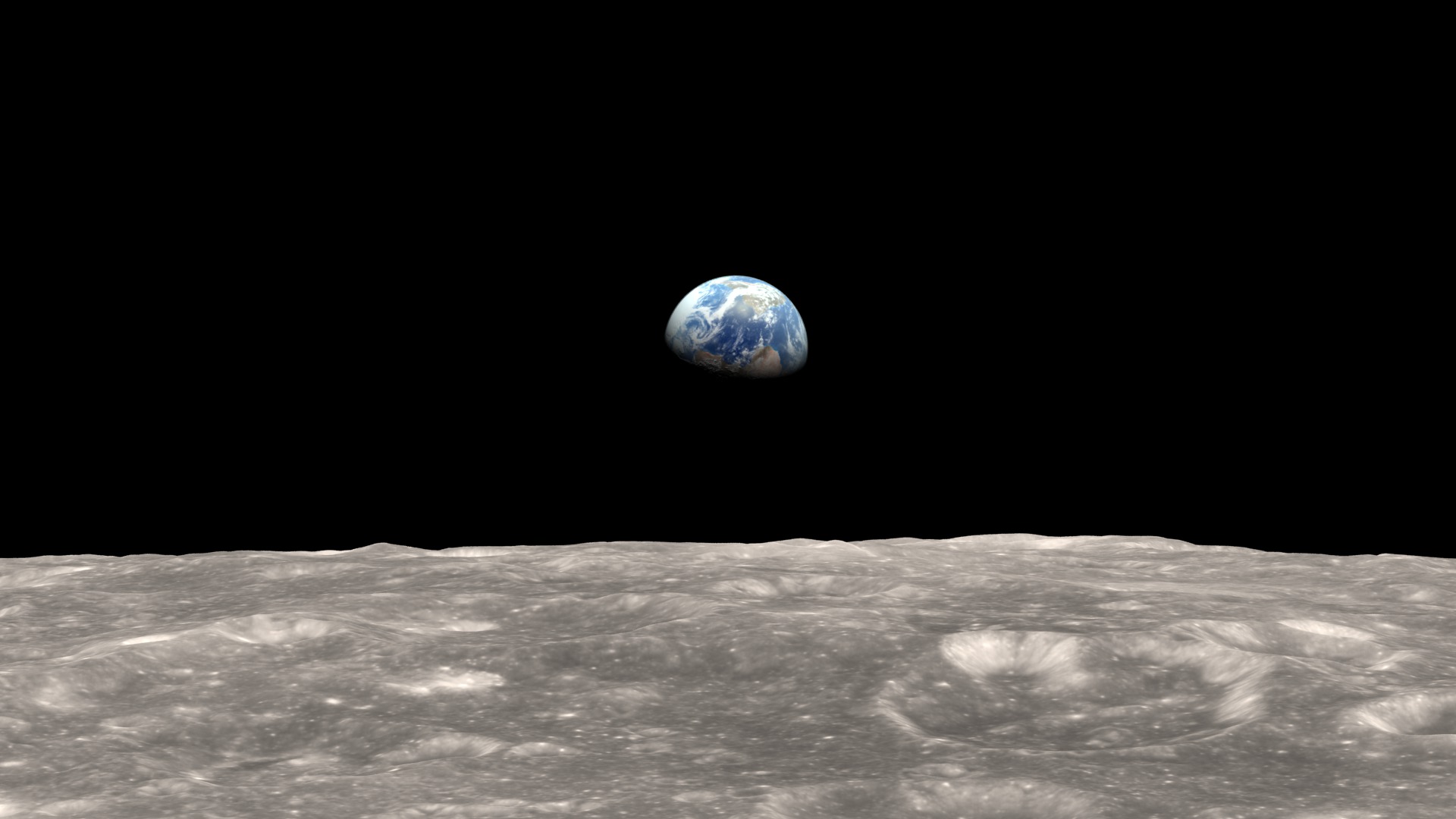
My participation in the first Earth Day on April 22, 1970 evolved in a convergence of social vectors. Among them was this Apollo 8 photograph of Earth above a lunar landscape by astronaut William Anders.
After viewing the photograph I felt conflicts and maladies in society were insignificant compared with what we have in common within our tiny, shared ecosystem suspended in the dark vastness of space. The photograph and its wide publication were a call to action to work for a common good. I still feel that way. It makes sense.
By spring 1970 we had witnessed the Tet Offensive, the My Lai Massacre, and renewed bombing of North Vietnam. We watched the violence of the 1968 Democratic National Convention in Chicago. We saw bits of Woodstock and Altamont in the media. We also landed men on the moon and returned them safely to Earth. At this convergence I didn’t know what to do, so joined with some high school classmates who were organizing Earth Day events. Earth Day was a common denominator.
What has Earth Day become?
Last week the Johnson County Board of Supervisors proclaimed April 17 through 23 Earth Week and announced two related events: an energy fair, and a local foods panel.
The focus on energy, CO2 emissions particularly, is well placed. We continue to use the atmosphere as an open sewer, discharging millions of tons of the greenhouse gases into it daily. Any reduction in electricity usage benefits the environment, even if the changes needed to solve the problem are trickier to accomplish than changing light bulbs.
Our food system is an obvious pick for Earth Day. Nine percent of greenhouse gas emissions come from agriculture according to the U.S. Environmental Protection Agency. It is a commonplace people need food to live, and the merging of Earth Day with the local food movement is an expected assimilation within normal spring activities. There are few better ways of appreciating Earth than getting one’s hands dirty in the ground, and spring in the Northern hemisphere is a great time to do it. It’s tough to see how planting a few trees, flowers or vegetables will rescue the environment, but as with electricity usage, every bit helps.
There is an entire menu of Earth Day related activities in our county.
Quoting Albert Camus in a recent opinion piece in the Washington Post, Kareem Abdul-Jabbar described why the 2016 election is important,
“This is no longer a prayer but a demand to be made by all peoples to their governments — a demand to choose definitively between hell and reason.” That is what the stakes of this election are: We are choosing between hell and reason.
In 1970 I thought we were already living a form of hell and the Earthrise photograph gave us hope. I would not have believed that in 2016 the Age of Reason itself would be on the brink of dissolution.
The good news is solutions to the climate crisis are working, particularly in the development of alternatives to fossil fuels to generate electricity and industrial power. The challenge is everything on our blue-green sphere is connected in a single ecosystem. What I do in my back yard has implications for living creatures around the planet.
Individuals in the U.S. are willing to do their part and what’s lacking is no secret: the political will to do straightforward things like ratify the Paris Agreement. Negotiated by 195 states within the United Nations Framework Convention on Climate Change, the agreement addresses greenhouse gases emissions mitigation, adaptation and finance starting in the year 2020. Some 120 nations are expected to sign when the agreement opens for signature this Earth Day.
Will the United States be among them? It’s an open question. Many politicians have indicated the United States should not participate in the agreement at all. Their rational doesn’t make sense, and that’s what Abdul-Jabbar was getting at. Reason the way most understand it is not in vogue in parts of our government.
Politics aside, Earth Day is a chance to revisit this iconic photograph. When we consider the big picture, as the photograph encourages us to do, little has changed since it was taken. Our troubles seem petty compared to the overriding fact we live on our only home and it’s much smaller than we often see.
That yesterday was opening day in Major League Baseball, and day after tomorrow begins the Masters Golf Tournament in Augusta, were inescapable sports facts on social media.
Spring is about Derby Day for me. It’s a race to get the early garden work done by then so once the risk of frost is minimal the main seedling crops of tomatoes, peppers and the like can go into the ground.
Most years I have been able to take a break from gardening to watch the two-minute Kentucky Derby, taking in just enough of the pageantry to feel a bit queasy. The old saw is horse racing is the sport of kings and who wants or needs it? It’s just there.
Iowa political class member Jerry Crawford asserted last year he had two goals: delivering Iowa for Hillary Clinton and winning the Kentucky Derby. Hillary won the Feb. 1 Iowa caucuses, just barely, and his team Donegal Racing’s 2015 entry in the Kentucky Derby placed fifth. That’s about as close as my life gets to so-called kingmakers.
I’ve been hobbled in gardening by my hand injury. Yesterday I limited my work to planting seeds in trays and transplanting those grown — celery, broccoli and basil — into larger pots. No digging for me… yet.
It was 71 degrees in Alaska in late March, almost 80 degrees in Iowa yesterday. The Alaska temperature was highest in recorded history and not a good sign for the thawing tundra and its release of long banked methane gas.
While sports distracts many, for those of us listening to a different narrative such distraction puts many more at risk of stopping Earth’s engine of sustainability.
That matters even on this small plot in Iowa removed from much of the turbulence in society.
On Friday, Feb. 5, the benchmark crude palm-oil future contract traded on the Bursa Malaysia Derivatives exchange reached its highest level since May 2014, according to NASDAQ.
Traders were feeling bullish as warm, dry weather caused by El Niño in the region receded from the prime palm plantations in Sumatra, Borneo and other parts of Indonesia.
These palm oil producing regions are half a world away, yet they matter to Iowa more than one knows.
The use of palm oil for cooking is in direct competition with soybean oil, including Iowa-grown soybeans traded on international markets. In a recent interview, Iowa Secretary of Agriculture Bill Northey said one out of four rows of Iowa soybeans are bound for international sales.
“India, the world’s largest importer of cooking oils, will buy more soybean and sunflower oil this year (2015) than ever before as a global glut weakens prices and prompts buyers to switch from palm oil,” according to Bloomberg News.
Because of the decline in farm commodity prices, current trends may favor soybeans over palm, but at the expense of soybean farmers. There is a clear case to be made to avoid products like chocolate, ice cream, detergent, soap and cosmetics that contain palm oil and its derivatives as a way to support Iowa farmers.
What matters more is deforestation to expand the cultivation of palm trees. Using a slash and burn methodology to clear equatorial rain forest for palm plantations, the haze covering Indonesia was visible from space. While haze may be viewed as a temporary inconvenience, deforestation has a direct impact on the planet’s capacity to process atmospheric carbon dioxide. That’s not to mention the loss of habitat and biodiversity, as well as release of carbon stored in trees into the atmosphere.
From logging, agricultural production and other economic activities, deforestation adds more atmospheric CO2 than the sum total of cars and trucks on the world’s roads, according to Scientific American.
“The reason that logging is so bad for the climate is that when trees are felled they release the carbon they are storing into the atmosphere, where it mingles with greenhouse gases from other sources and contributes to global warming accordingly,” the article said. “The upshot is that we should be doing as much to prevent deforestation as we are to increase fuel efficiency and reduce automobile usage.”
Most corporate food conglomerates use or have used palm oil and its derivatives as an ingredient. What’s a person to do?
The first recourse in Iowa is the power of the purse. Avoid purchasing products with palm oil because it competes with Iowa-grown soybeans, and is a contributor to climate disruption. There is no such thing as sustainably grown palm oil.
Palm oil and its derivatives go under many names. A list of alternate names for palm oil can be found here along with a handy wallet sized printout.
Here is a list that discusses use of palm oil in various consumer products.
Explore the Rainforest Action Network web site, beginning with this link. There is a lot of information about the issue and actions you can take to address the most pressing aspects of deforestation.
While Indonesia may seem distant, what goes on there and in other equatorial palm plantations matters here in Iowa.
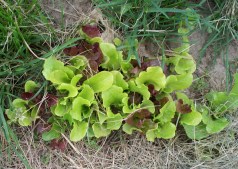
Lettuce and basil germinated in the tray planted last week, reminding me of why I garden.
It is a chance to witness life as cold sets in for one last spell. Soon winter will turn to spring. I can’t wait. For now, suffice it that the seedlings rise to face the sun through a bedroom window.
The emergence of hearty weeds among my seedlings was unexpected and easy to remedy. We all have weeds growing in our garden, even when it is planted a couple of months before last frost. I continue to pluck them out to make room for what I intended.
The death of Associate Supreme Court Justice Antonin Scalia yesterday was unexpected. It sparked conversations in social media, which for practical purposes includes formal news organizations. Scalia was quail hunting at an exclusive ranch in West Texas — a place where Mick Jagger and the Dixie Chicks have hung out. The event ramped up my understanding of opinions and attitudes regarding the meaning of Scalia’s legacy and the process of choosing a replacement.
By all accounts, Scalia’s was a brilliant if acerbic legal mind.
The Congress is in recess, so President Obama has the option to make a recess appointment. That would be the cleanest way to go, with the selected associate justice serving until the end of the next session. Why would Obama forego the possibility of a lifetime appointment? As he indicated in his remarks on Scalia’s passing, he won’t. However, I pulled a Scalia and began with the text of the Appointments Clause of the U.S. Constitution. There is no time limit on gaining the consent of the U.S. Senate. They have given their advice already: “leave the position open until the next president is sworn in.”
When a nominee is presented to and blocked by the Senate, and if the Supreme Court divides evenly by ideology, the situation would contain both good and bad. There is no guarantee justices will divide by ideology. If they do, the powder keg that is the Supreme Court docket this session would sustain lower court decisions. Winners would include labor (Friedrichs v. California Teachers Association) and losers would include the TEA Party (Evenwel v. Abbott; Harris v. Arizona Independent Redistricting), undocumented immigrants (US v. Texas) and women’s reproductive rights (Women’s Whole Health v. Hellerstedt; Zubik v. Burwell). It seems too early to say all of this will actually happen.
With Scalia deceased, three remaining Supreme Court justices will turn age 80 by the end of the next presidential term. The stakes in the 2016 presidential election could not be higher. Ronald Reagan’s Supreme Court nominee Anthony Kennedy was appointed in February of Reagan’s last year in office, so there is precedent for Obama. Precedent means little in the toxic political environment in which we live.
Life is never as simple as germinating seeds rising toward the sun on a Sunday morning. There will always be weeds in the garden, and so it is with yesterday’s news as Scalia was plucked out by God’s hand.
Starting a garden is not always easy, especially if one lives in a city.
The main thing is planting the first time and that can be a big step.
The good news is the potential to stumble is more related to attitude than anything else. There is hope. Here are a few bits to get started.
A gardening journey can begin with a trip to the public library to browse the stacks. A lot of gardening books have it all and my current favorites are The Iowa Edition of the Midwest Fruit and Vegetable Book by James A. Fizzell, and MiniFARMING: Self sufficiency on 1/4 acre by Brett L Markham. The former is a comprehensive look at crops that grow well in the Midwest. The latter presents aspects of the growing process with an eye toward sustainability. Because gardening is popular, libraries tend to have a wide selection of research materials and other resources. Remember. Gardening is engaging in a local food system and book learning is only part of it.
Gardening is about changing one’s relationship with the food as much as providing food for the table — process more than produce. A common mistake is inadequate attention to gardening’s social context. I’ve heard stories of people seeking solace in tilling the ground and nurturing plants from seeds to fruit and vegetables — a form of personal retreat. In most cases gardening involves others — family, fellow consumers, merchants, farmers and gardeners. Discussion of gardening issues and their resolution is endemic to the process and represents the broader context in which gardening occurs.
When people think of local food, most have sweet corn and tomatoes in mind. There is a lot more. A way to begin is to think about what fresh veggies and fruit to buy and which to grow. Because of the space it takes, I always buy sweet corn rather than grow it myself. The other way around with tomatoes and green beans. Squash takes a lot of space, and there are lots of great producers of it everywhere… another to buy. Bell peppers require a certain something I haven’t mastered, so I barter for mine, taking seconds from the farm. Why not buy local food when it is abundant, especially if you know the farmer and how the crops are grown?
If you have a small potential garden plot, I recommend picking 8-12 crops and focus on learning how to grow them well. Pick varieties to ripen throughout the season — spring greens and onions, a few herbs, cucumbers, tomatoes, green beans and kale are all easy to grow. The idea is to dip into the soil and experiment using available resources. Another part most people dislike is dealing with pests and predators. Use those books you checked out from the library and better yet, develop friendships with other gardeners and growers in your area — ask them questions, visit their farms. You’ll find gardening is one of the most popular activities and there is lots to talk about, especially when it comes to common problems.
With a positive attitude, there is little to lose in planting a garden. Once one turns the first spade of soil, there is a world worth experiencing in the microcosm of a back yard. Before long, you’ll be craving life in society to talk about your garden. It is about more than home grown fruit and vegetables.
Local food may be what’s grown in a backyard garden, herb jar or patio pot. It may be heirloom livestock raised in grass paddocks, supplemented with carefully selected feed, and served in a local restaurant. It is definitely vegetables and fruit, increasingly available at farmers markets and roadside stands, from community supported agriculture operations, and even in chain supermarkets.
The local foods “movement,” is less coordinated than what media make it out to be. However, there is a consistent theme: it is small scale, farmers are interdependent, and the face of the farmer is visible in every apple, tomato and ear of sweet corn.
Many of us notice the increased availability of local choices when stocking our kitchens, a sign the food system is changing. After leaving a corporate job in 2009, I had a chance to work on half a dozen farms and gained a closer view of what local food farmers do. It is hard work made worthwhile by a network of cooperation among producers.
I met Susan Jutz, who operates Local Harvest CSA when two of her children were in 4-H with my daughter. Twenty years into the operation, Jutz has about seven acres in vegetables, pastures rented to local livestock producers, a large field in the Conservation Reserve Program, and a set of paddocks for her flock of ewes and spring lambs. Walking around the farm, you’ll find beehives, a greenhouse and a high tunnel, all adding to the economic structure of a farm using sustainable practices to produce shares for a medium-sized community supported agriculture project.
I began working at Local Harvest in March 2013 when I swapped labor for a share in the CSA. The work was physical, and I enjoyed it enough to return every spring since then. It was the beginning of understanding a local food network.
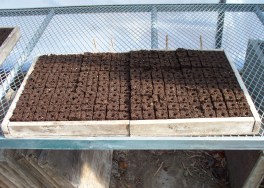
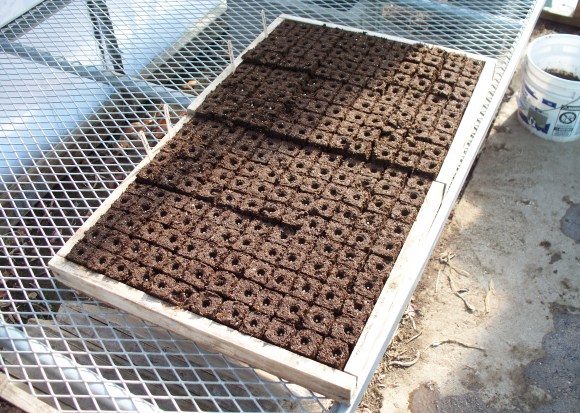
My first job was soil blocking in the greenhouse — making trays of small, square starter soil blocks where seeds are planted. In March, the ground is usually still frozen, yet I have to take off my coat and shirt in the warm workspace. The labor is physical, and a good opportunity to follow seeds turning to seedlings and then to crops with the season. Susan shared her greenhouse with other farmers with whom she cooperated to produce the contents of her member shares. Over time I worked on most of their farms.
One was Laura Krouse, owner/operator of Abbe Hills Farm near Mount Vernon, Iowa. Laura uses part of Susan’s greenhouse space in the spring and provides potatoes for Susan’s fall shares.
Because Krouse’s potato operation is large, she gains economies of scale. Using a tractor with a potato harvesting attachment, along with shared labor from other CSAs, and a large number of volunteers, she can harvest a field quickly. We harvested potatoes and washed them using a specialized root vegetable cleaner, bringing a load of potato-filled buckets back to Local Harvest for storage and distribution.
This is just one example of the cooperative ventures among farmers which include squash, eggs, carrots sweet corn and other vegetables for CSA shares.
While Susan and Laura have been operating for decades, since the local food movement got started in Iowa, the increased interest in local food is encouraging more farmers to enter the market.
I met Lindsay Boerjan who returned to her family’s century farm in Johnson County in 2011. To supplement family farm income, she used leftover material from a razed barn to construct raised planting beds. With manure from the cattle operation she runs with her husband and aunt and uncle, she planted the beds in vegetables for a CSA she began in 2015 with seven members. She hopes to grow her number of customers. Boerjan said she faced challenges as a female farmer.
“It’s predominantly an older male thing or career,” she said. “Should you want to make a career of it, it’s harder to wrestle in costs now the way they are.”
Boerjan is an example of a minimally financed operation, able to get started because she owns the land and is part of a larger farm operation. That Boerjan’s family owned the land and already farmed helped get her CSA going.
In January, Wilson’s Orchard in rural Iowa City announced it was entering the CSA market with a partnership with Bountiful Harvest Farm near Solon. Dick Schwab’s involvement in Bountiful Harvest is an example of a well-capitalized CSA start up. Schwab is a local entrepreneur who is involved in a variety of financial investments, including a timber business, an auto repair shop and more. He already hosted another CSA, Wild Woods Farm, on his acreage in rural Johnson County. He has experience, owns the land and equipment needed to operate a farm, and has a network of marketing contacts that include Wilson’s Orchard.
Knowing the face of the farmer has been part of the local food movement. Today, people want to know more about where and how food is produced. Getting to know a farmer was important at the beginning of the local foods movement in Iowa, and still resonates. At the local supermarket, buyers stock the produce aisle with locally produced items, along with a daily count of local food items on hand and a life-size photographic cutout of the farmers who produced them.
Driven in part by mass media, consumers are concerned about a wide range of food issues that include contamination with harmful bacteria; dietary concern about consumption of carbohydrates, fat and sugar; the way in which plant genetics are modified to improve them; and more. Partly in response to media campaigns, annual sales of organic food exceed $30 billion in the U.S. (USDA). The increase in organic market share from national advertising campaigns is significant. If you get to know your local food farmer, what you may find is they benefit from this marketing, but their customers come and stay with them because of a personal relationship with the farmer.
Whether you grow herbs on a kitchen window, belong to a CSA or garden a plot in the backyard, it is all part of a local food movement that is just getting started and depends on knowing the face of the farmer.
“Publishers are not accountable to the laws of heaven and earth in any country and regardless of my opinion, editors and publishers will print what they will.”
I wrote this in a letter to the editor of the Quad City Times in 1980 reacting to a popular feature section called Soundoff.
“(It is) little more than a vanity press for many of the writers,” I wrote. “It gets pictures, letters and opinions into print as a final goal; shouldn’t there be more to public voicing of opinion than that?”
This is more applicable today than it was three and a half decades ago.
What I learned in graduate school is the same statement can be applied to almost everything written in public. Reflecting on the Times experiment to make their pages more open to comments and retain readership, chaos reigned. What has changed since then is the emphasis on viewpoint in media — corporate, social or self published — which has been formalized. It’s not all good.
As I turn to the hard yet fun work of writing this year, I plan to journal my experiences in the food system here. Four years from full retirement, there are bills to pay and a life to live. I may pick other topics from time to time. I need to make the best use of every moment.
I’m writing off line as much as I can. While I don’t like to work for free as long as there is less cash than budget, I may occasionally post about those creative endeavors.
Thanks for reading this blog. Check out the tag cloud for your interests. I hope readers will be back often.






 Journey Home
You must be logged in to post a comment.