Categories
Environment Living in Society Social Commentary Sustainability

Protect Environment; Stop Nuclear Weapons

Paul Deaton
Paul Deaton

(Editor’s Note: When this guest column ran in the Cedar Rapids Gazette on Wednesday, Sept. 21, its abstract nature became real as heavy precipitation events pummeled Butler County and other parts of northeastern Iowa, disrupting lives there and downstream. Living in an environment where rain damages crops instead of nurturing them; where rivers jump their banks, close schools and displace people; and where Cedar Rapids must protect the city from record amounts of floodwater multiple times in eight years, something’s wrong. We must take action that includes electing a government that will address the causes of global warming and nuclear proliferation, not just deal with the actuality we have created).

Protect environment; stop nuclear weapons
By Paul Deaton

Guest column for the Cedar Rapids Gazette Sept. 21, 2016.
Reprinted with permission of the author

If we accept the premise articulated by Hillary Clinton’s presidential campaign, that we are stronger together, there is a lot in society requiring our collective attention.

There are no lone wolves in human society, although a number of people want to get away from the pack. Can we blame them? Being stronger together is a fundamental characteristic of Homo Sapiens. It’s what we do as a species.

What should we be working on?

It is hard to avoid the primacy of following the golden rule. We should be applying the golden rule, better than we have been, to everything we already do. This is basic.

Two other issues call for our attention, the threat of nuclear weapons, and mitigating the effects of climate change.

Today, on very short notice, nuclear powers can unleash a holocaust ending life as we know it. Nuclear war is not talked about much in the 21st Century; however the threat is as real today as it was when President Truman authorized the Hiroshima and Nagasaki nuclear bombings. The United States should take the lead in eliminating nuclear weapons. We need a transformational change in our nuclear policy that recognizes these weapons are the gravest threat to our security and must be banned and abolished.

We are wrecking our environment and should stop. Just 90 companies are to blame for most climate change, taking carbon out of the ground and putting it in the atmosphere, geographer Richard Heede said. If that’s the case, the move to eliminate fossil fuel use can’t come quick enough. These companies should be targeted for regulation by governments. Companies say they are not to blame for the demand from billions of consumers that drives fossil fuel use. Technologies exist to eliminate fossil fuels, and we should adopt them with haste. One purpose of government is to act as a voice for people who have no voice. Regulating business to protect our lives in the environment would serve that purpose.

After the 2016 election these issues will remain. The first can gain wide support easily. It is time the other two gain parity.

~ Paul Deaton retired from CRST Logistics in 2009.

Categories
Environment

Autumn Begins with a Flood

Flooded Wetland
Flooded Wetland

There was a lot to make one cranky as summer ended yesterday, including the weather.

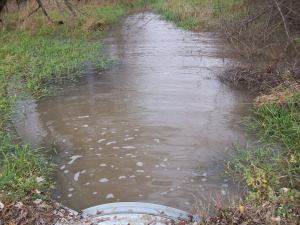
Extremely heavy rains are flooding parts of Iowa and the impact will soon be felt downstream.

The Cedar River is expected to crest at 24.1 feet next week in Cedar Rapids, Iowa, the highest level after the record 31.12 foot crest on June 13, 2008.

“We have four days to get ready, and now is the time to start,” Mayor Ron Corbett said Thursday.

We’ve had a lot more time than that to get ready.

During Al Gore’s Climate Reality Leadership Corps Training, conducted in Cedar Rapids in May 2015, Mayor Corbett made a presentation about the 2008 Cedar River flooding, how it impacted Cedar Rapids, and what actions were taken and being considered to mitigate damage from potential future floods. The next week will determine whether the plans and discussions were enough to prevent serious damage.

Senator Joni Ernst has been pushing the U.S. Army Corps of Engineers to expedite completion of the Cedar Rapids Flood Control Project, recently in the Water Resources Development Act.

“This legislation includes my work to direct the Army Corps of Engineers to expedite the completion of the Cedar Rapids flood control project,” Ernst wrote in a Sept. 15 press release. “The provision emphasizes to the Army Corps of Engineers that Congress wants this project to remain a priority. I will continue working to ensure the Army Corps of Engineers understands the great need for this long-standing project to be completed in a timely and efficient manner.”

These efforts seem well intentioned, but too little, too late.

The connection between this flood and global warming is clear. When the atmosphere is warmer, its capacity to store water vapor increases. When it does rain, it can do so in heavy precipitation events in which a large amount of rain falls in a brief amount of time. The frequency and intensity of heavy precipitation events has increased since World War II and that appears to be what happened in northeastern Iowa over the last few days.

Here’s an excerpt from a WHO-TV news article about flash flooding in Butler County. It tells the story:

BUTLER COUNTY, Iowa — Storms in northern and northeastern Iowa overnight caused some damage as they spawned tornadoes and dropped heavy rain – up to 10 inches – in some areas.

“We expect the crest this evening what we’re being told around 7 p.m. probably water levels similar to 2008 or more so,” said Jason Johnson, Butler County Sheriff.

Flooding from the Shell Rock River has cancelled classes in the North Butler School District for Thursday and many students gathered at the high school to help fill sandbags. Highway 14 on the way to Charles City is impassable because of water over the road.

Butler County Sheriff  Johnson says there isn’t a widespread evacuation in Greene but some residents are moving to higher ground.

In Floyd County, 7.55” of rain was reported and Charles City saw 6.35”. The Little Cedar River is at moderate flood stage at Nashua and near Ionia. The rainfall total reported for Ionia is 6.24″.

Work will remedy the crankiness of summer’s end. One didn’t expect it to be sand bagging levies, homes and businesses to prevent damage from what is projected to be the second worst flood in Cedar Rapids history. It will get us through the weekend.

The newest flood begs the question of what’s next to mitigate the damage from future flooding? Government involvement in a solution is necessary but it must be implemented faster than it has been. We also have to connect the dots between our personal actions, global warming and climate change more than we have.

For now, we’ll just have to deal with the existential reality of the flood, something I recall doing since the 1960s. It’s a way of sustaining our lives in a turbulent world, but we can do better.

Categories
Home Life Kitchen Garden Writing

Into The Vanishing Point

Vanishing Point
Vanishing Point

A new perspective revealed itself from paths traveled daily.

Something showed through the uncut grass and garden in the light of a rising sun.

I should quit thinking and mow the damn lawn.

It depends. What time will I finish at the orchard? How will I feel after interacting with locals for a shift? Will the press of decaying produce draw me into the kitchen again? How guilty will I feel about letting grass grow long?

So much depends. If conditions are right — temperatures moderate, weather dry, and a couple hours of remaining daylight — I may mount the John Deere and make a first pass. The lawn is so long it will take at least two.

So much depends upon weather, capacity for work, and a will to sustain our lives in a turbulent world.

I looked up and saw the vanishing point through the middle of my garden for the first time in 23 years this has been our home.

It has been there all along, the work of the farmer who subdivided his homestead, the surveyors who platted the lots, and the home builders who positioned structures according to convention and restrictive covenants recorded at the county administration building. I played my part unintentionally by positioning my garden in the southeast corner of our lot.

It was hard to miss.

Yet it was there. I walked into it and am still here.

Categories
Kitchen Garden

Poblanos, Onions and Pickles

Fermenting Dill Pickles

JOHNSON COUNTY, Iowa — In the margins of time between social engagements lives a local food movement available to all who seek it.

There is inadequate time in life’s span to become an enthusiast, however pursuit of local food culture is not only okay, it can be rewarded with meals that comfort more ways than imaginable.

While Jacque was in town with her sister, I made last night’s supper of seconds of poblano peppers and yellow onions from the farm, a couple of links of vegetarian sausage, and a variety of home made pickles.

After removing bad spots from the onions and peppers, I cut them into thin strips and piled them on the cutting board. I cut the sausages on the bias and browned them in a pan. Once finished, I removed them to a paper napkin sitting on a plate and began sauteing the onions and peppers in olive oil, seasoning with a bit of cilantro, granulated garlic, salt and pepper.

While the vegetables were cooking I arranged three kinds of pickles, sweet, dill and daikon radish in a bowl. Once the vegetable mix was finished I spooned it into the bowl beside the pickles and topped it with the cooked sausage. With a glass of iced water, it made a meal.

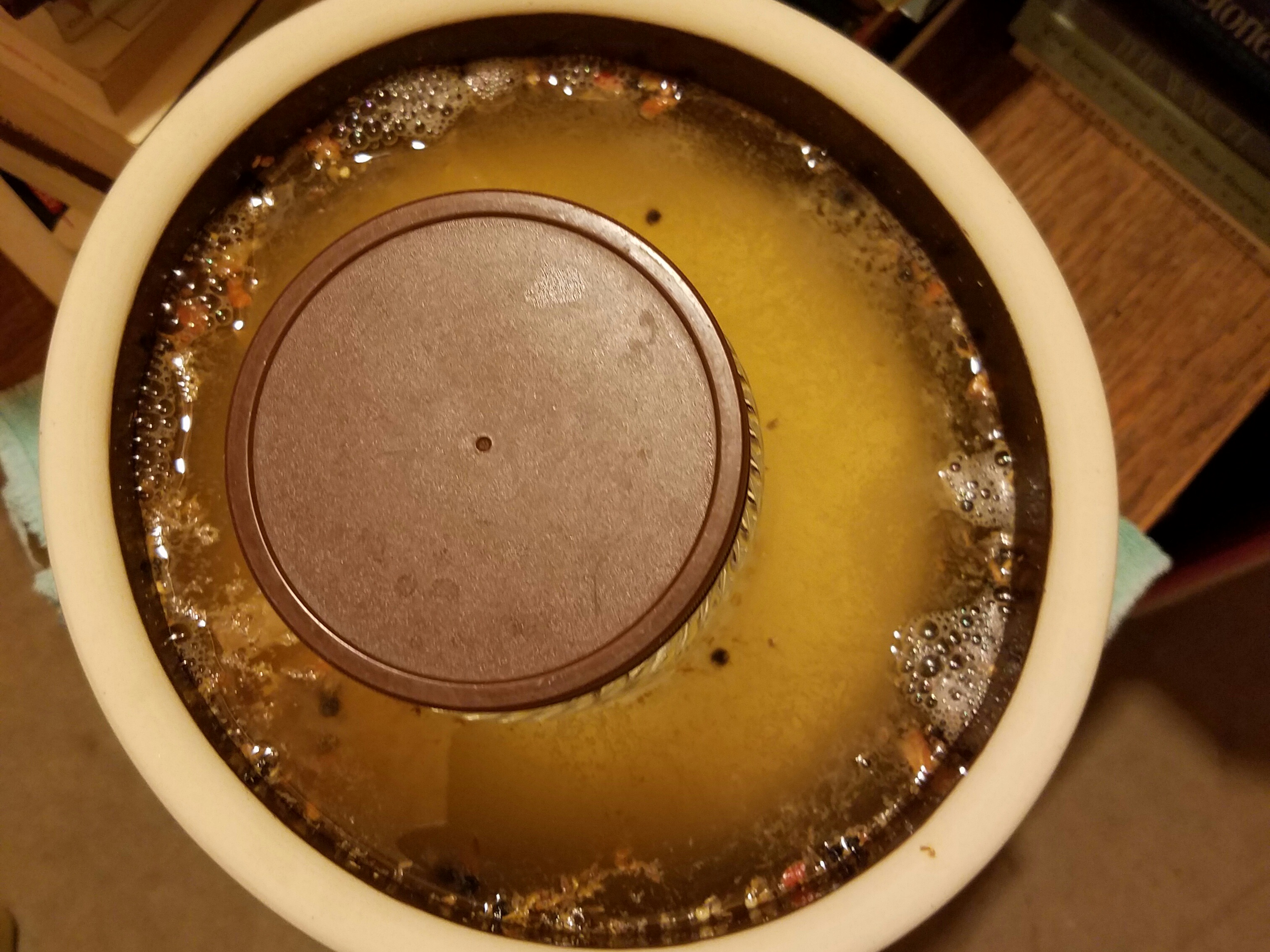
After dinner I went downstairs and checked the crock full of cucumbers. Fermentation bubbles had begun to appear after two days, indicating a successful pickling process. Patience is a key ingredient when making pickles. I hope I have enough of it on hand to make it 11 additional days when the dill pickles will be ready to eat.

Simple stir fries and pickles become a way of life when vegetables are available from the farm and garden in abundance. Cooking in the local food culture is an act of rebellion from a consumer culture that engendered us in the Western hemisphere. It represents taking control of our lives.

Do I always cook locally produced food at home? No. I pay attention to the seasonality of food and align with it as much as possible. I’ve found it makes for better ingredients and depending on the cook, for better eating.

There is more to the seasons of food than common affection for sweet corn and tomatoes. Learning more is a step toward living a better life and who doesn’t want to do that?

Categories
Work Life

Into Fall

Box of Onions
Crate of Onions

The first leaves on our Autumn Blaze maple tree turned over the weekend — a reminder of summer’s imminent end.

A lesson learned this season was of the limits of worklife and the tendency to let personal things go when engaged in a big endeavor.

The garden, yard and house cleaning fell to the bottom of the priority list as I worked four jobs. It is ironic that in a year when my skills as a gardener improved, I was unable to keep up with the weeding and harvesting, which when combined with the lack of mowing for a month, created a jungle in our back yard. The birds and rabbits may be happy, but I was not.

Harvesting will continue. The garden paid for itself many times over. The question is what level of abundance is enough? I’m already thinking about preparing the plots for winter. It won’t be long before I pull the plants, stack the cages, roll up the fencing and mow. It assuages my guilt from leaving so much produce — tomatoes and pears especially — in the field.

Thunder and lightning blew past the orchard Sunday afternoon and I was released from work early. Because of the lightning, I skipped the greenhouse work at the farm — we don’t work when there is lightning. The storm created an opportunity to rest and after finishing my last post during Trish Nelson’s hiatus from Blog for Iowa, I did.

This week I hope to finish the onion trimming work and move on to what’s next. The presidential election is sucking up oxygen, so dealing with that is out there.

More importantly, what do I want to do next with my remaining years.

I used an on-line life expectancy calculator which determined I have a 75 percent chance of living past age 80, with an estimated life expectancy of 87 years. If that’s true, there’s a lot of living to do.

It will take a full day, maybe two, to clean up the tangled mess the yard and garden have become. Some time — not too much — must needs be spent learning to choose my occupations wisely.

Categories
Sustainability

A NATO Nuclear Weapons Problem

B-61 Nuclear Bombs in Storage

One risk of U.S. nuclear weapons deployed in NATO countries is that security may fail and bombs could fall into unknown hands.

During the recent coup attempt in Turkey, Turkish forces surrounded the U.S. Air Force base at Incirlik (where several dozen Cold War era B-61 gravity bombs are vaulted), cut off electrical power, and temporarily closed the air space around the base as they repelled the coup attempt.

“General Bekir Ercan Van, the commander of Turkey’s Incirlik airbase, which is used both by the Turkish Air Force and NATO forces, has been detained by Turkish authorities accused of complicity in the attempted coup,” according to RT News and covered by the Wall Street Journal (Paywall). “The senior Turkish military commander was arrested along with over a dozen lower ranking officers at the base. A government official has confirmed that the general has been detained.”

The bombs were secured… this time.

Is the risk of nuclear weapons deployment worth the reward? It isn’t.

During a recent heavy rain storm, water got into our basement where a box of political memorabilia was dampened. I spread the contents on the living room floor to dry, and while putting them away found half a dozen responses from U.S. Senator Chuck Grassley during my advocacy to ratify the New START Treaty with Russia signed April 8, 2010.

Grassley responded in a formulaic manner, indicating staff had written the response. In his last letter before the Senate vote, which I believe Grassley wrote, he acknowledged my advocacy and said simply he disagreed. New START was ratified without Senator Grassley’s vote.

While the existence of nuclear weapons and their deployment is said to be an apolitical defense strategy, it isn’t. As long as U.S. nuclear weapons exist and are deployed, there is a risk of a security failure after which they could fall into the wrong hands. I’m not the first to say nuclear weapons serve no practical purpose and can never be used.

If you want to learn more about what happened during the Turkish coup and what it means, here are some links to articles about it.

The H-Bombs in Turkey by Eric Schlosser, author of Command and Control, The New Yorker, News Desk July 17.

Should the U.S. Pull Its Nuclear Weapons From Turkey? by Jeffrey Lewis, director of the East Asia Nonproliferation Program at the Monterey Institute of International Studies. and Kori Schake, fellow at the Hoover Institution, July 20, The New York Times.

U.S. planes grounded at key Turkish air base in fight against ISIS after coup attempt by Dan Lamothe, National security writer for The Washington Post, The Washington Post, July 16.

Turkey Arrests Incirlik Air Base Commander by Julian E. Barnes, he covers the Department of Defense and national security issues from The Wall Street Journal, The Wall Street Journal, July 17 (Paywall).

The Coup and the Crackdown: Turkey and American Foreign Policy by Trevor Hill, senior fellow for the Cato Institute’s Defense and Foreign Policy Department, CATO at Liberty, July 18.

The U.S. stores nuclear weapons in Turkey. Is that such a good idea? by Dan Lamothe, National security writer for The Washington Post, July 19, The Washington Post.

How safe are US nukes in Turkey? by Barbara Starr and Ryan Browne, CNN, July 19.

~ Written for Blog for Iowa

Categories
Living in Society Social Commentary

Opioids: A Conjured Crisis

U.S. Department of Agriculture Secretary Tom Vilsack

Secretary of Agriculture Tom Vilsack scolded the University of Iowa Carver College of Medicine about opioid abuse on Friday.

The institution is not doing enough to train its soon-to-be health professionals on an opioid abuse epidemic that claims thousands of lives a year nationally, Vilsack said, according to the Cedar Rapids Gazette.

The university just got the word about its role in the opioid abuse epidemic last week. According to the article,

After Vilsack’s remarks, UI Health Care medical affairs vice president and dean of the medical college Jean Robillard told The Gazette the institution does plan to make changes in the way it teaches med students about prescribing opioids. He said the UI received information on it from the White House earlier this week.

Vilsack oversees the White House Rural Council, established by executive order on June 9, 2011 by President Obama. Opioid abuse is on a long list of maladies that impact rural communities. It is one issue among many the council hopes to address.

News media and politicians have made much of opioid abuse. Facts suggest at 28,648 (2014) annual deaths related to opioids — including heroin, hydrocodone and oxycodone — abuse is not a leading cause of death in the United States. It’s not even among the Centers for Disease Control’s top ten causes of death, with heart disease, cancer, chronic lower respiratory disease, unintentional injuries and stroke being much more prevalent.

What gives?

Fanning the embers of opioid abuse into a raging wildfire serves the interests of Big Pharma and its minions in the U.S. Congress. The opioid epidemic represents another opportunity for corporations to mold government in a way that serves their interests.

We’ve seen this before with methamphetamine abuse. Methland: The Death and Life of an American Small Town by Nick Reding makes the case that it’s less a drug’s addictive propensity than a combination of economic policy, government complicity with Big Pharma, and corporate policies that are behind the degradation of rural communities like Oelwein, Iowa, the subject of his book.

The short version is when meth had its fiery burn into the media atmosphere, corporations used it as an opportunity to control importation of key ingredients to a profitable cold medicine in a way that led to many small-scale meth lab busts in Iowa, and the rise of methamphetamine trade among Mexican drug cartels. The opportunity regarding opioids may be a little different, but why wouldn’t Big Pharma want another bite from the apple?

It is ironic that Nancy Reagan’s “Just Say No” campaign, part of the “war on drugs,” was window dressing to her husband’s economic policies that drove the underlying causes of abuse and addiction, not only in small towns, but throughout the country.

People suffer from many types of addiction and neither government nor the insurance companies that drive health care are doing much to address them. Opioid abuse is an issue, yet the bigger issue is related to the growing divide between the richest Americans and the rest of us, corporate influence in government, and a K-12 education system that inadequately prepares children to sustain themselves in a society where corporations have the upper hand.

Opioids? Schmopioids! Let’s have a conversation about appropriate school curricula, something Vilsack addressed Friday in a weird, special interest kind of way.

~ Written for Blog for Iowa

Categories
Environment

Can Hipsters Stomach The Truth About Avocados From Mexico

Avocado from Mexico

Can consumers buy avocados from Mexico at the grocery store, or in prepared guacamole with impunity?

Probably not.

Last week’s article “In Mexico, high avocado prices fueling deforestation” by Associated Press author Mark Stevenson explained why.

Americans’ love for avocados and rising prices for the highly exportable fruit are fueling the deforestation of central Mexico’s pine forests as farmers rapidly expand their orchards to feed demand.

Avocado trees flourish at about the same altitude and climate as the pine and fir forests in the mountains of Michoacan, the state that produces most of Mexico’s avocados. That has led farmers to wage a cat-and-mouse campaign to avoid authorities, thinning out the forests, planting young avocado trees under the forest canopy, and then gradually cutting back the forest as the trees grow to give them more sunlight.

“Even where they aren’t visibly cutting down forest, there are avocados growing underneath (the pine boughs), and sooner or later they’ll cut down the pines completely,” said Mario Tapia Vargas, a researcher at Mexico’s National Institute for Forestry, Farming and Fisheries Research.

Why does it matter?

Deforestation plays a key role in the release of greenhouse gases. Carbon stored in trees and other vegetation is released into the atmosphere as forests are converted to avocado plantations.

With the advance of climate change, securing adequate water to produce the fruit has increasingly been an issue in avocado growing regions. A video posted by the World Bank explained the problem and how farmers are coping. It’s pretty simple. In recent years there has been less rainfall in Michoacan, desiccating the soil. Farmers divert rainwater runoff to retention ponds for use during dry months. Avocados require twice the water of pine forests they replace, depriving downstream users of an essential resource.

If that’s not enough, these particular forests are part of the Monarch butterfly wintering grounds. Deforestation impedes the butterfly’s evolved life cycle.

You may have seen one of the web ads featuring celebrity chef Pati Jinich promoting avocado use for the trade association Avocados from Mexico. Here is an example:

(Editor’s Note: Sorry, the video was deleted from the Avocados from Mexico Website)

When encountering these ads, I found Jinich endearing and her tips helpful. That is, if I were a user of avocados, something she and the trade association is trying to change with the promotion. My experience with guacamole has been a tablespoon served on the side of Mexican food with other condiments, so not much.

One doesn’t always know what to do about stories like Stevenson’s. How extensive is the deforestation problem in avocado growing regions? How will downstream users react to deprivation of water from the mountains? How are workers treated on avocado plantations? Can we live without Monarch butterflies, and will another plot of forest gone really make the difference for this pressured species?

I don’t know, but here’s a relevant question raised by Joanna Blythman in The Guardian, “Can hipsters stomach the unpalatable truth about avocado toast?”

“When we pick up a fashionable import like avocado,” Blythman wrote, “we need to be sure that it not only benefits our personal health and well being, but also that of the communities that grow it.”

The issues around deforestation are well known. To the extent avocados add to the problem users should be driven to do something.

That may be as simple as asking the server to hold the guacamole.

~ Written for Blog for Iowa

Categories
Home Life

Perhaps It Was a Sign

Water Damaged Memorabilia Drying

For the first time since we covered our foundation with earth in 1993 we had water downstairs after a heavy rainfall.

Perhaps it was a sign.

As soon as we discovered the problem, we reacted. Later in the day I bought a 20-inch fan at the home, farm and auto supply store to circulate air as the cement floor dries. It’s muffling out every other sound as I write.

Most of our storage items are on pallets, and planning paid off. About half a dozen boxes on the floor did get damp. We caught it soon enough to remove the contents and dry papers out before getting ruined. My musical instruments were also on the floor, but they were dried off before wreckage.

Casualties included a small collection of Franklin Mint items, a box of letters from pre-email days, and a banker’s box full of political memorabilia going back to when I worked on LBJ’s 1964 campaign. It looks like everything will be okay.

We don’t plan to build an ark, and must figure out what is happening then take action. By the end of today, I’ll inspect the wall inside and out and develop an action plan. I’ve learned to pay attention when nature and the forces behind it give us a sign.

The last thing we needed was one more thing on the Big Grove do list. On Thursday I made a schedule at the home, farm and auto supply store during a break. It must now be modified.

Weekend Schedule Draft

With such a schedule it is hard to relax. In fact, it is easy to see why people turn to methamphetamine to get through everything that needs doing in 24 hours. Maybe I need to pull a couple of all nighters, as a substitute since I eschew meth and stimulants except coffee.

A friend of mine who attended Georgetown University continued the collegiate practice of pulling all nighters well into the 1980s as a way of catching up with things that could not be delayed. The trouble is there is no “next day” for me to crash with my constant schedule through the end of the apple season.

Mine is the situation of any low wage worker, and I don’t see it being fixed in the U.S. by the “fight for $15,” an advocacy effort to raise the minimum wage. I will suck the pap of life dry with constant activities regardless of economic status. What would help from government is hard to accomplish: universal health care; bolster Social Security so our pensions will be there;  and preserve and protect the commons. It doesn’t seem like too much to ask.

Onion Trimming Progress

Meanwhile, the onion trimming is going well. Instead of crossing the lakes after work, I head East on Interstate 80 to Highway One and spend a couple of hours in the nearby greenhouse.

I’m about a third of the way through summer onions, after which I’ll do storage onions. The crates are custom made and have slats in the bottom for aeration. As part of my compensation I keep the seconds, so there are plenty of onions in our house for the next few weeks.

It’s all part of sustaining a life in a turbulent world.

Categories
Environment

Chuck Isenhart Addresses Iowa Clean Water Strategy

Runoff Heading to Lake MacBride

On Wednesday, Aug. 3, State Rep. Chuck Isenhart issued a press release addressing the need for Iowa government to update the state’s clean water strategy.

Following a visit to Louisiana, where he consulted with stakeholders regarding Gulf of Mexico hypoxia, Isenhart wrote a letter to Iowa Secretary of Agriculture Bill Northey urging the Water Resources Coordinating Council to adopt a 20 percent reduction in nitrogen and phosphorus load. Read his July 17 letter here.

Isenhart is ranking member of the House Environmental Protection Committee and a leading voice for the environment and on energy issues in the Iowa legislature. Following is his press release in its entirety.

Time to update state clean water strategy

In light of Gov. Terry Branstad’s renewed call for more funding for water quality initiatives, State Rep. Chuck Isenhart (D-Dubuque) has asked the Iowa Department of Agriculture and Land Stewardship (IDALS) to update Iowa’s nutrient reduction strategy to establish performance goals to be achieved with any new money.

In a letter to the Water Resources Coordinating Council — chaired by Secretary of Agriculture Bill Northey — Isenhart has encouraged the body of state and federal officials to recommend that Iowa adopt the interim milestones endorsed by the Mississippi River/Gulf of Mexico Hypoxia Task Force

Northey is co-chair of that task force. Isenhart is ranking member on the House Environmental Protection Committee and liaison to the state Watershed Planning Advisory Council.

The Gulf task force’s 2015 report to Congress called for a 20 percent nitrogen and phosphorus load reduction at the watershed scale by the year 2025.

“After three years of demonstration projects, we know what works,” Isenhart said. “Time to move to the implementation stage and scale up our efforts with widespread adoption of effective pollution-reduction practices. But first we owe it to Iowa citizens to show them how we will be accountable and what their money will buy: How clean will the water be and when will it happen.”

Isenhart noted that, while the Gulf task force is looking for documented results by 2025, Governor Branstad’s funding plan doesn’t kick in until 2029. “That is a glaring oversight, hopefully not intentional,” he said.

During the last legislative session, Isenhart and State Rep. Marti Anderson (D-Des Moines) offered an “Iowa Clean Water Partnership Plan,” based on their participation in the Greater Des Moines Partnership’s Iowa’s Soil and Water Future Task Force.

If adopted, the plan would create a clean water trust fund comprised of both public and private monies contributed by farm producers through water quality checkoff programs. The legislators plan to improve and re-introduce the bill in 2017.

“In the meantime, we will continue to educate and learn from Iowans during the upcoming election campaign season,” Isenhart continued. “We want to know if we are on the right track. We also want to know if Iowa voters still want us to raise the sales tax by 3/8 cent to fund the Natural Resources and Outdoor Recreation Trust fund they put in the Constitution with a 2010 referendum.

“If Iowans still want it — and surveys indicate that they do — that would bring the greatest, most consistent funding that a long-term enterprise like this requires,” he said.

This week, Isenhart is attending the annual meeting of the National Conference of State Legislatures in Chicago. He serves on NCSL’s Natural Resources and Infrastructure Committee.

Isenhart has offered an amendment to the NCSL water policy directive that would prioritize nitrogen and phosphorus pollution as a water quality improvement objective in the Mississippi River basin and “wherever such pollution from pervasive point and non-point sources creates serious hypoxic conditions in waters of economic, ecological and/or recreational significance.”

The proposal also calls on the federal government to “foster and assist in the financing and support of working groups of state legislators within major watersheds where water pollution is a multi-state responsibility.”

Such working groups or compacts could be formed to “coordinate the development of strategies, policies, statutes, regulations and spending priorities for the attainment of clean water, including goals, timelines and accountability for performance,” Isenhart explained. “Right now, many state legislatures are AWOL when it comes to clean water. We need to get in the boat.”

~ Written for Blog for Iowa