It’s time to write about this year’s garden — plot by plot.
Dedicated gardeners reflect on the past year and I am mostly serious about gardening.
As the garden has grown, so has my knowledge of how to care for the soil and grow crops. Evaluation of the year just past is part of learning.
Plot one was the first dug during spring 1994.
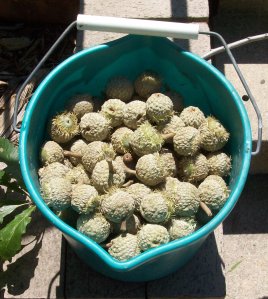
It is dominated by three Burr Oak trees planted from acorns collected the year our daughter graduated from high school. One tree for each of us. It is adjacent to a row of lilac bushes plants in 1994. As drought conditions often plague Iowa, accompanied by scorching heat, it is better to plant some vegetables in a partly shady area. Shade creates a longer growing season for lettuce and reduces the amount of watering needed. The three oaks and lilacs are staying for now, although eventually may be thinned.
On the north side of the plot are some spring flower bulbs transplanted from the Indiana trucking terminal where I worked. They grew in the ditch near Highway 41 and were likely planted by a previous owner. They bloom faithfully each year and need to be dug and separated.
Next to the flowers is what used to be a row of iris. They are dying and what’s left needs to be dug and separated. Only an occasional flower now appears.
The rest of the plot was planted in garlic rescued from the town library. It eventually spread to cover the entire plot. A few years ago I placed tarps over the middle of the garlic patch to store stakes, cages and fencing. Each spring garlic pops up around the tarp perimeter. I harvest it for spring garlic, otherwise let it grow wild.
This year I pulled up one of the tarps and planted Turk’s Turban and Acorn squash. Both produced and some wait on the counter to be used.
This is the first year I tried an annual crop in plot one, and based on the results, I might try more. The near continuous shade makes crop selection the essential dynamic. While we enjoy the spring garlic, we should convert production to a regular, annual cycle of planting and harvesting garlic cloves. It is not too late this year, but with continuous daily work outside home until November, it is doubtful I’ll get a crop in.
Plans for next year: dig up the bulbs, separate and move to a more decorative spot in the yard; try an early spring crop like turnips, beets or radishes; till the entire plot after spring crop, evaluate, and likely plant beans to fix nitrogen in the soil; plant garlic in the fall.
(EDITOR’S NOTE: I send more letters to the Des Moines Register than get printed. This topic has been well covered in the news, so I doubt they will run it. Will post a link if they do).
There’s a bitter irony in the letter Iowa’s two U.S. Senators sent the U.S. Army Corps of Engineers Sept. 27 regarding $73 million in funding for a Cedar River project for flood risk management authorized but not funded by Congress in 2014.
The tough, clear message from Senators Grassley and Ernst to the Corps is find the money for the project in your budget. The irony is there will be no specific appropriation by the Congress to meet the needs of Iowa’s second largest city.
The Iowa Department of Natural Resources indicates on its website that eastern Iowa can expect increased frequency of precipitation extremes that lead to flooding. The need for the project is real.
While Iowa’s Senators have taken the Corps of Engineers to task for not prioritizing the Cedar River project, their effort to tie the Corps to the whipping post are transparent in this election year.
The letter is what austerity policy looks like. It’s not good for the people of Cedar Rapids or for other flood impacted areas in Iowa.
Instead of drafting terse letters, show us how Cedar Rapids gets funding for the Cedar River project.
These rechargeable, portable batteries power our mobile phones, tablets, laptops and cars, providing longer battery life, low self-discharge, better recharge life and comparatively low weight.
Many of us take these benefits for granted, not thinking much beyond the brand of our phone, computer or car — other than the fact it is better with a lithium ion battery.
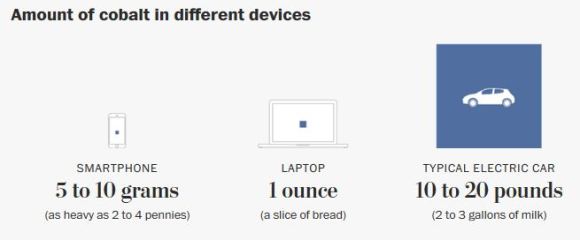
There are issues with cobalt, a key element in lithium ion batteries, mined and produced in the Democratic Republic of Congo.
The world’s soaring demand for cobalt is at times met by workers, including children, who labor in harsh and dangerous conditions. An estimated 100,000 cobalt miners in Congo use hand tools to dig hundreds of feet underground with little oversight and few safety measures, according to workers, government officials and evidence found by The Washington Post during visits to remote mines. Deaths and injuries are common. And the mining activity exposes local communities to levels of toxic metals that appear to be linked to ailments that include breathing problems and birth defects, health officials say.
“60 percent of the world’s cobalt originates in Congo — a chaotic country rife with corruption and a long history of foreign exploitation of its natural resources,” Todd Frankel of the Washington Post wrote. “A century ago, companies plundered Congo’s rubber sap and elephant tusks while the country was a Belgian colony. Today, more than five decades after Congo gained its independence, it is minerals that attract foreign companies.”
Image Credit – Washington Post
Cobalt is not covered under U.S. law regarding conflict minerals. When Congress passed the Dodd-Frank Act in 2010, it directed the U.S. Securities and Exchange Commission to draft rules for companies that use conflict minerals — tantalum, tin, gold and tungsten — when deemed “necessary to the functionality or production of a product.”
“Congress enacted (this section) of the Act because of concerns that the exploitation and trade of conflict minerals by armed groups is helping to finance conflict in the DRC region and is contributing to an emergency humanitarian crisis,” according to the SEC web site.
Some advocate inclusion of cobalt in Dodd-Frank rules.
Conditions among cobalt miners in the Congo are deplorable compared to hipsters who use phones in part produced by their hands. Can hipsters live with Congolese cobalt?
Our social responsibility regarding Congolese extraction and production of cobalt is unclear. Like much of the work that supports our global supply chain cobalt mining has been out of site and out of mind. There is no adequate, intuitive answer. Nonetheless, users of lithium ion batteries share responsibility for the conditions in Congo whether we are aware of them or not.
Two hours before my shift at the orchard I was feeling punk. I went to work anyway.
While ringing up a dozen customers I felt light headed and a bit nauseous so my supervisor sent me home. She didn’t want whatever I had to infect other workers. Good call on her part.
After two four-hour sessions of sleep, I feel much better and am ready to head over again later this morning. Before I do, some last thoughts about this 96-hour staycation in Iowa.
I’m lucky to have worked a full career that paid our mortgage and helped put our daughter through college. There are plenty of people who work low-paid jobs like mine who don’t have that kind of financial platform for support. To make up the difference between income and operating expenses we’ve taken on some debt. We feel it’s manageable and have a plan to pay it off. Like most anyone should, we watch our cash flow. We also have been able to weather multiple challenges in recent years that would have sent others to the poor house if such a thing still exists.
Everything on my “deal-with list” has been addressed. Some things — car repairs, understanding and signing up for Medicare, writing about the Cedar River flood — came easily. Others — financial planning, longer writing projects, producing value from life as a sixty-something — present longer term challenges. What I wrote on Sept. 11 proved to be useful.
The key to dealing with this and everything else on my deal-with list is to take care of myself and not freak out. That I have this blog helps with the not freaking out part. There is solace in work.
I haven’t freaked out and am taking better care of myself as the staycation ends.
Sliced Red Zeppelin Onions
Canned goods were moved to the lower level where the storage rack is once again full. The production was less than in previous years, but focused on items we will use well over the coming months. Gardening is a perpetual process and this year produced in abundance. The trouble was August when I worked four jobs without adequate time to reap what I sowed. It was a learning point more than disaster and local farmers helped me make up for what was missed at home.
Remaining is fall yard work, home maintenance, financial planning, and most importantly writing. The reason for retiring in July 2009 was to enable my writing. I’ve gotten better at it and am ready for something longer, maybe book-length, which can be promulgated. That and ensuring our sustainability in a turbulent world remain on the deal-with deescalated to to-do list on my white board.
Better prepared to tackle today’s challenges, I’m hopeful. Hopeful about the lives of family members. Hopeful about the community of friends and acquaintances we’ve built here in Big Grove. Hopeful our country will make sound decisions during the Nov. 8 election.
Whatever the outcomes, the brief vacation this week helped get me back to who I am. I’m thankful for that and ready to engage in society again.
Without a home apple crop, this year’s batch is a little different.
The continuum of vinegar making goes back a long time: it’s the mother. Mine was procured from a neighbor and has been present since I began home fermentation of apples. His mother of vinegar had been in the family since the 19th century when Iowa was first settled. Traces of vinegar have been found in Egyptian urns dated the third millennium BCE.
The recipe for vinegar is simple. Keep a container of vinegar with the mother in the pantry and add apple juice from time to time. Cover with a cotton cloth for ventilation and let it ferment. After the bacteria have converted sugars to alcohol, then alcohol to vinegar, it’s ready to bottle and use. Currently there is a gallon ready to use and a gallon just started this year. At least one jar never goes empty to preserve the mother.
My production is small compared to the orchard where I work on weekends. We both use the same mother, although he uses brewer’s yeast to hasten production of alcohol. My method, using apples from my back yard and no yeast, works as well but takes more time. Making vinegar is about time more than anything.
This year I stopped at a shop that caters to people who ferment their own beer and wine to ask about brewer’s yeast. The proprietor said I was the first customer to arrive asking about making vinegar. Not a lot of people make their own.
After studying a few things on the internet he recommended a yeast made by a major company that would produce about 14 percent alcohol. He said too much alcohol may kill the vinegar bacteria. Both of us thought the low end of alcohol production would not. The $0.99 packet I bought will ferment a lot of apple cider.
Without a crop at home, I’m using cider from where I work. It is flash pasteurized, which will allow my bacteria to drive the process. I hope it is a better result. I bought half-gallon Mason jars for the project and have two started about 3 weeks apart.
I trimmed the mother with a pair of kitchen scissors and put part in the jar. I added a scant half gallon of cider and let it warm to room temperature. I added a 16th teaspoon of yeast which began producing alcohol within a couple of days. The liquid tastes more like hard cider today with hints of vinegar. The process appears to be working.
I organized and bottled last year’s production and am ready for winter. I’ll keep making it and making pickles and dressings with it.
Making apple cider vinegar is one way we emulate an agrarian life in a modern kitchen. It’s also how we sustain our lives in a turbulent world.
Only after a couple of days away from daily routine can a person begin to be themselves.
That’s where I am this morning.
I crave a place to work.
Desire is a blessing and a curse. When we want something, we set ourselves up for disappointment. We may get it, but can’t always get what we want.
It is a difficult path to nirvana. I do my best to void consciousness of self. It persists. There are selfies.
Like Eugene Henderson we feel restless and unfulfilled, harboring a spiritual void that manifests itself as an inner voice crying out I want, I want, I want.
Work is a cure for that.
Busy hands make happy children and happy children build a new world.
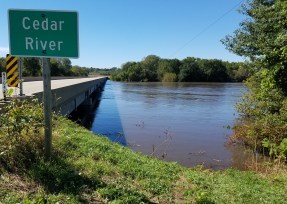
Cedar River at Iowa Highway One on Sept. 27, 2016 at 11:36 a.m.
The Cedar River crested in Cedar Rapids at 21.91 feet at 11 a.m. yesterday.
As the river recedes over the next few days the temporary flood wall and earthen berms built over the weekend will be monitored for breaches.
They held during the crest, protecting people and property from damage. Here’s a link to a news story about the flood.
State Senator Rob Hogg announced a “Flood Relief, Recovery and Resilience Tour” of Cedar Falls, Waverly, Clarksville, Shell Rock, Charles City, Vinton and Palo today and tomorrow. Hogg hopes to learn about the damage done, what kind of help people need, what worked and what didn’t work, and how we can do more together to reduce future flood damage, including better flood mitigation infrastructure and better watershed and floodplain management according to the event page on Facebook.
The City of Cedar Rapids knew what to do when flooding was predicted after heavy precipitation events upstream. Over the weekend officials executed a plan to build a temporary flood wall, evacuated low-lying areas and ramped up emergency services to prevent large-scale damage to homes, property and people living in Iowa’s second largest city. News media stories focused on the human drama of reaction to the impending flood. There has been little coverage of the causes of the heavy precipitation events that produced rain that caused the flooding in northeastern Iowa.
“Iowa is already experiencing the effects of climate change,” according to the Iowa Department of Natural Resources website. This includes “increased frequency of precipitation extremes that lead to flooding.”
Flooded Farm Near the Cedar River, Sept. 27, 2016
Because this is the second major flood in Cedar Rapids since 2008, solutions to protecting people and assets going forward have been discussed and are clear.
Senator Hogg outlined three essential strategies: get Congress to help fund permanent flood protection that has already received state and local funding; better upstream watershed and floodplain management to reduce peak flooding; and action on climate change to stop extreme precipitation events from getting worse.
U.S. Senators Chuck Grassley and Joni Ernst sent a letter to the Army Corps of Engineers “demanding answers on why they have neglected to complete flood mitigation projects in the Cedar Rapids region and have put the public’s safety at risk.”
They wrote:
With all due respect, it is no longer sufficient to say that your hands are tied and that nothing short of a congressional earmark can help communities like Cedar Rapids that have lower property values. You have some discretion to help and have simply made the decision to forego the assistance even though the community endured a 500-year flood event in 2008, worked with the Corps to develop a project to address that flood risk, and worked with Congress to get it authorized. Due to your refusal to budget for this project, Cedar Rapids is now facing another major flood event without the needed levee improvements.
Hidden in this tough language is a bitter irony. Congress won’t appropriate money for the project, yet the senators expect the Corps of Engineers to find it somewhere else in their budget. This is what austerity policies look like and they are not good for the people of Cedar Rapids and other flood impacted areas.
While Iowans impacted by flooding are concerned, in the upper atmosphere carbon dioxide levels maintained a level above 400 part per million according to monitors in Hawaii. Atmospheric carbon dioxide level is a key contributor to global warming which increases the intensity of precipitation events that have led to Iowa flooding.
“September is usually the month when carbon dioxide is at its lowest after a summer of plants growing and sucking it up in the northern hemisphere,” Brian Kahn wrote in an article on Climate Central. “As fall wears on, those plants lose their leaves, which in turn decompose, releasing the stored carbon dioxide back into the atmosphere. At Mauna Loa Observatory, the world’s marquee site for monitoring carbon dioxide, there are signs that the process has begun but levels have remained above 400 ppm.”
The United Nations Intergovernmental Panel on Climate Change’s fifth Assessment Report notes that, “continued emission of greenhouse gases will cause further warming and long-lasting changes in all components of the climate system, increasing the likelihood of severe, pervasive and irreversible impacts for people and ecosystems.”
That means more flooding in Iowa similar to this week’s event. While politicians like Senator Hogg are well-attuned to the urgency of this climate crisis, too many politicians and public officials are dismissive of climate change.
Governmental action to mitigate the effects of climate change is needed. If our current crop of politicians isn’t willing to take action, we should replace them with people who will.
A political meet up, dinner using orchard-fresh apples, watching the presidential political debate on my phone, and five hours of sleep highlighted the first 12 of 96 hours of vacation this week.
I need to get more rest, but not now. Not today.
Awake and writing, soon to be picking detritus from the yard, I expect to spend most of the day outside. According to my weather widget, sunrise is three hours away with zero percent chance of precipitation until after sundown.
The beginning of soup is on the stove — three jars of tomato-y liquid from the ice box and a bag of onions. I’ll add vegetables and seasonings from the garden, ice box and pantry through the day, progressing toward a peasant’s meal tonight.
In the United States we aren’t peasants and homegrown vegetables owe fealty to no one. Raising vegetables is a revolt against those who would enslave us.
I paid my taxes so the land is ours… at least for now. Property rights are an American common denominator stronger than any political party. Having dispossessed those who lived here before, we are free until someone dispossesses us.
A long list of tasks resides on my phone. I left the device on the night stand while I bask in this window of freedom before sunup. Feeling the breeze from the lake, and for a brief moment, being myself against the wind — resisting for a while, then giving way to its cool waves in the predawn darkness.
Extreme One-Day Precipitation Events in the Contiguous 48 States. Bars = years; line = 9-year trend. Image Credit: U.S. EPA
The headline from this morning’s Des Moines Register was that residents of 5,000 Cedar Rapids homes were asked to evacuate in advance of the flood crest predicted to arrive Tuesday morning. The height of the crest has been revised downward to 23 feet, however, damage is expected to be severe.
Cedar Rapids fire officials plan to ask for the names of next of kin of residents who refuse to leave the flood zone.
City officials say government has been preparing for a major flood since the record-breaking 2008 event.
There is bravura in the execution of the local preparations indicating the city knows how to mobilize to prevent anticipated damage — better than it did in 2008. It is always good to see people coming together in times of natural disaster to help each other.
At the same time, almost everyone in government, in news media and in other accounts of the disaster fail to consider the root causes of the heavy precipitation events driving record flooding. The world continues to annually dump more than 38 billion tons of carbon dioxide into the atmosphere like it was an open sewer. That’s 2.4 million pounds per second.
News media and politicians may be enamored of the story of human resistance to the forces of nature, but failure to address the root cause of increased levels of carbon dioxide and other greenhouse gases in the atmosphere through proper governance should be unacceptable.
Government plays a significant role in mitigating the effects of climate change. Perhaps it’s time we changed the current crop of politicians who fill elected office seats from those who are cheer leaders for reaction to natural disasters to those who will take action to prevent them.
Without action, the chart above from the U.S. Environmental Protection Agency will continue to map a direction that puts people and assets in jeopardy.
We should know better and do something about global warming and climate change as a society.
Godspeed Cedar Rapids. May your elected officials who don’t already do so perceive tomorrow’s flooding as a wake-up call to action.
Things are falling apart so Tuesday I begin four days paid vacation from the home, farm and auto supply store. I plan to catch up around the house and run a few errands in and near the county seat — and try to regain a sense of being in control.
It is time to deal with existential realities in the life of a sixty-something.
There is a lot of crap going on.
As I posted Friday, autumn began with a flood, one wholly predictable, but still catching many by surprise. Politicians talked about doing something after the 2008 flood to mitigate future flood damage. Not much talk turned into action. One doesn’t need to be Jeane Dixon to predict there will be more, similar flooding caused by heavy precipitation events during the next ten years.
The presidential election is sucking up space to the extent even I’m tuning it out. Tomorrow is the first televised debate between Hillary Clinton and Donald Trump. If it is streaming I’ll tune in for as long as I can take it (still haven’t solved the problem of owning an analog television set).
Trump is a ridiculous candidate supported by many of my neighbors and co-workers. The Republican Party of Iowa appears to be running a superior ground game when compared to the Iowa Democratic Party. However, this presidential election is changing the rules, tactics and values of ground games. If both parties have mastered similar Get Out The Vote practices, the next winner will breakout with something new. Trump is trying to do that. The outcome is uncertain even if Clinton continues to lead in the polls. Trump would make a disastrous president if elected.
Perhaps a few days of retreat will help me get centered and facilitate positive action going forward. At least that’s the hope. Right now it feels like crashing into September with a long skid into insanity if I don’t do something about it. I intend to take corrective action.







 Journey Home
You must be logged in to post a comment.