Among other things, participating states pledge to “commit to work together to advance a global aspirational goal of tripling nuclear energy capacity from 2020 by 2050, recognizing the different domestic circumstances of each Participant.” The problem is adding nuclear capacity by 2050 is not fast enough to address the climate crisis. In essence, the declaration is yet another delay tactic by moneyed interests. Like it or not, we are set to blow past a temperature rise of 1.5 degrees Celsius. We can’t wait for nuclear power, especially when effective, easier to implement, and less expensive alternatives are available.
This 60-second video by Stanford Professor Mark Z. Jacobsen cuts to the chase. Time is running out.
Sunday evening, my congresswoman released a statement after attending COP 28. It includes this sketchy language about nuclear power: “advanced nuclear energy is being revisited to provide capacity and dispatchable continual base load to the energy mix.” In other words, she didn’t get the word that ten years ago, Iowa had an opportunity to build new nuclear power capacity and pulled the plug on it.
As Professor Jacobsen said in this video, new nuclear energy is no help whatsoever in solving the climate problem. We should proceed on that basis.
One of my long-standing beliefs is nearby Iowa City is a safe haven for LGBTIQA+ people. It is a place where people can live without undue fear and be who they are. It was, anyway. I recently heard the LGBTIQA+ community is breaking up. Folks are moving out of state to escape the regressive policies of our Republican state government. Governor Kim Reynolds has been the lynch pin in persecuting LGBTIQA+ folks and her supporters cheer her on. If what I heard is accurate, this is a sad legacy. We need a haven for the vulnerable until broad acceptance of diversity is forthcoming. By the fact of Iowa City being the county seat the haven it has been exists, yet seems under pressure.
I have been insulated from this because I don’t live or do much in the county seat. My LGBTIQA+ friends are long-standing and rooted. They are friends, not members of some group. When we get together we discuss important stuff like which schools are best, which clinics provide good health care, and politics, of course. This is what normal people do.
Changing perspectives of our lives in contemporary society is part of living. As Iowans abandon the countryside in favor of living in large metropolitan areas, there will be diversity in cities. That it is concentrated is more the problem. Like every other time in the state’s history diversity can cause isolation, alienation, and conflict. People literally get run out of small towns and cities because they are different. Unless one was born and grew up in Iowa, there is no reason to stay. My issue as a native Iowan is I don’t know where I would go if I left.
All of this makes life more difficult for an aging American. It would be great to invite LGBTIQA+ family members to move here and find a home closer to ours so we can spend more time together. They could be their authentic selves, including being part of our family. That remains possible in a more liberal county like ours, yet the freedom needed to perpetuate this culture is being eroded.
We’ll see where this ends. What I now understand is I must be more attentive to diversity in the county seat as well as where I live. If I am not, there will be safe havens no more.
It was 2:30 p.m. by the time I took my daily walk along the lake trail. Many people were out as the ambient temperature approached 50 degrees Fahrenheit. It was a wholly different community in the afternoon compared to morning.
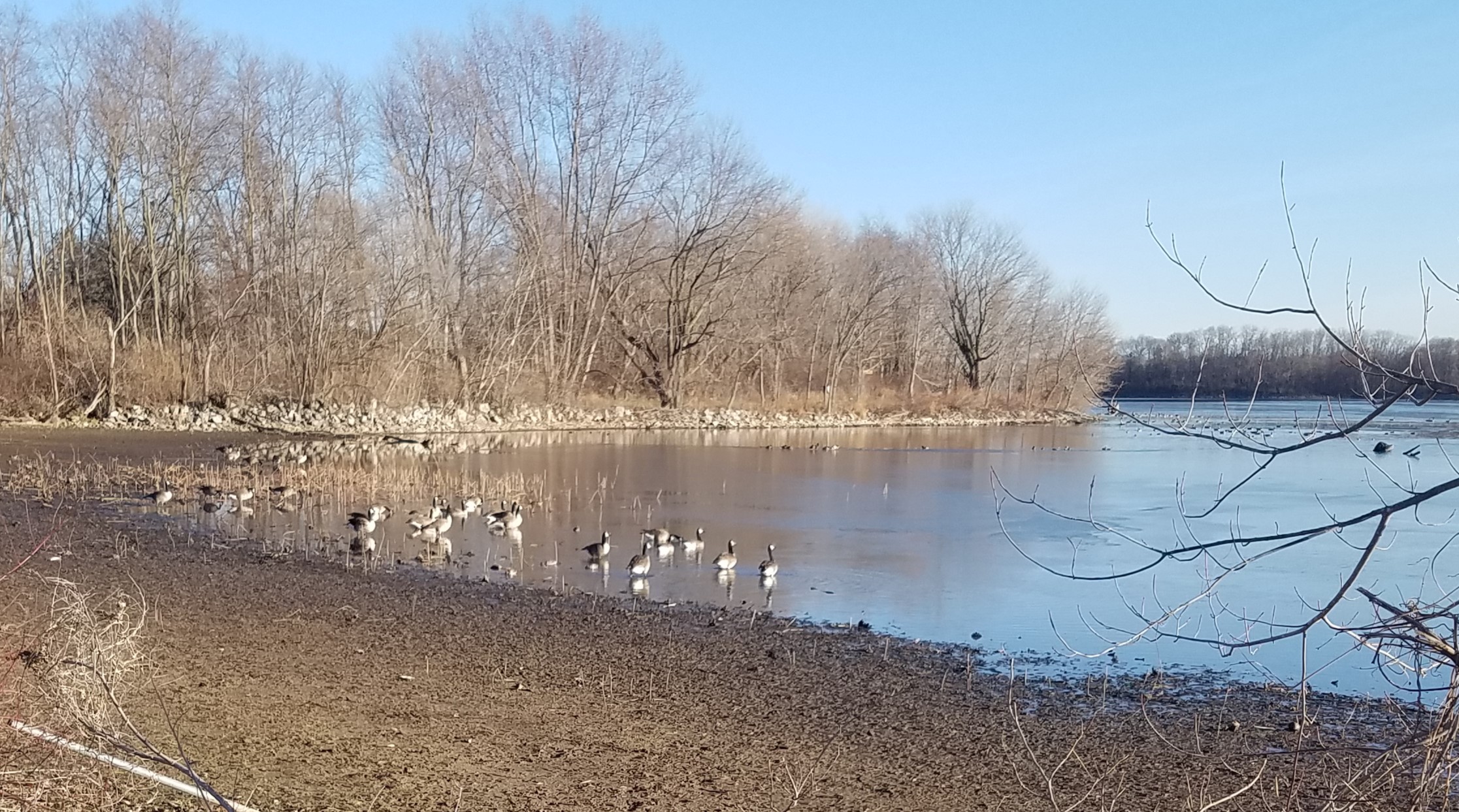
A large flock of geese swims on the lake. I don’t know why they linger. Ice had formed on parts of the surface, and waterfowl took to standing on it in groups. If it remains this warm, I’m not sure they will migrate further south. The lake has plenty in it to nourish them.
I was told by someone close to me I get a bit grouchy during winter. The warm weather encourages me to get outdoors, although communing with geese and other waterfowl doesn’t seem to relieve the condition. Breathing outdoors air is good for us, and the stench from nearby hog lots has mostly been absent. When spring comes farmers will spread manure on their fields and we locals will notice. This is part of living in Iowa, although anymore, grouchiness is endemic to living in the United States. We should treasure those among us who can resist this.
While checking the mail toward sunset, my neighbors were outdoors with their small children in the warm air hanging colored lights on a tree for the holidays. While walking back to the house, I remembered when our child was little. I said “hello” and minded my own business. Those early family memories are precious and fleeting. I didn’t want to intrude.
And so it is, we are living a life and then all of a sudden realize it is shorter than we thought it would be. My reaction to winter is to nestle into my writing room, turn on the space heater, and try to make progress on my autobiography. I also avoid thinking about my ultimate death and return to dust. Except for the manure spreading farmers, I look forward to spring. So it goes.
Lafayette Flats, Buffalo, New York. Photo Credit – Wikimedia Commons.
Millennials seem unlikely to purchase homes in the same numbers as my cohort did. So many are sharing an apartment or house and paying rent. It becomes difficult for them to build equity the way I did when we paid down a mortgage. There are other consequences of living with others in a shared apartment or house.
The worm has turned on millennial home purchases according to some. When student loan payments were paused during the coronavirus pandemic, newly available funds were directed into home-buying. According to CNN, “The Department of Education said Wednesday it has approved the cancellation of nearly $5 billion more in federal student loan debt, bringing the total amount of student debt relief provided under the Biden administration to $132 billion for more than 3.6 million borrowers.” This should be a catalyst for more home-buying in the millennial cohort. Maybe they will catch up.
The other part of this financial equation is the lack of good-paying jobs. In part, this is driven by consolidation and outsourcing of functions in the business world. Pay packages have changed so more of compensation goes into hourly wages or contractor fees. Thanks Ronald Reagan and the Republicans for this crappy economic environment for younger people.
The change in types of jobs available also has to do with automation. The automation revolution began some time ago, yet it is taking off with force in 2023. Anything that can be done by a computer or robot will be. Human workers? Not needed as much any more.
Stuck living together with unrelated others is an issue, in particular, during the continuing coronavirus pandemic. According to the University of Minnesota, older adults made up 90 percent of U.S. COVID deaths in 2023. While the younger people the virus targets may be less likely to die of COVID, they continue to get sick and it’s debilitating. A goal for mixed households is to prevent the coronavirus from entering the residence. If it does get in, isolating individuals so they don’t contract it in close proximity to each other is a priority. For some that means shutting the door to a private room if they have one and not leaving one’s room except to use the plumbing.
I had a conversation this week about what food could be eaten in isolation from COVID without going to the kitchen or refrigerator often. It came down to only items that could be eaten as is, or made with boiling water. It didn’t take long to develop something both nutritious and filling. I had some ideas to contribute to the conversation.
When I was younger, I rode buses a lot. From time to time I encountered Hispanic men heading North for agricultural work from Mexico and points south. They solved the food issue for a long journey by making a meal of two cans of food: one beans with sauce and the other some kind of vegetable. They carried the full trip’s supply with them in their bags. It was shelf stable, filling, and reasonably nutritious. They could eat them while standing in a bus station and did.
When my group of Army officers left Germany in 1979-80, one of my buddies was assigned to the U.S. Army’s Fort Natick Labs. He participated in development of meals, ready to eat (MREs). Modern versions of these are available to the public, yet are too expensive for a person who has to share an apartment in order to live in a large city. They make nutritional eating, and people keep them in their bug-out bags to use in case of an emergency. The reality is there exists a generation that can’t afford to live, even in the most ideal economic circumstances, let alone in difficult situations during a time of contagion.
Eventually all the housing stock will become available as older generations die off. Perhaps prices will decline enough for millennials to buy. When I was born, I came home to a three generation home where an aunt and uncle lived along with Grandmother, Mother and Father. It was how they coped with limited income from mostly menial or low-skilled jobs. If I believe being related to housemates makes a difference, it’s because I have experience it has. Multi-generational households are a tradition that goes back deeply into my Appalachian roots. My forebears were dirt poor in many cases.
Being unrelated to others in a shared house is something different, though. I don’t have good advice for those who must do so. What may be the first step is realizing shared households have become a permanent fixture in the American landscape, a significant change from what has been. With such acceptance may come peace of mind if not riches. Peace of mind is well needed in a modern society that evolved around wealth migrating to the richest among us. It’s become a place where we must fend for ourselves.
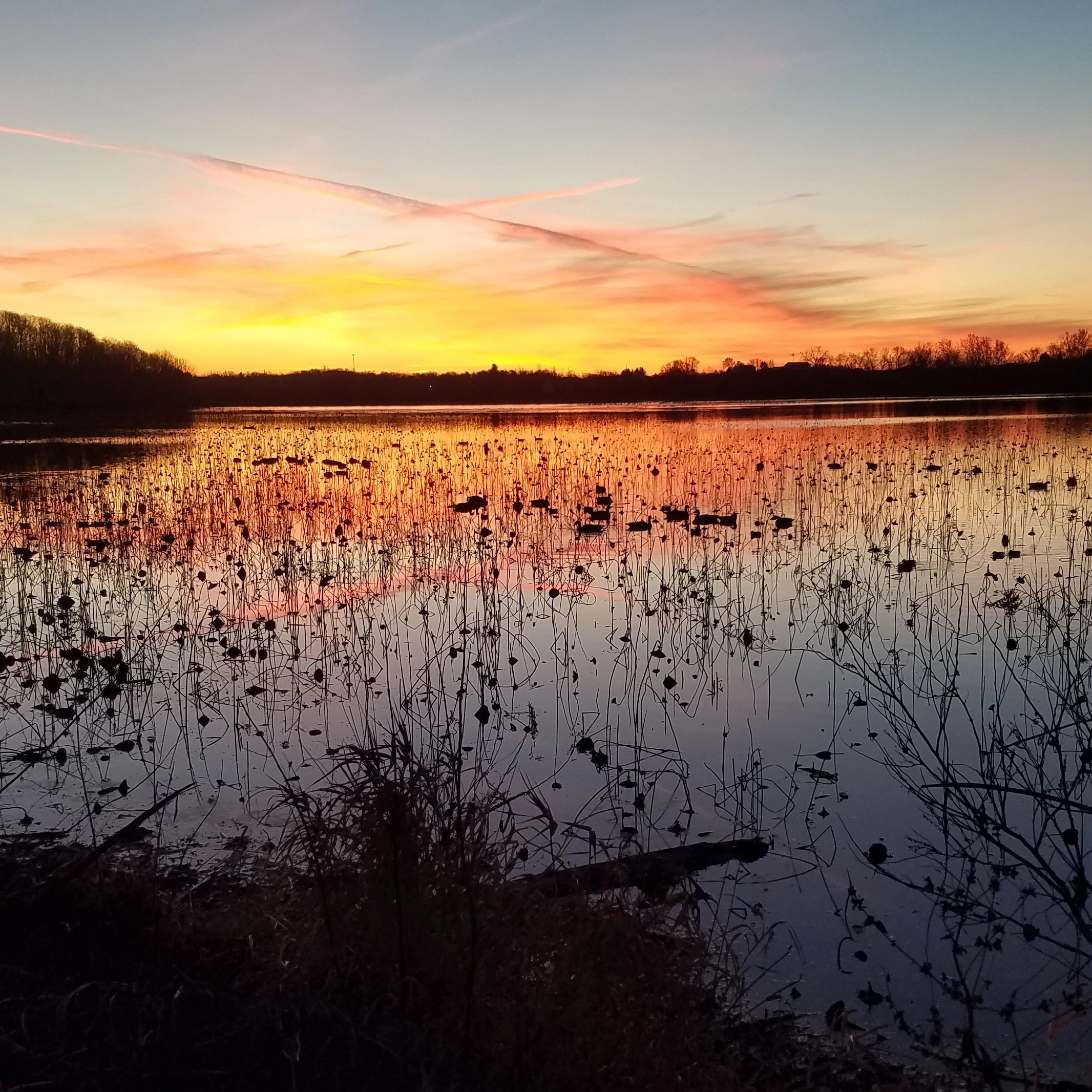
Waterfowl swimming in dawn’s light on Dec. 7, 2023.
The nearby City of Solon contributed about $1,000 to a four-year study of the Silurian Aquifer. By comparison, The U.S. Geological Survey contributed $153,000, Johnson County contributed $310,700, and the City of Marion, much larger than Solon, and a subject of the 2011 Silurian Aquifer study, didn’t give one penny. Johnson County is hosting the study and expected to eat cost overruns of about $50,000 thus far, Josh Busard, Director of the Johnson County Planning, Development and Sustainability Department said in a meeting I had with him yesterday.
I’ve been following sustainability of the Silurian Aquifer, where much of east-central Iowa draws groundwater, for almost 20 years. The meeting with Busard was prompted by County Supervisor Rod Sullivan after I sent him a link to this post. After the meeting, the good news is there is plenty of groundwater for the next couple years. Cut to the chase: Y’all should be conserving water where ever you live. The study is about a year from completion, said Busard.
The study is important locally because Solon, Tiffin, and North Liberty are among the fastest-growing cities in the state. Solon alone grew 50 percent in the 2020 U.S. Census. If Solon does nothing more than build out already approved subdivisions within city limits, it could easily add another 750 to 1,000 residents. That’s not to mention the many subdivisions surrounding the city. Each new person will bring increased demand for water. The entire area draws from the Silurian Aquifer.
I have a lot to say about what the study does and doesn’t do. I’ll save that for another post.
The main outcome of my meeting was to get up to date on what the county is doing. It is always positive to find someone else working on the same issues. We had a good conversation. Busard sent me some public documents to which I link below. If interested in the sustainability of the Silurian Aquifer, I recommend you read them.
Yesterday I updated my profile picture across much of my internet presence. The 2011 image I had been using was taken in our garden by my spouse. That I’m now choosing a selfie is a sign of the times, the meaning of which is to be determined. Eventually the new image will be propagated throughout my accounts. I felt it was time for a change. An indoor shot in lieu of a garden image is indicative only of the season in which it was taken. The books in the background? Don’t make too much of those as it was a setting of convenience. In December it’s time to move most activities indoors and I spend a lot of each day in my writing room where there are shelved books.
The more impactful change is deactivating my X account on Nov. 22 after 15 years on the platform. That, combined with becoming more active on Threads decreased my personal mental tension almost immediately. I’ll miss certain people and accounts from X, yet the clean break will serve me longer term. So far, so good with Threads. There is so much more positive engagement on Threads it’s hard to believe that vibe will persist. In any case, there’s no going back to X.
I think the myth of the “big account” sustains X. That is, folks there feel like all the key players for their conversations remain. Likewise Threads in particular, but other new microblogging sites as well, have a paucity of news accounts. Some great news and commentary folk from X are moving or setting up accounts on other microblogging platforms, yet don’t post a lot. X is not dead, but gonna die, I predict, once news and political accounts abandon it. For now, I have newspaper subscriptions to get news when I need it. If I get desperate, there is always radio and cable television to backstop me.
As the year winds down, it’s time for budgeting as well as determining if this life in Big Grove Township is sustainable. Living on a fixed income has been challenging. I hope we can make it this way for a long while. Sadly, in American society, life is more often about financial numbers than fulfilling our wants and needs. This blog is an attempt to change that.
Will the Silurian Aquifer have enough water to support the population that draws from it? Answers to that question are a bit sketchy due to infrequent research into groundwater projections. A 2011 study published by the Iowa Department of Natural Resources had this to say about nearby Coralville, which draws water from the Silurian Aquifer.
The City of Coralville may have to limit its future withdrawal of water from the Silurian aquifer to maintain the sustainability of the resource. Contingency plans should be prepared by the City of Coralville to evaluate alternative water sources.
Groundwater availability modeling of the Silurian Aquifer in East-Central Iowa, November 2011.
Read that quote again and say after me, “Yikes!”
Last summer, water usage on our community’s public water system surged with the drought. We are also on the Silurian Aquifer. So much more water was used during the worst days of drought the well faltered. We instituted voluntary conservation practices and the issue resolved. Usage dropped by 26 percent the following month. The question repeats itself. Will there be enough water in the aquifer?
In 2006 a similar study was published by the U.S. Geological Survey. While I was on the board of health, we reviewed it, and saw it’s conclusion that until 2025, projections indicated there would be enough water to serve the population. That was good enough for the Public Health Department and the Board of Supervisors. It may be time for a new survey, and perhaps one of the involved entities has already undertaken it. I hope so. The message was clear in 2011: decrease reliance on the Silurian Aquifer.
Things have shifted. Two of Big Grove Township’s neighboring cities, Tiffin and North Liberty, are among the fastest growing in Iowa. All those people will need water and their public water systems draw from the Silurian Aquifer. Similarly, there has been an exodus of population from rural parts of the state with many moving to urban areas where there are jobs, healthcare, and commerce. This also creates more localized demand for groundwater. Finally, our rivers have been a source of drinking water, as they are in Iowa City. Surface water quality in Iowa continues to get worse with extractive agricultural operations going on in almost every square inch of the state. For how much longer can cities rely on river water for humans to use? Drawing more from the Silurian Aquifer may not be a reasonable alternative when Coralville is being told to make other plans.
My point in this post is ground water is not a limitless resource. We should each be taking steps to minimize household use and if on a public well, use more of our water during off peak hours. The talk about water used for flushing the toilet, watering the lawn, and fixing household leaks is not a liberal conspiracy. Conservation benefits everyone.
We don’t know if there will be enough water for human populations. We cannot live without adequate water and our scientists and governmental organizations should make sure the projected usage models are accurate, and then work on solutions to shortages. If the Silurian Aquifer goes dry we are in for a wake up call. I predict it won’t be pleasant.
Editor’s Note: I checked with the county and, in fact, a new study of the Silurian Aquifer is in progress. Looking forward to reading it when finished.
A person wouldn’t know it in Big Grove Township yet today has been designated a Global Day of Action Against Nuclear Weapons by the International Campaign to Abolish Nuclear Weapons (ICAN). This is in advance of the upcoming Second Meeting of States Parties to the Treaty on the Prohibition of Nuclear Weapons (TPNW) which convenes tomorrow in New York.
All around the world, people will be taking action to demonstrate to meeting delegations that we expect them to be bold, courageous and use the TPNW to dismantle nuclear deterrence, and make sure the rest of the world is paying attention to this crucial opportunity. “Your action can take whatever shape you can pull off,” ICAN said in a statement.
Absent interested others near me, this post is what I can pull off.
While the TPNW entered into force on Jan. 22, 2021, it has not been ratified by the countries that possess nuclear weapons. The United States has turned a blind eye to TPNW. It does not appear any of the nuclear states will break the silence and ratify the treaty any time soon.
During negotiation of the Nuclear Non-proliferation Treaty (NPT), signed in 1968, it was agreed by the parties nuclear weapons should be eliminated and the parties should work toward that end. If anything, the risk of detonation of nuclear weapons is as great as it has been. The conflicts in Ukraine and the Middle East created risk that one of the players (Russia and Israel particularly) will use nuclear weapons. People forget the devastation in Hiroshima and Nagasaki in 1945 so we may be bound to repeat that error.
While our lives are complex and possess numerous challenges, nuclear abolition should be on our radar. One single activist won’t bring about the change we need. Working together, we might. It is worth the effort.
Ahead of Joe Biden and Xi Jinping’s Nov. 15 meeting at the Asia-Pacific Economic Cooperation conference in San Francisco, the parties pledged to strengthen their cooperation on climate change. The U.S. State Department released a statement detailing areas of agreement. Both presidents pointed to the importance of the upcoming Conference of the Parties (COP 28) that begins Nov. 30, in Dubai, United Arab Emirates.
The luster has gone off the Conference of the Parties, as hundreds of fossil fuel lobbyists participate as delegates to impede progress toward conference goals of eliminating use of fossil fuels. Biden and Jinping’s mentioning COP was important to regenerate interest. Their agreement on climate change was significant, yet hardly noticed in major media.
Members of the Climate Reality Leadership Corps, part of The Climate Reality Project founded by former Vice President Al Gore to address the climate crisis, seeks three outcomes of COP 28.
During a year of record-breaking temperatures and climate disasters, we cannot afford to stay silent. We must ensure that global leaders convening in Dubai hear our demands for an agreement at COP 28 to:
Phase out fossil fuel emissions and stop funding fossil fuel projects.
Increase funding for climate solutions in countries that need it most.
Email from The Climate Reality Project, Nov. 14, 2023.
Fossil fuel interests are fighting any and every advance that leads to a true net-zero economy. My Congresswoman Mariannette Miller-Meeks (R-IA01) has taken the fossil fuel companies’ positions and attended COP 26 and COP 27. In a newsletter earlier this year, she wrote:
Americans have suffered the consequences of reckless and misguided energy policy. From day one of his administration, President Biden has waged an all-out war on American fossil fuel production that has contributed to record inflation and weakened our national security.
Miller-Meeks Weekly Script, April 16, 2023.
Miller-Meeks couldn’t be more wrong. The Washington Post recently called out people like her regarding the so-called war on fossil fuels:
Former vice president Mike Pence framed the issue in one of the presidential debates: “On day one, Joe Biden declared a war on energy, which was no surprise, because when Joe Biden ran for president, he said he was going to end fossil fuels, and they’ve been working overtime to do that ever since.”
It sounds just awful. But I have good news for Republicans: U.S. fossil fuel exploitation is pretty much booming. Here are a few stats from this supposed war’s front lines:
After plummeting early in the pandemic, U.S. crude oil production has been climbing and is now back near record highs. That’s according to data released by the U.S. Energy Information Administration. The agency also projects that oil production will hit new all-time highsnext year.
U.S. natural gas production has also been hovering around record highs.
To date, the Biden administration has approved slightly more permits for oil and gas drilling on public lands than the Trump administration had over the same periods of their respective presidencies, according to Texas A&M professor Eric Lewis. (My Post colleague Harry Stevens has previously covered this in depth.)
If “energy independence” means exporting more than you import, we’ve achieved it in spades. The United States has been exporting more crude oil and petroleum products than it imports for 22 straight months now, far longer than was the case under Trump.
When fossil fuel interests and Republicans who parrot their talking points focus on the so-called war on fossil fuels, it distracts society from pursuing solutions to the climate crisis. There are viable solutions to ridding the world of man-made greenhouse gas emissions caused by burning fossil fuels without compromising our quality of life. They distract us because distraction is a time-tested method of furthering their interests while seeking to avoid blame for causing the the climate crisis.
As society races toward exceeding the 1.5 degree Celsius limit in increasing global temperatures since the pre-industrial era, it seems increasingly evident we will wait until it is too late to take action. While Biden and Xi call our attention to COP 28, it seems doubtful the conference will accomplish what is needed. The United Nations Framework Convention on Climate Change is all we currently have to address the climate crisis as a global society. Individual countries doing so is not enough. We’ll see if delegates get serious this December. I am hopeful they will.
A library is curated, which means it inherently contains the biases of the librarian or curator. How will books be organized? When space is at a premium, which go to a thrift shop and which go into a box for potential future use? Which books should be acquired and which checked out of a library? I have a lot of books — a few thousand in my writing room alone. My collection of books, papers and other media is idiosyncratic. That’s as it should be. The meaning of the collection goes little further than the door through which I took this photo. My library mostly serves my writing.
As winter approaches, the pace of my reading increased. I’m reading about 50 pages a day and more if the text is engaging. Since the coronavirus pandemic began I read an average of 58 books each year. A recent Gallup poll found Americans started 12.6 books per year and finished five of them on average. This chart from the poll tells the story that reading books in America is in decline:
When I retired during the pandemic I adopted a firm rule that no matter what, I’d read at least 25 pages per day. This is harder when garden work is in full swing, and easier when I’m more home bound in winter. What I didn’t plan is how to curate the books and papers accumulated since the 1950s. Curation includes acquisition and disposal, two skills I haven’t practiced with consistency in decades.
I used to buy books at thrift shops and yard sales, but I haven’t been to one of those in years. I do buy new books, mostly based on recommendations from people I know on social media or related to my writing projects. The whole thing is hodge-podge and it shows.
Work on my autobiography energized the curating process. In addition to telling my story, writing includes going through possessions the way a Forty-Niner panned for gold in the California Gold Rush. The yield has been more than a few good nuggets.
In addition to preparing a bound book, I hope to reduce possessions by 75-90 percent. You can’t take it with you and our millennial child may never be able to afford a house. Nor would I want them to accept and store all my stuff. When they visit, we discuss what is of interest and what is not. It is a recurring thing we do that I enjoy.
Who knows when I’ll need to refer to a 1920s book titled Rural Sociology? I want to be able to find it when I do. Will I ever need to refer to my facsimile of the 1771 edition of the Encyclopaedia Britannica? With Google I likely won’t need it to gather information, yet there are reasons to keep it… idiosyncratic ones. Should I keep my copy of Charles and Mary Beard’s The Rise of American Civilization, purchased at the local library used book sale to which it was donated by the estate of Alexander Kern? Kern was one of the first American Studies professors in the program in which I matriculated. His more important papers reside in the University of Iowa Special Collections. Don’t get me started on the problems with the Beards’ book. I feel I should keep it just for those issues.
Using the verb to curate is not likely the intended use for what I do with my collection of stuff. Cataloguing the books is out of the question. Like most people, I seek truth and meaning in my life. Part of that is dealing with too many books, papers and media by making something of them the way my forebears mined coal. I want a work product both recognized and useful to others.
Based on the numbers in the Gallup Poll, I’m different from most Americans when it comes to reading and collecting books. I’m okay with being different.








 Journey Home
You must be logged in to post a comment.