The ambient outdoor temperature is 89 degrees and the heat index is 100. Another midday spent inside.
I feel caged.
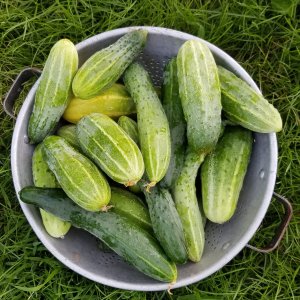
Near sunup I harvested cucumbers and watered. I tasted a red tomato — they are not ready.
Won’t be long.
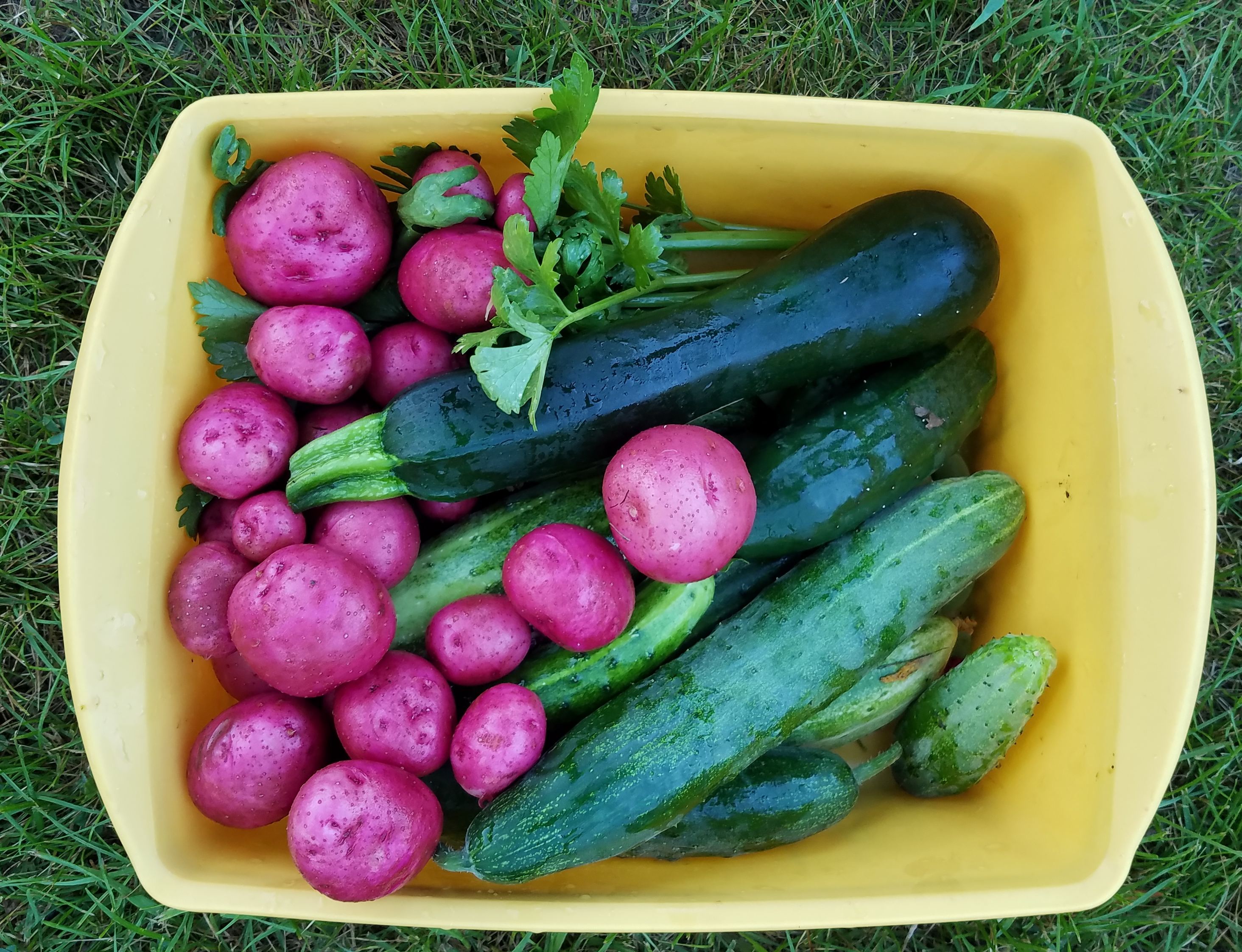
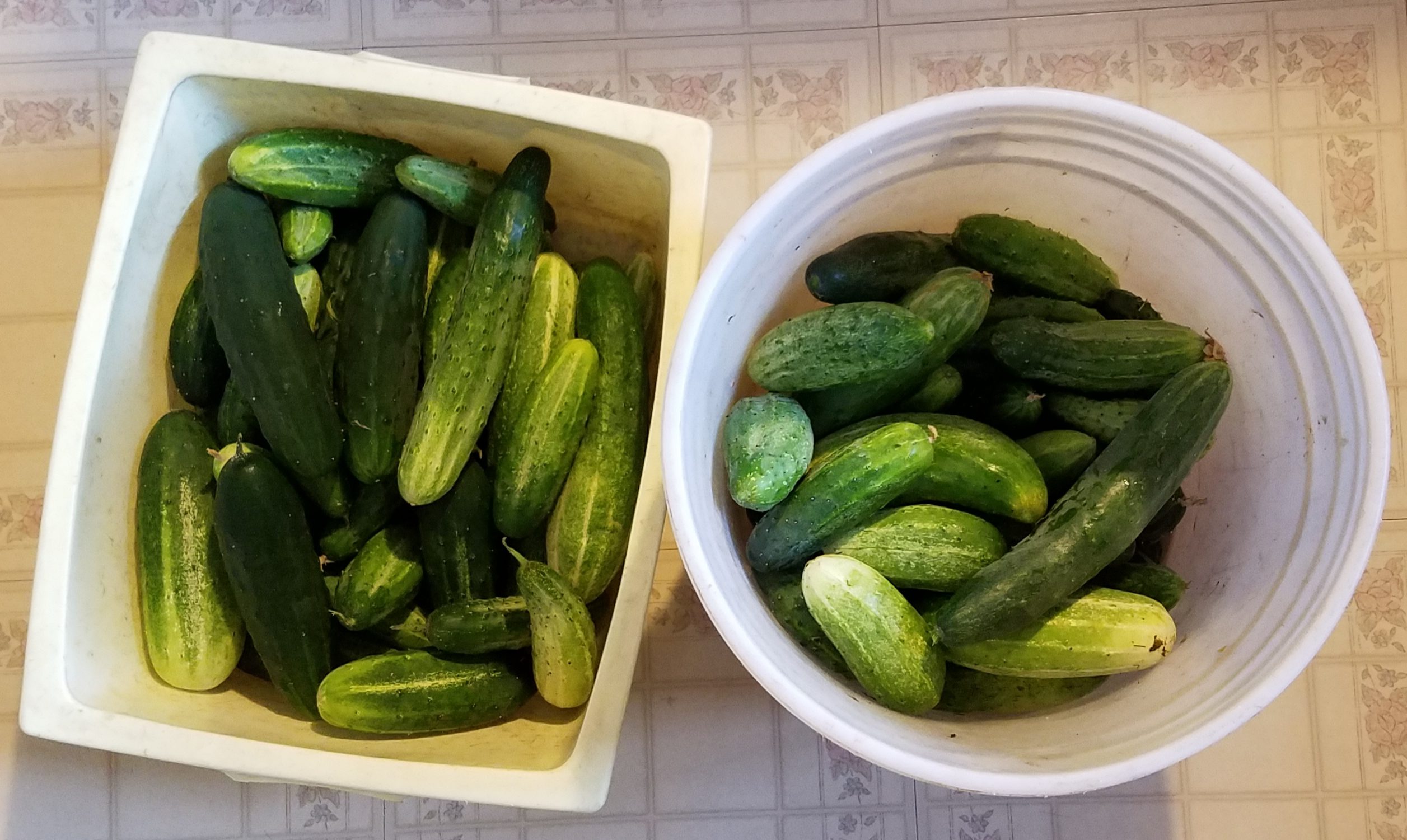
In the kitchen I emptied the crock of fermented dill pickles and started another batch. I washed and sorted cucumbers on the counter: first the dills, then sweet pickles, then some for eating, then a pile of too plump ones for juicing. There are so many cucumbers I could be selective. Soon I’ll run out of things to do with them… not yet.
I felt restless. I feel restless.
Cucumbers
I cleaned under the kitchen sink and returned the soaps, cleaning supplies and waste basket to their appointed places. I’m glad that work is done. I’ve been putting it off.
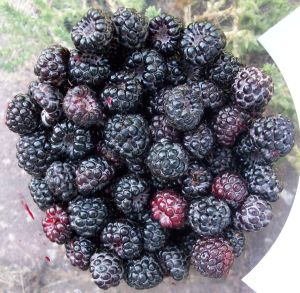
Using fruit thawed from the freezer, I made a smoothie for lunch with cow’s milk, kale, a banana and the fruit. It was satisfying… and very blue.
There is only so much kitchen time a person can take before moving on.
Someone spotted water coming up through the ground near a main water line junction. I emailed our crew of well volunteers and we met near the leak. We saw water seeping up but couldn’t diagnose the problem. I told them I’d call our well service to come out and fix the leak. It was a productive exchange as I hadn’t seen some of them for a while. It was a chance to do something outside home. It will be an ongoing project for the weekend.
I came back. It got hot and here I am.
Our president had tea with Queen Elizabeth II today. I wonder if they had scones like she did with Ike. In Washington, D.C. Robert Mueller’s investigation produced 12 indictments of Russian intelligence officers who had been hacking U.S. computers in the run up to the 2016 general election. The hacking was with nefarious purpose and intent. The press event was at the same time the president was having tea. It will give him something to discuss with Vladimir Putin next week in Helsinki.
In the hottest part of the day I feel an urge to go somewhere else. I felt the same way when I lived near the main train station, the Hauptbahnhof, in Mainz, Germany, especially on weekends away from the kaserne. I would drive to the big box stores over in Wiesbaden… or maybe walk to the small grocery store down the hill and buy fresh fruit and a liter of Coca Cola. I had to time it right because they closed for a couple of hours in the early afternoon. About the same time it is now. I feel connected to those days 40 years ago.
I just got the call the well technician is on his way. Guess I can meet that urge… for now.
The culprit is a long, engaging worklife. The crime? Diminished creative output.
Early on I realized, with a few exceptions, creative endeavor doesn’t pay. To support it I took work… for over 50 years. We raised a daughter, built a home, worked outside home, and lived an often exhausting life.
Older, I’m not sure I’m much wiser. I’m worn down and less productive than I hoped to be. Yet the creative impulse persists. I hope to write my way out of the current situation into new energy and creativity.
I haven’t given up.
The wellspring of creativity has been several things, most important among them is meeting and engaging with new people. If we are to be successful as artists we need an audience. I’ve been lucky to find one on this blog and in our community. Relationships with people are important.
Here’s my problem. For too many years reading and writing has been a way of processing society and the world around me. Such processing engaged me and produced two results: a good quantity of writing and distraction from more specific creative output. At age 66 there’s no time for distraction so I must renew focus on writing.
Like the compost bin in the garden I keep throwing life experiences in, hoping to get to something elemental and nourishing. It’s time to spread compost on the garden plots and see what grows. No doubt there will be some weeds… and hopefully a flower or two… and vegetables for nourishment.
Life, its beauty and ugliness, is all around us. An artist must be able to perceive it, process and make something useful of it. On a summer Tuesday that’s what I’m hoping to do.
It may seem late yet I declared the garden planted on Friday.
We’ve already had a bumper crop of vegetables and we’re not even started with tomatoes, eggplant, peppers, green beans and more. There will always be garden work to do but for now it’s planted.
Time to turn to other things.
What I mean is between now and Aug 4, when orchard work begins, there is writing, household repairs and cleaning, and loads of work to improve our home life. At some point I switched from being a consumer to a doer and that makes the difference in my mid-sixties. I just stay home and do.
Water Bottles
Politics plays a role in current affairs and it’s much different than it was. My focus is to understand the complex world in which we live and work to make a positive impact. My themes haven’t changed (environment, social justice, economic survival, good governance) although my understanding of what needs doing has. During the re-election of George W. Bush I re-activated in politics. Each succeeding campaign was both learning and engagement. After seven campaigns, I enter my eighth with a deeper understanding of the role social networks play in determining winners and losers. I’m not referring to Facebook, Instagram and Twitter here, but broader social movements and the momentum they bring to an election.
The first Obama campaign, with its demographics analysis and targeted voter lists seems like ancient history. What Obama did can’t be replicated, even if we wanted. To better understand the electorate, we must knock on every door, hear every voter, and determine how to fix the broken politics endemic to our lives. Creativity and networking are important. We don’t know if what’s broken can be fixed in a generation. If we don’t start now, it may never be fixed.
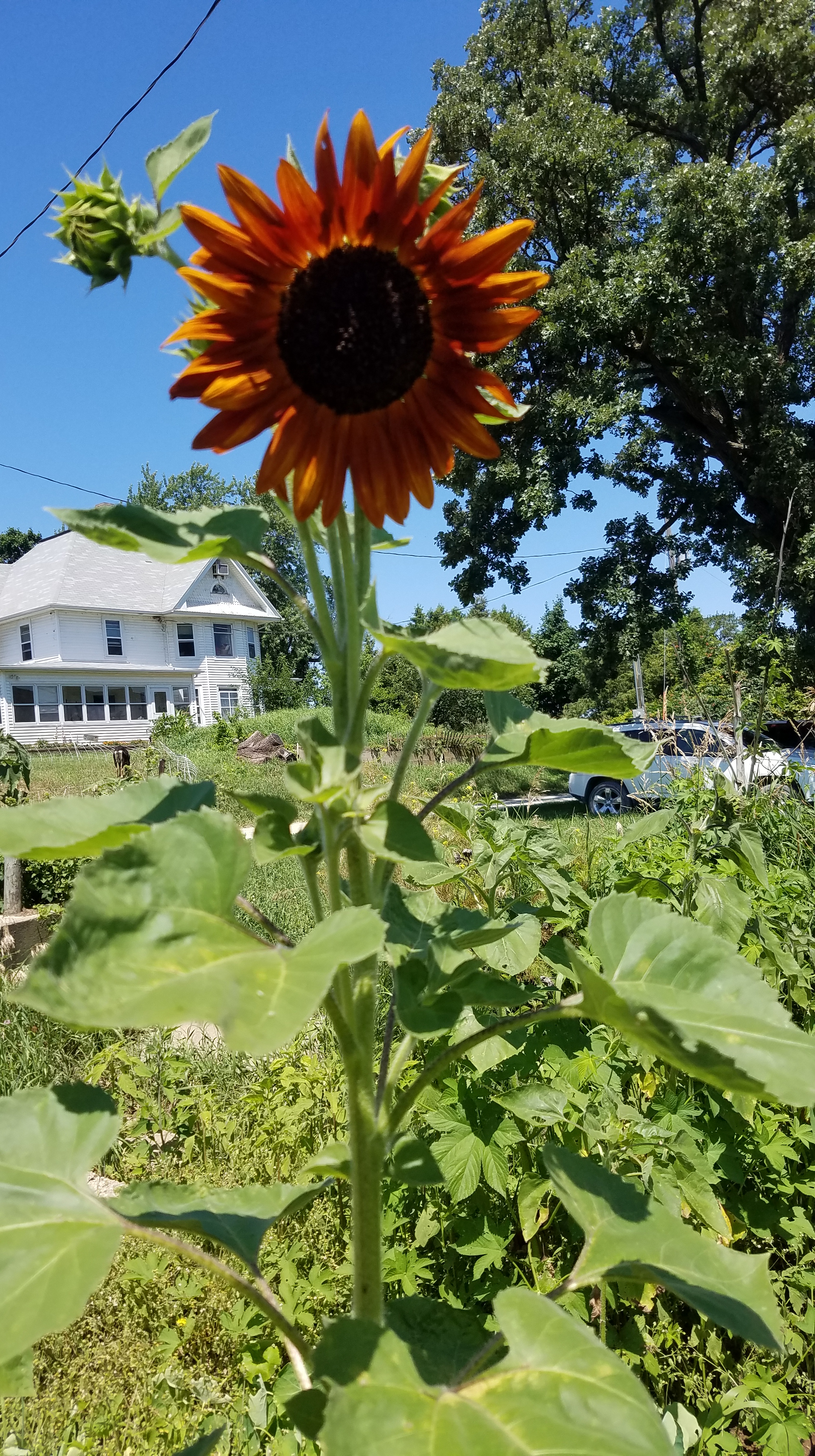
Flower at the Farm
Politics is not everything. After only three hours at yesterday’s garlic harvest at the farm I felt a bit dizzy, presumably because of hard work in the sun. It was a temperate day, nonetheless, I played it safe and called it early. My point is I’m not getting any younger. Working a six or eight hour shift in the sun doesn’t work as well as it did a few years ago. Working smart is replacing working harder.
The rest of the year goes something like this. July is a month to work at home: advance my writing projects, get space at home to be more livable, and work to get the yard into better shape. August through October is work at the orchard. This year I may be taking on additional responsibilities, but for sure I’ll be there weekends and on Friday Family nights. November and December will be focused on writing. While this is going on, I’ll continue to work at the home, farm and auto supply store two days a week. Every dime of income has a place to be used at this point.
Declarations like mine about the garden are ephemeral. What matters more is a process of continual improvement in which life goes on as best we can make it until the final curtain falls. In the meanwhile, we expect there will be garden vegetables to eat.
Here’s a second recipe for kale and garlic scape pesto. The first uses walnuts and Parmesan cheese and can be found here.
Get out the food processor and place it on the counter.
Measure the following and place in the bowl of the food processor in the same order:
Two thirds cup raw pine nuts
One third cup thinly sliced garlic scapes
One and one half cups roughly chopped kale, packed
One third cup whole basil leaves, packed
One teaspoon sea salt
One half teaspoon freshly ground black pepper
Two tablespoons lemon juice. If fresh lemon, peel first and add the yellow rind
Two thirds cup extra virgin olive oil (reserved)
Turn on the processor and grind the mixture until it starts to break down.
Drizzle the olive oil into the mixture as the machine runs.
Scrape the bowl into a quart canning jar with a spatula.
Spread some immediately on a slice of sourdough bread toast for the cook and any kitchen visitors. Screw on the lid and refrigerate until ready to use.
Fresh pesto keeps only briefly without oxidation in the ice box. If you want to use it way later, put the jar in the freezer.
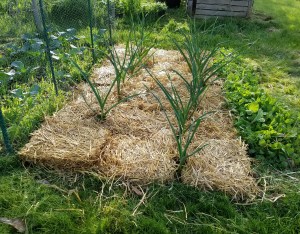
After randomly planting it in a plot where it propagated year after year without care, last October I planted cloves the way I learned from my friend and mentor Susan Jutz.
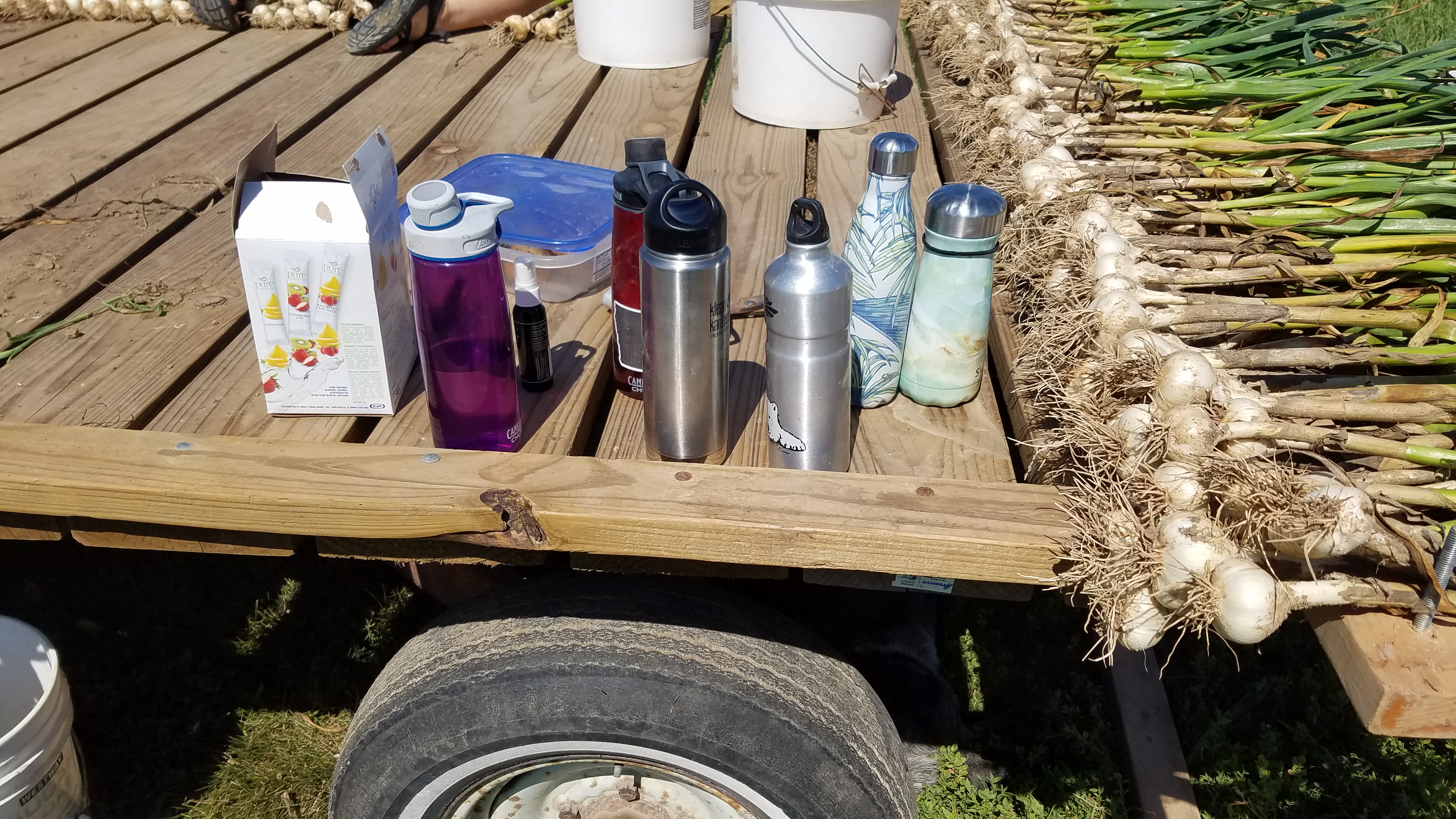
I harvested 20 head of garlic this morning.
What made this year different was devoting time to find every available opportunity for good growth. It was worth it.
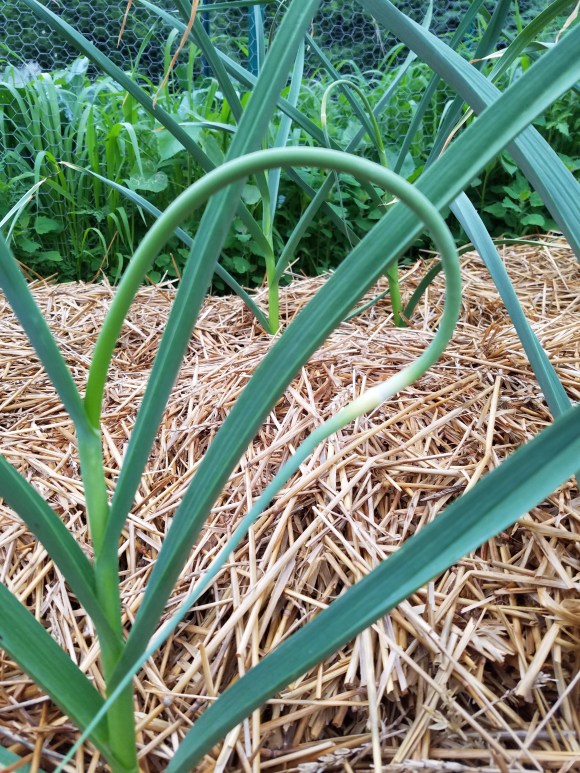
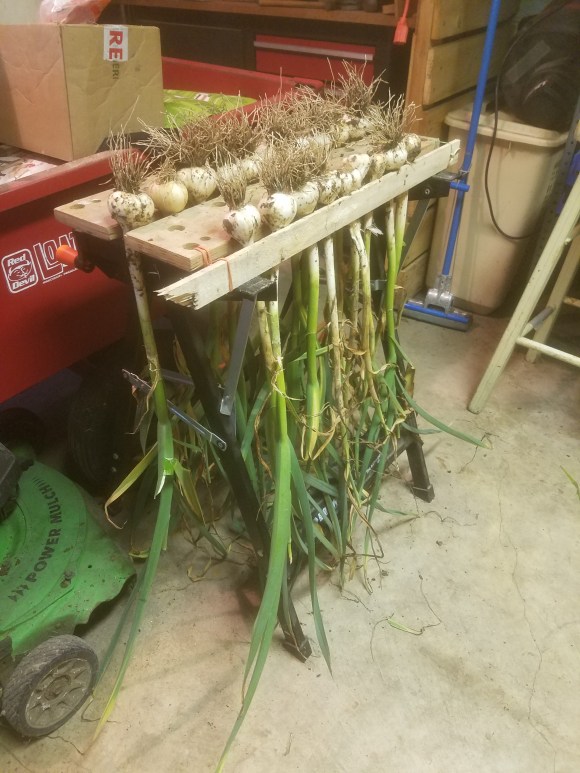
Following are some photos of the harvest.
Garlic ScapesFirst Head of GarlicThe Garlic HarvestMakeshift Garlic Rack
Now that the harvest is in the garage, I’m heading to the kitchen to make some kale-garlic scape pesto for lunch.
Beginning Monday, I’ll be covering the editor’s desk for Trish Nelson at Blog for Iowa for the month of July.
Everyone needs a vacation and Trish works harder and more persistently than most to get a progressive message up every weekday.
That means a lot of writing for me. It also means I get better with the work. I’m looking forward to the renewal.
With work at the farms finished and the home, farm and auto supply store down to two days per week, There is more time for writing.
For today, it’s home repairs, cleaning and making the first batch of dill pickles with this morning’s harvest. It is expected to be a full day and for that I’m thankful.
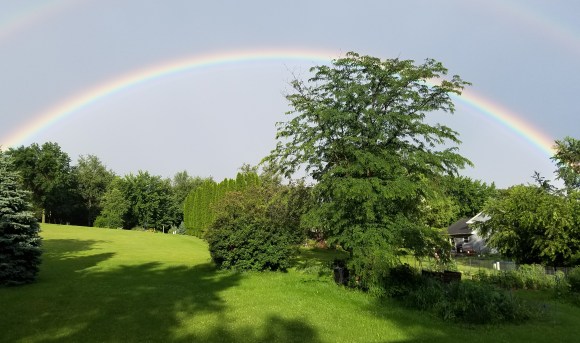
Clouds broke while I watched it rain through the west-facing garage door. It was a slow, steady, gentle and soaking rain of the kind remembered from childhood.
Realizing there might be a rainbow I rushed upstairs and looked out an east-facing window. I saw a double rainbow framing the garden plots and our back yard.
The colors were as intense as I remember ever seeing. A sign the shit-storm of American politics would eventually end and our lives might heal.
Earlier I’d been on the roof cleaning gutters. A tree branch had blocked one of them, collecting leaves and impeding water flow. The view of the nearby lake was obscured by trees and vegetation that had grown up since we moved here. In the beginning there had been a clear view of the lake from the roof peak. We, people and plants, are older now.
Refraction of light through rain is simple and powerful physics. Outside quotidian affairs of which lives are mostly made, a rainbow brings hope. For a few fleeting moments we marvel at the colors and reflect upon the role rain and recovery can play in our lives. We notice.
Rain clears the air and washes away dust created by simple lives. On days like that, a better life seems possible. We weathered the storm and that may be enough.
(Editor’s Note: This article was written July 3, 2009, shortly after my first retirement. It has been lightly edited to remove misspellings and grammatical errors I can’t bear to promulgate).
It begins by foraging for wild blackberries in Lake Macbride State Park.
Between a twenty five year career in transportation, and Independence Day 2009, gathering berries in the forest seemed a natural and appropriate way to mark my retirement at age 57. I knew that my work life would continue even if my employment for Iowa’s largest transportation firm was over. On this first day of what’s next, I hoped to wander the forest with my bag and gather what blackberries I may, an archetype of my life as an American salary man turned loose.
To say I lacked the commitment of a career in transportation misses the fact that I devoted much of my waking time and personal energy to being a successful transportation manager. At the same time, it was a bargain of time for money with what I now realize as little chance to get ahead. Transportation is not a traditional career as are medicine, the law, retailing, carpentry and plumbing. At the highest levels of transportation’s hierarchy executives are few in number and part of a clearly defined and relatively small social network. It was never my world, nor was there opportunity to make it my world, even if I was successful in delivering the business results my employers expected.
I figured this out late in the game, and it drove me to leave the business, not just recently, but in 1998 and 2003 as well. Finally, after a job as Director of Operations for CRST Logistics, Inc., my team achieved remarkable results, one last time, and I left the business.
Why did I sacrifice so much? I hoped to establish a home, meet the basic needs of our family, support our daughter’s start in life and leave time to enjoy ours. It was, among other things, for the ability to forage for wild blackberries.
And as the sun rises in the security of my partially finished study, I have concerns. I am most concerned that I will use the talents I have been given, the experiences I have had and the meager resources we have been able to accumulate, to contribute to life in society.
This means more than paying taxes and getting along with neighbors. It means considering life from my unique perspective and create an endeavor that brings peace and prosperity to a larger segment of society. The sacrifice we made resulted in a life that is economically better than many families. Our current life is a foundation upon which to build what is next. It has never been about the money or economic gain. It is about fulfilling life’s promise, and the moment I realized this and it sunk in, my so-called career in transportation was destined to end.
To start an autobiography at my age is not unusual. What is different is I want to cover the middle of life, beginning when I was married and age 32. There is another autobiography of the earlier period to be written. If I am lucky, I will get an opportunity to write that part as well.
I sense a pressing urgency to understand how I spent the middle years. If I hope to inform others of the perils of working for wages, this story should be told now, with certainty and the energy of a life lived for others. I want the story out so our daughter can benefit from it. This book will pull in parts of my whole life, but the focus will be living with a family, the meaning of labor, the consequences of delayed gratification and subservience, and the possibilities of living a life as a manager in a large company. It is a story I do not see others aware of or writing today.
My feeling about work is as old as the colonial days in Virginia. I suspect it is derived from the intellectual history passed down in my family through the generations. People indentured themselves to pay for their passage and get a start in the new world. They might indenture themselves for another contract period to pay for the passage of their family. It was a tough bargain and as many as half of the white emigrants are said to have come to the New World as indentured servants. I suspect my ancestors were among these people whose contracts were sold upon arrival in Virginia.
Henry David Thoreau wrote of the trade off we make in taking employment in Walden,
“…men labor under a mistake. The better part of the man is soon ploughed into the soil for compost. By a seeming fate, commonly called necessity, they are employed, as it says in an old book, laying up treasures which moth and rust will corrupt and thieves break through and steal. It is a fools life, as they will find when they get to the end of it, if not before.”
I am lucky to have figured this out while having a life expectancy of another quarter century. As I look through boxes of artifacts and papers I laid up before and during my working life, the papers are yellowing and dusty, diminished in importance. While I do not seek to be like Thoreau, I would learn from his writings.
I have worked for large and small businesses. I was in the military and worked for the University of Iowa. I worked brief periods of my time as an independent contractor. I belonged to a union, voted against unionization and managed union employees. I negotiated union contracts, the modern successor to the indentured servitude of the colonial days. I worked through 25 years in transportation to yield a nest egg insufficient to retire in the traditional meaning of that word. If I had stayed on, until age 65 or 68, I would not then have accumulated enough money upon which I could finish life, work free.
I seek to inform, not complain.
In a varied work life I gained experience in many facets of life, both in and outside my career. Reflections on a thousand meetings and experiences inform how lives devoted to labor can be improved. My hope and intention is that as I consider the detritus of a life in transportation my view will become more informed and I can help others, our daughter particularly, avoid the pitfalls of which Thoreau and others warn us.
On my last day of employment I had parked at a distance from the employee entrance, as usual. As I settled into my blue Chevrolet Colorado, I stopped to look at the building. I sat for a couple of minutes trying to remember entering for the first time.
A woman named Jean King took my application and gave me the Wonderlic test. There was a sign made from a 4 x 8 foot sheet of plywood that said “A Company on the Grow.” I worked most of my 25 years for CRST and saw it grow from a $60 million company to more than $820 million in revenue. I am pleased to have been a part of that.
The growth and success expanded the property, and while the main building was the entire company when I started in 1984, we acquired land from Wiley all the way to Edgewood Road along 16th Avenue. A grocery store was converted to CRST Van Expedited Headquarters and we built a training center for the asset divisions. There are major facilities in Birmingham, Alabama, Carlisle, Pennsylvania, Fontana, California and dozens of agent and sales offices dotted across the country.
What attracted me to the company was that it was owned by Herald Smith’s family and of a size where I could get to know everyone in the company. For most of my time there, I did. On my last day of work, Herald’s son, John called to wish me well.
These were things going through my mind as I sat in my pickup truck getting ready to go home. I started the engine and instead of driving to 16th Avenue to turn right and take Wiley to Edgewood, I exited the parking lot north and drove 12th Avenue east to Edgewood, seeking to have a different view of the drive home. I did not look into the rear view mirror.
Our life has been good by any standard. We have a roof over our head, clothes to wear and food to eat. There is plenty to occupy our time and we have hope that our daughter will experience success. We were able to send her to Cornell College in Mount Vernon and support her through her beginnings after college. I am not complaining about our quality of life, nor would I. We have had a good life, to a large degree because we have lived in the United States and in Iowa for most of our time.
Journal entry from July 2, 2009:
Lake MacBride. It is 20 minutes before I leave for the last day of work at CRST Logistics and I am ready for the change. There will be uncertainty but we have to have courage to get through each day’s challenges. I am not sure how much this means, but hope the new path leads to a brighter day.”
Post on Big Grove Garden July 3, 2009:
“Each year I walk to the state park and search for wild blackberries. They are typically ripe around Independence Day, and after walking to town and searching for them I gathered about a pint. The berries on the south side of the trail were more abundant and on the north, were almost finished. The variation in sunlight seems to matter, although not by much. From the looks of the plants, we are about a week into the season.
After a few years we learn how to look for the plants and some places there are a lot to be picked and others one or two. We build expectations based on remembrance of where the best spots were previously. To write these locations down is unthinkable as the knowledge resides within us, and we don’t want to reveal our best areas to others. This is a natural human behavior.
One of the best places in previous years is replaced with a natural gas substation. The town and the youth recreational complex adjacent to the elementary school continue to encroach upon the wild places. The odor of natural gas came from the pipes, reminding me of West Texas. It was disappointing to see the berry patch gone.
Once I had more than a pint, I looked at other things along the trail. The flowers are in bloom and abundant as home construction peeps into the once isolated trail.
I made it home and made oatmeal topped with a handful of the wild blackberries picked this morning.”
Perhaps the encroachment on the wild blackberries is evidence of the corruption and thievery of which Thoreau wrote.
E-mail to Mike Fouts, President of CRST Logistics, Inc. on July 5, 2009:
Mike:
Please let everyone know how much I appreciated the many goodbyes and best wishes last week.
The cards and gifts were more than a person should expect, and will be useful in my life in Big Grove and beyond. I wore the hat at the Coralville parade on Independence Day and young women wanted to hug me: surprising and happily accepted.
Two bits of news since Thursday are 1). My uncle sold his coffee shop last week, so that idea is out. 2). our daughter is talking about returning to Iowa in 2010, so it looks like we will be staying here for the present.
Thanks again for the thoughtfulness in celebrating my tenure with CRST Logistics. I found CRST Logistics to be, every day, without exception, a great place to work.
Best Regards, Paul
Paul Deaton
Solon, Iowa
I made wild blackberry jam with the day’s findings and we enjoyed it through the Christmas and New Year’s Holidays. What may have been on the periphery of our life became a main event. However, that is another story. Let’s dial back the clock to March of 1984 when we made the decisions that led me to a career in transportation.
I’m sitting in the back of my pickup truck, the tailgate is down. Gentle summer rain is falling. The tips of my toes are getting wet but I don’t mind. We need the rain.
In Des Moines political parties are holding their conventions. I followed the action on social media, but not closely.
Breeze from the rain is cooling my forehead. It feels quite good. It is much better than working on a computer, or thinking about politics.
This afternoon I tried pulling weeds in the garden. The ground was so dry they broke off at the surface. Now, after this long gentle rain, the roots should loosen and weeding be done more easily.
Wind is blowing from the west and my knees are getting spattered with rain. I still don’t mind.
Dozens of birds are out in yards around the neighborhood. They don’t mind rain either. All of nature seems to welcome the rain.
Lightning and boomers are starting to roll in. The rain continues to fall gently and steadily.
Some nights it is best to just listen to the rain, and so I will tonight.
Gardening is of light and shade, moisture and soil health, seed genetics and cultivation. It is an endeavor in which we can invest personal effort and a few resources to see practical results.
We garden in complex creation, only partly of our own making. Imbued with elements, animals, insects and microorganisms we don’t fully understand, this year’s garden plots brought new understanding, a bountiful harvest and a busy kitchen.
Gardeners become the verb “to garden,” and if lucky, become inseparable from the process of growing and cooking food. What was once new knowledge becomes embedded in daily actions that appear intuitive. We become the syntax of food production. Words can’t do justice to what gardeners experience and learn over decades. One sees it only in practice.
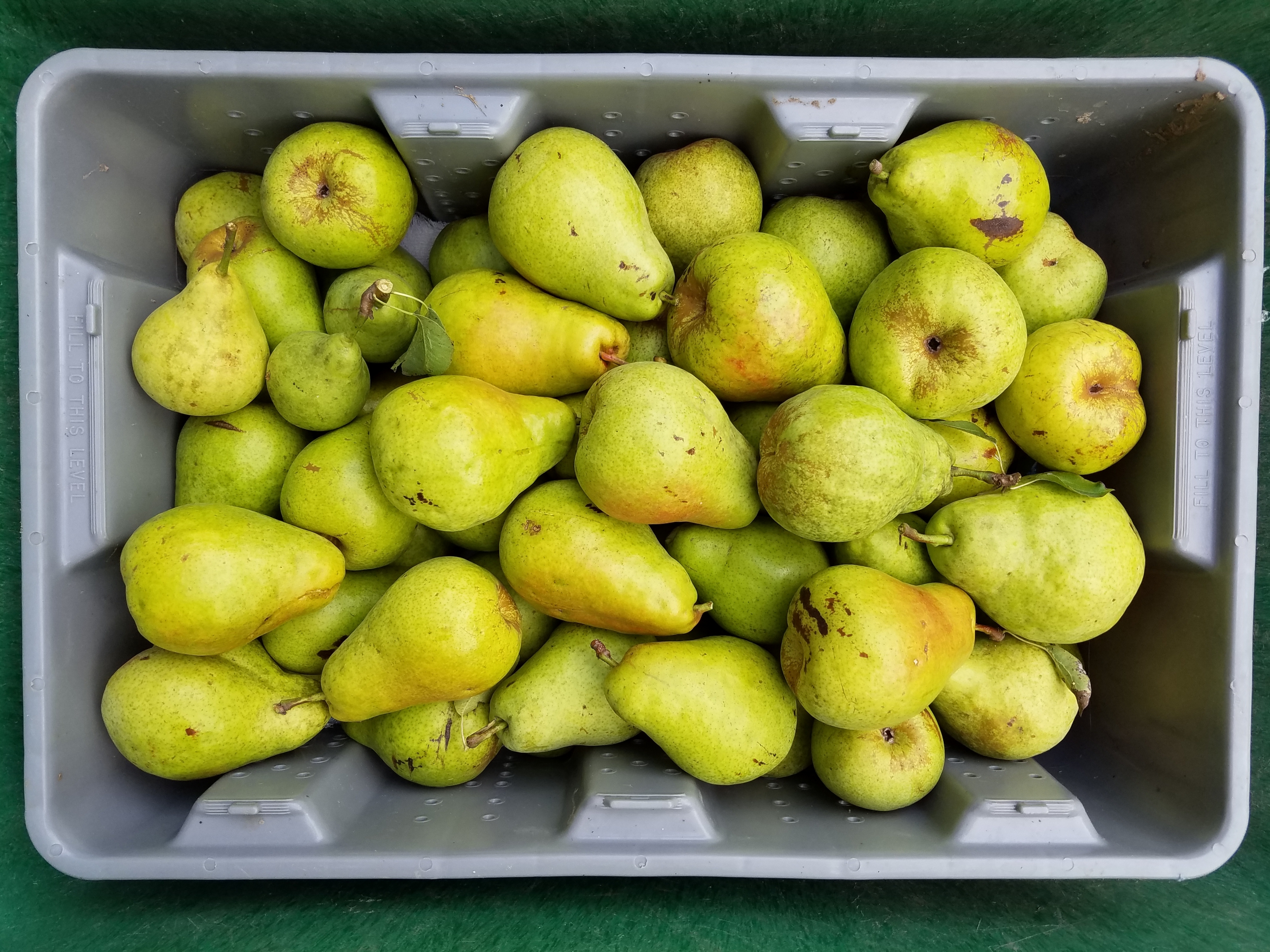
Pear Harvest 2017
Last night I rushed into the house after work at the home, farm and auto supply store to change clothes, get the ladder, and pick pears before they all drop. We planted the tree at our daughter’s high school graduation party and have had some almost every year since they bore fruit. The season is very short as are our lives. We plan to enjoy the sweetness of fresh pears as long as we can.
Red Delicious apples are not fully ripe. I ate one while rushing around the back yard chasing pears and sunlight. Sugars are beginning to dominate starches and a couple more weeks on the tree will serve them well. After that it will be a mad rush to pick and preserve them. It could be another 1,000 pound harvest.
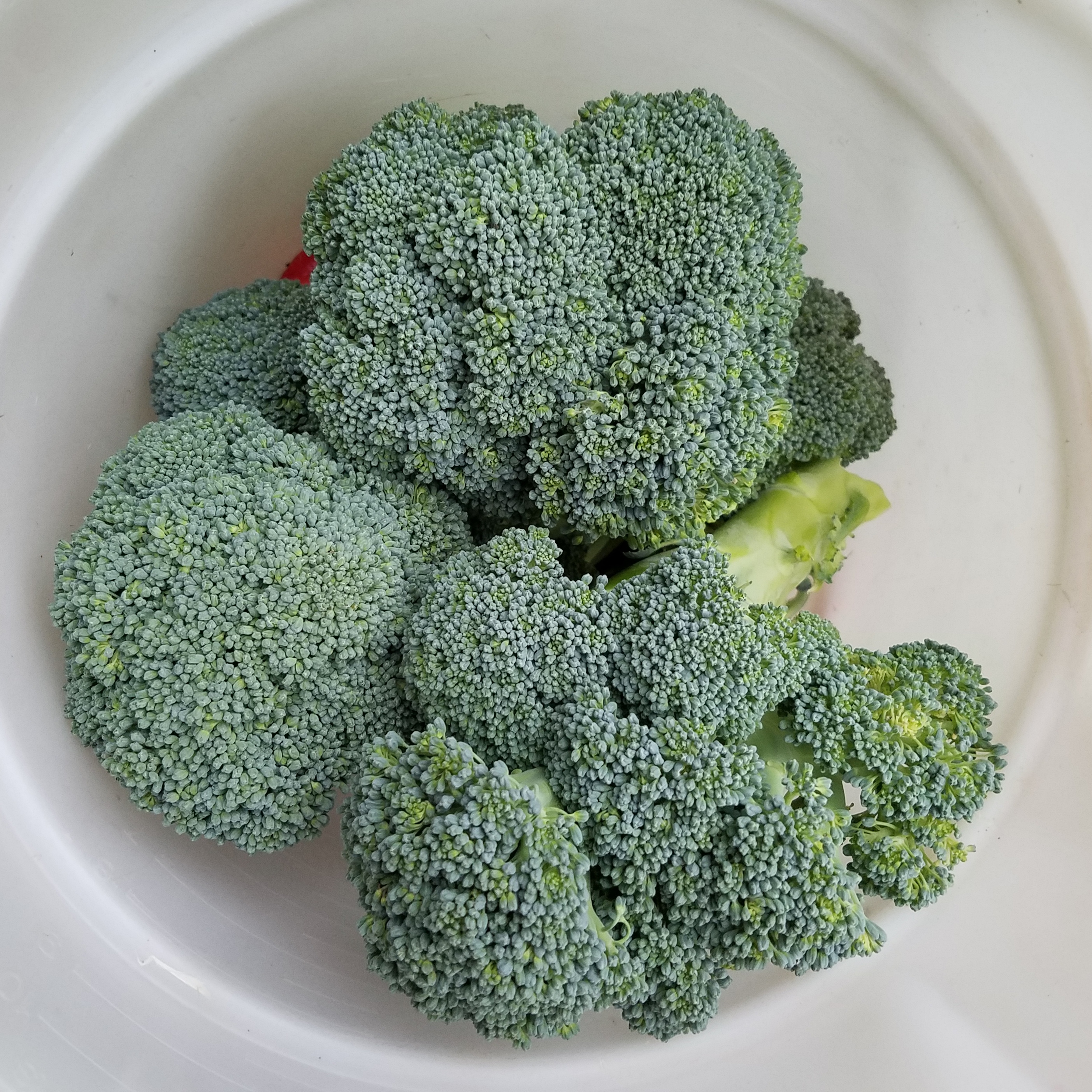
Second Growth Broccoli
There were beautiful second growth broccoli heads, about eight of them. I broke them off by hand, cut and peeled the stems for work lunch.
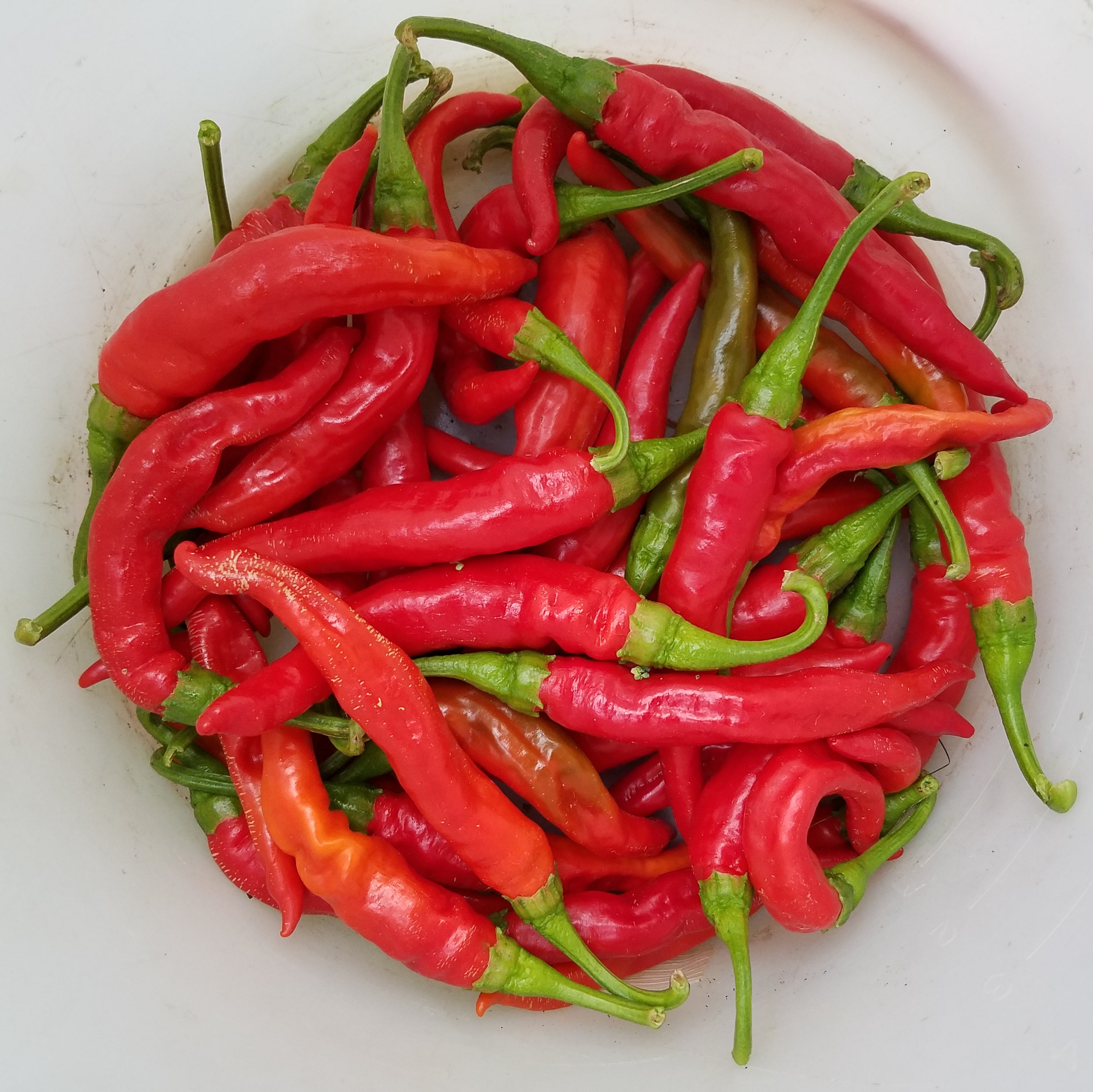
There were more Red Rocket peppers. I harvested the reddest ones, leaving many more to ripen. In the kitchen I took the others from the baking sheet in the oven (oven turned off) and carefully spaced them on the five trays of the dehydrator. I’ll dry them until they are ready to grind into red pepper flakes.
Someone brought cucumbers to the orchard on Monday. I took half a dozen (there were an inch thick and 5-6 inches long) and combined them with what was already in the ice box to make a second batch of fermented dill pickles. It takes 10 days if everything goes according to plan. Fingers crossed.
Monday I picked up two crates of tomatoes and two dozen quart Mason jars at Kate’s farm for canning. This is part of our barter arrangement in which she provides tomatoes, I process them, and we split them resulting canned goods. I sorted them Tuesday morning before my shift. Once spread out they filled four and a half crates instead of two.
I made ground tomatoes from the ones with bad spots as a base for pasta sauce. Here’s the process: Wash, trim and quarter the tomatoes then pulse in a blender until the big pieces break down. Put the blended tomato pulp in a juice funnel to separate liquid from the flesh.
After an hour, the split was 50 percent juice to 50 percent flesh. I put the results in jars and stored them in the ice box. I’ll can the juice and make pasta sauce while I work in the kitchen tonight or tomorrow night.
With two paid jobs and diminishing daylight there’s not much gardening time in my schedule. The lawn needs mowing and I plan to plant garlic in a week or two and there’s work to do preparing the soil.
It’s a rush until first frost, after which I may be able to slow down — but I doubt it.





 Journey Home
You must be logged in to post a comment.