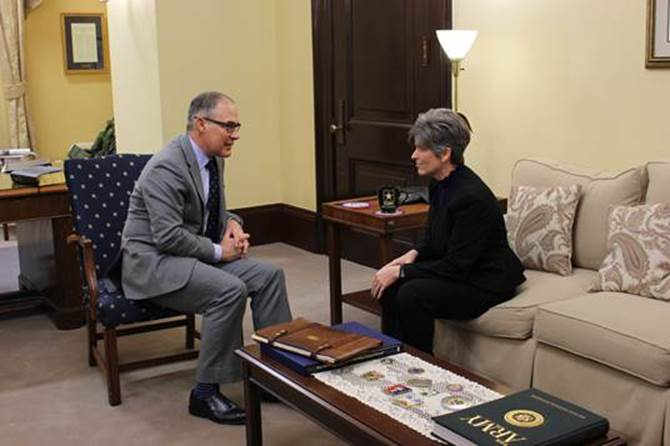
Oklahoma Attorney General Scott Pruitt meets with Iowa Senator Joni Ernst in her office. Photo source: Radio Iowa
Coping with Donald Trump during the next four years will require critical thinking and teamwork.
Our legitimate yet imperfect electoral process took the next step yesterday. A joint session of the U.S. Congress counted the electoral votes and determined Trump won the general election. All that remains is the Jan. 20 swearing-in ceremony, after which he will be the 45th President of the United States.
I would never have predicted writing such words. I still feel a little numb after the election and that’s a good thing. Our nation survived Warren Harding, Calvin Coolidge, Richard Nixon and George W. Bush. We will survive Donald J. Trump.
If I got upset last week, it was after seeing this photograph of Trump’s nominee to be administrator of the Environmental Protection Agency with Iowa’s junior U.S. Senator. It served as a reminder that the figurehead at the top of the administration is less important than the work being done by his employees and appointees. Scott Pruitt is expected to dismantle much of the Obama administration’s work to protect the environment at EPA, including the Clean Power Plan.
As ridiculous and petty as many of Trump’s public statements seem, his government will be no trivial threat to everything we hold dear. It’s clear where the government will be going under 45: rolling back progressive initiatives since the New Deal in a full court press.
To cope with Trump’s presidency, and to keep my sanity and mental health, it is critical to watch, listen and learn about his and his minions’ efforts. It is equally important to evaluate his opponents’ arguments and actions, and keep my own powder dry so I’m able to use my limited resources effectively.
I’m ready to take action to defend our progressive way of life. I’m not willing to randomly select points of outrage driven by Trump’s effective management of corporate media.
The key to perseverance in Trumpworld is to first take care of oneself. Without that, effectiveness in resistance would be diminished. I am ready for Trumpworld knowing I’m not alone in feeling this way.
Seeming to have forgotten high-profile cases that led to the creation of the office in 2008, the move seems brazen, craven, even traitorous. That the action was taken in the middle of the night without any Democrats present provides the flavor of what’s to come during the next two years.
The first order of business in the 115th Congress is expected to be repeal of the Patient Protection and Affordable Care Act, something House Republicans have voted to do scores of times since the bill became law. Members favoring the move appear to have no clue what to do about the political blow back such an action is expected to bring.
On Friday, Jan. 20, President-elect Donald Trump will be sworn in as the 45th president but Trumpworld has already begun.
EDITOR’S NOTE: Later in the day, House Republicans abandoned proposed changes to the OCE. Media reports indicate there was a blizzard of negative public reaction directed at congressional offices once the secret meeting became public. Two positive things about this: the news media reported the story quickly, and public reaction was evidence that contacting one’s representative can move the needle on such egregious actions.
It’s Christmas Eve in Big Grove, the ambient temperature is about freezing, and we’re ready to bunker in, finish decorating our Christmas tree and prepare a traditional supper of chili and cornbread.
My Christmas wish is for peace on earth.
Elusive as that may have been during 2016, we can’t give up hope. Not now. Not like this.
As winter solstice brought longer days — increasing light imperceptible in each day’s cycle — it is time again to fly with eagles, gain a broader perspective, and thank people who are always in these written words if rarely mentioned — my wife Jacque, our daughter, my parents and my maternal grandmother.
Reading
I continue to read more on my phone and computer than I do full-length books. Nonetheless I managed thirteen books in 2016, the most important of which were authored by people I know: Connie Mutel and Ari Berman.
Methland by Nick Reding had the biggest influence, by a distance.
Here’s the list of books, most recent first:
Diet for a Hot Planet: The Climate Crisis at the End of Your Fork and What You Can Do About It by Anna Lappé; My Life on the Road by Gloria Steinem; Sapiens: A Brief History of Humankind by Yuval Noah Haran; Methland: The Death and Life of an American Small Town by Nick Reding; Give Us the Ballot: The Modern Struggle for Voting Rights in America by Ari Berman; A Sugar Creek Chronicle: Observing Climate Change from a Midwestern Woodland by Cornelia F. Mutel; Atlantic: Great Sea Battles, Heroic Discoveries, Titanic Storms, and a Vast Ocean of a Million Stories by Simon Winchester; And Then All Hell Broke Loose: Two Decades in the Middle East by Richard Engel; Slavery in the Upper Mississippi Valley, 1787-1865: A History of Human Bondage in Illinois, Iowa, Minnesota and Wisconsin by Christopher P. Lehman; The Diary of a Napoleonic Foot Soldier by Jakob Walter; Old Man River: The Mississippi River in North American History by Paul Schneider; MiniFARMING: Self-Sufficiency on 1/4 Acre by Brett L. Markham; and Fast Food Nation: The Dark Side of the All-American Meal by Eric Schlosser.
For the fourth year I edited Blog for Iowa while Trish Nelson took a break, writing at least one post each weekday during August. My book review of Give Us the Ballot ran in The Prairie Progressive, a guest column ran in the Cedar Rapids Gazette, and I wrote two letters to the editor of the Solon Economist since the general election. I cross posted Next for Iowa Democrats on Bleeding Heartland, my first post there.
More outside publication is planned for 2017.
Working
Income from five jobs helped financially sustain us in 2016. Work at the home, farm and auto supply store provided health insurance and a regular, predictably low paycheck. In descending order of income were jobs at Wilson’s Orchard, Local Harvest CSA, Blog for Iowa and Wild Woods Farm.
Each of these jobs was good for a reason. Blog for Iowa encouraged me to write every day. Farm work helped me connect with others in the local food movement. The home, farm and auto supply store provided a venue for conversations with low-wage workers. I’ll seek additional income in 2017 and maintain relationships with each of these organizations.
The common denominator among these jobs is interaction with people. As I enter my last year of work before “full retirement,” I seek that as much as income.
Gardening
2016 was another improved year in our home garden. Among many experiments were growing root vegetables in containers (a success with carrots and daikon radishes), growing squash in the unused storage plot, and using sections of 4-inch drainage tile to protect young seedlings. Failures included bell pepper plants which succumbed to weed competition, and loss of tomato yield due to a lack of attention. The best crops included broccoli, celery, eggplant, tomatoes, Bangkok peppers, turnips, basil, sage, oregano and kale.
Ancillary activities included distribution of kale and a few other vegetables to local library workers and friends, and weekly posts about the garden on Facebook.
We raised adequate produce to serve the needs of our kitchen. I also learned a lot through collaboration with friends and neighbors.
Apples
I followed the 2016 apple season at the orchard and continued to develop our home apple culture. Our apple trees did not produce a crop this year.
The last of the 2015 crop is peeled, sliced and frozen, or turned into applesauce and apple butter. We have enough frozen apples left for a Christmas Day dessert. This year’s orchard apples were mostly eaten fresh.
I made more apple cider vinegar. The process was simple: I added Jack’s heritage mother of vinegar to apple cider from the orchard in half-gallon ventilated jars and waited. This year I added an eighth-teaspoon of brewers yeast to each container at the beginning. The benefit was hastened alcohol production and a superior final product. I also learned that a cooler temperature slows alcohol production and this can produce a better result. Today there are two gallons of apple cider vinegar in the pantry and another gallon and a half in production.
Politics
The general election did not produce the result many people, including me, wanted.
At the same time, a lot of acquaintances seek to become active and “do something” during a Trump administration. There is plenty of work to resist the expected rollback of what we value in society. Specifically, work toward protecting the environment, reducing the number of nuclear weapons, and ensuring social justice.
My term as a township trustee ends Dec. 31, so regarding politics, I can be an unencumbered agent of change. The next step is to leverage the opportunity the general election brought with it.
Retirement
The time since my July 2009 retirement from CRST Logistics can be divided into clearly defined phases. First came a period of social activism characterized by work with community organizations. It lasted until the end of 2011. Next was the political year 2012. After that, life found me working low-wage jobs to support my writing. That’s where I am today. In 2016 came a realization that in order to spend more time writing, I have to get past the finish line to “full retirement” as defined by the Social Security Administration. For me that’s in December 2017. I took the first step by signing up for Medicare this month.
2016 was a time to learn, work on writing, and do things that matter. More than anything, I have been writing. Everything else provided a platform or material for it. If 2017 presents significant challenges, there should be plenty to write about.
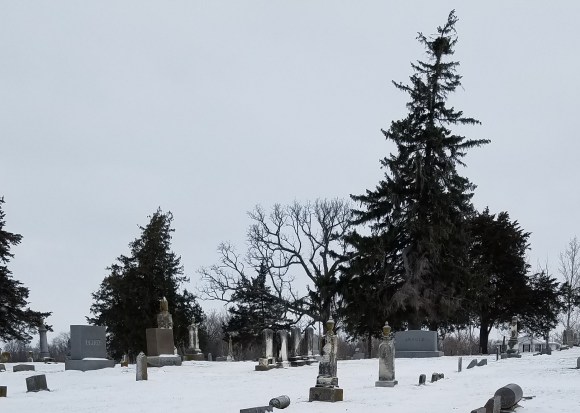
Oakland Cemetery, Big Grove Township, Johnson County, Iowa. Dec. 17, 2016
BIG GROVE TOWNSHIP — The Big Grove Township Trustees don’t sell many grave plots.
One of our responsibilities is a pioneer cemetery called Fackler’s Grove where no one has been interred for several generations. Oakland Cemetery, near the City of Solon, was expanded with an additional acreage before I was elected to the board of trustees.
At the current rate of sales, we’ll have space for more than a century.
My four-year term as a Big Grove Township Trustee ends Dec. 31.
Stopping by Oakland Cemetery on Saturday, on the way home from the orchard, I noticed the new section was colorful with artificial flowers. We haven’t posted the new rules asking people to remove grave decorations before winter. The signs are made and hanging in the clerk’s garage until being installed. While decorations shouldn’t be there, they are — evidence of modern lives no trustee seeks to suppress. Maybe the new board will install the signs next year — or not.
The main activity in the older section was squirrels building nests in mature trees. Old limestone monuments stood stark and weathering in the day’s wintry mix. With the Memorial Day remembrance moved to the American Legion field, fewer people visit the cemetery.
Drawn by our school system, a strong religious community with three church congregations and proximity to work in Cedar Rapids, Iowa City and Coralville, new settlement continues with young families arriving every year.
A township trustee has a relationship with the living and dead. We hear more from the living and spend time with the dead.
I learned a lot during my tenure.
2012, the year I was elected, was the high water mark of my political work. I was helping Dick Schwab with his campaign for state representative, and when it came time to run for office myself, I knew how to win without being on the ballot. I doubt I’ll ever be as active in politics as I was that year.
In addition to managing the cemeteries, the trustees are responsible to manage a budget, levy taxes, provide fire suppression and emergency services, and resolve lot line disputes. While the township form of government was the earliest in Iowa, consolidation of services may better serve residents. At the same time, the long-standing political organization is slow to change — the same way limestone monuments weather in sun and wind.
In society we experience an impulse to serve a greater good and seeking elected office can be that. It was for me. Every area of responsibility was addressed during my tenure.
We encouraged the Ely Historical Society to begin restoration of Fackler’s Grove Cemetery, we signed a long term contract for Oakland Cemetery maintenance, we formalized creation of an agency to share emergency service responsibilities between three townships and the City of Solon, and there were no scandals.
As I walked among the graves on Saturday I couldn’t help but think of the inevitable end of my own life. There is so much more I want to do. At least I can point to this work and say we did something for the greater good.
As the cold front moves in, that may be the best we can offer.
A small group of writers met at The Java House in the county seat last night to consider what’s next. It was my first outing with friends since the general election.
Consensus was it’s too late to complain about the president elect and his coming administration. The election is over, the Electoral College meets Dec. 19 in each state to cast their votes, and electors are expected to vote for each state’s winners.
All of us supported Hillary Clinton yet Donald Trump’s margin of victory in Iowa was 9.4 points. The fact ours was one of six Iowa counties voting for Clinton was cold comfort.
At the same time there is energy from a variety of sources to resist Republicans and their agenda at all levels.
What are we willing to do?
As a low wage worker my main challenge is building bandwidth for community organizing. It won’t be easy in 2017, the last year before my “full retirement.” In addition to budgeting income from a half dozen seasonal jobs, I need time and energy to organize.
Other challenges include picking activities where my efforts can make a difference. I don’t know what exactly that means today. The focus should be less on issues and more about process — how we arrived in Trumpland, and how we get out.
Here is a short list of things a person can do:
Set aside regular time to work on community organizing.
Join together with friends to work on what matters most.
Set specific goals and timelines.
Meet new people.
Advocate for Democratic principles in public places, writing for publication in newspapers and participating in local media coverage of events.
Hold meaningful events that engage community members.
This list represents a small step toward being an occupier of the society Republicans have made on our historic turf. Something essential to sustaining a life in a turbulent world.
The president-elect made stunning cabinet picks in the 30 days since the general election. I don’t like any of them.
As political institutions re-tool, it’s clear millionaires and billionaires will be the primary beneficiaries of Trump’s administration. He won the election so it’s his right to name a team and set an agenda.
As my colleagues at the home, farm and auto supply store said often in recent weeks, “the election is over.”
Who knew it would be the agenda of the Republican party of Warren G. Harding and his return to normalcy that elected Trump?
“America’s present need is not heroics, but healing,” Harding said during a speech in Boston May 14, 1920. “Not nostrums, but normalcy; not revolution, but restoration; not agitation, but adjustment; not surgery, but serenity; not the dramatic, but the dispassionate; not experiment, but equipoise; not submergence in internationality, but sustainment in triumphant nationality.”
Harding’s view was nothing was the matter with world civilization after World War I that couldn’t be fixed by returning to “normalcy.” Trump’s campaign slogan, “make America great again” is reminiscent, if not derived from this.
“The world needs to be reminded that all human ills are not curable by legislation,” Harding said, “and that quantity of statutory enactment and excess of government offer no substitute for quality of citizenship.”
There is a lot to unpack in the Harding – Coolidge – Hoover era, which we now know gave us four-term President Franklin Delano Roosevelt. It was an unintended consequence of Andrew Mellon’s execution of Harding’s plan for a prompt and thorough revision of the tax system, an emergency tariff act, readjustment of war taxes, and creation of a federal budget system. Mellon’s long tenure and contribution to policy resulted in the Great Depression. His failures gave us FDR.
Whether the stress on western civilization after World War II was more or less than after World War I is hard to say. Republicans sought to overturn everything FDR stood for and enacted into law, then and now. With Trump they see a chance to turn back progressive reforms dating back to that era.
“The people were demanding a return to ways of prewar living — Harding’s ‘normalcy,'” Herbert Hoover wrote in his memoir. “But in reality, after such a convulsion, there could be no complete return to the past. Moreover, the social sense of our people, livened by the war, was demanding change in many directions.”
Enter Trump’s cabinet, comprised of elite citizens, each of whom appears to have disdain for the office to which they were appointed. They intend to unravel government as we currently think of it, leaving the rest of us behind.
There will be no making America great again under President Donald Trump for reasons similar to what drove the failure of Republicans during the Harding – Coolidge – Hoover era.
Now, more than at any time in my lifetime, the resources and energy of citizens are needed to protect the commons from the new hoard of marauders until the worm turns and progressives gain power again.
That day will come. I hope it doesn’t take the same 12 years after World War I to produce a new, progressive era.
President-elect Donald Trump made a victory lap in Iowa last night, speaking to a crowd in Des Moines estimated at 5,000.
The word “great” was used frequently, at least once in quick succession, referring to the “great, great people of Iowa.”
At least one of my neighbors attended. I did not.
The internet was filled with chatter about Trump, and to a lesser extent, Hillary Clinton. Much of it seemed outrageous and ridiculous as anonymous people asserted false and true notions with opinions thereof in a melee heard throughout the wires of social media. The world wide web enabled Iowans to hear the remote cackling of presentism from as far away as China.
I wish we had a cat.
If people spent more time posting photos of cats on the internet, life would be better. Better cats than politicians, their entreaties and supporters.
I don’t really want a cat.
Supporters are finding Trump can’t or won’t fulfill some of his campaign promises. For example, he said in Iowa during the primary he would change his hairstyle if elected president.
“I would probably comb my hair back. Why? Because this thing is too hard to comb,” Trump said, according to The Des Moines Register. “I wouldn’t have time, because if I were in the White House, I’d be working my ass off.”
No hair-styling appointment has been announced.
There were other pie crust promises:
Drain the swamp: You’re kidding, right? Millionaires, billionaires and retired general officers have been his picks for key positions. The District of Columbia swamp was drained long ago and the better question is what types of creatures will populate it during Trump’s first term? The mix will change, but every one of his picks has lobbied on Capitol Hill, some more prominently than others. They all seem to be swamp rats.
Lock her up: He won’t appoint a special prosecutor for Hillary Clinton. That’s the role of the Justice Department, and anyway, he doesn’t have the will to go through with it.
“I don’t want to hurt the Clintons, I really don’t,” Trump said during a New York Times interview. “She went through a lot and suffered greatly in many different ways, and I am not looking to hurt them at all. The campaign was vicious.”
Build the Wall: Whether the Congress will approve funds to build a wall on the United States southern border is an open question. In any case, Trump acknowledged part of the “wall” will be a fence.
The idea a “wall” would keep out undesirables has always been fallacious. Have we forgotten the open border with Canada? “Wall” was always a metaphor for putting the United States first, protecting U.S. jobs, and revitalizing an odd anthropological domain of American culture. That it advanced to a major campaign theme is emblematic of a bogus need for “security” in a country where any criminal can get a gun and wreak havoc in our schools, churches and other public places.
I predict Trump will follow Reagan’s lead on immigration reform as business interests persuade him to back off the deportation plans so the benefit of low wage workers can enhance their bottom lines. He already reduced the number of undocumented residents he seeks to deport.
As we consider the 2016 election aftermath, recall how long it took for corruption during the Warren G. Harding administration to come to light under Calvin Coolidge. Harding led to Coolidge, then to the richest president at that point, Herbert Hoover. Hoover led us through the consequences of business excess when regular people seemed all to be living in Hooverville.
I hope that part of history doesn’t repeat itself under Trump. If it does, life will likely be better with cats. It took 12 long years for the worm to turn after World War I, bringing Roosevelt and the New Deal. We have to pace ourselves.
Let’s all take a deep breath and post a few pictures of cats. It’s not a real solution, but fit diversion to get us through to inauguration day and the repudiation of everything we hold dear. That’s when the true challenge will begin.
making a mottled, pre-dawn blanket of white and dark.
It won’t last long.
Stored heat in the driveway already melted some of it.
Snowfall portends winter and the end of autumn work.
We turn indoors to the somnolent beast within.
The 2016 general election was a pisser.
Almost no one outside my immediate family and friends talked in public about politics before the election. Now… colleagues and denizens of the county are unpleasant, gossipy and intolerant. Where did that turn in attitude originate?
It’s easy to blame presidential candidates, politicians and corporate media, and many do. It’s not that simple. Our discontent comes from the unsettling nature of life in the post Reagan era. The reality of it hits hard as social fabric, woven with progressive ideas, unravels.
Now is the winter of our discontent
Made glorious summer by this son of York;
And all the clouds that low’r’d upon our house
In the deep bosom of the ocean buried.
Now are our brows bound with victorious wreaths;
Our bruised arms hung up for monuments;
Our stern alarums chang’d to merry meetings,
Our dreadful marches to delightful measures.
Grim-visag’d war hath smooth’d his wrinkled front;
And now, — instead of mounting barbed steeds
To fright the souls of fearful adversaries, —
He capers nimbly in a lady’s chamber
To the lascivious pleasing of a lute.
~ Richard III, Act I, Scene I, A street in London
Right now the country could use a good Plantagenet-era revolt — like the one in 1381 — to check the excesses of the coming shit storm of governance. By all accounts, there is a growing will to resist and take action. We wait and watch as skies darken despite approaching dawn.
Inside a beast is awakened. Once groggy and listless, now restless and wondering whether Robartes’ vortex has begun to narrow.
“Iowa Democrats have a paucity of large donors. There just aren’t that many in the state. The chair plays a role in party fundraising, but the effort would be better served by delegating it to prominent Democrats on a volunteer basis. The idea some have proposed of requiring the chair to spend a percent of time fund raising belies the chair’s more important role in party building.”
The response was quick
@PaulDeaton_IA that’s been tried several times. Problem is the vols don’t follow through and it just puts the party farther behind.
What the heck is he talking about? The state party chair is traditionally responsible for fundraising.
It is time to break with tradition. The chair will always be responsible for the major activities of the state party headquarters, including fundraising. The question is how should his or her responsibilities be prioritized? In my view the chair will continue to have a daily call list for those donors where the chair’s involvement makes a difference. Most of the fundraising work would and should be done by others.
The main purpose is not to create a fundraising shortfall, but to get firm commitments from prominent Democrats who are also experienced fundraisers to help manage the financial need for income. That should enable the chair to work more on party building.
Who the heck is Paul Deaton and what does he know about fundraising?
My main experience in political fundraising was working with Dick Schwab in his campaign for state representative. Schwab had raised hundreds of thousands of dollars for numerous enterprises including non-profits and businesses. When it came to raising over $100,000 for his political campaign he already had the network in place to tap people for donations. He lost the election but it wasn’t for lack of money.
In the years after the election I was approached three times about raising money for other candidates in the district based on my experience with Schwab. What I told them is relevant to this post. “The donor list is a matter of public record, but Schwab had a relationship with most of the people who contributed to his campaign. Neither I nor likely you can replicate that.”
Would Schwab be one of those “prominent Democratic volunteers” I mentioned? I don’t know but he serves as an example.
The Iowa Democratic Party needs dozens of this kind of volunteer — that have a Rolodex and relationships — who are willing to commit to fundraising. Maybe they do one event per cycle. Maybe they work longer to hunt the elephant that will feed the whole village. Maybe they work in a decentralized group. Based on my experience, it is unreasonable to rely on the single Rolodex and relationships of a party chair for fundraising. Cold calling lists provided by others is no substitute for existing relationships. There is a need to broaden the fundraising base by recruiting the prominent Democrats who are willing to play.
What the heck is all this money for?
The main point of my original post was “our quadrennial coalition building relies less on political parties and more on the places we go every day: church, schools, work, daycare, the grocery store and in our neighboring yards, gardens and apartments.” The commitment needed to run this kind of campaign is much broader into the electorate and boils down to what kind of people will we be as Democrats and can we get to know and recruit people in our circle of influence to join us? How much money is needed for that? Not much.
An eye opener for me came during the 2008 general election. One of my neighbors had a list of everyone in the neighborhood. It was her job to canvass them all, along with others persuade those she could, and get all of the Democratic supporters to vote early or on election day. Toward election day, we discussed every name on the list and made sure they either had voted or were still with us. It is election work as it should be, as I am proposing be supported by the Iowa Democratic Party.
The main needs from the party headquarters to support such an operation are a strong communications team and a stronger information technologies team. If done right, this decentralized approach can come at a very reasonable price.
Hillary Clinton outspent Donald Trump in campaign expenditures $450 million to $239 million. This broke the unwritten rule that the campaign with the most money wins the election — the origin of which is often attributed to Bill Clinton. Clinton was outspending Trump on TV ads 7-1 and 5-1 some weeks. After 2016 one should question the efficacy of political TV advertising, and every expense incurred during the course of the campaign. That is, if we want to elect Democrats to public office.
The Iowa Democratic Party should be blown up and its structure re-engineered — from scratch.
There has been a lot of internet discussion about what’s next for the Iowa Democratic Party after three terrible election cycles. That is, terrible in terms of winning elections.
Here are my thoughts, most of which have been expressed previously.
Part of me says the Iowa Democrat Party has become irrelevant to most Iowans of voting age. According to the Iowa Secretary of State, 1,367,072 active voters (68 percent) were not registered as Democrats on Nov. 1.
Part of me says the Iowa Democratic Party is needed as a voice to counter Republican dominance in the legislature and governor’s office.
Part of me says the current Iowa Democratic Party should be completely blown up — new people, new office, new strategy, new tactics, new everything.
Part of me says I am getting too old to be investing much time in Democratic politics. I should let go and let the next generation take charge. I’m working on that.
The current generation doesn’t get to pick the next party leaders, nor do men and women in their twenties and thirties need a lecture from bloggers about what should or shouldn’t be next. They, and in turn we, will be fine.
I believe the strength of the Democratic party is it remains a big tent with people of all ages participating to some degree, if only by voting. We need to be less like a caravansary wandering in the desert and more like occupiers of the society Republicans have made on our historic turf. In that regard, age and experience in Democratic politics matters very little. What matters more is forgetting the anthropomorphism of “Democratic Party” and understanding our quadrennial coalition building relies less on political parties and more on the places we go every day: church, schools, work, daycare, the grocery store and in our neighboring yards, gardens and apartments.
What does that mean to the Iowa Democratic Party?
The time has come to compensate the party chair. Not a stipend. Not expense reimbursement. A salary with benefits.
Communications is the most important thing the party does and we need improvement. I subscribe to the news summary, read the press releases and listen to statements by the chair. While they have their high and low points, we are chasing the news rather than leading it. We need news people can use in places we go every day to talk about why we identify with the party. Party communications staff must spend some time figuring out what that means and making information easily available to party members.
Iowa Democrats have a paucity of large donors. There just aren’t that many in the state. The chair plays a role in party fundraising, but the effort would be better served by delegating it to prominent Democrats on a volunteer basis. The idea some have proposed of requiring the chair to spend a percent of time fund raising belies the chair’s more important role in party building.
The world won’t end if we ditch the caucuses. I see no reason to continue to collaborate with the Republicans in their party building. They are much better at using the caucuses toward this end, so why cede an advantage? I’d move the presidential preference vote to the June primary election and walk away from the notion that Iowa Democrats have any true influence. David Redlawsk disagrees with me, but I don’t spend any time in academia and almost all of my time in public with Trump voters drawn in as a result of Republican organizing during the caucus cycle. The Iowa caucus disadvantaged Democrats in 2016 and if it continues, it will get worse.
Data analysis is important to modern elections and some permanent staff is required to maintain it. Probably two or three people to make sure there is cross training if one gets recruited outside the party. What matters less is using voter history as the primary driver in targeted canvassing. In fact there is a case to be made targeted canvassing should be relegated to the dustbin of history. It is neighbors and friends who voted Republican this cycle. We need to get to know them better throughout the state and recruit them to vote for our candidates. The party can assist in this effort, but the importance of decentralizing the canvass and get out the vote effort cannot be overstated.
The party needs a bookkeeper and my preference would be to find a talented, bonded firm to perform that work on a contract basis.
So that’s it — four or five permanent staff, and the rest contracted out or drawn from volunteers willing to work on Democratic politics year-around.
While I appreciate the internet discussion hosted by bloggers in the state, most voters I know don’t read many blogs. To be successful in 2018 and beyond, our focus as Democrats must be on making sure we know what we stand for and then working within our community to create a climate of listening to divergent views, followed by accommodation where it is possible and persuasion that Democrats have something to offer.
Additional Comment Dec. 6, 2016:
I sincerely appreciate the platform (Bleeding Heartland, where I cross posted) to present my ideas about restructuring the Iowa Democratic Party. I have no hope or illusions that anyone outside the blogosphere will pay much attention to what I say here but there has been some internet chatter about my post.
This statement was curious:
“This post does not say how to ‘blow up the party and start over.'”
Let me make it clear.
Withdraw from participation in the first in the nation caucuses and move presidential preference to the June primary.
Reduce IDP staffing to 4-5 paid employees focusing on leadership, communications and information technology.
Get rid of the targeted canvass and GOTV process.
Decentralize control of the party to counties, hopefully reducing the Polk County influence.
Empower local Democrats with information that can be used in our daily lives.
Renew focus on party recruitment by local Democrats.
Sixty-somethings like me should find another way to contribute and step back so young leaders can build the party they want to see.
If that’s not blowing up the current structure, I don’t know what is.
Thanks again to DesMoinesDem for providing this platform.





 Journey Home
You must be logged in to post a comment.