Categories
Kitchen Garden

There is a Family Dairy Farm Crisis

Cattle

Things are bad when the coop sends the suicide hotline number with the milk payment.

Milk prices are currently about $15 per hundred weight while cost of production at family farms is more than $22 per hundred weight. Like so many segments of agriculture, consolidation is driving down costs and small farmers are going out of business.

The National Family Farm Coalition believes the federal government should do something about it and has written a letter to congress and the USDA.

“The nation’s dairy farmers are again in dire straits, just like we were in the 1980s,” Jim Goodman, Wisconsin dairy farmer and board president of National Family Farm Coalition said in a press release. “Proposed safety nets are totally inadequate and without real long-term market reform, dairy farmers will continue to lose their farms. Consumers who care where their milk comes from and policymakers claiming to care about rural America must support these steps to ensure farmers a fair price. Without immediate government action, the days of the small dairy farm are numbered.”

A key component of government action would be to establish a floor for milk pricing at $20 per hundred weight which would provide immediate relief for farmers in debt and unable to pay bills.

“Dairy farmers today are facing no money, no hope, no way to plant spring crops or pay last year’s debts,” Pennsylvania dairy farmer Brenda Cochran, said in the press release. “Nothing will stop the financial hemorrhage we are facing except a better farm milk price.”

Dairy farmers are coming full circle, sort of.

In 1933, Congress passed the Agricultural Adjustment Act as part of President Franklin Roosevelt’s New Deal. Among other things, the AAA was designed to boost agricultural prices (including milk) by reducing excess production.

“Farm programs in America were originally created as a way to shrink the great mountain of grain, and for many years they helped to do just that,” Michael Pollan wrote. “The Roosevelt administration established the nation’s first program of farm support during the Depression, though not, as many people seem to think, to feed a hungry nation…. but to help farmers reeling from a farm depression caused by … collapsing prices due to overproduction.”

Fast forward to President Richard Nixon and his Secretary of Agriculture, Earl Butz, in the 1970s. Facing political pressure due to high food prices, Nixon ordered Butz to do whatever was necessary to drive down the price of food.

“Butz implored America’s farmers to plant their fields ‘fence row to fence row,’” Pollan said, “and set about dismantling 40 years of farm policy designed to prevent overproduction.”

Food prices have not been high enough to engage consumers ever since. That brings us to today’s dairy crisis.

“I have a hard time imagining how we can conserve farmers without some kind of production controls to curb the overproduction that causes the ag markets to crash,” dairy farmer Francis Thicke wrote on the Practical Farmers of Iowa list serve. “Are American farmers even open to considering production controls?”

The National Family Farm Coalition believes they must be and outlined aspects of a government program to ease oversupply:

  • Setting an immediate floor price of $20/cwt for milk used to manufacture dairy products;
  • Establishing a milk product purchasing initiative by utilizing U.S. Department of Agriculture’s authority under 7 USCS Section 612c, commonly referred to as Section 32 surplus removal;
  • Placing an immediate moratorium on Environmental Quality Incentives Program (EQIP) funding and direct and guaranteed loans for concentrated animal feeding operations (CAFOs);
  • Holding hearings on the milk pricing formula and the dairy crisis;
  • Implementing a supply management program as outlined in the proposed Federal Milk Marketing Improvement Act of 2011 to stabilize milk production.

It’s clear from watching the Republican controlled federal government that small dairy farmers are on their own. It’s hard for consumers to react when the price of cheese and other dairy products is down and milk sells for less than $2 per gallon. In this scenario, something’s got to give. Unless the federal government steps in with production controls it will be family dairy farmers.

Categories
Living in Society

Primary Picks

Polling Place

I’m picking Democrats in the June 5 primary election.

My main political goal before early voting begins May 7 is to door knock my precinct until I make contact with everyone who might vote. It’s a tricky business this cycle.

Not only is there a six-way contest for the gubernatorial nomination, the secretary of state nomination is contested. Our state senate district has four primary candidates and the board of supervisors has three candidates for two positions. With one exception, former Iowa Democratic Party chair Andy McGuire, I like them all.

From the perspective of knocking a neighbor’s door, no one size fits all, and that changes my role to one of telling/reminding people there is a primary election and encouraging them to use voting as a way to ease the frustrations of living in Iowa in a time of Republican power. I believe it will go well since my canvass targets are mostly registered Democrats.

I’m making my own contact list and crafting my own message, as my picks are unlikely to be everyone’s picks. I won’t be parroting campaign slogans or policy points during my canvass. Outside of a couple of candidates providing their campaign literature, the message will be my own. It can become muddled if I’m not careful. The main interest is to foster good feelings and relationships among Democrats while hopefully nominating some of my candidates in the primary. I don’t know how it’s going to go, but this home-made canvass should be fun.

I support John Norris for governor. He has the breadth and depth of experience needed to guide the state through recovery from the disaster governance of Terry Branstad and Kim Reynolds. It’s going to take multiple election cycles to recover and Norris acknowledges this and has a plan to do it. Second, his policies are aligned closely with Democratic values. However, this election is less about policy and more about leadership. Norris is ready to lead.

There is an unspoken criticism that Norris is part of the old guard of Democratic governance. I view that as a positive. He understands Democrats need to win more than Johnson County and other urban areas to win the gubernatorial general election. He has been around long enough to know how it can be done. By any standard, he has been a political insider at the highest level, with his spouse, Jackie Norris, serving as Michelle Obama’s first White House chief of staff, and John serving in the U.S. Department of Agriculture under President Obama. Some view political insiders as “establishment” politicians, but that description is 1). untrue, and 2). if it were true, more asset than liability in 2018.

Perhaps adding to his primary campaign’s challenges, Norris is focusing attention on rural Iowans. While primary votes may be in more urban areas, Republican strength includes small towns and rural Iowa. Norris has a plan to make Democrats competitive there again. It’s a plan I believe and hope will work in the primary.

I support Deidre DeJear for secretary of state. While Jim Mowrer ran unsuccessfully for congress in both the third and fourth districts in recent election cycles, there is nothing to indicate anything has changed for him in a statewide race. DeJear would bring a fresh perspective and needed Democratic views regarding inclusion in voting.

I support Zach Wahls for state senate district 37. Wahls is working harder than any of the three other candidates for state senate. He is also doing the right kind of work, which during a primary election is making voter contact. If he works that hard to get elected, he will work for constituents in the legislature. From observing how he’s conducted his campaign, he’s leaving no Democrat behind and that’s what the district needs in their representative in the Iowa Senate.

I support Janelle Rettig and Mike Carberry for county supervisor. This pick was the hardest because many of my friends are picking Pat Heiden, with some bullet voting. I profiled all three candidates here, here and here. I know all three candidates better than many politicians and believe any two of them will serve the interests of voters. We have to choose.

There was never a question I would support Janelle Rettig. Some characterize her as argumentative. She does her own research from a distinct viewpoint and maintains an independent voice on the board. She is not afraid to argue for what she believes is the right course for the county. I respect and value those qualities in her and on the board, even when I disagree with her.

I came around to supporting Mike Carberry again. As I explained to another candidate’s campaign manager, Mike and I have a long relationship, I helped him get elected to his first term, and as a voice for environmental issues he is closely aligned with mine. I explained part of this history here. Why did I hesitate? There were multiple stories from credible sources complaining about Carberry. Most notable of these was at the county Planning and Zoning Commission’s April 9 public meeting during a discussion of the County Comprehensive Plan. While unconventional, and sometimes wrong on positions he has taken, he is not afraid to argue for what he believes it the right course for the county. The board of supervisors has been better with Carberry as a member and that is why I’m voting for him.

How does one parse these picks while door knocking Democrats without getting people mad? There is enough unbelievably bad stuff going on with Republican governance that any freckles on Democrats won’t matter one bit in the general election.

Categories
Environment Living in Society

Letter to the Johnson County Board of Supervisors

Woman Writing Letter

Dear Lisa, Mike, Kurt, Janelle and Rod,

It’s funny how when one gets all the information the picture looks different.

Since I complained about the purchase of Dick Schwab and Katherine Burford’s property using conservation bond money after partial information was leaked via our local newspaper, I wanted to get back to you now that the purchase has been made public.

The fact Burford/Schwab donated the developed portion of the property mitigates my concern about how bond money is being used. In fact, because of that, the plan, as explained in the Press Citizen, complies with what I said in my March 7 email. “I hope and expect you to vote no on the acquisition of this property using conservation bond money.” My concerns are rendered moot because of the donation.

On reflection, this decision was a good one for which the board should be commended. It is also consistent with conversations I have had with Schwab about how he planned to dispose of his property.

While I continue to be dissatisfied by the partial leakage of information, I have no beef with you.

Thanks for your service on the board of supervisors.

Regards, Paul

Categories
Living in Society

Iowa Governor’s Race – Down to Two?

Rural Polling Place

The winner of the June 5 Democratic gubernatorial primary will face Governor Kim Reynolds in the Nov. 6 general election. A popular Democratic view is expressed in the following email received from a neighbor who is usually politically quiet:

I want to encourage everyone to vote since turnout is usually pretty low in primary elections. I also want to encourage you, to encourage your friends and peers to vote.

In regard to the gubernatorial election, there are six candidates on the Democratic side. In my opinion, based on the polls, only two of the candidates have any real chance of getting the 35 percent needed to win the primary. If no candidate gets 35 percent, the selection of the candidate will be made at the Democratic convention. I personally would not like this to happen since one never knows who might come out of the convention (horse trading of support).

In my opinion, it is critical for Iowa to elect a Democratic Governor to balance the Republican Senate and House majorities. (I certainly would also love to see the Democrats take back at least the House or Senate also). You may not agree with my opinion, and that is just fine.

The two Democratic candidates who appear to have the only chance of getting 35 percent are Nate Boulton and Fred Hubbell. I could live with either individual. Nate is a state senator and attorney. He is quite a bit younger than Fred Hubbell — so I think he appeals to the more far end of the liberal wing of the party. Fred Hubbell has had a very successful career with Younkers and an insurance company but he has a very strong record as a progressive leader also. In my opinion, this comes down to the candidate who has the best chance of winning the general election. I think Iowa has been trending a bit more Republican on a statewide basis. I thus think that Fred Hubbell might have a better chance of winning the general election. I have spoken with several state legislators who I trust, and they are supporting Fred Hubbell. So, I will be voting for Mr. Hubbell. (There are also many legislators supporting Nate Boulton).

Is this where the Iowa electorate is regarding the Democratic gubernatorial primary? Probably. It’s nothing against the other four candidates, Cathy Glasson, John Norris, Ross Wilburn and Andy McGuire. This view is consistent with the primary electorates that gave us Chet Culver in 2006, and Hillary Clinton in the 2016 Iowa caucus.

Some things are worth noting here.

First, encouraging primary turnout is de rigueur this cycle. More and more people like my neighbor recognize it. In the shit storm 2017 and 2018 have been, voters are engaged in politics as they haven’t been since the 2006 reaction to George W. Bush’s 2004 re-election. That’s a hopeful situation for Democrats.

What about Cathy Glasson? Couldn’t she get 35 percent? Based on conversations with dozens of primary voters, the answer is no. There is too much push back on her statewide campaign. Popular opinion is she can’t win against Reynolds because her support is too Johnson County and out of state union-money centered. Voters don’t see her as able to win people in the rural expanses of Iowa and that’s important this cycle. Glasson has framed a set of progressive issues but those issues are less important among primary voters to whom I’ve spoken.

What about my guy, John Norris? I see a possibility but primary voters do not. I continue to believe Norris would perform better as governor than the others if elected. While I volunteered to work on the Norris campaign, I have yet to be contacted for a specific request. I plan to door knock before the primary for Norris and my slate of candidates, but that is all I see going on other than frequent campaign stump stops everywhere in the state.

It would be best for the Democrat to win the primary outright. I was elected as a delegate to the state convention and if the gubernatorial choice went to convention I’d do my best work to help pick a winner. The downside is whoever that would be will be tainted because of the lack of primary votes. Going to the convention to pick a winner has no upside for Iowa Democrats.

Take back the house and senate? Sure, we’d like to and with good Democratic turnout in the primary and general elections winning a majority in the House is possible with 95 of 100 races being contested. The senate? That will be a 2020 objective.

My neighbor’s email was a back door, rational, Iowa nice way of endorsing Fred Hubbell. Our precinct is more like the rest of Iowa in a number of ways, including being less liberal than the urban centers of Iowa City, Coralville and North Liberty. I don’t see the appeal of Hubbell based on reading his numerous mailings and listening to his speeches. However, as a compromise candidate, I’d support him and most primary voters to whom I’ve spoken would.

The focus this cycle has to be on defeating Kim Reynolds. Party unity on that idea exists, and will be needed in November.

Categories
Reviews

Heads in the Sand by Matthew Yglesias

Heads in the Sand: How the Republicans Screw Up Foreign Policy and Foreign Policy Screws Up the Democrats by Matthew Yglesias
My rating: 4 of 5 stars

Yglesias’ book was a timely read in the context of the Trump administration’s forays into foreign policy, notably the April 13, 2018 bombing of Syrian chemical weapons capacity. Written before the Obama presidency, the lines of thought and policy started during the George W. Bush administration continue to the present. There is little evidence liberals received the author’s message or have done much to support a sustainable, bold foreign policiy. Rather they often co-opt neocon positions.

Categories
Living in Society

Day in the Life of a Political Junkie

Senate District 37 Candidates, Coralville, Iowa. April 9, 2018

Politics embraces the idea elected officials have term limits and the electorate gets a chance to accept or reject what they have done in office. That’s basic, and not saying much if it’s all we have.

I managed to avoid retirement life by attending political events yesterday. Countless conversations and eight hours invested by the time I got home, I’m not sure I’m any wiser.

When State Senator Bob Dvorsky announced his retirement he did it long enough in advance for a field of potential Democratic successors to file for election to replace him. We saw them together for the first time yesterday afternoon.

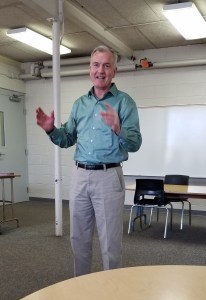
At the Senate District 37 candidate forum in Coralville, Eric Dirth, Imad Youssif, Zach Wahls and Janice Weiner created a dialogue that was informative and wide-ranging. As usual, the Johnson County Task Force on Aging arranged an event that enabled candidates to showcase their positions, personality and public speaking ability. All four candidates demonstrated a reasonable command of the issues in this race. There will be at least two more forums before the June 5 primary election. I’m voting for Wahls.

Three Democrats are vying for two seats on the Johnson County board of supervisors. Mike Carberry, Pat Heiden and Janelle Rettig filed nominating papers and will be on the ballot. When I dropped off some extra garden seeds to my friend John Deeth at the auditor’s office yesterday, he said early voting begins Monday, May 7.

One of my picks in the county supervisor race is incumbent Janelle Rettig who I got to know when she first ran eight years ago. She has a pistol of a personality and a bullet-point approach to her life as a politician. She’s been known to take aim at injustice in the county. As a journeyman datahead, I appreciate that and have supported her since the beginning.

I’ve known Mike Carberry longer through our mutual association with Iowa Physicians for Social Responsibility. We got to know each other in our work to stop coal-fired power plants in Waterloo and Marshalltown, and then worked together when MidAmerican Energy proposed a bill in the Iowa Legislature to have legislators approve a process for a new nuclear power plant. We were successful in stemming the tide on those bad ideas. I haven’t given Mike the nod at this time and am in no hurry to decide my second primary vote.

Supervisor candidate Pat Heiden has not previously served in public office. I’ve known her only since she retired from her career at Oaknoll Retirement Residence where she was executive director for 21 years. She’s positive and talented. What I noticed about her at most events we both attended is she is continuously meeting people, handing out business cards, and talking about issues. She seems a natural politician. I haven’t given her the nod either.

Since the filing period for the supervisor election closed, I’ve discussed the race with numerous Democratic primary voters. It’s surprising to me how much dissatisfaction there is with the current board. Most with whom I spoke were voting for Pat Heiden, many bullet voting. I’ve had my nose to the grindstone and haven’t been paying the supervisors much attention. What happened?

There have long been people I know who don’t think much of what the county supervisors are doing. The dissatisfaction I’m hearing now is different from that and more widespread. The reason I gave hours of my life to a county Planning and Zoning Commission meeting last night was in an effort to understand what’s going on. I’m not there yet, but from that meeting, and my conversations with voters, the supervisors appear to have a wicked problem. It’s called process. Boring? Yes. Voters don’t pay much attention to process unless it spills over into their lives, and that’s what appears to be happening and in turn driving negativity.

There’s more to do to understand this, and I expect another post, maybe two, once I’ve spent more time on it.

For now, I’m going to finish a shift at my desk and get outside to begin garden preparation a couple hours after daylight. I’m also going to quit reading the book Unbelievable by Katy Tur. It reads like eating political cotton candy and I’m pretty sure it’s not good for me. It’s been another day in the life of a recovering political junkie.

Categories
Living in Society

Journeyman Datahead

Political Retirement Party

I volunteered to be the “data guy” for a local political campaign this year.

Being a datahead, data guy is a reasonable fit, although I prefer the usage “datahead” to “data guy.” Whatever they want to call me will do.

“Datahead” refers to a person who is well versed in general knowledge. What we dataheads know is data is dead if it becomes disconnected from a living society. For example, in politics people often compare the number of registered Republican voters in a district to the number of registered Democratic voters and make an argument based on “data.” Often forgotten in such analyses is that no preference voters, like those in the district on which I am working, have more voter registrations than either party-specific voter group. People are weary and suspicious of politics and no preference voters include mostly recovering Democratic and Republican voters. Think of it as the voter version of Alcoholics Anonymous: Voters Anonymous. I’m not quick to draw conclusions based on voter registrations, despite what such data may indicate in a spreadsheet or computer application.

After arrival at Fort Jackson, S.C. for U.S. Army basic training I was assigned to a barracks on Tank Hill. On weekends we hung out at the barracks. I would read Chaucer in my upper bunk while a group of fellow soldiers played whist on the lower bunk. They called me “professor,” and I liked the appellation. Sometimes people call me “professor” today but I am no longer the sharpest knife in the drawer, so I’m not sure the usage is warranted. I know a few things but have forgotten as much as I know. I enjoyed hanging out with those Alabama National Guardsmen.

In a political campaign people have specific questions and want answers. My experience often comes into play. In part, I serve as technician, collecting and analyzing data and experiences… suggesting which voters to contact, which strategies and tactics to pursue. I’m also an advisor using life experience to influence the direction of a campaign while answering questions. I’m a journeyman datahead, helping where I can but always deferring to others in decision making. I enjoy hanging out with people working on our campaign.

Much has been made of the data-driven campaign beginning with Howard Dean and Joe Trippi in the run up to the 2004 election. There is no political substitute for meeting voters, especially at their home, and ferreting out what they believe and feel about the needs of the body politic. Campaigns will always need workers to do the tedious, repetitive work of voter contact. Lesson learned: wearing orange hats while canvassing voters, as out of state Deaniacs did, is not recommended.

I’m glad there continues to be a role in politics for journeyman dataheads like me. It’s a chance to make a positive contribution as we pass the baton to the next generation.

Categories
Living in Society

Janelle Rettig Democrat for Johnson County Supervisor

Janelle Rettig

Janelle Rettig announced March 18 she would run for re-election to a third term on the Johnson County Board of Supervisors.

Rettig will face incumbent supervisor Mike Carberry and Democratic Central Committee member Pat Heiden in the June 5 primary election for two board seats.

“In the eight years I have been a supervisor we have a long list of accomplishments,” Rettig said in an email. “We have lowered the countywide levy while undertaking significant projects. Progressive accomplishments and financial responsibility are my driving causes.”

Rettig is a graduate of Knox College who has lived with her spouse, Robin Butler, in Iowa City for over twenty eight years. They are involved with numerous non-profits, are activists, avid bicyclists, and ride a Harley-Davidson motorcycle. They also have a border collie named CJ.

“I think my single best contribution to the board of supervisors has been to focus on financial issues,” Rettig said. “I have led in the creation of a Finance Department, financial policies and transparency.”

While on the board, Rettig used short-term bonding to access Tax Increment Finance districts thereby reducing cost on individual property taxpayers. It allowed the county to take advantage of lower construction costs and get more road projects completed more quickly, she said.

“I spend a lot of time reviewing our financial reports and studying budget requests,” she said. “I often figure out a way to get things done without significant tax increases.”

Rettig is proud of her role on the board.

“We have built six solar projects, increased programs and funding for mental health/disability services and for those living in poverty,” she said. “We have improved our infrastructure by building roads, bridges, trails and paved shoulders, and we have invested in affordable housing — all while creating a finance department, balancing every budget, and lowering the overall county debt. In addition, we have increased sustainability, raised the minimum wage, and implemented a Community ID system.”

An important part of the board’s recent work has been the Johnson County Comprehensive Plan.

“I have been consistent with current land use plan and believe supervisors should follow the plan and not pick winners and losers based on things that are not contained in the plan,” Rettig said. “I have supported a number of amendments to the Unified Development Ordinance that I believe have made our land use plan stronger.”

“The new plan under consideration currently has some items that concern me. I’m afraid that the proposed map and matrix may lead to more political decisions and may lead to more development on higher corn sustainability rated land. I look forward to reviewing the final plan that will be recommended by (the Planning & Zoning Commission) and listening carefully to a public hearing with input from residents.”

“In the past eight years, I have worked every day to reflect the progressive values of the people of Johnson County,” she said. “None of this happens in a vacuum. It takes leadership, innovation, vision, determination, teamwork and sometimes courage.”

“My most rewarding vote was to raise the minimum wage,” Rettig said. “The vote that will have meaning long after I am gone is the vote to save the Sutliff Bridge.”

Website: janellerettig.com
Facebook: Janelle Rettig
Twitter:@JanelleRettig

Editor’s Note: The author has endorsed Janelle Rettig for Johnson County Supervisor in the June 5 primary.

Categories
Living in Society

Mike Carberry Democrat for Johnson County Supervisor

Mike Carberry

Mike Carberry of Iowa City filed for re-election to the Johnson County Board of Supervisors before last week’s filing deadline.

First elected in 2014,  Carberry will face incumbent supervisor Janelle Rettig and Democratic Central Committee member Pat Heiden in the June 5 primary election for two board seats.

Well known in the local, progressive ecosystem, Carberry worked as an environmental lobbyist before his election to the board. As a county supervisor he seeks to apply his talents to local issues from a sustainable perspective — environmentally, economically and with social justice, according to his website.

“I’ve called Iowa City home since 1976,” Carberry said in an interview. “It’s the greatest place to live in the Midwest, but also the most expensive in Iowa. Fighting poverty is a big umbrella under which I’ve done really good work.”

Carberry voted to increase the minimum wage to $10.10 per hour in Johnson County shortly after his first election. During his tenure on the board, the county budgeted about $2 million for the Housing Trust Fund of Johnson County, initiated projects to relieve food insecurity including activities at the former Johnson County Poor Farm, and has identified a need to create a better transportation structure to serve the working poor, he said.

“I want to do everything I can to help fight the war on poverty in Johnson County and hopefully across the state,” Carberry told the Cedar Rapids Gazette. “Hopefully, we can be a leader.”

An important part of the board’s recent work has been the Johnson County Comprehensive Plan.

“The comprehensive plan contains policy goals for many aspects of the community; including, for example, land use, transportation, housing, parks and open space, infrastructure, facilities and economic development,” according to the Johnson County website. Carberry provided an update on the plan’s progress.

He expects the county Planning and Zoning Commission to evaluate and discuss the comprehensive plan at their April 5 working session. Then, on Monday, April 9, the commission will discuss the proposed plan and potentially make a recommendation to the Johnson County Board of Supervisors.

Carberry hopes for an up or down vote on April 9, he said. If they do not approve the plan, he expects the commission to recommend changes. Once the supervisors have a response from Planning and Zoning, they will hold a work session, an informal meeting, and then a formal meeting on the plan.

Carberry said he did not get everything he wanted in the comprehensive plan, attributing that to the political process of compromise. His main interests are addressing urban sprawl, creating smart growth, and encouraging growth from the city limits outward through policy.

“I hope the supervisors’ work on the Comprehensive Plan is finished by the end of April,” he said.

Carberry has weighed in on a host of issues since he first ran for the board of supervisors.

“We’re not done yet,” Carberry said. “We want to continue to make Johnson County the best in the Midwest, and one of the ways to do that is to keep fighting. That’s what I’m going to do.”

Website: CarberryForSupervisor.com
Facebook: Carberry For Supervisor
Twitter: @MikeCarberry

Editor’s Note: The author has endorsed Janelle Rettig for Johnson County Supervisor in the June 5 primary.

Categories
Living in Society

Pat Heiden Democrat for Johnson County Supervisor

Pat Heiden

Pat Heiden of Iowa City filed to run for election to the Johnson County Board of Supervisors.

“Johnson County is an exceptional place to live and work,” Heiden said in a press release. “I know our neighbors are best served when we facilitate partnerships, when we collaborate to solve problems, and when all communities and citizens believe they will be heard with respect. I’m running because I know we can do better, and I want to be a part of that effort.”

When the filing period for the June 5 Democratic primary closed yesterday, three candidates had filed for two seats, Heiden and incumbents Mike Carberry and Janelle Rettig.

This is Heiden’s second attempt at election to the board of supervisors, placing fourth in a field of six for three seats during the June 7, 2016 Democratic primary.

“I realized I just wasn’t ready the first time,” she wrote in an email. “I was serious about the race and so were my supporters, but juggling the end of my career at Oaknoll and trying to run for the first time was just too much. This time, I’ve got the time and focus to do it right.”

Heiden announced her second campaign for county supervisor Oct. 3, 2017 and has been organizing ever since. She reached out to mayors and community leaders in the county, and introduced herself at council meetings. She met with voters throughout the county — individually, and in small groups, coffees and listening posts. She attended every board of supervisors meeting and work session in person to get a deeper understanding of both the issues, and the dynamics of decision-making and process.

At the February precinct caucuses, when no one responded when the caucus chair asked for a second person to serve on the Johnson County Democrats central committee, Heiden looked around and said, “why not?”

“I raised my hand and they voted for me,” she said.

Heiden engaged in central committee activities and attended last Saturday’s Johnson County Democrats county convention where she made an impassioned speech to delegates explaining her campaign.

Heiden has lived in Johnson County more than 40 years, and has been involved in numerous community organizations. She served as Executive Director of Oaknoll Retirement Residence for more than 20 years, retiring in September 2016. She expects to bring her skills and experience to the board of supervisors. In order to gain a county-wide perspective, her campaign steering committee includes representatives from all 11 cities in Johnson County.

Key to her appeal is offering a fresh look at county activities. Few issues that come before the board are more complicated and contentious than the land use plan with its intersection between natural resources, agriculture and community development. Heiden is engaged in the board’s decision-making process regarding land use and is hearing feedback on the plan throughout the county.

“When we ask community members to volunteer their expertise and time,” Heiden said, “their recommendations have to be received, if not incorporated, in some meaningful way.”

When she filed her petitions, Heiden had garnered 422 signatures from all parts of Johnson County. She plans to be a candidate for all Johnson County.

Website: Pat-Heiden.com
Facebook: Pat Heiden Democrat for Johnson County Supervisor
Twitter: @pat_heiden

Editor’s Note: The author has endorsed Janelle Rettig for Johnson County Supervisor in the June 5 primary.