Categories
Living in Society Work Life Writing

Pushing Age’s Envelope and the Debate

Apple Tree June 25, 2019.

Wednesday I worked outside for five hours at the home, farm and auto supply store.

As temperatures reached toward 85 degrees, a colleague and I consolidated the remaining plants and supplies and opened up traffic flow where the garden center had been. I used a lift truck although there was plenty of physical labor. Our permit with the city expires soon and it’s time to make the parking lot a parking lot again.

Lifting numerous bags of mulch, soil and garden products took a toll. I was tired when I clocked out at 4:30 p.m.

Stopping to pick up provisions at the warehouse club, the trip home took an hour and 40 minutes. I followed a large sprayer from North Liberty to Solon and it drove really slowly. There was no way I could make the trip to the county seat for a meeting where a group is coordinating a presidential candidate debate on our issues: nuclear abolition and climate change.

Aware of the televised and webcast first presidential candidate debate, I skipped it for complicated reasons, but mostly because I couldn’t stay awake until it ended at 10 p.m. With a large glass of milk and an appetizer plate for dinner, I retired early and slept through the night.

I woke around 2:45 a.m. and picked up my mobile device without turning on the lights. A friend from one of the farms where I work participated in a CNN discussion panel after the debate and sent me video. She represented our community well in the brief amount of air time.

My main conventional news sources, Associated Press and the Washington Post each had their spin about what was most significant. AP framed health care and immigration as the top issues debated. The Washington Post headlined economic policy, although they presented multiple articles on several topics.

My social media scroll showed partisans supporting their candidate and little else new. What stood out was broad support for Elizabeth Warren’s performance and a breakout for Julián Castro. In the honorable mention category, de Blasio was not as bad as expected and U.S. Senators Cory Booker and Amy Klobuchar came across as knowledgeable and presidential. Of the ten in the first debate, it is time for Bill de Blasio, Tim Ryan, Beto O’Rourke, Tulsi Gabbard, Jay Inslee and John Delaney to make their way to the exits and find other Democratic work needing to be done. If we have too many presidential candidates, there is no shortage of work to regain a Democratic majority in the legislature.

No regrets about missing the debate as I feel rested and ready to start another day. When you get to be a certain age, physical limits are familiar. One hopes to keep our powder dry and live to fight when it really matters. I can’t honestly say sifting through dozens of announced presidential candidates matters that much.

Editor’s Note about June 27 debate: Survivors of the second debate, according to accounts I read similar to those mentioned, and not from watching the debates, are Joe Biden and Bernie Sanders (only for their high ranking in the polls), Kamala Harris (for her discussion of the importance of race relations in 2019), and Pete Buttigieg for his millennial status and as a reminder of the promise of youth. As U.S. Senators Michael Bennet and Kirsten Gillibrand get honorable mention, they should make their exits from the presidential race to work on electing additional Democratic U.S. Senators to secure a majority. Eric Swalwell, Marianne Williamson, Andrew Yang and John Hickenlooper should recognize the exit music and gracefully seek other important work in the Democratic Party to improve our chances of securing majorities in both federal legislative chambers.

Based on this analysis, there are few choices for me: We need to turn the page on Joe Biden and Bernie Sanders even though their current standing in polls is evidence many like them both. That leaves Elizabeth Warren, Kamala Harris, Cory Booker, Pete Buttigieg, Amy Klobuchar and Julián Castro. I’d like to hear more from each of these candidates in the next debate. The field needs to reduce by half again after that process is completed. Of everyone that is running, on June 28 I’m more likely to support Elizabeth Warren than I was. My willingness to listen will decrease as summer continues. Making a decision of who to support should be doable by Labor Day.

Categories
Living in Society

You Say You Want a Revolution

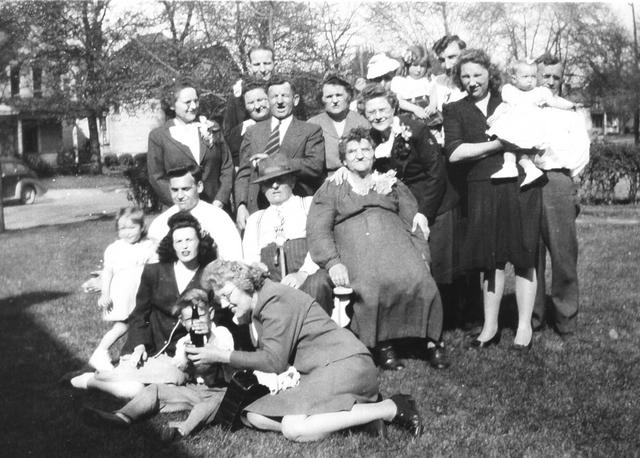
Easter 1946

In Iowa presidential candidates attempt to generate hope. Not just hope of winning in 2020, but to make our country a better place beyond the next election.

So much has changed in our lives and not for the better.

Progress will be difficult for Democrats when the hegemony of wealth and business touches most of us. The hold libertarians and conservatives have on us is based on influence in our jobs, health care, energy companies, transportation, retail stores, and social institutions. Whether we know it or not, we mostly work for them. Something’s got to give in our politics because as the richest get richer, society is not working for the rest of us.

“Establishment politics is just not good enough,” presidential candidate Bernie Sanders said at a CNN Town Hall in 2016. “We need bold changes, we need a political revolution.”

If the shine came off this trademark Sanders claim and the revolution has stalled according to the Washington Post, it may be because a number of candidates, including Elizabeth Warren, Pete Buttigieg, and even long shot Marianne Williamson, are all calling for profound change in American life.

Warren calls for “big, structural change to rebuild the middle class.”

Buttigieg wants a “fresh start for America… It’s about more than winning an election. It’s about winning an era.” He’s thinking of the millennial era.

Williamson wants evolution to a politics of love, saying on her website, “Our task is to generate a massive wave of energy, fueled and navigated by we the people, so powerful as to override all threats to our democracy. Where fear has been harnessed for political purposes, our task is to harness love.”

Presidential candidates need something to elevate their campaigns, which is well and good. I recall a time when I looked for that in a presidential candidate. The nomination of Hubert Humphrey in 1968 cured me. I’m looking for something else and question the idea of remaking everything. We are in pretty deep for that.

A main issue is libertarians and conservatives, the Radical Right as Jane Mayer calls them, would undo everything progressives have accomplished since the Franklin Delano Roosevelt administration. Under President Trump they have a shot at that, maybe the best shot ever. What do they believe? As Mayer pointed out in her 2016 book Dark Money: The Hidden History of the Billionaires Behind the Rise of the Radical Right, “taxes are a form of tyranny; that government oversight of business is an assault on freedom.” Things we take for granted — Social Security, Medicare, the Environmental Protection Agency, OSHA, the National Labor Relations Board — would all be dissolved if the radical right had their way. To the extent a revolution is called because of changes in this status quo, it is too little, too late.

The radical right already owns us. Whether we consume their media, buy their fuel, use their electricity and natural gas, invest in their financial services companies, or shop in their stores, a percentage of each transaction finds it’s way to the wealthiest people in the country. We don’t care if using Wells Fargo, shopping at Amazon or Walmart, using fossil fuels, or working at their jobs is bad for us. We have chosen a way of life and if the radical right is behind it, they have been out of sight, out of mind for a very long time. Not only are we owned, we have been hoodwinked into believing the status quo has been good to us.

During Summer 2019 the Democratic candidates for president will be putting their best foot forward to persuade Iowans to caucus for them. A bright light should shine on the idea of remaking everything in a candidate’s framework. The last time Democrats had a mandate for change was after the re-election of Lyndon Johnson in 1964. Given the structural problems with our government — the electoral college, gerrymandered congressional districts, voter suppression, to name a few — it is unrealistic to expect any political revolution, evolution, big structural change, or winning of an era.

When in 2016 Hillary Clinton said we are stronger together, the phrase was not new. Among the challenges of the 2020 election are for Democrats to maintain control of the House of Representatives and elect a Democratic president. The extended presidential primary season works against us on both of those goals pitting good Democrats against other good Democrats as we promote “my” candidate. Our goal should be to stop the radical right from further bleeding a Democracy on life support by winning the election. It will take all Democrats to get this done. Once we do that we can talk about what’s next.

It is hard to keep hope alive. The problem with our democracy is logic no longer applies when it comes to voting or to almost anything else outside the purview of the richest Americans.

You say you want a revolution. Well, you know, we all want to change the world. Unlike the Fab Four, I’m not sure it’s gonna be alright.

Categories
Living in Society

Marianne Williamson Close to Home

Marianne Williamson addressing a gathering at Kirkwood Community College in Cedar Rapids, Iowa on June 10, 2019.

About 11:15 a.m. I left the garden and drove Ely Blacktop to 76th Street and headed West to Cedar Hall on the main campus of Kirkwood Community College where presidential candidate Marianne Williamson joined State Senator Rob Hogg in a “climate conversation.”

Since I would be returning to the garden after the event, I wore my overalls and mud-caked gardening shoes.

I joined a number of students and staff, along with local members of environmental groups in a large operating theater-style classroom. By the time we got started more than 40 people had joined us.

I attended partly because the venue was close to home, partly to support Senator Hogg’s efforts to engage presidential candidates about climate change, and partly to see if Williamson’s campaign is, as some have called it, a “joke.”

Marianne Williamson taking questions at Kirkwood Community College, June 10, 2019.

Williamson’s campaign is not a joke. Why anyone would criticize a woman who is successful in her own right, by objective standards such as having written four number one New York Times best selling books, had me curious. She made it to the first two Democratic National Committee presidential debates, although just barely achieving one percent support in three separate national polls to qualify. She’s dead serious about her platform and as confident as any of the other 23 presidential candidates. With great optimism she said, “If you’re going to run for president, you might just win.”

The main news out of the event was Williamson did not support a separate DNC debate on the topic of climate change. The reason, she said, was “because there is no competing with Jay Inslee.” Williamson also said the topic cannot be separated from the broader problems in the United States. She made a point. Advocates for addressing the deleterious effects of the climate crisis cannot separate this one issue into a silo separate from other important matters like health care, education and national defense and expect to resolve them.

State Senator Rob Hogg explaining why the Iowa caucuses are first in the nation. “We do it right,” he said.

Williamson made a strong case for slowing our relationship with Saudi Arabia. She said as president she would immediately stop arms sales to the kingdom and end United States support for the war in Yemen, a conflict she said was immoral.

She also weighed in on nuclear disarmament, asking why we need 100 aircraft capable of delivering nuclear bombs when dropping ten of them could end life as we know it? It was refreshing to hear a candidate raise the issue without prompting.

Dave Bradley at Blog for Iowa wrote Williamson was positioned in the third tier of candidates, among those “who truly have little chance and are often running to push some ideas or philosophy.”

Marianne Williamson has been finding her way all her adult life. Win or lose, the time spent with her this afternoon was memorable for her determination to assert her solutions her way. As Hogg referred to her speech in Cedar Rapids yesterday, it is the “politics of love” and quite different from the offerings of other candidates.

Neighborhood Network News recorded this event. The YouTube video can be viewed here.

To learn more about Marianne Williamson follow this link to her website.

Categories
Environment Living in Society

Jay Inslee at the Cedar River

Governor Jay Inslee at Ellis Park in Cedar Rapids, Iowa, June 8, 2019.

CEDAR RAPIDS, Iowa — Saturday afternoon I drove to the Overlook Pavilion in Ellis Park where State Senator Rob Hogg had organized a “climate conversation” with Washington Governor Jay Inslee who is an announced candidate for president.

Hogg reminded us of the 2008 Cedar River flooding. The river was visible behind him.

It is hard to forget the 2008 flood that devastated Iowa’s second largest city. On my way to the event I compared flooding levels of the Atherton Wetland on Ely Blacktop which had been covered with flood water in 2008. From the center of Cedar Rapids I used First Street Southwest, which runs next to the Cedar River, to find the park. On the eastern bank someone had built a flood wall. An earthen berm restricted the view of the river on some parts of First Street. The low-lying area had been inundated in 2008 causing damage to more than 5,000 homes, evacuation of 25,000 people, and roughly $4 billion dollars damage. The flood was made worse by climate change.

In his introductory remarks, Senator Hogg recognized elected officials and organizations present and encouraged the almost 200 attendees to engage in the Iowa caucus process of meeting with presidential candidates. Hogg added later, “with the spirit of citizenship, we can bring Americans together for climate action we so urgently need and the many climate solutions that work.”

Governor Inslee began his remarks with the reason he seeks to defeat climate change, his grandchildren. “We have a moral obligation to the young people of America to defeat climate change,” he said. Noting last week’s atmospheric carbon dioxide concentration was 414.42 ppm (only slightly less than the record (415.70) set May 15), he added, “It is time to act on climate.”

Defeating climate change would be the first priority for an Inslee administration, the governor said. It was a “predicate for success” in all policy areas. If addressing climate change is not job one it won’t get done.

Inslee split from environmental groups like Citizen’s Climate Lobby when he said he did not support a tax on carbon. He favors regulatory reform to reduce carbon emissions. Based on his experience in Washington State, voters are unlikely to accept such a tax, he said.

Inslee asked for help in two areas of his campaign.

While he met the qualifications to participate in the first two debates being hosted by the Democratic National Committee, he has not met the 130,000 donor threshold to participate in the third and fourth. He encouraged those present to donate one dollar or more to his campaign and ask friends and family to do likewise.

Inslee wants the Democratic National Committee to devote one candidate debate to climate change so every participating candidate can lay out their plan to defeat it for voters to see. The request has been rejected, making supporting Inslee the best way to make sure the topic is covered during the debates, he said. Holding a climate change debate outside those sanctioned by DNC is not an option.

“It is the DNC’s job to organize the debate schedule, and the ground rules on unsanctioned debates were made clear with all the candidates, including Governor Inslee, and media partners months ago,” DNC spokesperson Xochitl Hinojosa told Mother Jones. The DNC welcomes candidates to join issue-specific forums instead.

The thrust of the conversation was Inslee has a positive progressive record in Washington State and wants to take that success to Washington, D.C. To learn more about Governor Jay Inslee, visit his website at JayInslee.com.

The Inslee campaign posted video of the event here.

~ Written for Blog for Iowa

Categories
Kitchen Garden Living in Society

Garden Crunch Time on a Political Weekend

Sunrise

The forecast looks perfect for a day in the garden. I intend to get started soon after sun up at 5:31 a.m. and work as long as I’m able or until needed work is done.

Tomatoes and cucumber seedlings are reaching the critical stage where either they get planted or composted and I favor the former. Otherwise, what was the point of all the planning and preparations in the greenhouse? If I establish the tomato patch and plant cucumbers and peppers that will be enough of an accomplishment.

My scale is larger than a typical household garden with 38 plum and slicer tomato plants planned, a scaled down cucumber patch, and a patch of 12 hot peppers alongside one row of guajillo and one row of ancho chilies. If I get that all in, anything else would be a bonus. The goal is to finish by 4 p.m. so I can go out to dinner in the county seat with some of my blogger friends.

Sunday, June 9, is the Iowa Democratic Party Hall of Fame induction in Cedar Rapids. The Hall of Fame is one of the biggest party fundraisers of the year and this year’s inductees are Fred and Charlotte Hubbell who have long been active in Democratic politics. They are also among the most significant financial contributors to the party. Fred Hubbell was our gubernatorial candidate in 2018. Other individuals and groups are also recognized at the event. Here’s a link.

19 candidates for president will take five minutes each to address attendees. Most candidates have events scheduled in and around Cedar Rapids this weekend to expand the reach of their trip to Iowa’s second largest city. The events range from sign waving rallies outside the event location to family-friendly gatherings in a park to food and social time with candidates. The event I plan to attend is a climate conversation with Washington Governor Jay Inslee who made the climate crisis the focus of his campaign for president. Organized by State Senator Rob Hogg, a long-time member of the Climate Reality Project, I’m looking forward to hearing how the conversation goes Saturday, June 8 at 6 p.m. at Ellis Park in Cedar Rapids.

I had a brief chat at the county party central committee meeting with one of the Our Revolution of Johnson County organizers about the Bernie Sanders campaign. The campaign saved voter information from Sanders’ 2016 effort, which resulted in half of caucus-goers supporting Sanders. The salient question is whether 2016 Sanders support can be converted to 2020 support. Our local Sanders organizer is in training this week and they haven’t finished the canvass to know the answer. They have significant endorsers and thousands of volunteers to perform the canvass.

“This incredible group of endorsers are some of the most well-known progressive voices that Iowa has to offer,” Misty Rebik, Sanders’ state director, said in a June 6 statement to Iowa Starting Line. “Together with our 25,000-strong volunteer base in the state, these progressive Iowans will help us build on our grassroots movement and win on caucus night.”

I don’t see any of the other campaigns packing up and going home after this statement. However, if what Rebik told the blogger is true, I’m sure everyone will use their five minute speech at the Hall of Fame to add their Sanders endorsement to the list.

As I reported April 26, Newman Abuissa confirmed he is running for Congress in Iowa’s second district at last night’s county central committee meeting. I’ve known Abuissa for years and he’s a good guy. In addition to being an engineer for the Iowa Department of Transportation, he is a member of the Arab American Institute’s National Policy Council. Active in peace and justice issues within the Iowa Democratic Party his focus has been on foreign policy as it relates to the Middle East. It seems unlikely he will gain traction against announced candidate Rita Hart, but his announcement was clearly heartfelt. He’s right. We could do a lot of good with the money being wasted on our perpetual wars.

I can see the light of a new day dawning through the window on the other end of my writing space. Time to get to work in the garden.

Categories
Living in Society

Biden 3.0

Vice President Joe Biden in the Rope Line in Cedar Rapids, Iowa, May 19, 2010

As a registered Democrat with substantial political experience, former Vice President Joe Biden is welcome to run for president. The question in my precinct is whether he can find enough supporters to achieve viability in the February 2020 precinct caucuses.

In 2008, Biden was not viable on his own, or when his supporters formed a coalition with Chris Dodd and Bill Richardson supporters. He dropped out of the race in January.

During that cycle, we had ample opportunity to meet members of the Biden clan.

I met Jill Biden in nearby Solon during a 2007 non-partisan, multiple candidate event held by the Solon Senior Advocates. She was campaigning for her husband. I met Beau Biden at Old Brick in Iowa City that cycle after he gave a speech. I finally met Joe in Cedar Rapids while he was serving as vice president after a 2010 campaign event for Chet Culver. Joe Biden stayed long after his speech and shook hands with anyone who cared to. His campaigns seemed about what is referred to as the “Biden clan.” Appearances in person, or through a surrogate, were part of the same energy. If you supported him, you became part of that energy, a de facto member of the Biden clan. Some viewed that as a positive.

I recently read Jill Biden’s memoir, Where the Light Enters: Building a Family, Discovering Myself, which effectively lays out the meaning of the Biden clan. I didn’t know what to expect when I bought the book, just that I found her personable when I met her. What I found is a well-crafted narrative of a type of American family that when I was younger, I wanted to be part of. That type of family is now fading from our collective imagination. With Biden 3.0 the same energies emanate from their home in Delaware. They don’t seem that spell-binding today.

Evaluating Biden 3.0 involves specific queries.

Do you believe Joe Biden is a fake politician or is he genuine?

When I worked in transportation my supervisor was an active Republican who unexpectedly criticized Biden for his hair transplants. “He’s fake,” he said to me on several occasions, referring to the hair plugs and Biden’s vanity for getting them. That seemed a superficial analysis, even though he had encountered Biden at an airport and confirmed up close the hair looked bad. When I met Biden, I didn’t look at his hairline, but felt the warm handshake and attention he gave me. That’s similar to what other Democrats have mentioned when talking about Biden. I know few Democrats who doubt the genuine nature of Joe Biden’s personality. Nonetheless, it’s a question to answer. He’s the real deal.

Is Biden in it to win it?

On his third attempt to win the Democratic nomination for president, at age 76, life is too short to enter the race to make a point. There is no doubt Biden wants to win. National media reported on Biden clan deliberations about the 2020 opportunity. When he announced, national media gave him good coverage. Because of his near-universal name recognition among Democratic primary voters and caucus-goers, he is running a different type of campaign. Yesterday the Washington Post ran an article titled, “Joe Biden’s campaign of limited exposure: How long can he keep it up?” They summarized the campaign strategy as follows,

With near universal name recognition and high favorability ratings among Democrats, the former vice president does not need to introduce himself to voters like nearly every other candidate. And as the leader in early polls, he can attract media attention without splashy events.

Focused on fundraising instead of early state local events, Biden can appear above the fray. He’s been criticized for this approach, but if the focus is to win, it may be a solid strategy — maybe good enough to see him through Iowa, New Hampshire, South Carolina and Nevada, and if he wins there, through Super Tuesday.

What about Biden’s record in the U.S. Senate?

People criticize Biden’s work as Senate Judiciary Committee chair during President George H.W. Bush’s nomination of Clarence Thomas as associate justice of the U.S. Supreme Court. The criticism is specifically of Biden’s handling of Anita Hill’s testimony. Such criticism seems justified from a 2019 perspective. What is forgotten is Biden was judiciary chair during President Ronald Reagan’s nomination of Robert Bork as an associate justice. The Bork nomination became famous for Massachusetts Senator Ted Kennedy’s floor speech within 45 minutes of the nomination, in which he said,

Robert Bork’s America is a land in which women would be forced into back-alley abortions, blacks would sit at segregated lunch counters, rogue police could break down citizens’ doors in midnight raids, and schoolchildren could not be taught about evolution, writers and artists could be censored at the whim of the Government, and the doors of the Federal courts would be shut on the fingers of millions of citizens.

Biden did an effective job shepherding rejection of that nomination and should get appropriate credit. As much as the Bork nomination and Kennedy’s speech reflects our politics in 2019, I believe voters and caucus-goers must take Biden’s entire political history into consideration, including his vote for the Iraq War.

Is Joe Biden the same person who stepped on the stage with Barack Obama in Chicago’s Grant Park on Nov. 7, 2008 in front of an estimated million people?

I don’t know. I hope not. He’s gotten older, has eight years of the Obama administration on his resume, and hasn’t spent much time in his third campaign to be president defining policy. He stands out in Iowa for those things.

He hasn’t been a part of the campaign grind we see played out in local media hardly at all. While Elizabeth Warren, Cory Booker and others have 50 or more organizers on the ground in Iowa, Biden 3.0 appears to be banking on his prior work to gain him the viability he couldn’t find in 2008.

It is fair to ask the question Jill Filipovic did in a May 17 New York Times op-ed, “Does anyone actually want Joe Biden to be President?” It is equally fair to feel badly about asking it after coming into contact with the Biden clan’s energy over so many years.

I like Joe Biden. I don’t like him for president. If he’s nominated, I’ll support him, like I would any of the 24 potential nominees. That’s a feeling many in my political circle of friends have expressed. It will override the tit for tat niggling over candidates when it comes to the general election. At least I hope it does.

Categories
Living in Society

Memorial Day 2019

Flags at Oakland Cemetery

The president is said to be considering pardons for convicted war criminals as we go into the Memorial Day weekend.

Jamelle Bouie names some of the criminals under consideration in a New York Times article.

Last year, a federal jury in Washington convicted Nicholas Slatten, a former security contractor, of first-degree murder for his role in killing one of 14 Iraqi civilians who died in 2007 in a shooting that also injured more than a dozen others. Matthew Golsteyn, an Army Green Beret, was charged late last year with the murder of an unarmed Afghan man during a 2010 deployment. Edward Gallagher, a Navy SEAL who served in Iraq, was reported to authorities by his own men, who witnessed him “stabbing a defenseless teenage captive to death,” “picking off a school-age girl and an old man from a sniper’s roost” and “indiscriminately spraying neighborhoods with rockets and machine-gun fire.”

It is the president’s prerogative to grant pardons. What does it say about our country that he picked these men?

It says nothing positive on a day set aside to recognize those who gave their lives for our country.

Categories
Living in Society

A Veil of Reasonable

Tom Miller Photo Credit – Iowa Attorney General’s Office

On Wednesday, May 22, Iowa Governor Kim Reynolds line-item vetoed HF 615, the justice system appropriations bill, to remove sections 24 and 28 pertaining to the role of the attorney general.

The law would have “required the approval of the Governor, Executive Council, or Legislature to prosecute any action or proceeding, including signing onto or authoring amicus briefs or letters of support, in any court or tribunal other than an Iowa state court,” according to the press release.

While she vetoed that part of the bill, Reynolds said the law had brought Attorney General Tom Miller into discussions about their respective roles. In the transmittal letter accompanying the bill, Reynolds wrote,

As a result of the Legislature’s leadership on this issue, Attorney General Miller and I have had the opportunity to engage in a thoughtful discussion about the appropriate balance of authority between the Governor and the Attorney General with respect to Iowa’s involvement in litigation. And ultimately, Attorney General Miller agreed to my proposal to adjust our litigation practices in a manner that I believe addresses my core concerns without amending Iowa’s current statutes.

Attorney General Tom Miller said his agreement with the governor was made in good faith,

This agreement allows my office to continue to protect Iowans through consumer enforcement actions, which are primarily filed in Iowa courts. It also allows me to express my opinion on matters affecting Iowans before federal agencies and Congress.

Republicans got the leash out but avoided collaring the popular Miller.

In part, the ability to reasonably negotiate differences between state-wide elected officials is part of what makes Iowa different from nearby states like Wisconsin and Kansas. We look at them and say to ourselves as Iowans, “Dear God! Let’s not be like them.” That Reynolds and Miller were even able to discuss and negotiate a better solution to Republican dislike of his activities is something. It is also something else.

While Miller, first elected in 1978, is the longest serving attorney general in the United States, he will eventually retire or die in office. That he is a Democrat is less important to his longevity than the way he looks after the interests of Iowans. When Miller’s seat becomes an open race to replace him, electing a Democrat is not assured. If anything, the office of attorney general will lean in the direction of state government’s majority party.

There are one-offs like Democratic Auditor Rob Sand, who won statewide election despite Republican dominance in other offices. If Reynolds has the same longevity as Terry Branstad, Democrats holding statewide office may well be sanded off in the woodshed of Republican re-making of the state. By vetoing sections of the HF 615 pertaining to the attorney general, Reynolds is playing the long game in politics, looking after her own interests as much as settling an immediate political dispute.

We live in an open society and Republicans have been working to shape it according to their image. In many ways they have been successful. The longer it is before Democrats win a majority in the legislature and re-take the governor’s office the more permanently Republican initiatives penetrate our culture and become the background against which we live our lives. Democrats failed to stop Republicans in 2018. 2020 remains our last best hope to do so. Flipping the Iowa House of Representatives to Democratic is both doable and a primary goal for Democrats this cycle.

A veil of reasonable envelopes the judiciary budget bill and the settlement between Reynolds and Miller. One hopes the outcome is indeed reasonable, and not the vapid dealings of a Republican party looking out for their own long-term self-interest.

Categories
Living in Society

Where’s the Beef Mayor Pete?

Pete Buttigieg Arrives at Wildwood Smokehouse and Saloon May 18, 2019

JOHNSON COUNTY, Iowa — If I ranked Mayor Pete Buttigieg of South Bend, Indiana in the third tier of presidential candidates, why did I attend his town hall meeting five miles west of the Herbert Hoover birthplace in West Branch?

In a field of two dozen Democratic candidates one voter’s personal choice of a candidate is not as important as supporting the eventual nominee. What matters more in Iowa is the senate and congressional races because without a Democratic majority in both chambers of the legislature any Democratic president won’t get much done.

I went to learn about the electorate and who is active this cycle to better serve my campaign work for whoever are the Democratic nominees for Second District congressperson and U.S. Senate. The good news is a lot of people I’d never seen before were in the crowd of several hundred. Everyone was glad to be there despite the body heat in the over-crowded room.

The attraction people have to Buttigieg is palpable. We’re looking for something different and in some ways Mayor Pete is that. He’s young, living in his home town, a Rhodes scholar, a military veteran, goes to church, and is well known in the Democratic party. That’s part of the allure.

He’s also a good orator and handles audience questions with due consideration and aplomb. As I mentioned in my review of his memoir, “he illuminates the example of South Bend and what’s possible in creating a more sustainable life in urban centers.”

Emblematic of today’s town hall meeting was the five panel mural of a bull hanging over the stage, combined with the penetrating aroma of freshly smoked meat and barbecue sauce. If a person enjoyed barbecue one might stick around for dinner service. It had me asking, “where’s the beef?”

It was a pretty skinny cow. Pete Buttigieg has skilled elocution. His ideas are not very deep. He touted newly released policy pages on his website and said his policy roll out was as good as any of his competitors. I’ve never heard any of the women who are presidential candidates refer to others as “competitors.” I suppose we might give that male-ism a pass, but Hillary taught us we are stronger together. The caucus process doesn’t have to be similar to a sports event. A lot more is at stake than the horse race, even if it does generate clicks and serve egos.

The only news out of the town hall meeting was Buttigieg embraced the Citizens Climate Lobby position of adopting a Carbon Fee and Dividend. No matter how dire the environment gets, a president Buttigieg will need a house majority and a filibuster-proof senate majority for a fee and dividend bill to pass. Look at the ability Senator Mitch McConnell developed to block progress when he was minority leader during Obama’s first term.

The real action at the town hall meeting happened outside the main stage and venue. People in line talked about expectations, others thanked a friend for inviting them, families rushed to their vehicles to make the day’s next event. The strength of those relationships is what gives Democrats hope. That combined with what we hope will be an ability to pull together.

I’m glad I had a chance to attend today’s event. In Iowa we don’t know how lucky we are to have a presidential candidate within 15 miles of our home. Based on today, my faith is strong that Democrats will pick an excellent candidate to face off with the incumbent president. I believe we will soon find the wind at our backs lifting our sails toward a better tomorrow. The idea and a lot of hard work will get us there.

~ For conventional coverage of the event read James Q. Lynch here. To view video of the entire event, Robin Kash of Neighborhood Network News posted it here.

Categories
Living in Society

Political Checklist – President

Jimmy Carter at the Iowa State Fair, August 1976 – Photo Credit – Des Moines Register

I try not to inflate the importance of Iowa’s first in the nation caucuses. Whatever it was, the caucus process is less personal today than depicted in the media or by campaign consultants. Gone are the days of a Jimmy Carter-style candidate appearing unannounced at the Iowa State Fair to meet and greet people.

I’m okay with that and don’t seek a return to those times. They weren’t that great and for the most part, our politics has become smarter.

If I get a chance to meet the Democratic nominee for president in 2020 that’s good, but not necessary for me to go on living. I feel confident the Democratic nominating process will pick a viable candidate to challenge the incumbent no matter how individual campaigns muck it up. Democrats I know favor support of the eventual nominee over any transitory enthusiasm for another candidate on caucus night.

When Iowa Republicans fielded 18 presidential candidates in 2016, I thought that really worked for them by increasing the number of events where Iowans could talk about politics. It solidified a sense of community among party members and is paying them dividends in state and federal government. Now that Democrats have fielded 22 23 candidates, what Republicans had doesn’t seem very likely. Let’s face it. We are too Democratic to develop that kind of culture.

The Democratic field is dividing into non-hierarchical tiers, like it or not. Here’s my take on for whom I might caucus as of this morning. Implicit is the idea I will finalize a choice and begin to work for a campaign after Labor Day. When I say “work for a campaign,” I mean in my political precinct.

Tier One: Possibilities

Given the long list, there are only three candidates I’d talk to my neighbors about supporting, Amy Klobuchar, Kamala Harris and Elizabeth Warren.

I’ve heard Minnesota Senator Amy Klobuchar speak in person (in the 2016 cycle) and like her a lot. There is also pronounced grassroots interest in her campaign among my fellow Big Grove Democrats. She won her re-election for U.S. Senate in 2018 with more than 60 percent of votes cast. If she is nominated and fails to beat the incumbent, her senate seat is safe. If she wins the presidency, it does not seem assured a Democrat would replace her. I’m remembering the Al Franken-Norm Coleman 2008 election which Franken won by about 300 votes.

Kamala Harris hasn’t been to Iowa very often, but my perception is she is running a campaign the way it should be done. She won her election for U.S. Senate in 2016 with more than 62 percent of votes cast. If she is nominated and fails to beat the incumbent, her senate seat is safe. If she wins the presidency, the expected outcome of an election to fill her remaining term in California would be a Democratic winner.

Elizabeth Warren is one of only two candidates I’ve heard speak this year. Her policies align closely with mine and her campaign is the only one that’s reached out to me personally about joining. I’ve been contacted multiple times, by multiple organizers. She has a large Iowa staff, which seems needed to win the 2020 Iowa caucus delegate count. She won re-election to the U.S. Senate from Massachusetts in 2018 with more than 60 percent of the vote. If she is nominated and fails to beat the incumbent, her senate seat is safe. If she wins the presidency, the expected outcome of an election to fill her remaining term would be a Democratic winner, despite the permanent stain on Massachusetts Democrats for failure to elect a replacement for Senator Ted Kennedy.

Tier Two: Go back to the Senate and build a Democratic Majority

It is not necessary for all Democratic U.S. Senators to run for president. I like each of them for different reasons, however, Michael Bennet, Kirsten Gillibrand, Bernie Sanders and Cory Booker should join Sherrod Brown and Jeff Merkley in declining to run for president and work to build a Democratic senate majority.

Tier Three: Like them a lot, just not for president

Pete Buttigieg should run for statewide office in Indiana. He seems to have a bright future ahead of him in Democratic politics but after reading his book and listening to a couple of speeches on the internet, my judgement is he’s not ready to become president. A career model he might follow is that of Evan Bayh who was elected Indiana governor, then U.S. Senator.

Jay Inslee’s all climate policy agenda may be what’s needed, it doesn’t seem viable in the general election.

Montana Governor Steve Bullock should run for the U.S. Senate against Republican incumbent Steve Daines in 2020.

Beto O’Rourke should run for U.S. Senate in Texas again, this time against Republican incumbent John Cornyn in 2020.

Joe Biden could do the most good for Democrats by speaking and raising money for the eventual nominee.

Tier Four: Just give it up

The remaining candidates should just give it up. I met Tulsi Gabbard, John Delaney and Julián Castro and have nothing bad to say about them. The others no doubt have many qualifications and credentials, but that alone doesn’t make for a presidential nominee. I’d reconsider someone if they or their staff reached out to me, but none of them seems to have Iowa staff presence at Elizabeth Warren level or even what’s needed. None of them has been otherwise able to gain traction.

Eight months from the Iowa caucus it seems premature to cast any of this in concrete. Picking a Democratic presidential nominee is low priority on my political checklist. More about that later.