Kale and collard seedlings planted Feb. 13, 2025. Pinkish hue from the grow light.
I delayed indoor kale planting for a week until Feb. 13. I will delay planting the other cruciferous vegetables and herbs by two weeks or more. Live and learn. It is an exciting time of the year with seeds going into soil. My heating pad and grow light held up for another year.
2024 was a marginal year for our garden. I couldn’t get the plots planted. Deer started jumping the fence and ate two successive plantings of cruciferous vegetables. Then, weeds grew everywhere. I couldn’t get some crops harvested when they matured. I got decent crops of garlic, tomatoes, cucumbers, lettuce, and collards. I hope to renew my efforts with vigor this spring. May gardening do better in 2025.
The main work is clearing the old plots, weeding, and pulling up the plastic sheeting in a way that preserves it to use again this year. This means a LOT of work. I tried making very large plots last year and the result was deer jumped the fence more often, as mentioned. The idea that plots should be smaller, leaving no landing zone for deer proved to be most effective. Given the Social Security Administration life expectancy table, I have 11 more gardens to plant. No more experimenting with plot size at this stage of life.
I bought two batches of seeds. There will be herbs, lettuce, Asian greens, cauliflower, green beans, and a lot more. The apple trees should produce this year. The Red Delicious tree planted in 1995 has been a work horse. Storms, including the 2020 derecho, have damaged it so it looks like half a tree. I will keep harvesting Red Delicious apples from it until the last windstorm takes its final toll.
Despite all the talk about inflation, food continues to be a smaller percentage of our household budget. Insurance is the killer, ironically. Car, home, life, an multiple health care policies add up. We garden because we control inputs, plus the produce tastes better than store-bought. Our garden will continue in this enduring culture of life again this year.
Gold Rush apples at Wilson’s Orchard and Farm Oct. 22, 2022.
During the eight years I worked with Paul Rasch at Wilson’s Orchard I learned a lot about apples. I was offered a chance to return after the coronavirus pandemic, yet I declined. Things had changed too much as they diversified their offerings. They moved from being mostly a seasonal apple orchard to being more of a year-around event destination with multiple big crops available for u-pick, musical entertainment, special dinners, and of course the rebuilt barn that could host a wedding or other special event. It would be difficult to recapture how I felt about my tenure in the earlier years by taking the job. I’m okay with everything.
When my apple trees fruit, I don’t hardly go to the orchard. I can get all the apples I need for a year from the five remaining trees. At the end of each season, regardless of whether I have apples, I buy Gold Rush apples from the orchard because they keep really well in the refrigerator. On Feb. 14, I’m still eating last season’s apples, even though they are getting wrinkled. They seem sweeter now than they did when they were just-picked.
When I have apples, I replenish my stores of applesauce, apple butter, apple cider vinegar, and dried apples. In the beginning, I would process every good apple I grew. A person only needs so much of processed goods. Today I make what I need to replenish the shelves and leave the rest for wildlife to eat fresh and over the winter. Invariably, every apple I leave in a backyard pile is gone by spring.
I’ve gotten to Henry David Thoreau’s view of apples:
Early apples begin to be ripe about the first of August; but I think that none of them are so good to eat as some to smell. One is worth more to scent your handkerchief with than any perfume they sell in the shops. The fragrance of some fruits is not to be forgotten, along with that of flowers. Some gnarly apple which I pick up in the road reminds me by its fragrance of all the wealth of Pomona, carrying me forward to those days when they will be collected in golden and ruddy heaps in the orchards and about the cider-mills.
Thoreau captures something I can’t. I think about this quote every time I take a wrinkled Gold Rush apple from the refrigerator drawer and inhale its perfume.
Since 1982 I’ve grown vegetables where I live. I planted them in every home or apartment but one (we had mature black walnut trees to forage there). If I rank the 2024 garden with others during the 43-year period it goes in the upper third. Not the best, not the worst, better than average.
I planted five of seven plots this year. There was not enough time or energy to get them all planted. Likewise, I’m not sure we need seven vegetable plots for our household. Some year, maybe next, one of them will be converted to flowers, and another to a raised herb garden. Likewise, the northeast plot, next to the oak trees, is not the best location to get sunlight. That plot needs conversion to some kind of garden shed with a border planting of more flowers.
The main plot problem was that in combining the two largest plots into one fenced area, the fence did not serve as a deer deterrent like it did in the smaller plots. In the past, the close proximity of all the fencing deterred deer from jumping in for lack of a landing space. Opening it up made the leap more attractive. I like the large plot, but if I persist, I need to put ten-foot fencing around it. In 2025, I should split them back up as I don’t want to spend the money for a deer fence.
Garlic. I built a burn pile over the stump of a locust tree in hope of burning it out when the drought abates. I don’t know if that will work, but I could reclaim the whole plot for vegetables again. This year I used it for garlic, which grew okay, except there is a significant percentage of cloves with some kind of fungus. I segregated the heads that appear to have the fungus and was able to find plenty of clean heads for next year’s seed. I peeled the infected ones, removed the bad spots from the cloves, and pureed them in a blender with extra virgin olive oil (see photo above). We’ll see how those preserve, but it is a good use of damaged cloves. It is Oct. 28, and I don’t have next year’s crop planted. I walked the planned plot and just need to do the work before the ground freezes solid. Garlic can even be planted in the spring, although that’s not what most farmers do.
Tomato plot map, 2024.
Tomatoes. It was a good year for tomatoes. I had plenty of cherries, plums, and slicers to meet our needs and give some to the local food bank. The map above indicates the varieties I planted. The Amish Paste, Granadero, and San Marzano were made into tomato puree which was mostly used fresh or canned. There was an abundance of cherry tomatoes, with them coming in first and lasting until the first hard frost. The slicers — Better Boy, Abe Lincoln, Goliath, Black Krim, Brandywine and Yellow Brandywine — provided a long season and adequate variety. The Yellow Brandywine did not produce much but the fruit was tasty and adequate in quantity.
Failures. Onions, Turnips, Radishes, Celery, Broccoli, Cauliflower, Green Beans, Bell Peppers, Peas, and Okra did not produce as expected. Part of this was planting in the extra large plot mentioned above where seedlings became deer food.
Potatoes. My tub method of growing potatoes worked again this year, keeping the small rodents from eating them first. This is a time-tested practice and I’m glad to have developed it. It works.
Cucumbers. An adequate crop with plenty of varieties. Not too many. I was able to can all the pickles I need until next year. There were plenty for eating fresh and donating to the food bank.
Hot Peppers. There were enough to get by until next year with preserved blends of peppers, onions, garlic and vinegar in the refrigerator. I always have more than I use. There were plenty to use fresh. I have a backlog of dried peppers in the pantry. I began turning some of them into powder to use to repel bugs.
Cruciferous Vegetables. It was a light year due to the big plot situation. Luckily, there is plenty in the freezer from last year. I could stand to grow a few more cabbage.
Fruit. It was the off year for the main apple trees. I did get some Zestar! and Crimson Crisp and made applesauce to use fresh. The pear tree produced in abundance and we ate fresh fruit while it was in season.
Row Cover. The covered rows are the best part of the garden. I get plenty of early lettuce and bok choi. There was basil, parsley and sage in abundance. When I mention a raised herb garden above, the intention is to put as much of it as I can under row cover. I need to work through succession planting so the supply of lettuce is continuous for a longer period of time.
Gardening was worth the work in 2024. I plan to put in another in 2025.
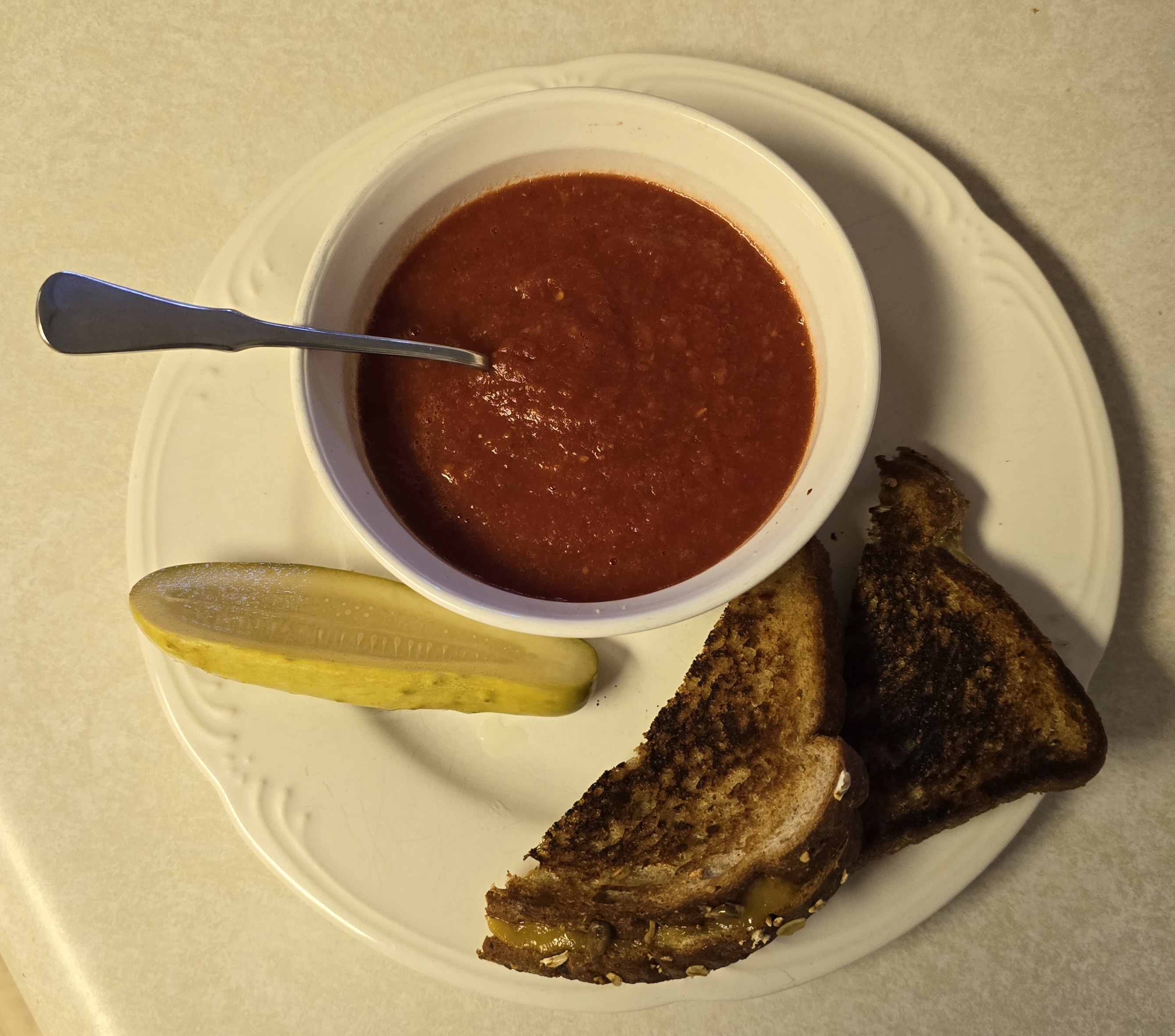
Grilled cheese sandwich with home made tomato soup and a home made pickle.
This tomato soup is much better than what Mother made from condensed soup out of a can. I’m confident if she were here, she would enjoy mine better than hers. This is a simple recipe, worth writing down.
Tomato Soup
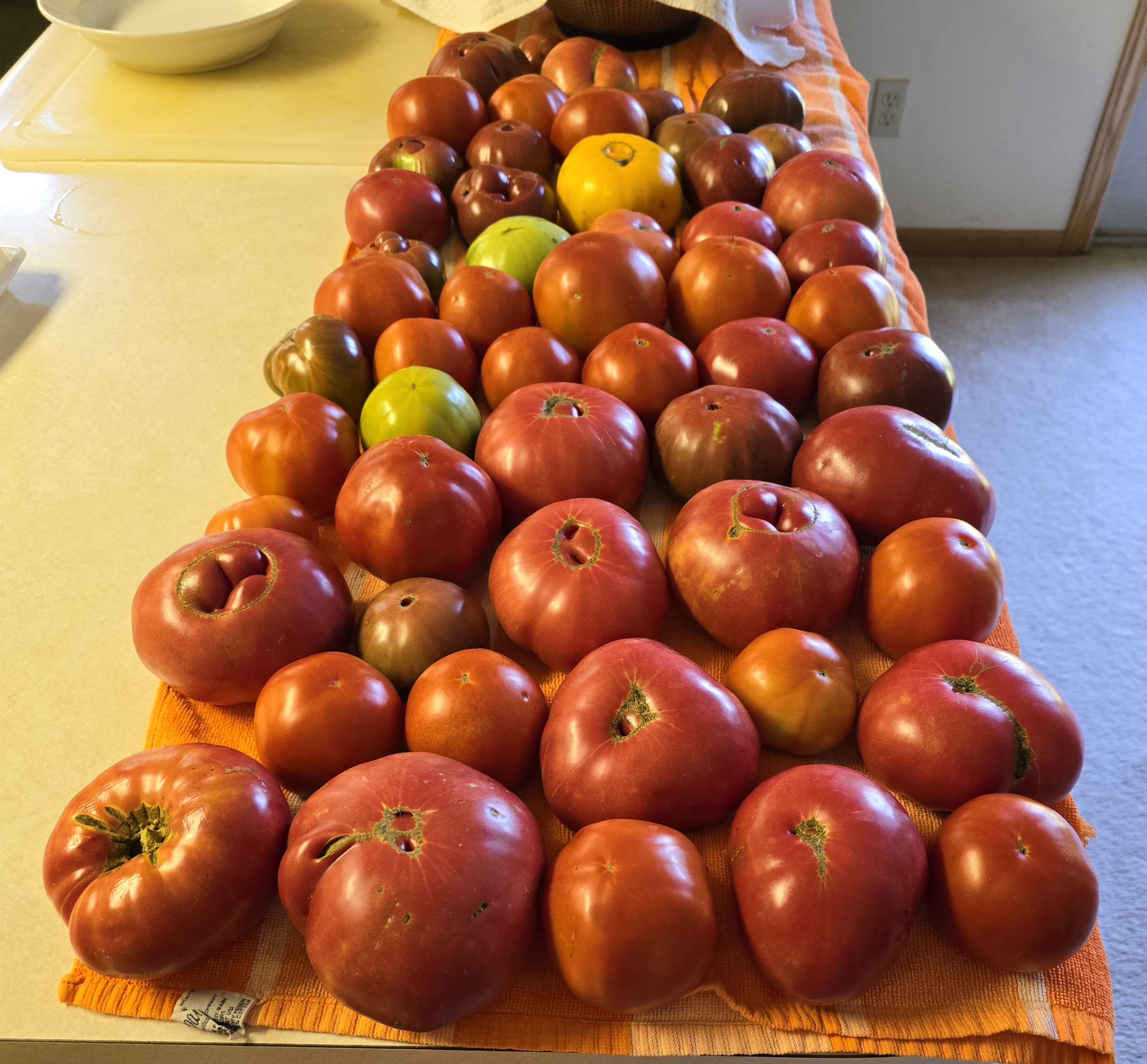
When tomatoes are in from the garden, cut out any bad spots, halve them, and cook in a large stock pot for about 20 minutes until the skins loosen. No extra water is needed. Turn off the heat and let them sit for a while, maybe half an hour or the time it takes for a long walk on the trail. Extract as much of the tomato water as you an using a meshed funnel. Once it stops dripping, reserve the liquid. Use the wooden mallet to press the pulp through the screen, leaving behind the skins and seeds. The skins and seed go into the compost.
In a 3-quart saucier place roughly a half inch of tomato water. Once it is boiling, add two medium diced carrots and one medium yellow onion, also diced. Salt to bring out the moisture. Black pepper to taste. Add a generous tablespoon of Italian seasoning and incorporate. Cook until the vegetables are softened.
Add the tomato pulp. You will need about eight cups, but match everything to the amount of tomatoes you have. Bring it to a boil and then turn the heat down to a simmer. Cook until the carrots are tender, about 30-40 minutes.
Put the mixture in a blender and blend until the carrots and onions are incorporated. Return it to the saucier and it’s finished.
Optional: garnish with fresh basil, croutons, or a dollop of sour cream. A milk lover could add a cup of heavy cream to the saucier and incorporate before serving. Makes roughly four servings.
It is ironic that I used to be a member of the Amalgamated Meat Cutters and Butcher Workmen of North America Local 431 and am now vegetarian. This is because in 1982 I married a vegetarian who recently became vegan. More precisely, I am an ovo-lacto vegetarian, as long-time readers of this blog may know. It is not hard to get enough food as a vegetarian in the United States. There is no deprivation in it either.
In my childhood home, countless meals were prepared in the kitchen, typically by Mother. When my grandmother visited, usually on Sundays, she helped prepare food. I don’t recall Father cooking hardly at all.
Because Father worked at Oscar Mayer, where there was a butcher shop for employees to buy meat at a discount, meat was a main course at most evening meals. We had a family cuisine different from other families in the neighborhood. Although I don’t recall exactly how it differed, it became a discussion topic among my friends and neighbors.
I learned how to cook, beginning at university. With fresh ingredients and an array of information sources about culinary preparations, I got better over the years. Any more, I don’t like eating in restaurants. Partly because I prefer food I cooked myself as I know what’s in it and it tastes better. Partly it is an economic consideration: eating at home can be less expensive.
Our meals resemble non-vegetarian fare often: pasta sauce, pizza, chili, casseroles, and tacos all adapt well to being vegan. What is more interesting, though, is making soup with fresh ingredients from the garden. It is almost always good, always different, even when fresh produce is less available in winter. Stir fry is another difficult to do badly meal that changes with the seasons. Over forty years we developed a cuisine distinctly our own and we enjoy it. It also keep us nourished.
There is no going back to eating meat. It doesn’t fit into our culinary world view. I’ve moved beyond meat to another place where plants provide what nourishment we need. In many ways, it is a better place.
I went to the garden to see if there was any decent basil. There was. With it, plus garlic scapes, an onion from my plot, and the first harvest of San Marzano tomatoes, I made a traditional pasta sauce for dinner. There was just enough for the two of us because that is how many tomatoes there were. I look forward to this meal all year.
Without eight seasons of working on Susan’s farm, I wouldn’t be half the gardener I am. Garlic alone is a testament to the value of learning on the farm over successive years. Susan also taught me the value of a vibrant local food system. That said, my views of a local food system have evolved. What matters more is how we engage with the food system to provide nutritious meals year-around. It is important to know the face of the farmer, yet locale is not always the penultimate concern.
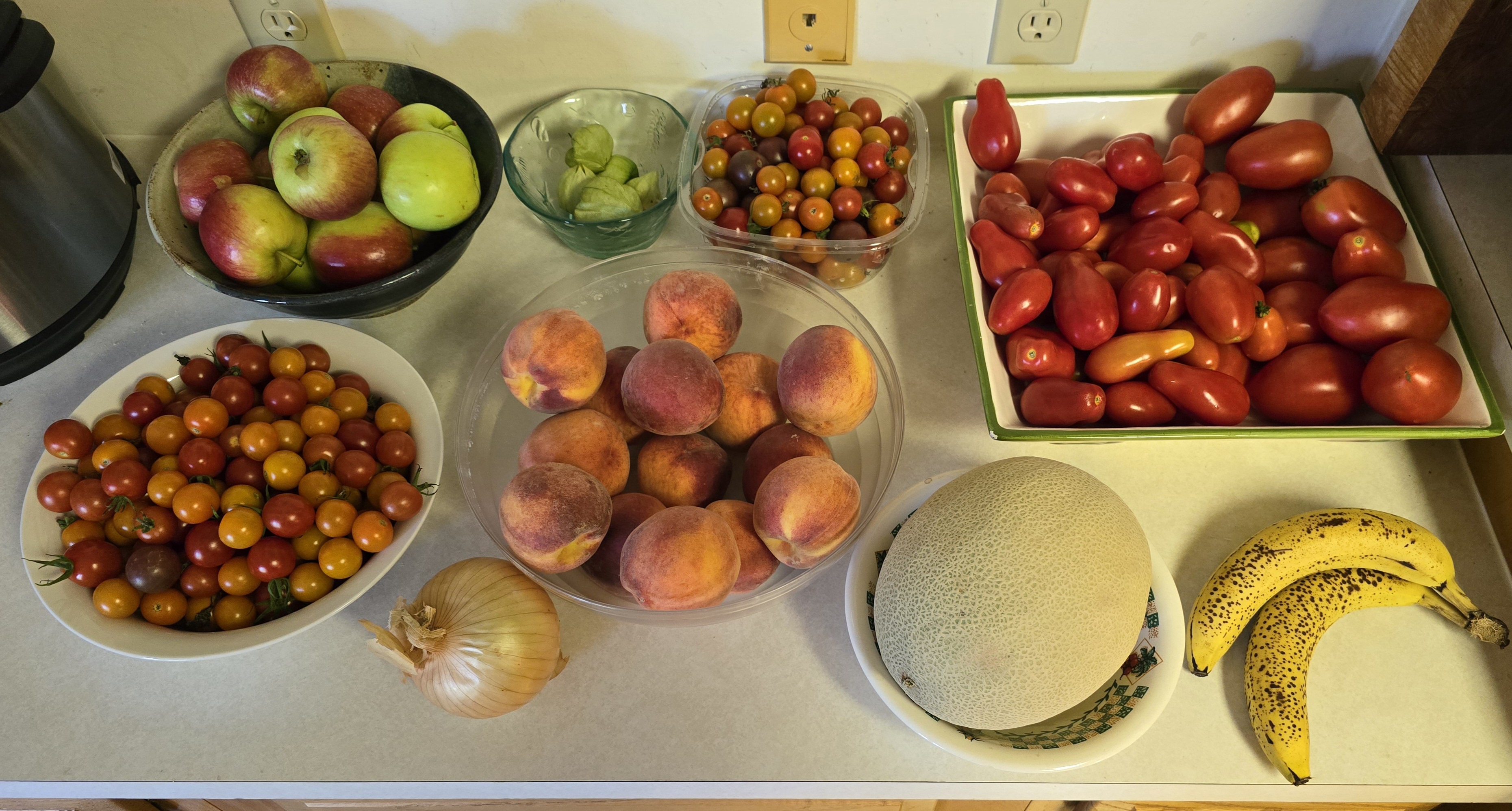
Bonner apples from local orchard; Red Haven peaches from Michigan; plum tomatoes for sauce; cherry tomatoes mostly for the food pantry; Cavendish bananas; local melon; tomatillos, Vidalia onion. Aug. 10, 2024.
When local farmer Paul Rasch gets Red Haven peaches from his relatives in Michigan, I’m likely to buy a bag. This summer treat is better than stone fruit I buy at the grocer, and part of a tradition going back to 2013 when I first worked at his orchard. These peaches have always been good, and they come only once a year. I’m okay with living with their season.
I have not been able to grow an adequate number of good-sized onions. I lean on the grocers because their produce is consistently available and good quality. We like Vidalia onions because of their sweetness. Buying them from a major grocer keeps us in supply. We also get yellow onions and probably should get white onions. When we do, it’s at the grocer.
It makes little sense to buy many apples at the store. We have a couple of great local apple orchards with a wide variety of fruit. During my eight seasons at Wilson’s Orchard I learned which varieties ripen when and our apple consumption follows the season. If we are lucky, I get a good crop at home for cooking, eating fresh and storage. When we don’t have a crop, I buy certain varieties to meet our needs, including a large amount of Gold Rush for storage into winter. We don’t eat many apples the rest of the year and when we do get them from a grocer, we buy organic.
There is no comparison to fresh, home grown tomatoes. When they are in season, we eat some daily. When they are out of season, we rarely buy them at the grocer. With tomatoes, it’s all about the flavor of home grown.
Life with a kitchen garden is a series of moments like the dinner with fresh, home made pasta sauce or from the bite of a Red Haven peach. These moments don’t go on forever, yet if we are lucky, they will repeat from time to time.
More than any recent summer, this one has been exceptional for growing food in the garden. The rain came, then it came some more. Ambient temperatures were not too hot, and if they climbed above 90, it wasn’t for long. It has truly been the summer of the garden. I can feel it every time I go out there.
A garden represents humans asserting their will over nature. I have not been so disciplined. All the same, I’m getting onions and potatoes, yellow squash and zucchini, kale and collards, parsley and basil, peppers and peas, and oh my God, tomatoes! Today I harvested Zestar! apples and they are great tasting. I can’t keep up with the genetics and environment producing this abundance. That is okay. Let nature have its way.
If I live my life according the Social Security life expectancy calculator, I can expect to plant 13 more gardens. That’s exactly what I plan to do. We’ll see if I can take better control, not that I want to. It is all part of the great circle of life and I’m in it!
This year thistles grew near the east side of the house. While planting the garden, I let them grow. Now came the time to remove them and start a brush pile.
After morning reading, writing, and cooking, I took an old sweatshirt from the closet and put it on. Over that I wore coveralls. Socks, garden shoes, a ball cap, and heavy leather gloves completed the ensemble. The idea was to prevent the thistles from puncturing my skin. For the most part that was accomplished. Ensemble is a pretty fancy word for my attire. We don’t do much stylin’ around here.
These jobs seldom take as long as I plan. The idea is to do them well and do them once. While I had the lopper out, I cut back low-hanging branches I’ve been dodging all year while mowing. I cut back a total of five trees. By the time I pile up all the brush, it will be a decent stack. After I add the brush stored in a fallow garden plot, and conditions are good, I’ll burn it. I put the brush pile over the stump of a locust tree, having heard the fire will remove the stump. We shall see.
The first tomatoes ripened. Orange cherry tomatoes as is usually the case. The garden is a bit of a mess yet it is producing like crazy. The refrigerator is at capacity and there is no shortage of ingredients to prepare a meal. This abundance is complicated by the fact my spouse has been helping her sister for three weeks. I’m doing my best to prepare meals without leftovers, although that is hard to do dining alone.
When J.D. Vance was selected as the Republican vice presidential candidate I pulled down my copy of Hillbilly Elegy and read it. It hasn’t been a priority until now. The ivy league lawyer who grew up in poverty has a story to tell, yet, he makes generalizations that don’t ring true. I’ve known more than a few people, mostly family or kin, who are poor and live in Appalachia. To a person, the word hillbilly was never used to describe themselves. From there the book went downhill as having any broader application than his personal life. Vance’s story is engaging, yet it seems written to support his conservative point of view. When I went to Goodreads to declare I finished the book, the software wouldn’t let me rate the book. I got a message that said,
Do you suppose people are dunking on Vance now that he is running for high office?
Each summer I make iced tea a couple of times. I heat up the water and brew three black tea bags in a teapot purchased for our child’s long ago school project. I buy the cheapest black tea available and it serves. I drink it over ice, no sugar. It is one of the pleasures of summer. On a Saturday afternoon, there is little else more satisfying to a septuagenarian pensioner.
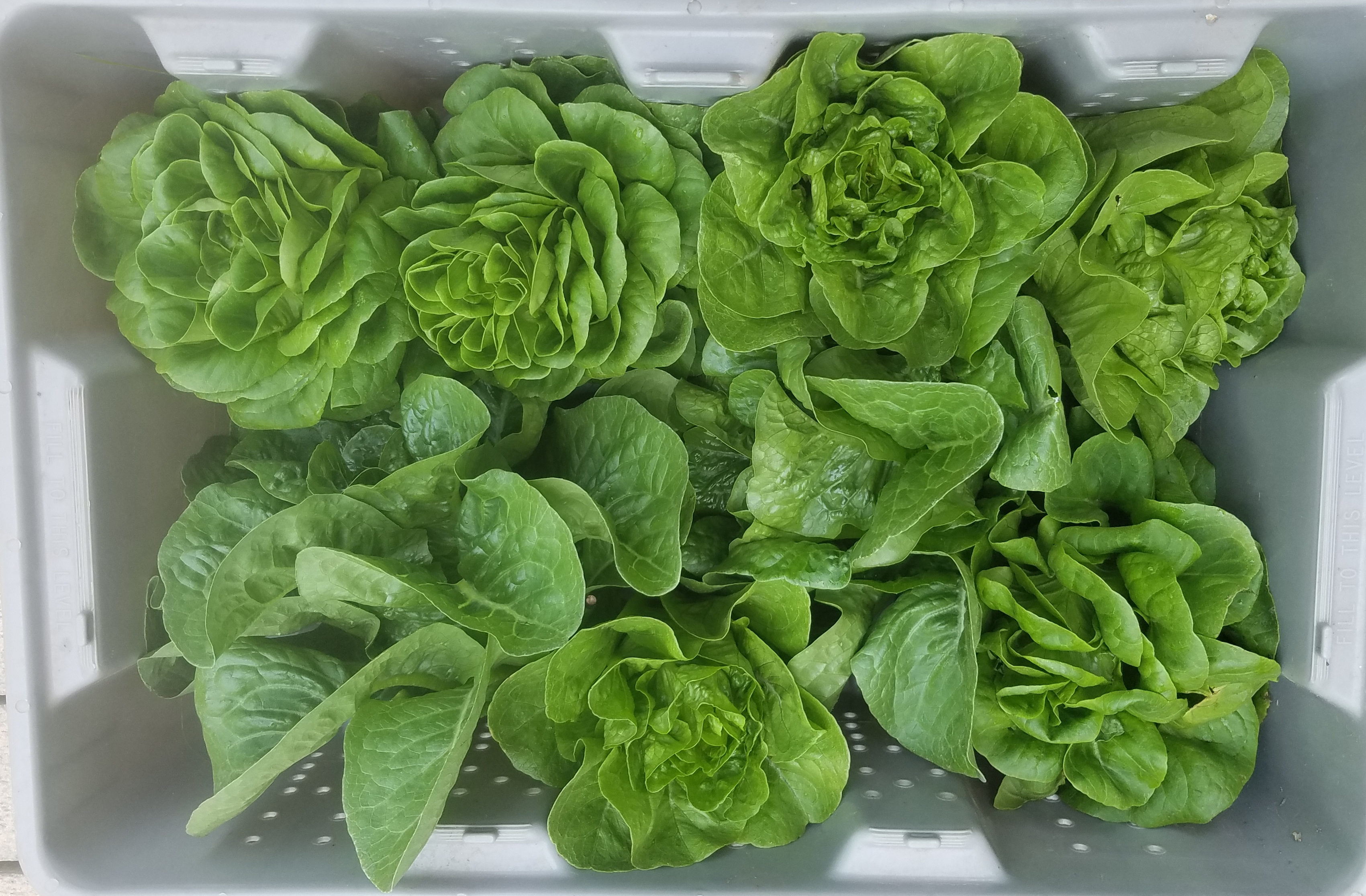
I harvested the rest of the first round of lettuce before it bolted. The last few years, I’ve been growing lettuce under row cover and it has fewer bugs and better growth than when I exposed it directly to the elements. A gardener does what works and this does.
That afternoon I separated leaves and cleaned them in the sink. I lay them out on a large bath towel to dry before putting them away. As the afternoon progressed, it became obvious some of the lettuce should be part of dinner in the form of a big salad. So that is what we did.
Lettuce forms the base, and whatever vegetables and other items are available goes in. For protein we usually use beans, or in this case, we had leftover baked tofu. The mix of textures and flavors is hard to beat for a summer supper. We eat only lettuce that I’ve grown, when it is in season. The rest of the year we do without. There aren’t many dinners that are obvious yet this is one of them.
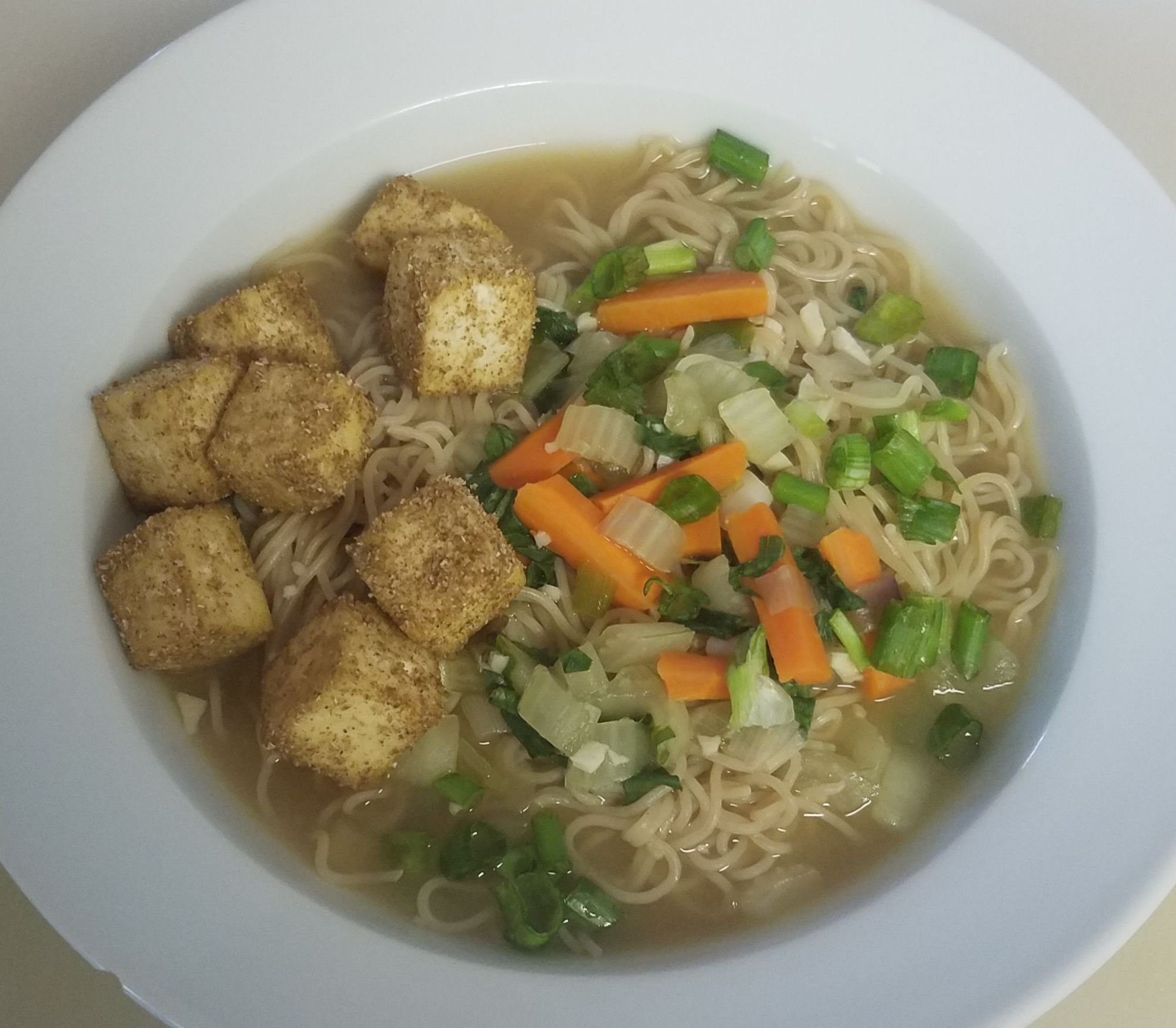
The building blocks of our kitchen came into play at dinner time Monday. Canned home made vegetable broth, tofu from Iowa City, brown rice flour ramen and white miso paste from China, organic carrots from California, and spring onions, garlic, and pac choi from the garden. This is the American vegetarian kitchen garden at work.
It’s not really local food, is it? The ramen was suitable for vegans, and the flavor of the pac choi really came through. No wheat in this dish, and it is the first time in a while I used tofu for something other than stir fry. It is unlikely 20-year-old me would have prepared something like this.
I reserved some of the pac choi leaves, yet in retrospect should have added them all. The dish didn’t suffer from lack of greens yet there is no sense being frugal about leafy green vegetables. The world is full of them and in general Americans don’t eat enough of them.
There is no recipe for this dish. It was a product of that moment, my experience as a cook, and available ingredients. Mainly, I had to do something with the abundance of pac choi from the garden. We should cook like this more often.
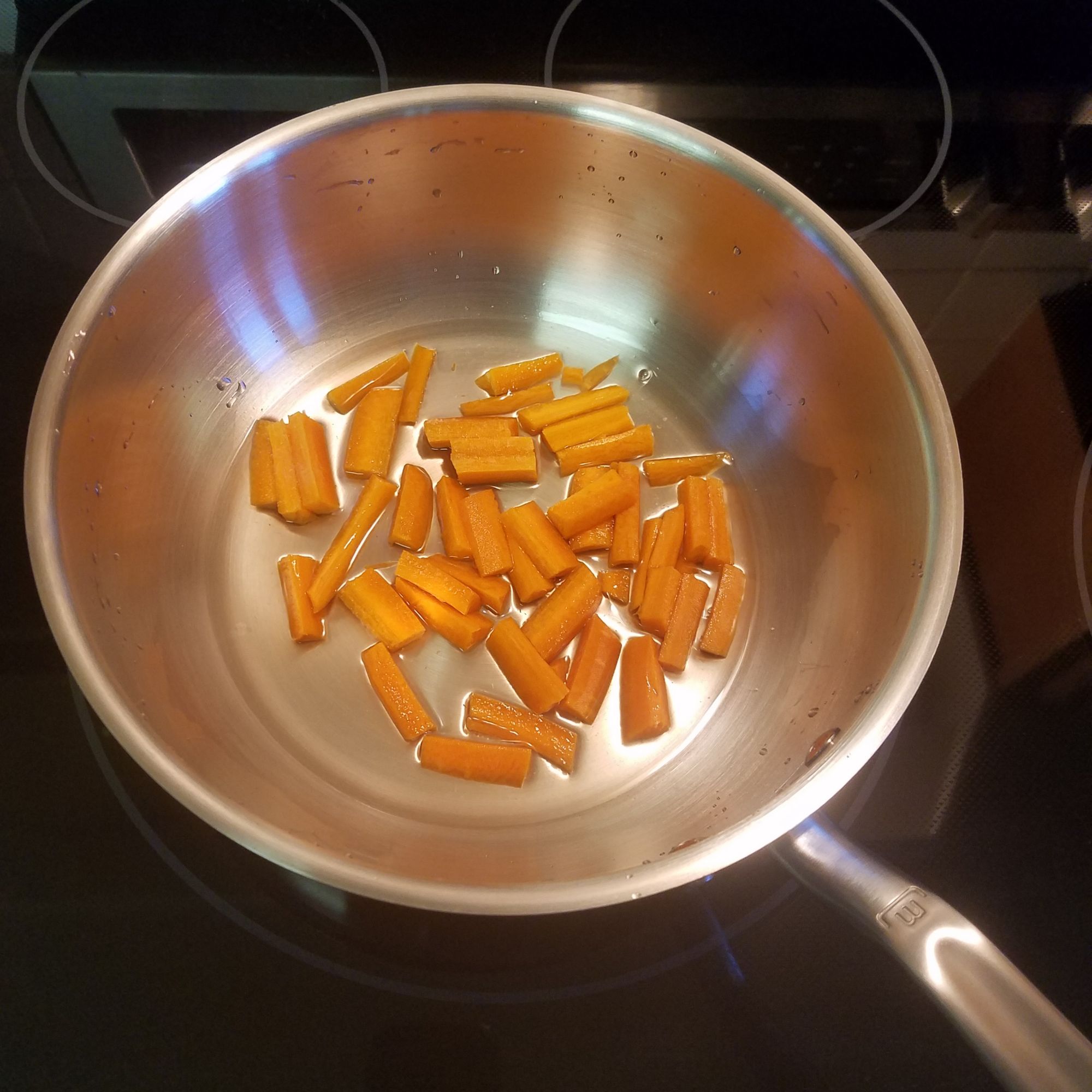
Cooking carrots first in my saucier.
The ramen was satisfying on multiple levels.
This was the first use of my new saucier, and I was happy cooking with it. At three quarts it is of a size to make dinner for four. I hope there will be many more uses of the pan.
It is easy to get behind using leafy green vegetables. The garden produces so many, and certain ones, like pac choi, are best used fresh. One more giant pac choi in the refrigerator then on to the smaller ones.
I’ve written about making vegetable broth before. Baked tofu has become our standard preparation. What set this dish apart was flavoring. Salt and white miso, highlighted the flavor of the pac choi. Likewise, there was enough garlic, but not so much to be overpowering. Making food that tastes good can be done. It is not as simple as it may seem.
Would I make this dish again. Probably something like it in the never ending meal that comes from a kitchen garden.






 Journey Home
You must be logged in to post a comment.