“Publishers are not accountable to the laws of heaven and earth in any country and regardless of my opinion, editors and publishers will print what they will.”
I wrote this in a letter to the editor of the Quad City Times in 1980 reacting to a popular feature section called Soundoff.
“(It is) little more than a vanity press for many of the writers,” I wrote. “It gets pictures, letters and opinions into print as a final goal; shouldn’t there be more to public voicing of opinion than that?”
This is more applicable today than it was three and a half decades ago.
What I learned in graduate school is the same statement can be applied to almost everything written in public. Reflecting on the Times experiment to make their pages more open to comments and retain readership, chaos reigned. What has changed since then is the emphasis on viewpoint in media — corporate, social or self published — which has been formalized. It’s not all good.
As I turn to the hard yet fun work of writing this year, I plan to journal my experiences in the food system here. Four years from full retirement, there are bills to pay and a life to live. I may pick other topics from time to time. I need to make the best use of every moment.
I’m writing off line as much as I can. While I don’t like to work for free as long as there is less cash than budget, I may occasionally post about those creative endeavors.
Thanks for reading this blog. Check out the tag cloud for your interests. I hope readers will be back often.
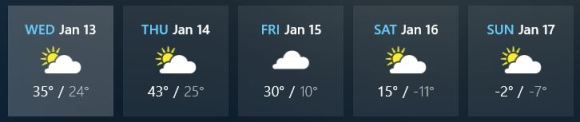
It doesn’t appear we will get a solid week of subzero temperatures this winter. Based on the five-day forecast I’m planning to prune the fruit trees on Sunday.
Would that growing food were all there was to worry about.
The challenge has been to assimilate a new work schedule at the home, farm and auto supply store into my writing schedule. Halfway through January, I’m no closer to a plan.
While it may seem self-indulgent, mentioning the word “I” so many times, unless I get this right, it’s curtains for my aspirations as a writer.
I won’t let that happen.
How to use the couple of hours in the morning, my break periods at work, and time in the evenings and on weekends for writing production needs definition. Family, our food system, maintenance on the property, and adding revenue have to be considered as well.
Confident I’ll get there, midweek before the cold it’s not clear how. Something will get figured out. I hope it will be sooner rather than later.
Sixty nine percent of adults age 20 and older were overweight during the period 2011 – 2012, according to the Centers for Disease Control. We hear constantly from medical professionals, dietitians, mass media, politicians, friends and family: to do something about being overweight — and we should — moderate our caloric intake and move.
Despite such commonplaces, something is amiss. It goes beyond notions of eating a “proper diet” and exercising, and most of us don’t really understand what’s right and what’s wrong. Many don’t even learn what is required to live well in the contemporary food culture.
As people move to urban areas — disconnected from how food is grown, processed and marketed — another layer is added to our food system. It includes dining out more often, claims and assertions in mass media about food and food products, and the reduction of daily life to a restricted set of patterns involving less exercise, more processed and prepared foods, and an abundance of food everywhere — unlike in many other places in the world.
Fixing the obesity problem requires more skill than eating and drinking until satiated. What guidance exists among food writers, health professionals and scientists comes under fire from almost every direction.
In the end, we must each make decisions about a personal cuisine or diet. Where will food be sourced? How much cooking will I do at home? How much should I rely on the convenience of an ingredient-based industrial food supply chain? How do I determine the difference between food that tastes good and food that is good for us? There are no easy answers and as time passes we make decisions and live our lives as best we can — making decisions by default.
The film In Defense of Food aired on public television Dec. 30, 2015. In it, author and food writer Michael Pollan takes nutritionism to task.
“Nutritionism is an alleged paradigm that assumes that it is the scientifically identified nutrients in foods that determine the value of individual food stuffs in the diet. In other words, it is the idea that the nutritional value of a food is the sum of all its individual nutrients, vitamins, and other components,” according to Wikipedia.
Pollan’s message in the film is we should “Eat food. Not too much. Mostly plants,” and pay less attention to nutritionism. While he has his critics, this seven word statement is as good as any other guidance I’ve heard as help for developing a family cuisine.
Pollan encourages people to eat meat, which is a bone of contention in urban circles, especially among vegans, vegetarians and environmentalists. He neither embraces nor rejects genetically modified organisms in the film, perhaps recognizing that the anti-GMO movement is more marketing than science. If one has been reading Pollan, his affection for bread is well known.
I follow Pollan and a few other food writers. What matters more is the choices made in our kitchen: how will we process the abundance of garden and farm? What cooking oil should we use? Should we buy lettuce at the grocer during winter? Should we eschew making big batches of food in favor of making enough at a time for a single meal? The questions can be endless, each decision of some importance.
For our family, getting started with local food has been an answer to these questions and more. It is easy to know the face of the farmer when it is visible in the bathroom mirror each day. As the circle of food producers and processors expands beyond our lot lines, it gets more complicated, but not impossible.
What’s needed most is to turn off outside influence from time to time and do what seems right. There is nothing to be afraid of. Food itself will help us find a better diet, especially when combined with the complex understanding of the world that comes with being human. Instead of trying to understand food culture, we may be better off to just go on living and take what comes. Going forward, that’s what I plan to do. That is, in addition to moderating caloric intake and moving.
The good news about finishing three full weeks at the home, farm and auto supply store is the company offers health insurance that meets the Internal Revenue Service “minimum value standard” for less money than coverage available through the government’s health insurance marketplace or elsewhere.
The bad news is all of the pay from this full-time job will fund health care insurance, co-pays and deductibles for our family if we seek any care. If we don’t need health care once the coverage goes into effect Feb. 1 that will leave us roughly $150 take home pay per week. We’ll need more than that to pay the rest of our expenses.
Ada Blenkhorn and J. Howard Entwistle wrote the song “Keep on the Sunny Side” in 1899:
There’s a dark and a troubled side of life;
There’s a bright and a sunny side, too;
Tho’ we meet with the darkness and strife,
The sunny side we also may view.
Most people know the version Mother Maybelle Carter sang on the 1972 record album Will the Circle Be Unbroken produced by William E. McEuan. I favor the original A.P. Carter version which hearkens back to our family roots in Southwestern Virginia. Dig deep enough and you’ll find we’re shirt tail relatives on the Addington side, which is Mother Maybelle’s maiden name.
Not only may we view the sunny side, keeping there will be the only thing that gives us hope. This first job sets a foundation upon which to build the rest of my worklife.
What else?
In the works are spring at the Community Supported Agriculture project, summer editing at Blog for Iowa, and fall weekends at the apple orchard. These were all discussed during my interview with the home, farm and auto supply company, so getting time off shouldn’t be a problem.
The most excitement I felt in a while was finding the Seed Savers Exchange 2016 seed catalog in the mailbox yesterday.
Someone gave me a packet of their scarlet kale seeds last year and it was a great addition to the garden. Too bad all of my customers are used to getting kale for free, or it could be a source of some income.
It is conceivable I could generate a thousand or so dollars from the garden this year by expanding the planting area and selling excess. Circumstances may have me doing that.
It is a reasonably warm fall day near the lake — a time for hope and getting lost in seed catalogs.
The local food movement is a growing group of individual operators struggling to make a living and an impact in a turbulent world.
It is a nascent system directly tied to our consumer culture, dependent upon disposable income and open mindedness in meeting humankind’s most basic need.
I spent six years in our local food culture and can say food we consume is not all local, and needn’t be. At the same time there are benefits of a local food system beyond better taste, eating fresh, and knowing the farmer who produced the groceries.
In our home fall canning leads to a pantry full of soup, tomatoes, hot peppers, sauerkraut, vinegar, apple sauce, pickles and sundry items from the garden and farm. The freezer gets filled with bell peppers, apples, broccoli and sweet corn. It is food – as local as it gets – driven by what is fresh, abundant and on hand.
Along with home processed goods are bits and pieces from all over the globe, each serving a purpose in our culinary lives. Putting ingredients together in a personalized cuisine is where the local food movement will live or die.
More people seek processed or precooked food because of a perception there is too little time for cooking. If adding kale to a smoothie seems easy, making a stir fry using kale is less so. Contemporary consumers want a quick and easy path to making meals and snacks, and don’t have the patience it requires to add new recipes to their repertoire. Cuisine as an expression of local culture has been tossed out the window by many.
Having worked in the local food system, whether at home, on a farm, or in a retail store, has been an important part of my life since retiring in 2009. It is a way of life to grow food for direct consumption or sales. Local food is also a jumble even if farmers and consumers want it to be more organized and systematic.
One operator runs a community supported agriculture project where members pay in the spring to help avoid a farm loan then share in the luck, good or bad, of the farm. Another sells chits which can be used to buy the face value of any goods at a local outlet framed as a “store.” Another grows specific crops to sell to restaurants, absorbing any financial risk. All of this leads us to a point where an onion isn’t only an onion anymore. And it’s not about the onion but the culture.
If someone could organize a local food system, there may be a living in it. That misses the point. Local food systems are intended to cut out the middlemen in the food supply chain. At the same time, faced with a need for scalability, most operators could potentially use the help of local food brokers.
While some of the figures of a sustainable, local food movement – Alice Waters, Joel Salatin, Fred Kirschenmann, and others – are well known, a sense of coherence or agreement on basic terms seems missing among local producers. It is as if operators would rather work inside the bubble of what works for them personally as long as it does work for them. In a way that is not much different from how corn, soybean, egg and livestock producers view their operations.
Where we go from here is uncertain. Something I hope to discover in the pages of this memoir of my experience in with our food system.
On June 23, 2009 I made my last business trip in a career with many of them.
Arriving in Chicago on the corporate aircraft, we drove to the Loop to explain the account transition precipitated by my retirement to our largest customer. The meeting took place at their corporate office in the Wrigley Building. We could see the recently completed Trump Tower Chicago through the windows. It had become time to change the skyline of my life.
I had taken to dozing off during staff meetings and lost interest in getting along with the other members of the management team. It was time to make my exit. I hoped to do so with some measure of grace and didn’t know what would be next.
Now, I do.
After years of experimentation, volunteering, and a portfolio of part-time and temporary jobs, I have begun to write in earnest, and intend to make something more than 500-1,000 word posts for publication in newspapers, on blogs, and in other outlets.
The first subject will be a memoir about the evolution of my understanding of local food over the last six years. The goal is a 25,000-word essay that can be combined with other short pieces into a self-published book. Book sales will become a way for people to contribute financially to my work at events.
Equipped with a reasonably sound memory, a sheaf of recent writing on food, labor, farming, gardening, cooking and agriculture, I’m ready.
At a thousand words a day, the essay should be complete by year’s end. Hopefully people will find it unique and worth reading. If I’m lucky, it will be a contribution toward expanding the local food movement.
The garden season officially ended today with gleaning that filled eight crates with tomatoes, apples, celery, Swiss chard, kale and hot and bell peppers.
I delivered a second 200-pound load of apples to the CSA for shareholders and the food pantry. While there, I picked up some potatoes, garlic, lettuce, a large squash, sweet potatoes and some onions.
With a hard frost expected early Saturday morning, I made a harvest soup with vegetables. Five quarts of it are processing in a water bath as I type.
Times like this, a list of ingredients suffices. Not as a recipe, but as a record of what went into the soup.
Fresh and canned tomato juice
Onions
Carrot
Celery
Potatoes
Kale
Swiss chard
Large winter squash cut into cubes
Bay leaves
Sea Salt
Orange lentils
Dried red beans
Pearl barley
Prepared organic vegetable broth
The draft toward winter is inescapable. Snow will soon be flying and subzero temperatures not far behind — and the comforting warmth of harvest soup.
I connected with Local Harvest CSA last week. The farm looked great.
Iowa Secretary of Agriculture Bill Northey stopped there with my state representative, Bobby Kaufmann. I spent a couple of hours chatting and collecting information for an article that appeared Saturday in the Iowa City Press Citizen.
The next day Susan provided three crates of bell pepper seconds to eat and preserve. The freezer and vegetable drawer are now full. The good news is there weren’t many clinkers among them.
Our garden kept me busy this summer, producing more than enough for our kitchen and some to give some away. Tomatoes, kale and hot peppers are in abundance. The rest of the Red Delicious apples will soon be harvested. I spent most of Monday in the kitchen preserving food.
The kitchen day began with picking a bucket of tomatoes and jalapeno peppers in the garden.
Cutting the bad spots from the tomatoes, I cooked them and made sauce using an old timey tomato juicer with a wooden cone. The byproduct was 1-1/2 quarts of juice which is chilling in the ice box, ready for soup.
Coring and cutting bell peppers into slabs for the freezer is straightforward. I freeze them on a cookie sheet, then bag them for storage. That way they don’t freeze together. Two bags left from last year were in good shape so I added six more — a full year’s supply.
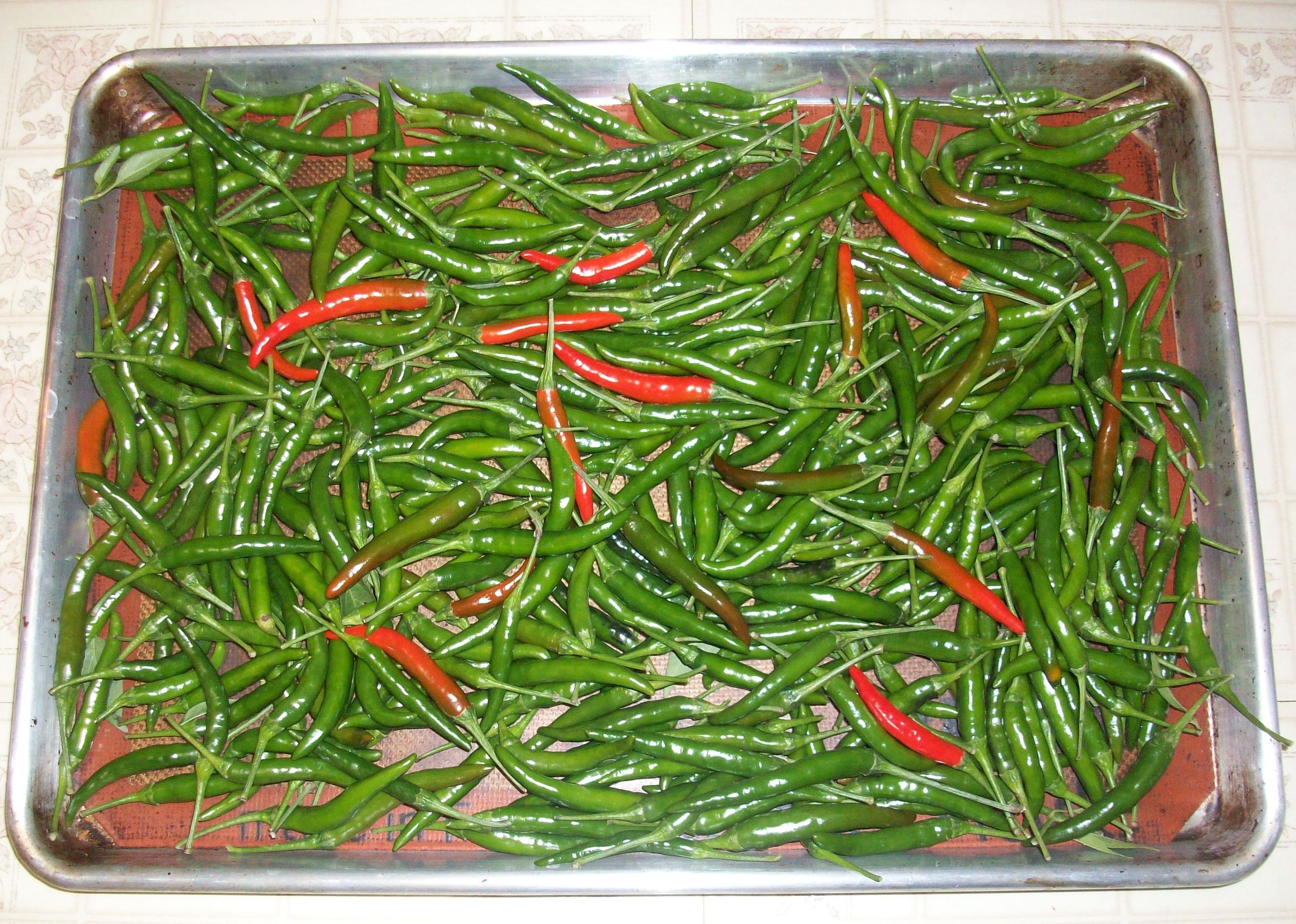
A bag of roasted red peppers and one of jalapenos was left in the freezer from last year. After thawing, I cut the jalapenos in half and put both into the Dutch oven. Adding bits and pieces of pepper leftover from the freezing operation, once tender, the lot went into the food processor until the mixture reached the consistency of relish. I put the result into half-pint jars and processed in a water bath.
I make some applesauce each year even though there is plenty in the pantry. The labor produced two quarts which wait in the ice box until more jars are ready to process in the water bath.
The remainder of the first crate of Red Delicious apples was juiced. I spent half an hour managing vinegar, bottling what was finished from the two-quart jar started in the spring and adding new juice to the mother. There are three finished quarts in the pantry. I may never buy apple cider vinegar again.
When the sun set, the implements of preservation were scattered on the counter — clean and drying. Yesterday I used my hand tomato juicer, a sieve, an apple peeler, an electric juicer, the food processor, a turkey baster, the granite ware water-bath canner, and the usual lot of bowls, jars, lids and rings. Knowing what to do makes it easier with each passing year.
There is a sense that these days of harvest cookery can’t go on forever. Suffice it I’ll keep living them for as long as possible, trying to learn from every season.
Friday’s Brandywine, Rose and Beefsteak Tomato Harvest
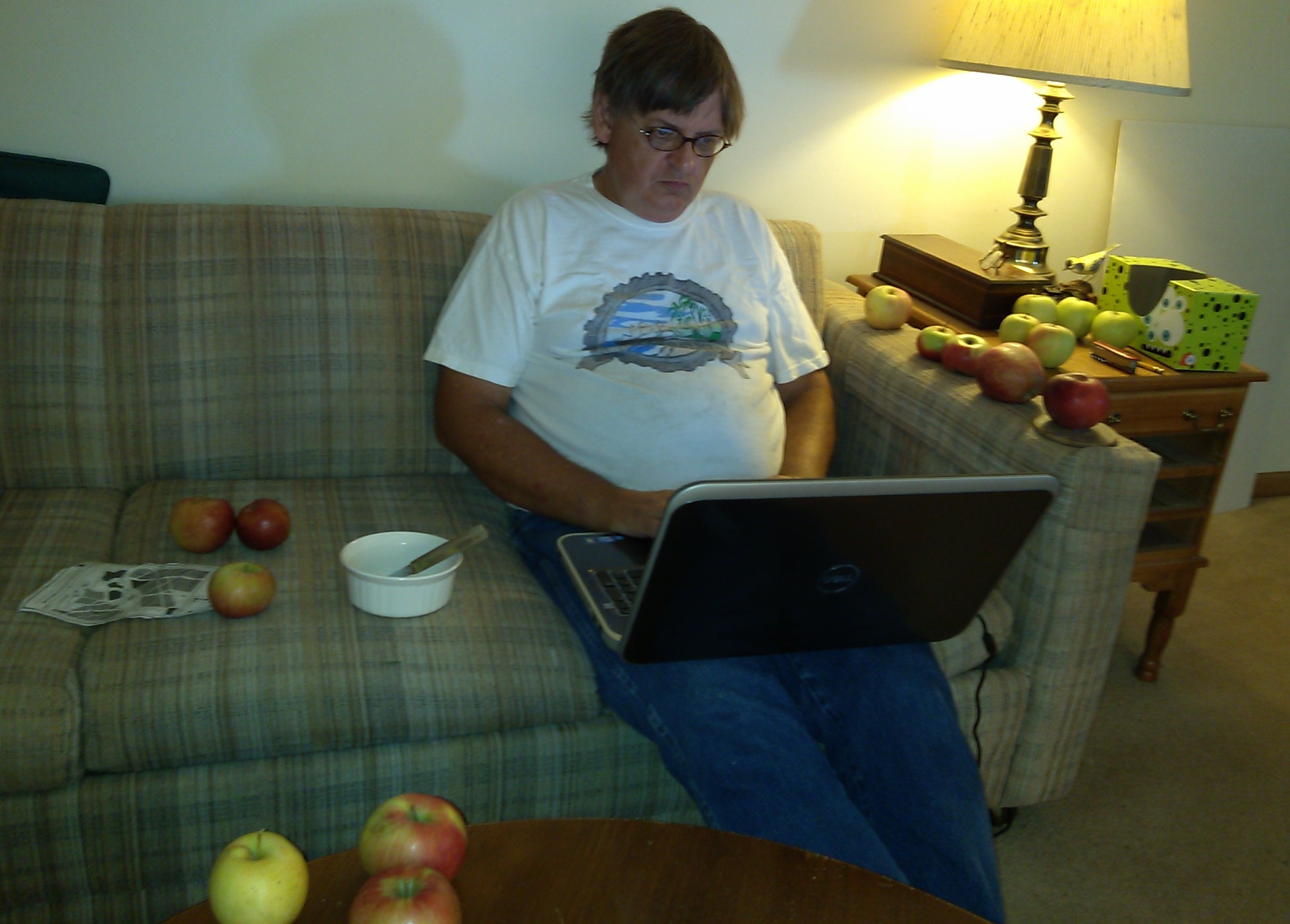
Each day for the last two weeks I picked an apple and tasted it. The crop of Red Delicious is abundant and I want to make sure when the majority is harvested they are at the peak of sweet crispness. We’re almost there.
The pear harvest was limited to what could be reached. The tree grew well above the house leaving some ripe pears beyond the reach of even my long picking pole. We have enough to eat fresh and some leftover for apple-pear sauce.
Tomatoes are coming in faster than they can be eaten fresh. The plan is to can smaller ones whole and the slicers diced. There should be plenty of jars to fill the pantry shelves. The by-products of juice and ground bits and pieces will make soup or chili, although there is a limit to how much can be canned and used over the next year.
The bell pepper plants are flowering again and celery continues to grow. The main job of deconstructing the garden in preparation for winter will soon begin.
But for now, it’s time to pick and preserve as much of the harvest as we can.
There is a big difference between working at a Community Supported Agriculture project and at the end of a gigantic retail food supply chain. I’ve recently done both and found there are inevitable problems for the former in the latter. It has to do with the health halo.
“The health halo effect refers to the act of overestimating the healthfulness of an item based on a single claim, such as being low in calories or low in fat,” according to an article in The Guardian.
Humans want a shorthand to navigating recurring life decisions, and often, after recognizing a sign, head down the path to acceptance.
I’ve witnessed multiple instances – more than I can count – of when a feature of a type of food, such as “no sugar added,” is presented, people ask the confirming question, “that means it’s healthy, right?” Consumers seem driven, at least in what they say publicly about it, to search for and purchase “healthy food.”
“The purpose of Buy Fresh Buy Local Iowa is to create a statewide marketing campaign to encourage the connections among locally grown food, the farmers who raise it, and the consumers who eat it,” according to its web site. The campaign has been largely successful.
The campaign’s success, beginning in Iowa in 2003, resulted in checking marketing off the to-do list for small-scale local growers. Hard work in a bucolic setting shielded some from the fact that when consumers seek healthy food options marketing plays a more important role than any single campaign can produce.
Buy Fresh Buy Local has not been enough to compete with vigorous marketing of “USDA organic,” “GMO Free,” “gluten free,” “100% natural,” “fat free,” “sugar free,” “no added sugar” and other healthier option campaigns of large-scale food producers. Big operators have substantial financial resources and invest a lot in advertising, including messaging about features of their products.
While the local foods movement has a recognizable marketing campaign, mega-food companies have relentlessly pursued customers with national campaigns that dominate the consumer culture of our society. They benefit from the health halo as I’ve described it, and from market dominance.
We all want to be healthy because, well… being unhealthy or sick can suck.
Today, Alice Waters will receive the 2014 National Humanities Medal for championing a holistic approach to eating and health, celebrating her integration of gardening, cooking and education. Maybe some of us want to be Alice Waters and join the slow food movement. I know I might.
Most of us don’t feel we have time for the slow food Alice Waters promotes. We look for shorthand markers along the way and settle for what we find available in the market place and in our kitchens.
If we want to eat healthy we often look for the health halo and bask in its glow long enough to make a purchase and get on to the next thing in our lives. This consumer behavior is exactly what mega food companies target in their marketing campaigns.
To “Buy Fresh Buy Local” I would add “grow your own” and “know the face of the farmer.” A CSA can make a business with a couple hundred members because of Dunbar’s number. Gaining broader acceptance in our consumer society will take more than the good idea to buy fresh and local. It will also take more than an image of saintliness.


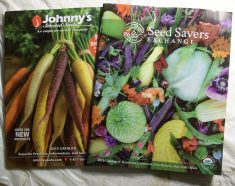 The most excitement I felt in a while was finding the Seed Savers Exchange 2016 seed catalog in the mailbox yesterday.



 Journey Home
You must be logged in to post a comment.