Yesterday I made 4,944 soil blocks which were planted in winter share. Leeks, broccoli and the like. It took four hours.
While driving north on Highway One I nodded off for a brief moment. After realizing it I sat upright, glanced in the mirror and concentrated on staying awake.
It’s not like I didn’t get a full night’s sleep Thursday… I did.
The combination of sun and repetitive work may have worn me out.
After arriving home I walked the garden, checked seedlings for moisture level, took a shower, and crashed into a two-hour nap. It’s become a Friday pattern.
Then I remember it was not soil blocking that wore me out but the news of Anthony Bourdain’s suicide in France.
Bourdain was a celebrity I liked. I read Kitchen Confidential a number of years ago and watched him on Food Network. In many ways, he is what I’d like to be as a writer, although with less inebriation. How little we know about celebrities. His suicide makes no sense. It may never make sense.
A memorable episode from Bourdain’s television work was when he returned to Borneo and got a chest tattoo on camera. He appeared to be drunk and uncomfortable. In a later CNN interview he recounted the process was much more painful than expected. We already knew that from the video. A reality came through in much of Bourdain’s work — one of his making. That’s why I liked him. The ability to depict a reality is essential to creative endeavor. Bourdain and his crew were masters at what they did. He’s gone too soon and will be missed.
I brought home a bag of groceries from the farm — lettuce, sugar snap peas, garlic scapes, kohlrabi, spring onions and kale. After napping I washed lettuce for salads and stored it in the ice box until supper time. I’m not sure what else got done. Maybe nothing, or something… whatever.
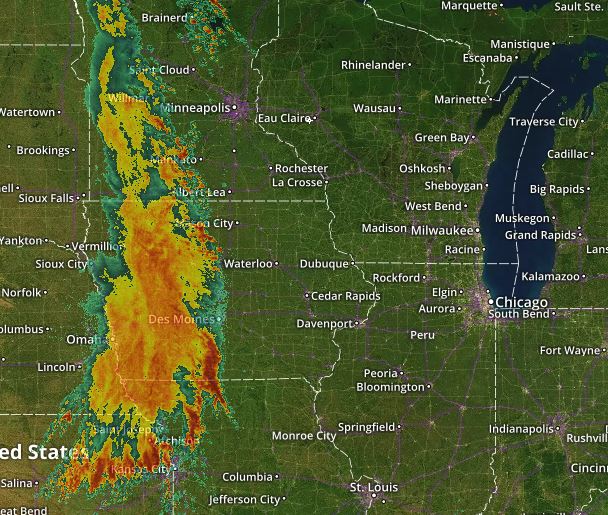
The forecast had been rain for a couple of days. The weather radar looked ominous Saturday at 4 a.m. It was heading our way.
At sunrise I went to the garden to beat the rain.
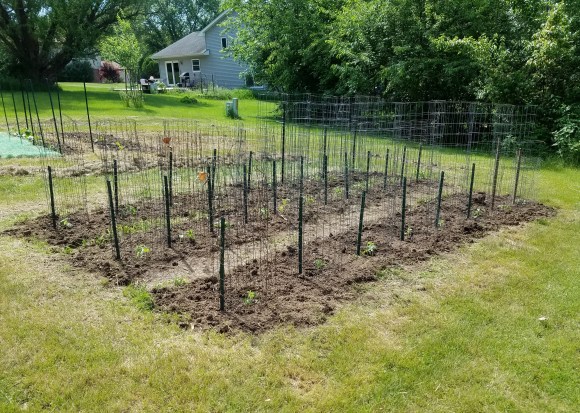
Our garden is big enough to engage a person for hours — weeding, harvesting, planting, mulching, fence mending and the like. It never ends. I think there, mostly about our relationship with the environment and toward a food ecology, the dreams of gardeners.
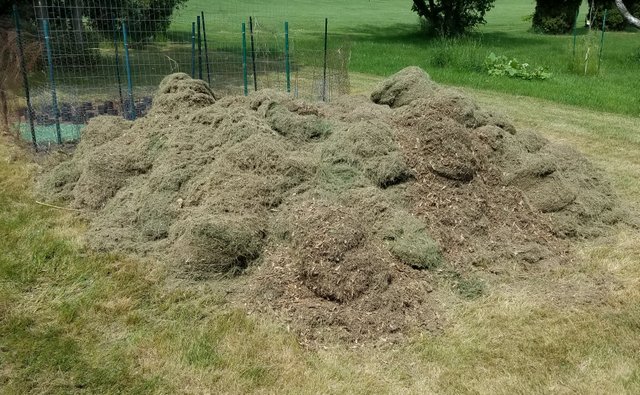
The work was to mulch tomatoes, weed carrots and beets, clean up kale leaves bitten by intense heat, replant seedlings where they failed and organize for the next planting session. The mulch collected this week is about half used. Before I plant, it must all be relocated to a final destination to clear space for peppers and beans. There is another day’s work waiting today.
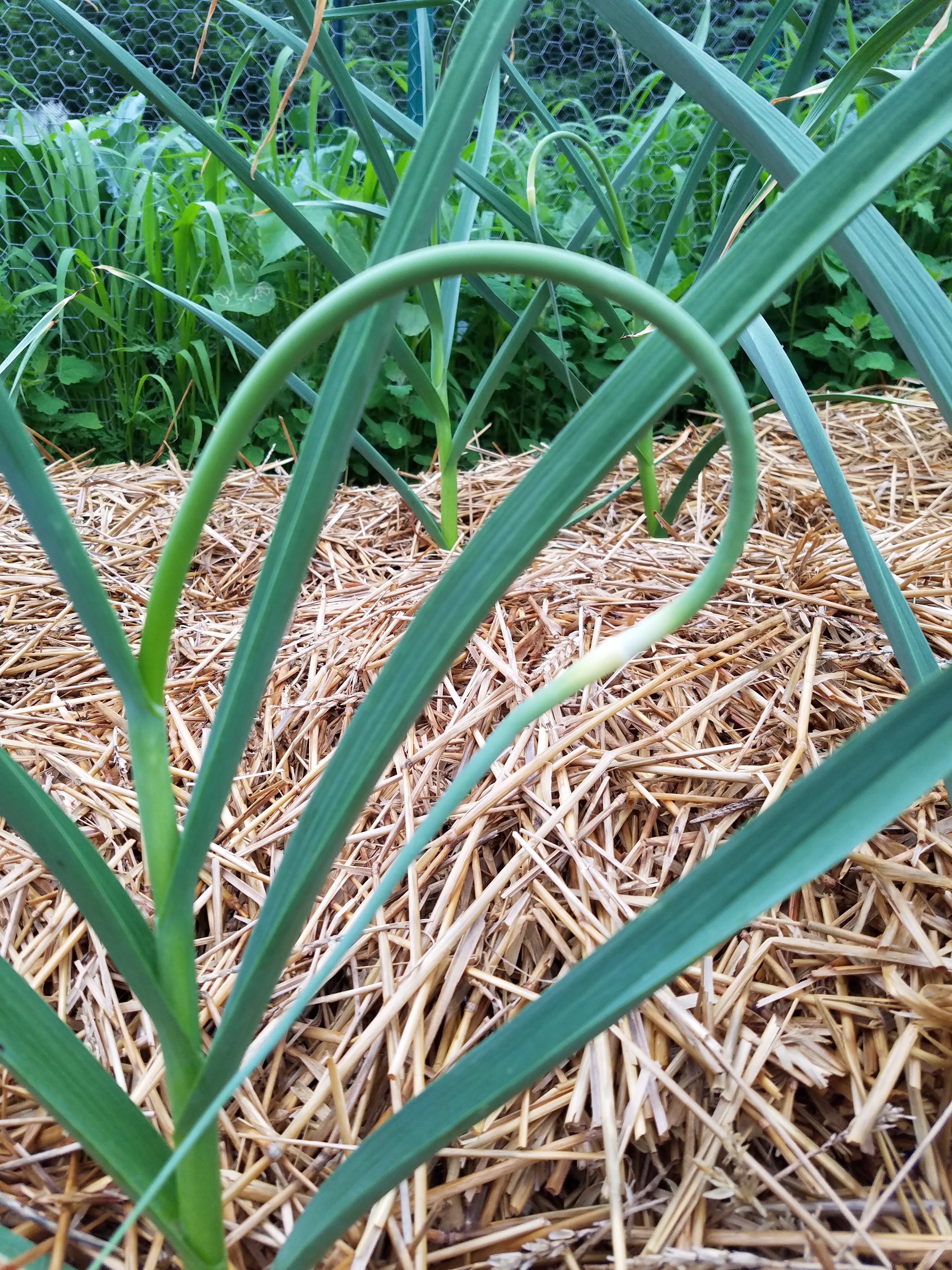
Garlic Scape
The garlic crop has been exciting. Scapes began to appear and as soon as they twist back around on themselves I’ll cut them off, to enable the bulbs to benefit from the plant’s energy, and to use them in the kitchen. The seeds were planted seven months ago so it’s great to see we’re getting closer to harvest.
The cloud formation I saw on radar broke up before it got to us. Where I expected rain, there were blue skies. I got out the hose and watered.
Like it or not, I must deal with my physical capabilities. I’ve been blessed with good health most of my life. When I had to give up running a couple years ago things began going downhill. What I mean is there was a perceptible decrease in flexibility and energy coupled with selected aches and pains in my shoulders, feet and hands. The foot pain is likely related to running although I’ve been spared the joint pain runners experience in their knees and hips. My shoulders? One of the transient doctors at the nearby clinic diagnosed arthritis, but I doubt it. I’ve learned to be careful not to injure myself with lifting. My back is sound. I get along.
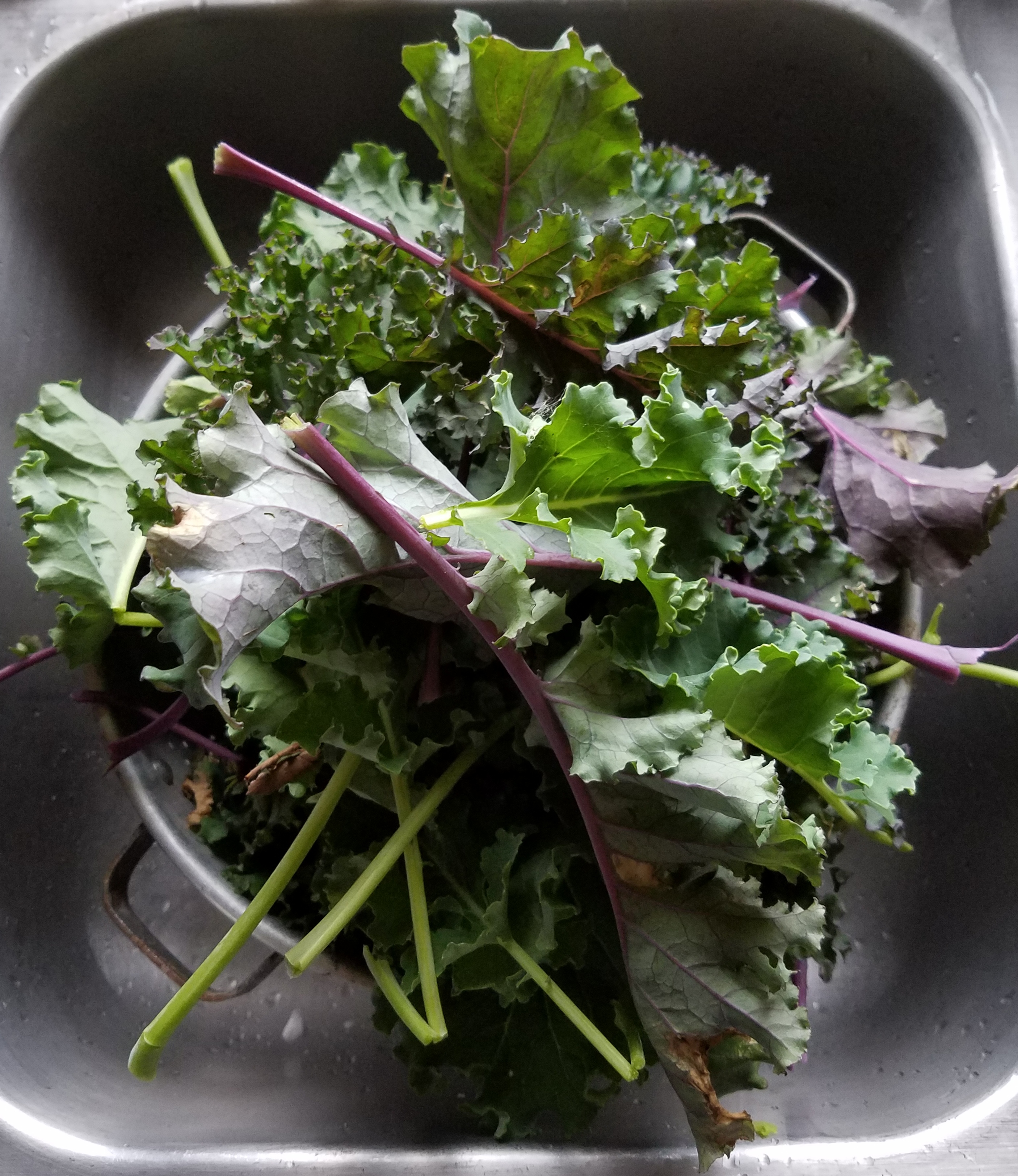
Kale Harvest
The main thing is dealing with energy levels. Instead of staying in the same place to finish a job I’ll take a break and go walking… to the garage, to my desk, to the kitchen. Sometimes I sit in the recliner for a while. I get back up and return to the garden. It’s a hodge-podgey way of doing things, however, I believe variation in work routine staves off further bodily ailments. It’s likely good for my mind as well.
The spring share at the CSA finished on Monday. The ice box is filled with fresh greens and rhubarb. On deck is rhubarb something, a vegetable broth for canning, and spinach daily until the kale avalanche arrives. I did not barter for a summer share at either CSA in order to survive mostly from our garden. Each year I become a better grower. It enables us to sustain ourselves with fresh produce while the season continues.
Wednesday I worked from sunrise until 2:30 p.m. in the yard and garden. Ambient temperatures rose only to 89 degrees, and the relatively cooler day enabled me to work longer.
Early hours were harvesting spinach and spring onions, weeding, planting Red Rocket peppers, tending seedlings in the garage, and installing nine feet of fencing for pickling cucumbers to climb. The major work was preparing the yard for mowing and then mowing with a grass catcher to harvest mulch for the garden. It takes about four times as long to mow when collecting clippings.
It was a big project.
Riding the mower around our 0.62 acre yard provided a chance to inspect everything. There’s more work to do besides gardening.
A greenish moss is growing on the north side of the house. Dead tree branches requiring trimming. One of the apple trees looks like disease is spreading as the yellow leaves already fall from the branches. The lilac bushes are overgrown and require a chain saw to cut them back. The mulberry and pear trees are forming fruit.
The lawn is reverting to what it was before we built and installed a lawn. Compared to the chemically treated neighboring yards, ours looks a step out of the prairie — greens and browns blended together compared to lush green. After mowing and grass collecting it looks like a hay field. There is a lot of yard work after the garden is in.
After five days in a row off work, I return to the home, farm and auto supply store today and tomorrow. Friday is a farm day then four days in a row off to work on the garden. Once the mulch is laid and peppers and beans planted the initial garden planting can be called done.
For the second day in a row ambient temperatures reached the high 90s with a “feels like” over 100 degrees. Farmers and gardeners were up at sunrise and curtailed outdoor activities by noon — a simple adaptation to unseasonable weather.
It was too damn hot.
While picking up the final spring share at the farm a fruit farmer friend arrived. We talked about the weather, then joined two farmers who were loading the truck for share deliveries in Cedar Rapids. They read my new T-shirt, which is red and says, “The United States of America Established 1776.”
“Very patriotic,” they opined.
The irony is the tee was made in China. They offered to screen print the farm logo on a new shirt at the next farm get-together. After the farmers left for the city we discussed politics until we gathered our shares and returned home.
I left seedlings outside in the morning, but well before noon, the pepper plants began to wilt. I brought them inside and they perked back up in the moist darkness. When I watered toward sundown the tomatoes, eggplant, cucumber and zucchini seedlings looked healthy — giving them plenty of water appears to be the key to survival. One kale plant looked worse for the heat and unlikely to be revived. Regrettably, I turned all the extra kale seedlings into salad the day before, so there will be a hole in that row.
Concerned about my ability to stand the heat, the afternoon and evening was spent indoors reading, cooking and working on my memoir. There is a lot of that kind of work to do and if the weather won’t cooperate with my gardening wants and needs, a person has to do something.
The good news is the forecast today is for highs in the high 80s. I’ll be out there as soon as the sun comes up.
Despite extreme heat tomatoes were planted yesterday.
Temperatures set new records throughout the state. Here it was 96 degrees by noon. I began planting at sunrise and finished around 10:30 a.m. when it became too hot. Snow last fell on April 15, so spring, if we can call it that, lasted about five weeks.
It is shaping up to be a punk vegetable season although it’s far from over. The heat stresses cucumbers and zucchini requiring a close watch to make sure they get enough water to survive. Likewise tomatoes. Some plants won’t survive and I reserved the extra seedlings to get through initial planting and establishment. Gardeners will adapt as best we can to weird and unseasonable weather. It’s what we do in a time of global warming.
Tomato Worksheet
That said, the tomato seedlings survived planting and the heat.
This year I planted eight varieties, Martha Washington, German Pink, Brandywine, Soldacki, Nepal, Red Pearl, Taxi and Clementine. If they all make it, harvest should include a variety of textures, colors and flavors.
The process was to dig three yard wide trenches in the designated plot. Using a hoe I broke up the clods of dirt then fertilized. Next I used a garden rake to further break up the dirt then fertilized again. Finally I smoothed everything over with a rake.
Down the center of the plot I spaced Soldacki and Brandywine seedlings about 18 inches apart — a bit close together but it allowed a dozen plants in the row. These varieties will produce fruit that weighs less than a pound.
I began the east row with German Pink. This variety grows fruit up to two pounds and I planted all five seedlings that germinated, spacing them more generously. It is one of my favorites because of the large slices it produces. Next I planted four each of Taxi, Red Pearl and Clementine bunched together. Each stake held two cages in which two each of the seedlings were planted together. These three varieties are smaller, with fruit weighing from 20 to 150 grams each.
In the west row I planted four each Nepal and Martha Washington spaced at 24 inches. These slicers will produce fruit weighing less than a pound. It’s the first time trying them both.
With seedlings planted, next is mulching. I need to harvest grass clippings for that, which got pushed off because of the heat.
Farmers Market Asparagus
After planning to skip the Solon Fire Fighters Pancake Breakfast, I showered and went to town after five hours in the garden. The morning crowd had dissipated so there was no line and plenty of food.
The big news was announcement of a $5 million fund raising goal to build a new fire station near the Dairy Queen. According to the handout, the building will be funded by private donations, donated goods, services and labor, and via loans. The goal is to raise the money by Jan. 1, 2020, although $5 million is a lot for our community comprised of a small city and four townships. “We’ll donate something,” I told first assistant chief Scott Wolfe.
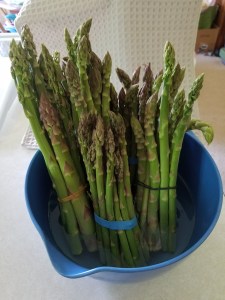
It’s been a bad spring for asparagus with none from the farm this year as the farmer tries to reclaim her asparagus field. To make up for it, I went to the farmers market in the county seat on Saturday and found some. We featured it for dinner last night — steamed with butter and a seasoning mix. It was fit reward for a hot, tiring day.
Plants and seeds are going into the ground — the main spring event in a kitchen garden.
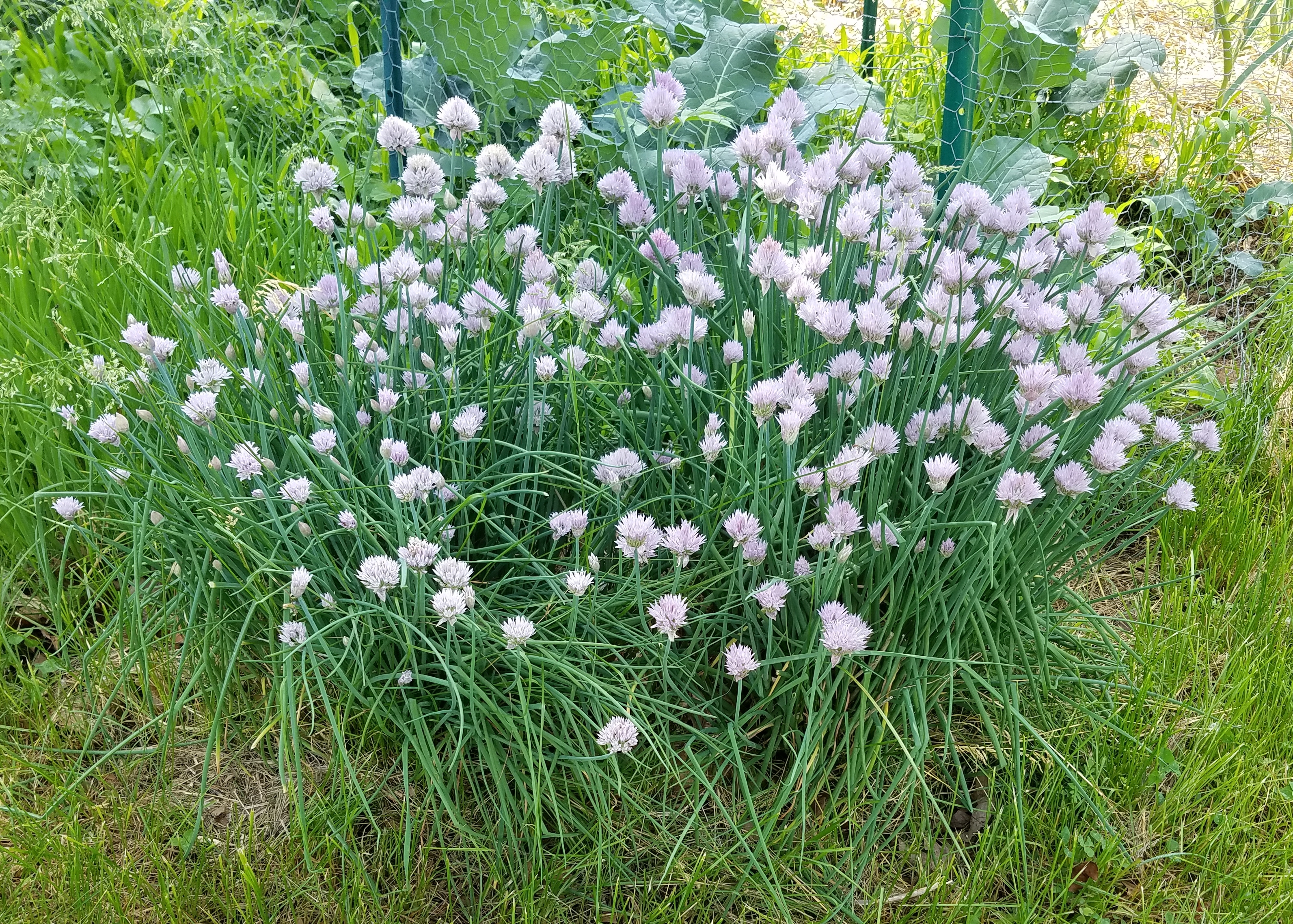
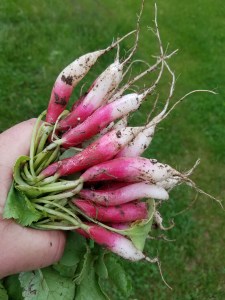
Harvest is ramping up with d’Avignon radishes, spinach, cilantro and chives heading to the kitchen.
I planned cilantro for my gardener’s lunch, and the spinach has been cleaned — some frozen and some in a big, recycled plastic clam shell chilling in the ice box. Chives will be for dinner and the radishes for snacks and salads.
This is why we have a kitchen garden.
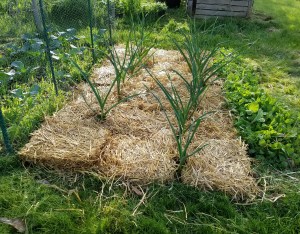
Yesterday I spent ten hours working in the garden. Big projects were making a space for zucchini and Marketmore cucumber seedlings, and mowing the lawn for the grass clipping mulch. I removed seedling rings from the kale, mulched garlic with a bale of wheat straw, and studied small sprouts to determine which were from planted seeds and which weeds. It’s not clear. Weeding and mulching are so commonplace it’s almost not worth recounting. It’s assumed.
Garlic Patch
Weather was perfect for being outdoors.
The harvest began before the garden is fully planted. Tomato and pepper seedlings mature in the greenhouse while celery plants are ready to go into the ground as soon as I can find time and a space. There are pickling cucumbers and green beans to go somewhere, winter squash to plant. The combination of planting, harvesting and cooking — kitchen gardening — will continue throughout the growing season.
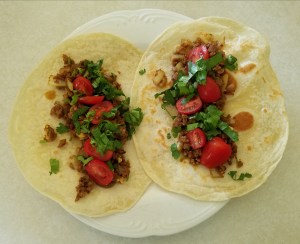
I stopped around noon and made lunch — fresh cilantro tacos.
Fresh Cilantro Tacos
Using pantry ingredients — storage onions, garlic, recipe crumbles, salt and home blended seasonings — I made a filling. I cooked tortillas in a large frying pan, and finely cut cilantro stems and ribboned the leaves. I topped the filling with halved grape tomatoes from California and fresh cilantro, which made the dish.
I bartered for a spring share at the farm so there are bags of greens in the ice box. We had a tub of firm tofu, so I decided on stir fry for dinner. Making stir fry is a way to use up vegetables.
I started two cups of raw brown rice in a quart of home made vegetable broth. I fried the tofu in olive oil, cut in half-inch by one and a half inch square slabs, then set them aside.
Included in the stir fry were baby kale (stems and leaves), carrots, onion, celery, garlic, pine nuts, halved grape tomatoes, red cabbage, a teaspoon of lemon juice and salt. Once the vegetables were soft, I spooned the mixture over a bed of rice and topped with spring onions and chives. It made four servings.
I texted Carmen to get the work forecast at the farm on Sunday. A light load of seedling trays is planned. After farm work, it’s back to the kitchen garden.
Friday is my day to work with Farmer Kate near Iowa City.
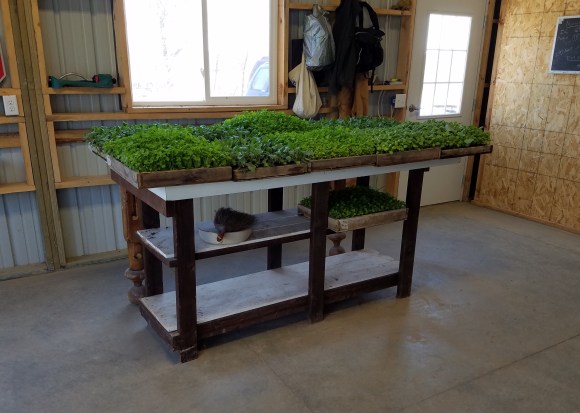
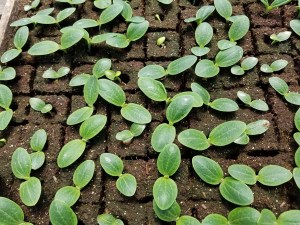
I made 30,288 soil blocks for plants at Wild Woods Farm this season. Add in additional work at Sundog Farm and my total production was 59,688 soil blocks since Feb. 25. That’s a lot of vegetable seedlings.
We’re planting lettuce, squash, cucumbers and zucchini which indicates we are more than halfway through spring production. Last year I finished at both farms on June 25 to get ready for the apple season beginning in August.
Cucumber Seedlings
Soil blocking is specialized. I use unique tools and soil to make the 72 and 120 block trays. This is my sixth year and I’ve incorporated soil blocked seedlings into our kitchen garden. Better propagation through this process makes a difference. Soil blocked seedlings are a part of growing better plants which produce great tasting vegetables. With retirement, healthy seedlings combined with additional weeding and better cultivation should result in higher yields. Importantly, it is all about freshness and flavor.
I receive fair compensation for my farm work. Over a few years we arranged a part barter – part cash settlement that works out for both parties. Each season has been a little different. This year I exchange labor for standard CSA shares in the spring and fall, then secure crates of tomatoes, potatoes, peppers and onions for preservation and storage. If my labor is more than that, I get a cash settlement. It is probably unnecessary to place a monetary value on these arrangements. Vegetable shares supplement our kitchen garden which produces much of what we need along with some specialty crops not grown on the farms. In turn, sourcing some crops from the farms reduces work in my garden. The arrangement is part of an ecology of food our household developed over time.
Over the course of spring, soil blocking at the farms has become part of our culture. I intend to continue as long as I can and the farmers are willing.
My next shift at the home, farm and auto supply store is May 16. That schedule provides a solid block of time at home to work in the yard and garden.
If it rains, I’ll work inside. There is no shortage of work, although I’m not concerned with that now.
The 87th Iowa General Assembly has been a pisser.
When Republicans won control of the Iowa Senate during the 2016 general election everything changed. It wasn’t small changes. They had a vision of Iowa and executed their legislative agenda in support of it. They took a broadsword to almost everything that matters. They reduced taxes beyond belief and hobbled the state’s ability to generate sufficient revenue to balance the budget. Then, because of the revenue shortfall, they drastically cut services. In Iowa that means cutting education, health and human services, public safety, and governmental compliance. Tomorrow the legislature is expected to pass more tax cuts and a budget that as of this writing isn’t finalized.
The state sought to get more involved in people’s lives under Republican governance, seeking to control how counties manage the minimum wage, how residents protest, how communities work with the federal government, and managing reproductive rights under established law.
Almost none of this legislation during the last two sessions was bipartisan.
The legislative changes impact everyone, including our family. We are not better off for it now and the prospects for the future are dim. The Republican vision for Iowa is not widely shared, especially among the 30 percent of Iowa voters who register as Democrats.
That doesn’t mean we have given up, we haven’t. Participation in the four Iowa Democratic district conventions was the highest anyone can remember during a midterm election cycle. A number of groups rose in resistance to Republican governance immediately after the election. The Iowa Democratic Party fielded the largest number of house candidates this year in most people’s memory.
However, the obstacles to convincing Iowans that Republican governance leaves much to be desired are daunting. 800,983 Iowa voters, or 51 percent of the electorate, chose Donald Trump as president. The votes are there to flip the state Democratic if we can find them. When everyone is running for cover by registering no preference or retreating into small family networks, that is no small task.
Proverbs 16:29 informs us here, “A violent man enticeth his neighbour, and leadeth him into the way that is not good.” Republicans may have been successful in accomplishing much of their agenda in the 87th Iowa General Assembly. We don’t plan to let them get away with it for long.
A relationship with food in American society is complicated.
Some don’t have enough. Others are awash in calories. We each have a human need for nourishment and the ways we go about meeting it are as different as the families which engendered us.
A favorite childhood memory is when Mother went to work in the school cafeteria after the Catholic Church built a new grade school near our home. With other women like her, she took a list of ingredients based partly on government programs (including lots of cheese) and partly on a limited budget, and made meals that included such dishes as porcupine meatballs (hamburger and rice) and grilled cheese sandwiches with tomato soup. Father worked at the meat packing plant which had an employee butcher shop where he could buy beef, pork and meat products at a discount, and did. The idea of stretching hamburger by mixing it with cooked rice was a novelty in our household and eventually we implored Mother to make porcupine meatballs for us at home, just like the ones at school. She did.
This story of external culinary practices coming into our home is essential to understanding the rise of a diverse diet in American society. We see things out there, they look good, and we want them. Most people, including low-wage workers, have or find the means to get them.
Many books, careers and lives have been based on food in society. We are an individualized rather than generalized culture with regard to food acquisition, preparation and consumption. To a large extent, the rise of the modern mega grocery store has shaped our eating habits in ways no one would have expected. Much ink has been spilled about that and I’m less interested in regurgitating my slice of it.
What I do know is local food farmers work hard for the sparse income they garner. All farmers do. The local food movement of which they are a part is based on the hope more people will bring locally produced, raw ingredients produced in a sustainable manner into their kitchens, ice boxes and pantries. Enough people do for a small group of farmers to make a living.
In many ways the increased interest in local food is the same type of behavior that took place in our home in the 1960s. We experience surprise when our CSA share includes Broccoli Raab, Koji or Bok Choy. We learn how to eat and cook them and want more. It’s not that our home nourishment plan is boring. We want and enjoy the experience of creation as it relates to cooking and eating. We want that experience to be personal and shared with family. That is very American.
I concede promotion of local food is a form of consumerism no different from a tomato catsup purveyor who spends dollars on an advertising campaign to enhance sales. The same behavioral forces are at work. I’m okay with that.
Just so you know, I’m not bewitched by the allure of eating a kale salad, at least not yet. Suffice it to say the diversity and behavior regarding food in our household with its kitchen garden, farm sourcing and grocery shopping has some unique qualities that may not be of interest to the authors of the Michelin Guide, but make our lives a little better. That too is very American. That’s part of who I am, who we Americans all are.
I planted onions and cilantro in the garden, transplanted some seedlings to larger pots, but that’s about it. The septic tank service arrived and pumped our solids tank while I trimmed the lilac sprouts from the space in front of our house.
Constant wind beating against me took its toll.
The first of five spring shares was ready yesterday afternoon from our CSA: Bok Choy, Koji and Broccoli Raab.
Both CSAs where I work are running behind due to weird spring weather. Carmen Black’s newsletter summed up where we are nicely:
First of all I want to thank all of you for your patience and understanding in starting a week later than planned! As I’m sure all of you can guess this weather has been very difficult to deal with on the farm. Two weeks ago it snowed, and today it’s eighty degrees! In addition to the swings in temperature its been the driest April on record, which means that everything we’ve finally been able to plant has needed to be watered immediately. Through all of this weather stress I’ve been very grateful to know that you all are so supportive of this farm, and will understand the challenges we’re facing in organically growing local veggies this spring.
First Seasonal Salad
Dinner was a salad to go along with pasta last night. Three kinds of greens and this year’s spring onions along with odds and ends of cold storage vegetables. It’s why we invest our time and resources in a food ecology.
The words “local food” mean less today than they did, and not what we thought they meant. I discuss local food with farmers and gardeners and I’ve heard the usage it is a form of green washing. Is “local food” a form of green washing? Maybe.
I know the produce harvested in our back yard is local food. With each passing season I see less significance. We want food we serve at home to be fresh, tasty and pleasurable. When we take a dish to a potluck, using garden produce gives a personal touch to a classic casserole. A kitchen garden like ours serves those things well.
“Local government can make policy that makes it easier to grow and consume #LocalFood,” Johnson County Supervisor Kurt Michael Friese posted on twitter.
If anyone is familiar with the local food system, Friese, a long-time restaurateur and food writer is. He is well positioned to make and implement policy that supports local food. But what exactly is that?
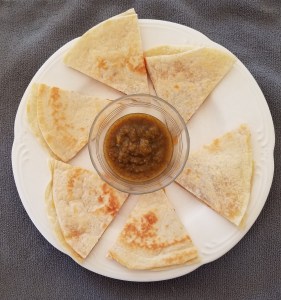
Breakfast Quesadilla with Homemade Salsa
Early on, local food referred to how and where food was sourced. There was talk about mitigating “food miles.” As I explained in a 2013 post, “Food distribution and related costs are a social construct that makes transportation seem inexpensive, or irrelevant to what we find in grocery store aisles.”
Where advocates of local food may have gone wrong is using the idea of food miles as a place holder for complex, flawed arguments. Costs are costs, and a producer has to recover his or her financial production costs when the consumer buys an item. Using any complex argument, including food miles, as a place holder seems a diversion. Such talk belongs more appropriately in a sales and marketing context as a form of puffery.
The better framing for “local food” is to know the face of the farmer. Two years ago I wrote at length about what it means to know your farmer and practices they use. Here is the salient point related to green washing:
Driven in part by mass media, consumers are concerned about a wide range of food issues that include contamination with harmful bacteria; dietary concern about consumption of carbohydrates, fat and sugar; the way in which plant genetics are modified to improve them; and more. Partly in response to media campaigns, annual sales of organic food exceed $30 billion in the U.S. (USDA). The increase in organic market share from national advertising campaigns is significant. If you get to know your local food farmer, what you may find is they benefit from this marketing, but their customers come and stay with them because of a personal relationship with the farmer.
Local food is not exactly green washing, which is defined as “disinformation disseminated by an organization so as to present an environmentally responsible public image.” However, there is a lot of conflicting and sometimes contradictory information related to food. Plant genetics alone set off a firestorm of media and organizational controversy and spawned a new food labeling process under the aegis of the Non-GMO Project. Simply said, it’s complicated.
If a definition of “local food” is elusive, how our county defined a local food system may be as good as it gets:
In Johnson County we see the need to localize our food system – and we are working to create a healthy, intact system that lessens resource inputs, promotes worker’s rights and preserves the natural environment.
Yesterday’s wind blew a single-use plastic bag into our Ash tree where it got stuck and is flailing in the wind. Part of me is tempted to leave it there as a symbol of all that is wrong with our society. Then again, if I want it fixed, I’d better do something about it. So it is with the local food system.

 My next shift at the home, farm and auto supply store is May 16. That schedule provides a solid block of time at home to work in the yard and garden.


 Journey Home
You must be logged in to post a comment.