Lettuce and basil germinated in the tray planted last week, reminding me of why I garden.
It is a chance to witness life as cold sets in for one last spell. Soon winter will turn to spring. I can’t wait. For now, suffice it that the seedlings rise to face the sun through a bedroom window.
The emergence of hearty weeds among my seedlings was unexpected and easy to remedy. We all have weeds growing in our garden, even when it is planted a couple of months before last frost. I continue to pluck them out to make room for what I intended.
The death of Associate Supreme Court Justice Antonin Scalia yesterday was unexpected. It sparked conversations in social media, which for practical purposes includes formal news organizations. Scalia was quail hunting at an exclusive ranch in West Texas — a place where Mick Jagger and the Dixie Chicks have hung out. The event ramped up my understanding of opinions and attitudes regarding the meaning of Scalia’s legacy and the process of choosing a replacement.
By all accounts, Scalia’s was a brilliant if acerbic legal mind.
The Congress is in recess, so President Obama has the option to make a recess appointment. That would be the cleanest way to go, with the selected associate justice serving until the end of the next session. Why would Obama forego the possibility of a lifetime appointment? As he indicated in his remarks on Scalia’s passing, he won’t. However, I pulled a Scalia and began with the text of the Appointments Clause of the U.S. Constitution. There is no time limit on gaining the consent of the U.S. Senate. They have given their advice already: “leave the position open until the next president is sworn in.”
When a nominee is presented to and blocked by the Senate, and if the Supreme Court divides evenly by ideology, the situation would contain both good and bad. There is no guarantee justices will divide by ideology. If they do, the powder keg that is the Supreme Court docket this session would sustain lower court decisions. Winners would include labor (Friedrichs v. California Teachers Association) and losers would include the TEA Party (Evenwel v. Abbott; Harris v. Arizona Independent Redistricting), undocumented immigrants (US v. Texas) and women’s reproductive rights (Women’s Whole Health v. Hellerstedt; Zubik v. Burwell). It seems too early to say all of this will actually happen.
With Scalia deceased, three remaining Supreme Court justices will turn age 80 by the end of the next presidential term. The stakes in the 2016 presidential election could not be higher. Ronald Reagan’s Supreme Court nominee Anthony Kennedy was appointed in February of Reagan’s last year in office, so there is precedent for Obama. Precedent means little in the toxic political environment in which we live.
Life is never as simple as germinating seeds rising toward the sun on a Sunday morning. There will always be weeds in the garden, and so it is with yesterday’s news as Scalia was plucked out by God’s hand.
Starting a garden is not always easy, especially if one lives in a city.
The main thing is planting the first time and that can be a big step.
The good news is the potential to stumble is more related to attitude than anything else. There is hope. Here are a few bits to get started.
A gardening journey can begin with a trip to the public library to browse the stacks. A lot of gardening books have it all and my current favorites are The Iowa Edition of the Midwest Fruit and Vegetable Book by James A. Fizzell, and MiniFARMING: Self sufficiency on 1/4 acre by Brett L Markham. The former is a comprehensive look at crops that grow well in the Midwest. The latter presents aspects of the growing process with an eye toward sustainability. Because gardening is popular, libraries tend to have a wide selection of research materials and other resources. Remember. Gardening is engaging in a local food system and book learning is only part of it.
Gardening is about changing one’s relationship with the food as much as providing food for the table — process more than produce. A common mistake is inadequate attention to gardening’s social context. I’ve heard stories of people seeking solace in tilling the ground and nurturing plants from seeds to fruit and vegetables — a form of personal retreat. In most cases gardening involves others — family, fellow consumers, merchants, farmers and gardeners. Discussion of gardening issues and their resolution is endemic to the process and represents the broader context in which gardening occurs.
When people think of local food, most have sweet corn and tomatoes in mind. There is a lot more. A way to begin is to think about what fresh veggies and fruit to buy and which to grow. Because of the space it takes, I always buy sweet corn rather than grow it myself. The other way around with tomatoes and green beans. Squash takes a lot of space, and there are lots of great producers of it everywhere… another to buy. Bell peppers require a certain something I haven’t mastered, so I barter for mine, taking seconds from the farm. Why not buy local food when it is abundant, especially if you know the farmer and how the crops are grown?
If you have a small potential garden plot, I recommend picking 8-12 crops and focus on learning how to grow them well. Pick varieties to ripen throughout the season — spring greens and onions, a few herbs, cucumbers, tomatoes, green beans and kale are all easy to grow. The idea is to dip into the soil and experiment using available resources. Another part most people dislike is dealing with pests and predators. Use those books you checked out from the library and better yet, develop friendships with other gardeners and growers in your area — ask them questions, visit their farms. You’ll find gardening is one of the most popular activities and there is lots to talk about, especially when it comes to common problems.
With a positive attitude, there is little to lose in planting a garden. Once one turns the first spade of soil, there is a world worth experiencing in the microcosm of a back yard. Before long, you’ll be craving life in society to talk about your garden. It is about more than home grown fruit and vegetables.
Local food may be what’s grown in a backyard garden, herb jar or patio pot. It may be heirloom livestock raised in grass paddocks, supplemented with carefully selected feed, and served in a local restaurant. It is definitely vegetables and fruit, increasingly available at farmers markets and roadside stands, from community supported agriculture operations, and even in chain supermarkets.
The local foods “movement,” is less coordinated than what media make it out to be. However, there is a consistent theme: it is small scale, farmers are interdependent, and the face of the farmer is visible in every apple, tomato and ear of sweet corn.
Many of us notice the increased availability of local choices when stocking our kitchens, a sign the food system is changing. After leaving a corporate job in 2009, I had a chance to work on half a dozen farms and gained a closer view of what local food farmers do. It is hard work made worthwhile by a network of cooperation among producers.
I met Susan Jutz, who operates Local Harvest CSA when two of her children were in 4-H with my daughter. Twenty years into the operation, Jutz has about seven acres in vegetables, pastures rented to local livestock producers, a large field in the Conservation Reserve Program, and a set of paddocks for her flock of ewes and spring lambs. Walking around the farm, you’ll find beehives, a greenhouse and a high tunnel, all adding to the economic structure of a farm using sustainable practices to produce shares for a medium-sized community supported agriculture project.
I began working at Local Harvest in March 2013 when I swapped labor for a share in the CSA. The work was physical, and I enjoyed it enough to return every spring since then. It was the beginning of understanding a local food network.
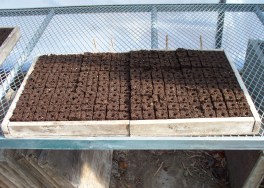
My first job was soil blocking in the greenhouse — making trays of small, square starter soil blocks where seeds are planted. In March, the ground is usually still frozen, yet I have to take off my coat and shirt in the warm workspace. The labor is physical, and a good opportunity to follow seeds turning to seedlings and then to crops with the season. Susan shared her greenhouse with other farmers with whom she cooperated to produce the contents of her member shares. Over time I worked on most of their farms.
One was Laura Krouse, owner/operator of Abbe Hills Farm near Mount Vernon, Iowa. Laura uses part of Susan’s greenhouse space in the spring and provides potatoes for Susan’s fall shares.
Because Krouse’s potato operation is large, she gains economies of scale. Using a tractor with a potato harvesting attachment, along with shared labor from other CSAs, and a large number of volunteers, she can harvest a field quickly. We harvested potatoes and washed them using a specialized root vegetable cleaner, bringing a load of potato-filled buckets back to Local Harvest for storage and distribution.
This is just one example of the cooperative ventures among farmers which include squash, eggs, carrots sweet corn and other vegetables for CSA shares.
While Susan and Laura have been operating for decades, since the local food movement got started in Iowa, the increased interest in local food is encouraging more farmers to enter the market.
I met Lindsay Boerjan who returned to her family’s century farm in Johnson County in 2011. To supplement family farm income, she used leftover material from a razed barn to construct raised planting beds. With manure from the cattle operation she runs with her husband and aunt and uncle, she planted the beds in vegetables for a CSA she began in 2015 with seven members. She hopes to grow her number of customers. Boerjan said she faced challenges as a female farmer.
“It’s predominantly an older male thing or career,” she said. “Should you want to make a career of it, it’s harder to wrestle in costs now the way they are.”
Boerjan is an example of a minimally financed operation, able to get started because she owns the land and is part of a larger farm operation. That Boerjan’s family owned the land and already farmed helped get her CSA going.
In January, Wilson’s Orchard in rural Iowa City announced it was entering the CSA market with a partnership with Bountiful Harvest Farm near Solon. Dick Schwab’s involvement in Bountiful Harvest is an example of a well-capitalized CSA start up. Schwab is a local entrepreneur who is involved in a variety of financial investments, including a timber business, an auto repair shop and more. He already hosted another CSA, Wild Woods Farm, on his acreage in rural Johnson County. He has experience, owns the land and equipment needed to operate a farm, and has a network of marketing contacts that include Wilson’s Orchard.
Knowing the face of the farmer has been part of the local food movement. Today, people want to know more about where and how food is produced. Getting to know a farmer was important at the beginning of the local foods movement in Iowa, and still resonates. At the local supermarket, buyers stock the produce aisle with locally produced items, along with a daily count of local food items on hand and a life-size photographic cutout of the farmers who produced them.
Driven in part by mass media, consumers are concerned about a wide range of food issues that include contamination with harmful bacteria; dietary concern about consumption of carbohydrates, fat and sugar; the way in which plant genetics are modified to improve them; and more. Partly in response to media campaigns, annual sales of organic food exceed $30 billion in the U.S. (USDA). The increase in organic market share from national advertising campaigns is significant. If you get to know your local food farmer, what you may find is they benefit from this marketing, but their customers come and stay with them because of a personal relationship with the farmer.
Whether you grow herbs on a kitchen window, belong to a CSA or garden a plot in the backyard, it is all part of a local food movement that is just getting started and depends on knowing the face of the farmer.
“Publishers are not accountable to the laws of heaven and earth in any country and regardless of my opinion, editors and publishers will print what they will.”
I wrote this in a letter to the editor of the Quad City Times in 1980 reacting to a popular feature section called Soundoff.
“(It is) little more than a vanity press for many of the writers,” I wrote. “It gets pictures, letters and opinions into print as a final goal; shouldn’t there be more to public voicing of opinion than that?”
This is more applicable today than it was three and a half decades ago.
What I learned in graduate school is the same statement can be applied to almost everything written in public. Reflecting on the Times experiment to make their pages more open to comments and retain readership, chaos reigned. What has changed since then is the emphasis on viewpoint in media — corporate, social or self published — which has been formalized. It’s not all good.
As I turn to the hard yet fun work of writing this year, I plan to journal my experiences in the food system here. Four years from full retirement, there are bills to pay and a life to live. I may pick other topics from time to time. I need to make the best use of every moment.
I’m writing off line as much as I can. While I don’t like to work for free as long as there is less cash than budget, I may occasionally post about those creative endeavors.
Thanks for reading this blog. Check out the tag cloud for your interests. I hope readers will be back often.
The good news about finishing three full weeks at the home, farm and auto supply store is the company offers health insurance that meets the Internal Revenue Service “minimum value standard” for less money than coverage available through the government’s health insurance marketplace or elsewhere.
The bad news is all of the pay from this full-time job will fund health care insurance, co-pays and deductibles for our family if we seek any care. If we don’t need health care once the coverage goes into effect Feb. 1 that will leave us roughly $150 take home pay per week. We’ll need more than that to pay the rest of our expenses.
Ada Blenkhorn and J. Howard Entwistle wrote the song “Keep on the Sunny Side” in 1899:
There’s a dark and a troubled side of life;
There’s a bright and a sunny side, too;
Tho’ we meet with the darkness and strife,
The sunny side we also may view.
Most people know the version Mother Maybelle Carter sang on the 1972 record album Will the Circle Be Unbroken produced by William E. McEuan. I favor the original A.P. Carter version which hearkens back to our family roots in Southwestern Virginia. Dig deep enough and you’ll find we’re shirt tail relatives on the Addington side, which is Mother Maybelle’s maiden name.
Not only may we view the sunny side, keeping there will be the only thing that gives us hope. This first job sets a foundation upon which to build the rest of my worklife.
What else?
In the works are spring at the Community Supported Agriculture project, summer editing at Blog for Iowa, and fall weekends at the apple orchard. These were all discussed during my interview with the home, farm and auto supply company, so getting time off shouldn’t be a problem.
The most excitement I felt in a while was finding the Seed Savers Exchange 2016 seed catalog in the mailbox yesterday.
Someone gave me a packet of their scarlet kale seeds last year and it was a great addition to the garden. Too bad all of my customers are used to getting kale for free, or it could be a source of some income.
It is conceivable I could generate a thousand or so dollars from the garden this year by expanding the planting area and selling excess. Circumstances may have me doing that.
It is a reasonably warm fall day near the lake — a time for hope and getting lost in seed catalogs.
The garden season officially ended today with gleaning that filled eight crates with tomatoes, apples, celery, Swiss chard, kale and hot and bell peppers.
I delivered a second 200-pound load of apples to the CSA for shareholders and the food pantry. While there, I picked up some potatoes, garlic, lettuce, a large squash, sweet potatoes and some onions.
With a hard frost expected early Saturday morning, I made a harvest soup with vegetables. Five quarts of it are processing in a water bath as I type.
Times like this, a list of ingredients suffices. Not as a recipe, but as a record of what went into the soup.
Fresh and canned tomato juice
Onions
Carrot
Celery
Potatoes
Kale
Swiss chard
Large winter squash cut into cubes
Bay leaves
Sea Salt
Orange lentils
Dried red beans
Pearl barley
Prepared organic vegetable broth
The draft toward winter is inescapable. Snow will soon be flying and subzero temperatures not far behind — and the comforting warmth of harvest soup.
The garden and trees turn to fall colors all at once — right now, as I write.
First frost can’t be far away, maybe next week. Leaves and grasses turn without freezing temperatures. The landscape assumes a warm brilliance.
Apple Harvest
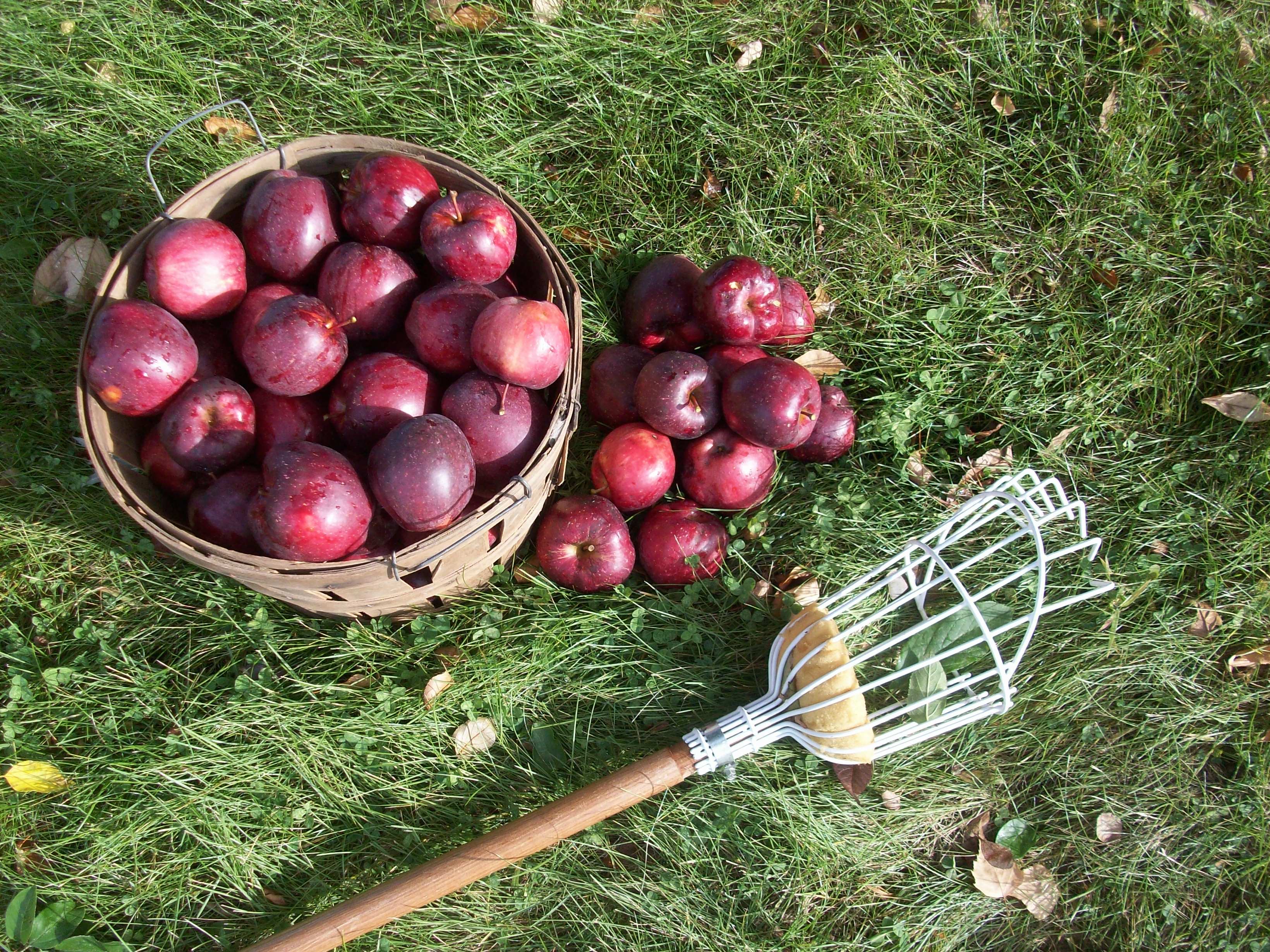
I picked more than 200 pounds of apples Wednesday and donated them to Local Harvest CSA. Enough for shareholders to bake a pie or crisp, or even eat! The apple variety is Red Delicious.
The trees have never been sprayed, and grow as near organic as possible. Fruit sometimes develop black spotting which can be washed off easily. They are delicious in more ways than one.
I walked the garden, filling a bucket with bell peppers, Swiss chard, scarlet kale, celery, a few tomatoes, basil and oregano — what was available. Most of it became soup for dinner.
Beginning with a cup of tomato juice in the Dutch oven. I steamed a diced large onion, sliced chard stems, fine ribbons of kale and chard leaves, celery, turnips and carrots. Except the onion, all were grown in our garden. Once the vegetables softened I added savory, bay leaves, sea salt, dried orange lentils, barley and a can of prepared organic kidney beans. Tomato juice to cover. The pot boiled and I turned it down to simmer. While soup was on, I cooked a cup of organic rice. Plating was a scoop of rice in the middle of the bowl with soup ladled around it.
The next day I water bath processed two quarts of soup, along with three pints of apple butter and a quart of apple sauce. Because of the backlog of apple sauce and apple butter in the pantry, I’m making a limited amount, just to have this year’s vintage when previous jars are used up. There’s more than enough soup for winter into spring.
The tine of my apple peeler cracked, rendering it useless. I drove to the orchard to buy a new one, but in conversation with the chief apple officer, it turns out they had plenty of spare parts. He gave me a used replacement part which fit perfectly and put me back in business.
Cider, New and Apple Vinegar
We got to talking about apple cider vinegar.
This conversation began in 2012 with another friend, who also works at the orchard. He gave me some mother of vinegar which originated with his family in the 19th century. It’s still alive. The orchard used it to start a line of bottled apple cider vinegar to sell in the sales barn.
Today’s discussion was about whether or not to use brewer’s yeast. Jack, the source of the mother, has a large plastic container to which he occasionally adds new juice, but never any yeast. We decided that the yeast must have come from other sources, and therefore no new need be added. Since it works, and in a home kitchen we expect there to be variation in the level of acetic acid, I decided to forego using yeast for the time being.
Yeast is basically everywhere. As anyone who made sough dough from scratch knows, it needn’t necessarily be purchased from a store. Jack’s mother likely has yeast in it, although I rarely see bubbles forming after adding new apple juice. It makes vinegar and that’s the hope.
Fall’s progress is one of the best times of the year. Squirrels scour oak trees for every last acorn. Birds roost on tomato cages where vines still produce.
It takes a walk in the garden to remind us of Earth’s potential, providing soup for dinner and apples for the sweet and sour of life.
Leaves are beginning to fall from the Green Ash trees. Those on the two early apple trees have been down more than a week. The garden is producing and likely will until the hard frost comes in mid-October.
This time, more than any in the year, is for work at home.
Today’s to-do list includes harvesting tomatoes and peppers, canning, and cooking gumbo. I prepared a lunch of sliced tomato, salt, pepper and feta cheese using blemished fruit. It’s a simple and satisfying repast.
For so many years, work was elsewhere. While downsizing I found a three-ring binder with papers from expense reports dated 1992. I was managing trucking terminals in Schererville and Richmond, Indiana, and starting recruiting operations in West Virginia, Georgia, Pennsylvania and Missouri. I would wake up on an airplane unsure of where I was, or where I was going. It was a busy time and there was little left for family. They were days of intangible hope for a future that included success. I don’t know what that means any more.
President Obama stopped at the Iowa State Library in Des Moines yesterday. The stop wasn’t on his formal agenda, but while there he submitted to an interview by Marilynne Robinson, the Pulitzer prize-winning author who lives in Johnson County. Obama reads Robinson and listed Gilead as one of his favorite books. It is pretty neat that one of our own has this kind of relationship with the president. Obama quoted from the book in his eulogy for the Rev. Clementa C. Pinckney in Charleston last July.
I’ve been trying to read Gilead without success. Starting it three times over the last three weeks, I don’t get it. Maybe eventually I will. It’s one of the must read books produced by an author affiliated with the Iowa Writer’s Workshop, where many less acclaimed books than Robinson’s have been produced. Maybe the time is not right. Maybe the president’s visit will encourage me to give it another try.
It’s two months to the 21st Conference of the Parties, or COP 21, in a suburb of Paris. Iowa environmental groups are wrangling for a unifying Iowa event just prior to the first day of the conference, Nov. 30. It seems a bit late to be planning as leaves fall, the harvest comes in, and we turn our attention to the work necessary to sustain ourselves. It’s important the parties reach an enforceable agreement. It won’t be the end of the world if they don’t. Or maybe it will.
Friday’s Brandywine, Rose and Beefsteak Tomato Harvest
Each day for the last two weeks I picked an apple and tasted it. The crop of Red Delicious is abundant and I want to make sure when the majority is harvested they are at the peak of sweet crispness. We’re almost there.
The pear harvest was limited to what could be reached. The tree grew well above the house leaving some ripe pears beyond the reach of even my long picking pole. We have enough to eat fresh and some leftover for apple-pear sauce.
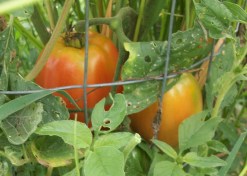
Tomatoes are coming in faster than they can be eaten fresh. The plan is to can smaller ones whole and the slicers diced. There should be plenty of jars to fill the pantry shelves. The by-products of juice and ground bits and pieces will make soup or chili, although there is a limit to how much can be canned and used over the next year.
The bell pepper plants are flowering again and celery continues to grow. The main job of deconstructing the garden in preparation for winter will soon begin.
But for now, it’s time to pick and preserve as much of the harvest as we can.
You’d think I had never been through an abundant harvest before. Bushels of fruit, tomatoes aplenty, and more kale than my regulars can eat in a year. Everywhere fresh produce is abundant as Iowa produced one of the best growing seasons ever for small-scale gardeners.
Most of yesterday’s outdoors time was spent picking pears and tomatoes. There are three crates full of apples and pears in the kitchen ready for processing, along with a counter full of tomatoes. The pressure is on to preserve some of this food for winter and beyond.
The branches on the Red Delicious apple tree are bending with the weight of the fruit. They are not sweet enough to pick, but when they are, there will be bushels more than can be used. People don’t generally like to receive home apples as gifts, but I plan to try to give some away.
The last of the basil made pasta sauce for an Italian spaghetti dinner. I used all of the small-sized tomatoes and it didn’t make a dent in the supply.
I ate several pears that were getting soft in the middle, scooping out the softness with a spoon. There is a short season for pears, and last year produced enough pear butter to last another year. Looking for a recipe for pear-apple-rhubarb sauce for canning, or maybe I will just mix them together and see what happens.
Days without need to leave the property are rare, but much appreciated. They provide time for a life as we choose to live it. Having the luxury of a family home, reasonably far from neighborhood noise, and large enough to create a generous space is just that — luxury.
Harvest days make one appreciate what we have, with hope to sustain our lives another season in Big Grove.



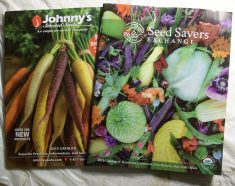 The most excitement I felt in a while was finding the Seed Savers Exchange 2016 seed catalog in the mailbox yesterday.


 Journey Home
You must be logged in to post a comment.