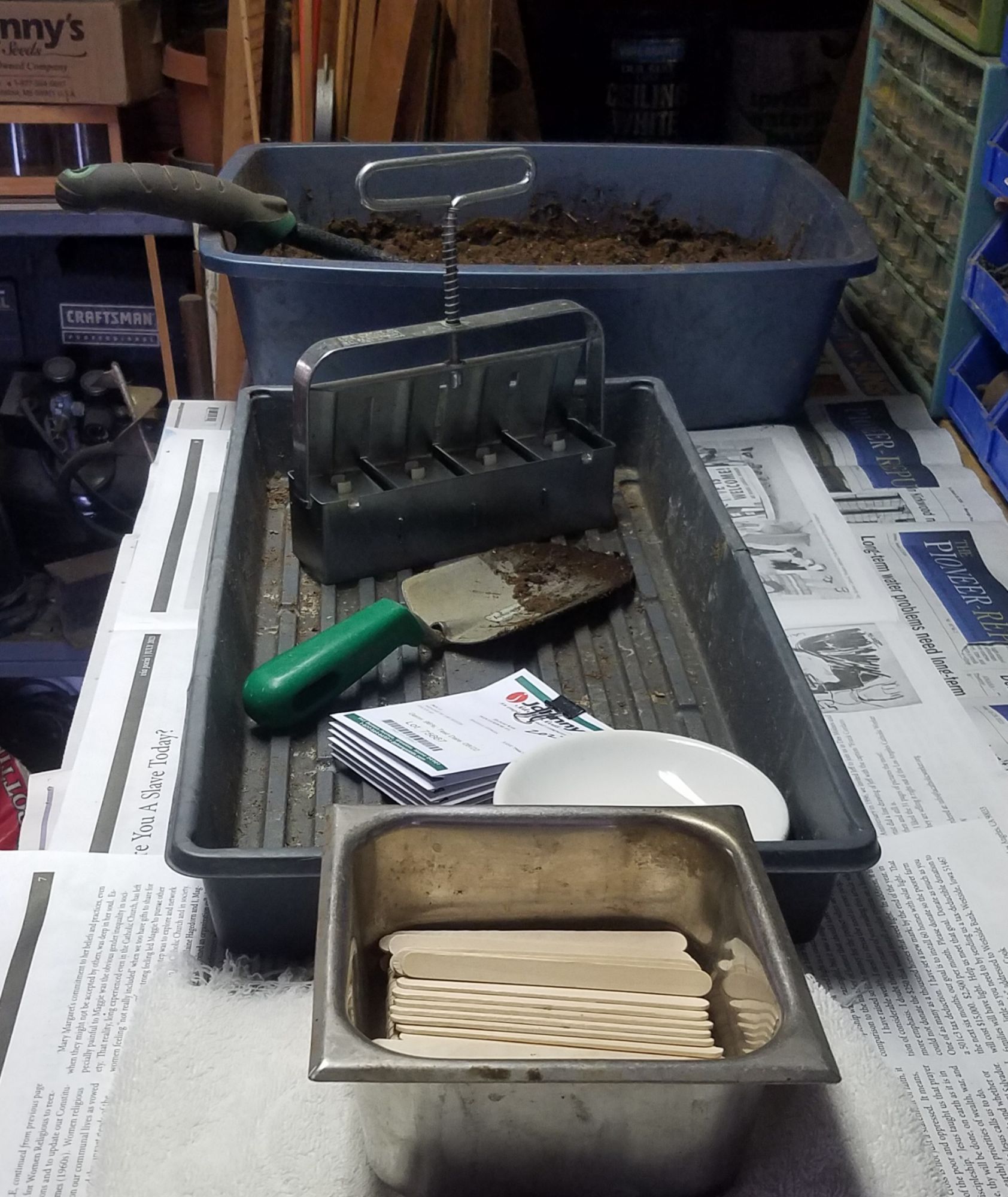
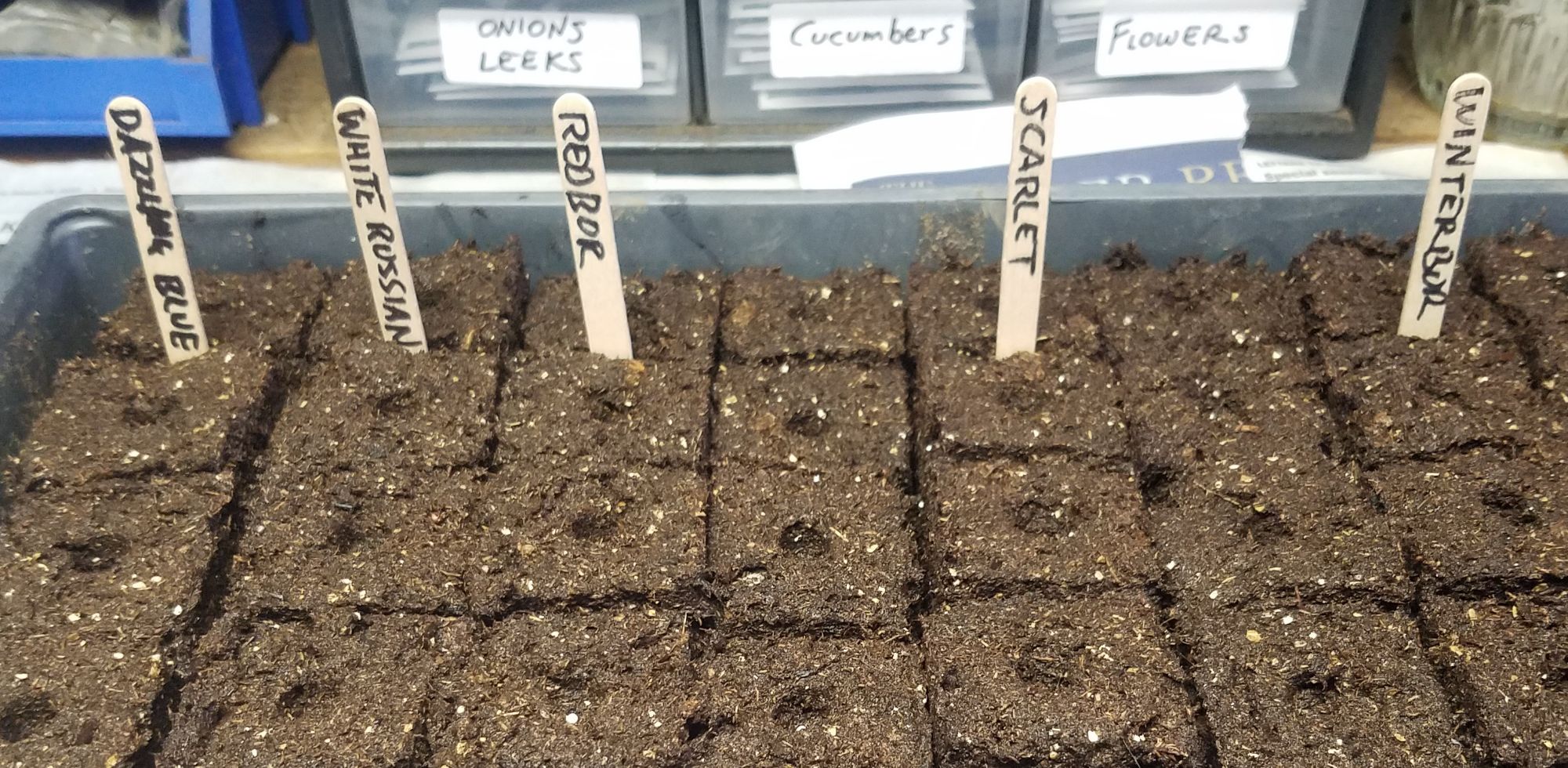
Tools to make the first tray of garden seedlings. Kale went in on Feb. 3.
I’ve been chatting it up with some neighbors on social media. There was consensus we hunkered down inside our homes for most of January because of snow and freezing ambient temperatures. There is hope for a break in winter and we’d just as soon move into spring. Personal productivity lags in winter. It’s time to step up the pace.
The idea of a “week” still resonates. Monday means start of the week, Friday is for closing down activities, Saturday is to perform a number of small household tasks, plus help our child with their small business. Sunday remains a day of rest, sort of. It’s not the same as when I worked full time. Then I knew that Friday usually meant casual clothes, voluntary trips to the office, and time to pursue my writing and family life.
I walked about the garden. The green I saw from the kitchen was collards that had been eaten more than I could tell from a distance. I had no interest in picking through the leaves, especially with a freezer full already available. I suppose the cruciferous vegetable-eating insects that survive the cold don’t have a lot to choose from in winter.
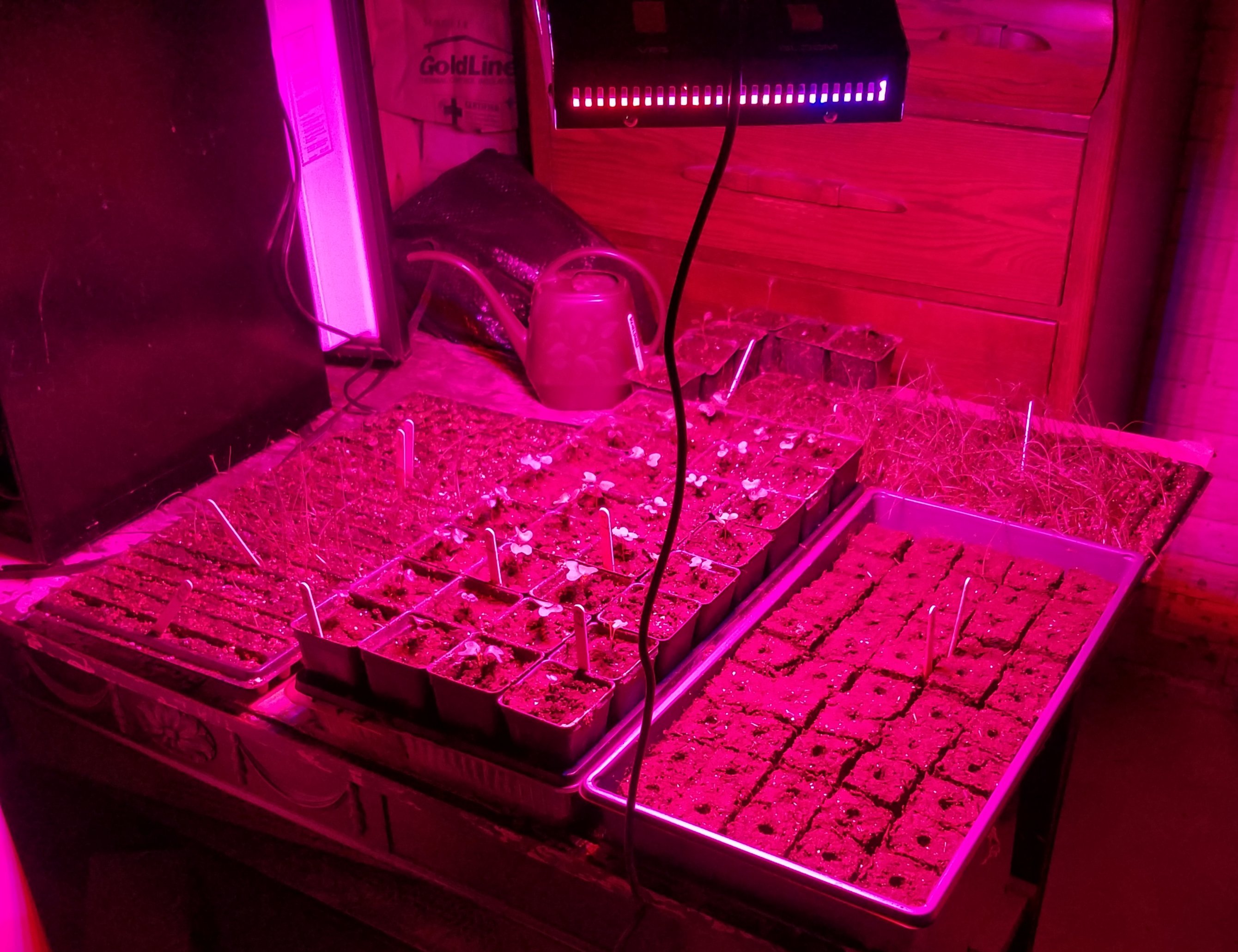
On Saturday I planted the first seeds for the garden and put the tray on a heating pad under a grow lamp. They are mostly last year’s seeds and that should not be a problem for kale. Kale is one of the vegetables I have mastered growing. It was something to see the tools lined up and ready to start. I worked with the garage door open for the fresh air and because we seem to be exiting the Iowa deep freeze.
February is an indoor planting month so I cleared the table where seedlings will go. First up this weekend is a tray of kale and selected herbs. Next it’s weekly planting until the garden soil is warm enough to sustain transplants or direct seeding. I bought new row cover as the old wore out and it helps grow herbs and lettuce like I never was previously able. Gardening 2024 has begun.
The Social Security Administration life expectancy calculator forecasts I will live for 13.9 more years. Based on that, and continued good health, I have 13 more gardens to grow. I already began scaling back.
Drip irrigation would make some vegetables grow better. Instead of learning about and installing it, I’m eliminating water-demanding vegetables like bell peppers, winter squash and carrots. None of these grew well here, and they are cheap to buy at the farmers market or grocery store. I’m focusing on what I grow best and leveraging the food system for the rest of our pantry.
A main driver in gardening changes has been changes in how we eat. My spouse changed to vegan during the coronavirus pandemic, so that changed how I cook shared meals. Cooking without dairy, especially butter, is a challenge. It renders large sections of cookbooks obsolete… especially the dessert section. We haven’t had meat in our home cooking since we married, so some of this is not new. Losing dairy makes a big difference, though, one to which I haven’t yet adjusted.
Nonetheless, growing a big garden is important to our way of life. The time to begin is now. I’m looking forward to the pinkish light illuminating trays of fledgling kale and broccoli.
This winter I lost the power of imagination when it comes to cooking. I know skills of cooking and the pantry, refrigerator, and freezer are full of food. Yet I give a blank stare when asked what we should have for evening meal.
Last night I made a vegan version of red beans and rice. It was based on the “holy trinity” of bell pepper, onion and celery. I added canned red beans and tomato sauce, garlic and kale from the garden, and seasoned with salt, dried thyme, and parsley. The dish came together with a slurry of white miso, tomato juice and arrowroot. Served on rice with a side of cooked corn, it was a satisfying meal. We discussed and are putting red beans and rice in the rotation.
The Iowa Legislature is in session and OMG! These Republicans are one paternalistic, low-IQ, incompetent group — filthy with unpleasant habits, brutes in human form, resembling human beings far too closely for the liking of most Iowans. (h/t Jonathan Swift). Where should I start?
We, as a society, have to elect enough Democrats to stop their madness by regaining the majority in both chambers of the legislature. When we held a majority in the senate, the radical craziness was held at bay. It wouldn’t hurt to retake the governor’s office.
Here’s a short list of legislative issues with Republicans:
Conversion therapy ban ban. Prevent local jurisdictions from banning this discredited pseudoscience as any decent person would.
Restrictions from use of information from the American Library Association in public school libraries.
Reduce services by the Area Education Agencies which serve disabled children.
Continue to do nothing with nursing homes where another patient recently died of neglect.
After the court enjoined their book ban bill for public schools, they doubled down with a book ban in public libraries.
School children would be required to sing the national anthem at the beginning of each day.
Politicization of the investment of public funds like the Iowa Employee Retirement System.
The chair of a subcommittee humiliated speakers addressing a bill concerning loss of local control for guaranteed income programs for the poor.
Good grief! The session is just beginning, so the worst is yet to come.
2024 is the time, now more than ever, to get involved in the political process. Even if it just means letting family members know it is important to vote.
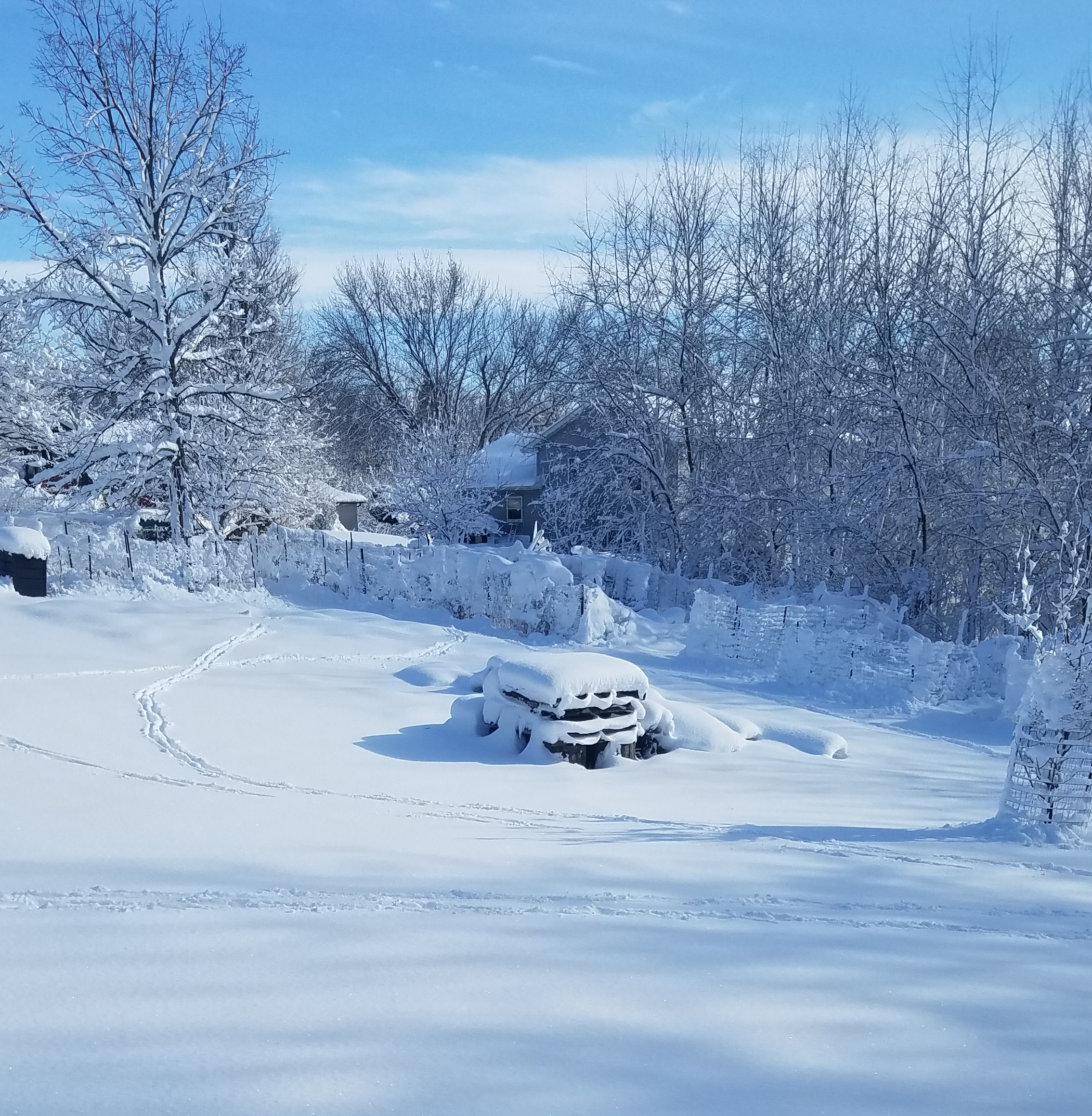
We got a dusting of snow last night, enough to use the electric snow blower on the driveway after sunrise. The forecast next week is for rain after ambient temperatures dip well below freezing this weekend. Is this the end of winter? I doubt it. I hope not.
In two weeks I begin planting seeds in indoor trays for the garden. This year I bought all nursery-started onions, so the first seeds into soil mix will be varieties of kale. Kale is a mainstay of our kitchen and the early start brings an early crop. After kale, I follow a time-tested, weekly procession of seedling starts that continues until the first week in May when I plant squash. I learned and developed this process while working for area vegetable farmers.
While I’m ready for spring, I’m not ready for winter to end. So much remains undone. I nudged my autobiography along, but have not had the long writing spells needed to finish the work this year. Based on feedback from a reader, I returned to part one for some revisions. I could easily spend another year there while part two remains in infancy. Partly this is a process of learning how to write. In part, I want to declare the work finished. The present obstacle is boxes and boxes of artifacts needing review and disposition before finalizing the narrative. I need external prompts to generate the narrative.
I began to dream during the blizzard. They have been dreams about travel, and topics I can’t remember. I don’t think much about dreams, they have little significance to me. I do notice the change in sleep patterns. For the most part, I’m sleeping through the night for a solid five or six hours.
I stand at the dining room window and look at the snow-covered garden. I have the plan about half worked out. Garlic is in the ground and I left space for a covered row on the west side of that plot. Tomatoes are planned with a return to my previous fencing method to keep deer from jumping it and eating tender seedlings. The next task is picking a spot for cruciferous vegetables. If I keep looking at the space, a plan for the rest will emerge.
Like much of my eighth decade of living, time goes too quickly. Part of me wants to apply discipline to get things quickly done. Part of me wants to take it easy, something I was unable to do much during my working years. Somehow I’ll find a balance as I understand what it means to age in America during a time of political turbulence. There is no universal understanding. We do the best we can.
The year has been okay, yet nothing to write home about. In fact, most of the year was spent at home with three months of my spouse being gone to help her sister. Whatever happened mostly happened in Big Grove Township.
Each year, beginning at Thanksgiving, I review my life. In the past I reviewed my most viewed blog posts. There are additional highlights to include this year.
Writing
My most viewed blog post was History of a Wing Nut published Aug. 25, on Blog for Iowa. I wrote, “(Mariannette) Miller-Meeks has become a wing-nut institution. Iowans deserve better.” I reviewed the influence of the fossil fuel industry on her work in the Congress, as well as her six congressional campaigns. It was the third most popular new post on Blog for Iowa this year.
On Journey Home my remembrance of friend since high school Joe Garrity was the most popular post. Joe died March 22 of complicated health issues triggered by COVID-19. It makes no sense this post would get so much traffic, except for the fact his obituary was not widely published. I continue to miss Joe and our many conversations, letters and emails.
The worm turned for me regarding the climate crisis this year. In a Sept. 21 letter to the editor of the Cedar Rapids Gazette, I wrote, “Environmental activism seems unlikely to solve the climate crisis. All the talk about climate change distracts us from the fundamental problem: the effect of unmitigated capitalist growth ravaging the resources and systems of the earth and its atmosphere.” The words “climate change” have become a lightning rod for people who seek to sustain the unsustainable status quo. A single activist can do little unless they team with other, like-minded people. In the meanwhile, Earth is experiencing it’s hottest temperatures on record in 2023.
Health
My almost 72-year-old frame still carries me along. I developed a regimen of exams, tests, and monitoring. If I’m not in perfect health, I feel aware of my deficiencies. I can no longer jog the way I did and now walk 30 minutes daily along the state park trail. The path is similar each day and I have been able to watch the turning of seasons up close.
In our household, my spouse is vegan and I am ovo-lacto vegetarian. We’ve been working through menu planning since she decided to eat vegan during the coronavirus pandemic. We developed a core ten or so dishes which we prepare in rotation. We need more than that. This was an unexpected development, yet there is unique engagement in trying new things while shifting our diet. Much more to come from the kitchen on this next year.
Reading
As of today I finished reading 62 books in 2023.
In fiction, my favorite was Whose Names Are Unknown by Sanora Babb. I also enjoyed The Last Chairlift by John Irving, and American Dirt by Jeanine Cummins.
None of the poetry stood out particularly. I read Plantains and Our Becoming by Melania Louisa Marte. I believe she has a bright future and look forward to her next book. I revisited Adrienne Rich’s Diving into the Wreck. I first read this in graduate school. She’s an important poet, although reading her is a bit like taking medicine.
More than half of what I read was nonfiction. I interviewed Thom Hartmann regarding his new book The Hidden History of American Democracy and published my review here, on Blog for Iowa, and on Bleeding Heartland. I asked if this would be his last in the Hidden History series and he said he didn’t know but is negotiating with his publisher.
Timothy C. Weingard’s Mosquito: A Human History was likely the best nonfiction of the year. Other top nonfiction includes The Farmer’s Lawyer by Sarah Vogel, A Fever in the Heartland by Timothy Egan, Democracy Awakening by Heather Cox Richardson, and White Trash: The 400-Year Untold History of Class in America by Nancy Isenberg. Each of the nonfiction books I read had redeeming qualities. That’s likely because of how I selected them.
Three other books stood out yet defy category. I re-read Martha Paulos’ Doggerel. Martha and I were friends at university and we had constant conversations about art, literature, and living a creative life. Someone had given a mediocre review of the book on Goodreads and I felt I had to balance it with a positive one. Marilynne Robinson’s When I was a Child I Read Books was exceptional. I’m not a fan of some of her work, but this one… holy cow! The other was William Styron’s Darkness Visible: A Memoir of Madness. I had no idea of his problems when I heard him read in the English Philosophy Building at the university. We often live for such reading experiences as these three books represent.
Kitchen Garden
For the first year, deer got into the tomato patch. I changed the fencing to allow more space between rows and it was a disaster. Deer were able to land between rows and eat the tender leaves of recently planted tomatoes. Once inside the fencing they couldn’t figure out how to get out and bent the stakes over to make their exit. I’m going back to the old way in 2024.
Bell peppers were poor quality and cucumbers, zucchini, and cruciferous vegetables thrived. There was a bumper crop of hot peppers and fennel. There was a problem with the garlic mulch which cut production by about 20 percent. There was still enough garlic to last the full year.
We had all the pears we could eat. All four varieties of apple trees produced something and two were abundant. I put up all the apple cider vinegar, apple butter and apple sauce we would need for a couple of years. We filled the produce drawer of the refrigerator to preserve fresh apples, and there remains a bushel with which I need to do something soon. I didn’t hardly touch the production of Earliblaze and Red Delicious apples. The deer made out with nightly visits for an apple feast.
The portable greenhouse didn’t make it through the season and will have to be replaced in the spring. Row cover was great for herbs and lettuce, although the fabric saw its last crop in 2023 and will be replaced. The freezer and canning jars were filled early in the season with leafy green vegetables and vegetable broth. I figure I have 14 more seasons in the garden before age catches up with me, at least according to the Social Security Administration.
Overall the garden was a success, as was the use of produce in the kitchen. I put 100 cloves of garlic in the ground in October for next July’s harvest.
Photography
My Instagram account is a record of the best photos I’ve taken. The subjects are the kitchen garden, hiking, and sunrises, with a bit of travel and indoors shots thrown in. The quality of photos produced by the camera in my mobile device is remarkable. What once was a throw away snapshot process is now something more.
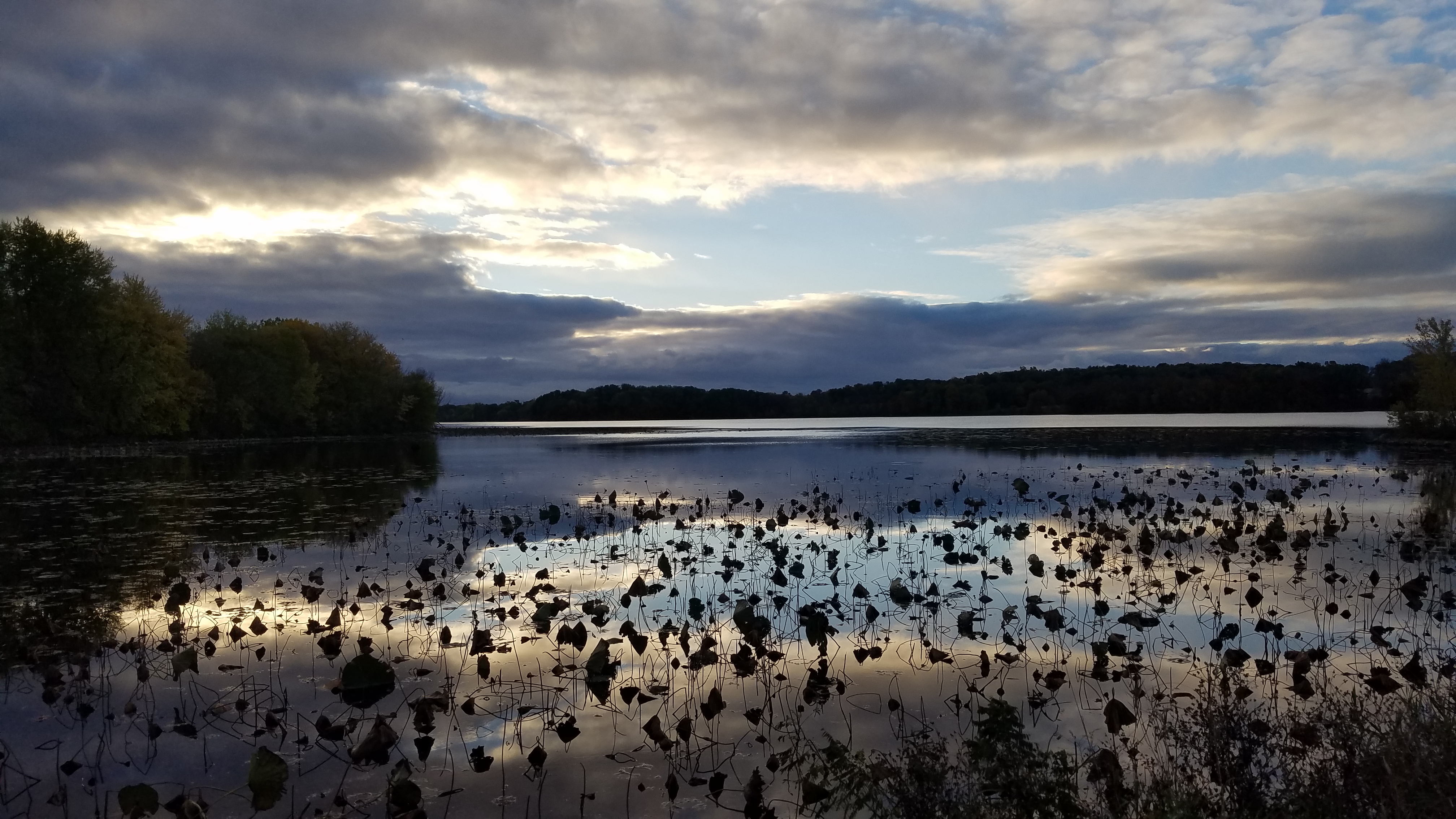
Sunrise on Lake Macbride October 2023.
Financial
Living on our pensions was a struggle so we had to borrow money. Maybe it’s because the mechanical systems in our home were mostly the original ones installed in 1993 and needed replacing this year. We are also living with a car loan for a couple more years. There are some health care bills but most of those expenses have been covered by insurance. Compared to most Americans, we are doing okay. There wasn’t as much discretionary spending in 2023. There will be less in 2024.
Compared to previous years, this one wasn’t stellar. All the same, it is important to give thanks for our many blessings this time of year.
My spouse went vegan a while back and I didn’t. I’m having to re-learn how to cook for both of us and I’m okay with that. It’s more work than expected, but I shouldn’t just kick back and grow old according to my former ways. This vegan bent in cooking, combined with other dietary restrictions we follow, led to a long list of food we don’t buy or seldom eat. Long-time readers may be familiar with some of them.
A pox on avocados because popular demand leads to deforestation with avocados being planted beneath the canopies of tropical rain forests before the rain forests are cut down. Either we are serious about preserving rain forests or we are not. That means no guacamole or avocado toast in our household.
Coconut oil? It’s a saturated fat people! Don’t be eating it when other, healthier options are available. I read the summaries pertaining to lauric acid. Still don’t eat it.
I forget why we don’t like mushrooms, yet there hasn’t been one of those in the kitchen for decades.
We never bothered being pescatarian enroute to vegetarianism. Folks should lay off fish for the sake of maintaining our fisheries. If unchecked, humans would take every fish that swims in the seas. If you missed it, sushi is usually some kind of fish, so avoid it.
Don’t get me started on jackfruit. Leave that one in Mexico or Guatemala. See the first item about deforestation.
Seitan is fine unless one has a sensitivity to wheat. We don’t eat it regularly.
After a long search for a recipe to make vegan pumpkin bread with my wealth of frozen Casper pumpkin flesh, I developed this one, which was good.
Vegan Pumpkin Bread
Dry ingredients:
2 cups all purpose flour
1/2 cup granulated sugar
1 teaspoon baking soda
1 teaspoon baking powder
1 scant teaspoon pumpkin pie spice plus extra cinnamon to taste
Pinch of sea salt
Wet ingredients
2 teaspoons vanilla extract
1/3 cup water at room temperature
1/3 cup apple sauce
1-1/2 cups pumpkin puree (or 15-ounce can prepared pumpkin)
Preheat convection oven to 350 degrees Fahrenheit.
Mix dry and wet ingredients separately then add wet to dry. Mix thoroughly, although not too much. Pour into a loaf pan greased and lined with parchment paper. Bake 55 minutes or until a toothpick comes out clean. Remove to a rack and let sit for 10 minutes. Makes 8-10 slices.
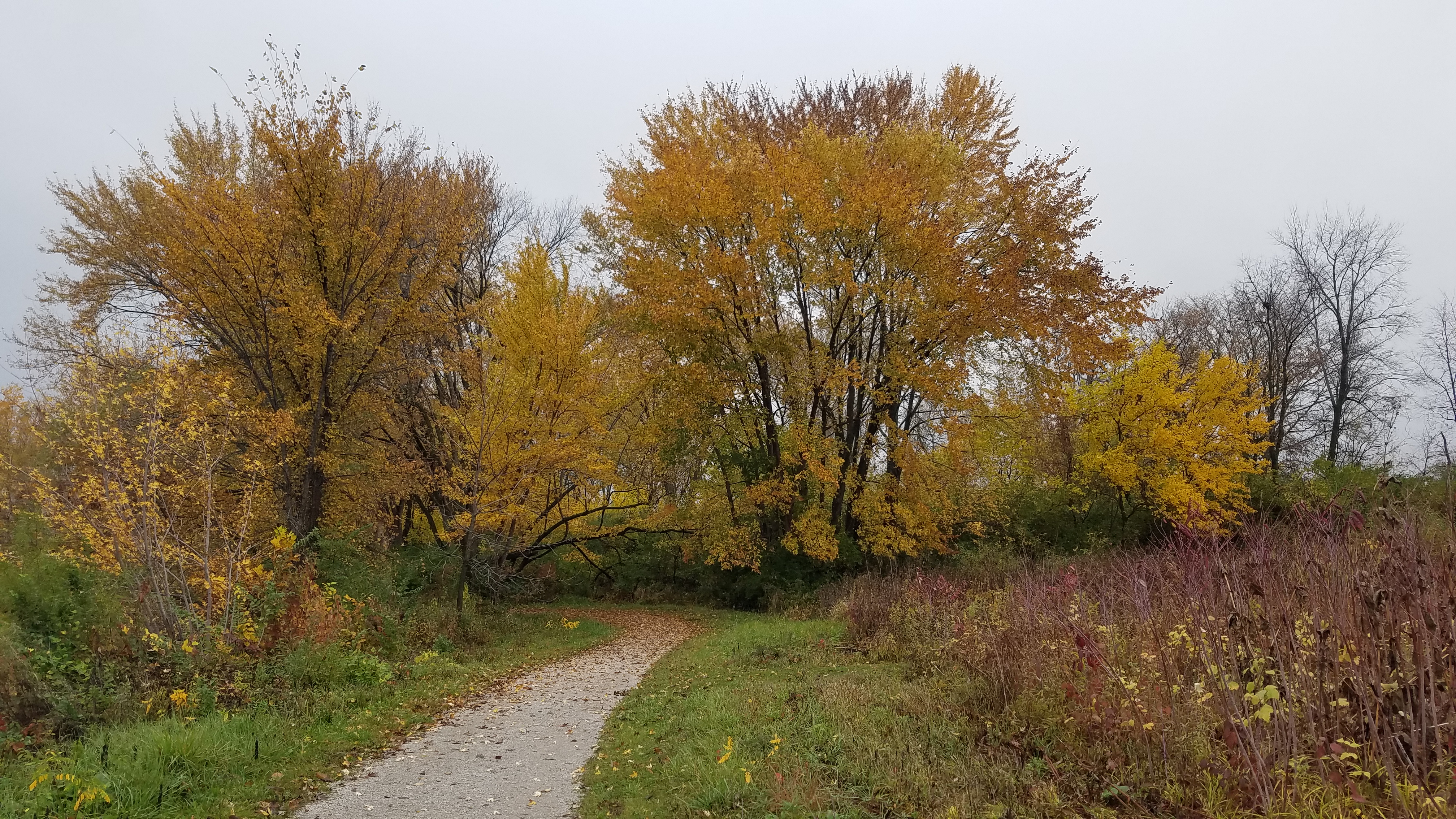
One last shot before the deciduous tree leaves have fallen. Oct. 27, 2023.
The first hard frost is a couple weeks late. The forecast is Sunday night with ambient temperatures in the 20s. I’m ready. Perishables are harvested from the garden, the garden hose rolled up in the garage. I plan to mow one more time. With any luck it will be before the Trick or Treaters come Tuesday evening.
Kale harvest before the first hard frost, Oct. 27, 2023.
The wheat straw covering my garlic patch sprouted. I assume frost will kill it. I’ve never had that much seed in my straw. Buying it from a different vendor makes a difference. If wheat survives the cold, I’ll have to turn the straw and kill it myself. I am reluctant to add the descriptor “wheat murderer” to my resume. Garlic takes precedence over making a few wheat biscuits.
Golf carts of Halloween.
Halloween trick or treat night is an occasion for parents of young children to get out the golf cart and run with their neighborhood peers. I get around the neighborhood by walking, but I’m old school.
Short post today. It’s turning out to be a busy Sunday. Thanks for reading.
There is a frost warning tonight and that means one more garden gleaning before sundown. I expect to get kale, parsley, and maybe some tomatoes. I also expect this will be a hard frost, unlike previous nights that turned deciduous trees into paintbrushes full of color. Evolving what used to be cooking into a kitchen garden has been engaging and fulfilling. It changed — in a substantial way — how I cook meals with what grows on our property.
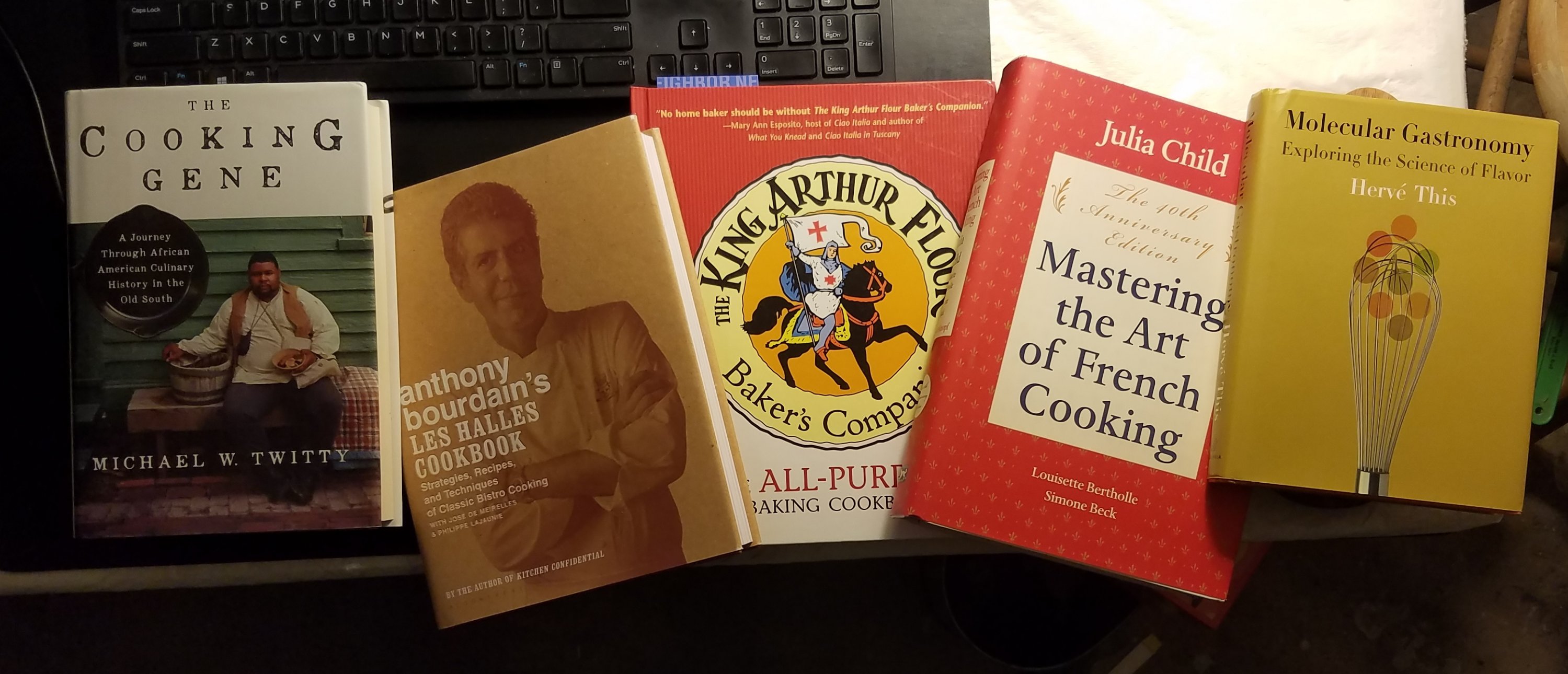
I have been a collector of cookbooks yet no more. These days I cook for weeks without opening one or consulting a recipe. When I make something sensational it is often unlikely the dish can be repeated. The reasons are many, whether it be living in the moment, freshness of ingredients, temperature and distribution of cooking heat, or how seasonings blend together. We bought a new range in May. It cooks differently from the previous one and continues to take time to understand settings, temperatures, and uses of the five cook top burners and oven.
A couple of posts ago I wrote about cooking grits and posted the photo on social media. People replied with variations I could make to improve the recipe. Thing is, the bowl of grits is rooted in ingredients already in my pantry and refrigerator. It is also rooted in my cooking process, which in this moment was to stand over the pot stirring constantly. The boiling liquid I used was half made by me vegetable broth and half two percent cow’s milk. I used Cabot’s extra sharp cheddar cheese I keep as a staple in the refrigerator. This particular bowl of grits was also rooted in that moment of creation and it seems unlikely I will get the same results the next time I make it.
Canned salmon was a big deal back when we had five digits in our private (as compared to party line) telephone numbers. In our 1950s and ’60s household, salmon patties were a once in a while treat on Fridays when we fasted from eating meat. The school I attended published a cookbook that lists multiple dishes to be made with this innovation found in the canned goods aisle at large grocery stores. Then, large grocery stores were also an innovation. Salmon salad, moist salmon loaf, salmon and vegetables in a dish, salmon custard, salmon in rice nests, salmon loaf, and other recipes were listed on the pages of the Holy Family School P.T.A. Cook Book. These days there is an abundance of fresh salmon available so the idea of using canned salmon is outdated. In 2010, when I was in Montana visiting friends, we went to the store and bought salmon steaks for a family meal. The meal was memorable. Canned salmon was revolutionary, as are the modern industrial salmon fisheries and farms. As a mostly ovo-lacto vegetarian, salmon wouldn’t be a part of any meal we prepared at home today.
People I know use recipes as a jump point in meal preparation. They search the internet, use a single purpose recipe application, or look through magazines and cookbooks to find something for dinner. They then modify the recipe to match personal preferences or ingredients on hand. I think most home cooks follow one of these methods.
I use internet searches when I have an abundance from the garden. For example, I recently searched garlic, tomatillos and chili peppers and came up with several ideas about how to preserve them as a condiment until the next crop is available. My home made apple cider vinegar is used as a preservative, making the dish ultra local. There are currently about a dozen jars of chili sauce in the refrigerator and pantry, no two of which are the same. It keeps things interesting while also using the harvest.
Another spontaneous aspect of cooking is using “my recipes,” meaning personally developed dishes, the recipe for which resides in memory or is written down in a notebook, 3 x 5 index card, or in the margins of cook books. We all have dishes like this. In our case, they form the framework of a weekly menu. Stir fried tofu with vegetables and rice is a complicated undertaking and we do that every week or two. Big batches of home made soup and chili stored in quart jars in the refrigerator are go-to meals when we don’t feel like cooking. Tacos are another mainstay. We use uncooked flour tortillas from the wholesale store and on hand ingredients from the garden and pantry for filling. The ingredients follow the seasons year-around with fresh tomatoes when they are available and frozen greens in winter. When we cook like this, there are few reasons to consult with a cookbook or recipe unless we’re understanding how to cook a new dish.
Morning has turned to afternoon and I haven’t been to the garden yet. I’d better get going. Thanks for reading.
I let my southern roots show by making grits for breakfast. There is no recipe, just an approximation. For a single large serving bring two cups of liquid to a boil (half milk/half vegetable broth) and add half a cup of grits. Salt and pepper to taste and cook on medium low heat until the texture of ground corn begins to show. Add one tablespoon of butter and then half a cup of shredded extra sharp cheddar cheese. Stir until every thing melts and the dish comes together. When the grits are soft, they are finished.
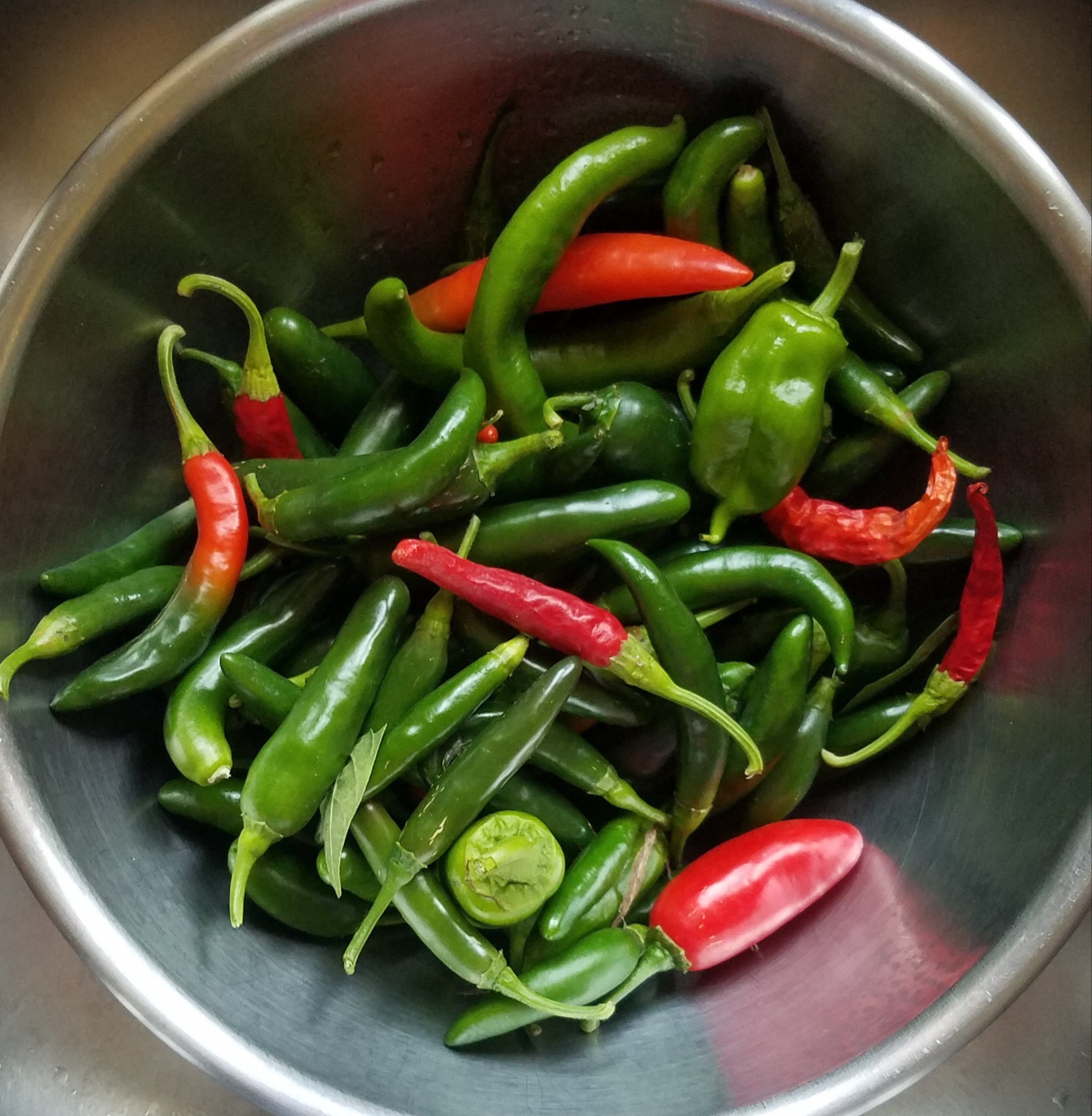
Last of the hot peppers as I cut the pepper plants down to clear the plot.
I’m taking down the third garden plot because I need a place to store tomato cages over winter. This was a hot pepper, fennel, eggplant and tomato plot. Fennel is coming back to life so I may get enough for a stir fry or two. To preserve the ground cover for another year, I cut the plants off close to the ground, remove the staples, and lift it off gently to get minimal tearing. Reusing assets like ground cover is a key economic factor in gardening.
Looks like we’ll get a hard frost over the weekend. It’s about time. I rely on cold weather to suppress garden pests. In addition, I already have enough hot peppers and kale to last until next year.
A local farm had a bumper crop of specialty pumpkins this year. Everything was priced half off over the weekend. I bought a large Casper pumpkin for pumpkin bread. I’ll bake it all and freeze it in amounts to fit the recipe. What they don’t sell will be fed to their cattle. Cattle enjoy eating pumpkins, apparently.
That’s all for this life in Iowa. Thanks for reading and make it a great day!
After turning soil in the new garlic plot the next steps are breaking up the heads of seed garlic to pick the best 100 cloves, spreading composted chicken manure over the plot, and running the rototiller until the soil is thoroughly mixed. This year the soil is a bit diverse with composted wood chips, compost from the large garden waste composter, and a variety of soil types from planting a diverse mix of vegetables here. Gardening is always an experiment. We’ll see how garlic in this mixed plot goes.
Garlic marks the last planting of the year. From here, garden work consists of taking down all the fencing and caging and stacking it for next year. I don’t always finish that work, leaving some of it for spring.
My posts about garlic are among the most popular on this blog.
Seed garlic 2023.
Last night, two of my political friends Laura Bergus and Pauline Taylor won their primary to advance to the City Council ballot in November. Here in Big Grove, the November election is not significant. As I covered previously, there are two incumbents running for two school board seats and that’s it. Our household plans to vote.
U.S. Senator Joni Ernst and U.S. Representative Mariannette Miller-Meeks were both on a trip to the Middle East when Hamas attacked Israel. Miller-Meeks returned early for the House Speaker election today, and Senator Ernst met with Prime Minister Netanyahu on Tuesday. Ernst is co-chair of the Abraham Accords Caucus and a member of the Senate Armed Services Committee. While she was there, Israel had begun bombing Gaza. The situation in the Middle East is complicated. The Hamas attack on Israel is not and the United States stepped up to help.
I am working my way off Twitter. I uninstalled the application from my mobile device and read it only on my desktop. There continue to be too many newsworthy accounts and too many valued friends and acquaintances there to give it up completely. Eventually, though, I will. Not having the application on my mobile lets me know how much I relied on it. That needs changing.
Rain is forecast around noon today. I hope to have garlic planted before it comes. It has been unseasonably warm, so if I miss the window, there will be another.








 Journey Home
You must be logged in to post a comment.