Since we became a one-car family in August the extra garage space filled the way water seeks its own level. Garden stuff, tools and equipment were scattered in every available space. I spent a couple of hours cleaning up and organizing on Saturday. It was a mess, and now is less so.
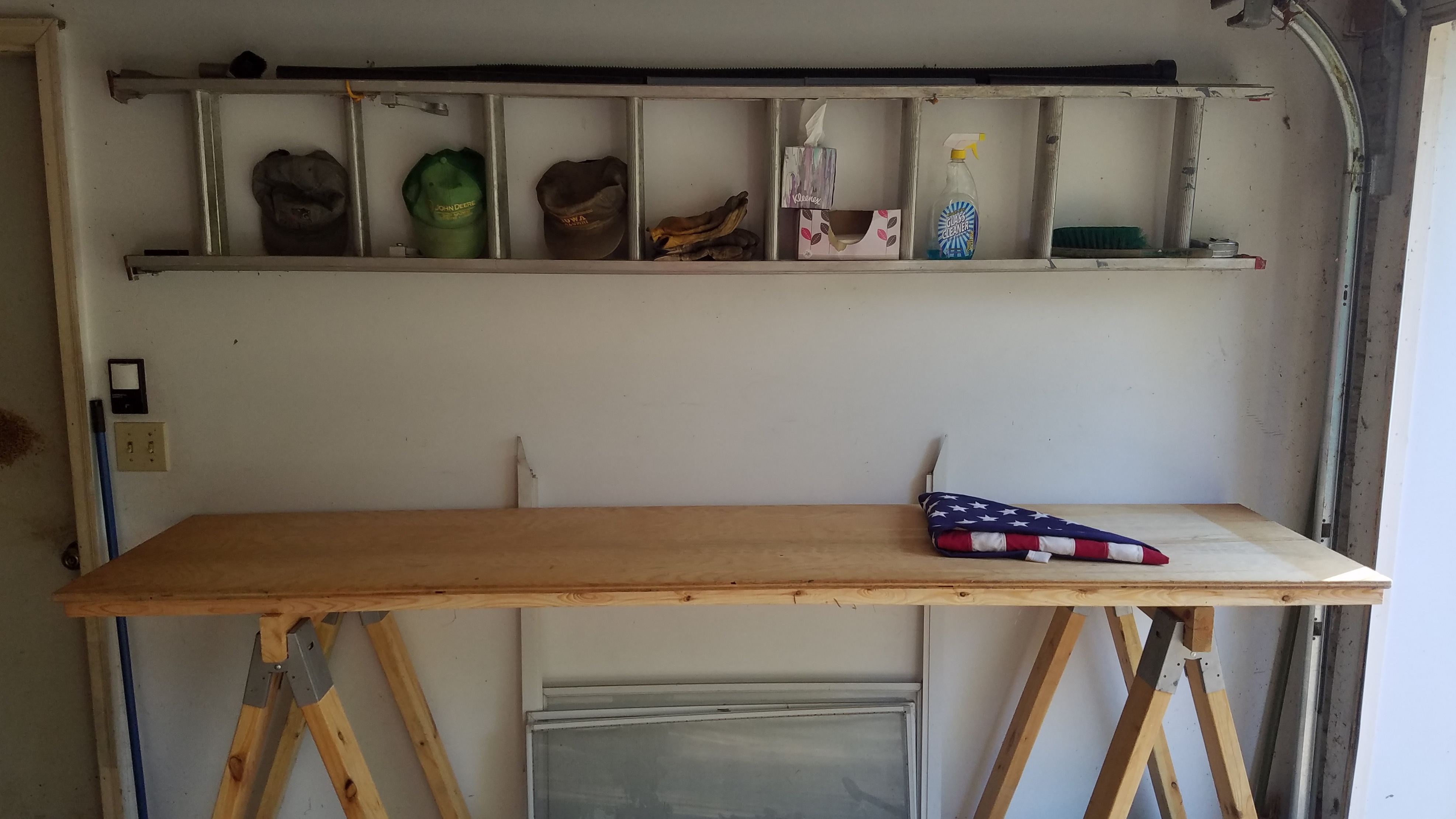
When I began having larger garlic harvests I cut two by fours to make temporary sawhorses for a drying rack. “Temporary” because I didn’t nail them together so they could be disassembled and easily stored once the garlic cured. In my large panel storage rack I had the remnant of the four foot by eight foot by three quarter inch plywood left from making the platform for our daughter’s loft bed in college. I spread four two by fours across the span of sawhorses and put the plywood on top, finished side up. It made a sturdy table.
I used this surface to clean up the stairway where many cups, COVID-19 test kits, picture frames, and other detritus of living were camped. I also cleared the other sawhorse table near my writing table of its contents. Now I have two transitional surfaces to go through stuff. Three if I can clear the folding table I brought with me from Germany.
In a home, space tends to get used. While approaching septuagenarian status the goal is to clear that space and dispose of old printers and computers, countless electrical cords, and everything not needed for living out the rest of my days. I don’t need one hundred coffee cups. To live a life less on a life expectancy of 15.4 more years (figured using the Social Security online calculator) and more on being here now. That means stop talking about getting rid of stuff and actually do it. No more delays!
Once space was cleared, my daily task list quickly filled with activities related to the disposition of things. I’m a bit excited about the prospect of owning less. We also have plans for new space created. That is, plans other than filling it with more stuff.
It was another day of rain on Wednesday. We need rain yet I’m getting a bit tired of being cooped up.
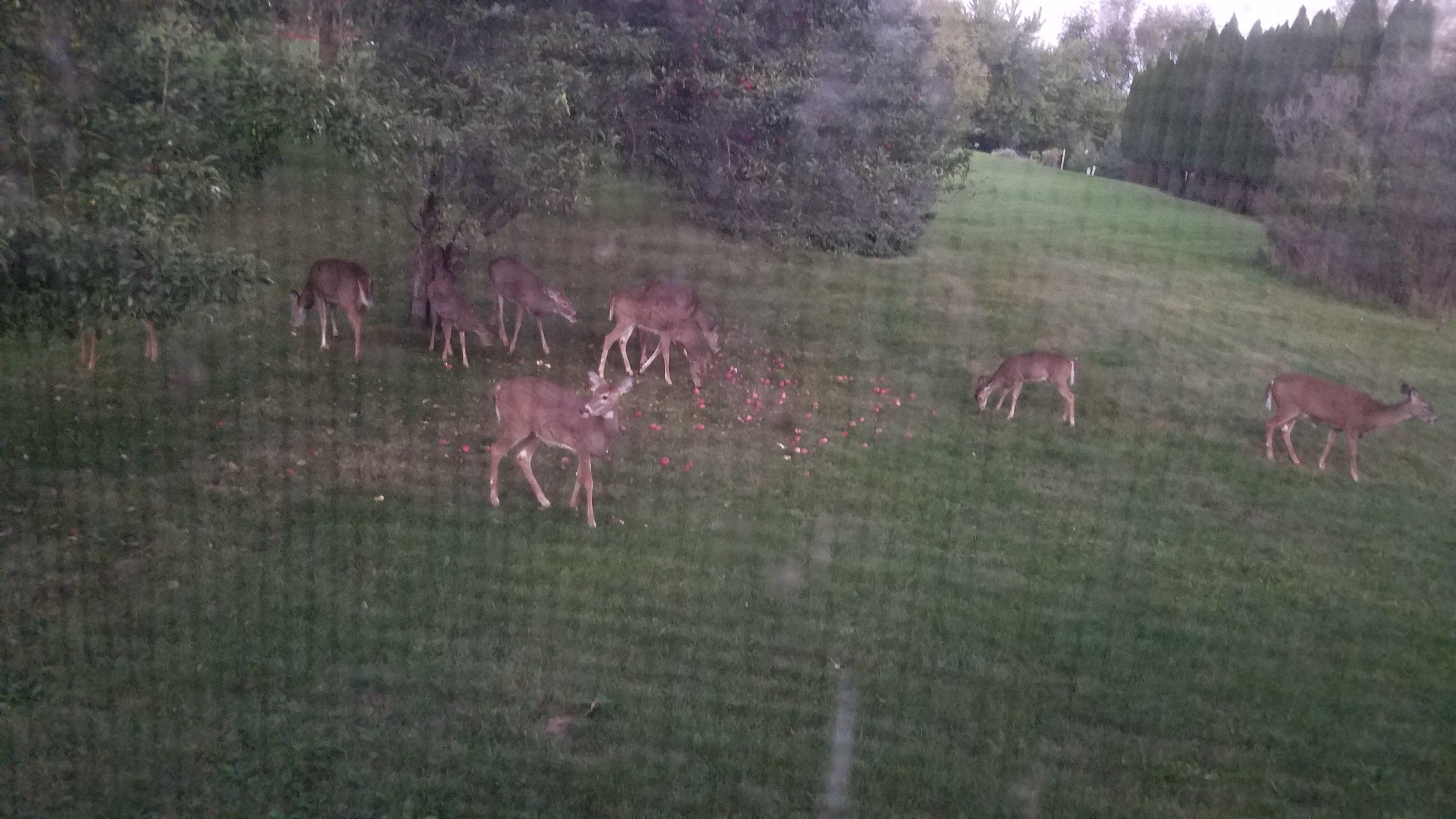
We ate the last of the acorn squash I grew for dinner. We are down to the yellow and red storage onions, 27 garlic heads, and about ten pounds of potatoes. There is garden gleaning to do and the first frost has not been forecast. We have a glut of apples and deer are not making enough progress eating fallen ones under the tree, even if they all know the smorgasbord is open.
I bought two boxes of packets of USDA organic gummy bears for any trick or treaters this year. I haven’t decided whether or not to turn on the front door light because of the recent outbreak of COVID-19 in the schools. I want to be ready because of supply chain issues much publicized in the media. Only regret is the gummies have gelatin, so are not a vegetarian option for the kiddos, as parents today call their children.
I wonder how my mental capacity is changing with age. I wonder if I will be able to tell it changed… probably not. I’m not ready to kick back and work on my reading pile for the rest of my days. God help me if I connect a new television to the cable. There are more gardens to grow and a house to fix up, all with the limited resources of a pensioner. I’m ready to retire, but not sure what that means in 2021.
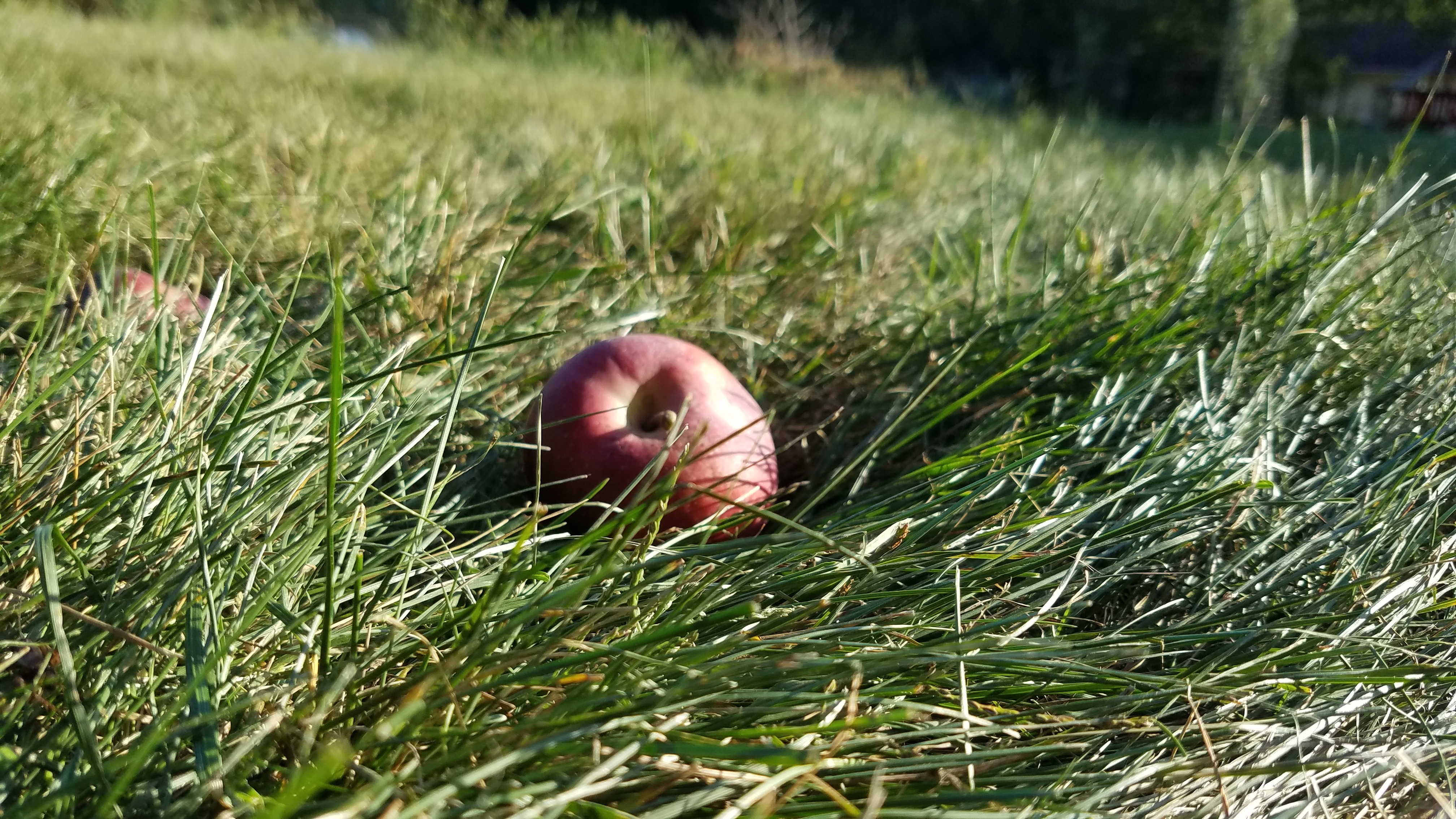
Fallen apples, some partly eaten by deer and other wildlife.
It rained the last two days and Tuesday’s forecast is clear in the high sixties. After my appointment in Cedar Rapids, the plan is to work outdoors. There is the garden to glean, apples to pick, dead branches to trim, and a brush pile to build. As I age, progress on my list of tasks proceeds steadily yet more slowly.
I don’t like where the coronavirus pandemic is going. It’s not ending. In fact, there was an outbreak this month in the K-12 schools. It doesn’t appear Iowa will hit anything close to 70 percent of the population vaccinated. The delay in a vaccine for young people is part of the problem. Rejection of the science of vaccines is the rest. Iowa used to lead the nation in the quality of our education, but no longer. Living in society is being dumbed down.
Rain is typical of mid-October and this year it is welcome. I’ll wait a week or two to mow for the last time. I’ll set the deck low to produce a lot of grass clippings for the garden. After that, I’ll schedule the mower in the shop for what is becoming every other year maintenance. I don’t use my tractor for much besides mowing.
We scheduled the HVAC technician to come out and go over our furnace. It is the same shop that installed the system new, although staff changed since 1993. Once that is done, we are as ready for winter as we’ll be.
A pall hangs over everything. Partly it is the isolation caused by participating in so many things via Zoom, Google Meet, Twitch and social media. Partly people are focused on their families. Our politics is unreasonable, and there seems to be less common cause in everything. Dog eat dog, every every person for themselves is the way things are going. The insularity will not be good for society, yet I have no good alternatives.
I’m thinking about the burn pile I need to build. It’s purpose is to clean up the yard of brush from trees and bushes I planted when we arrived in Big Grove. I could have saved the trouble and not planted them. Yet what kind of place would this be without them. It would be the less and we can’t settle for that.
Based on squirrel activity the last two weeks, our backyard will be a Bur Oak forest in ten years. I hope we live to see it.
I brought a generous pound of potatoes and two pints of canned vegetable broth from downstairs. There was an almost forgotten patch of leeks in the garden so I made leek and potato soup for dinner. With some sliced apples from our tree, spread with peanut butter, it made a meal.
It has taken some work to get the soup right. While sauteing the leeks and diced onion, seasoned with salt, in some of the vegetable broth I peeled and cut the potatoes into a half-inch dice. I added them to the leek-onion mixture with enough broth to just cover them. The Dutch oven simmered on low heat until the potatoes were soft.
Next I added a tablespoon of arrowroot powder mixed with water, then a cup of oat milk, and then two cups of frozen corn. It simmered a half hour. I added sliced chives from the garden and it was ready to serve. We don’t blend the soup to get a smooth texture, although one could. The key is reducing additions of cooking liquid so the soup thickens. Arrowroot helped.
I finished reading Poet Warrior: A Memoir by Joy Harjo this morning. Harjo is poet laureate of the United States. It was moving in a way other memoirs have not been. It had me thinking about my own life and how it differed and was similar to hers. Now that I’ve tended to my mother’s death bed, reading her story about her mother’s death resonated. I had not previously known of her connection to the University of Iowa Writers Workshop. Maybe what she learned there makes it easy to relate to the narrative. Highly recommend.
Our vehicle is in the shop getting a wheel bearing changed. The mechanics work was made difficult by rust formed on the chassis and undercarriage during our 20 years of ownership. They can do this work, but parts are becoming less available. “It’s not a long-term keeper,” my mechanic said of the vehicle. This is the second or third conversation we’ve had about the rust. Now I’m asking the question, “what kind of vehicle does a septuagenarian need to make it until he can no longer drive?” No answers yet, but thoughts.
The future of transportation is electrification, especially for passenger vehicles and light trucks. If I planned to keep a vehicle for a few years, then trade it, I would have no issue going electric now. We didn’t win the lottery last night and can afford to buy just one car to last. Electrification of automobiles is in transition presently, so as technology develops, who knows if what goes on the market today will be eclipsed by newer technology tomorrow? Well we do know. It will be eclipsed because there will be issues. I’ve worked with Original Equipment Manufacturers enough to know this.
I’m leaning toward a new Toyota Prius which operates with excellent fuel economy and has been on the market long enough to have bugs worked out of it. It is the right size for the two of us and I’ve ridden in them with friends on many occasions. We have a dealer in the county seat that posted a starting price of $28,814. Pricing is negotiable and dependent on specifications. I’d rather just keep the car we have but if repair parts are unavailable and the undercarriage rusts through, our hand is forced.
Once the wheel bearing is replaced we should be good to go for a while. A while may be all we have.
Among things that have become harder to manage in the digital age are images. It is easy to take photographs with my Samsung mobile device today. Because it’s so easy, and has been for a while, the quantity of images on file is huge.
Every photograph is not important. Most are geared toward editing and posting on line in one of my social platforms, including WordPress. It is unclear what I should keep longer term. The cheap availability of storage suggests there is no need to sort through and delete some of them. While that may be the default process, I want change as I transfer files to my new CPU.
In August I captured 186 images, which is a typical monthly amount. Most of them are photos of garden produce, cooking, books, artwork, and things that happened or places I went. The best solution to reducing the quantity of files is to delete originals after cropping them for posting. Another is decide on the story a series is to tell. For example, I have 12 images related to donating my 1997 Subaru to Iowa Public Radio. They could be reduced to four. The best time to do this is immediately after I download them from my mobile device.
As I transfer thousands of images I plan to go through them all. To get this done I put an item on my daily outline, “work on file transfer.” I don’t know how long it will take yet I’ll work until it is done, a bit each day.
I don’t know the provenance of many of my photos, especially those with political subjects. In 2006-2008 I was getting used to a digital camera as my main image capturing technology. I felt little restraint about downloading photos by others when my own at a specific event were sub-par. I work harder to give credit today, but some of the older digital images are fond, and I have little idea who made them. I try to avoid using them outside my computer.
A main use of the files is in story telling. Before I deleted my Flickr account it was a great platform for story telling. The problem is how to translate those types of online stories into something more meaningful inside our home. When Yahoo had the problem with personal information security, I killed all the related accounts and downloaded the text from the stories on Flickr. It’s not the same.
Photos are a significant part of my autobiographical research. While ten years later I don’t care what I had for dinner on a given Sunday, those photos play a role in daily life, one that should be explored and developed for the story. A few will go into the final book yet the rest are best stored by editing, printing them out, and placing in an album. That’s as big a project as working through the transfer. The file transfer project will, in part, be designed to set up an album-making project for later.
There is no denying quality varied a lot over the more than 50 years I’ve been taking photographs. Sometimes a blurry image is all one has and it must be used for the album or story to make a point. I hope the formats .bmp, .jpg, .jpeg, .tiff, .png, and .tif persist yet there are no guarantees. The main issue going forward is there are a limited number of commercial outlets to print photos. We are tied to whatever those technologies are. It is too expensive to make our own prints on a home printer, except for on special occasions.
As I approach my seventieth birthday I think more about not leaving a large task of image sorting behind when I die. I may want to keep a couple of photos of tomatoes I grew, yet I don’t need a thousand. Likewise, if I can’t remember the name of a person in a photo, there is little reason to keep it. The recycling bin is already getting full.
I’ll be better off by giving this project some measure of thoughtful approach. Now that I’ve started, I hope to persevere until the work is done. The best part will be in actually completing the transfer so I can devote this time to something new. Wish me luck!
Labor Day weekend work: preserving Guajillo chilies.
For the second year in a row I’m not employed on Labor Day. The kinds of events marking the day are not the same as they were.
An announcement on the Iowa Labor News website read, “Most of the Union sponsored Labor Day events around Iowa have been cancelled, for safety reasons.”
“Safety reasons” refers to the coronavirus pandemic, which is not over, which has no end in sight. “The virus is here to stay,” Governor Kim Reynolds said at a Sept. 2 news conference. “Which means we have to find a way to live with it in a responsible, balanced and sustainable way.” There is no going back to the way things were before the coronavirus came along on Labor Day or on any day.
It’s been 48 years since I carried a union card at a meat packing plant. Since then, private business restructured to minimize its exposure to a unionized workforce. I’m not sure what Labor Day represents any longer. It sure isn’t about unions even if they are the groups most likely to plan events during better times.
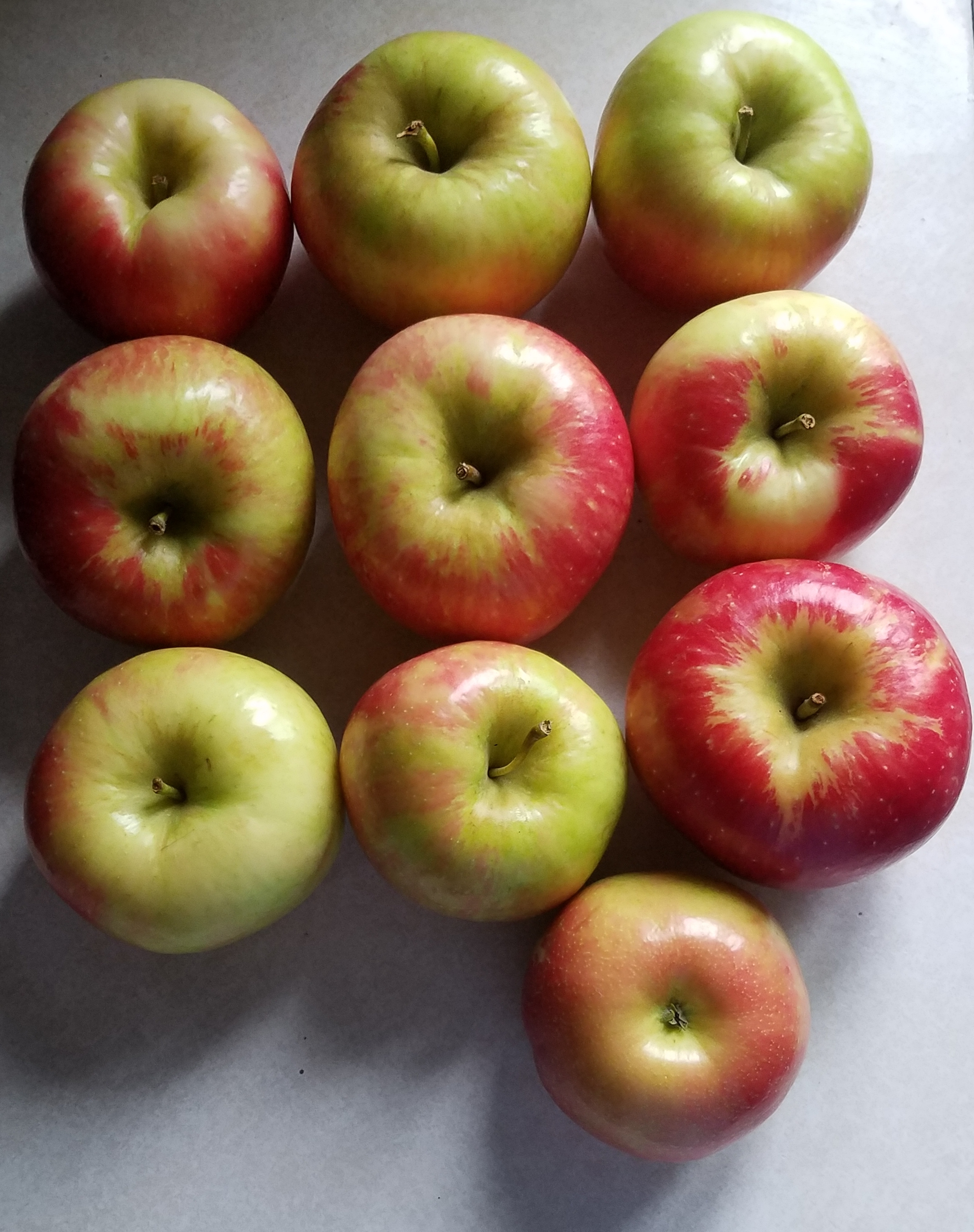
Locally grown Honeycrisp apples.
This weekend the orchard began its Honeycrisp apple season, the university had a Saturday home football game, and there is a Labor Day Vendors Market in nearby Mount Vernon. It’s not much considering how many people work for a living. This year’s Labor Day Mayor’s Bike Ride in Cedar Rapids has been cancelled due to the pandemic. Suffice it Monday is a holiday and the weekend can be a time to take it easy.
Labor Day weekend is the “unofficial end of summer.” That’s going to have to do. Since I returned from a trip to Florida at the beginning of July the weather has been exceedingly hot and humid. Sunday morning’s ambient temperature was 59 degrees, reminding us of autumn’s approach. Sumac along the state park trail has begun to change color. There are signs of the end of summer all around.
In February I bought a new CPU to replace the one I’ve been using since 2013. This Labor Day weekend I hope to get it up and running, with files transferred. I face the same issue as in the past: what files do I want to keep? Ready or not, change has come and it’s time to decide. Like with the Labor Day holiday I must act like there is no going back. What is hard is deciding whether that means keeping old behavior or developing new. For now, I plan to work at home on Labor Day.
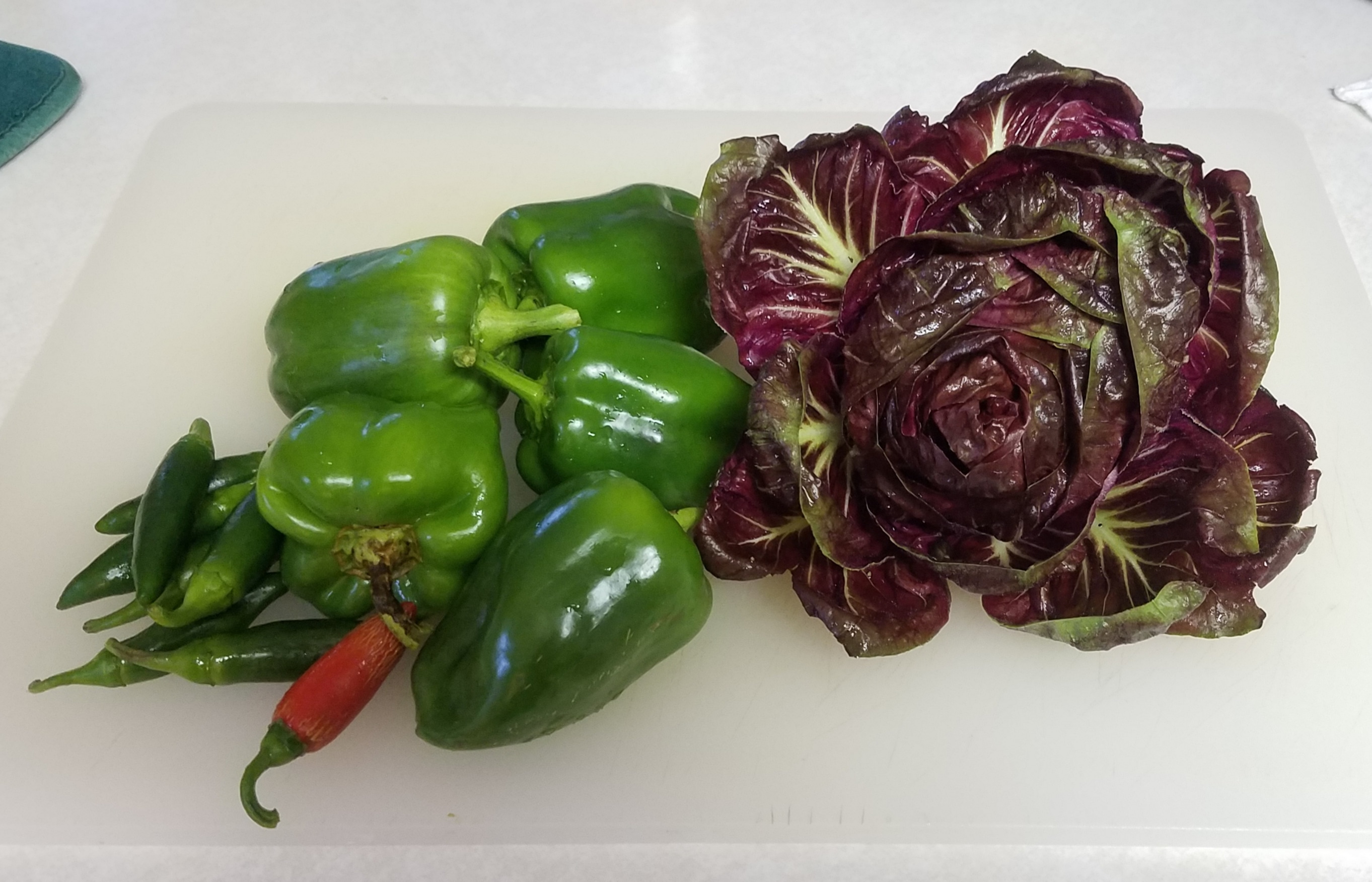
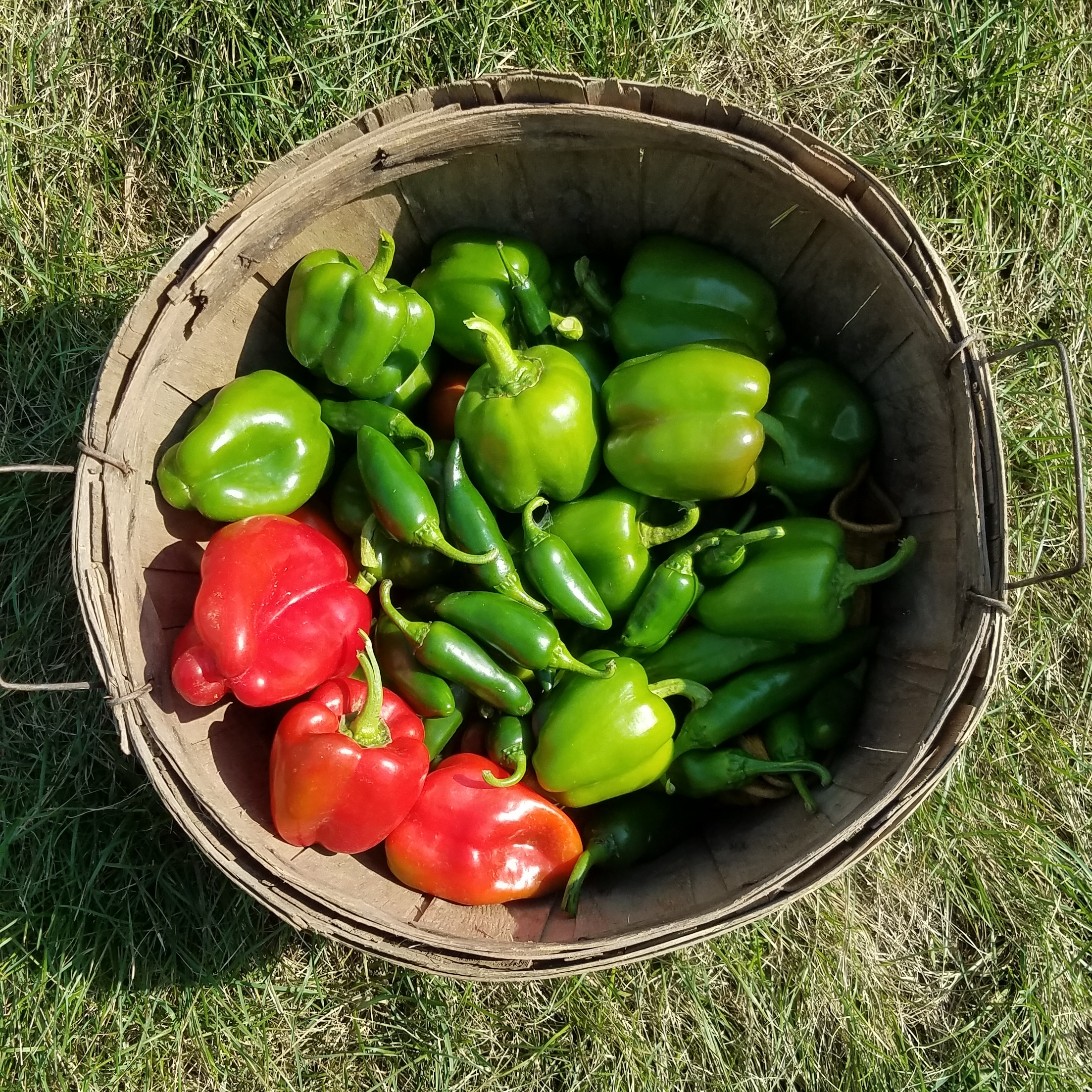
As we turn toward autumn tomatoes are finishing and peppers are coming on strong. I put up a lot of tomato product and am well-prepared to make it until next August. There is always a question of what to do with peppers. This year there are some new ideas.
Pickled jalapenos and hot sauce are traditional. I’ll also grind up what remains of hot peppers and mix it with salt and apple cider vinegar to use in lieu of fresh peppers in cooking. This worked last year so a repeat is in order.
Hot sauce and pickled jalapeno peppers.
I am backlogged with dehydrated hot peppers so no more this year. The main use is to grind for red pepper flakes. I have plenty on hand. I will re-hydrate the old ones next spring and use them to deter pests in the garden.
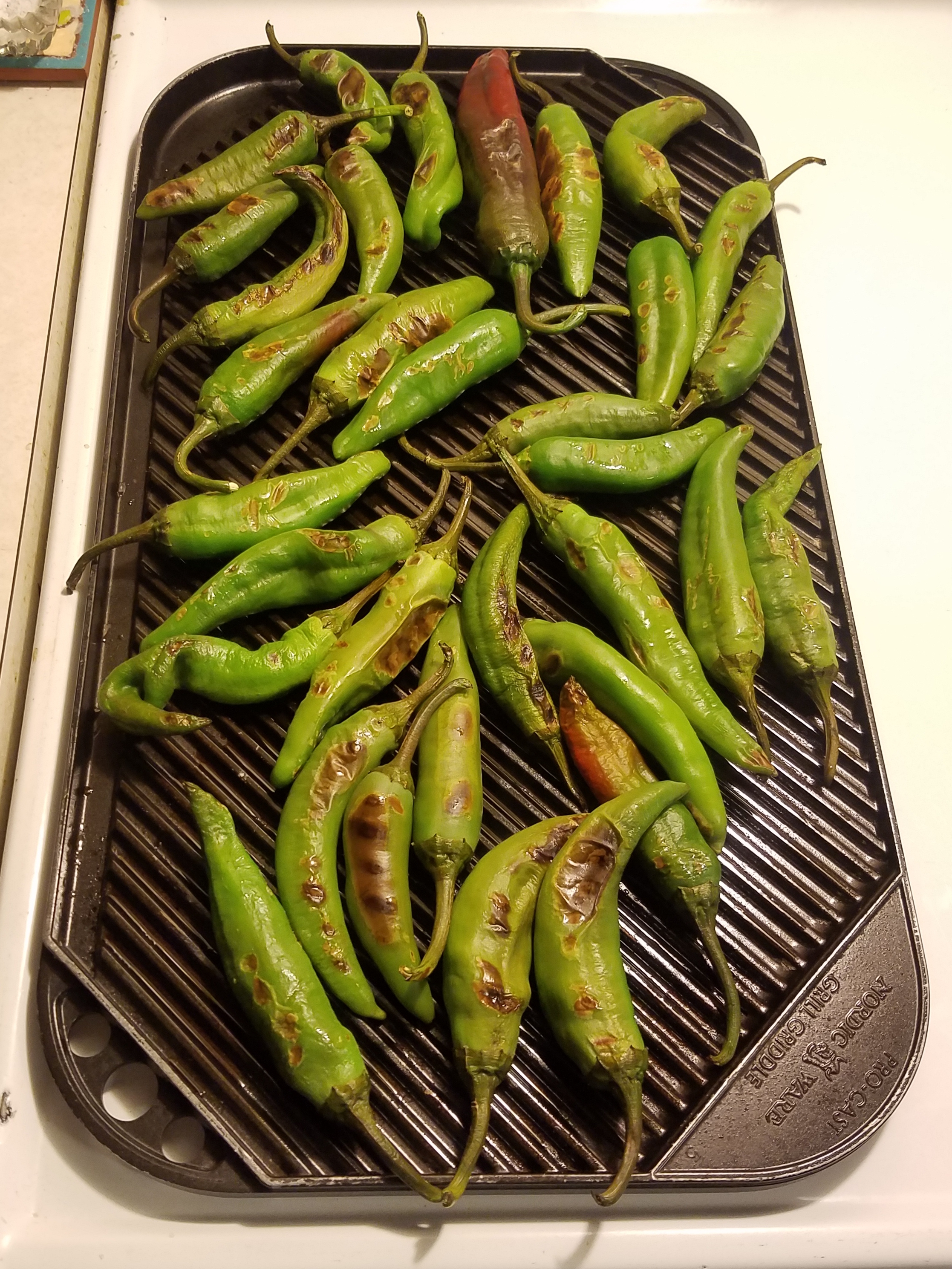
I grew Guajillo chili plants. The yield wasn’t what I hoped but will roast what there is, skin and coarsely chop them, and mix with apple cider vinegar, salt and garlic to use in Mexican-style cooking. I buy a commercially prepared version of this, so the idea has been in the works for a while.
Bell peppers will be cleaned, sliced in half and frozen in zip top bags. I don’t need many of these as there are some remaining from last year. The main use for bell peppers is for an afternoon snack. At two per day I could make it well into September with fresh ones for out of hand eating and cooking.
Arrival of pepper time also means the end of the garden is near. It’s hard to believe we’re already at that point in the growing cycle.
On Tuesday, Aug. 24, 2021 I temporarily deactivated my Twitter and Instagram accounts. Instagram reported I was averaging an hour a day on the site. Twitter was likely two or three times that amount. There are plenty of other things on which to use this time.
As I approach my seventieth birthday I’ve been taking stock and focusing energy on things that matter. While I enjoy social media, a person has to set priorities. The energy formerly used on those platforms can now be devoted to writing and other forms of creative endeavor.
At some point, temporary deactivation will become permanent.
The change was almost immediate. I slept through the night. My blood pressure dropped overnight to within range. I felt like reading a book again. I feel like doing things instead of occupying time with computer screens. Change was unexpected, yet welcome.
I received a phone call from the Iowa Department of Natural Resources yesterday, informing me a recent special test they performed on our public water system indicated a high level of manganese, well above acceptable limits. I spent part of yesterday and will spend much of today determining what we should do to return the amount of manganese in our drinking water to safe levels. For the time being we issued a health advisory, which, this morning we will hand deliver to the 80 or so households that use our system. I went to town and bought ten gallons of bottled drinking water to use in the kitchen while we work through the process. It’s not how I was planning to spend my time.
In the county seat there is a controversy about an MRAP (Mine Resistant Ambush Protected) light tactical vehicle procured by the county sheriff from military surplus. Some call it militarization of the police and object to it being in the table of organization and equipment of the sheriff’s office. The sheriff, who inherited the MRAP from his predecessor, said he’s keeping it and it’s non-negotiable. Like many public debates, this one is off the rails. Critics have evaded the basic question of whether or not the sheriff has authority to operate such a vehicle in the county. There should likely be better guidelines on how to use the MRAP, but neither do we want to tie the hands of the sheriff who needs to be fluid when responding to a crime. The whole debate is a distraction from improving interaction between the sheriff’s office and citizens of the county.
Not sure what I’ll do with the new found time. Maybe I’ll take a nap and rest for what’s next.
We are bunkering in for another lock down. In Iowa, the governor doesn’t believe in mandatory lock downs and schools are opening without mandates to wear a face mask or to get vaccinated. It is a setup for disaster. I bought an extra 30-pack of toilet tissue at the wholesale club and am ready.
While I would not recognize their music, last night the band Nine Inch Nails summed up where American society is two months into Summer 2021:
We will come out of the coronavirus pandemic eventually, either walking upright or six feet under. Am hoping it’s the former.
My current project is structuring a week that makes sense to a retiree. The seven-day pattern is a bit arbitrary, yet it is what I’m used to, what cultural resonance that remains encourages. Friday is my day.
On Fridays I eschew shopping and leaving the property to focus on household activities. For example, on deck today is picking up fallen apples under the EarliBlaze trees, harvesting tomatoes, canning Roma tomatoes, making apple cider vinegar, wrapping up a book review for Blog for Iowa, and my usual morning routine with an added hour of reading. The end of the day usually begins with supper of a home made pizza and sometimes a beer.
If there are things to wrap up with my engagements with groups, I pay attention to them on Friday. If it can wait until Monday, it does. Friday represents a turning toward renewal over the following two days of the weekend.
I’m okay with where Fridays are landing. We have to maintain our sanity, and making Friday my day is a step in that direction.
Best wishes to my regular readers for a happy Friday!
EarliBlaze apples are ready to pick. They are sweet and crunchy. I have two five-gallon buckets of them to make apple cider vinegar, although I’ve been eating down one of them and might need more.
Taking stock of the pantry, we don’t need any applesauce, apple butter, dried apples or any apple products really. Fresh eating, baking and cider vinegar will be the main uses of this August apple. A lot of them fall before they are ready to pick. Deer come each evening to help us clean them up.
When Red Delicious ripen during late September or early October, I’ll revisit the plan. I have at least one person who would like this year’s apple butter, so I may make more. Despite losing a major branch during the Aug. 10, 2020 derecho, and more during a strong wind storm this year, it will be a big crop.
I would have planted the orchard differently in the 1990s had I known what I know now about apple culture. I planted trees too closely together. The six original trees were two EarliBlaze, two Red Delicious, and one each of Lodi and Golden Delicious. Wind and disease took a toll and only one Red Delicious and two EarliBlaze remain.
The varieties I chose are not the ones I would pick today. Having worked at an apple orchard since 2013, I learned a lot about which trees do well in Iowa’s climate and how to plan continuous apple picking from late July to the first hard frost in late October. In addition, I would match the varieties to what I want to accomplish in the kitchen. Late apples are more attractive to us now and everything they mean: storage for winter, apple cider making, and of course, fresh eating. There are no do-overs for our home orchard. The main questions today are what else will be planted in our yard for fruit, and what will we do when the three trees I planted finally live their last days.
I decided to decline returning to work at the orchard this year. The reason is pretty clear. The coronavirus pandemic played a key role.
I changed my mind about working this fall and won’t be reporting for work on the 28th.
The main reason is the surge in the coronavirus pandemic in Johnson County. Hospitalizations increased close to bed capacity, there is an influx of 30,000 people to attend university (about whom we know little of their vaccination status), the University of Iowa cannot require vaccination for COVID-19, and the CDC rates our level of community transmission of the virus as substantial.
Since I wrote this, the level of community transmission has gotten worse.
In late summer, the whole garden seems to come in at once with apples being a key crop. There is pressure to deal with all of it. Not enough pressure to prevent us from enjoying the taste of summer.
You must be logged in to post a comment.