Categories
Environment

Earth Day – 2019

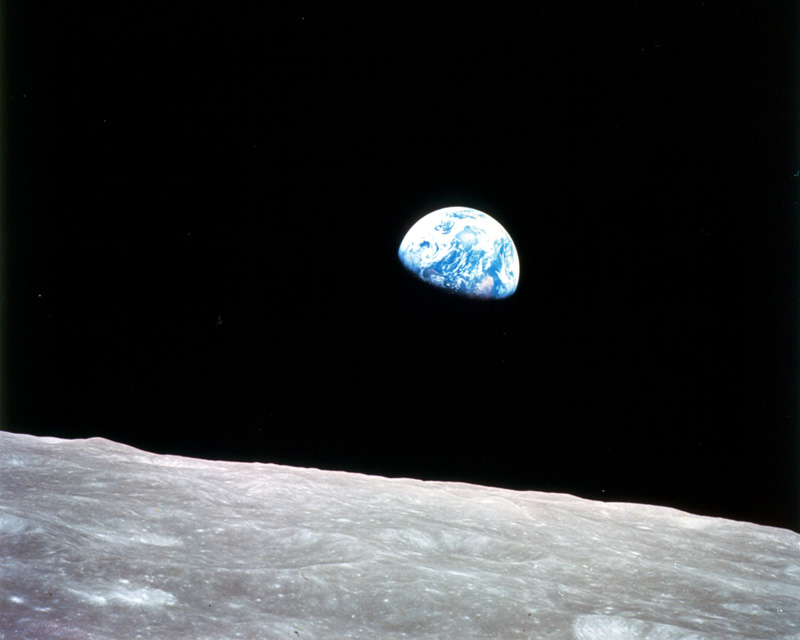
Earthrise by Bill Anders, Dec. 24, 1968

A thin haze dimmed reflected light from the moon. Thin enough to allow dots of starlight to penetrate the atmosphere and with moonlight illuminate the neighborhood.

The haze was just enough to know it was there.

I moved trays of kale, broccoli and parsley seedlings from the garage to a pallet near the driveway in the hazed light of a waxing gibbous moon.

Today is the 50th Earth Day.

Earth Day is less about a view of night’s starry presence than it is about seeing Earth as a whole. Few times in our history has a photo of Earth made such a difference in so many lives as Earthrise taken by astronaut Bill Anders. It sparked the movement that brought us Earth Day which continues to this day.

We humans have not been the best stewards of Earth since April 22, 1970.

Early Years

Vague notions of ascendancy were taught by our grade school teachers. In the seventh grade I was segregated from neighborhood friends to join a college-bound group of peers in a special classroom. I entered the National Honor Society in high school and when I graduated in 1970 had no clue what I wanted to be. I knew I was college bound, not because I wanted that, but because the nuns said I should be. That I finished college at all was miraculous. I felt a sense of relief as President Nixon appeared to heed a shared need to do something about the environment. When he created the Clean Air Act (1970), and then the Clean Water Act (1972) I felt Earth Day had done its job.

Military Service

When I left Iowa in 1976 for basic training at Fort Jackson, S.C. I had little idea of what being a military officer meant. I knew the Vietnam War was over and I wanted to serve as my father had. The context was a paternal grandfather went to prison for draft evasion during World War II. Given a choice, I would serve. Among other things, military service taught me the environmental cost of war.

The environment has long been a silent casualty of war and armed conflict. From the contamination of land and the destruction of forests to the plunder of natural resources and the collapse of management systems, the environmental consequences of war are often widespread and devastating. ~ Ban Ki-moon, UN secretary general

Oil consumption and related carbon emissions are significant contributing factors to degradation of our atmosphere. The use of depleted uranium in military ordnance, notably during the 1991 Gulf War, created a complex array of environmental problems including introduction of carcinogens into the environment. We destroyed Iraqi infrastructure, including water and sewer systems, and contaminated surrounding ecosystems. The use of defoliant Agent Orange in Vietnam created sickness among soldiers and decimated biodiversity in the country’s tropical rain forests. We should include potential use of nuclear weapons which studies have shown, in a limited nuclear war, could create a nuclear winter making 2 billion people food insecure.

Awareness of the military’s environmental problems is a lesson learned.

Worklife

I worked 25 years in the transportation business, including an 18-month stint with Amoco Oil Company in Chicago. What goes almost unnoticed as part of background noise in modern society is the amount of fossil fuels burned by trucking, railroad and ocean-going transport vehicles. When I was maintenance director for a large trucking firm, I spent $25 million per year purchasing diesel fuel for our vehicles. That doesn’t count fuel burned by our affiliate companies which used independent contractors who fueled their own semi-tractor trailers. The fundamental dynamic during this period was I needed a job to support our family and given what I perceived as a lack of opportunity after college and military service I took what I could find, staying there for most of my professional career. I traded the environment for financial security. My main concerns were job performance and getting ahead. The nuns in grade school didn’t adequately prepare me for this kind of worklife. Environmental issues were off the table.

Retirement

When I left transportation ten years ago the climate crisis became more real.

In 2013 I participated in The Climate Reality Project conference in Chicago, taught by former Vice President Al Gore. It made a difference to learn the science of climate change and in the following months I began presenting the information learned in public speaking, in letters and articles in the newspaper and in my daily life.

We entered a period of politicization of everything. Facts ceased to matter. Income inequality worsened and the U.S. government seemed owned by the richest people. The scientific facts about climate change became a political choice: do you or don’t you believe the science of climate change?

Climate change is real and is impacting our lives now. Even banks are seeing how it can impact their business. From an open letter from the Governor of Bank of England Mark Carney, Governor of Banque de France François Villeroy de Galhau and Chair of the Network for Greening the Financial Services Frank Elderson:

The catastrophic effects of climate change are already visible around the world. From blistering heatwaves in North America to typhoons in south-east Asia and droughts in Africa and Australia, no country or community is immune. These events damage infrastructure and private property, negatively affect health, decrease productivity and destroy wealth. And they are extremely costly: insured losses have risen five-fold in the past three decades. The enormous human and financial costs of climate change are having a devastating effect on our collective well being.

The authors call for an orderly transition to a low-carbon economy. “The stakes are undoubtedly high,” the authors wrote. “But the commitment of all actors in the financial system to act on these recommendations will help avoid a climate-driven ‘Minsky moment’ – the term we use to refer to a sudden collapse in asset prices.” In other words, the climate change bubble could burst.

The Future

Less than 24 hours remain in this 50th Earth Day, a brief moment in Earth history. Whatever humans do, the earth will be fine. It’s human life and society that’s at risk. My takeaway from 50 years of considering Anders’ image of Earth against a background of the immensity of space is the same as when I first saw it: we humans are all in this together. It is going to take more than Earth Day to bring political will to act on climate.

Categories
Environment Writing

Burning Brush in the Carbon Cycle

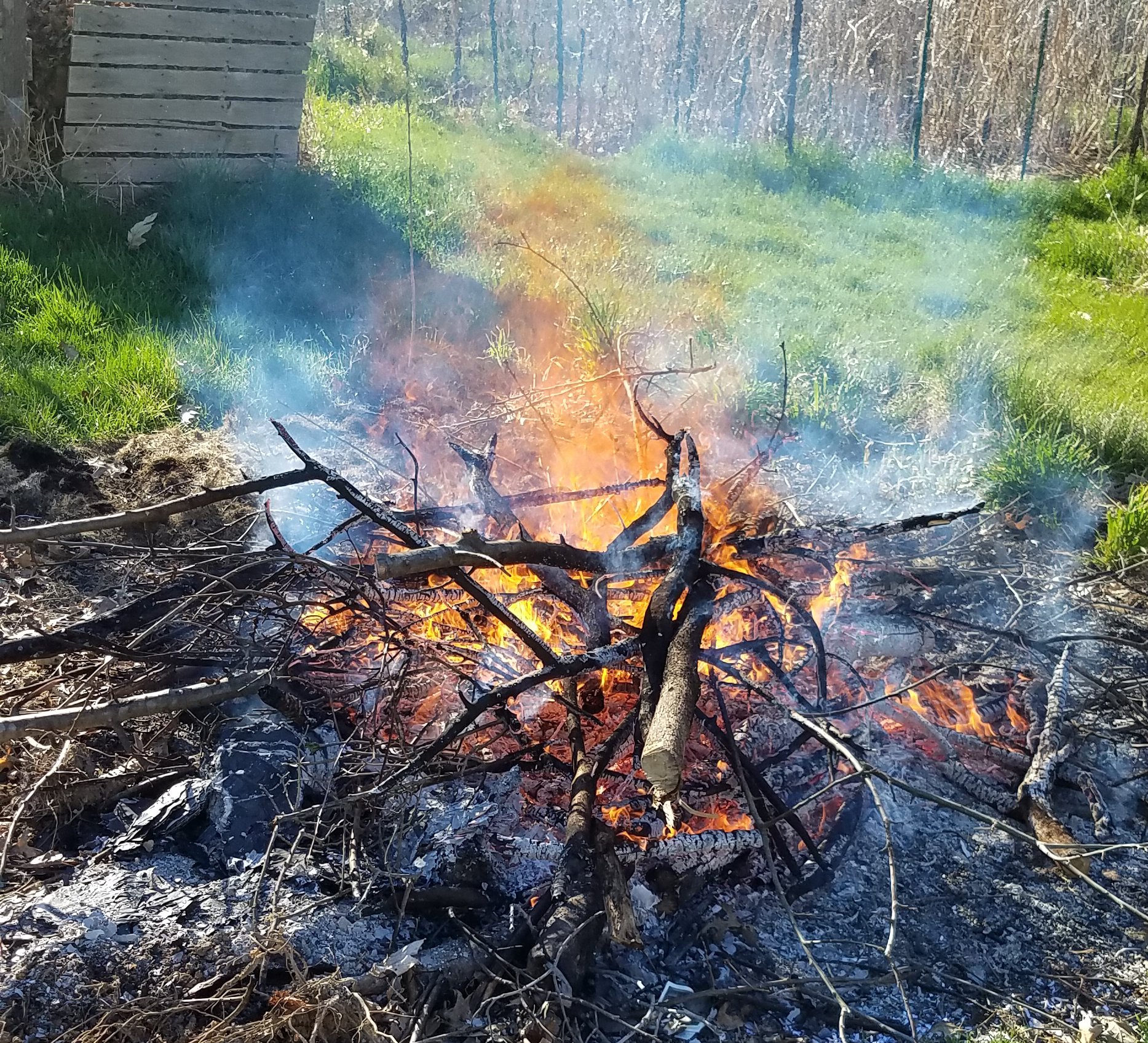
Brush Fire April 19, 2019

Is burning brush good for the environment?

As a gardener I burn brush on a garden plot a couple times a year, rotating the burns on each of seven plots over time. The idea is the mass of the brush is reduced, carbon dioxide is released, and minerals return to the soil. It’s a common practice.

The alternative is purchasing a wood chipper to turn brush into garden mulch — expensive for the amount of brush accumulated in a single gardening season. For the time being, I plan to continue to burn brush because of the carbon cycle.

In 2015 I discussed carbon release from burning wood and other biomass in fires like mine, for home heating, and in the University of Iowa power plant where they burned a mix of fossil fuels and biomass.

What scientists told me was it was better to burn biomass than fossil fuels, partly because the amount of carbon dioxide released into the atmosphere was less than burning coal in experiments they performed.

Ben Anderson, who operated the University of Iowa power plant said, “It’s still combustion but the carbon cycle is what is important there.”

Biomass takes carbon from the atmosphere and stores it until it is released back into the environment in a cycle as old as time. Mining and burning fossil fuels also releases stored carbon which has been stored for millennia. Given our present ecosystem, it is better to leave fossilized carbon where it is, according to the analysis, because releasing it contributes to global warming.

I wrote about this for the local newspaper. The article below was published on Oct. 7, 2015 in the Iowa City Press Citizen with my by line. Many thanks to my editor Josh O’Leary for improving my initial submission.

UI study finds benefits in burning oat hulls for thermal energy

Biofuel use is a well-known contributor to meeting sustainability goals at the University of Iowa. Since 2003, UI has used oat hulls sourced from Quaker Oats in Cedar Rapids to generate electricity, heating and cooling on campus.

Several chemistry department faculty and students recently completed a study of gas and particle emissions from co-firing coal and two types of biomass versus straight coal at UI’s main power plant.

Researchers also found that using oat hulls with coal reduced carbon-dioxide emissions by 40 percent and significantly reduced the release of particulate matter, hazardous substances and heavy metals.

“The UI is working toward meeting a goal of using 40 percent renewable energy by 2020,” said Betsy Stone, an assistant professor in UI’s chemistry department. “Part of their plan to achieving that goal is the use of biofuel, which is a renewable source of energy, instead of fossil fuel, in this case coal.”

The group was interested in understanding how using biomass instead of coal changed emissions released into the atmosphere, Stone said.

“When burning 50 percent oat hulls and 50 percent coal, we saw a big reduction in criteria pollutants compared to burning 100 percent coal,” she said. “When I say ‘criteria pollutants,’ I’m talking about things like fossil carbon dioxide, sulfur dioxide and particulate matter.”

Use of the 50/50 mixture reduced the mass of particulate matter by 90 percent, Stone said.

While overall CO2 emissions were constant among the three fuels used in the study — straight coal, 50/50 oat hulls/coal, and 3.8 percent wood chips/96.2 percent coal — the use of plant material makes the process more sustainable, Stone said. Biomass takes CO2 out of the atmosphere and incorporates it into the plant. When it’s burned, CO2 is released.

“It’s considered to be a renewable fuel because we have that carbon cycle going on,” Stone said. “With fossil fuels, we’re releasing fossilized carbon. It goes into the atmosphere and takes millions of years to get back to fossilized form again.”

The major take-home message is there is a significant reduction in fossilized CO2, sulfur dioxide and particulate matter, which is beneficial to people living near the power plant, Stone said.

“I thought the study was definitely encouraging and in line with our thoughts that biomass is good for the environment,” said Ben Anderson, UI power plant manager. “Overall, the results are encouraging and provided assurance we are going the right way with the biomass project.”

The biomass project brings the renewable component to the plant, but is also a component of fuel diversity, he said.

“That’s really important for reliable operations,” Anderson said. “Natural gas markets have been known to spike from a cost perspective. If there is a problem with pipeline transport, we can use the biomass and still keep this plant online.”

Maureen McCue, coordinator for Iowa Physicians for Social Responsibility, noted important considerations of this study, including locally sourced fuel options and the avoided cost of buying and shipping coal. McCue called UI’s biofuel efforts “a good use of a resource that might otherwise go to waste.”

“The mixture avoids some of the known adverse health effects associated with burning more coal,” McCue said in an email. “There is no health benefit to anyone unless you assume burning coal is obligatory/unavoidable and thus count as benefited the person(s) who would have been impacted by more coal.

“It’s like saying not hitting your head with a hammer is a health benefit,” she added. “No one wants to risk their health breathing coal emissions or headaches by hammer if there are alternatives.”

Categories
Environment

50th Earth Day Coming Up

1970 Earth Day Button

I looked in the recycling bin and there were only eight items in it. Thursday is our day to leave the bin at the end of our driveway and I’m going to wait until next week.

It’s not that we’re throwing more in the trash instead of recycling. The trash bin is completely empty, making the second week in a row it remains in the garage as the trash collector comes through the neighborhood.

We’ve learned to reduce the amount of stuff we use, recycle what is accepted, and reuse what can be. In part we do that because of my participation in the first Earth Day on April 22, 1970.

Do the math. The 50th Earth Day is Monday and the news is that few are aware or interested, based on my personal interactions with people and reading news coverage.

I’ll have more to say on Monday, but a couple things are clear.

In the long run, the Clean Air Act, the Clean Water Act and other environmental laws enacted since the famous Earthrise Photo have run their course. The U.S. Environmental Protection Agency did good work for a time, which included measurable environmental improvements, yet in today’s de-regulatory government their future effectiveness is being gutted in favor of business interests.

The regulatory environment created beginning with President Richard Nixon didn’t do the job. Climate scientists indicate society is in a position where if we don’t de-carbonize and fast, within the next decade or so, there will be dire consequences. The Earth will be fine, but the people on it will not.

We see the effects of global warming everywhere. Vegetable farmers discuss ways to produce a crop that accommodates extreme weather we face. While row-crop farmers know how to a get a crop in the field in record time, the nutritional quality of food they produce is less because of global warming. This is not to mention the flooding in Iowa where 56 counties have been declared a disaster by the governor. We’ve had our share of straight line winds, drought, excessive and heavy rainfall, and flooding during the time we’ve lived in Big Grove Township.

We had good intentions on the original Earth Day. 50 Years later, we need a better, smarter movement to reverse global warming. Even if we do create such a movement, we let the problem go on so long the ecosystem will continue to change in ways that seem totally new and not for the better. There is no going back to some halcyon time when all things were great.

I’m not depressed about our current situation, even if there is cause. Our only hope is to remain engaged, to engage in actions that reduce our carbon foot print and mitigate the effects of damage already being done. With help from friends, I continue to believe that is possible.

I am working toward that end.

Categories
Environment

Long Tail of Carbon Emissions

Flooded ATV Park, Johnson County, Iowa.

Earlier this century India and China decided to build fleets of coal-fired power plants as their citizenry entered a world most Americans and Europeans already knew for its modernity and comparative affluence. The two populous states required more electricity.

Carbon emissions from the new plants have come home to roost. According to the International Energy Agency,

Global energy consumption in 2018 increased at nearly twice the average rate of growth since 2010, driven by a robust global economy and higher heating and cooling needs in some parts of the world. Demand for all fuels increased, led by natural gas, even as solar and wind posted double digit growth. Higher electricity demand was responsible for over half of the growth in energy needs. Energy efficiency saw lacklustre improvement. As a result of higher energy consumption, CO2 emissions rose 1.7 percent last year and hit a new record.

China, the United States, and India together accounted for nearly 70 percent of the rise in energy demand, according to the report. Failure to reduce carbon emissions is a result of the lack of political will to adopt renewables as aggressively as their lower cost warrants.

Having lived through the India-China build-out of coal plants, I understand why and importantly that they are planning renewables and to some extent, natural gas and nuclear power, for new electricity generation. The writing is on the wall for coal’s hegemony according to Energy Innovation:

America has officially entered the “coal cost crossover” – where existing coal is increasingly more expensive than cleaner alternatives. Today, local wind and solar could replace approximately 74 percent of the U.S. coal fleet at an immediate savings to customers. By 2025, this number grows to 86 percent of the coal fleet.

While their analysis does not adequately consider stranded costs, it is doubtful India or China will abandon coal-fired power plants built since the turn of the century as they are comparatively new. That is, unless the climate crisis is adequately recognized by governments.

Any doubt climate change is real? The New York Times reported on the flooding in Hamburg, Iowa:

“I’m looking at global warming — I don’t need to see the graphs,” said Hamburg, Iowa’s mayor, Cathy Crain, referring to the role of climate change in increasing the frequency of extreme weather events. After two record-setting floods in a single decade, Ms. Crain said, “I’m living it and everybody else here is living it.”

We shouldn’t be shocked by the International Energy Agency report as rising emissions were planned by China, India and the United States a long time ago. There is a long tail on carbon emissions and government is largely responsible to turn the corner. The report highlights we are going the wrong direction.

How many more tragic incidents like the one in Hamburg are necessary before government acts on climate? More people are ready to act on climate now but we haven’t reached our politicians… yet.

Categories
Environment

Climate Change, Roundabouts and Retail Stores

Rural Johnson County – 140th Street NE west of Ely Road on March 23, 2019.

During a tour of my usual spots to observe flooding it doesn’t look as bad as it has.

In 2008, the flood waters came to within 100 yards of our home before receding. We are nowhere near that now.

Yesterday afternoon Governor Kim Reynolds issued a press release saying the president had approved a major disaster declaration for 56 Iowa counties. Hazard mitigation funding became available for the entire state.

What’s going on?

“Are we just rolling snake eyes over and over or is there something happening here?” Erin Murphy of Lee Enterprises asked on Iowa Press this weekend.

“We have 147 years of temperature and precipitation records for the state,” Iowa State Climatologist Justin Glison responded. “The trend shows us warming and with the warmer atmosphere, a warmer surface temperature, we’re able to hold more water vapor in the atmosphere. That gives us a higher probability of having more precipitation events. What we are seeing over the past thirty years is that the intensity of precipitation events is increasing… Yes, we are moving into a new type of precipitation regime.”

No mention of the words “climate change” and that’s okay. Glison’s message is what I have been saying the last six years, and part of what Al Gore said the two times I heard him present his slide show. The current flooding is climate change happening in plain view. It is time to do something to mitigate not only the damage caused by climate change but the changing climate itself.

What should we do about climate change? Embrace the truth about what this scientist said. Then develop the political will to change human activities that contribute to global warming in a way that makes sense and creates a resilient culture.

The rest of my day seemed anticlimactic. While crossing the Cedar River bridge on Highway One I decided to visit the Ace Hardware Store in Mount Vernon to see if they had a replacement part for the faucet handle in the bathroom.

I entered the roundabout at the intersection of U.S. Highway 30 and Route One. It is a bit confusing but I was able to decipher the signs related to which lane was correct for my trip. I like the roundabout for intellectual reasons, although most locals hate it.

Before the roundabout was completed in October 2013, the intersection was one of the five most dangerous in the state, based on frequency of accidents. In the years since the new roundabout opened, the frequency of accidents remained higher than expected. The intersection is currently exhibiting a crash frequency of 16.8 crashes per year according to a 2018 study. The expectation was there would be from six to eight crashes per year. To make a 60 percent reduction in accident frequency, the study recommends better driver education and improved signage near the roundabout. In other words, Iowa drivers are not finding navigation of the roundabout intuitive and it shows.

I arrived in Mount Vernon and parked across the street from the small hardware store. The future of small city retail was on display as I walked through the entrance. As an employee of a home, farm and auto supply store my radar was up to take in the sales process.

Two cashiers greeted me as I entered and asked if they could help. They directed me to the plumbing aisles which were easy to find in the small space. I walked past a popcorn machine that offered fresh, hot popcorn to eat while shopping. Eating and retail seem inseparable in the 21st Century. I declined to sample a bag. I quickly found a selection of faucet handles.

Using my handheld device, I had taken a photo of the old handle with a ruler held up to it from two angles. I sought an exact match. Within a couple minutes, a sales associate walked up and asked if he could help me find something. I said yes as I wasn’t finding what I wanted. He confirmed the display represented what was on hand and led me to a dual-monitor computer where he researched alternatives. The idea was if we could find the part, the associate would order it on the spot. We looked through four examples, both the Ace and manufacturer brands and couldn’t match the size.

In my experience, expanding product offerings from a retail store’s physical inventory is essential to survival in small cities and towns. It harkens back to the early days of the Sears catalogue. While there were no mobile or home computers back in the day, modern retail at its best emulates the idea there is a broad array of available products that with time can be delivered just about anywhere. The difference between my experience at Ace Hardware and a large on line retailer like Amazon.com is the personal attention I received from everyone I encountered at the store. That service is what satisfies our human need for personal interaction, and is likely to make us a repeat customer. In doing so, local retailers can learn and work toward sustainability.

What do climate change, roundabouts and retail stores have in common? I’m not sure, but that was my day in society.

Categories
Environment Home Life Writing

Starting Spring

Buckets of sand and salt near the garage door.

It felt good to be outdoors on Friday. The sky was clear and temperatures warmed enough to shed my coat. Green-up has begun.

We filed our income taxes with the Iowa Department of Revenue and the Internal Revenue Service. Earlier in the week I paid the second half of our annual county property taxes.

This morning I plan to walkabout our subdivision, inspect roads, and address concerns about water and sewer leaks. With the hard winter and significant ambient temperature swings, there is damage. Whatever needs fixing requires a plan and a budget. As a board member and trustee of our home owners association and sanitary sewer district I share responsibility for both.

We’ve done our part to support government services. Now spring can begin.

Outdoor work was sweeping up enough sand from the road in front of the house to refill sand buckets used last winter. I haven’t purchased sand in about five years. Because of the hard winter there was plenty available. A 50-pound bag of solar salt filled empty salt buckets.

I found the fan to blow air across the damp garage floor. It took about two hours for moisture to evaporate. Baby steps to start spring 2019.

Governor Kim Reynolds issued a disaster proclamation for Howard County Friday afternoon. The number of counties under disaster proclamations is now 53 (of 99), according to the press release. Current estimates of damage exceed $1.6 billion according to this morning’s Iowa City Press Citizen, although counties reported they have yet to fully assess damage within their jurisdictions. Governor Reynolds proclaimed nothing about what government would do to help mitigate the deleterious effects of climate change going forward.

My farmer friend from the home, farm and auto supply store reported the ground needs drying before getting into his fields. While the weather quickly became spring-like, the usual issues for row-crop farmers remain. My specialty crop friends also found the ground too wet to work. They are planting in their hoop houses which are traditional season-extenders.

Spring began Wednesday and is just getting started. We’re ready.

Categories
Environment

Flooding in Late Winter

Cedar River on March 15, 2019

The amount of snow and ice melt in the Midwest is monumental.

Iowa Governor Kim Reynolds issued disaster proclamations for 41 counties because of flooding (Click on the map to see details).

News photographs show Offutt Air Force Base in Bellevue, Nebraska, home of the U.S. Strategic Command, is one third underwater with at least 30 buildings damaged.

Where did all the water come from?

Warmer atmosphere held more water vapor which was dumped on Iowa and surrounding states in the form of snow and rain during recent polar vortex events. Wild swings in temperature, sometimes as much as 70 degrees in less than 24 hours, combined with rain quickly melted the snow. Because of deep frost in the soil, there was nowhere for the water to go but downstream. Iowa is used to spring flooding, but not like this.

Climate change created conditions for this flooding, both by enabling a warmer atmosphere to hold more moisture, and through warming in the arctic, which destabilized the trade winds and made the polar vortex. It has been depressing to live through this winter. The damage we see on our small lot in rural Iowa is minuscule compared to the bigger picture.

Last week, Al Gore and the Climate Reality Project trained another 2,000 leaders in mitigating the effects of climate change. News media cover climate change now more than in recent years because viewers and readers experience its effects every day. Climate change is real, it is happening now and we hope it’s not too late to find the political will to do something about it.

The state is watching how our governor and other politicians react to this iteration of flooding.

Categories
Environment

Flooding at Mill Creek

Cedar River at Iowa Highway One Sept. 27, 2016 at 11:36 a.m.

Mill Creek swelled its banks swamping nearby farm fields. It looks like the nearby city sewer system was spared inundation… for now.

Snow melt is everywhere in the county. Inches of packed snow yielded to ambient temperatures in the 50s and continuous rain. After a frigid, snowy winter the ice and snow pack is melting all at once. Snow was here Sunday and now is mostly gone.

Winter’s damage is being revealed. Our driveway buckled with the big swings in temperature. In one event, ambient temperatures swung more than 70 degrees in a day. Ice melted, then refroze under the cement, buckling the slabs leading to the road. Yesterday’s rain diverted inside the garage because of a buckle, requiring clean up to prevent further damage. Whether the buckled driveway will settle back down as it has before is unknown. It’s never been this bad.

The scale of the melt in a short period of time is what has Mill Creek flooding. Farmers removing buffer strips to grow a few more rows near the creek will take topsoil and farm chemicals downstream. It was foolish to sacrifice topsoil for a few more bushels of corn or beans. Farmers who did this likely didn’t see it that way even though flooding is not new to the area. Topsoil can’t be easily replaced but chemicals can.

Is this about climate change?

“A historic March blizzard is taking shape across Colorado, Wyoming, Montana, Nebraska, South Dakota, and North Dakota,” according to the National Weather Service. “Between one and two feet of snow is expected in some locations with wind gusts as high as 80 MPH.”

It is called a “bomb cyclone.” With hurricane strength, it has been forming over the Rocky Mountains and Great Plains, creating blizzard conditions and stranding hundreds of motorists.

“During the first 10 days of March, the Colorado Avalanche Information Center recorded more than 500 avalanches statewide (a record number),” wrote Jonathan Romeo in the Durango Herald. “For the season, a total of eight people have been killed in avalanches.”

Issues abound. Icebergs and open water were found on Norton Sound near Nome, Alaska where the Ititarod Sled-Dog Race finished this week. It’s raining in Greenland when it shouldn’t be. Global oceans are at the highest heat content on record. The planet is warming, there is no doubt.

It won’t take long for water to recede into the banks of Mill Creek. When everything melts at once, immediate damage is exacerbated, the duration shortened.

My colleagues with The Climate Reality Project are meeting this week in Atlanta to train another group of leaders. As newcomers join thousands of others, let’s work to mitigate the effects of climate change on humans. March has been a month where the evidence of climate change has come to the forefront. March has run only half its course.

Categories
Environment Kitchen Garden Work Life

Wind Howled All Day

Squirrels Dining on Sunflower Seeds

The store manager from the home, farm and auto supply store phoned Sunday afternoon to ask me to work on Monday. The colleague who assumed my full time job last spring was visiting family in Nebraska and bad weather closed roads across the state, including Interstate 80. She couldn’t make it back in time for her shift.

In Iowa, helping out is part of our culture. I said yes I’d work and rearranged my plans so I could.

In addition, the farmer decided the weather was bad enough she didn’t want people venturing out to the farm. The roads were iced over and the wind howled at 30 miles per hour all day. Her sister, the shepherdess, posted social media photos of installing a new anemometer and weather station. Its LED panel displayed the digital message, “hold onto your hat!”

As I was settling in last night, the Washington Post put up an article about White House plans to form an “ad hoc group of select federal scientists to reassess the government’s analysis of climate science and counter conclusions that the continued burning of fossil fuels is harming the planet.”

In other words, the Fourth National Climate Assessment told the story of how dire our future could be without climate action. Rather than doing something, the administration is arguing with their own scientists that global warming is not caused by burning fossil fuels. These are times that will fry men’s souls.

Which part of yesterday’s howling wind was an amplification caused by global warming? The answer doesn’t matter because it’s the wrong question. We know the deleterious effect of burning fossil fuels. We also know thawing permafrost, agriculture, methane releases during oil production, building construction, manufacturing processes, air transport, deforestation, landfill decomposition and other human activities contribute to greenhouse gas emissions and global warming. We can’t get bogged down in details when the bigger picture is we have an obstructionist government led by Republicans and their conservative, dark-moneyed think tanks who would interpret the howling wind as something else. The better question is when will voters do something to fix this?

Yesterday’s wind was the kind that calls for hunkering down until it ends. Eventually we will have a calm, sunny day and the opportunity to work as normal. Or maybe it is something else, as Bob Dylan sang in the 1970s,

Idiot wind, blowing like a circle around my skull
From the Grand Coulee Dam to the Capitol
Idiot wind, blowing every time you move your teeth
You’re an idiot, babe
It’s a wonder that you still know how to breathe.

Categories
Environment

Hard Winter

Through the Window

This weird weather is unsettling. Wild variations in temperature made it a damaging winter… it’s not over.

The driveway buckled a few feet from the garage door because of temperature swings. Water must be trapped underground with inadequate drainage before refreezing. The buckled pavement is directing rain under the door, flooding the car park.

Everything is off the floor as I advance plan for water emergencies. I found all the parts for the wet/dry vacuum and removed about 60 gallons from the floor. I let the water settle for a while, then will go at it again.

I’m supposed to soil block at the farm today. Temperatures are dropping and a coat of ice is expected on roads, on everything, as the wind howls 30 miles per hour until sunset. I’m to text the farmer before leaving for my shift to make sure roads are passable.

With the ground still frozen, snow melt and rain have nowhere to go. It is pooling near the main intersection a few dozen yards south of our home. The culvert under the road must be blocked with snow and ice. There will be river flooding later in the week as everything drains to the Mississippi basin.

I’m not freaking out… yet. I don’t know what to do but mitigate water damage and wait it out. Fixing the cause of this weird weather is not something to address in a day or two.

Media discussion of climate change seems more frequent. I reviewed Google Trends and there was a spike in searches about global warming the first week in February. Every day or so local newspapers carry a story about climate change. A lot of it has to do with the Green New Deal resolution proposed in the U.S. House of Representatives. Who doesn’t like what the resolution says? It seems toothless until a Democratic majority returns to the U.S. Senate. We are at least two years away from the possibility of that happening.

What will the Congress do to act on climate? More importantly, what will they do that the president will not veto? These are dark times if we rely solely on politicians.

Water may have settled in the car park, so it’s time to vacuum up a few more five-gallon buckets. Hopefully spring is on the horizon, even if it hasn’t arrived.