No food is more local than a kitchen garden. I’ve got to get moving on mine after a late spring.
Everyone was in a good mood at the farms when I soil blocked Friday and Sunday. My farmer friends caught up last week by finishing onion and potato planting. Trays of seedlings are moving to wagons and then into the ground, thus clearing the greenhouse for what will be June and July crops. I started zucchini and cucumbers Sunday in the greenhouse.
The first spring share is today and in honor of it I’m composting my over-wintered lettuce.
A neighbor and I had a conversation about spinach and how it grows. She is changing her garden around as last year the zucchini they love developed powdery mildew. Her tactic is to plant the whole garden in corn to give the soil a break and let the fungus dissipate. Here’s hoping that works.
As for me, Monday is mine to do what I want. This week that will include getting our septic tank pumped, writing off line, gardening and yard care. It’s time to put winter behind us.
Things are bad when the coop sends the suicide hotline number with the milk payment.
Milk prices are currently about $15 per hundred weight while cost of production at family farms is more than $22 per hundred weight. Like so many segments of agriculture, consolidation is driving down costs and small farmers are going out of business.
“The nation’s dairy farmers are again in dire straits, just like we were in the 1980s,” Jim Goodman, Wisconsin dairy farmer and board president of National Family Farm Coalition said in a press release. “Proposed safety nets are totally inadequate and without real long-term market reform, dairy farmers will continue to lose their farms. Consumers who care where their milk comes from and policymakers claiming to care about rural America must support these steps to ensure farmers a fair price. Without immediate government action, the days of the small dairy farm are numbered.”
A key component of government action would be to establish a floor for milk pricing at $20 per hundred weight which would provide immediate relief for farmers in debt and unable to pay bills.
“Dairy farmers today are facing no money, no hope, no way to plant spring crops or pay last year’s debts,” Pennsylvania dairy farmer Brenda Cochran, said in the press release. “Nothing will stop the financial hemorrhage we are facing except a better farm milk price.”
Dairy farmers are coming full circle, sort of.
In 1933, Congress passed the Agricultural Adjustment Act as part of President Franklin Roosevelt’s New Deal. Among other things, the AAA was designed to boost agricultural prices (including milk) by reducing excess production.
“Farm programs in America were originally created as a way to shrink the great mountain of grain, and for many years they helped to do just that,” Michael Pollan wrote. “The Roosevelt administration established the nation’s first program of farm support during the Depression, though not, as many people seem to think, to feed a hungry nation…. but to help farmers reeling from a farm depression caused by … collapsing prices due to overproduction.”
Fast forward to President Richard Nixon and his Secretary of Agriculture, Earl Butz, in the 1970s. Facing political pressure due to high food prices, Nixon ordered Butz to do whatever was necessary to drive down the price of food.
“Butz implored America’s farmers to plant their fields ‘fence row to fence row,’” Pollan said, “and set about dismantling 40 years of farm policy designed to prevent overproduction.”
Food prices have not been high enough to engage consumers ever since. That brings us to today’s dairy crisis.
“I have a hard time imagining how we can conserve farmers without some kind of production controls to curb the overproduction that causes the ag markets to crash,” dairy farmer Francis Thicke wrote on the Practical Farmers of Iowa list serve. “Are American farmers even open to considering production controls?”
The National Family Farm Coalition believes they must be and outlined aspects of a government program to ease oversupply:
Setting an immediate floor price of $20/cwt for milk used to manufacture dairy products;
Establishing a milk product purchasing initiative by utilizing U.S. Department of Agriculture’s authority under 7 USCS Section 612c, commonly referred to as Section 32 surplus removal;
Placing an immediate moratorium on Environmental Quality Incentives Program (EQIP) funding and direct and guaranteed loans for concentrated animal feeding operations (CAFOs);
Holding hearings on the milk pricing formula and the dairy crisis;
Implementing a supply management program as outlined in the proposed Federal Milk Marketing Improvement Act of 2011 to stabilize milk production.
It’s clear from watching the Republican controlled federal government that small dairy farmers are on their own. It’s hard for consumers to react when the price of cheese and other dairy products is down and milk sells for less than $2 per gallon. In this scenario, something’s got to give. Unless the federal government steps in with production controls it will be family dairy farmers.
First Day of Soil Blocking 2018 Photo Credit – Maja Black
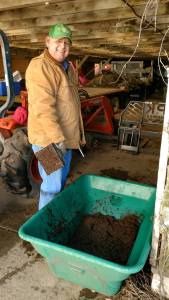
This is me soil blocking at Sundog Farm last Sunday.
Working at farms has been a spring ritual which helps me feel like part of a larger organization. The older I get, the more important that seems.
Farmers may seem isolated, but the farms where I work engage dozens of people in many roles. I met people from all over the world as a result of farm work.
It’s part of who I am and will be for as long as the relationships are sustainable.
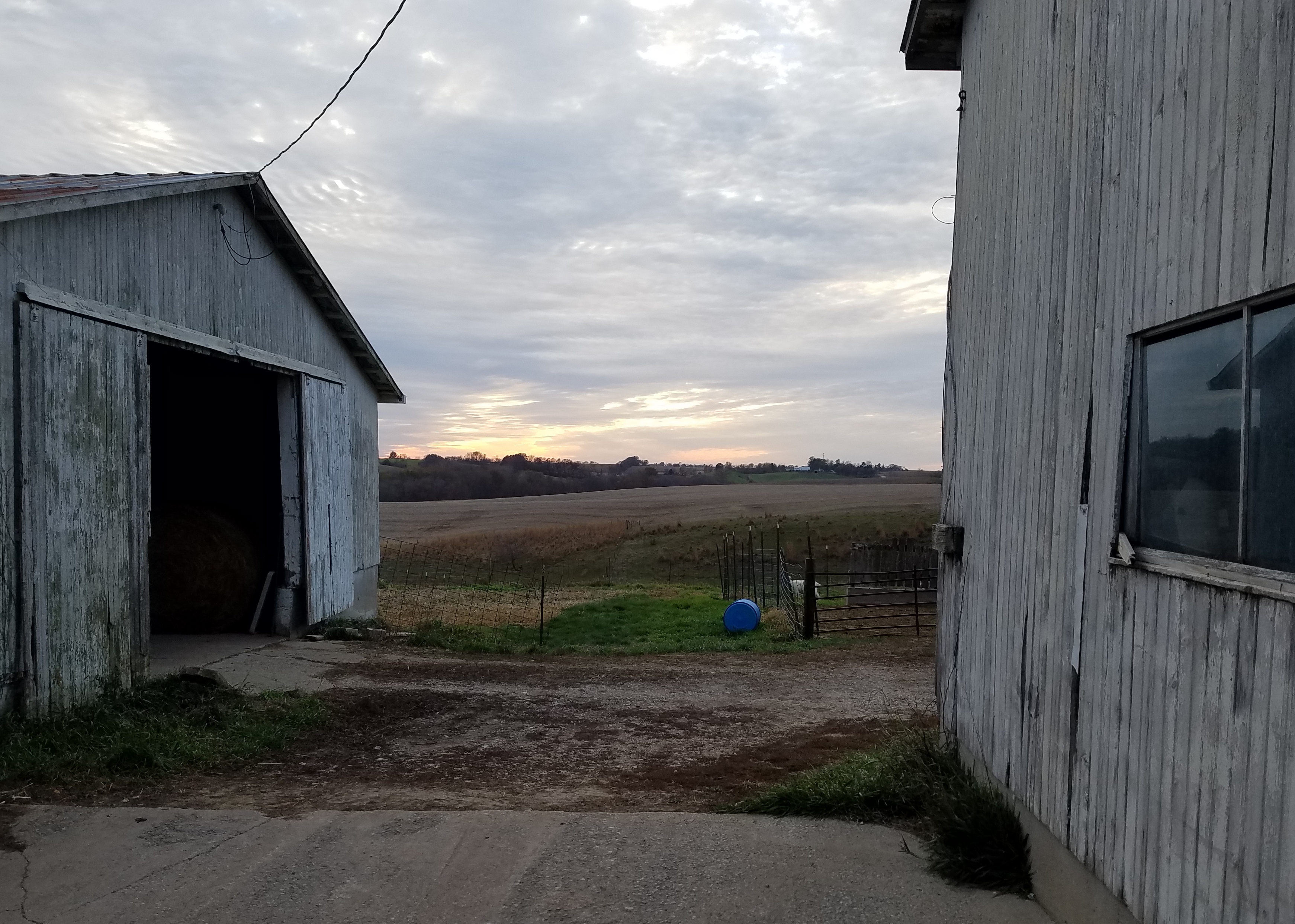
It took about an hour of setup time as the water lines and hydrants remained frozen from winter. I settled on working in this doorway to the barn on top of a windy hill.
Once the lines thaw out, I’ll move to the germination shed.
Inside the barn, ewes were lambing and young ones kept escaping pens where they were isolated with their mothers from the flock. It’s a story as old as life.
Group of captured Allied soldiers on the western front during World War I representing eight nationalities: Anamite (Vietnamese), Tunisian, Senegalese, Sudanese, Russian, American, Portuguese and English. Photo Credit – Library of Congress
Most of Armistice Day was at home.
The forecast had been rain, however, a clear fall day unfolded and I planted garlic. Pushing cloves into the ground with my thumb and index finger, I made two rows and covered them with mulch retrieved from the desiccated tomato patch. It doesn’t seem like much, it’s my first garlic planting ever. If it fails to winter I have plenty of seed to replant in the spring.
Had I been more prescient about the weather I would have spent more time outside: mowing, trimming oak trees and lilacs, clearing more of the garden, and burning the burn pile. Neighbors were mowing. The mother of young children piled up leaves from the deciduous trees at the end of a zip line portending great fun. Instead, I spent the morning cooking soup, soup broth, rice and a simple breakfast.
Leaves of scarlet kale were kissed by frost leaving a bitter and sweet flavor. I harvested the crowns and bagged the leaves to send to town for library workers. Usable kale remains in the garden. It will continue to grow with mild temperatures. Leaves of celery grow where I cut the bunches. There is plenty of celery in the ice box so I didn’t harvest them and won’t until dire cold is in the forecast. An earlier avatar of gardener wouldn’t have done anything in the garden during November.
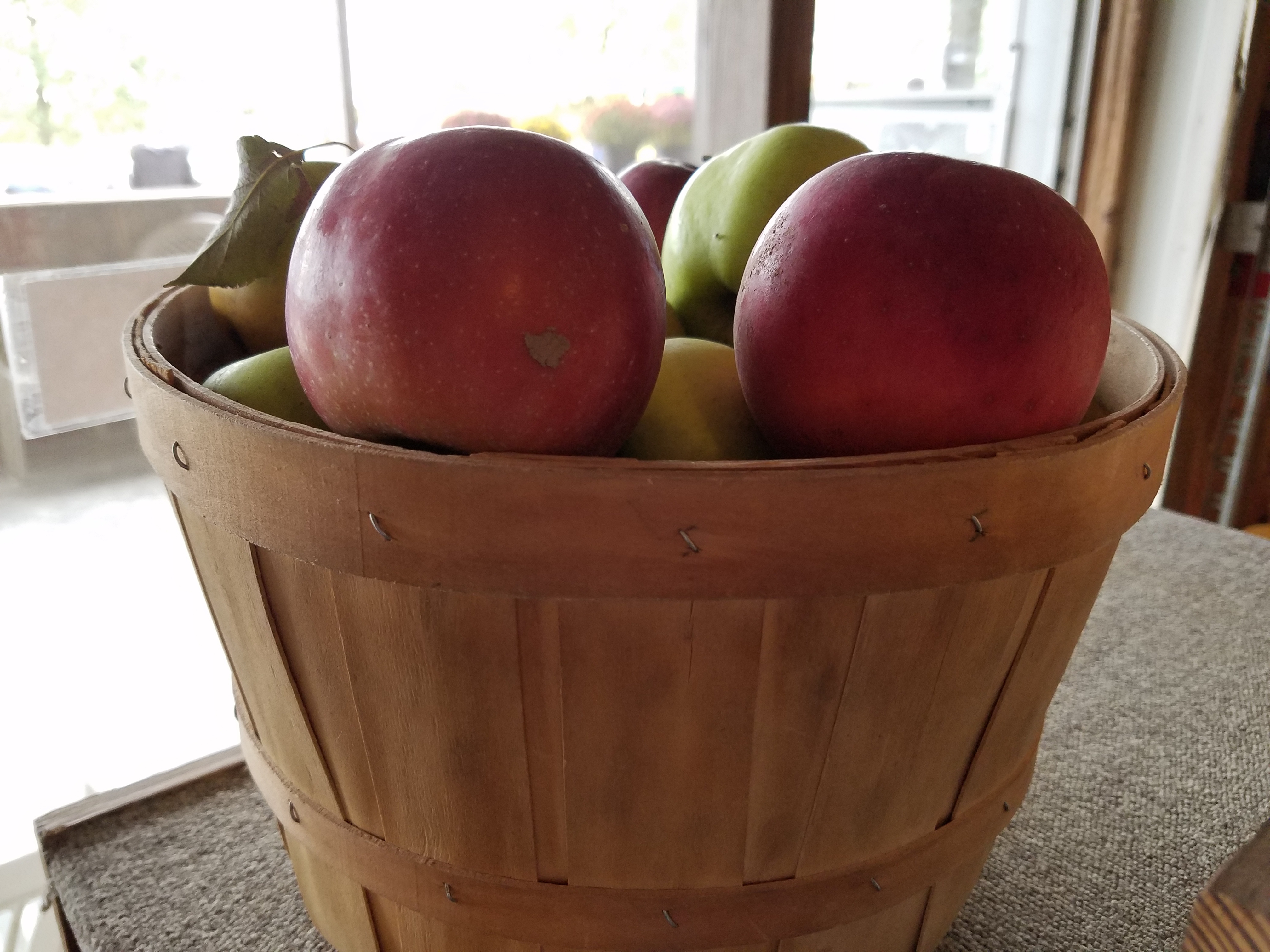
I picked up provisions at the orchard: 15 pounds of Gold Rush apples, two gallons of apple cider, two pounds of frozen Montmorency cherries, packets of mulling spices and 10 note cards. Sara, Barb and I had a post-season conversation about gardening, Medicare and living in 2017.
The morning’s main accomplishment was clearing the ice box of aging greens by producing another couple gallons of vegetable broth. I lost count of how many quart jars of canned broth wait on pantry shelves. For lunch I ate a sliced apple with peanut butter.
We live in a time when favorite foods are under pressure from climate change. Chocolate, coffee and Cavendish bananas each see unique challenges from global warming. In addition, recent studies show the higher concentration of carbon dioxide in the atmosphere is reducing the nutrient value of common foods. Our way of life has changed and will continue to change as a result of what Pope Francis yesterday called shortsighted human activity. He was immediately denounced in social media by climate deniers.
This week, Congressman Ron DeSantis (R-FL) introduced the HERO Act which purports to reform higher education. Specifically, the bill would open up accreditation for Title IV funding to other than four-year colleges and universities. In an effort to break up the “college accreditation cartel” DeSantis would keep current Title IV funding but add eligibility for other post K-12 institutions. States could accredit community colleges and businesses to be recipients of federal loans for apprenticeships and other educational programs.
Telling in all of this is that as soon as he introduced the bill, DeSantis made a beeline for the Heritage Foundation for an interview about it with the Daily Signal. Does higher education funding need reform? Yes. What are Democrats doing to effect change in higher education? That’s unclear. A key problem is progressives don’t have a network of think tanks and lobbying groups funded by dark money to counter the HERO act or the scores of other conservative initiatives gaining traction in the Trump administration.
Even though the 45th president seems an incompetent narcissist, the influence of a conservative dark money network within his administration is clear: in appointments to the Supreme Court and judiciary; in dismantling the Environmental Protection Agency, in undoing progress in national monuments and parks, in weakening the State Department, in potentially politicizing the 2020 U.S. Census, and much more. The reason for his success is his close relationship with wealthy dark money donors and the agenda they sought to implement since World War II.
Today is the 39th anniversary of my return to garrison from French Commando School. I returned with a clear mind, physically fit, and an awareness of my place in the world.
“I am ready to experience the things of life again,” I wrote on Nov. 12, 1978. “The time at CEC4 has cleansed me of all things stagnant. I will pursue life as I see it and make it a place where I pass with love and peace for all.”
We work for peace on the 99th anniversary of the Armistice. If people are not unsettled by evidence of climate change and a Congress that ignores it in favor of pet projects designed to please the wealthiest Americans, we haven’t been paying attention. The need to sustain our lives in a global society has never been clearer.
The sun set as I pulled into Sundog Farm, home of Local Harvest CSA.
Eileen from Turkey Creek Orchard had just dropped off fresh aronia berries and jars of fruit jam to fill orders placed over the weekend. Farmers Carmen and Maja were there but didn’t have time to talk as they had deliveries in Cedar Rapids.
That left me with the goats and sheep to pick up our share.
Low wage work has kept me so busy everything that was once important gave way. I finished reading What Happened by Hillary Rodham Clinton, the first book I read since April. Clinton’s book is an important read for Americans and finishing it a year after she lost the election seemed good timing. What surprised me was how much space she devoted to Russian meddling in the 2016 election. My native reaction was what happens on the internet doesn’t matter much to a U.S. general election, but she convinced me that maybe it does. I also enjoyed her personal stories throughout the book. As was the case while reading her last book, Hard Choices, I found her analysis to be helpful and reasonable.
Today is election day in Iowa’s cities and towns. My pal from the Clinton campaign, Lauren Whitehead, is running unopposed for city council in the town nearest us. There is no election in the unincorporated area where we live. Because of our family roots in southwestern Virginia, I have been following the gubernatorial race there. The Democrat is leading in the polls although that’s no guarantee he’ll win. Whatever the result in Virginia my Twitter feed will be clogged up with analysis and punditry tonight. It’s a good night to retire early with a book and read about the election in the morning.
Yesterday I applied for Social Security retirement benefits. If all goes as expected the first check will hit in late January. By Spring I’ll be in a position to scale back my work at the home, farm and auto supply store. After that I hope to return to the CSA farms to help with spring planting. It will be the sixth year.
For now, I took the vegetables home and will consider how best to use them before they turn to compost. That’s an essential human question. One I spend extra time trying to answer.
On Friday I clocked out of work at the home, farm and auto supply store for four days off in a row!
I drove straight home, dumped the coleslaw I made in the morning into a bowl and mixed it up one last time before the potluck. I grabbed a pair of tongs for serving and headed to the orchard for the 6 p.m. event.
The annual crew potluck is our biggest and only non-work event at Wilson’s Orchard.
About 80 people attended at the on-site Rapid Creek Cidery, bringing the best side dishes imaginable to go along with chef Matt Stiegerwald’s braised pork from hogs raised at the orchard’s farm.
We joked we weren’t sure if we were supposed to bring potluck table service. A veteran of many church potlucks brought a basket with plates, silverware, glasses and everything one would need. Most of us used paper plates and flatware. I enjoyed a glass of plain hard cider as aperitif before switching to non-alcoholic.
When serving began, I made a southern-themed plate with pork, my coleslaw, macaroni and cheese, dumplings and raw tiny carrots. One of countless possibilities given the many tables of side and desserts. All that was lacking was corn bread but it was a potluck after all.
My work pals were all there: the octogenarian who makes dinosaurs and showed off the scar from his recent knee surgery to all who were curious; the pilot who recounted his air-search for the other orchard, which he couldn’t find until I gave directions from ground level; the artist who gave a speech about entering the drawing for fabulous prizes mostly from the Orchard’s lost and found (think sunglasses); the data analyst who is sharp as a tack yet made a six-figure error on the cash register; the Ukrainian guest workers; and the crew of bakers with their families — it takes a lot of bakers to make all the turnovers, pies, apple and peach crisps and blueberry buckles we sell. The sales barn manager was there. She works non-stop from before the August opening until the end of the season. Actually just about everyone was there. Needless to say the conversations and meal, with a chance to win prizes, were delicious. That’s no apple joke.
We talked about when we might see each other again and confirmed that God willing and the creek don’t rise we would be back next year. My only regret was it wouldn’t be soon enough. Heaven help us if it’s not until next season.
The marketplace of home vegetable gardens, community supported agriculture, farmers markets, road side vegetable stands, restaurants, retail interests and direct farm sales hasn’t coalesced into a sustainable local food system, and may not.
One should never doubt the resilience of farmers. At the same time, due to unwelcome changes in society, our local food system is at risk before it has become sustainable.
A small group of pioneers made progress toward a sustainable, local food system. People like Denise O’Brien, Dick and Sharon Thompson, Fred Kirschenmann, Francis Thicke, Laura Krouse and Susan Jutz took ideas about sustainability and put them into practice. Their work enabled a new generation to enter the local food business — people like Tony Thompson (New Family Farm), Kate Edwards (Wild Woods Farm) and Carmen Black (Sundog Farm).
The idea of a return to diversified farms producing food for local markets begs the question how did we get away from it?
If markets for local food become stale or disappear due to changing tastes or financial stress, increased commodification could erase slim margins and lead to bankruptcy.
A local food system is about cooperation and support: between farmers, and with their customers, suppliers, workers, volunteers and bankers. Without that a family may have their dinner on the table, but the entire system is risked if such individualism is the prevailing attitude.
Change is in the air. Change driven by economic hardship and oppressive policies originating in Des Moines and Washington.
It doesn’t look good for growers, retailers or consumers, not because business models have changed, but because we are entering an era when wealth flows to the top, leaving the rest of us struggling. How will farmers get health insurance if the individual market becomes too expensive? They may take a job in town and let their agricultural aspirations go.
These changes and the challenges they bring will test the sustainability of a fledgling local food system.
Climate change is impacting society negatively as well. What we assume about Iowa’s growing conditions — adequate rainfall and predictable temperatures — is subject to change as the oceans and atmosphere warm, increasing the number and intensity of extreme weather events. Likewise, increased carbon dioxide in the atmosphere may be reducing the nutritional value of food, according to a recent study published in the journal Nature.
I don’t doubt the resilience of farmers I know. If a local food system can be sustained, they will do it. Isn’t it time you got to know your farmer? We could all use a friend during these turbulent times.
~ First published in the Saturday, Sept. 30, 2017 edition of the Cedar Rapids Gazette.
Midst falling leaves, grasses turned brown, and apples dropping to the ground, I mowed for the first time in over a month. It may be the last cut before winter.
Monday I visited the vegetable farms where I work each spring and caught up with the farmers. Both farms want me to soil block next year. I plan to do it.
I picked up vegetables for which I bartered: a fall share at one farm, seed garlic, storage onions and potatoes at the other. We cooked a spaghetti squash for dinner and had sides of a burger patty and fresh green beans. I made pasta sauce with tomatoes, garlic, basil and onions. A jug of apple cider is in the ice box, but we didn’t open it just yet. It’s been hard to keep up with the abundance since the garden began producing and the summer vegetable share began. We could feed a larger family than we have.
Fund raising letters have begun to arrive via snail mail. If we had the cash, I’d contribute to each one of them: Practical Farmers of Iowa, Catholic Worker Houses in Iowa City and Des Moines, Veterans for Peace, Physicians for Social Responsibility, and others.
I called the snow removal contractor for our home owners association and the receptionist took a message. He’s out of town until Wednesday. She said they haven’t really started thinking about snow removal because they have been so busy. Isn’t that true for us all.
During the next six months I’ll be re-engineering our lives to live on our social security, transition our health insurance to Medicare, and slow down on work I do mostly for the paycheck. After a two-day retreat, I head back to jobs which have daily shifts until Nov. 3. I need focus so I get the transition right. That means something has to give.
With the current political and economic climate, most everyone I know seems to be in transition. Each week some new affront comes out of our federal government. The same would be true in Iowa if the legislature were in session. It’s a time to re-group and figure a strategy to deal with an aging frame, diminished income potential, and unwelcome changes in society.
My posts have slowed down. Although there is plenty to write about, life’s turbulence has increased making it more difficult. The existential threat to our way of life manifests itself more each day. We will survive the next steps if we take time to do them right. Writing in public may take a back seat to the tasks of living for a while.
Fall going into winter is a great time to do that.
Our local food system is at risk before it has even become established.
The mix of retail interests, community supported agriculture, farmers markets, road side vegetable stands, restaurants and direct farm sales hasn’t coalesced into a sustainable local food system and it doesn’t appear it will any time soon.
One should never doubt the resilience of farmers. At the same time if markets go away due to changing tastes or financial stress, increased commodification could take slim margins out of farm businesses leading to bankruptcy. Iowans remember well the farm crisis of the 1980s.
A small group of pioneers made progress in starting a sustainable, local food system. People like Denise O’Brien, Dick and Sharon Thompson, Fred Kirschenmann, Francis Thicke and Susan Jutz took ideas about sustainability and put them into practical application. Their work enables a new generation of farmers to enter the local food business, people like Tony Thompson (New Family Farm), Kate Edwards (Wild Woods Farm) and Carmen Black (Sundog Farm). The idea of a return to diversified farms producing food for local markets begs the question how did we get away from it?
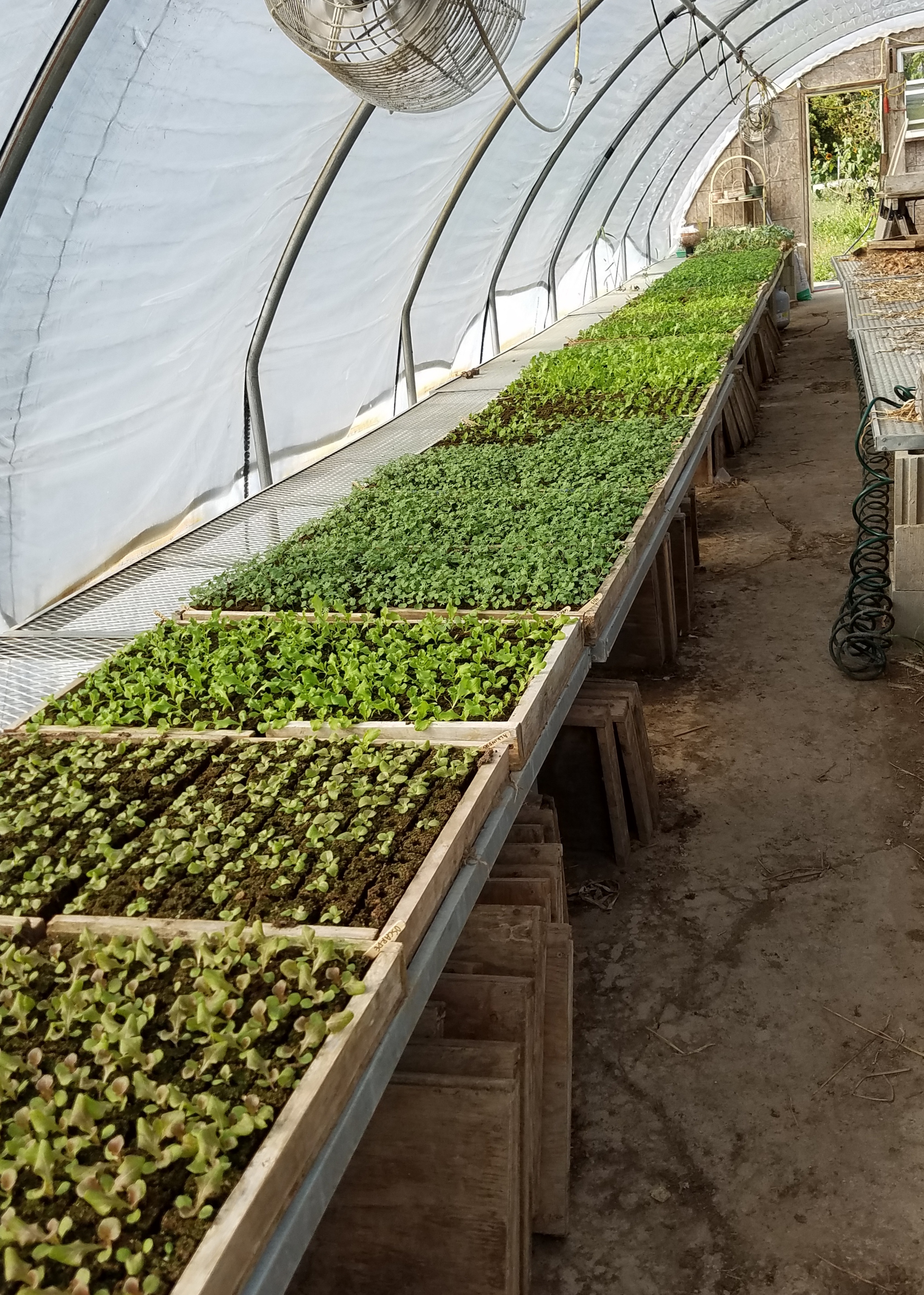
September Seedlings
Change is in the air. Change driven by economic hardship, oppressive policy in Des Moines and Washington, D.C., and climate change. It doesn’t look good for growers, retailers or consumers, not because business models have changed, but because we are entering an era when wealth flows to the top, leaving the rest of us struggling for subsistence. Cultural changes driven by our political and economic climate will test the resilience of a fledgling local food system. What we assume about Iowa’s growing conditions — adequate rainfall, predictable temperatures and soil quality — is subject to change as the oceans and atmosphere warm resulting in increased numbers and intensity of extreme weather events in Iowa.
The challenge is this: If I can buy perfect-looking Honeycrisp apples for $1.98 per pound at the grocery store, why would I pay more at a local apple orchard? The local foods answer is because one knows the farmer, has likely met him or her, and knows the inputs that go into fruit production. As families increasingly make limited resources go further, the risk to local food farmers is they will feel it as consumers pinch pennies.
Today’s food system centers around being able to say, “I’ve got mine,” with regard to a family’s food on the table or a viable agricultural business model. That individualistic, self-centered approach is not sustainable. Sustaining a local food system will take all of us working together.
Versaland, a farm owned by Suzan Erem and Paul Durrenberger, and operated by Grant Schultz, has been in the news. Schultz is well known locally and serves as an example of how a local farmer can create bad press, alienate neighbors and risk failure. In a recent blog post, Erem and Durrenberger answered the question what kind of farmer Schultz is in no uncertain terms: a neglectful, unfocused one. Read their post titled, “Grant Schultz — Facts to Consider.”
Schultz recently applied to the Johnson County Board of Supervisors to rezone part of Versaland. The supervisors rejected the application unanimously, in part because land owners Erem and Durrenberger did not support it. Local farmers with whom I’ve discussed the matter don’t understand why he wouldn’t get buy-in from the landowners before applying for rezoning. The answer is likely he can’t afford to buy the farm according to contract terms without the money his proposed idea might generate.
Whatever one feels about the Versaland saga, disputes — some including lawyers and some not — are common in agriculture. The reason the Versaland dispute stands out is there have been so few of them in the local food system. For the most part, people get along despite differences.
What is more concerning than a legal dispute is the disconnect between Versaland and its reality. This narrative started a couple of years ago.
“Mr. Schultz and Versaland have completely shifted the climate change narrative in the heartland,” author Jeff R. Biggers opined in the Nov. 20, 2015 New York Times. “Today’s farmers can play a key role in climate solutions.”
The narrative Biggers crafted about farming and climate change, featuring Schultz’ work, tells what may be possible but falls far short of what is. Schultz’ first steps in what Biggers asserts should be a global climate change campaign faltered with the revelations about Versaland the dispute brought to light. That Schultz appears to be a neglectful, unfocused farmer isn’t a crime. Those who live in the country know plenty of farmers like that. However it detracts from the credibility of Biggers’ narrative. To the extent Versaland is part of the local food system it drags everyone down.
Our local food system is not at risk for lack of a narrative. What matters more is the relationships between farmers and their customers, suppliers and landlords. Government plays a role and the negative cultural impact of federal and state governments in society remains to be seen. That is the greatest risk the local food system faces.
One hopes the window to establish a vibrant, sustainable local food system remains open, at least for a while.
The Johnson County Board of Supervisors disagrees on how to use the property known as the “Poor Farm” and that’s okay.
There’s no surprise something will be done with the property, especially to those paying attention. Supervisors recently decided what that may be.
In June, “The Johnson County Board of Supervisors on Friday voted (3-2) to move forward with a plan to restore and develop the historic county Poor Farm, including increasing the amount of land leased to small farmers and adding permanent affordable housing,” Iowa City Press Citizen reporter Stephen Gruber-Miller wrote.
I accept the 3-2 vote because we don’t elect supervisors with differing views to agree all the time. We want a diverse group of five supervisors. One that creates enough friction among themselves to hone the use of county assets and community resources in a way to make society better for everyone in this liberal-dominated community. Supervisor Rod Sullivan laid out the case for the board’s decision in a June 23, 2017 post on his website Sullivan’s Salvos. I’m confident something positive can come out of the board’s decision to develop the long-neglected county asset.
I like the idea of using county land as a way to help beginning farmers get started. The idea is different from reality. If they don’t have capital, farmers lease land — a temporary solution in which a lot of hard work building soil health can come to nought if they have to relocate. The cost of farm land remains high in Iowa. Every beginning farmer with whom I’ve spoken said their start-up issue is not only access to land, but the ability to purchase it. The county could help farmers by changing the definition of a “farm” from 40 acres to something smaller. In some cases an acre or two was all that was needed to get started in business. The point is local food operators can make a living farming less than ten acres. Resolution of this challenge does not lie in developing the Poor Farm.
In Johnson County there is a concern that if the farm size were changed, developers would take advantage of a smaller farm definition and build single homes on a larger acreages to serve the affluent local market of highly paid workers and retirees. The concern is not misplaced. This board of supervisors has the smarts to figure out how to enable beginning farmers to buy smaller acreages while protecting any changed land use ordinance from what the county deems undesirable development.
The key unanswered question about development of the Poor Farm is how do farmers make the transition from government dependency to independence via a stint there? Using the Poor Farm to provide land access presumes things I’m not sure are accurate — particularly a level of farming competence I’m not sure many have. It also presumes there will be a high failure rate from beginning farmers who take advantage of the program but then choose another career path. It seems obvious a better apprenticeship for new farmers would be to work on an established farm with an experienced farmer, as some local operators have done. On-site, subsidized housing is a way to help new farmers financially and makes some sense. Answering the question of how to enable a successful farmer to use and then leave the Poor Farm is the dominating question.
The idea of a “poor farm” is so Midwestern 19th century. I resist the idea of isolating beginning farmers from the agricultural community or outside the infrastructure of the city with its proximity to work, transportation, shopping and church. I would have thought we had learned a better way in the more than 175 years since Iowa was first settled.
We elected our board of supervisors to do what they think is right. If we don’t like it, we can elect someone else. That’s the way the system works. Based on the way they are handling development of the Poor Farm I’m not ready to fire any of them yet, despite unresolved issues.





 Journey Home
You must be logged in to post a comment.