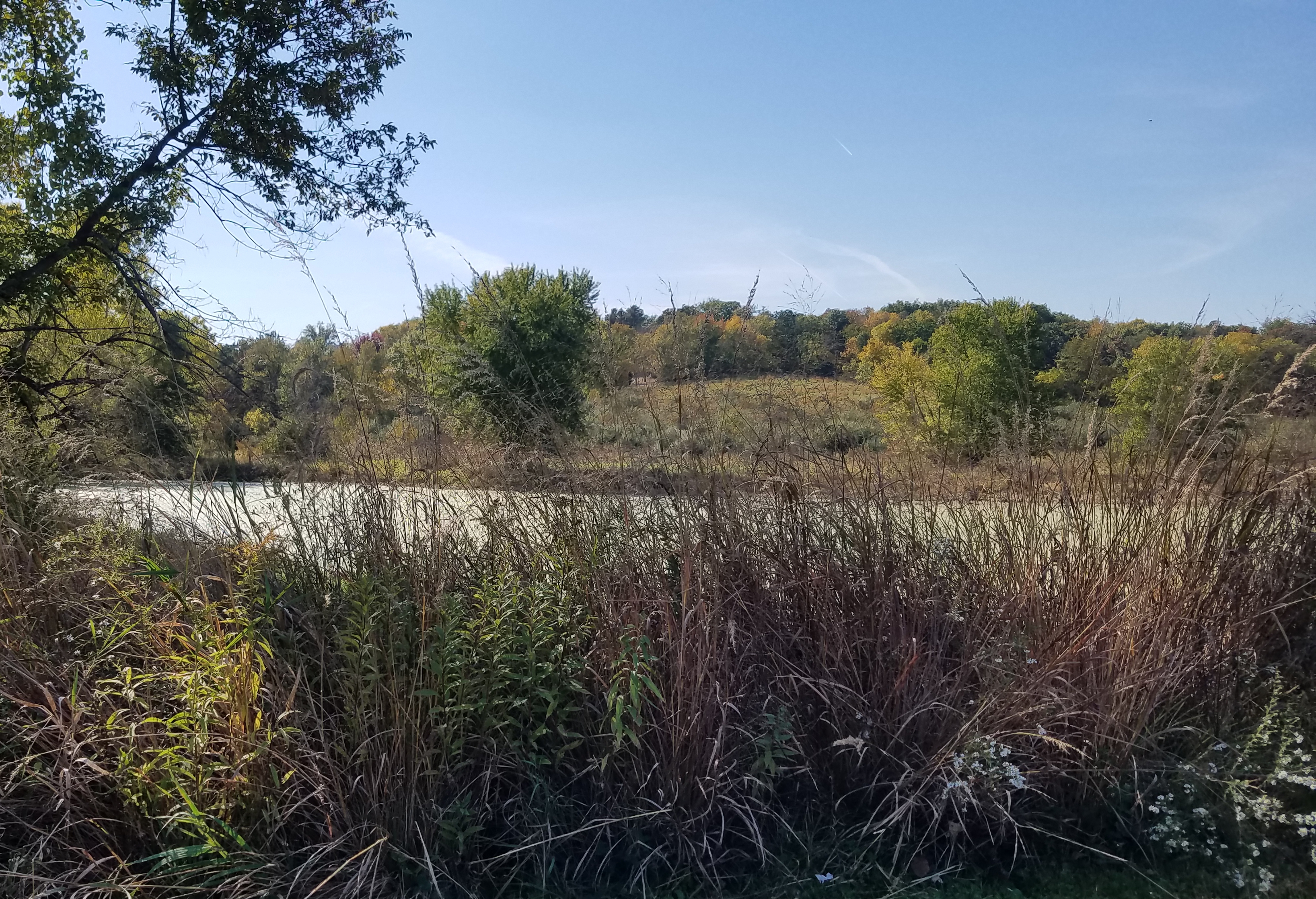
I occasionally hike a section of the Hoover Trail that branches from the North Shore Trail along Lake Macbride. It is a longer walk and with fall weather, I seek to spend more time outdoors. It was perfect for a long Sunday walk.
A couple of gray kittens were sunning on dirt next to the trail. “What are you doing here?” I asked. It was half a mile or more to the nearest building.
They were not just born yet still very young. I talked to them, but didn’t touch them. If I had a bag or backpack with me, I would have picked them up, brought them home, and had them checked out by a local veterinarian. Lacking suitable cat transportation, I left them where I found them, hoping for the best.
The next day, my spouse and I discussed the kittens and decided if I could find them again I would bring them home for processing and potential domestication. That is, as pets. We decided they were not yet feral cats, because if they were, they would have hidden when they saw humans on the trail. Our fear was that someone dumped them, a common occurrence in rural Iowa.
Grabbing an old moving box, I put a couple of old towels and a pair of gloves in it and walked back to the spot. It is inaccessible by automobile and took a half hour or more to make it back.
I stopped by the benches and bike racks near the pond to cool down. The sound of birds was all around. There were squirrels, grasshoppers and other insects on a bright afternoon. It was peaceful and restful. The kittens were nowhere to be found. I will assume that is good news although was a little sad when I left. The lesson is to pay attention to one’s surroundings. I doubt bicyclists noticed the kittens while they sped by.
We seek to do good in life, yet sometimes it works out differently.
I worked for seven seasons at what is now Wilson’s Orchard and Farm near Iowa City. At the time it was mostly an apple orchard with seasonal imports of cherries, peaches, raspberries, blueberries and blackberries from other farms.
During the coronavirus pandemic they expanded their offerings and yesterday announced they bought a 115-acre farm near Des Moines as a further expansion of what is proving to be a successful local food concept.
The grand opening of the Des Moines farm is spring 2023 with the strawberry season. Paul Rasch, owner and grand poobah of the farm described his first strawberry crop in Iowa City to me as “money.”
I don’t know if the proposed transition is possible, yet it may be our best hope to break the cycle of growing row crops in Iowa. Wilson’s Orchard and Farm is an idea whose time has come.
Here is the announcement video released this week that describes Paul’s vision of an Iowa food system transformed.
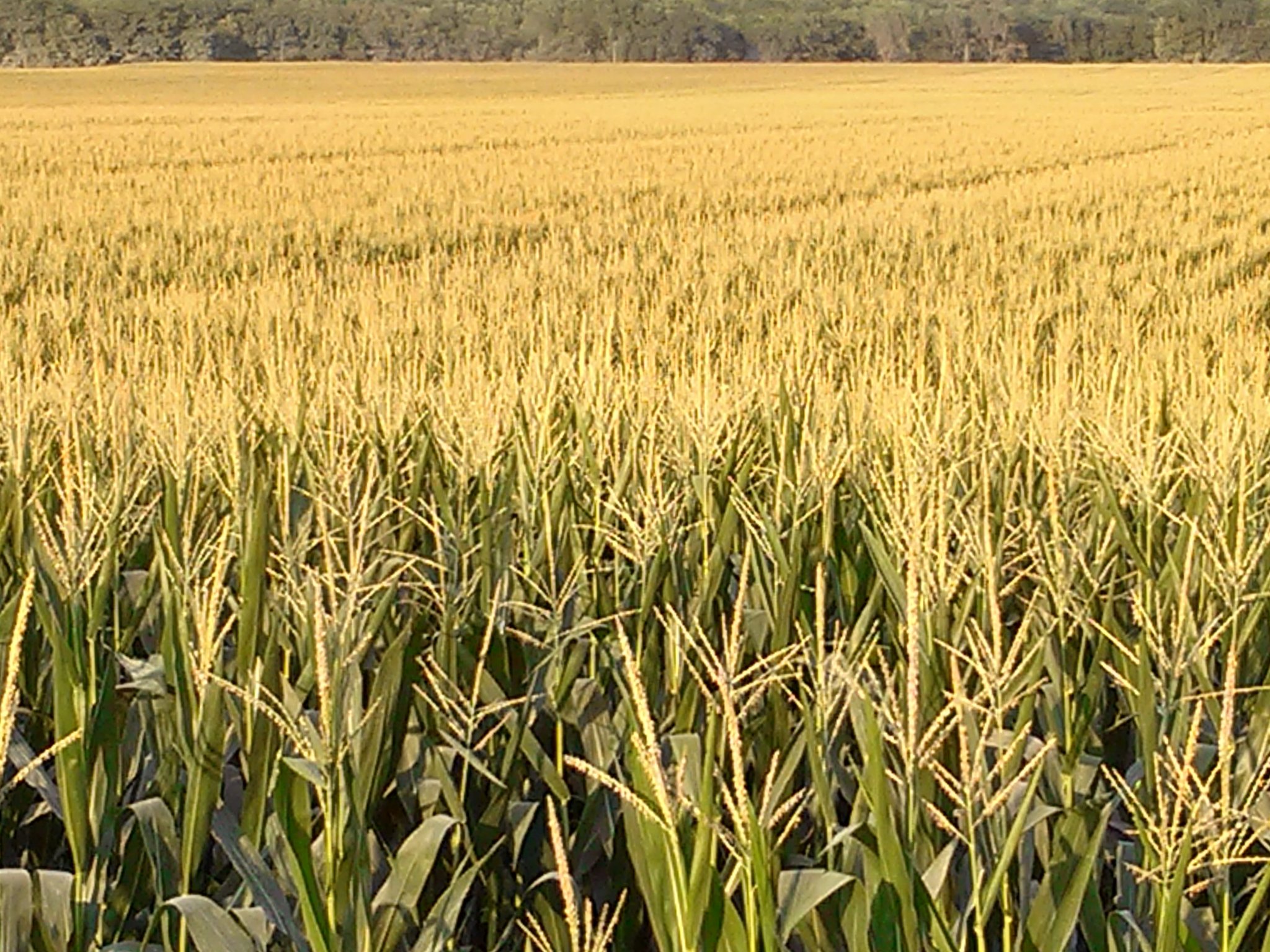
Drought-stressed corn crop in Cedar County, Iowa, 2012.
2022 has provided evidence in plain sight of the consequences of burning fossil fuels. The Greenland ice sheet is melting and expected to raise global sea levels by a foot. Such melting is already in motion and even if we stopped emitting greenhouse gases into the atmosphere today, it would have no effect on this destruction. A melting Greenland ice sheet cools the Northern Atlantic Ocean, which in turn slows the Atlantic Gulf Stream circulation and could lead to climate disruption on a massive scale.
From the American West to Europe to China, rivers are drying up. Our oceans are warming, causing fish and water-bound mammals to migrate to cooler places, disrupting fishing stocks. The upper Midwest is home to the largest global concentration of field corn. Continued high temperatures and lack of rainfall are expected to reduce yields. At $6.73 a bushel, corn is now roughly 50% above its 10-year average price.
None of this is good news. It is the truth.
In part, we got ourselves into this situation by ignoring scientists about the dangers of global warming. Here’s some more truth: President Lyndon Johnson, in a Feb. 8, 1965 special message to Congress, warned about build-up of carbon dioxide that scientists recognize today as the primary contributor to global warming.
“Air pollution is no longer confined to isolated places. This generation has altered the composition of the atmosphere on a global scale through radioactive materials and a steady increase in carbon dioxide from the burning of fossil fuels.”
There is little an individual can do. A solution will take governments addressing the physics of the issue at the highest level. It has become clear Republicans are the party of the fossil fuel industry and won’t take serious climate action. While some Democrats have fallen under the influence of fossil fuel interests and money, they were able to pass the Inflation Reduction Act which is the first legislation that addresses the climate crisis. We need more legislation to address the climate crisis, and that means electing more Democrats today.
The evidence of global warming is all around us. While everyone should get involved in what has become an obvious, global problem, the path forward in the United States is in retaining a Democratic controlled Congress and Executive Branch. No one wants to change their quality of life. However, life would be much better if we took action to control the changes caused by global warming by engaging in society.
The remaining two Bur Oak trees in the garden made an abundance of acorns this year. They are weighing down the branches so they almost touch the ground. Acorns are welcome nutrition for squirrels who took up residence in trees I planted after moving to Big Grove in 1993. These particular oak trees were planted from acorns harvested the year our daughter graduated high school and left home. There were three trees, one for each family member, but the August 2020 derecho took one of them out.
The plan is to remove one of the remaining two after the garden finishes this year. It will allow the final one to grow to maturity. By the time it does, I’ll likely be too old for much gardening yet I hope to be able to appreciate its native glory.
It took an hour to harvest tomatoes yesterday. There were two and a half gallons of San Marzanos, a milk jug full of mixed cherry tomatoes, and a bushel of slicers. Today’s plan is to clean them all, remove the imperfect ones to make tomato sauce, and organize what’s left for optimum storage and use in the next couple of days. Tomatoes planted under the oak trees are looking better, so there will be a harvest of plums and Amish paste for canning. This season is running late across the garden.
While I reached into tomato cages to take fruit from the vines I thought about next year. I plan to continue the trellis system for cherry tomatoes and plant two additional long rows, one of mixed slicers and one of San Marzanos, Granaderos, and Amish Paste. The trellis will be longer, as we are using more cherries in the kitchen. It needs to be more sturdy so I may invest in t-posts for the upright supports and place them closer together. They will be flanked by the other two rows, which in turn will be flanked by bell peppers on one side and a mix of eggplant and hot peppers on the other. That would allow focus on that particular garden patch at the same time of year. One can tell fall is not far away by this contemplation of next year.
Where the garlic will go this fall is not decided. This year’s crop continues to cure in the garage and the heads used have been healthy and tasty. I planted 100 head last fall and it produced plenty for the kitchen. Almost every seed planted yielded a head. When the curing process is finished, I’ll save the best heads for seed. This garlic originated on Susan Jutz’ farm and has been planted year after year for a very long time. It has good characteristics and stores well.
Soon I will mow the harvested garlic patch and use the plot to store grass clippings. With the recent rain, the yard grass is long and will make plenty for storage. I also need to tear down the failed onion patch and prepare it to store fencing. I need a sunny afternoon for this work.
We move through the gardening season so quickly any more. In late August, the work continues to be about tomatoes, peppers, greens, celery, and eggplant. Cucumbers and zucchini are about done. I hope to plant lettuce before the week is done. Acorns forming on oak trees are the sign I had better get going.
Some days I’m thankful for the ability to walk the state park trail and see the ever-changing plant, animal and insect life. Being thankful is enough for this Saturday.
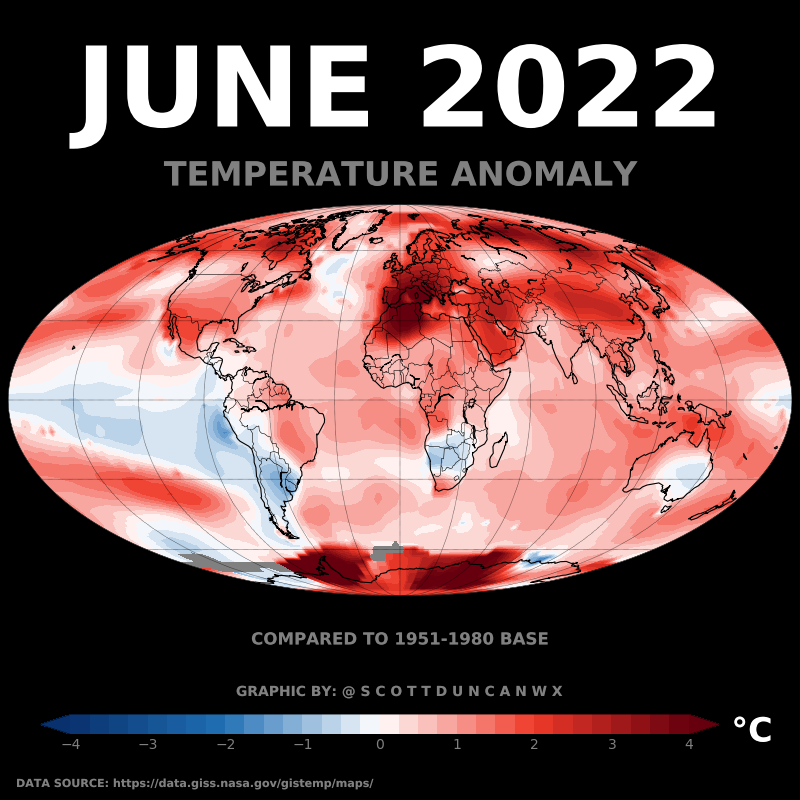
I’ve written about the environment on Blog for Iowa since my first post on Feb. 25, 2009. Never in the time since then has there been more happening regarding degradation of our environment. As Scott Duncan’s graphic above indicates, it is getting a lot hotter on most parts of Earth. Methane and carbon dioxide emissions are rising, the oceans are getting warmer, ice sheets at the poles are melting, and there is a general lack of political will in the United States and elsewhere to do enough reverse our course.
More than 40 percent of U.S. population lived in counties affected by climate disasters in 2021, according to Sarah Kaplan and Andrew Ba Tran of the Washington Post. In a report issued June 27, Kayrros, a firm that analyzes satellite data, said methane emissions have climbed despite the launch of the Global Methane Pledge at the U.N. climate conference in Glasgow, Scotland, last fall. The firm said that “global methane emissions so far appear to be going in the wrong direction.”
“Sadly, we have taken the ocean for granted, and today we face what I would call an ocean emergency,” U.N. Secretary General António Guterres told delegates at the June opening of the United Nations Ocean Conference in Lisbon, Portugal. “We must turn the tide. A healthy and productive ocean is vital to our shared future.”
Despite substantial evidence of environmental degradation that affects human life and society, President Biden’s plan to address the climate crisis fell flat in the Congress because there were not enough votes to pass it with a divided U.S. Senate.
“The reality we face implores us to act,” Al Gore said.
In Iowa we tinker around the edges of addressing the climate crisis. Decisions like the one I wrote about in 2009, which stopped Interstate Power and Light from building a coal-fired electricity generating station in Marshalltown, have been driven by economic factors rather than any concern about the environment. “You don’t like coal? Fine! We’ll use natural gas which is cheaper anyway,” they might have said. Neither the government nor industry in Iowa takes action on the climate crisis unless there is a positive, monetary effect on someone’s bottom line. Human health and well being has been a secondary consideration despite the warnings of public health officials like I was back in the day.
A lot of Iowa environmental activist bandwidth is being taken up by the fight to stop three different Carbon Capture and Storage proposals. Art Cullen cut to the chase in a July 15 editorial in the Storm Lake Times, saying, “The pipelines will get buried. The Iowa rainmakers will get theirs as we pretend that we are addressing the planet being on fire.” It is hard to give up on the fight against CO2 pipelines, even if it plays out like some of the other transportation proposals to take oil, electricity, liquefied CO2, or other commodities across county lines.
What is a climate activist to do? I would start by learning about big scale solutions and getting involved in electing candidates willing to take action on them. I reviewed The Decarbonization Imperative: Transforming the Global Economy by 2050 by Michael Lenox and Rebecca Duff here. It’s a good place to start. A couple of things seem clear. Individual action is unlikely to solve the climate crisis. Large scale solutions take technical skill to design and political will to implement.
I recommend readers become part of the solution to the climate crisis by getting involved in efforts to implement large scale environmental projects. In most cases, that begins at the ballot box with voting for candidates willing to do the work.
Ten years ago I posted about the impact of the 2012 drought on Iowa agriculture. Read the post here, yet the crux of the article was climate change was absent from public discussion of the drought. Nothing has changed since then.
Drought conditions continue to affect Iowa crops. Josie Taylor with Iowa Environmental Focus writes about how the current drought impacts crops in Northwest Iowa:
“Corn and soybean plants are continuing to suffer in some parts of Iowa from excessive heat and drought,” she wrote. “This has been seen especially in far northwest Iowa where drought conditions are worsening. Large areas of Plymouth and Woodbury counties are in extreme drought, according to the U.S. Drought Monitor.”
Isn’t it time, ten years later, we acknowledged the 800-pound gorilla in the room? Climate change is real and Iowa agriculture won’t discuss solutions to it. We are running out of time to address the climate crisis before it is too late.
Learn more about The Climate Reality Project and how you can get involved in solving the climate crisis by clicking this link: https://www.climaterealityproject.org.
If Iowa agriculture won’t take action to mitigate the effects of climate change on their primary industry, the rest of us must.
In retrospect, Earth Day has been a bust. It turned into an annual reminder among privileged Americans to do something about environmental degradation. It became a do-nothing tradition that had little material impact on the environment.
It would have been better to pursue social justice, elimination of poverty, or equal protection under the law, right from the beginning. All paths would lead to improving the environment regardless of the starting point.
Charles C. Mann wrote about the elitist nature of Earth Day in his book The Wizard and the Prophet: Two Remarkable Scientists and Their Dueling Visions to Shape Tomorrow’s World:
So ineradicable was the elitist mark on conservation that for decades afterward many on the left scoffed at ecological issues as right-wing distractions. As late as 1970, the radical Students for a Democratic Society protested the first Earth Day as Wall Street flimflam meant to divert public attention from class warfare and the Vietnam War; the left-wing journalist I.F. Stone called the nationwide marches a “snow job.”
The Wizard and the Prophet: Two Remarkable Scientists and Their Dueling Visions to Shape Tomorrow’s World by Charles C. Mann, page 81.
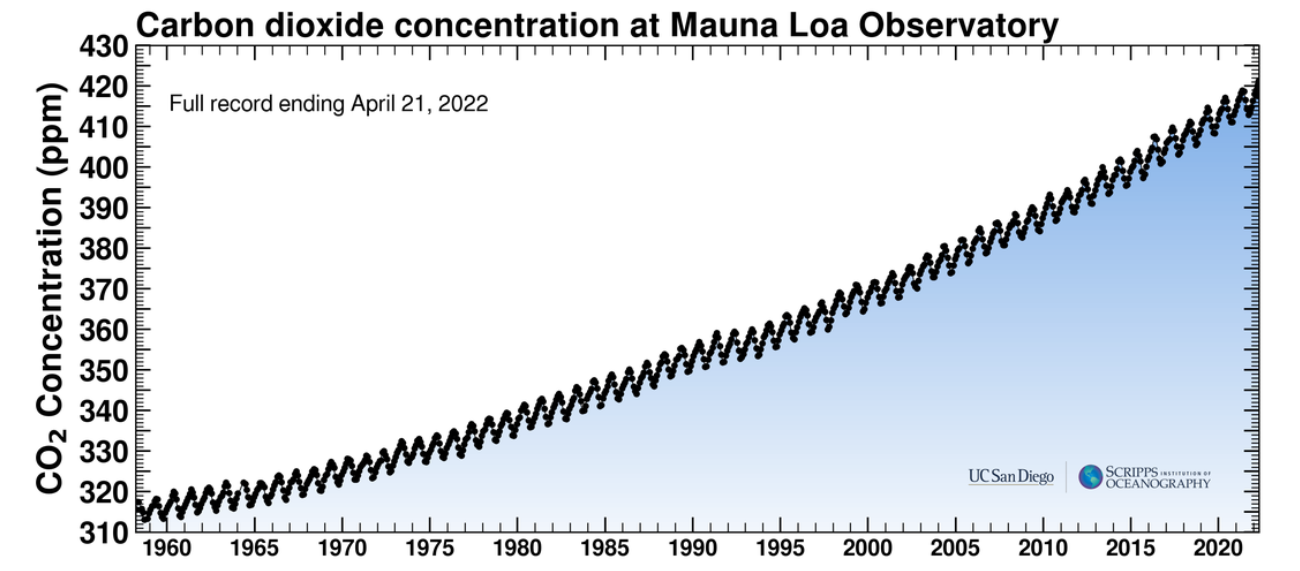
As data from the Mauna Loa Observatory in Hawaii indicates, carbon dioxide concentrations in the atmosphere continue to increase. The latest reading was yesterday at 420.25 ppm. We may not have understood the significance of such a small part of Earth’s atmosphere on the first Earth Day, but we do now and the numbers continue to roll upward at what can be described as a steady pace. It is as if the environmental movement accomplished nothing.
A climate crisis is happening in plain view. The folks at The Dark Mountain Project described it like this in their April newsletter:
The climate disaster unfolding around us is itself a convergence between the breakdown of ancient organic matter and modern industrial ambition, technology, greed and carelessness, a calamitous meeting of worlds.
Email from The Dark Mountain Project, April 15, 2022.
However one describes the climate crisis, part of our problem in taking action to remediate it is we don’t have the intellectual skills to understand environmental degradation or what actions would be effective in reversing it. Likewise, current society has limited functioning methods to take action without a calamitous incident precipitating a need big enough to gain political consensus.
When in 1985 the scientific journal Nature revealed that over Antarctica, a hole in the ozone layer had formed, exposing humans to the sun’s cancer-causing ultraviolet rays, reactions were mixed.
At the time, President Ronald Reagan was in the White House. Environmental policy hadn’t been a priority for him and his advisers, who were more focused on fighting the creep of Cold War communism or federal involvement in issues they believed the states should handle. Even the revelation of the ozone hole didn’t change things–or at least not right away. In fact… Reagan’s Secretary of the Interior Donald Hodel was ridiculed in the press for reportedly saying in a meeting that an international treaty wasn’t necessary to address the damage and that Americans should just put on sunscreen and wear hats.
Reagan Administration Officials at First Dismissed the Ozone Hole. Here’s What Changed by Olivia B. Waxman. Time Magazine, April 10, 2019.
As we know now, the Montreal Protocol, the first-ever global treaty to reduce pollution and phase out chlorofluorocarbons, gained Reagan’s support and was agreed in 1987. The U.S. Senate ratified the treaty unanimously the following year. Our current political environment has degraded to a point where such common-sense action is no longer possible.
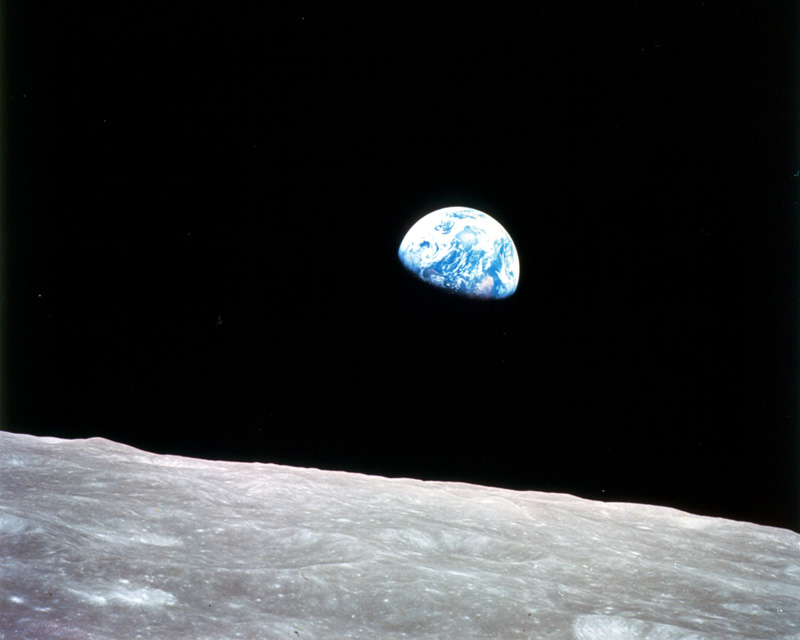
Bill Anders’ Earthrise photograph reminds us of Earth’s suspension in the vast darkness of the universe. We are unique, and dependent on each other on this our only home. For complex reasons, we understand the risks of further environmental degradation and the warming of the atmosphere. We have been unwilling to take adequate action and Earth Day isn’t helping.
On walkabout, garlic poked through the mulch. It is spring.
I assembled the portable greenhouse yesterday afternoon. The extra space and light will make a difference, another step toward planting the garden.
A big batch of vegetable soup simmered on the stove most of the day. We ate it for dinner and filled five quart jars. Three of them are to take as my spouse returns to her sister’s to finish packing.
My daily routine is disrupted by spring. That’s good. Like grass greening in the lawn, it is a sign of renewal. Without it, sustainability is elusive.
Opening statements at Ketanji Brown Jackson’s Supreme Court confirmation hearings with the U.S. Senate Judiciary Committee were yesterday. It was as if I wandered into a retirement home occupied by committee members. My conclusion, after listening to most of them? We need younger senators. Thankfully, in Iowa we have three suitable candidates to replace Senator Chuck Grassley during the November election.
War in Ukraine continues. The Ukrainian government refused to surrender even though most of Mariupol has been bombed to ruins. The Russian war machine will rapidly wear down, yet not before more destruction. Somehow Ukrainian farmers will get a crop in the ground this spring.
This week, António Guterres, the United Nations secretary general, pointed out what most should know: we are sleepwalking to climate catastrophe. The upshot is there is time to act on climate, although not for long.
Today’s high is forecast to be 78 degrees. Now Mother Nature is just messing with us. On the plus side, maybe the warmth will melt the 3-4 inches of snow that fell overnight. Iowa weather always has something a little different. What I found to be different is I used a different weather app to check the forecast and it was set to Washington, D.C. We don’t need a weather app to know there will be a lot of hot air over there.
Seven trays of vegetables rest on the germination table and the landing near the front door. Everything looks reasonably good. I added the task “assemble greenhouse” to my list and am ready to move onions and cruciferous vegetables outdoors. After the snow melts, I will.
There was an F3 tornado on Saturday that killed six people in central Iowa. Today, the Iowa legislature takes up House File 2299 which would make it harder for Iowa homeowners to prove damage from disasters like a derecho or tornado. There is a GoFundMe for one of the families affected by the tornado, and that appears to be the way society is going these days. We are on our own.
I like it when I can turn off the fan on the ceramic heater in front of my desk. It looks to be one of those days, that is, after I bundle up to take care of snow removal on the driveway. Soon the space heater will be moved to the greenhouse. I can’t wait.
You must be logged in to post a comment.