It is my minority opinion that avocados should be avoided in the United States. Don’t buy them, don’t eat them. The fruit has become popular, and because of it, Mexican growers can’t keep up with demand. This creates a problem.
To meet surging demand in the U.S., farmers in Mexico have cut down swaths of forest in the western state of Michoacán, one of the most important ecosystems in the country. By some estimates, as many as 20,000 acres of forest — the area of more than 15,000 American football fields — are cut down each year and replaced with avocado plantations. The rapid expansion of orchards will threaten forests in Mexico for years to come.
Dishes like guacamole, avocado toast and smoothies taste delicious. Refined oil from the fruit is popular among foodies and nutritionists because of its unsaturated fats. By one estimate, sports fans eat through 105 million pounds of avocados on Super Bowl Sunday. The deforestation problem is directly related to such consumer demand.
The immediate catalyst for this post was a project to reduce my cookbook collection. I found many recipes for guacamole and felt we needed a reminder to moderate consumption and address the deforestation their popularity causes. I can hear long-time readers asking, “Didn’t you cover this before?” Yes, I did in the post titled, “Can Hipsters Stomach the Truth about Avocados from Mexico?” Not much has changed.
What can consumers do about deforestation which creates high-margin avocado plantations? Solutions are complicated. Ecosystem Marketplace outlines some of the challenges here. In the meanwhile, go light on the guacamole and avocado toast, and find another oil for cooking.
It is something we can do to contribute to efforts to solve the climate crisis.
View of Trail Ridge Estates on Thursday, Sept. 30, 2021.
SOLON, Iowa. — It is no surprise a year into development of Trail Ridge Estates by the Watts Group additional public costs are being identified. The first is environmental.
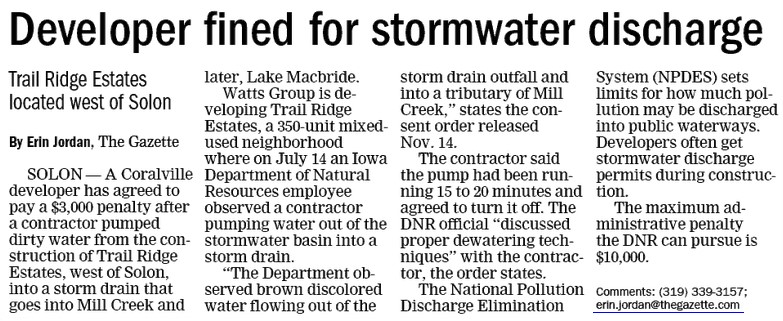
The Cedar Rapids Gazette reported yesterday the Watts Group was fined $3,000 by Iowa Department of Natural Resources for pumping construction runoff into a storm drain that leads to Lake Macbride. I note the Watts Group built the storm drain after developing what was previously a farm field. Such environmental pollution is part and parcel of a development this size. The lake is already feeling pressure from development and this additional loss of farmland has an impact. The matter was settled by the parties in a consent order signed Oct. 25.
What will cost more is the recently announced $25 million school bond expected to go to voters this spring. Trail Ridge Estates will contribute directly to area growth and the requirement for more classroom space in the school system.
The district, like the town of Solon, has seen a steady increase in enrollment since 2014, and anticipates planned housing developments — with another 500 new residential units — to bring additional families in to the district. Solon schools’ current enrollment is 1,450 and is expected to increase by about 350 to 750 students over the next 10 years, depending on how quickly new housing developments take shape.
The farm field in development was planted mostly in corn and soybeans, so converting it into housing is no significant loss to the food system.
Trail Ridge Estates was annexed to the City of Solon and will contribute to significant growth, maybe 50 percent more than the 2020 U.S. Census count of 3,018. What may get missed in this news is the area is evolving from what it was when we moved here into something new: a more expensive, environmentally compromised place to live. While promoters of the bond issue say it won’t increase taxes, how can it not increase expense as the school system grows to match population? The district will eventually see increased costs as a result of this development.
We will welcome more information on the bond issue. I plan to study it closely yet will likely vote for the bond. Public schools are endemic to thriving communities and we want our nearby city to thrive.
When a person lives in Iowa it is hard to avoid noticing the harvest.
74 percent of Iowa soybeans and 38 percent of corn had been harvested as of Oct. 17. We are running a few days ahead of historical averages because it has been exceedingly dry. The entire state is experiencing drought conditions. I held off burning the brush pile because there is a Red Flag Warning, which means extreme fire conditions combined with high wind and low relative humidity. Everything is parched.
As I write this post on a Saturday afternoon, the ambient temperature is 78 degrees with a high of 82 expected in a couple of hours. The average high temperature here is 61 degrees in October. For Oct. 22, it is warm. One needn’t be a scientist to understand something is going on.
On Thursday I delivered my spouse to her sister’s place in Des Moines. We had a lot to talk about as we passed fields with farmers harvesting corn and beans. Between Williamsburg and Altoona, Interstate 80 is a hinterland of row crops, wind turbines and the detritus of retail establishments grown up to service a few locals, but mostly travelers. Towns and cities are hidden from sight.
On the way back, I turned on the car radio and began searching for channels. I avoided the religious stations and settled on a couple of country music and classic rock programs to help me make it back within range of my usual ones. From the ads, it became clear that Republicans dominate rural Iowa.
Governor Kim Reynolds has a substantial campaign war chest and attorney general candidate Brenna Bird just got a major donation from the Republican Attorneys General Association to defeat incumbent Tom Miller. These two Republicans have money to burn on their campaigns. The radio ads repeated during my trip. Whether any farmers were listening while running the combines and grain wagons, I don’t know. Republican messaging filled the vacuum left by Democrats.
To be effective, radio advertising must exist and be repetitive. In the Iowa hinterlands, it is the domain of statewide candidates and big money. Tom Miller was unlikely planning to spend millions on his campaign. Republicans are trying to buy an attorney general.
Our gubernatorial candidate, Deidre DeJear, simply doesn’t have the money for radio advertising even though it is cheap. My worry is her television advertising goes dark as we enter the last two weeks of the campaign, leaving Republicans the only voices heard there as well. During the primary, another Democratic candidate for governor dropped out of the race because he couldn’t get a meeting with major Democratic donors.
As the miles fell behind me the ads repeated. Running down President Biden and associating the Democratic candidates with him because of his unpopularity. Every sentence repeated was a pack of lies. When it is the only political voice rural people hear, it’s hard to stand up to it.
The election is in 17 days. Whatever the outcome, we have to do better to dig out of the hole we dug for ourselves. It’s possible, yet without the rural areas, I’m not sure how that happens.
I occasionally hike a section of the Hoover Trail that branches from the North Shore Trail along Lake Macbride. It is a longer walk and with fall weather, I seek to spend more time outdoors. It was perfect for a long Sunday walk.
A couple of gray kittens were sunning on dirt next to the trail. “What are you doing here?” I asked. It was half a mile or more to the nearest building.
They were not just born yet still very young. I talked to them, but didn’t touch them. If I had a bag or backpack with me, I would have picked them up, brought them home, and had them checked out by a local veterinarian. Lacking suitable cat transportation, I left them where I found them, hoping for the best.
The next day, my spouse and I discussed the kittens and decided if I could find them again I would bring them home for processing and potential domestication. That is, as pets. We decided they were not yet feral cats, because if they were, they would have hidden when they saw humans on the trail. Our fear was that someone dumped them, a common occurrence in rural Iowa.
Grabbing an old moving box, I put a couple of old towels and a pair of gloves in it and walked back to the spot. It is inaccessible by automobile and took a half hour or more to make it back.
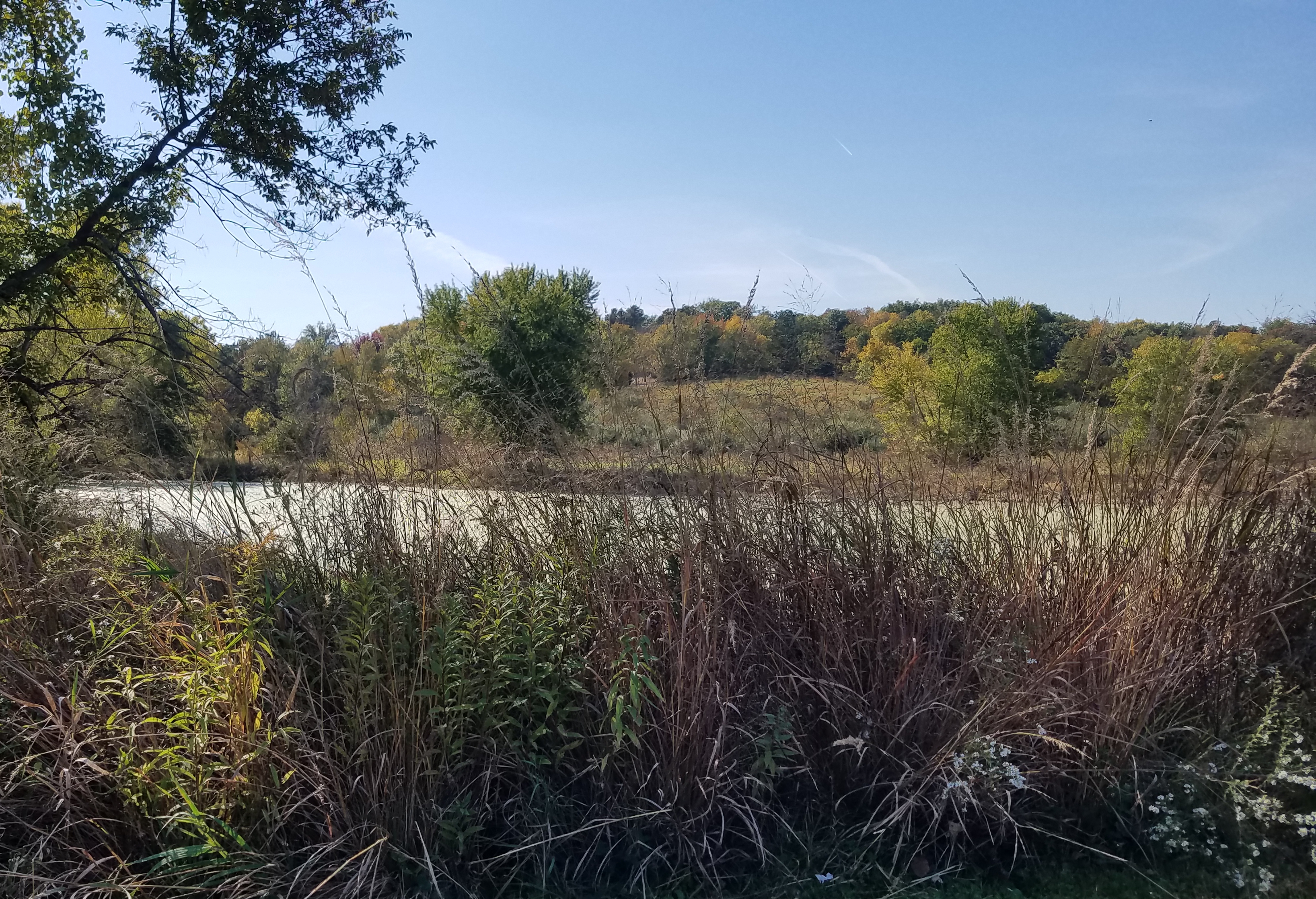
I stopped by the benches and bike racks near the pond to cool down. The sound of birds was all around. There were squirrels, grasshoppers and other insects on a bright afternoon. It was peaceful and restful. The kittens were nowhere to be found. I will assume that is good news although was a little sad when I left. The lesson is to pay attention to one’s surroundings. I doubt bicyclists noticed the kittens while they sped by.
We seek to do good in life, yet sometimes it works out differently.
I worked for seven seasons at what is now Wilson’s Orchard and Farm near Iowa City. At the time it was mostly an apple orchard with seasonal imports of cherries, peaches, raspberries, blueberries and blackberries from other farms.
During the coronavirus pandemic they expanded their offerings and yesterday announced they bought a 115-acre farm near Des Moines as a further expansion of what is proving to be a successful local food concept.
The grand opening of the Des Moines farm is spring 2023 with the strawberry season. Paul Rasch, owner and grand poobah of the farm described his first strawberry crop in Iowa City to me as “money.”
I don’t know if the proposed transition is possible, yet it may be our best hope to break the cycle of growing row crops in Iowa. Wilson’s Orchard and Farm is an idea whose time has come.
Here is the announcement video released this week that describes Paul’s vision of an Iowa food system transformed.
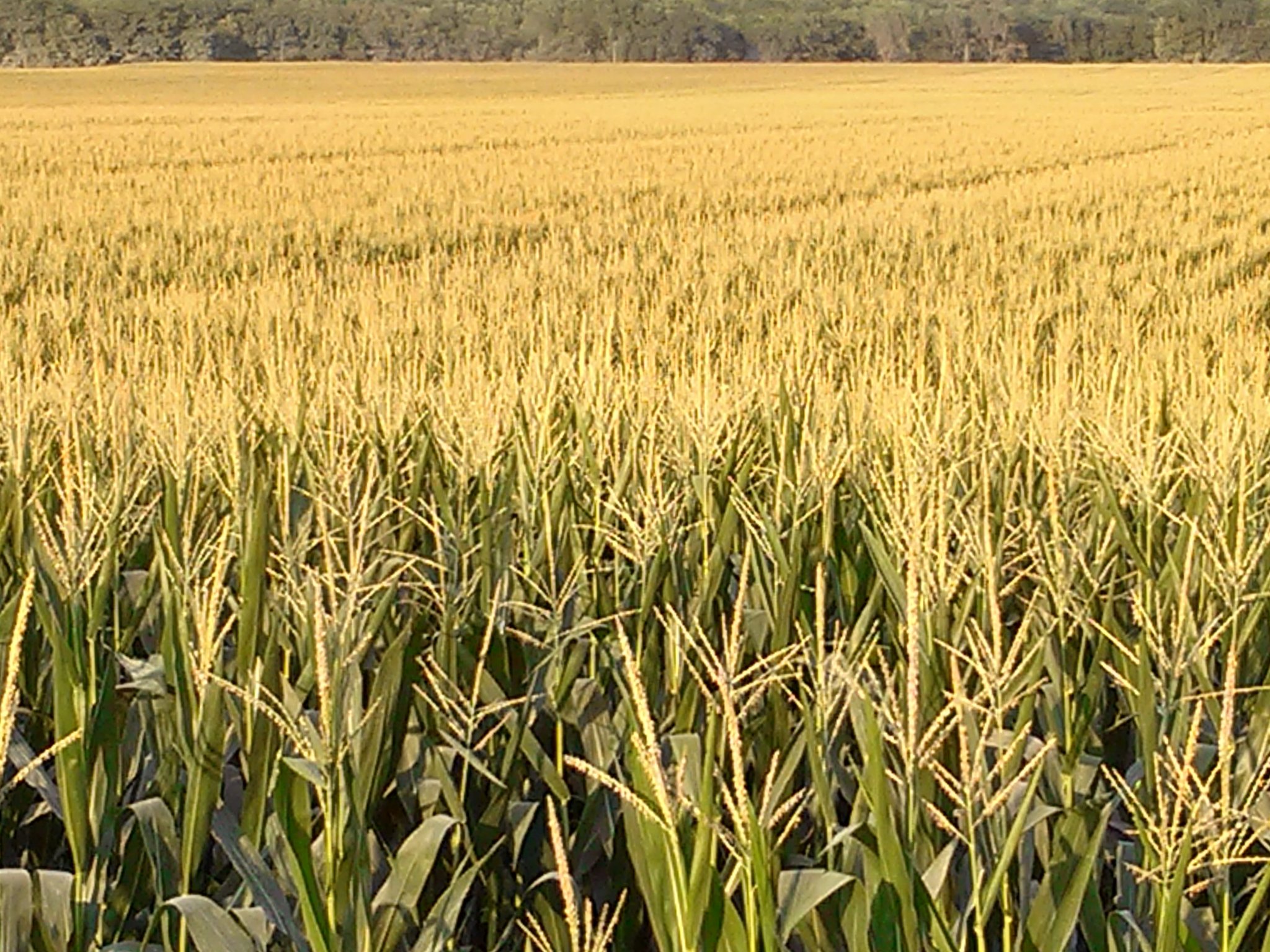
Drought-stressed corn crop in Cedar County, Iowa, 2012.
2022 has provided evidence in plain sight of the consequences of burning fossil fuels. The Greenland ice sheet is melting and expected to raise global sea levels by a foot. Such melting is already in motion and even if we stopped emitting greenhouse gases into the atmosphere today, it would have no effect on this destruction. A melting Greenland ice sheet cools the Northern Atlantic Ocean, which in turn slows the Atlantic Gulf Stream circulation and could lead to climate disruption on a massive scale.
From the American West to Europe to China, rivers are drying up. Our oceans are warming, causing fish and water-bound mammals to migrate to cooler places, disrupting fishing stocks. The upper Midwest is home to the largest global concentration of field corn. Continued high temperatures and lack of rainfall are expected to reduce yields. At $6.73 a bushel, corn is now roughly 50% above its 10-year average price.
None of this is good news. It is the truth.
In part, we got ourselves into this situation by ignoring scientists about the dangers of global warming. Here’s some more truth: President Lyndon Johnson, in a Feb. 8, 1965 special message to Congress, warned about build-up of carbon dioxide that scientists recognize today as the primary contributor to global warming.
“Air pollution is no longer confined to isolated places. This generation has altered the composition of the atmosphere on a global scale through radioactive materials and a steady increase in carbon dioxide from the burning of fossil fuels.”
There is little an individual can do. A solution will take governments addressing the physics of the issue at the highest level. It has become clear Republicans are the party of the fossil fuel industry and won’t take serious climate action. While some Democrats have fallen under the influence of fossil fuel interests and money, they were able to pass the Inflation Reduction Act which is the first legislation that addresses the climate crisis. We need more legislation to address the climate crisis, and that means electing more Democrats today.
The evidence of global warming is all around us. While everyone should get involved in what has become an obvious, global problem, the path forward in the United States is in retaining a Democratic controlled Congress and Executive Branch. No one wants to change their quality of life. However, life would be much better if we took action to control the changes caused by global warming by engaging in society.
The remaining two Bur Oak trees in the garden made an abundance of acorns this year. They are weighing down the branches so they almost touch the ground. Acorns are welcome nutrition for squirrels who took up residence in trees I planted after moving to Big Grove in 1993. These particular oak trees were planted from acorns harvested the year our daughter graduated high school and left home. There were three trees, one for each family member, but the August 2020 derecho took one of them out.
The plan is to remove one of the remaining two after the garden finishes this year. It will allow the final one to grow to maturity. By the time it does, I’ll likely be too old for much gardening yet I hope to be able to appreciate its native glory.
It took an hour to harvest tomatoes yesterday. There were two and a half gallons of San Marzanos, a milk jug full of mixed cherry tomatoes, and a bushel of slicers. Today’s plan is to clean them all, remove the imperfect ones to make tomato sauce, and organize what’s left for optimum storage and use in the next couple of days. Tomatoes planted under the oak trees are looking better, so there will be a harvest of plums and Amish paste for canning. This season is running late across the garden.
While I reached into tomato cages to take fruit from the vines I thought about next year. I plan to continue the trellis system for cherry tomatoes and plant two additional long rows, one of mixed slicers and one of San Marzanos, Granaderos, and Amish Paste. The trellis will be longer, as we are using more cherries in the kitchen. It needs to be more sturdy so I may invest in t-posts for the upright supports and place them closer together. They will be flanked by the other two rows, which in turn will be flanked by bell peppers on one side and a mix of eggplant and hot peppers on the other. That would allow focus on that particular garden patch at the same time of year. One can tell fall is not far away by this contemplation of next year.
Where the garlic will go this fall is not decided. This year’s crop continues to cure in the garage and the heads used have been healthy and tasty. I planted 100 head last fall and it produced plenty for the kitchen. Almost every seed planted yielded a head. When the curing process is finished, I’ll save the best heads for seed. This garlic originated on Susan Jutz’ farm and has been planted year after year for a very long time. It has good characteristics and stores well.
Soon I will mow the harvested garlic patch and use the plot to store grass clippings. With the recent rain, the yard grass is long and will make plenty for storage. I also need to tear down the failed onion patch and prepare it to store fencing. I need a sunny afternoon for this work.
We move through the gardening season so quickly any more. In late August, the work continues to be about tomatoes, peppers, greens, celery, and eggplant. Cucumbers and zucchini are about done. I hope to plant lettuce before the week is done. Acorns forming on oak trees are the sign I had better get going.
Some days I’m thankful for the ability to walk the state park trail and see the ever-changing plant, animal and insect life. Being thankful is enough for this Saturday.
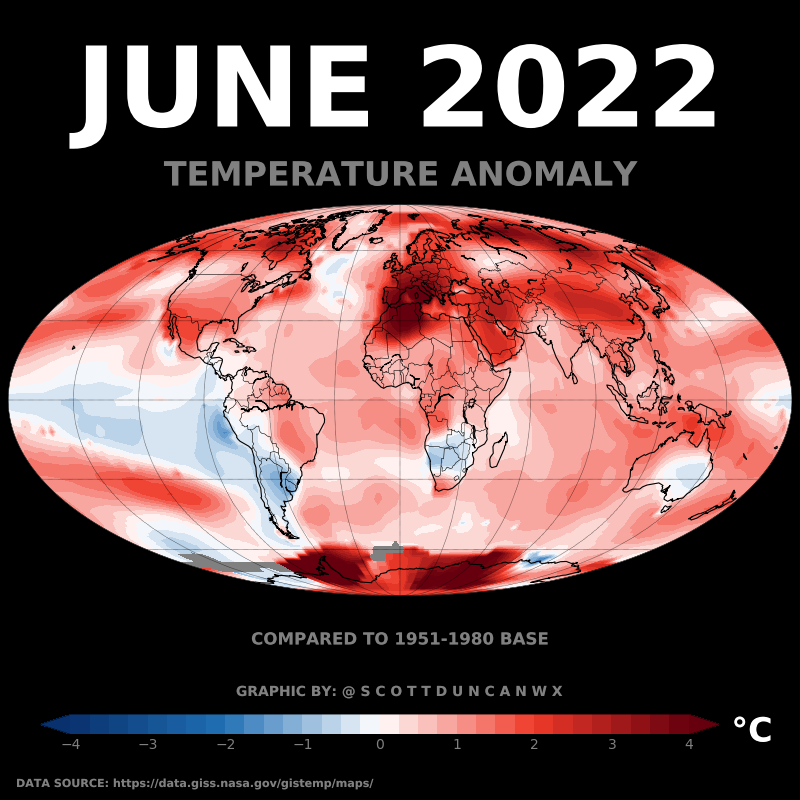
I’ve written about the environment on Blog for Iowa since my first post on Feb. 25, 2009. Never in the time since then has there been more happening regarding degradation of our environment. As Scott Duncan’s graphic above indicates, it is getting a lot hotter on most parts of Earth. Methane and carbon dioxide emissions are rising, the oceans are getting warmer, ice sheets at the poles are melting, and there is a general lack of political will in the United States and elsewhere to do enough reverse our course.
More than 40 percent of U.S. population lived in counties affected by climate disasters in 2021, according to Sarah Kaplan and Andrew Ba Tran of the Washington Post. In a report issued June 27, Kayrros, a firm that analyzes satellite data, said methane emissions have climbed despite the launch of the Global Methane Pledge at the U.N. climate conference in Glasgow, Scotland, last fall. The firm said that “global methane emissions so far appear to be going in the wrong direction.”
“Sadly, we have taken the ocean for granted, and today we face what I would call an ocean emergency,” U.N. Secretary General António Guterres told delegates at the June opening of the United Nations Ocean Conference in Lisbon, Portugal. “We must turn the tide. A healthy and productive ocean is vital to our shared future.”
Despite substantial evidence of environmental degradation that affects human life and society, President Biden’s plan to address the climate crisis fell flat in the Congress because there were not enough votes to pass it with a divided U.S. Senate.
“The reality we face implores us to act,” Al Gore said.
In Iowa we tinker around the edges of addressing the climate crisis. Decisions like the one I wrote about in 2009, which stopped Interstate Power and Light from building a coal-fired electricity generating station in Marshalltown, have been driven by economic factors rather than any concern about the environment. “You don’t like coal? Fine! We’ll use natural gas which is cheaper anyway,” they might have said. Neither the government nor industry in Iowa takes action on the climate crisis unless there is a positive, monetary effect on someone’s bottom line. Human health and well being has been a secondary consideration despite the warnings of public health officials like I was back in the day.
A lot of Iowa environmental activist bandwidth is being taken up by the fight to stop three different Carbon Capture and Storage proposals. Art Cullen cut to the chase in a July 15 editorial in the Storm Lake Times, saying, “The pipelines will get buried. The Iowa rainmakers will get theirs as we pretend that we are addressing the planet being on fire.” It is hard to give up on the fight against CO2 pipelines, even if it plays out like some of the other transportation proposals to take oil, electricity, liquefied CO2, or other commodities across county lines.
What is a climate activist to do? I would start by learning about big scale solutions and getting involved in electing candidates willing to take action on them. I reviewed The Decarbonization Imperative: Transforming the Global Economy by 2050 by Michael Lenox and Rebecca Duff here. It’s a good place to start. A couple of things seem clear. Individual action is unlikely to solve the climate crisis. Large scale solutions take technical skill to design and political will to implement.
I recommend readers become part of the solution to the climate crisis by getting involved in efforts to implement large scale environmental projects. In most cases, that begins at the ballot box with voting for candidates willing to do the work.
Ten years ago I posted about the impact of the 2012 drought on Iowa agriculture. Read the post here, yet the crux of the article was climate change was absent from public discussion of the drought. Nothing has changed since then.
Drought conditions continue to affect Iowa crops. Josie Taylor with Iowa Environmental Focus writes about how the current drought impacts crops in Northwest Iowa:
“Corn and soybean plants are continuing to suffer in some parts of Iowa from excessive heat and drought,” she wrote. “This has been seen especially in far northwest Iowa where drought conditions are worsening. Large areas of Plymouth and Woodbury counties are in extreme drought, according to the U.S. Drought Monitor.”
Isn’t it time, ten years later, we acknowledged the 800-pound gorilla in the room? Climate change is real and Iowa agriculture won’t discuss solutions to it. We are running out of time to address the climate crisis before it is too late.
Learn more about The Climate Reality Project and how you can get involved in solving the climate crisis by clicking this link: https://www.climaterealityproject.org.
If Iowa agriculture won’t take action to mitigate the effects of climate change on their primary industry, the rest of us must.






 Journey Home
You must be logged in to post a comment.