There has been a lot of news about the Dakota Access Pipeline (aka Bakken Oil Pipeline) during the last three months. Where does the project stand? Here’s an update based on information gathered this week.
After the petition has been fully reviewed by board staff and is determined to be sufficiently in order, an order will be issued by the board setting the date for a public hearing.
“Due to the size of this project, the petition review process will take considerable time and there is no certain way to predict an exact hearing date,” Tormey said. “When a hearing date is established, it will be posted on the Board’s hearing and meeting calendar on the IUB website.”
During a meeting with state Senator Joe Bolkcom (D-Iowa City) yesterday, he said a bill has been introduced into the legislature to increase the amount of liability insurance for companies seeking to pursue large projects such as the Bakken Oil Pipeline. State Rep. Bobby Kaufmann (R-Wilton) said he is seeking House support for a similar bill.
Wally Taylor and Pam Mackey Taylor, representing the Iowa Chapter of the Sierra Club, were at the capitol soliciting signatures on a letter to the IUB opposing approval of the Dakota Access project. The draft letter cited four reasons for opposition. The pipeline would provide no benefit to Iowans, landowners would be forced to give up their land by eminent domain, pipelines leak, and the pipeline will further enable this country’s addiction to oil.
A new pipeline will delay the U.S. transition to clean and renewable energy and more fuel-efficient vehicles according to the Sierra Club.
The period for filing comments, objections and letters of support is still open according to Tormey. Anyone seeking to file objections, comments, and letters of support in this docket may do so by using the Iowa Utilities Board’s Electronic Filing System (EFS), citing the docket number, and clicking on the “Submit Filing” tab and following all instructions to log-in as a guest. Persons lacking computer access may file written comments by mailing them to the Iowa Utilities Board, Executive Secretary, Docket No. HLP-2014-0001, 1375 E. Court Ave., Rm 69, Des Moines, Iowa 50319-0069
The direct link for electronic submissions is here. To view other filings, click here.
An approach toward sustainability begins the way Hollywood movies sometimes do—with a view of Earth from space, successively narrowing the frame until we arrive at street level. In U.S. cinema the final shot is of individuals, characters mis en scene.
A new perspective is possible with the launch of the Deep Space Climate Observatory last week. Aboard a Falcon 9 rocket, the 1,250-pound satellite was sent on a 110-day trip toward the L1 Lagrange point, a gravitationally-stable location nearly a million miles from Earth in line with the sun. While monitoring streams of particles from the sun, it will also look back to Earth. That’s a beginning point.
In a life one has to make choices. Using the Hollywood convention, my public focus can be narrowed as follows:
In the global community I make two engagements: nuclear abolition and dealing with the consequences of global warming. This means continued involvement with International Physicians for the Prevention of Nuclear War and the Climate Reality Project. IPPNW won the Nobel Peace Prize in 1985, and the Climate Reality Project’s founder, Al Gore, won it in 2007 along with the United Nations’ Intergovernmental Panel on Climate Change. These organizations have standing, and are worth engaging.
Nuclear weapons and global warming both impact people’s health and survival, which aligns my view with that of public health. On Tuesday, Pamela Mollenhauer of the State Hygienic Laboratory told me, “One can’t speak of the environment and health separately because they are intertwined.” Issues relating to nuclear weapons and climate affect us all and are likewise different sides of the same environmental coin.
My involvement in nuclear abolition is being part of the international humanitarian campaign. This movement has not gained traction in the U.S., but around the world people and nations are calling for nuclear weapons abolition.
The U.S. position is abolition will come through the established Nuclear Non-proliferation Treaty process. Advancing the NPT has stymied because the nine nuclear states fail to take their obligations under the treaty seriously enough to make progress. Quite the opposite is happening. The Obama administration is about to launch a massive modernization program expected to spend hundreds of billions of dollars on the U.S. nuclear complex over the coming three decades. If I spent all my time with the humanitarian campaign, it would be a full time job.
The effects of global warming are becoming increasingly evident, requiring action.
“We’re here to remind people that a changing climate is resulting in environmental degradation that is having severe health impacts we can’t afford to ignore,” said Dr. Maureen McCue of Iowa Physicians for Social Responsibility on Tuesday. The PSR advocacy targets are also mine.
“Climate change poses enormous threats to our health. Heat waves, immense storms, floods, droughts and expanding disease ranges are just some of the dangers we face,” said an article in the Fall 2014 issue of PSR Reports. PSR enumerated four main targets for advocacy.
The Clean Power Plan is a proposed national plan that will build on a rule proposed by the Environmental Protection Agency. States would be required to significantly reduce carbon dioxide emissions from power plants. EPA is expected to finalize the rule this year and then states would implement. In Iowa, the Clean Power Plan would be administered by the Iowa Department of Natural Resources. A few Iowa legislators are aware this rule is coming, but many are not.
Moving beyond fossil fuels is a key concern and Iowa has been a leader in promoting renewable energy. Iowa must move from coal-fired and nuclear power plants to renewable energy for electricity generation. A key possibility is distributed generation.
More wind, more solar, and distributed generation of electricity are part of Iowa’s energy future. Our state is a leader in using wind resources to generate electricity. Solar powered electrical generating stations offer cost-effective potential. A constraint has been an electrical grid fraught with partisan issues between land owners, regulated utilities, merchant plant advocates and investors, and complex contracts and agreements regarding distribution. Logically, it makes sense to use the sun directly to generate electricity, but so often industries invested in other processes drag our collective feet. This complex work calls for our attention.
Energy efficiency is about more than changing light bulbs. Demand for electricity has been dropping in Iowa, partly because the generation, distribution and use of electricity has become more efficient. This is a complicated issue, but taking steps toward energy efficiency is doable. Advocating for changes in building codes, expansion of mass transit, creating bike friendly communities, and recycling, reduction and reuse strategies all help take us there. We must also deal with related issues in the rural landscape that dominates our state but each census has fewer people.
There is a lot to be done beyond economic survival and maintaining our personal good health. Getting things done requires recognizing and setting goals that create a path toward what is possible—to sustain our lives on the blue-green sphere that is our only home.
Yesterday the U.S. Senate voted 98-1 that climate change is real. More specifically, “to express the sense of the Senate that climate change is real and not a hoax.” Senator Roger Wicker of Mississippi was the lone vote against the amendment to the Keystone XL Pipeline bill.
The Senate wouldn’t go so far as to say that climate change is influenced by human activity, thus providing wiggle room for the climate deniers who voted for this amendment.
Senator James Inhofe (R-OK) wrote the book on climate change as a hoax, co-sponsored and voted for the amendment. Once he took the gavel as chairman of the Senate Environment and Public Works Committee Inhofe proceeded to lay out his view of the matter on the Senate floor, including explaining what he meant by a climate change hoax. Emily Atkin took apart his presentation on Climate Progress, but here we are—a climate denier is now in charge on an important Senate committee.
This week, NASA released the largest photographic image of the Andromeda Galaxy ever, rendering the meaning of the Senate votes small by comparison. Comedian George Carlin said “the planet is fine, the people are fucked.” This too gets lost in the scope of the universe in which we live.
Nonetheless, life as we know it continues and where we’re bound is rarely certain. This week’s lesson is to be cautious about inflating our relevance as we endeavor to sustain our lives in a turbulent world.
LAKE MACBRIDE— During the run-up to the Nov. 18 vote on S-2280, a bill to approve the Keystone XL Pipeline, I messaged Senators Tom Harkin and Chuck Grassley, asking them to vote no. Harkin voted no, Grassley yes.
Senator Grassley sent along an explanation of his vote, which is pasted below. As he indicated, the motion failed to pass the Senate. What this letter doesn’t say is that I asked him to vote no, without any other comment. I have been around politics too long to believe that logic and rational thinking have much to do with why a U.S. Senator votes a certain way.
The framing of Grassley’s response points out the challenges opponents of the pipeline will have once the 114th Congress convenes. His arguments are rational in their way, if misguided.
It is hard to disagree with building a pipeline per se. There are many pipelines in the world, and they are a mode of transportation that serves the oil and natural gas industry, which in turn supports political stability. As Grassley pointed out, building pipelines creates jobs.
This is not a partisan issue. In Hillary Clinton’s secretary of state memoir, she mentions building pipelines several times, always as a solution to energy problems which in turn increases political stability around the globe. It will be hard to win the argument against Keystone XL because of the existential fact of it being a pipeline.
If oil prices continue to decline, the economic conditions which made the Tar Sands viable will erode. The reasons for declining oil prices are complex, but it boils down to a combination of increased U.S. shale oil production, lack of willingness by OPEC to curb production, and our society’s addiction to fossil fuels. It seems unlikely that the oil and gas industry will allow prices to get too low, and we are not in control here, except for our personal energy choices.
Something’s got to give to reduce reliance on fossil fuels. Plugging an electric car into our household grid is not an answer if all we do is switch our energy source from gasoline to coal and nuclear, both of which have their own risks to human health. Grassley doesn’t directly mention decreasing reliance on fossil fuels as an issue in his response.
The argument about what happens to the oil in Texas is unresolved, despite Grassley’s assertion otherwise. The issue with refining, in light of increased U.S. oil production, is one of limited capacity. It has been a while since I was familiar with refining operations, but I suspect refineries are still running every minute they can to keep up with demand.
Could the refineries re-tool to handle Tar Sands oil? Yes, definitely. Is there an economic reason to do so when there is plenty of Middle East oil entering the Gulf of Mexico at a low price? Probably not in the short term, and there appears to be little interest in increasing refining capacity in light of the current regulatory environment. Going forward, one would expect the Tar Sands crude oil to be exported the way U.S. light sweet crude currently is—because the refineries are already doing all they can to keep up with imports.
Grassley’s right to say we should decrease our reliance on imported oil. The simple fact is there is not enough oil being produced in North America to meet U.S. needs, and as I mentioned, there are economic constraints to refining capacity. What is missing is affirmation of the need to decrease use of fossil fuels, and that’s more the problem with the response.
The trouble for opponents of Keystone XL is that Grassley takes apart many of their arguments in a way that will build political support for a likely re-consideration of the project in 2017, if not in 2015. It is important to read his response and learn from it… and hope the climate doesn’t reach the tipping point while we dance around what most needs doing: reducing and eliminating our reliance on fossil and nuclear fuels.
Charles E. Grassley
Washington, D.C.
December 4, 2014
Thank you for taking the time to contact me. As your Senator, it is important for me to hear from you.
I appreciate knowing your concerns regarding the crude oil pipeline from Canada to Nebraska called the Keystone XL pipeline. On November 18, 2014, the Senate held debate and voted on S. 2280, a bill to approve the Keystone XL Pipeline. I was an original cosponsor of this bill and supported its passage. However, the bill failed by a final vote of 59-41, one vote short of the 60 votes necessary for it to pass the Senate.
The pipeline would supply more than 800,000 barrels a day of Canadian crude oil to U.S. refineries and help to counteract both insufficient domestic oil supplies in the United States and reduce dependence on less reliable foreign sources. The Keystone XL pipeline is a $7 billion, 1,700 mile pipeline that would create thousands of private-sector jobs at no cost to American taxpayers.
In 2008, TransCanada applied for a presidential permit from the State Department to construct and operate the pipeline. Due to environmental concerns, the State of Nebraska approved a modified route in January, 2013. Following this modification, the State Department released a draft Supplemental Environmental Impact Statement (SEIS) on the new presidential permit application. The State Department noted that oil sands development would go ahead regardless of the production of the pipeline by using different pipelines or rail to get to market. The report essentially found that the pipeline would not accelerate greenhouse gas emissions or significantly harm the environment along its route.
After nearly six years of rigorous regulatory review, the State Department issued its fifth environmental review on January 31, 2014. This fifth review reached the same conclusion as earlier reviews. It found that the pipeline will have no significant impact on the environment and is the safest way to transport the oil. It also found that rejection of the pipeline will not affect Canada’s decision to develop these oil resources. The administration had been in the middle of a 90-day review period for federal agencies assessing the State Department’s environmental study when, on April 18, 2014, the State Department announced an indefinite extension of the agency comment period.
Opponents of the Keystone pipeline argue that the pipeline will not increase oil and gas supplies in the United States, rather, that all of the Canadian crude would be sold to world markets. Even President Obama reiterated this claim when he said the pipeline would allow the Canadians to “pump their oil, send it through our land, down to the Gulf, where it will be sold everywhere else.” However, the Washington Post “Fact Checker” disproved this claim. It noted that the State Department’s final environmental impact statement specifically disputed claims that the oil would pass through the United States and be loaded onto vessels for ultimate sale in foreign markets. It found that the crude oil would almost certainly be refined in the United States, with at least 50 percent of the refined products remaining in the U.S. market. It stated, “market conditions could change, of course, but there is little basis to claim that virtually all of the product, or even a majority, would be exported.”
The energy and economic development benefits of this pipeline are too important to delay any longer. We need an all-of-the-above approach to meet the country’s energy needs and give consumers choice. That means oil, ethanol, electricity from wind, and nuclear power. A pipeline would be safer than transporting oil by rail. Canada will produce this oil with or without U.S. involvement in the shipment. I’d rather work with one of our strongest allies than continue to get oil from the volatile Middle East or Venezuela.
What is needed now in the United States is an increased supply of oil. It is simple economics. If you increase the supply, you decrease the price. We are still relying on a very finite amount of oil. We must increase our own domestic supply of energy while promoting the use of alternative sources of energy at the same time. I will continue to support these goals with your thoughts in mind.
Again, thank you for taking the time to contact me. I appreciate receiving your comments and urge you to keep in touch.
LAKE MACBRIDE— People don’t connect the dots between lower gasoline prices and the shale oil boom.
Yesterday I filled my gas tank for $23.70, with the per gallon price in the mid-$2.40 range. That’s not low compared to when I commuted to Eldridge and fueled at Walcott for $1.02 per gallon for what seemed like months. Neither is it like when I was young and gas wars yielded prices below $0.30, enabling me to top off my tank for a buck or two. However, we are now below $3 per gallon with the prospect of going lower, so prices seems low in a short-term, relativistic way.
There is no doubt that the revolution in shale oil production through hydraulic fracturing is causing the lower oil and natural gas prices in the U.S. The shale boom is replicable world-wide (at least to some degree) because shale is a common and abundant form of sedimentary rock. In some ways, the game changing of shale is just getting started, even though it began in the 1940s.
When I was in my 20s, we thought shale oil was inaccessible. Hydraulic fracturing is a technology that revolutionized exploration, development and production of shale oil. In light of higher oil prices, it became profitable. Some credit goes to politicians, but most credit goes to the oil companies who persistently lobbied for a relaxed regulatory environment with anyone who could be influenced from the president on down.
What does this mean besides lower gasoline prices? Three things seem most important.
The arguments for and against hydraulic fracturing are reasonably accessible.
“Hydraulic fracturing is highly controversial, proponents advocating economic benefits of readily accessible hydrocarbons, and opponents concerned for the environmental impact of hydraulic fracturing including contamination of ground water, depletion of fresh water, degradation of the air quality, the triggering of earthquakes, noise pollution, surface pollution, and the consequential risks to health and the environment,” according to Wikipedia.
There is plenty of meaning in the existential fact of hydraulic fracturing and use of its products. What is less discussed is the impact on climate change, and the impact on renewable energy development.
While shale oil production is booming, 2014 will be the warmest year on earth since record-keeping began, and a clear departure from the climatic conditions in which the industrial revolution emerged. It’s hot and getting hotter world-wide. The climate has changed and is changing.
It is a scientific fact that man-made pollution is contributing to the warming planet. Natural gas is a fossil fuel that emits carbon dioxide when burned. While part of domestic carbon emission reductions during the last ten years have come by switching from coal to natural gas for electricity generation, there are problems.
Methane released as a byproduct of hydraulic fracturing operations is a more potent greenhouse gas than CO2. Methane leakage would reduce the value of the air pollution reduction realized by shifting electricity production from coal to natural gas. Some say methane leakage could negate any gains made in CO2 reductions from switching from coal to natural gas.
As a fossil fuel, natural gas should be viewed only as a so-called bridge fuel, although the clear and present danger is that it will be perceived as a destination fuel and become a permanent fixture in our energy mix.
That raises the third issue. There is a broader economic impact that the Bulletin of the Atomic Scientists (BAS) spelled out in a Dec. 10, 2014 article. Not only is gasoline cheap in a shale gas development scenario, it is impacting the U.S. energy mix, and nuclear power and renewables are taking the hit.
The basic argument about bridge fuels is that the shale boom and its products can act as “bridge” fuels, curbing emissions while non-fossil energy sources such as renewables and nuclear energy are ramped up.
As we have seen in Iowa, new nuclear power has become financially untenable unless its excessive costs can be passed along to rate payers.
Not only are new nuclear power plants imperiled because of the economics of the shale boom, existing nuclear plants have been as well. “While cheap gas is not the only culprit eroding the profitability of nuclear energy, it is the straw that is breaking the camel’s back,” wrote BAS.
What’s more important is the economics of shale gas are suppressing development of renewable energy. As we have seen in Iowa, without government subsidies of renewable energy, production of new renewable capacity languishes. In the current political climate, it is uncertain whether renewable energy subsidies will continue, and for how long.
While the economics of wind and solar may be reaching parity with fossil fuels in some markets, we are not there yet, and the subsidies are essential to continuing development of alternatives to fossil fuels.
It is important that we extend our reach beyond personal or family budgets and do what is right about the shale boom. That means developing the political will to finish a transition to a fossil fuel free world.
Easier said than done, but the price society will pay for failing to do so is much higher than what we see at the gas pump.
Congress put an unexpected gift under the Christmas tree the National Defense Authorization Act (NDAA) has become.
The U.S. is poised to give a foreign mining company 2,400 acres of national forest in Arizona that is cherished ancestral homeland to Apache natives. Details of the proposed land deal can be found here.
The giveaway of Apache burial, medicinal, and ceremonial grounds is currently within the bounds of Tonto National Forest. Resolution Copper, a subsidiary of the Australian-English mining company Rio Tinto and BHP Billiton, is to be the beneficiary of Congress’ largesse at the expense of Apache natives.
News of the land provision in the NDAA was kept under wraps until late Tuesday, when the bill was finally posted online. The land deal appears on page 1,105. The bill passed the U.S. House on Thursday 300-119. The bill now goes to the U.S. Senate where it is expected to pass during the lame duck session.
The Resolution Copper website describes the deal as “developing an Arizona copper resource to benefit the world. Located near Superior, Arizona, the project hosts one of the world’s largest untapped copper resources.”
“Since time immemorial people have gone there. That’s part of our ancestral homeland,” Terry Rambler, chairman of the San Carlos Apache Tribe said, referring to the overall area in question. “We’ve had dancers in that area forever—sunrise dancers—and coming-of-age ceremonies for our young girls that become women. They’ll seal that off. They’ll seal us off from the acorn grounds, and the medicinal plants in the area, and our prayer areas.”
Rambler said whether Rio Tinto’s economic assertions are true or not, it may not matter.
“It seems like us Apaches and other Indians care more about what this type of action does to the environment and the effects it leaves behind for us, while others tend to think more about today and the promise of jobs, but not necessarily what our creator God gave to us,” he said.
This year Congress named the NDAA the “Carl Levin and Howard P. ‘Buck’ McKeon National Defense Authorization Act for Fiscal Year 2015” after the retiring Senate and House Armed Services Committee chairmen. Arizona Senator John McCain is said to have been instrumental in getting the mining deal added to the law.
“The Resolution Copper project has the potential to utterly transform these communities (near Superior, Arizona),” wrote McCain in an article in AZCentral. “At full capacity, the mine could create as many as 4,000 jobs and produce roughly 25 percent of our nation’s domestic copper supply. Arizona as a whole will likely benefit from tens of billions of dollars in increased economic activity over the lifespan of the mine.”
This is who we have become as a nation. Exploring for and producing every last resource on the globe, regardless of long standing and legitimate concerns, for the sake of jobs.
Where will the copper go? It will be traded on the world market. One of the buyers is expected to be the country with the biggest shopping cart. Today’s that’s China. Another indicator of the times in which we live.
The government favors the military, and since the NDAA is expected to pass each and every year, what better place to hang an ornament of interest to the richest corporations in the world? The goal is economic development, but at what cost? Politicians like John McCain don’t answer that question.
BIG GROVE TOWNSHIP— There was trouble last night at the cemetery, the first such trouble since I was elected township trustee.
It had to do with who could be buried in whose plot, and the trustee who coordinates plot sales and burials wanted to discuss the issue. The funeral is Friday, so no time for dalliance. We are meeting at 8:30 a.m.
Two years into my term, being a township trustee has provided a steady stream of learning about our community. There has been time to consider things, and almost no controversy—just repeated expression of wills about what should get done and how. Any conflicts that surfaced were quickly resolved.
I’m confident we will figure this one out.
Yesterday it was shown that Mary Landrieu did have 59 votes to proceed on Keystone XL, and that’s all she had. The bill overriding the executive process on evaluation and approval of the project now goes into the dustbin of the 113th Congress. It likely will be back next congress.
I spent part of the last two days transcribing testimony to the Environmental Protection Agency (EPA) on reduction of greenhouse gas emissions, carbon dioxide particularly.
“I began my career as a summer intern at EPA 42 years ago under what has euphemistically become known as Russell House One,” Dianne Dillon Ridgely said. “I was a 19-year old kid. And what is most dramatic is much of what we addressed that summer—in terms of air pollution, in terms of the public’s engagement on power production—are exactly the same things, particularly in terms of coal, that we are still addressing and fighting 42 years later, and to me that is really a sad commentary.”
Ridgley is a 42-year veteran of governmental action (or inaction) on clean air and clean water, having been appointed by Presidents Clinton, Bush 41 and Bush 43 to international delegations to address environmental issues. We’re still addressing them. There is hope the EPA’s actions won’t be blocked by the 114th Congress, something the presumed Senate Majority Leader Mitch McConnell indicated is high on his to-do list. Time will tell, but I believe we are on the right side of history regardless of what the Congress does.
My last workday at the local paper was Sunday. It will feel a little weird to be able to focus on my writing on the weekends instead of proof reading the paper. The bucket of part time paid jobs is down to three, and one of those is finished the second week in December. When the number surged to eight last summer, it was too much to juggle. Having found a bottom, the goal for next year is to keep what remains, and use it as a base. In addition, I will seek paid writing jobs and temporary positions and opportunities that can add a few C-notes to the treasury each month. What remains is that I work to support my ability to write.
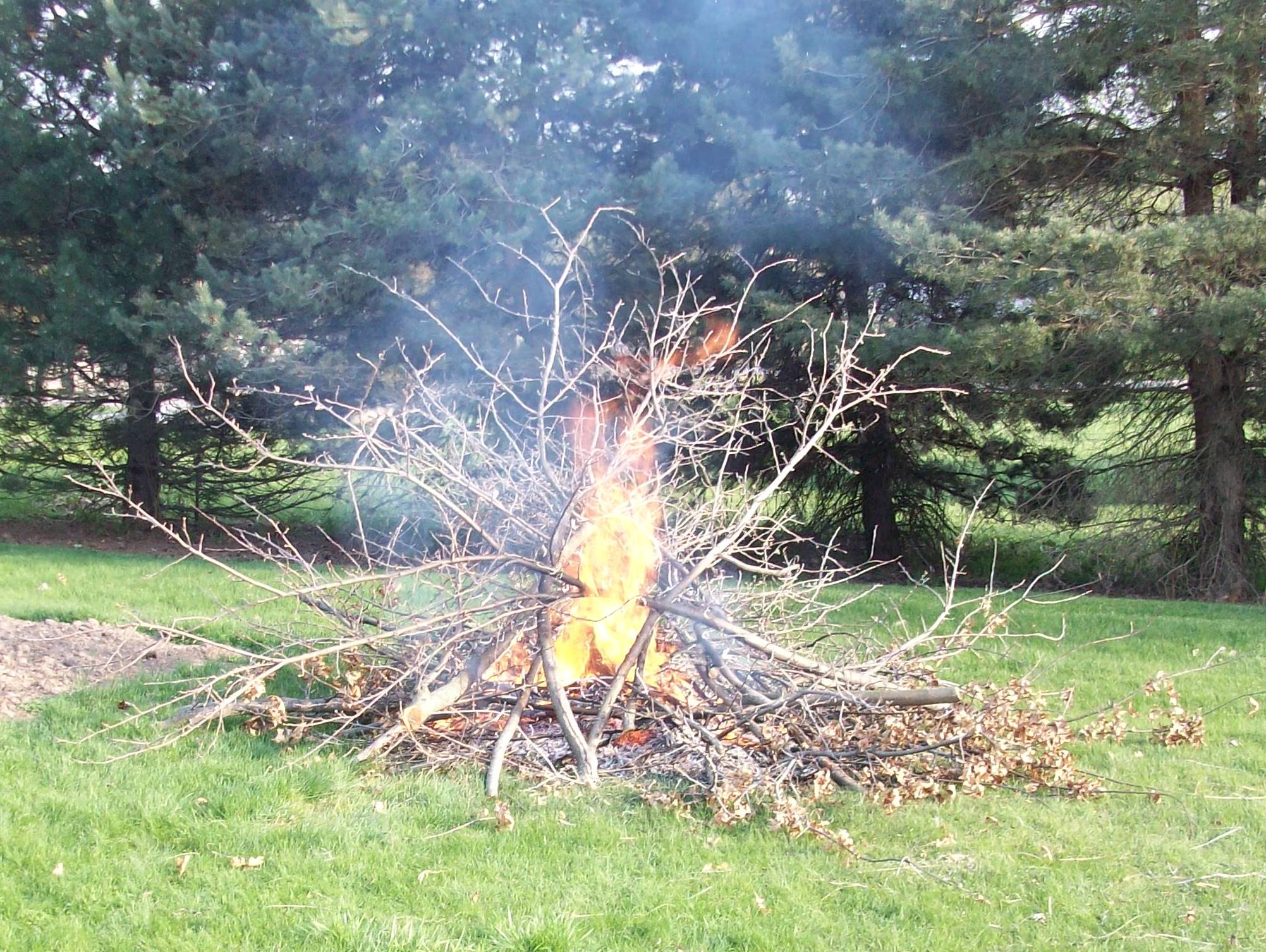
Hope against hope, I want to get out in the yard and mulch the leaves, and shorten the grass. For that to happen, the snow needs to melt, the yard dry out, and half a day of warmer temperatures roll in. In these days of crazy weather, that is possible, however improbable. That’s where this Wednesday finds me.
LAKE MACBRIDE— Yesterday the U.S. House of Representatives passed a bill directing the federal government to move forward on the Keystone XL pipeline on a 252-161 vote. It was less than the number of votes needed to override a presidential veto, but Barack Obama has been holding his cards close to the chest on Keystone. What he would do if a bill reached his desk is uncertain.
According to the New York Times, the U.S. Senate scheduled a vote on the bill for Tuesday, and Senator Mary Landrieu (D-LA) believes there are already 59 of 60 votes required to overcome a filibuster when the vote comes up. If the senate can get past a filibuster, the bill’s passage is assured, although getting 67 votes needed to override a presidential veto is less certain than it is in the the house. It’s all political theater.
Our Representative Dave Loebsack voted for the bill, reversing his last vote on Keystone XL. He sent social media atwitter with shock and disappointment framed in terms that appeared to help the authors vent frustration more than say anything coherent. I am disappointed with the vote, but what politician ever consistently voted my way?
I know a couple of things.
When people talk about “environmentalists” I no longer have a clue to whom they refer. Is a farmer who plants a buffer zone based on a government grant an environmentalist? Is a non-governmental organization’s local staff member—overly dependent upon funding sources—an environmentalist? Is a Washington lobbyist for a large NGO an environmentalist? What about members of the defense department working toward a lower carbon footprint for the military? What about my neighbors who protest building a subdivision near Lake Macbride? There aren’t real answers to these questions, and that’s the problem with vague references to “environmentalists.” There is no club to which they all belong, and fewer common denominators. The idea is actually a right wing talking point, and the frame “environmentalists” is used to demonize advocates for the U.S. Environmental Protection Agency, and against production of electricity using coal, natural gas and nuclear fuels. Keystone XL is not a common denominator among environmentalists.
The failure of environmentalists was targeting the pipeline at all, instead of the tar sands. The tar sands is a bigger problem because of humanity’s inexhaustible thirst for oil and natural gas. This is the same problem for the Bakken, West Texas and Eagle Ford formations. Because oil and gas are in demand, there is direct financial return, subsidized by our government, in exploiting these resources. The environmental communities have been unable to adequately articulate the unrecognized costs in terms of human health of these exploration, discovery and production operations—even if a small number of people are working on it. Successful efforts have taken a targeted, NIMBY approach, like the fight against frac sand mining in Allamakee County. By targeting Keystone XL, environmentalists set themselves up for failure. As a friend wrote me last night, “there are hundreds of pipelines in this country already—what’s one or two more?”
I also know unions favor building pipelines. Ken Sagar and Bill Gerhard laid out their position in a Dec. 11 opinion piece in the Des Moines Register. Only a cynic would say that Loebsack’s vote on Keystone XL was quid pro quo for union financial and canvassing support during the 2014 midterms. It is likely more complicated than that, but it had to have been a factor. Part of being Democratic is the fact that Democrats don’t always agree. Keystone XL and Iowa’s proposed Bakken Oil Pipeline are a prime examples of that. Loebsack’s framing of the explanation for his vote makes his sympathies for the union’s legislative priority clear.
“I was skeptical of side stepping the normal processes, but the jobs attached to building the Keystone Pipeline are too important and can no longer be tied to D.C. gridlock,” Loebsack said, according to Ed Tibbetts of the Quad-City Times.
What I also know is October 2014 was the hottest month recorded on the planet since record-keeping began, according to the Washington Post. Yes, you skeptics, the world’s temperatures may have been higher or much colder in some prehistoric era. But what matters more is our civilization, and the changes produced by the industrial revolution are at risk. The underpinnings of basic facts about our lives, when the first frost comes, the amount of rainfall in a region, how we produce electricity, how we sequester carbon in the land, water sourcing, and others are all being undone.
It will take more than one vote in one governmental body to address these broader challenges. What I know is that is unlikely to happen in my lifetime unless we stop focusing on bright and shiny objects like Keystone XL.
LAKE MACBRIDE— It is hard not to engage in the news from outside Big Grove Township. U.S. and partner states are bombing Syria, the United Nations is taking up the expiration of the Kyoto accord, and more than 100 world leaders will address security issues at the U.N. It has already been a busy week.
Today, the U.N. Climate Summit 2014 convenes on an optimistic note:
Climate change is not a far-off problem. It is happening now and is having very real consequences on people’s lives. Climate change is disrupting national economies, costing us dearly today and even more tomorrow. But there is a growing recognition that affordable, scalable solutions are available now that will enable us all to leapfrog to cleaner, more resilient economies.
There is a sense that change is in the air. U.N. Secretary-General Ban Ki-moon has invited world leaders, from government, finance, business, and civil society to Climate Summit 2014 this 23 September to galvanize and catalyze climate action. He has asked these leaders to bring bold announcements and actions to the Summit that will reduce emissions, strengthen climate resilience, and mobilize political will for a meaningful legal agreement in 2015. Climate Summit 2014 provides a unique opportunity for leaders to champion an ambitious vision, anchored in action that will enable a meaningful global agreement in 2015.
While many states recognize the validity of what Ban Ki-moon has said, in the U.S., a positive outcome in the form of a binding and meaningful legal agreement seems unlikely. Even if some of us are pessimistic about U.S. participation, it will be worth our attention today and in coming days, to see what the Climate Summit produces. It is noteworthy that President Obama will be trying to get a resolution on counterterrorism passed by the U.N. Security Council rather than making any bold announcements on mitigating the causes of global warming.
In the universe of a single life, there can be hope. So that’s how I will spend this day on earth. Believing that we can sustain our lives in peace despite so much evidence to the contrary.
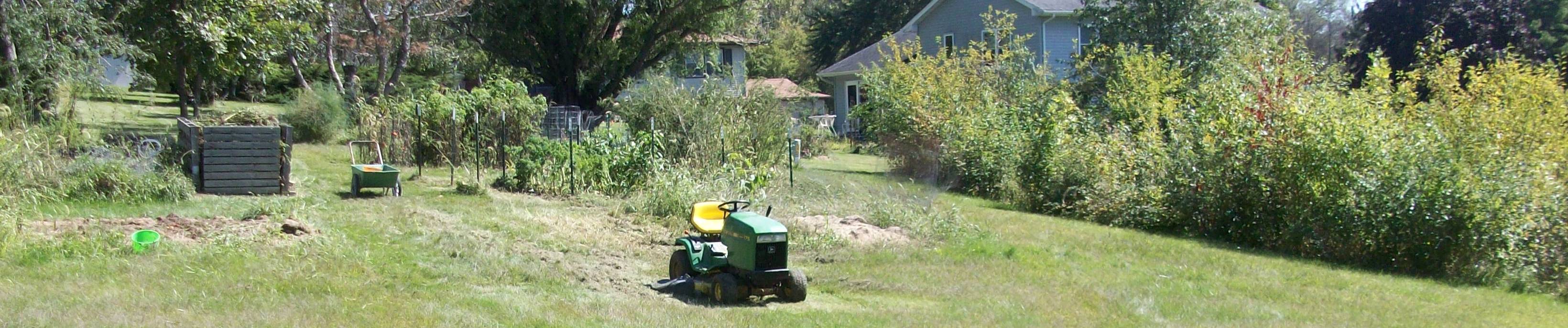
LAKE MACBRIDE— When the ditch in front of our house dried enough to run the lawn tractor through, it was a sign that dry conditions were returning to Big Grove. 140th Street remains flooded, but most of the other roads in the county are passable. After an exceptionally wet and pleasant spring and early summer, the hot, humid weather has returned and we need rain.
Forcing myself outside, away from kitchen work, I pulled weeds from very dry soil before the day got too hot. I watered the vegetables, hoping dew and rain later in the week will nourish them— will be watering again before nightfall.
Broccoli Closeup
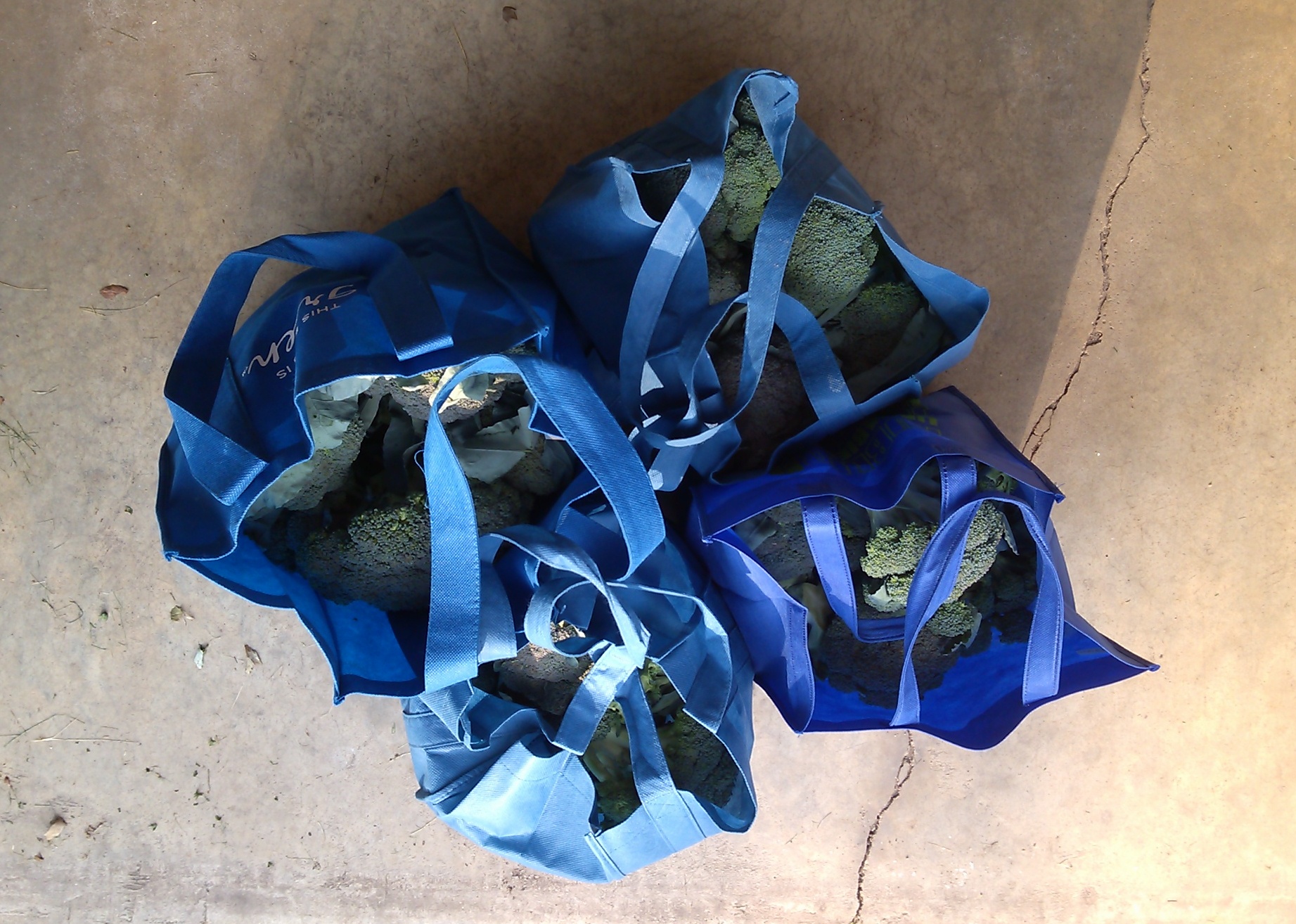
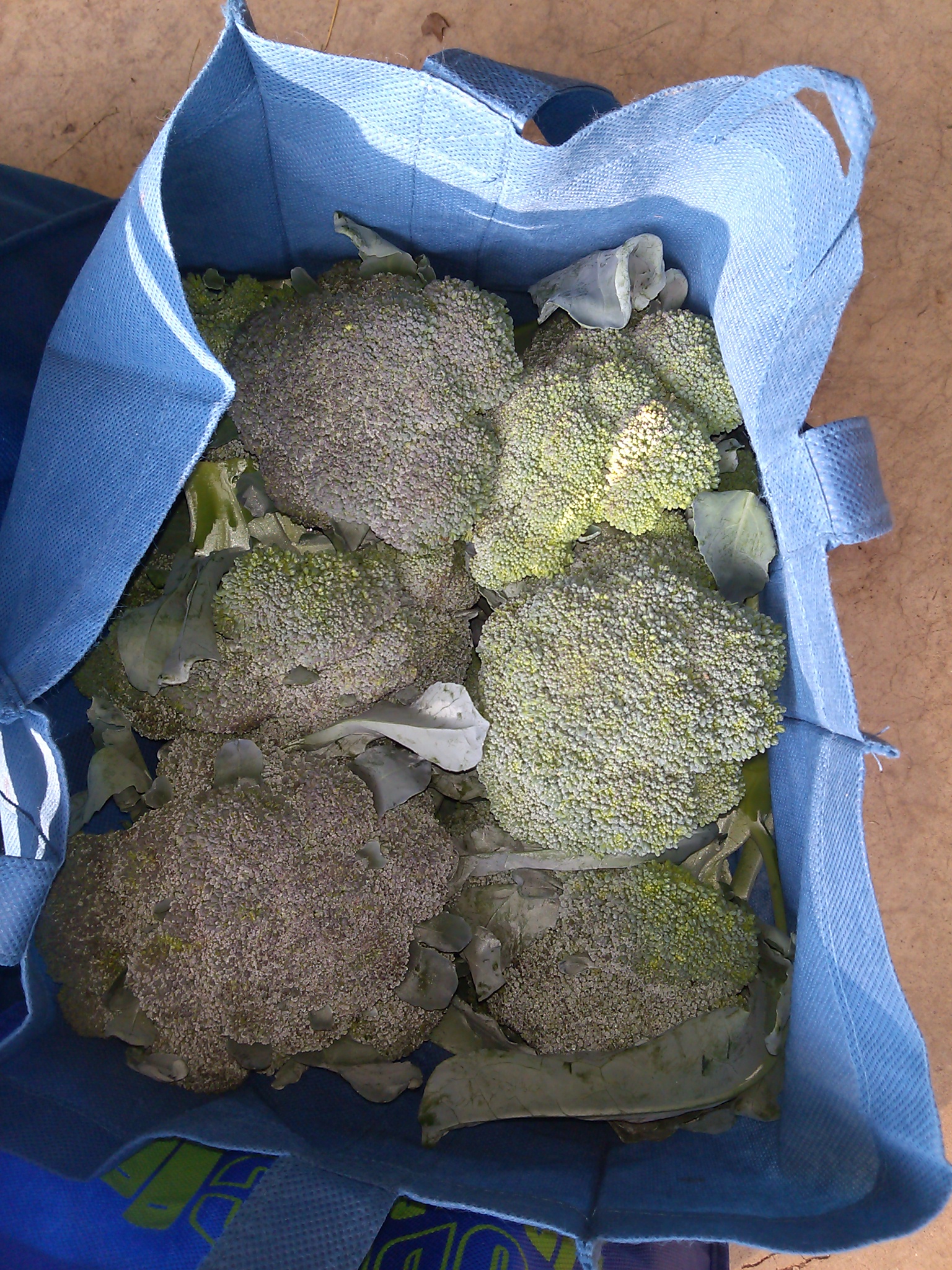
The last 24 hours has been what local food enthusiasts live for— securing broccoli for the winter, blanching and freezing it. It is work, with these outcomes: the best heads were kept fresh to cook later in the week; some of the best looking florets ever are processed and freezing; stems will be converted to soup, which then will be canned for later use; the freezer is getting a thorough cleaning of last year’s produce to make room, some of them going into the aforementioned soup; frozen rhubarb will be converted to sauce and canned; blueberries? Who knew?; and finally, vegetables that were frozen and are now coming in fresh will be composted.
Last night and today’s work is positive in so many ways.
That said, would it be better to buy frozen broccoli from the store during winter? When one lives close to the means of production, the answer is an emphatic no.
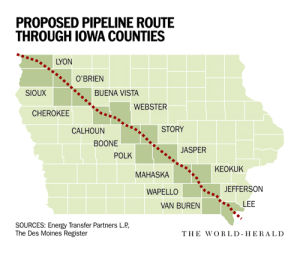 There has been a lot of news about the Dakota Access Pipeline (aka Bakken Oil Pipeline) during the last three months. Where does the project stand? Here’s an update based on information gathered this week.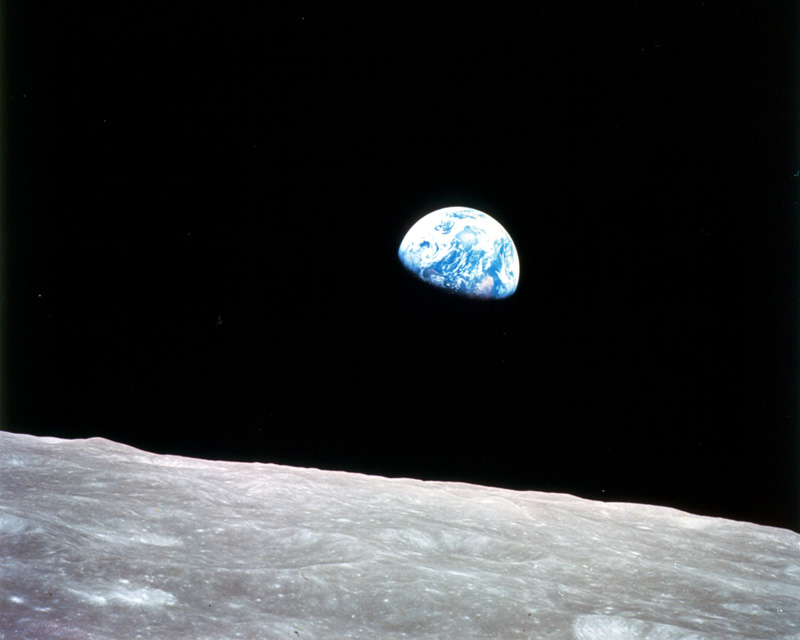





 Journey Home
You must be logged in to post a comment.