Today is the first day of shotgun deer season. Until Dec. 17 Iowa shows its culture in tradition-laden, bloody and violent detail.
The deer population needs culling. The damage they do in nature and on farms goes mostly unnoticed by city dwellers. The closer one lives to the land, the more empathy there is with the deer hunt. My solution to deer over-population — re-introducing wolves — is not going to fly where cattle, hog and chicken producers and ranchers live.
Roughly a third of Americans say they or someone in their household owns a gun, according to PEW Research Center. Estimates vary but there is about one gun for every man, woman and child in the United States. Given that reality, hunting serves a purpose to promote education, safe gun ownership, and proper handling of firearms. Gun ownership rates have been in decline since the 1970s.
I encountered a herd of deer on my way back from the home, farm and auto supply store last night. I’m pretty sure they sense what is coming. Many of my colleagues at the store are deer hunters. In some cases, husband and wife hunt together and mount their trophies side by side in the living room. Last year’s Iowa deer harvest was reported by hunters as 101,397, a typical year.
Iowa’s hunting culture seems sane and a bit reassuring against last week’s tumultuous news cycle. Opening the Twitter app on my smart phone was like viewing a portal directly to hell. Reading this week’s news stories was like drinking from a fire hose that left me ragged and didn’t suppress the hellfire. I felt thirsty for more after each Twitter session.
Given that, what to write about?
Despite what’s been in the news ad nauseum (Republican Tax Bill, Flynn flipping in the Mueller probe; emoluments investigation; U.S. boycott of the Nobel Peace Prize award ceremony; Interior Department selling vast seams of coal from national monuments for $0.41 per ton; EPA discarding Obama era rules requiring mining companies to fund cleanup from hard rock mining) the story that stuck with me is related to how we can change all the junk we see. Elections still matter and the 2018 election matters a lot.
Brent Hayworth, reporter for the Sioux City Journal, wrote about a Nov. 30 meeting of 110 Democrats from South Dakota, Iowa and Nebraska held in Sioux City.
“Let’s do something and not just have lunch,” Linda Smoley, chairwoman of the Siouxland Progressive Women said. The group worked on strategy to turn out voters during the 2018 election.
Iowa Democratic Party Chair Troy Price attended the meeting.
“They said we would never win again, we could just go out to pasture,” Price said. “Democrats do what we always do — when we get knocked down, we get back up.”
This verbiage could have happened at any Democratic meeting after a tough election. Here’s what made the difference:
“In Iowa,” Hayworth wrote, “Price said a lesson from the 2016 election was the so-called coordinated campaign, where candidates tap the state party for help, ‘has not been working, it has been too top down.'”
This was a key learning experience for me during past campaigns. Price acknowledging it, and potentially doing something to change our political campaigns, validates the idea Iowa Democrats must and will find a new path forward to regain control of elected offices currently held by Republicans.
Good news during a hellish week. Better news than I expected.
Group of captured Allied soldiers on the western front during World War I representing eight nationalities: Anamite (Vietnamese), Tunisian, Senegalese, Sudanese, Russian, American, Portuguese and English. Photo Credit – Library of Congress
Most of Armistice Day was at home.
The forecast had been rain, however, a clear fall day unfolded and I planted garlic. Pushing cloves into the ground with my thumb and index finger, I made two rows and covered them with mulch retrieved from the desiccated tomato patch. It doesn’t seem like much, it’s my first garlic planting ever. If it fails to winter I have plenty of seed to replant in the spring.
Had I been more prescient about the weather I would have spent more time outside: mowing, trimming oak trees and lilacs, clearing more of the garden, and burning the burn pile. Neighbors were mowing. The mother of young children piled up leaves from the deciduous trees at the end of a zip line portending great fun. Instead, I spent the morning cooking soup, soup broth, rice and a simple breakfast.
Leaves of scarlet kale were kissed by frost leaving a bitter and sweet flavor. I harvested the crowns and bagged the leaves to send to town for library workers. Usable kale remains in the garden. It will continue to grow with mild temperatures. Leaves of celery grow where I cut the bunches. There is plenty of celery in the ice box so I didn’t harvest them and won’t until dire cold is in the forecast. An earlier avatar of gardener wouldn’t have done anything in the garden during November.
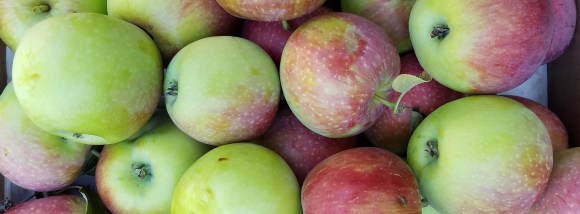
I picked up provisions at the orchard: 15 pounds of Gold Rush apples, two gallons of apple cider, two pounds of frozen Montmorency cherries, packets of mulling spices and 10 note cards. Sara, Barb and I had a post-season conversation about gardening, Medicare and living in 2017.
The morning’s main accomplishment was clearing the ice box of aging greens by producing another couple gallons of vegetable broth. I lost count of how many quart jars of canned broth wait on pantry shelves. For lunch I ate a sliced apple with peanut butter.
We live in a time when favorite foods are under pressure from climate change. Chocolate, coffee and Cavendish bananas each see unique challenges from global warming. In addition, recent studies show the higher concentration of carbon dioxide in the atmosphere is reducing the nutrient value of common foods. Our way of life has changed and will continue to change as a result of what Pope Francis yesterday called shortsighted human activity. He was immediately denounced in social media by climate deniers.
This week, Congressman Ron DeSantis (R-FL) introduced the HERO Act which purports to reform higher education. Specifically, the bill would open up accreditation for Title IV funding to other than four-year colleges and universities. In an effort to break up the “college accreditation cartel” DeSantis would keep current Title IV funding but add eligibility for other post K-12 institutions. States could accredit community colleges and businesses to be recipients of federal loans for apprenticeships and other educational programs.
Telling in all of this is that as soon as he introduced the bill, DeSantis made a beeline for the Heritage Foundation for an interview about it with the Daily Signal. Does higher education funding need reform? Yes. What are Democrats doing to effect change in higher education? That’s unclear. A key problem is progressives don’t have a network of think tanks and lobbying groups funded by dark money to counter the HERO act or the scores of other conservative initiatives gaining traction in the Trump administration.
Even though the 45th president seems an incompetent narcissist, the influence of a conservative dark money network within his administration is clear: in appointments to the Supreme Court and judiciary; in dismantling the Environmental Protection Agency, in undoing progress in national monuments and parks, in weakening the State Department, in potentially politicizing the 2020 U.S. Census, and much more. The reason for his success is his close relationship with wealthy dark money donors and the agenda they sought to implement since World War II.
Today is the 39th anniversary of my return to garrison from French Commando School. I returned with a clear mind, physically fit, and an awareness of my place in the world.
“I am ready to experience the things of life again,” I wrote on Nov. 12, 1978. “The time at CEC4 has cleansed me of all things stagnant. I will pursue life as I see it and make it a place where I pass with love and peace for all.”
We work for peace on the 99th anniversary of the Armistice. If people are not unsettled by evidence of climate change and a Congress that ignores it in favor of pet projects designed to please the wealthiest Americans, we haven’t been paying attention. The need to sustain our lives in a global society has never been clearer.
Water is life. We take its quality for granted if the source is a public water system.
Consumers rely on drinking water standards developed by the U.S. Environmental Protection Agency and enforced by the Iowa Department of Natural Resources. Where we live municipalities do a good job of compliance with drinking water standards. There are few standards for private wells and the experience is uneven at best in unincorporated areas with public water permits.
In January 2001 the U.S. Environmental Protection Agency issued a reference guide for compliance with the new standard for arsenic in public drinking water, reducing the allowable amount from 50 parts per billion to ten.
Arsenic is a naturally occurring element in many water systems. Neither number in the range seems like much, and at 10 ppb it isn’t. Public water systems have been required to comply with the new standard and if EPA persists in enforcing the new standard, all public water systems should be in compliance eventually.
Not so with private wells where testing and compliance is voluntary. A study published this month in Environmental Science and Technology estimates about 2 million people in the Unites States drink water from private wells with arsenic concentrations exceeding 10 ppb.
The change, initiated during the Bill Clinton administration, took time to develop and more time for communities to implement. The idea was to bring the United States into compliance with the World Health Organization standard for arsenic in drinking water. There are currently communities where the public water system does not meet the new arsenic standard, including one that has been the source of news here in Big Grove. Hopefully they are all working on complying.
There have been at least two deaths caused by cancer among the 85 homes on our public water system. Whether this experience is or isn’t connected to historic arsenic levels is a question that hasn’t been asked. I’m not sure of the merit of asking it, although there are studies with evidence supporting such a connection in larger communities. It is also unclear whether two deaths from anything would be statistically significant in a population of 300. In any case, our public water system has been in compliance with arsenic standards since the new treatment facility was brought on line more than ten years ago.
I doubt many home buyers look at public water or sewer records when considering buying a home even though the data is easily available on line. The proliferation of development in unincorporated areas raises an issue of the quality of management in home owners associations. The arsenic compliance experience demonstrates it is uneven at best.
People seek to escape municipalities. Gasoline remains inexpensive relative to average household income and there are perceived freedoms in living in a small, insular community away from city life. Commuting to a job within an hour’s drive from home is common in Iowa. There is a cost. Things that could be taken for granted in a municipality require attention and potential action in rural Iowa. Who has time for that?
The presence of arsenic in ground water is just one example of the issues of living in an unincorporated area. In a culture of affluence, the quality of water does not often come to the forefront. When it does there is a perception that money and technology will resolve it. That’s mostly true but it requires our engagement, something many people are unwilling to give.
It’s part of sustaining a life in a turbulent world.
Last week was stressful as Hurricane Irma passed through central Florida over our daughter’s home.
They boarded the windows, sandbagged the doors and laid in water and shelf stable food for when the electricity went out.
“The whole house has been playing Settlers of Catan, which we never get to play enough,” she texted. “Next up is Fluxx, a rules changing card game. The lights have been flickering slightly, but we still have power and water. Every so often, the outside sounds a bit like a car wash.”
She and her housemates weathered the hurricane, suffering minimal property damage. Her final message in the hurricane series was
Stay safe out there. If anything, I am reminded that everywhere in the US, there is some kind of emergency that can happen. Please, pack a Go Bag, prepare a plan, know where your evac locations are. I love you. Stay safe. Be prepared.
It turns out the previous board of directors for our sanitary sewer district failed to communicate new requirements to comply with ammonia nitrogen standards when they all resigned without notice. I emailed the Iowa Department of Natural Resources to learn more and there is a multi-year process for compliance added to our agenda. Stress level kicked up a notch with this.
The week ground down with efforts to meet my tomato contract. Farmer Kate and I traded my labor for her tomatoes. To finish the deal, I prepared seven quart jars of diced tomatoes each morning and water bath processed them in the evening. The work is not hard but it blocks out other things. A deal is a deal and she met her part of it with an abundance of organic tomatoes. On Friday before work at the home, farm and auto supply store I delivered two cases of canned tomatoes. We each should have plenty to make it until the next tomato season.
At Thursday’s county board of supervisors meeting a zoning application for a farm near here was considered and rejected unanimously. The controversy involves people I know in government and in the local food system. None of it is good for any of us.
“In one respect farming can be considered a tedious series of lawsuits, disputes and legal struggles,” I posted on Twitter. “Versaland bares that for all to see.”
I’m trying to understand the context and situation with more clarity and plan to write a longer post about local food in light of it.
September is always busy so there’s no surprise in any of the week’s activities and developments. Last night a group called the Iowa Faith and Freedom Coalition lavished praise and support for the 45th president. That was a pisser too.
Friends and family in the path of Hurricane Irma are well-informed of its danger and preparing for the worst this weekend.
Walt Disney World, where our daughter works, closes tonight at 9 p.m. until sometime Monday, presumably Irma’s schedule as well.
She is working today then hunkering down with supplies of water and shelf-stable food should the electrical grid fail. The open question is how much rain and wind will pelt central Florida.
“It’s not a question of if Florida’s going to be impacted, it’s a question of how bad Florida’s going to be impacted,” William “Brock” Long, administrator of the Federal Emergency Management Agency, said Friday, according to the Washington Post.
Irma maintained wind speeds of over 185 miles per hour for more than a day, the first storm in the world to do so.
Since 2007 I visited Florida several times. Each time people I met at the auto shop, convenience stores, retail outlets and elsewhere spoke of Hurricane Andrew and how it changed their lives. Floridians know hurricanes well. Surviving Irma is the focus for the next three days.
Environmental Protection Administrator Scott Pruitt commented about the link between Irma and global warming:
“Here’s the issue,” Pruitt told CNN Thursday in a phone interview. “To have any kind of focus on the cause and effect of the storm; versus helping people, or actually facing the effect of the storm, is misplaced. What we need to focus on is access to clean water, addressing these areas of superfund activities that may cause an attack on water, these issues of access to fuel. … Those are things so important to citizens of Florida right now, and to discuss the cause and effect of these storms, there’s the… place (and time) to do that, it’s not now.”
The upshot is in a backhanded way, Pruitt acknowledges the need to evaluate causation of large tropical storms. I’m confident facts will lead him to how global warming made Irma and other recent tropical storms worse. I may be overly optimistic but the truth matters.
Our household will be following the progress of Irma as it makes landfall in Florida and over the next 48 hours. Hoping the people of Florida withstand the death, destruction and economic consequences of this next in a series of major storms. I expect Floridians will be resilient as this is not their first hurricane rodeo. I trust our daughter will do what’s needed to weather the storm.
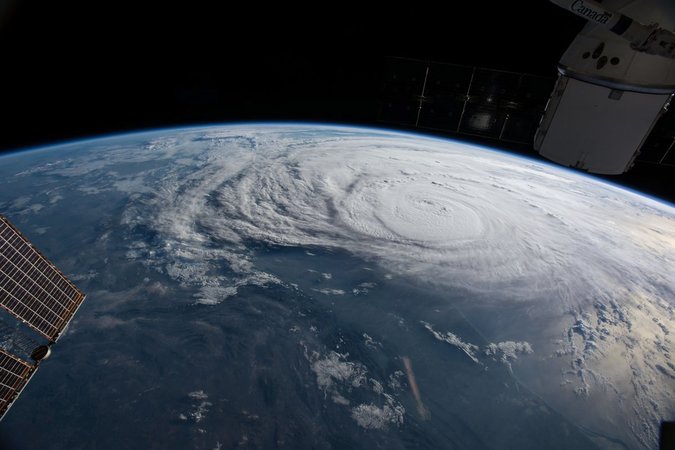
Hurricane Harvey from the International Space Station on Aug. 25, 2017. Photo Credit – NASA European Pressphoto Agency
Rain tapped the bedroom window this morning on the fringe of Hurricane Harvey.
It was a reminder of our connection to the oceans. They are absorbing heat from the atmosphere on a planet experiencing some of its warmest days in living memory. A warmer atmosphere holds more moisture and the result is intense storms like the Category 4 Hurricane Harvey.
In Iowa we adapt easily to hurricanes because of our distance from the coast. Needed rain benefits our gardens and farms. It recharges our surface aquifers. As the weather pattern moved over it seemed normal, not as devastating as it was when Harvey made landfall in Texas Friday afternoon.
Overcast skies and a slight rain depressed attendance at the orchard on Saturday. There were enough visitors to keep busy, especially in the afternoon when the sun came out. Sales seemed steady if light.
One of my favorite August apples is Red Gravenstein, a Danish cultivar. It was introduced to western North America in the early 19th century, according to Wikipedia, perhaps by Russian fur traders, who are said to have planted a tree at Fort Ross in 1811. Red Gravenstein is tart, juicy and crisp — great for eating out of hand.
The cider mill made the first press of apples for the sales barn. The gallon and half gallon jugs sold well. Over the years I’ve come to appreciate the changing flavor of our cider as we move through the apple harvest. I bought a gallon of cider and a dozen Red Gravenstein apples at the end of my shift.
I’ve been reading recipes for tomato catsup in old community cookbooks. After reviewing a dozen or so I went to the kitchen and created this sauce from the abundance of red bell peppers and tomatoes:
Red Pepper Sauce
Ingredients
Half dozen cored and seeded red bell peppers cut in quarters
Equal amount by weight of cored tomatoes one inch dice
One cup of malt vinegar
One teaspoon salt
One tablespoon refined sugar.
Process
Pour the vinegar into a saucepan and bring to a boil.
Add tomatoes and peppers.
Add sugar and salt.
Bring back to a boil and cook for 10-20 minutes until the vegetables are soft.
Strain the mixture. Retain the liquid to use as vinegar in salad dressings.
Run the vegetable mixture through a food mill and either serve immediately or bottle and refrigerate.
Recipe notes
To make a thicker sauce, either reduce it in the saucepan or add tomato paste.
I used malt vinegar because it was on hand. Absent malt vinegar I’d use homemade apple cider vinegar.
Between planning, planting and weeding a garden, and fall’s frosty end, lies a time to harvest, cook and preserve the results. So it is with our lives.
As humans we possess a unique ability to envision a future: one where we need supper and know we will need food later. We produce in abundance, fearing we won’t have enough. With modern food supply chains producing readily available foodstuffs in the United States this isn’t rational. In this sense, a gardener is an archetypal human living a life on urges, needs and wants we don’t fully understand.
Saturday Harvest in High Summer
The culture that produces a kitchen garden is complex, involving not just the gardener and soil, but seed producers, greenhouse operators, equipment manufacturers, chicken manure composters, potential future diners and others. A gardener is deeply engaged in human society. Much of our garden time seems solitary but isn’t. Animals wander nearby and we view the results when they eat garden plants and produce we’d hoped to harvest later. There is a daily drama of birds which are abundant in Big Grove. There is also a vast and little understood society of insects, some of which are annoying, a few deadly, and without others, the garden could not exist. A gardener embraces the complexity of life’s culture.
A gardener is not only a gardener nor does he or she seek to be. Each is just one iteration of humanity engaged in a broad society and we Americans are a peculiar bunch. We work hard, long hours whether it is at home or in a workplace and leave little time for enjoyment of the fruits of labor. Sometimes, like this weekend when I am between work at farms, we get time to ourselves to enjoy life lived how best we know. My story of Saturday is in four parts.
Predawn
My day begins around 4 a.m. and if I’m lucky, I got six or seven hours of sleep. I slept well Friday into Saturday waking only briefly to put in a load of laundry around 2 a.m. The routine was basic. Do stretching exercises, make coffee, say hello to spouse, go downstairs, and turn on the desktop computer to see what’s going on in the world. That’s not to say I didn’t already know. I use my mobile device in bed before turning on the light. Usually something new has happened since retiring the night before.
I wrote a series of tweets to better understand my memory of the Patient Protection and Affordable Care Act as it pertains to the false accusation it is a job killer. I recall local businessmen who said after the law went into effect they were in a position to add jobs but didn’t want to do so because they would have to provide health insurance per the ACA mandate. The assertion is the mandate killed these jobs and that idea got blown up into hyperbole of unprecedented proportions. Re-circulation of this idea is ongoing and rarely fact checked any more.
Businesses of a certain size should provide a health insurance benefit to employees or risk the possibility of being unable to recruit qualified staff. By defining the size at which to mandate health insurance, the law changed the business structure. In highly competitive local markets for landscapers, concrete workers, framers, heavy equipment operators and the like, employers faced a changed landscape. Operating on tight budgets, rather than embrace quality of life for employees they resisted change. The core problem lies in that the K-12 education system does a really poor job of preparing students to enter business. People carve out a niche, generate revenues and go out of business if they don’t properly manage risks or aren’t adequately capitalized. Small-scale operators I know are not educated in things we took for granted when I managed the profit and loss of a $12 million annual revenue transportation and logistics operation as part of a billion dollar corporation. The problem is not the ACA, or teachers. It is our education system doesn’t provide an adequate path for people to be successful owning and operating a business.
Pickle Fermentation
Outside
If there was no rain I water the garden shortly after sunrise. Without thinking it turned into weeding, then harvest and before I knew it the time was 11 a.m. The garden looks more like a weedy mess but inside there is abundance.
Before going outside I started soup to take for lunch at the home, farm and auto supply store, and mixed the brine for a batch of dill pickles.
I picked a box of kale for the library then went plot-to plot to collect what was ready. There were broccoli florets, leeks, onions and fairy tale eggplant in one. Jalapeno peppers, a bell pepper and cucumbers in the next. More broccoli and celery near the locust tree. Four kinds of tomatoes in the tomato patch. Basil is ready but I left it in the garden until I’m ready to make pesto.
Apples are sweet enough to eat out of hand, but not sweet enough to juice and ferment into apple cider vinegar. I picked the ripest for a batch of apple sauce. There are a lot of apples this year because of almost perfect pollination during spring. It should be a long apple season starting now.
I collected the harvest in a crate and placed it on the kitchen floor. There was another two hours of work cleaning the produce but that could wait.
Soup for Next Week’s Work Lunches
Short Trip
I try not to leave our property on weekends unless for work. Ours remains a car culture and we don’t have disposable income for shopping if we thought we had it before. Saturday I went to HyVee to pick up canned goods, pantry staples, organic bananas and Morningstar Farms frozen products we use. Organic celery is permanently on the shopping list although we have a lot of celery ripening in the garden. I picked three heads that morning so bought none at HyVee.
On the eight mile trip to town I noticed two sweet corn stands on Highway One.
One is the farm where we get most of our sweet corn, Rebal’s Sweetcorn. Supply was uncertain from their Saturday post:
It was tough picking this morning; we had to really search for the corn in this patch… we’ve got corn today, but it’s not a full load, so if you want it, try to get out here early. And, because of having to search to find the better ears, we might just let this one go and wait for the next. We’ve got 4 blocks (patches) coming up that look beautiful!!! The question is when they’ll be on… we’re checking them every day, so I’ll keep posting
They had plenty as I passed Southbound.
Lindsey Boerjan runs a seasonal road-side stand further south and was featuring sweetcorn and melons. I wrote an article about women farmers in the Sept. 22, 2015 Iowa City Press Citizen:
Lindsey Boerjan is a fifth-generation farmer living on the family-owned century farm where she grew up. She moved back in 2011 and farms alongside her aunt, uncle, husband and daughter, who run a beef cow and calf operation. To supplement income from beef sales, Boerjan raises chickens and operates a small community-supported agriculture project.
The CSA didn’t make it, although the road-side stand likely does better. I decided to stick with Rebal’s on my return trip.
A musician played for free will donations outside the entrance to HyVee. He seemed too young and inexperienced to be playing Folsom Prison Blues, although he was very musical.
Dinner Salad
Cooking
On arrival home I put away the groceries and started cleaning the morning harvest.
Leek stalks make a great vegetable broth base so I got out the large stainless steel pot. I added the leek leaves, broccoli stalks, a turnip — greens and root, kale and onion tops. I don’t usually salt vegetable broth and this time I didn’t add bay leaves. It cam out dark and flavorful — two and a half gallons.
Part of summer cooking is going through the ice box and making sure old stuff is used first. We have a broccoli abundance and need to do something soon with the gallon bags of florets. The freezer is almost full, so freezing more is not a good option.
I found some lettuce and decided to make a small salad and pizza for dinner. The salad is a work of art with two kinds of lettuce, kohlrabi, two kinds of tomatoes, cucumber, grated daikon radish, bell pepper, pickled jalapeno pepper, sugar snap peas and other items either from the farm or grown in our garden. Ironically I forgot to put some small broccoli florets on the salad.
I also made applesauce, salsa with tomato, garlic, jalapeno peppers and onion, and a cucumber salad of diced cucumbers dressed with home fermented apple cider vinegar, salt and pepper.
Our pizza process is to buy pizza blanks from the warehouse club and add toppings at home. Making our own pizza dough is no real work, but the convenience of a pre-made cheese pizza for $2.50 presents value. I added Kalamata olives and a diced red onion from the farm, then topped with Parmesan cheese. 15 minutes in a 425 degree oven plus a minute under the broiler and done.
This Morning
Everything on my list didn’t get done Saturday. I’m processing the vegetable broth in a water bath this morning and figuring out how to pack a summer’s worth of yard projects into today’s glorious summer weather. That is, I wrote stuff on my white board. Once I move outside into humanity and culture, I will likely forget about the plans and do what comes naturally.
Image of Earth 7-6-15 from DSCOVR (Deep Space Climate Observatory)
A recent article at Nuclear News reminds us the world is on the cusp of an energy revolution.
“The cost of renewables like solar and cell batteries for electric vehicles are making the carbon-based economy obsolete, with the turning point only a few years away,” author Christina MacPherson wrote.
The age of centralized, command-and-control, extraction-resource-based energy sources (oil, gas, coal and nuclear) will not end because we run out of petroleum, natural gas, coal, or uranium,” Stanford University professor Tony Seba recently said. “It will end because these energy sources, the business models they employ, and the products that sustain them will be disrupted by superior technologies, product architectures and business models. Compelling new technologies such as solar, wind, electric vehicles, and autonomous (self-driving) cars will disrupt and sweep away the energy industry as we know it.
When we consider the use of coal in Iowa, there are many of us who remember the coal trucks plying the streets and alleys of our childhood, dropping loads of the black stuff down chutes leading to a basement coal bin and then to our gravity furnaces. Through the winter, people shoveled coal into burning embers to heat their homes. Coal ash was shoveled out and in the spring, it was tilled it into gardens and spread on fields. Coal ash was also sent to dumps. On the farm, coal was purchased with seeds, feed and grain. It was part of a background to life that did not consider the potential harm to human health we now know it represents.
Those born in the 1950s and before have living memory of how natural gas replaced coal for home heating. The conversion was driven by much lower natural gas cost compared to coal. Similarly, lower costs of renewables will drive the move away from fossil fuels. We are almost at that point, as MacPherson indicated, and the business community is recognizing the reality by investing in renewables.
A recent article by Eva Zlotnicka for Morgan Stanley reiterates this point.
Economics and improving technologies, not regulation, are the driving forces behind many of the sustainability trends in global markets today. Our energy commodities team’s fundamental analysis of power-generation economics shows that longer-term coal can’t compete with natural gas or renewables, even on an unsubsidized basis. In a recent report, the team cut its 2017 coal-burn forecast by around 4%, and now sees only a modest year-over-year improvement, with most of those gains lost by 2018, due to ongoing competition from natural gas and renewables.
The 45th president made much of reviving the coal industry during his election campaign. The trouble for him is the market is heading a direction that not even he and his fossil fuel friends can stop. He can roll back all the regulations he likes and the market will continue to drive the switch to renewable energy.
Many of us were disappointed when President Trump announced his decision to exit the Paris Climate Agreement. It was all hat no cattle.
There is almost no disagreement in the scientific community that fossil fuel use contributes significantly to planetary warming and related climate change. However, that’s not the point. What gave rise to the Industrial Revolution continues to work, and as renewable energy costs decline and become cheaper than the cost of fossil fuels and nuclear, bankers, manufacturers, and service industries will convert because it makes business sense to do so.
Add the public health, environmental, business and economic value of renewables together and a scenario where energy companies may start divesting themselves of coal and oil operations emerges.
How will the U.S. exit the Paris agreement? 45 didn’t say. Will his administration follow the four-year exit process outlined in the agreement, or will he remove the United States from the U.N. Framework Convention on Climate Change (UNFCCC), exiting in about a year? If the drivers of transformation in our energy system are economic, what whit of difference does his decision make?
The agreement posed no financial risk to the United States, according to Morgan Stanley. It seems doubtful other nations will follow the United States out of the agreement, although some may. The pursuit of the goals in the Paris Agreement by remaining countries, combined with the efforts of U.S. states and cities acting on their own, offer the best chance to reduce carbon pollution in the atmosphere.
Nonetheless, an energy revolution is going on and at this point little politicians do seems able to stop it.
It’s a scary article with frightful truths circulating on social media.
Half truths according to Michael E. Mann, director of Earth System Science Center at Penn State. Mann wrote onFacebook:
Since this New York Magazine article (“The Uninhabitable Earth”) is getting so much play this morning, I figured I should comment on it, especially as I was interviewed by the author (though not quoted or mentioned).
I have to say that I am not a fan of this sort of doomist framing. It is important to be up front about the risks of unmitigated climate change, and I frequently criticize those who understate the risks. But there is also a danger in overstating the science in a way that presents the problem as unsolvable, and feeds a sense of doom, inevitability and hopelessness.
The article argues that climate change will render the Earth uninhabitable by the end of this century. Extraordinary claims require extraordinary evidence. The article fails to produce it.
If we are clicking on New York Magazine for our information about the threats of climate change then now, more than ever, it’s clear mental health care is needed in whatever healthcare bill Congress passes this year.
Taking action on climate (or anything else) based on fear would be as scary as Wallace-Wells’ article.
On Sunday, Al Gore was in the news about his climate work.
“Those who feel despair should be of good cheer as the Bible says,” Gore told Lee Cowan of CBS News. “Have faith, have hope. We are going to win this.”
The need to act on climate is all around us according to Gore.
“It’s no longer just the virtually unanimous scientific community telling us we’ve got to change,” he said. “Now Mother Nature has entered the debate. Every night now on the television news is like a nature hike through the Book of Revelation. People who don’t want to use the phrase ‘global warming’ or ‘climate crisis’ are saying, ‘Wait a minute. Something’s going on here that’s not right.'”
Gore is right. Don’t despair. Act on climate.
If you don’t know what to do, The Climate Reality Project provides an action kit to get you started. Click here to find it.
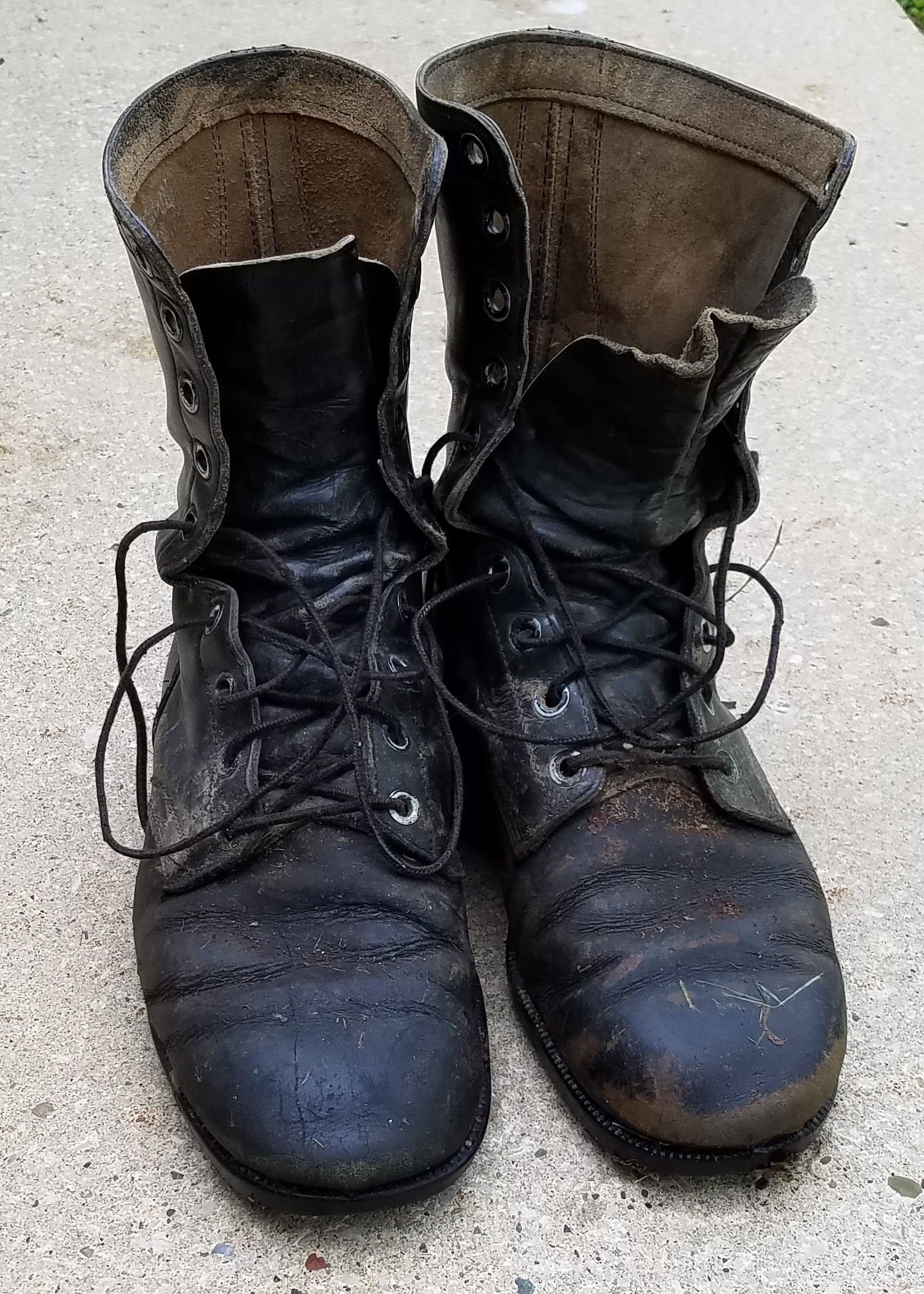
The debate was whether or not Army boots acquired in the 1970s should be retired.
I don’t think so.
I placed a set of inserts inside and they are as comfortable for walking as any of the expensive sneakers I bought to lighten the load of working on concrete floors all day at the home, farm and auto supply store.
At 40 years old they have a lot of life left in them. I have two pair.
They may make a fashion statement but I don’t wear them out in public very often so who knows? I plan to wear them in my garden and at the farms this weekend.
It has been impossible to get much done after a shift at the home, farm and auto supply store. With busy days combined with hot afternoons, I’ve had little energy left at 6 p.m.. Saturday has become the pivotal day in my garden life. With dry conditions, it will be again this weekend.
Main crops remaining to be planted are beans, cucumbers and peppers. Once that’s finished I can transfer to maintenance mode and focus on other aspects of yard maintenance. I have to get it finished though.
Other than non-stop work, this week has been uneventful. I may get across the finish line of spring planting before spring actually ends.






 Journey Home
You must be logged in to post a comment.