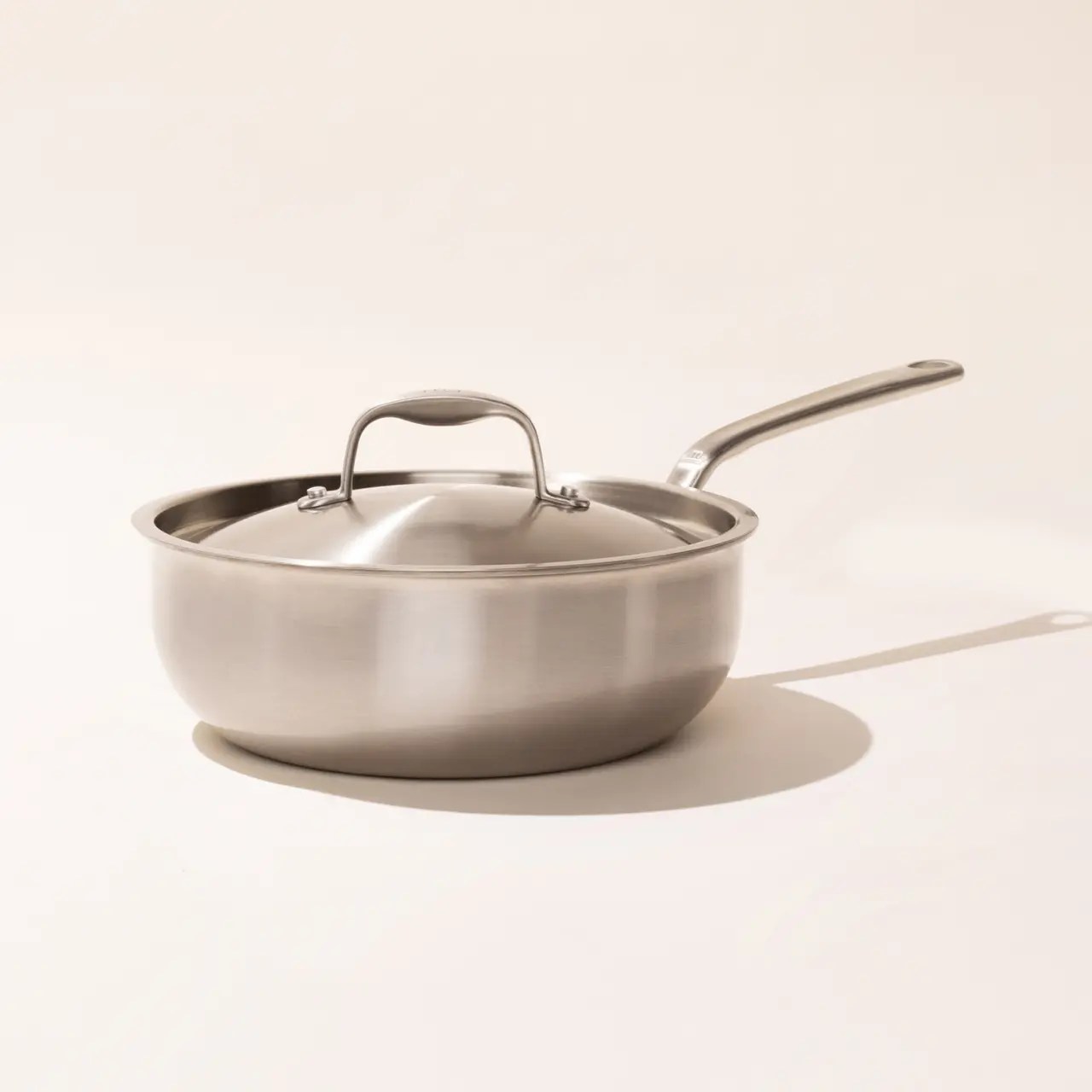
Made In three-quart, stainless steel saucier. Photo credit – Made In website.
I came into some extra money from my writing and ordered a Made In, five-ply stainless steel clad, three quart saucier. I saw the device on Olivia Tiedemann’s Instagram channel where she recommended it for sauces, grain cooking, one-pot dishes, and more. It is her go-to pan, she said. Tiedemann is a private chef with more than 4 million Instagram followers. She makes short cooking videos, curses a lot, and flips the bird at the camera at least once during each episode. The saucier sold out on the Made In website shortly after I ordered mine.
I am very excited to be receiving this saucier, tracking the shipment a couple times a day. As I type, it is at a warehouse in Iowa City awaiting delivery, presumably today.
Buying a saucier is a poor man’s extravagance. Did I need a special pan to make sauces? I was getting along just fine. Do I want to be like Tiedemann? Maybe, except she is definitely oriented toward using all the meat and dairy products, unlike what goes on in our household. Once one eliminates meat, fish, dairy, butter, eggs and the like from meal preparation, cooking becomes something else. I’m hoping the saucier will help me down a path of developing sauces and dishes for our hybrid vegetarian-vegan cuisine. If I had real money, I’d dine at a favorite restaurant multiple times a week. I don’t, therefore, saucier.
Will the saucier change my life? I hope so. I hope to be a better cook in my kitchen garden. Imagination and a special pan may be the way to distinguish what I do here. The anticipatory excitement is well worth the money spent on the saucier.
Plot #3 with seeds planted in the margins between sheets of ground cover.
Rain relented long enough to start planting. May 15 is the normal last frost, and it is Katy bar the door as far as getting things in the ground goes. Plot #1 was garlic planted last year with a strip for a covered row. Plot #2 was potatoes and onions. Plot #3 is radishes, green beans, turnips, Sugar Snap Peas and Snow Peas, along with whatever else I decide to put there from the greenhouse. If the weather holds, I should make fast work of the rest of planting.
This year I’m harvesting more than I can use from what over wintered. Collards, kale, spring garlic, green onions, and cilantro are abundant. Salad greens came from this year’s planting in trays. I haven’t been able to get them in the ground, so I just picked and washed them. Having so much early produce changes the dynamic of a kitchen garden.
For one thing, the season is extended. I enjoy fresh cilantro in my breakfast tacos and I’ve had it for more than a month. Fresh leafy green vegetables are always better than frozen, and we use them in everything. I’ve been using last year’s crop from the freezer to make vegetable broth and plenty remains. Having fresh from the garden vegetables in March and April is a definite treat resulting from just leaving the garden alone last fall.
In Plot #3 I laid down plastic ground cover and planted seeds around the edges. This technique enables me to get a bigger, more diverse crop out of the plot, in addition to easier spacing of crops. Last year this plot was in cruciferous vegetables and I’d like to rotate out of that. Once I inventory the greenhouse, I’ll know to what extent that is possible. For sure, I will place tomatillos, celery, and other types of seedlings. I’ll likely be left with a single row of kale, collards and chard just to fill out the plot. Wherever I plant broccoli and cauliflower in plot #4, I’ll plant more leafy greens. I like to keep cruciferous vegetables in as few spots as possible so I can monitor the little white butterflies and their progeny who like living with them.
Wednesday I got some things done while working up a sweat. My sense of where we are is that it will be a great growing year with healthy plants and an abundance for the kitchen. It’s why we garden.
Trail walking between rain showers on May 9, 2024.
While walking past the boat docks between rain showers, a neighbor hailed me and asked, “Is the drought over?” I replied, “With the rain we’ve had in the last ten days, I hope so.” Because I was on the association board for so long, many know me by name, although I have to ask them theirs. I don’t mind asking.
I took this photograph during my Thursday trail walk. I’ve been trying to take a decent photo of this barn for 30 years. This one isn’t it. I’ll try again.
I turned on my bird identification app and in 30 seconds, it identified eight different birds. Halfway into spring that seems about right. Fish continue to spawn near the foot bridge. Joggers, dog-walkers, bicyclists, and walkers were out on the trail in the couple hour period between morning rain and afternoon showers. I’m glad to have made it outdoors when I could.
While my vegan spouse has been away I’m fixing dinners she can’t eat. Tonight it is lasagna with home grown spring onions and ricotta cheese. I’ve been thinking about this dish for a week. It is baking while I write.
I counted seedlings in the portable greenhouse. There are 750. It seems like a lot, and if I had to buy them at the store it would be a substantial investment. I check on them multiple times a day.
My idea of a garden is to grow as much as I can for the kitchen and give the rest away. The food bank always needs donations. Neighbors welcome fresh vegetables in season. If the rain would let up, I could start transplanting more to the garden. Thursday was a bust day for gardening. Friday is looking better.
We should know when my spouse is returning home today. I hope it is soon.
Enchiladas, Spanish rice, and sauteed corn and bell pepper.
It seems early for a kitchen garden post yet here we are. The combination of a mild winter and plentiful plantings last year brought a Saturday vegetable harvest. There were collards, kale, cilantro, and spring onions growing in last year’s planting areas. Volunteer garlic came up where I plan tomatoes this year. After harvest, I cleaned the produce and made dinner with it. We had enchiladas, Spanish rice, and corn sauteed with bell pepper. I also used preserved guajillo chili sauce from last year. My recipe for enchiladas is here.
This meal has a lot of steps yet is worth the effort. The point I make today is while I enjoy plate photos like the one above, the sought end result is fleeting creativity in the kitchen, set in time, as I use ingredients picked an hour or two before. It is of such fleeting essences our lives are made.
During my time I viewed many television cooking shows, and lately, short-form videos about cooking. Rarely does any one of them stand out. Some are formulaic, some a brief distraction. There were so many of them, all the recipes and processes began to look alike. I mean, we know the combination of onion, carrot and celery with bay leaves makes a delicious soup base. We should know the Louisiana “holy trinity” is onions, bell peppers, and celery. How many times do we need to hear it? I imagine most of us have heard it enough.
It is possible to be a creative person. Creativity has some end goal in mind, with cooking, perhaps a plate photo or making a memory of a specific meal. Yet it is the process for which we live. I would never have put collard greens in the filling of an enchilada, except that’s what I found in the garden that day. I found fresh cilantro and that unplanned addition characterized the dish. While I often have recipes in mind, they are little more than a suggestion when cooking. The best of what we eat is often the result of a process that had no recipe in mind at the beginning. At least, it can be.
Grocers have a problem with my kind of food creativity. A grocer in a big box store must stock thousands of items while waiting for some customer to come along seeking one. They rely upon an item’s popularity to cover overhead and make a profit. Popular as they are, I can’t imagine many circumstances when I would buy fresh cilantro or spring onions at the grocer, even though they stock them all year. Therein lies the difference between my kitchen garden and cooking. There is something magical about a kitchen garden that can’t be replaced by commodities from the grocer.
Enchiladas are a well-liked meal in the United States and elsewhere. Our small community has two Mexican restaurants that sell them. If I wanted a Mexican-style dinner, I could just buy take out. That would be missing the point of time in the kitchen garden.
I made lentil soup for dinner last night. With a slice of bread, it made a satisfying meal. What distinguished this pot of soup from more generic vegetable soups I make was the restricted number of ingredients. Here’s how I made it.
I covered the bottom of the Dutch oven with tomato juice and brought it to temperature: enough juice to steam fry the vegetables. We use tomato juice instead of oil to reduce our consumption of cooking oil. My tomato juice is a byproduct of making tomato sauce from the garden.
Next came finely diced onions, carrots, and celery, the mainstays of any soup. I added three bay leaves and salted. Then I diced three medium potatoes and added them.
From the pantry I added one and a half cups of dried lentils and three quarters cup pearled barley. Cover with tomato juice and set to medium heat.
From the freezer I added two one-cup bags of shredded zucchini and two frozen disks of fresh parsley. By now, the lentils and barley were absorbing the liquid so I added tomato juice and one quart of water to cover. I used a total of three quarts of tomato juice and one quart of water.
Two or three cups of chopped, fresh leafy green vegetables from the garden. I had collards for this pot of soup, but kale, collards or others will serve. Frozen is fine also.
Once the pot boils, reduce the heat and let it simmer until the lentils, barley and potatoes are tender. This process yielded a meal for two people plus three and a half extra quarts of soup for leftovers.
It is the kind of meal regular folks like us appreciate.
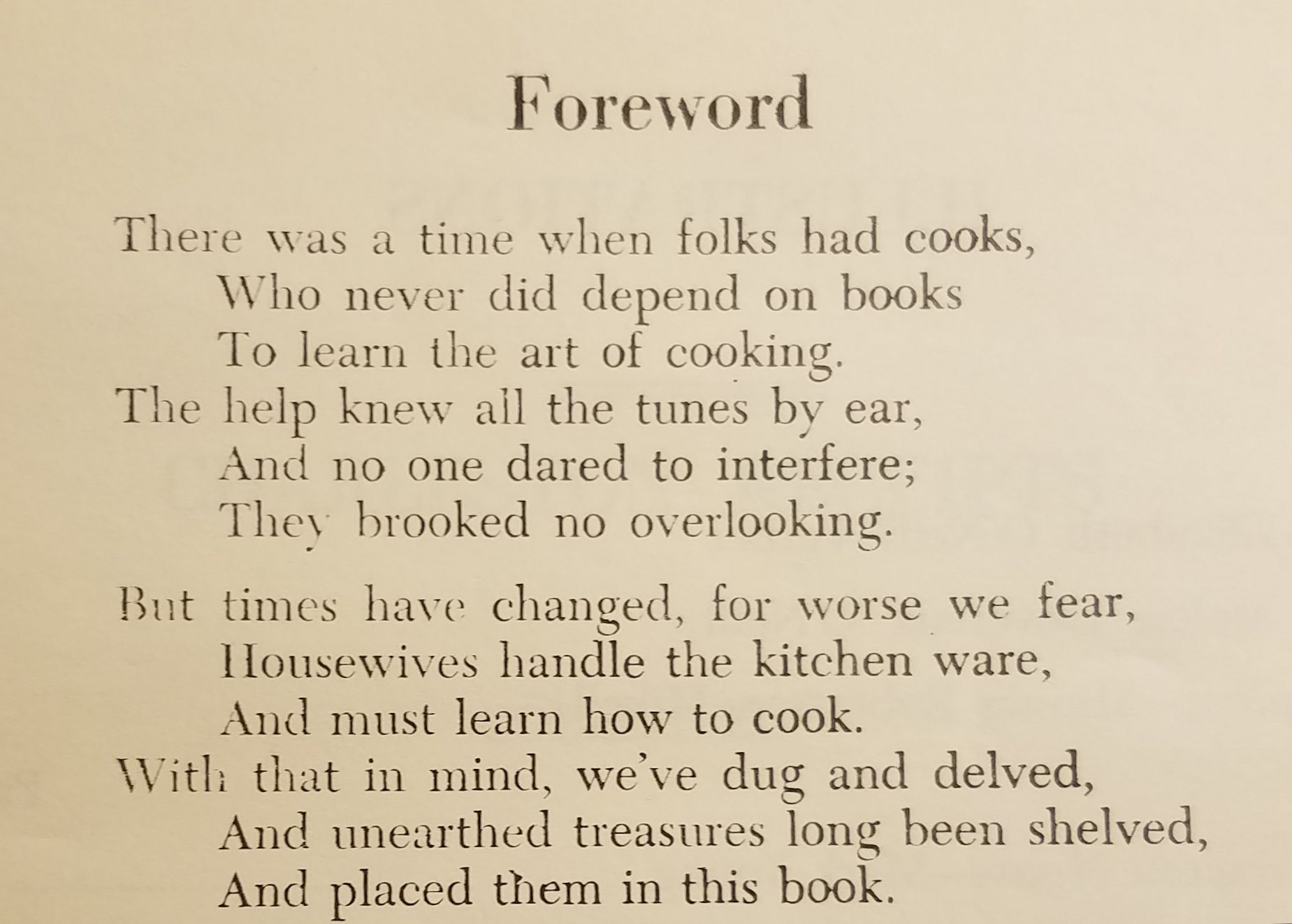
Excerpt from Charleston Receipts by The Junior League of Charleston, South Carolina, 1950.
I don’t know about this forward to a 1950s cookbook, Charleston Receipts. The unspoken part is cooks in the first verse were mostly black women, and housewives in the second were white. It is not overtly stated, but I’m certain it was implied. This book trades on fond remembrance of antebellum food culture. The word plantation is used in the names of some of the receipts (not recipes, per the author).
A large number of white women and girls worked as servants in the United States. It is possible the reference is not racist. Home cooking and cleaning were common employment for female Irish immigrants and those of other nationalities. When Grandmother left the Minnesota farm in the 1910s, she was employed as a servant in a home in Minneapolis. She worked as a cook well into her sixties. In the 1970s, people I knew in southern Indiana continued to employee a black woman as a home cook. It bothered me then, and it bothers me now. A person has to live, but not like this.
I have two copies of the book and one was missing its binder. Copies were readily available in thrift stores and used book stores. I read all the pages and saved a few from the volume without a binder to refresh my memory. There was a multi-page section about hominy, “long a favorite in the Carolina Low Country.” The section begins, “Man, w’en’e hongry, ‘e teck sum egg or cheese an’ ting an ‘eat till e’ full. But ‘ooman boun’ fuh meck wuck an’ trouble. ‘E duh cook!” I don’t recall the name of this type of language but it is stereotyped and hearkens to minstrel shows of the 1830s, which characterized blacks as lazy, ignorant, superstitious, hypersexual, and prone to thievery and cowardice. Charleston Receipts is racist, although I am confident the Junior League of Charleston, which published the book, would deny it.
When I stopped in Charleston enroute to military service in Germany, I had a couple days before dropping off my pick up truck at the port. Charleston traded in slave culture then, and they do now. I saw for the first time up close, slave auction blocks, shackles, and whips used on enslaved humans. I searched the internet and found today there is the Old Slave Mart Museum that tells Charleston’s role in slave trade from 1856 to 1863. They were domestic slave traders then, one of the biggest in the country for collecting and selling human chattel.
In writing my autobiography I find the racist side of my personal history was in plain sight. I didn’t understand that then, mostly because my parents taught me a person is a person and that was that. It helped this outlook to have made a family trip to the plantation where Grandfather was on work release from prison and see my father sharing memories with a group of black men we encountered there. They seemed like old friends. It was a formative experience.
Racism never died out, although I forgot about it for a while… until I began writing my story. In that context, it is hard to miss, even in old cookbooks.
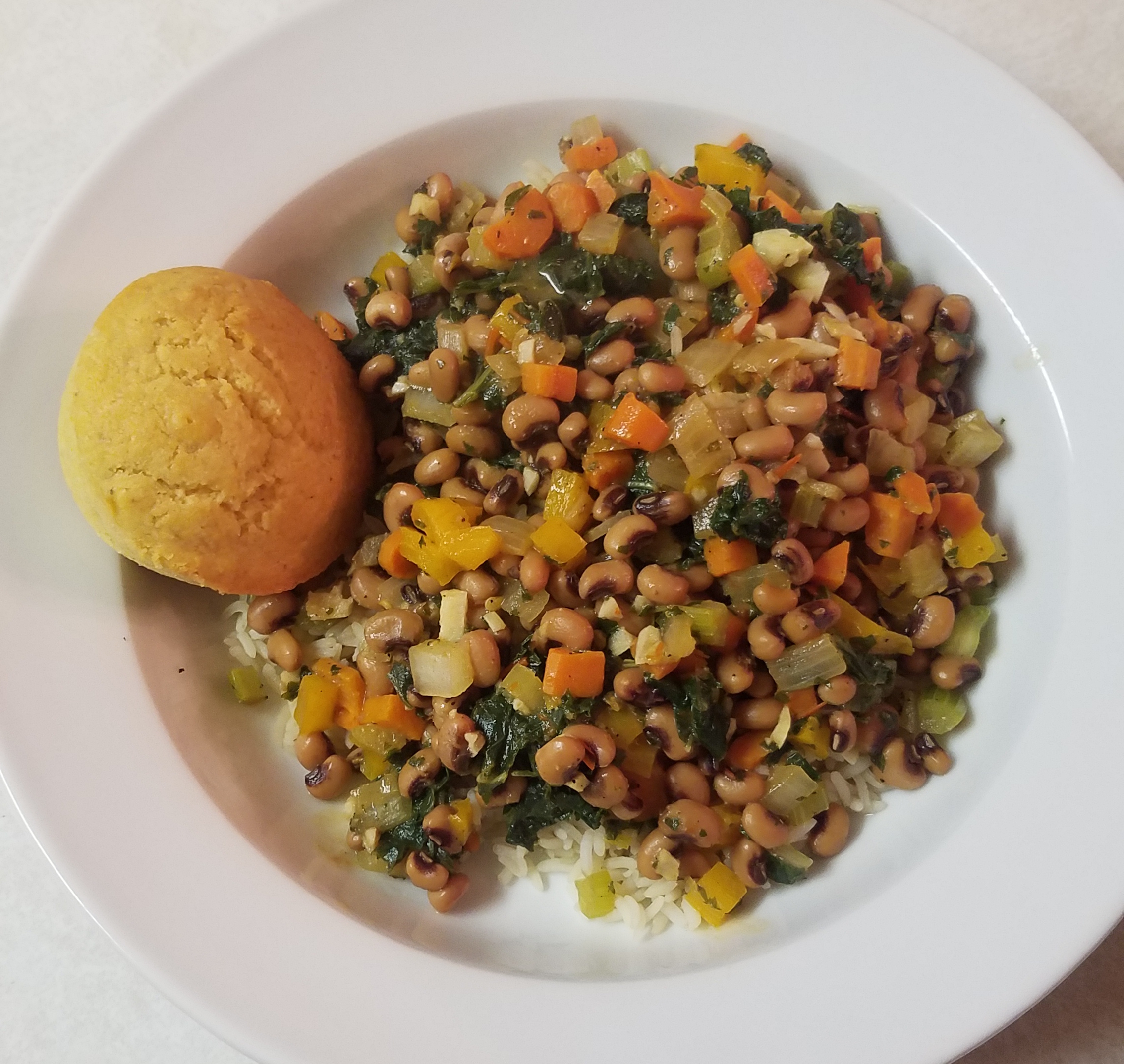
Black-eyed peas, rice, and cornbread for first meal of 2024.
An uncomfortable truth about environmentalism — that no one wants to discuss, especially in Iowa — is the amount of land used to feed and husband animals. To say it another way, the best thing we could do to mitigate the effects of ongoing climate disruption is to drastically reduce the amount of animal products consumed by humans. Not by a little, but by a lot… and immediately.
In his recent book, We Are the Weather: Saving the Planet Begins at Breakfast, author Jonathan Safran Foer wrote about this. In the appendix he discusses how he came to the environmental impact animal husbandry makes. It ranges from 14.5 and 51 percent among different experts. How does one even begin to address this? Here in Iowa, someone who suggests humans stop eating animals and their dairy products wouldn’t get one minute of attention. They would be run out of the state.
The State of Iowa developed into an agricultural state and with reason. The prairie that existed after the 1832 Black Hawk War is almost gone. In its place is a grid of once fertile fields and crop land to take advantage of our temperate climate, rich soil, and adequate rainfall. It seems quite organized in 2024. It is. It is organized to extract as many crops from this ground as it can, growing corn and beans fence row to fence row. If the nutritional content of the soil isn’t what it used to be, there are fertilizers to help. While not all of the corn and soybeans is fed to animals, the contribution Iowa-style farming makes to environmental degradation is astounding.
Safran Foer would have the population take collective action to reduce or eliminate consumption of animal products. As the title of his book suggests, he asks us as to eat no animal products before the evening meal. The problem, he points out, is that people will convert to a “plant-based diet” or “go vegan” in order to check a box, assuage guilt, and feel hope, rather than taking more substantial, collective action to mitigate the causes of climate disruption related to agriculture. This is a problem wanting a solution. Because it is controversial, few appear to be working on it.
As we face the climate crisis, it is important for our own sanity to feel like we contribute to solutions as individuals. Actions like reducing gasoline use, reducing natural gas use, reducing electricity use, eating less meat and dairy, and growing some of our own food are all important. These actions matter, yet what matters more is what we, as a society, do collectively.
While I type this post people are working to expand U.S. export of liquefied natural gas. Government support for this is among the crazy things the Trump and Biden administrations have in common. The level of methane pollution of this export operation is mind-boggling and Biden could do something about it. It is just one example of how collective advocacy could make a difference in reducing methane pollution. Few people even realize what is going on and that’s a problem.
The meal shown in the photograph above has no animal products in it. It was satisfying from the standpoint of living a New Year’s Day tradition, and from a save the planet perspective. I checked off the box and feel good. However, there is much more to do to organize our neighbors and encourage our government to take more affirmative climate action. That is just as important as what we eat.
My spouse went vegan a while back and I didn’t. I’m having to re-learn how to cook for both of us and I’m okay with that. It’s more work than expected, but I shouldn’t just kick back and grow old according to my former ways. This vegan bent in cooking, combined with other dietary restrictions we follow, led to a long list of food we don’t buy or seldom eat. Long-time readers may be familiar with some of them.
A pox on avocados because popular demand leads to deforestation with avocados being planted beneath the canopies of tropical rain forests before the rain forests are cut down. Either we are serious about preserving rain forests or we are not. That means no guacamole or avocado toast in our household.
Coconut oil? It’s a saturated fat people! Don’t be eating it when other, healthier options are available. I read the summaries pertaining to lauric acid. Still don’t eat it.
I forget why we don’t like mushrooms, yet there hasn’t been one of those in the kitchen for decades.
We never bothered being pescatarian enroute to vegetarianism. Folks should lay off fish for the sake of maintaining our fisheries. If unchecked, humans would take every fish that swims in the seas. If you missed it, sushi is usually some kind of fish, so avoid it.
Don’t get me started on jackfruit. Leave that one in Mexico or Guatemala. See the first item about deforestation.
Seitan is fine unless one has a sensitivity to wheat. We don’t eat it regularly.
After a long search for a recipe to make vegan pumpkin bread with my wealth of frozen Casper pumpkin flesh, I developed this one, which was good.
Vegan Pumpkin Bread
Dry ingredients:
2 cups all purpose flour
1/2 cup granulated sugar
1 teaspoon baking soda
1 teaspoon baking powder
1 scant teaspoon pumpkin pie spice plus extra cinnamon to taste
Pinch of sea salt
Wet ingredients
2 teaspoons vanilla extract
1/3 cup water at room temperature
1/3 cup apple sauce
1-1/2 cups pumpkin puree (or 15-ounce can prepared pumpkin)
Preheat convection oven to 350 degrees Fahrenheit.
Mix dry and wet ingredients separately then add wet to dry. Mix thoroughly, although not too much. Pour into a loaf pan greased and lined with parchment paper. Bake 55 minutes or until a toothpick comes out clean. Remove to a rack and let sit for 10 minutes. Makes 8-10 slices.
There is a frost warning tonight and that means one more garden gleaning before sundown. I expect to get kale, parsley, and maybe some tomatoes. I also expect this will be a hard frost, unlike previous nights that turned deciduous trees into paintbrushes full of color. Evolving what used to be cooking into a kitchen garden has been engaging and fulfilling. It changed — in a substantial way — how I cook meals with what grows on our property.
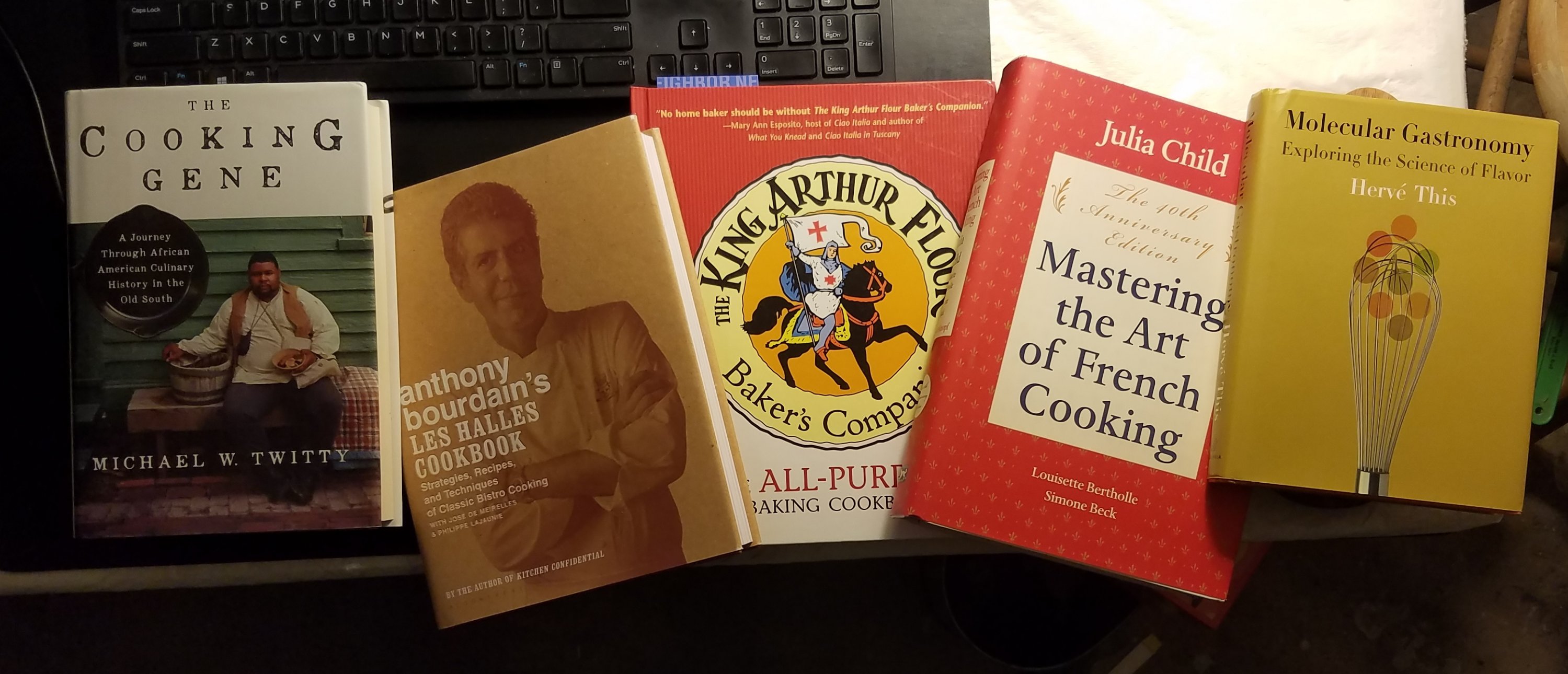
I have been a collector of cookbooks yet no more. These days I cook for weeks without opening one or consulting a recipe. When I make something sensational it is often unlikely the dish can be repeated. The reasons are many, whether it be living in the moment, freshness of ingredients, temperature and distribution of cooking heat, or how seasonings blend together. We bought a new range in May. It cooks differently from the previous one and continues to take time to understand settings, temperatures, and uses of the five cook top burners and oven.
A couple of posts ago I wrote about cooking grits and posted the photo on social media. People replied with variations I could make to improve the recipe. Thing is, the bowl of grits is rooted in ingredients already in my pantry and refrigerator. It is also rooted in my cooking process, which in this moment was to stand over the pot stirring constantly. The boiling liquid I used was half made by me vegetable broth and half two percent cow’s milk. I used Cabot’s extra sharp cheddar cheese I keep as a staple in the refrigerator. This particular bowl of grits was also rooted in that moment of creation and it seems unlikely I will get the same results the next time I make it.
Canned salmon was a big deal back when we had five digits in our private (as compared to party line) telephone numbers. In our 1950s and ’60s household, salmon patties were a once in a while treat on Fridays when we fasted from eating meat. The school I attended published a cookbook that lists multiple dishes to be made with this innovation found in the canned goods aisle at large grocery stores. Then, large grocery stores were also an innovation. Salmon salad, moist salmon loaf, salmon and vegetables in a dish, salmon custard, salmon in rice nests, salmon loaf, and other recipes were listed on the pages of the Holy Family School P.T.A. Cook Book. These days there is an abundance of fresh salmon available so the idea of using canned salmon is outdated. In 2010, when I was in Montana visiting friends, we went to the store and bought salmon steaks for a family meal. The meal was memorable. Canned salmon was revolutionary, as are the modern industrial salmon fisheries and farms. As a mostly ovo-lacto vegetarian, salmon wouldn’t be a part of any meal we prepared at home today.
People I know use recipes as a jump point in meal preparation. They search the internet, use a single purpose recipe application, or look through magazines and cookbooks to find something for dinner. They then modify the recipe to match personal preferences or ingredients on hand. I think most home cooks follow one of these methods.
I use internet searches when I have an abundance from the garden. For example, I recently searched garlic, tomatillos and chili peppers and came up with several ideas about how to preserve them as a condiment until the next crop is available. My home made apple cider vinegar is used as a preservative, making the dish ultra local. There are currently about a dozen jars of chili sauce in the refrigerator and pantry, no two of which are the same. It keeps things interesting while also using the harvest.
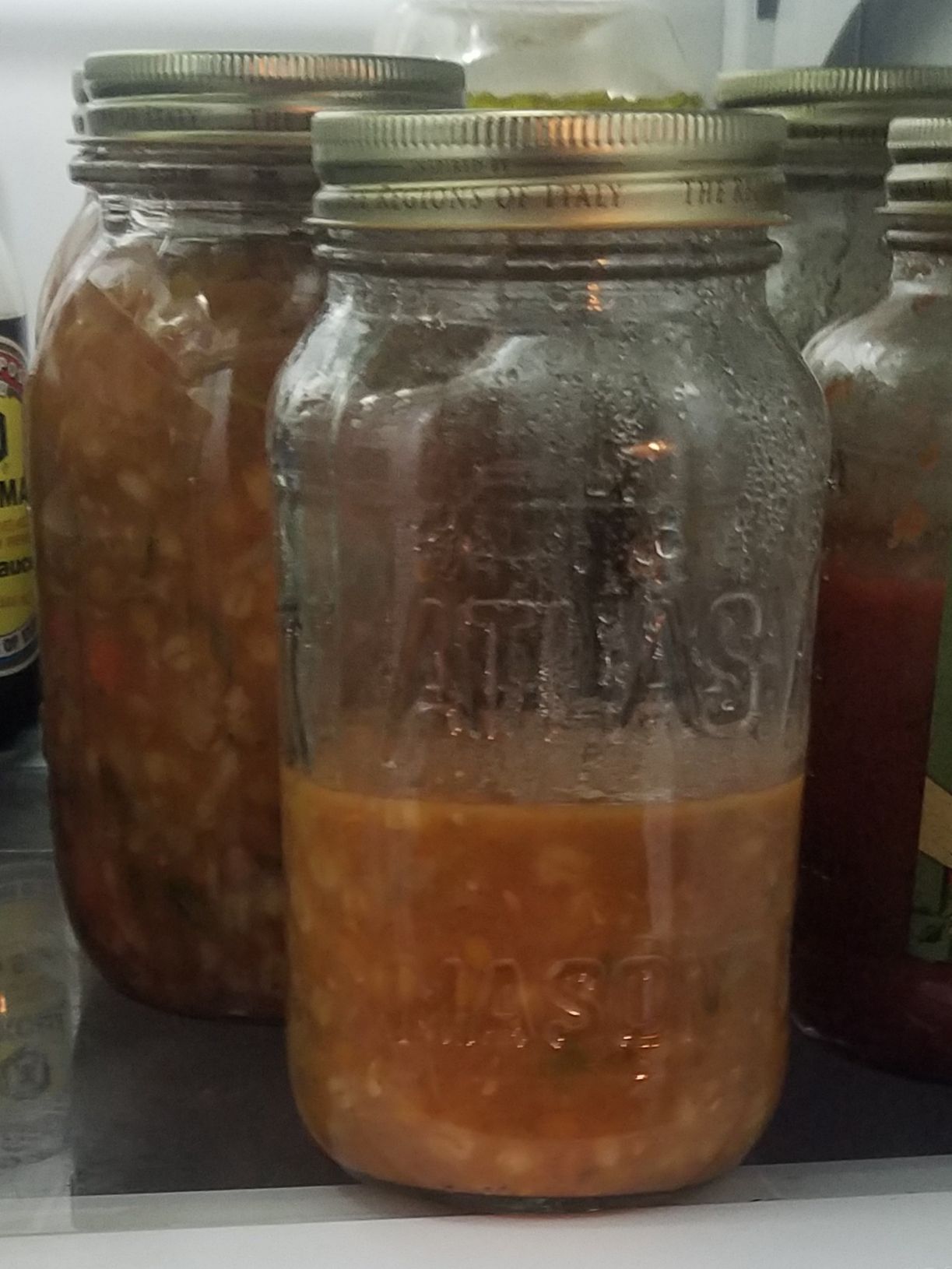
Another spontaneous aspect of cooking is using “my recipes,” meaning personally developed dishes, the recipe for which resides in memory or is written down in a notebook, 3 x 5 index card, or in the margins of cook books. We all have dishes like this. In our case, they form the framework of a weekly menu. Stir fried tofu with vegetables and rice is a complicated undertaking and we do that every week or two. Big batches of home made soup and chili stored in quart jars in the refrigerator are go-to meals when we don’t feel like cooking. Tacos are another mainstay. We use uncooked flour tortillas from the wholesale store and on hand ingredients from the garden and pantry for filling. The ingredients follow the seasons year-around with fresh tomatoes when they are available and frozen greens in winter. When we cook like this, there are few reasons to consult with a cookbook or recipe unless we’re understanding how to cook a new dish.
Morning has turned to afternoon and I haven’t been to the garden yet. I’d better get going. Thanks for reading.
I let my southern roots show by making grits for breakfast. There is no recipe, just an approximation. For a single large serving bring two cups of liquid to a boil (half milk/half vegetable broth) and add half a cup of grits. Salt and pepper to taste and cook on medium low heat until the texture of ground corn begins to show. Add one tablespoon of butter and then half a cup of shredded extra sharp cheddar cheese. Stir until every thing melts and the dish comes together. When the grits are soft, they are finished.
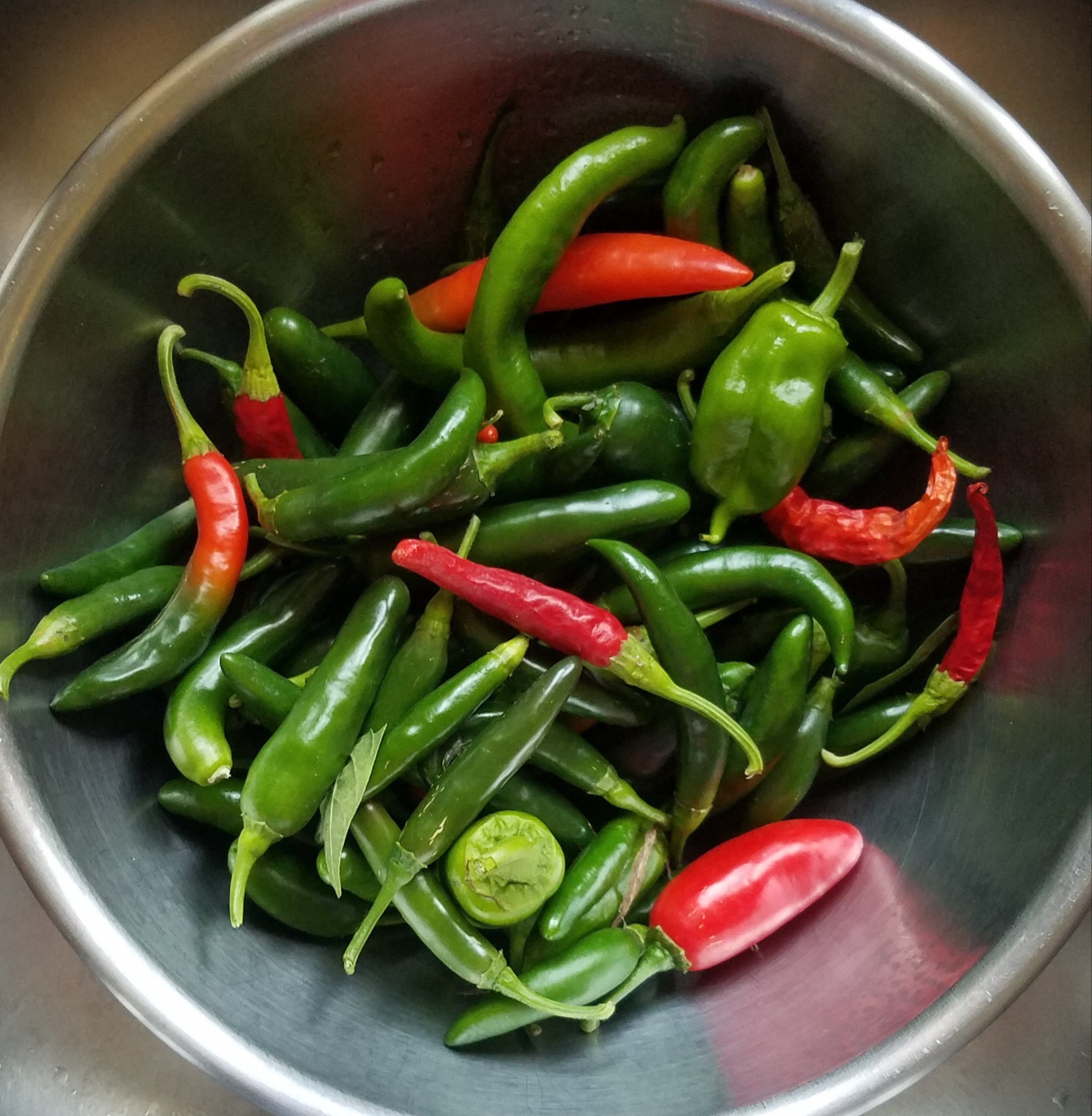
Last of the hot peppers as I cut the pepper plants down to clear the plot.
I’m taking down the third garden plot because I need a place to store tomato cages over winter. This was a hot pepper, fennel, eggplant and tomato plot. Fennel is coming back to life so I may get enough for a stir fry or two. To preserve the ground cover for another year, I cut the plants off close to the ground, remove the staples, and lift it off gently to get minimal tearing. Reusing assets like ground cover is a key economic factor in gardening.
Looks like we’ll get a hard frost over the weekend. It’s about time. I rely on cold weather to suppress garden pests. In addition, I already have enough hot peppers and kale to last until next year.
A local farm had a bumper crop of specialty pumpkins this year. Everything was priced half off over the weekend. I bought a large Casper pumpkin for pumpkin bread. I’ll bake it all and freeze it in amounts to fit the recipe. What they don’t sell will be fed to their cattle. Cattle enjoy eating pumpkins, apparently.
That’s all for this life in Iowa. Thanks for reading and make it a great day!




 Journey Home
You must be logged in to post a comment.