Categories
Environment Living in Society Social Commentary Sustainability

Protect Environment; Stop Nuclear Weapons

Paul Deaton
Paul Deaton

(Editor’s Note: When this guest column ran in the Cedar Rapids Gazette on Wednesday, Sept. 21, its abstract nature became real as heavy precipitation events pummeled Butler County and other parts of northeastern Iowa, disrupting lives there and downstream. Living in an environment where rain damages crops instead of nurturing them; where rivers jump their banks, close schools and displace people; and where Cedar Rapids must protect the city from record amounts of floodwater multiple times in eight years, something’s wrong. We must take action that includes electing a government that will address the causes of global warming and nuclear proliferation, not just deal with the actuality we have created).

Protect environment; stop nuclear weapons
By Paul Deaton

Guest column for the Cedar Rapids Gazette Sept. 21, 2016.
Reprinted with permission of the author

If we accept the premise articulated by Hillary Clinton’s presidential campaign, that we are stronger together, there is a lot in society requiring our collective attention.

There are no lone wolves in human society, although a number of people want to get away from the pack. Can we blame them? Being stronger together is a fundamental characteristic of Homo Sapiens. It’s what we do as a species.

What should we be working on?

It is hard to avoid the primacy of following the golden rule. We should be applying the golden rule, better than we have been, to everything we already do. This is basic.

Two other issues call for our attention, the threat of nuclear weapons, and mitigating the effects of climate change.

Today, on very short notice, nuclear powers can unleash a holocaust ending life as we know it. Nuclear war is not talked about much in the 21st Century; however the threat is as real today as it was when President Truman authorized the Hiroshima and Nagasaki nuclear bombings. The United States should take the lead in eliminating nuclear weapons. We need a transformational change in our nuclear policy that recognizes these weapons are the gravest threat to our security and must be banned and abolished.

We are wrecking our environment and should stop. Just 90 companies are to blame for most climate change, taking carbon out of the ground and putting it in the atmosphere, geographer Richard Heede said. If that’s the case, the move to eliminate fossil fuel use can’t come quick enough. These companies should be targeted for regulation by governments. Companies say they are not to blame for the demand from billions of consumers that drives fossil fuel use. Technologies exist to eliminate fossil fuels, and we should adopt them with haste. One purpose of government is to act as a voice for people who have no voice. Regulating business to protect our lives in the environment would serve that purpose.

After the 2016 election these issues will remain. The first can gain wide support easily. It is time the other two gain parity.

~ Paul Deaton retired from CRST Logistics in 2009.

Categories
Environment

Autumn Begins with a Flood

Flooded Wetland
Flooded Wetland

There was a lot to make one cranky as summer ended yesterday, including the weather.

Extremely heavy rains are flooding parts of Iowa and the impact will soon be felt downstream.

The Cedar River is expected to crest at 24.1 feet next week in Cedar Rapids, Iowa, the highest level after the record 31.12 foot crest on June 13, 2008.

“We have four days to get ready, and now is the time to start,” Mayor Ron Corbett said Thursday.

We’ve had a lot more time than that to get ready.

During Al Gore’s Climate Reality Leadership Corps Training, conducted in Cedar Rapids in May 2015, Mayor Corbett made a presentation about the 2008 Cedar River flooding, how it impacted Cedar Rapids, and what actions were taken and being considered to mitigate damage from potential future floods. The next week will determine whether the plans and discussions were enough to prevent serious damage.

Senator Joni Ernst has been pushing the U.S. Army Corps of Engineers to expedite completion of the Cedar Rapids Flood Control Project, recently in the Water Resources Development Act.

“This legislation includes my work to direct the Army Corps of Engineers to expedite the completion of the Cedar Rapids flood control project,” Ernst wrote in a Sept. 15 press release. “The provision emphasizes to the Army Corps of Engineers that Congress wants this project to remain a priority. I will continue working to ensure the Army Corps of Engineers understands the great need for this long-standing project to be completed in a timely and efficient manner.”

These efforts seem well intentioned, but too little, too late.

The connection between this flood and global warming is clear. When the atmosphere is warmer, its capacity to store water vapor increases. When it does rain, it can do so in heavy precipitation events in which a large amount of rain falls in a brief amount of time. The frequency and intensity of heavy precipitation events has increased since World War II and that appears to be what happened in northeastern Iowa over the last few days.

Here’s an excerpt from a WHO-TV news article about flash flooding in Butler County. It tells the story:

BUTLER COUNTY, Iowa — Storms in northern and northeastern Iowa overnight caused some damage as they spawned tornadoes and dropped heavy rain – up to 10 inches – in some areas.

“We expect the crest this evening what we’re being told around 7 p.m. probably water levels similar to 2008 or more so,” said Jason Johnson, Butler County Sheriff.

Flooding from the Shell Rock River has cancelled classes in the North Butler School District for Thursday and many students gathered at the high school to help fill sandbags. Highway 14 on the way to Charles City is impassable because of water over the road.

Butler County Sheriff  Johnson says there isn’t a widespread evacuation in Greene but some residents are moving to higher ground.

In Floyd County, 7.55” of rain was reported and Charles City saw 6.35”. The Little Cedar River is at moderate flood stage at Nashua and near Ionia. The rainfall total reported for Ionia is 6.24″.

Work will remedy the crankiness of summer’s end. One didn’t expect it to be sand bagging levies, homes and businesses to prevent damage from what is projected to be the second worst flood in Cedar Rapids history. It will get us through the weekend.

The newest flood begs the question of what’s next to mitigate the damage from future flooding? Government involvement in a solution is necessary but it must be implemented faster than it has been. We also have to connect the dots between our personal actions, global warming and climate change more than we have.

For now, we’ll just have to deal with the existential reality of the flood, something I recall doing since the 1960s. It’s a way of sustaining our lives in a turbulent world, but we can do better.

Categories
Environment

What’s After Paris?

Gore ParisLast week, Al Gore reflected on the ten years since he founded The Climate Reality Project. Following is an excerpt from an email he sent to the Climate Reality Leaders he trained.

Ten years ago, I trained the first group of Climate Reality Leaders in my barn in Carthage, Tenn. I asked them to join me in spreading the word about the urgency of the climate crisis, and I was impressed by the commitment and passion they demonstrated. I’m even more impressed now as the work they’ve done in their own communities and beyond has helped to spark a global movement for action on climate change.

In the decade since that first group came together, I’ve trained more than 10,000 Climate Reality Leaders who are just as committed to making the world a better place for future generations. The Climate Reality Leadership Corps is active in more than 130 countries around the world and represents people from all backgrounds and walks of life. I’ve enjoyed working alongside teachers, scientists, community leaders, business owners, students, and so many others who all share a dedication to promoting solutions to the climate crisis.

Ten years of concerted action by the Climate Reality Leadership Corps came together last year when 195 countries committed to working together to reduce greenhouse gas emissions planet-wide as part of the Paris Agreement. Now, it’s time for us to continue our work together and push countries to strengthen and implement their commitments so we can make the promise of Paris a reality.

Even as we look to the future, I want to make sure we take a moment to appreciate the last 10 years and all of the amazing work that you’ve done to help share the truth about the science and solutions of climate change with your friends, family members, colleagues, and everyone else.

I want to thank each and every one of you for what you’ve done in your own communities to bring attention to the most important issue of our time.

It is easier to play a role in the global effort to mitigate the causes of global warming and climate change when thousands of others are doing the same thing, each in their own way. That’s been my personal benefit from The Climate Reality Project.

I joined in Chicago (August 2013) and have no regrets. I learned the story behind Gore’s film An Inconvenient Truth, and the science behind it. Gore presented a broad mix of information about what is happening in our environment because of global warming and how it impacts communities.

Since then, I’ve presented my story to individuals and groups in the area and seek opportunities to do more. I served as a mentor at the Cedar Rapids training last year and have written about the need to act on climate change in my blogs, and in letters to the editor of our local newspaper. When I worked as a freelance correspondent, climate change informed my world-view and was a context in which I framed stories whether they were about farming or forestry, the school board or city council, or about new business openings or individual achievements.

Talking about global warming and climate change has become part of my life.

If the Paris agreement was the culmination of ten years of work, as Gore said it was, the work is not finished.

With a sharp focus on identifying the impact on our climate of CO2 emissions from burning fossil fuels, Gore and many allies made the point about seeking alternatives. As solar and wind-generated electricity reach price parity with fossil fuels (and they are doing so faster than anyone imagined) the coal industry is in disarray and nuclear power is waning.

There is a cloud on the hopeful horizon of renewable energy. Buoyed by exploration and discovery of oil and shale gas reserves, companies like British Petroleum, once green washing us with their interest in renewables, divested their interests in solar and wind energy this decade to focus on oil and gas.

I predict declining prices of solar power will help it dominate the future of municipal and regional electricity generation. Already companies like Central Iowa Power Company (CIPCO) are changing their tune. Not so long ago they were promoting nuclear power at their annual shareholder’s meeting. Today, they are building solar arrays.

If there is a blind spot in Gore’s laser focus on burning fossil fuels it is the impact of greenhouse gas emissions from other sources. He acknowledges them, but they have not taken the spotlight. There’s work to be done regarding manufacturing, agriculture, mining and other aspects of our industrialized global economy.

Every time I talk to an Iowa farmer Gore’s work can be heard in the conversation. Not so much from me, but from farmers. They’ll tell you the hydrology cycle seems different even if they dislike Al Gore and don’t acknowledge it is related to global warming. They don’t have to and I don’t need ratification of my own beliefs.

Like so many others I am focused on the work of mitigating the causes of climate change. You may not know it, but it is baked into everything I do.

What have you done lately to create a better environment for all of us to enjoy?

~ Written for Blog for Iowa

Categories
Environment Reviews

Book Review – A Sugar Creek Chronicle

A Sugar Creek ChronicleIn A Sugar Creek Chronicle: Observing Climate Change from a Midwestern Woodland Connie Mutel produced an engaging narrative of her efforts to cope with change while living on a parcel of Oak – Hickory forest in Northern Johnson County, Iowa.

The narrative is about climate change as the title suggests. It is also rich with descriptions of the flora and fauna of the region and how her life as a Midwestern ecologist, wife, mother, and cancer survivor has changed and is changing because of our warming planet.

It was hard to put the book down once I started reading.

The narrative is a combination of autobiography, new journalism, scientific research and advocacy for the political will to take action to mitigate the causes of anthropogenic global warming and its impact on our climate before it’s too late.

What makes the book important is less the scientific discussions about climate change, and more how Mutel copes with a life she believed held stability and predictability as key components. In telling her story Mutel articulates a personal perspective of current scientific research about climate change in a way that should provide easy to grab handles on a complex topic.

The idea that carbon dioxide causes global warming is not new. Around 1850, physicist John Tyndall discovered that carbon dioxide traps heat in our atmosphere, producing the greenhouse effect, which enables all of creation as we know it to live on Earth. That story has been told time and again.

The benefit of reading Mutel’s observations is one finds a lot in common with her life, on many levels. Her inquiry into global warming and climate change provides us a window not only to her world, but to ours.

~ Posted on Amazon.com.

Categories
Living in Society

Politics Takes A Holiday

Political Sign at a Business

The Bernie Sanders campaign is laying off hundreds of staff members, indicating either he is planning to throw in the towel after California, or that he won’t be placing people currently on his staff in local political organizations for the fall campaign. Maybe both.

The presidential nominating party may not be over, but most of the guests have left and the hosts have begun cleaning up the mess, getting ready for a return to normalcy, which in Iowa means organizing for the June 7 primary elections where there are contested races, and the fall campaign beginning after the Labor Day weekend.

Political campaigns will work through the summer, and there is a filing period in August, but each year, regular people engage in the election cycle later and closer to the election. For folks like me, politics takes a holiday after the primary elections until the fall campaign. We have lives to live.

I’ve written about the county supervisors race which has been reduced to a series of special interest forums in Iowa City and Coralville, along with fund raisers and whatever else each campaign sees fit to do.

I missed the first forum last night. Bottom line was I couldn’t afford the $5 in gasoline and an hour of driving on a work night. Stephen Gruber-Miller covered the forum for the Iowa City Press Citizen and here’s a link to his article. They say people in the county seat can access video of the event on their local cable television channel, but the service does not include Big Grove Township.

My trouble with picking three candidates for supervisor is besides the incumbents, I don’t share a view of the county with any of them. My relationship with the county seat is tenuous at best, although I likely benefit from the economic engine that is the University of Iowa. I’ll pick one of the two business people for my third vote and see what decision the urban centers make for me. No need to decide until late in the race, early June most likely.

The other primary election that matters is for U.S. Senate and I support State Senator Rob Hogg over three other candidates.

Politicization of our lives has become a detriment to living, so the compulsion I felt toward campaigns during the George W. Bush years is in remission. I work on issues, but like with the climate crisis, they represent human values and shame on those who politicize them or frame them in the false paradigm that is conservative vs. progressive. People like billionaire Tom Steyer is who I have in mind, but it applies equally to all of the billionaire class members.

Steyer Quote

My summer will be eking out a living on the margins of society, hopefully making enough money to live on, reducing debt, and finding joy in simple pleasures. We don’t need politics for that.

Categories
Kitchen Garden

Heading Toward Derby Day

Photo Credit: Quad City Times

That yesterday was opening day in Major League Baseball, and day after tomorrow begins the Masters Golf Tournament in Augusta, were inescapable sports facts on social media.

Spring is about Derby Day for me. It’s a race to get the early garden work done by then so once the risk of frost is minimal the main seedling crops of tomatoes, peppers and the like can go into the ground.

Most years I have been able to take a break from gardening to watch the two-minute Kentucky Derby, taking in just enough of the pageantry to feel a bit queasy. The old saw is horse racing is the sport of kings and who wants or needs it? It’s just there.

Iowa political class member Jerry Crawford asserted last year he had two goals: delivering Iowa for Hillary Clinton and winning the Kentucky Derby. Hillary won the Feb. 1 Iowa caucuses, just barely, and his team Donegal Racing’s 2015 entry in the Kentucky Derby placed fifth. That’s about as close as my life gets to so-called kingmakers.

I’ve been hobbled in gardening by my hand injury. Yesterday I limited my work to planting seeds in trays and transplanting those grown — celery, broccoli and basil — into larger pots. No digging for me… yet.

It was 71 degrees in Alaska in late March, almost 80 degrees in Iowa yesterday. The Alaska temperature was highest in recorded history and not a good sign for the thawing tundra and its release of long banked methane gas.

While sports distracts many, for those of us listening to a different narrative such distraction puts many more at risk of stopping Earth’s engine of sustainability.

That matters even on this small plot in Iowa removed from much of the turbulence in society.

Categories
Environment

Palm Oil is Bad for Iowa

Palm Oil Extraction Photo Credit Wikimedia Commons

On Friday, Feb. 5, the benchmark crude palm-oil future contract traded on the Bursa Malaysia Derivatives exchange reached its highest level since May 2014, according to NASDAQ.

Traders were feeling bullish as warm, dry weather caused by El Niño in the region receded from the prime palm plantations in Sumatra, Borneo and other parts of Indonesia.

These palm oil producing regions are half a world away, yet they matter to Iowa more than one knows.

The use of palm oil for cooking is in direct competition with soybean oil, including Iowa-grown soybeans traded on international markets. In a recent interview, Iowa Secretary of Agriculture Bill Northey said one out of four rows of Iowa soybeans are bound for international sales.

“India, the world’s largest importer of cooking oils, will buy more soybean and sunflower oil this year (2015) than ever before as a global glut weakens prices and prompts buyers to switch from palm oil,” according to Bloomberg News.

Because of the decline in farm commodity prices, current trends may favor soybeans over palm, but at the expense of soybean farmers. There is a clear case to be made to avoid products like chocolate, ice cream, detergent, soap and cosmetics that contain palm oil and its derivatives as a way to support Iowa farmers.

What matters more is deforestation to expand the cultivation of palm trees. Using a slash and burn methodology to clear equatorial rain forest for palm plantations, the haze covering Indonesia was visible from space.  While haze may be viewed as a temporary inconvenience, deforestation has a direct impact on the planet’s capacity to process atmospheric carbon dioxide. That’s not to mention the loss of habitat and biodiversity, as well as release of carbon stored in trees into the atmosphere.

From logging, agricultural production and other economic activities, deforestation adds more atmospheric CO2 than the sum total of cars and trucks on the world’s roads, according to Scientific American.

“The reason that logging is so bad for the climate is that when trees are felled they release the carbon they are storing into the atmosphere, where it mingles with greenhouse gases from other sources and contributes to global warming accordingly,” the article said. “The upshot is that we should be doing as much to prevent deforestation as we are to increase fuel efficiency and reduce automobile usage.”

Most corporate food conglomerates use or have used palm oil and its derivatives as an ingredient. What’s a person to do?

The first recourse in Iowa is the power of the purse. Avoid purchasing products with palm oil because it competes with Iowa-grown soybeans, and is a contributor to climate disruption. There is no such thing as sustainably grown palm oil.

Palm oil and its derivatives go under many names. A list of alternate names for palm oil can be found here along with a handy wallet sized printout.

Here is a list that discusses use of palm oil in various consumer products.

Explore the Rainforest Action Network web site, beginning with this link. There is a lot of information about the issue and actions you can take to address the most pressing aspects of deforestation.

While Indonesia may seem distant, what goes on there and in other equatorial palm plantations matters here in Iowa.

Categories
Writing

Mid-week Hustle

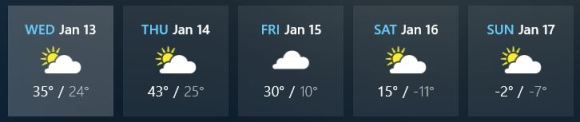
Five-Day Forecast
Five-Day Forecast

It doesn’t appear we will get a solid week of subzero temperatures this winter. Based on the five-day forecast I’m planning to prune the fruit trees on Sunday.

Would that growing food were all there was to worry about.

The challenge has been to assimilate a new work schedule at the home, farm and auto supply store into my writing schedule. Halfway through January, I’m no closer to a plan.

While it may seem self-indulgent, mentioning the word “I” so many times, unless I get this right, it’s curtains for my aspirations as a writer.

I won’t let that happen.

How to use the couple of hours in the morning, my break periods at work, and time in the evenings and on weekends for writing production needs definition. Family, our food system, maintenance on the property, and adding revenue have to be considered as well.

Confident I’ll get there, midweek before the cold it’s not clear how. Something will get figured out. I hope it will be sooner rather than later.

Categories
Environment

Post Paris

Paris COP 21Yesterday the 21st Conference of the Parties, including 195 nations, adopted an agreement to curtail greenhouse gas emissions.

A few people I know attended, but mostly the names and faces of the negotiators and players were reduced to certain heads of state and prominent activists.

Short version: now that the agreement is made, governments must adopt it.

A widely circulated article in The Hill quoted U.S. Senator James Inhoff.

“Senate leadership has already been outspoken in its positions that the United States is not legally bound to any agreement setting emissions targets or any financial commitment to it without approval by Congress,” he said.

Managing greenhouse gas emissions will be a challenge without U.S. leadership. The Republican-controlled Congress is unlikely to consider or adopt the agreement. The Heritage Foundation asserted the administration is planning to make an end-run around Senate scrutiny. That is ridiculous given the public nature of the negotiations that produced it and the long, lead-up to the accord.

Suffice it that the Environmental Protection Agency Clean Power Plan is the primary mechanism for compliance with the terms of the Paris agreement, and the Congress has been trying to kill it. Debate on the Clean Power Plan began long before it was published Oct. 23 in the Federal Register. On Nov. 18 the Senate passed a resolution to kill the plan. On Dec. 1 the U.S. House of Representatives did likewise.

The United States is not the leader we could be on mitigating the causes of global warming. Nothing about COP21 changed that.

What has changed is the world is coming together to address the greatest threats to human survival. Not only regarding greenhouse gas emissions, but in other areas. Whether the United States will lead or follow is to be determined. The direction has been set, and while there will be tenacious resistance to changes in the fossil fuel paradigm, new leadership is emerging. Life as we know it hangs in the balance.

Let’s hope our government steps up to the challenge. We have the capacity. Whether we have the political will is an open question as the world passes us by.

Categories
Environment

Eve of Paris 2015

Heads of State Photo Credit www.cop21.gouv.fr
Heads of State Photo Credit http://www.cop21.gouv.fr

President Obama is scheduled to depart Washington for Paris later today to attend the 21st Convention of the Parties (COP21 or Paris 2015). Paris 2015 offers our best hope to curb greenhouse gas emissions through the United Nations Framework Convention on Climate Change.

As of yesterday 150 heads of state had accepted the invitation to participate, with representatives of 196 nations planning to join. Each head of state will make a speech, with the order set by UN rules. President Obama’s speech will follow His Majesty Mohammed VI, the King of Morocco around noon local time.

In the wake of the Nov. 13 terrorist attacks, Paris is on lock down. Ed Fallon described the scene.

With public demonstrations banned, would-be participants lined up pairs of shoes in one of the rally locations that would have been. As I type, a human chain is lining up between Place de la Nation and Place de la Republic.

Even though people with means have traveled to Paris to demonstrate, contrary to what people like Naomi Klein and other prominent climate change advocates have said, accompanying demonstrations don’t seem so relevant to the bigger picture. With or without them, the heads of state and dignitaries will accomplish something with regard to mitigating the causes of climate change. Let’s hope it is enough.

That’s not to say there isn’t hope, just that all of the speeches could be reminiscent of the scene from Star Wars where Queen Amidala addressed the Galactic Senate.

Queen Amidala Addresses Galactic Senat Photo Credit StarWars.com
Queen Amidala Addresses Galactic Senate Photo Credit StarWars.com

Even though the U.S. political system, the legislative branch of government particularly, is unprepared to act on climate today, I believe, and with good reason, the effects of anthropocentric climate change will become so pronounced that even the most virulent climate skeptic will recognize the need to take action to mitigate its causes.

The time for which we have long waited is upon us. Here’s hoping our leaders take action.