Categories
Living in Society

Framing the Caucuses – Republican-style

Democratic Caucus Goer

I re-read Jennifer Jacobs’ 50 most wanted Democrats article twice and have to say I disagree with her framing.

In the first place, the Republican caucuses are a place where only registered Republicans who show up get to vote, not “where each Iowan gets one vote,” as Jacobs asserts.

Second, I know very few Iowa Democrats who jumped on board some presidential hopeful’s campaign because they were able to associate with people on this list. For example, when Dave Loebsack co-hosted Evan Bayh at Jim Hayes’ home in Iowa City, a crowd gathered, but to say it helped Bayh during his 2008 presidential bid, other than to help him decide to bow out, would be optimistic and self serving. Who would even say that besides someone like Jacobs?

Third, the selection of political activists for the list also serves Jacobs’ point of view. These are folks with whom she presumably has a relationship, and depends upon to present a “balanced” view of Democratic politics. Her view is anything but balanced, and stroking this group only builds her relationship with them, rather than saying anything about how Democrats select candidates.

Finally, this group more represents the problem with the Iowa Democratic Party than a leverage point for presidential hopefuls to gain support. If this list is our set of leadership, we are doomed to defeat as long as they are around. Jacobs clearly gets that wrong. What’s needed is a new, more diverse and much younger set of faces.

If we recall Dunbar’s number, Jacobs has limits on cognitive recognition, and setting fifty Democrats may be a reasonable limit for that part of the political spectrum, at least in her world.

A couple of points:

Is Roxanne Conlin not able to gather a crowd or raise money for Dems? Everyone who believes that, stand on your head.

Jerry Crawford? Really?

Zach Wahls? Besides a flash of celebrity, what does he add?

This sentence about Sarah Benzing is a killer. “Although the latest campaign she managed, Bruce Braley’s, was branded the worst U.S. Senate campaign in the country, Benzing has a good track record.”

I don’t seek to run people down, and know many people on this list. I’m just sayin’. Jacobs is trying to frame who we are as Democrats. If we sit by and let that happen, we had better get used to Republicans running the state.

~ Written for Blog for Iowa

Categories
Home Life

Friday in Iowa: Summer Reading

Photo Credit: Haunted Bookshop

The phrase “summer reading” evokes when we took off from school, and had leisure time between Memorial Day and Labor Day. For some it still involves barbecuing, boating, swimming, vacations and a host of activities tied to youth. Today, people continue to summer, but briefly and in competition with the constant clamor of the exigencies of modern life. People are busy trying to survive and get ahead, all the time, and there is less time for reading. Here are a few of my picks for reading during summer 2014.

Books

The classic novel of summer is The Great Gatsby by F. Scott Fitzgerald, and I recommend a second look.

My summer fiction reading will include The Home Place by Carrie La Seur. La Seur is the founder of Plains Justice and a practicing attorney in Billings, Montana, where she has family roots. The Home Place is La Seur’s first novel, due to be released July 29. A section of the book, can be found in New Voices in Fiction Sampler: Summer Selection, which can be downloaded free for Kindle here.

On the wonky side, check out Capital in the Twenty-First Century by Thomas Piketty, translated by Arthur Goldhammer. Piketty writes that the main driver of inequality is return on capital exceeding the rate of economic growth. Check out a section from the introduction here. Also a bit wonky, but very readable is Eric Schlosser’s Command and Control: Nuclear Weapons, the Damascus Incident, and the Illusion of Safety.

If you have not read Maya Angelou’s I Know Why the Caged Bird Sings, it is worth the time, even though it was published in 1969. “The first in a seven-volume series, it is a coming-of-age story that illustrates how strength of character and a love of literature can help overcome racism and trauma,” according to Wikipedia.

Poetry

Pick one poem, any one, and read it… aloud. Then read another. Go to the public library and find the poetry section. Spend an hour browsing through whatever comes into view. Readers will develop their own interests, but in my to-read pile are The Oldest Map with the Name America by Lucia Perillo, Collected Poems by Vachel Lindsay, Miracle Fair by Wisława Szymborska-Włodek, The Spirit Level by Seamus Heaney, An Inconvenient Genocide by Alicia Ghiragossían, and Scattered Brains by Darrell Gray.

Screen Time

Turn off the television. It won’t kill you. In our house, we haven’t disconnected from cable, but we shed the premium channels, including MSNBC, long ago. We rarely turn on the T.V. and life has been better. I suppose if we cared about the World Cup, we’d watch more.

That said, we have screen time, and using it efficiently is an important endeavor, equal in importance to the time we spend in the real world, talking and listening to real people. In many respects, time in front of the screen has replaced television and print media and can provide value.

This summer, Blog for Iowa recommends you check out some new authors who post on the Internet, including current fave Art Cullen of the Storm Lake Times, and the blogs Leaf and Twig, A Buick in the Land of Lexus, and ICI & LA NATURE PICTURES: Walk and Bike in France.

Best wishes for great reading this summer. Don’t forget to bookmark Blog for Iowa and check back often.

~ Written for Blog for Iowa

Categories
Writing

Friday in Iowa: Newspapers

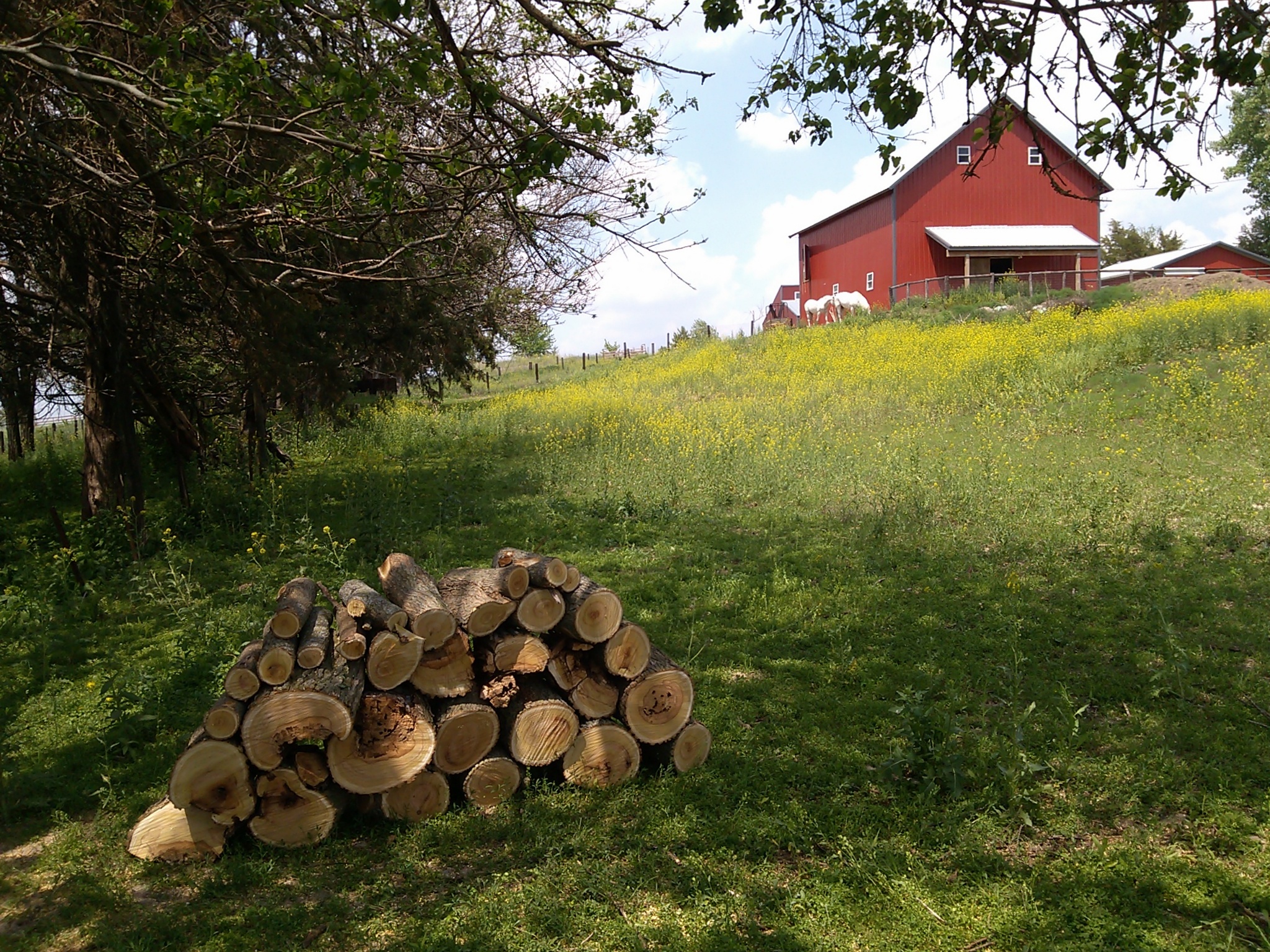
Barn
Barn

When I agreed to fill in as the summer, weekday editor of Blog for Iowa, the decline of newspapers, and substantial changes in corporate media was on my short list of topics to cover.

As I drove to town yesterday, people were collecting their copies of the Cedar Rapids Gazette from the roadside drop boxes. How long they will continue to do so is an open question. Newspaper publishing is a dying industry with 28.6 percent of newspapers closing since 2000. (See Harry Bradford’s article on Huffington Post here).

The Internet is becoming the pipeline for news, information and other content in a way none of us recognized as we first logged in on home computers back in the 1990s. These days, many people I know don’t even own a television set, much less subscribe to a newspaper or to cable TV.

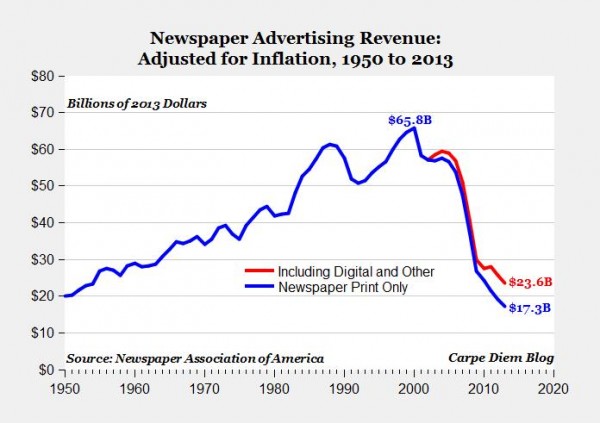
A lot has been written about the decline of newspapers and most readers have probably seen this chart:

Newspaper Sales

“The dramatic decline in newspaper ad revenues since 2000 has to be one of the most significant and profound Schumpeterian gales of creative destruction in the last decade, maybe in a generation,” wrote Mark J. Perry in the Carpe Diem Blog. “And it’s not even close to being over.”

Things have gotten so bad that newspapers have stopped publishing the quarterly results used to make this chart, favoring annual reports. What does that mean? More newspapers will consolidate or go out of business, leaving less writing jobs for those who need it as paid work.

How does Blog for Iowa fit in? As you can see at the bottom of the front page of the blog, we have a benefactor. “Blog for Iowa is paid for privately to the tune of $15 a month by Dr. Alta Price of Bettendorf, Iowa,” it says. As long as people want to work for beer money or less, there will be plenty of opportunities to write. Not that we want to encourage readers to go elsewhere, but just look at the WordPress Freshly Pressed site. There are tens of thousands of well written blogs and those blogs exist and need writers, even if most of them are not for profit.

The point is the world has changed and is changing, and one of my topics this summer will be occasional posts about the changing media and our role in the new world it is creating. Watch for my summer “Friday in Iowa” series to be posted irregularly on Fridays until Labor Day.

Special thanks to my colleagues at Blog for Iowa, Trish Nelson, Dave Bradley, and especially to Dr. Alta Price for making it possible for me to write for Blog for Iowa this summer.

~ Written for Blog for Iowa

Categories
Writing

Summer Jobs

Blog for Iowa
Blog for Iowa

LAKE MACBRIDE— Trish Nelson will be taking the summer off from editing Blog for Iowa, and I’ll be filling in. There is a small stipend, and the work will give me a chance to develop ideas around the 2014 midterm elections, and on other topics.

With the retreat of so many people to no preference voter registration, to say that party affiliation matters a lot misses the point. In my statehouse district, the Iowa Secretary of State May report showed 19,802 active voters, of which 6,275 are registered Democratic, 5,666 Republican, and 7,576 No Party. The Democratic edge is largely irrelevant with so many no party registrants.

Don’t get me wrong, there is a devoted corps of died in the wool Democrats and Republicans. They just make up a minority of the electorate. In my experience, the further down the ticket, the less party affiliation matters, and the more the personality and policies of candidates come into the foreground. This summer will be a time to explore the meaning of this in light of the Nov. 4 general election campaign. It should be fun and interesting. My posts can be seen at this link.

The other new summer job is a woodcutting project in nearby Cedar County. The work has flexible hours, and will add some needed income to the household budget.

Meanwhile, the farm, newspaper and warehouse work will form a base of income upon which I can build. One thing seems certain, with all of the gardening and my share from the CSA, there will be no shortage of good quality food for our pantry and table.

It is shaping up to be a productive summer.

Categories
Living in Society

To Amend In Iowa Get Moving

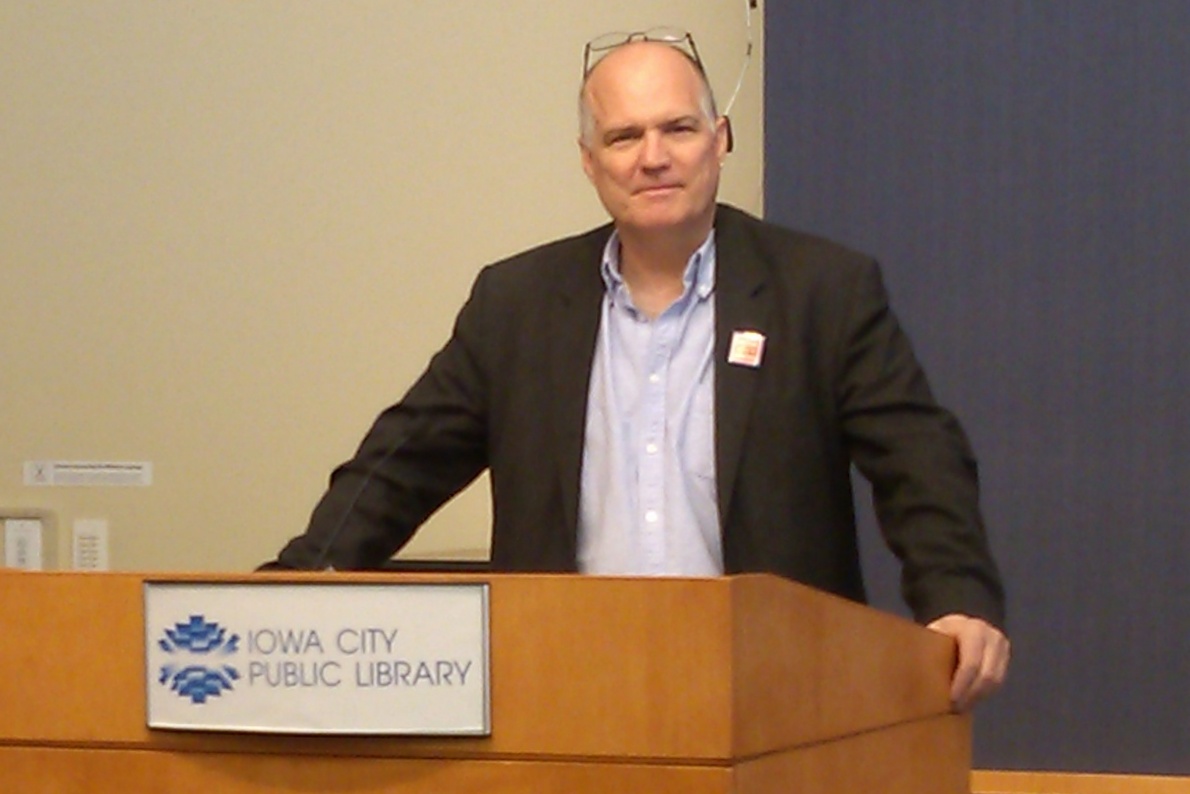
David Cobb at the Iowa City Public Library

IOWA CITY— We can thank Move to Amend for the sentences “corporations are not people,” and “money is not free speech.” Now what?

David Cobb, one of the founders of the organization, didn’t have an answer at the Iowa City Public Library on April 17. He did say if we filled out a sheet the national organization will plug us in. Plus us into what?

“Our essence was the realization that even people who engage in civic engagement on issues, and there has been just amazing work that’s done,” he said. “But we haven’t, in my lifetime and maybe in a generation, seen the kind of social movements that are the earmarks of this country. The social movement that culminated in the American Revolution, actually the creation of this country, was in fact a social movement. So too was the abolitionist movement, and the women’s suffrage movement, and the trade union movement, and the civil rights movement.”

“You see there is something different between movement and issue organizing or issue activism,” Cobb concluded.

The brochure Cobb distributed on Thursday had great organizing information, with solid ideas: form a study group; organize a workshop or street theater event and invite a speaker from their organization; pass out brochures at public events; write a letter to the editor or op-ed in your local newspaper; propose a local resolution or ordinance; contact elected officials and ask them to take a public stand; or sign a petition. Here’s the rub, organizing does not a movement make.

Blog for Iowa has been writing about Citizens United, which led to creation of Move to Amend, for years. Readers are familiar with the idea of amending the Constitution to say 1). Only natural persons have Constitutional rights and 2). Money is not free speech. After almost four years of being in Iowa, Move to Amend has picked some low hanging fruit: resolutions passed by a handful of governing bodies, some organizing, and a couple of Democratic sponsors for legislation. However, the bicameral Iowa legislature is no closer to acting on amending the Constitution than they were before the Citizens United decision was handed down.

What Move to Amend needs is to become a movement, something Cobb knew this afternoon. It is a long distance from that.

It is ironic that an organization born out of a think tank and turned into a 501 (c) 3 is what Cobb’s narrative implied is not needed. If Iowans want to amend the constitution regarding corporate personhood and money as free speech, then we better get moving. Move to Amend is looking at a 30 year process to amend the Constitution, according to Cobb. The truth is we can’t wait.

~ Written for Blog for Iowa

Categories
Living in Society

Why Philadelphia Made Me a Deaniac

Blog for Iowa: Trish Nelson, Caroline Vernon, Dr. Alta Price, Paul Deaton, Dave Bradley. Photo by Dan DeShane

Happy Tenth Birthday Blog for Iowa

The 2000 election was supposed to have elected Al Gore as the first environmentalist president. He was a shoe-in after a popular Bill Clinton, or so some of us thought. What happened after the U.S. Supreme Court gave the election to Bush was people I know, from the whole political spectrum, launched into activism unlike any in my experience. Howard Dean was at the center of this. Who had even heard of the 79th governor of Vermont as votes were counted, and then the counting was stopped in the election of the hanging chad?

When the 2000 election wasn’t settled on Nov. 7, we were enthralled. I listened to the returns on the radio as I drove to Chicago for a meeting on the 8th. When I reached the motel, I stayed up late watching the early morning coverage on television. I followed the Supreme Court action at home and downloaded a ream of briefs to read. It was a unique time. It was a cursed time. I felt sitting on the sidelines was no longer an option.

The turning point came shortly after the Al-Qaeda attacks on Sept. 11, 2001, and not for reasons one might think. My flight was scheduled to depart Moline, Ill. that day for Philadelphia. After our staff meeting in Eldridge, the televisions in the operations room were turned on with live images of smoke emitting from the World Trade Center. Air travel would not be an option that afternoon.

When I did fly to Philadelphia several days later, the aircraft was almost empty. Enroute to the Eastern Iowa Airport, the car radio informed me that President Bush was also heading to Philadelphia to fulfill a campaign promise at a battered women’s shelter. It meant a possible delay getting to my work site at the former U.S. Steel facility in Bucks County. As we approached, Air Force One had already landed, so we circled for 20 minutes— the delay was minimal.

After getting a rental car and leaving the airport, there were law enforcement officers on every corner, thousands of them. As I headed to work, I passed the presidential motorcade on I-95, heading back to the airport. It was only 10:30 a.m. All that public money on the flight, and law enforcement for a political event? The seed was planted: Bush had to go.

The rest is the history of Bush 43. Things rubbed the wrong way. The television address on the invasion of Iraq seemed similar to Nixon’s explanation of the invasion of Cambodia— both presidents appeared to be deceiving us. There were Cheney’s secret energy meetings, Christine Todd Whitman’s brief tenure at the Environmental Protection Agency, and a thousands cuts against everything I held dear. We were ready for change in 2004.

From the beginning of the 2004 campaign, I didn’t care for Howard Dean. He had the endorsement of Democratic leaders, including Al Gore, and U.S. Senator Tom Harkin, but no one I knew was supporting him. Our small family caucused for John Kerry, who won the nomination, and we lost the November election.

Vindication of Dean’s new campaign style came in the form of Democracy for America (DFA), which I heard about from the current Blog for Iowa editor, Trish Nelson and her friend Ellen Ballas at a DFA training at Kirkwood Community College in Cedar Rapids.

At the training, I met Arshad Hasan, Dorie Clark, Dave Leshtz and others who provided training in the mechanics of winning elections. Things like estimating voter turnout, fund raising, and setting a timeline for the canvass, were all important lessons. Thing is, the DFA techniques worked.

We experienced some success in 2006, and the culmination was in the ultimate grass roots campaign of Barack Obama, with Howard Dean as the chair of the Democratic National Committee. To say Howard Dean wasn’t a part of the transformation of electoral politics would be a lie. Unlike certain politicians, I’m not willing to tell a lie.

My first mention on Blog for Iowa was by Ed Fallon on Nov. 17, 2007, in a post titled Action on Coal Plants. What cemented my Deaniac status and my relationship with the group at Democracy for Iowa,  was when Trish Nelson asked me to start writing for Blog for Iowa. My first post was on Feb. 25, 2009 with an open letter to the Iowa Department of Natural resources on the then proposed Marshalltown coal-fired power plant. At some point along the way I got less formal, trading my suit for a T-shirt, but I have been writing ever since. And we can thank Philadelphia for that.

Congratulations Blog for Iowa! May you experience many new writers and another ten years.

Categories
Writing

Blog for Iowa Recharged

L to R: Trish Nelson, Caroline Vernon, Dr. Alta Price, Paul Deaton, Dave Bradley. Photo by Dan DeShane

DAVENPORT– Editors and contributors to Blog for Iowa met with our publisher on Thursday, Aug. 22, at a local restaurant to discuss the future of our blog. We plan to be around through our tenth anniversary on April 2, 2014 and beyond. That we could sustain this work for so long is the result of the efforts of editors and contributors over the years, but none of it would have been possible without our publisher, Dr. Alta Price of Bettendorf. Dr. Price renewed her commitment to Blog for Iowa, which “is paid for privately to the tune of $15 a month” according to to the footnote on the front page.

Horticulturalist Dan DeShane brought fresh tomatoes to the restaurant, which he sliced on the spot and offered. Bags of organic sweet corn and tomatoes were exchanged. But the “meat” of the dinner was conversation about issues we write about on the blog: media, ALEC, the Iowa legislature, health care, climate change, and others, including Howard Dean who got us started.

After the meal, we went to Cobblestone Place where Progressive Action for the Common Good (PACG) held its monthly community networking night. The group was hosting Evan Burger and Adam Mason from Iowa Citizens for Community Improvement (ICCI) for a discussion about the group’s campaigns, including Iowa water quality. Dr. Price serves on the board of PACG.

We don’t get together often, but when we do, there is new energy. Blog for Iowa plans to be around as the online information source for Iowa’s progressive community for years to come.

~ Written for Blog for Iowa

Categories
Writing

Guest Editor

Blog for Iowa

LAKE MACBRIDE— Trish Nelson, editor of Blog for Iowa, will be taking a summer break and I’ll be pinch hitting as weekday editor from July 15 until Sept. 2. I’m looking forward to regular posting on the Online Information Resource for Iowa’s Progressive Community.

The blog originated in the wake of the Howard Dean for President campaign when John Kerry won the Iowa Caucuses in 2004 and Dean dropped out of the race. Dr. Alta Price, a pathologist from Davenport, helped lead Democracy for Iowa, and decided to publish Blog for Iowa, a role she continues to play today. The first post is here, although what may be most relevant from it today is this statement, “we also seek to make Democracy for Iowa a place where all progressives and moderates are welcome, whether they consider themselves Democrats or not.” More than 5,000 posts later, Blog for Iowa continues to present a progressive viewpoint and maintain a friendly relationship with Democracy for America, the organizational successor to Dean for America.

When I write original content for Blog for Iowa, it will be cross posted on this site a day later. Among the topics will be the challenges of temporary workers in Iowa; implications for Iowa of the immigration legislation working through the U.S. Congress; Iowa’s role in mitigating and adapting to climate change (not the same thing); and occasional posts on energy policy, local food system issues, and peace and justice activities in the state.

I hope you’ll check in at Blog for Iowa from time to time, and continue to read my original content on On Our Own. It should make a great end to an already fine summer of 2013.