Independence Day is an American holiday if there is one.
A group of military veterans discussed participation in a local Independence Day parade via email. A member made this post:
I will not participate in the July 4th parade. This government is committing atrocities all over the world and locking up children is a heinous crime. I take a knee to this and stand with Frederick Douglass who said, “your celebration is a sham; your boasted liberty, an unholy license; your national greatness, swelling vanity; your sounds of rejoicing are empty and heartless; your denunciation of tyrants, brass-fronted impudence; your shouts of liberty and equality, hollow mockery; your prayers and hymns, your sermons and thanksgivings, with all your religious parade and solemnity, mere bombast, fraud, deception, impiety, and hypocrisy-a thin veil to cover up crimes which would disgrace a nation of savages.”
Being American is complicated. We are a diverse nation scarred by our original sins of slavery and unjust exploitation of what our forebears encountered here. We have not found our way out of the wilderness and may never.
We should take time for a bit of history on Independence Day. Reading an 1861 account of Independence Day in Jones County, Iowa has become a tradition for me. Find it here.
As we gather for special food and festivities this Independence Day, I hope we take time to consider our neighbors and walk in their shoes for a while. I mean the neighbors we don’t really know. Only then will we have a chance to make it out of the wilderness to an America worth knowing — and maybe we’ll feel more like participating in parades.
Last Friday the Iowa Supreme Court overturned the 2017 law requiring a 72-hour waiting period before a woman could have an abortion.
Here’s the money quote from Chief Justice Mark Cady, writing for the majority:
“The state’s capacity to legislate pursuant to its own moral scruples is necessarily curbed by the constitution. The state may pick a side, but in doing so, it may not trespass upon the fundamental rights of the people.”
There are lawyers among Republicans who crafted this law. Either their leadership was grossly negligent in writing it or they just don’t care if they impose their morality on Iowans through legislation.
Republicans are bad at law making. They’re crazy. But are they crazy like a fox?
Associated Press posted an article about the ruling last Saturday. In it is exposition about the so-called conservative strategy of getting Roe v. Wade overturned, which some say is the endgame of Iowa’s bad laws related to a woman’s right to choose.
Chuck Hurley, an attorney for the Christian conservative group The Family Leader said the ruling makes it even more important to get the fetal heartbeat law passed by Iowa lawmakers earlier this year before the U.S. Supreme Court. It bans abortions once a fetus’ heartbeat is detected, usually around six weeks of pregnancy.
Hurley and others believe it’s their best chance at reversing Roe v. Wade but the legal challenges are based on the Iowa Constitution and most likely will go again to the Iowa Supreme Court rather than the federal court.
“Americans know that when a baby’s heart is beating, she’s alive, but our state judges aren’t willing to protect her life,” Hurley said. “That’s why we need the U.S. Supreme Court to hear this case.”
Will this strategy work? I don’t know. Regardless, the 45th president will pick a replacement for Associate Justice Anthony Kennedy, and may also pick them for Associate Justices Stephen Breyer (79) and Ruth Bader Ginsburg (85) should they die or retire while he is in office. People like the Federalist Society’s Leonard Leo have coached the president in how to approach Supreme Court nominations so as to dodge the gorilla Roe v. Wade represents. If the nomination and confirmation of Associate Justice Neil Gorsuch is an example, the president will be adept at getting his picks to the high court. Cynics among us say regardless of the merits of the case, by packing the bench with conservatives Trump will midwife the overturn of Roe v. Wade. The unanswered question is to whom do Supreme Court justices owe fealty?
Last Friday was a good day for Iowans’ constitutional rights. It gave hope all is not lost in the Hawkeye State. It could be a bellwether of good things in November.
Hiroshima, Japan after U.S. Nuclear Attack. Photo Credit: The Telegraph
The Washington, D.C. rumor mill is saying President Barack Obama may “do something” about nuclear weapons before the end of his term.
Among ideas being discussed are early retirement of some of the non-deployed weapons in the arsenal; declaration of a no first use policy; or taking weapons off hair-trigger alert.
The arms control community is pushing for no first use policy, but whatever — any Obama action to reduce the threat of a nuclear weapons exchange near the end of his presidency would be welcome, and largely symbolic.
Saturday, Aug. 6, marks seventy-one years since the United States dropped the first of two nuclear weapons on Japan.
When the Enola Gay dropped “Little Boy” over an unsuspecting Hiroshima, it killed between 60,000 and 80,000 people immediately with a total death toll estimated at 135,000. The bombing of Nagasaki occurred three days later. Men, women and children were killed indiscriminately.
President Harry Truman made the decision to use the bomb. In the end, he had no questions or regrets. Truman believed in the larger picture of World War II, a conflict in which tens of millions of people lost their lives, dropping the bomb would save lives. More than seven decades later we continue to debate whether bombing Hiroshima was necessary or played any significant role in ending the war.
After signing the New START Treaty with Russia, which entered into force in February 2011, the U.S. Congress embarked on a nuclear weapons modernization process expected to spend as much as $1 trillion over the next 30 years. That’s a lot of money for a weapons system we hope never to use.
What’s an Iowan to do? My friend and colleague Peter Wilk speaks for many of us.
Calling for “No First Use” of Nuclear Weapons
Submitted to the Brunswick (Maine) Times Record
This August 6th and 9th we are once again reminded of the atomic bombings of Hiroshima and Nagasaki, which killed an estimated 200,000 women, men and children. This past May, President Obama was the first President to visit the site and to commemorate the bombing victims.
While in Hiroshima, President Obama declared, “Among those nations like my own that hold nuclear stockpiles, we must have the courage to escape the logic of fear and pursue a world without them.” Thousands of members and supporters of Physicians for Social Responsibility completely agree.
Although most of us would rather not think about it, the U.S. and Russia continue to have thousands of nuclear warheads deployed on hundreds of missiles, bombers and submarines. We and the Russians keep over 1,000 of them on so-called “launch on warning” status. These warheads can be launched within minutes and reach their targets around the world within thirty minutes, putting millions of innocent civilians at risk in each of our countries.
The recent military uprising in Turkey reminds us just how unstable our current situation is, with 50 of our nuclear weapons stored in a U.S. airbase there. This airbase was surrounded and cut-off during the most unstable period of that coup attempt.
Perhaps most frightening is that the U.S. maintains a policy of threatening to be the first to use nuclear weapons in a future conflict. Combining this policy with our “launch on warning” stance sets the stage for a potential nuclear war initiated out of fear, anger, miscalculation or accident.
These horrific weapons threaten our own national security rather than enhance it. They are unusable in any meaningful sense of the word, given the global disruption to the world’s climate, food supply and economy that would result. At the same time, they have no value in countering terrorists or cyber-attacks.
Fortunately there are also some positive developments upon which to build. 127 countries have taken the Humanitarian Pledge calling for elimination of nuclear weapons. As a result, the United Nations established an Open-Ended Working Group that has begun meeting to discuss the most promising next steps toward a treaty to ban nuclear weapons around the world.
Meanwhile, the potential humanitarian impact of any use of nuclear weapons is so overwhelming that we in the U.S. must pull ourselves back from the brink by taking an easy step of our own. Since these weapons are in reality unusable, the U.S. should minimize their role in our military planning. President Obama can and should declare that the U.S. is adopting a “no first use” policy – pledging to never again be the first nation to launch nuclear weapons against another.
The U.S led the world into the nuclear age. Now it’s time to lead the world beyond it – to move to safer national security strategies that do not put all that we care about at risk, under the false premise that threatening to use nuclear weapons against others can protect us.
President Obama – your legacy and our lives are at stake. Please complete your presidency by taking a meaningful step to reduce nuclear risks by initiating a “no first use” policy.
On this 71st anniversary of the destruction of Hiroshima, let us all pledge “never again” and commit ourselves to do what we can to help make progress toward a world free of nuclear weapons.
Peter Wilk, MD
Physicians for Social Responsibility — Maine
It’s time to prevent what we cannot cure, and abolish nuclear weapons.
The conventions dispersed and the road home was ahead as Blog for Iowa writers engaged with Senator Chuck Grassley last Friday.
Both Trish Nelson, in a chance meeting in Mount Pleasant, and Dave Bradley, at a town hall event in Columbus Junction, each encountered Grassley in eastern Iowa.
Both stories are worth hearing and indicate where our senior senator is regarding his life in the Republican party.
“News is sketchy while on RAGBRAI,” Nelson wrote in an email.
She was driving support for a team of veteran RAGBRAI riders and responding to Dave Bradley’s report from the Columbus Junction event.
“Speaking of RAGBRAI and Chuck, guess who I ran into checking out of our Super 8 this morning in Mt. Pleasant?” she wrote. “I even had a few minutes of face time with him.”
“I was like a deer in headlights at first but I managed to stay polite and we had a light, friendly conversation,” she continued. “I asked him what he thought about Hillary’s speech — he said he thought it was good and he fell asleep during it. He said she would just be more Obama.”
“I asked him his thoughts on Donald Trump and he said, ‘he needs to act more presidential,’ as if he was lamenting that he wouldn’t get elected because of that one small thing. I told him Trump can’t act presidential because he is so impulsive and that people are genuinely frightened that he could actually become president.”
Grassley asserted something positive about Trump, which Nelson countered.
“Chuck kind of backtracked and said, Trump ‘only’ has a 25% chance of actually being elected. He said the Republicans have too much ground to make up in the electoral college for him to win. It was weird, as as if he was trying to reassure me by acknowledging that Trump is probably going to lose anyway.”
I can’t believe I didn’t ask him about his obstruction of Obama’s SCOTUS appointment and the judiciary, and for awhile I was kicking myself, but at least I got to address concerns about Trump.”
Later in the day at a Columbus Junction town hall, Don Paulson of the Muscatine County Democrats asked Grassley the question about Merrick Garland.
“Grassley said 30 years ago some senators set a policy of no appointments in a president’s last year,” Dave Bradley reported. “What horseshit.”
Bradley assumed this was a variation on Grassley’s Biden talking point and nothing new.
During her campaign for state representative, Sara Sedlacek lost Louisa County, where Columbus Junction is located, by a significant margin.
“It was probably a 90% Republican crowd,” Bradley wrote. “All white except one. State Representative Tom Sands was there to give Grassley a big smack on the cheeks. Another guy praised Grassley for ‘standing up to Obama — you’re the only one that does.'”
This describes every Republican event I have attended — a venue for Republicans to vent. Dave ticked off these notes:
Several said leave the VA (or at least Iowa City) alone.
One woman had a prepared speech about puppy mills.
Another guy praised Republicans for defunding Obamacare and said they should pass the same bill every day.
Couple of other all praise to Grassley statements.
One college student did have some challenging questions on gun sales but of course Grassley had very well prepped responses rolled out in his folksy manner.
An anti-Grassley guy from Iowa City asked him about term limits — Grassley said he favored them, but you can also always vote me out.
Couple of questions on Social Security — Grassley claimed it has 17 more years (2033) but no one is willing to talk about it with everything on the table.
One guy claimed Obamacare took $900 million from Medicare — Grassley agreed and said it just disappeared from Medicare.
Damn it was painful not to just stand up and call him a f*cking liar.
“Unlike Muscatine much earlier this year (Grassley) is much better prepared and has his talking points down really well,” Bradley said. “Trying to get him to stumble will take an exceptional effort if someone is trying to. He even took pains to refute his not visiting all 99 counties — with a big sign on a stand proclaiming that he visits all 99 counties every year.”
Grassley doesn’t always hold public meetings on his 99-county tour according to a July 20 Des Moines Register editorial.
“Since 2011, he has held only three public, town hall meetings in Iowa’s 10 most populated counties, and there were no meetings of that type in eight of those 10 counties,” they said.
If you want to discuss an issue with Senator Chuck Grassley maybe you’ll randomly bump into him, or maybe you can speak for a couple of minutes at his public meetings. What is problematic about this type of accessibility is the unbridled forum — for Republicans particularly — to say just about anything.
In my experience at similar events, Grassley moderated the wackiest of the wacky. By enabling people to express themselves as he does Chuck Grassley encourages extremism and political spin. He helped create the party of Donald Trump even if he doesn’t think much of the mogul’s chances in November.
It is important to contact our elected officials, especially our federal representatives. However, when Senator Chuck Grassley talks about “representative government,” take it with a grain of salt. What you see isn’t always what you get.
SOLON, Iowa — While Trish Nelson takes a well-deserved break, I will attempt to fill her shoes at Blog for Iowa.
Delegates from the national party conventions dispersed last week and there is a lot to write about. Party and twitterverse aside, the telltale sign the election campaign shifted to a new phase was when a political friend called last Tuesday for help finding lodging for our Iowa Democratic Party organizer.
As politics takes a summer vacation in August for most Iowans, I want to cover as much ground as I can, and less of what everyone else is posting. Following is part of my storyboard.
I’ll cover each of the four Iowa congressional candidates at least once. This is mostly to learn what I don’t know. My Congressman Dave Loebsack was confident about his chances in the second district when I saw him in July. Monica Vernon is a hard worker and fighter, and the prospects look good for her winning against first term congressman Rod Blum. Jim Mowrer and Kim Weaver are running in the western half of the state, and those races will be informative. These four races are the most important, yet under-covered in the state.
Because of it’s high visibility, I’ll rely on the coverage of others for the U.S. Senate race. As primary winner Patty Judge attempts to upset incumbent Chuck Grassley it is unclear she has the organization to win or that he is truly vulnerable. A campaign operative told me convincing Iowa Democrats Grassley is vulnerable is a key challenge. My reaction when she spoke near my home July 17 was she needs to point out the faults of her opponent less and talk more about Democratic values. Let third parties do the work of calling out Grassley on his many flaws.
Here is an entire month of posting about the presidential contest in four sentences. “Republicans nominated Donald Trump and Mike Pence for president and vice president respectively at their national convention. If they think they are going to win this election solely by demonizing Hillary Clinton they are on crack. I disagree with them on virtually everything so that’s enough said about the mogul and his sidekick. The focus should be winning down-ticket races.”
There will be discussion of the 2020 presidential caucuses during the 2016 campaign and I land in the camp of eliminating Iowa’s first in the nation status. With due respect to Dave Redlawsk, author of Why Iowa: How Caucuses and Sequential Elections Improve the Presidential Nominating Process, the quadrennial presidential caucus should be the first casualty in blowing up the Iowa Democratic Party. I have long believed first in the nation helps Republicans more than Democrats and plan to lay out my case over the next few weeks. Shorter version: Democrats should stop helping Republicans organize in Iowa.
Iowa native Ari Berman posts constantly about the importance of voting rights after Chief Justice John Roberts gutted the Voting Rights Act in Shelby County v. Holder in 2013. What are the challenges to voting rights in Iowa? There has been a lot of posting about the Iowa Supreme Court decision about voting rights for convicted felons. There is more to elucidate.
What else?
At the county fair our group had a corn kernel vote on security issues. Air and water quality were most important to fair-goers’ sense of security by a distance. Forestry management is part of that discussion. People forget the state was once prairie with oak-hickory forests that stood and regenerated for millennia. What is surprising is how slight is the modern role of urban sprawl compared to pressure on forests. I hear almost no one discussing forestry management and its impact on air and water quality yet see farmers tear out riparian buffers on a regular basis to plant a few more rows of corn and beans. This issue needs a voice.
Our government insanely wants to spend more than a trillion dollars re-furbishing our nuclear arsenal. What we should be doing is eliminating it. I’ll share some of the work of my colleagues in International Physicians for the Prevention of Nuclear War during coming weeks.
Nuclear power is on the wane nationally and some attention should be paid to the Palo, Iowa plant. Their permit was extended to 2024, and already there are rumblings at the plant that the “good jobs” there will be going away. It is in Iowa’s best interests to shutter Duane Arnold Energy Center and I’ll explain why.
Lastly, we need an alternative to our industrial food production system. There is a nascent local foods movement, but its rise has not been fast enough. There are substantial questions about local foods sustainability in its present form. Issues like land ownership, creating markets, reducing the use of pesticides, and scalability are all unresolved. If the local foods movement does not work toward solutions, one questions whether it will exist as a distinct entity going forward.
These and other topics will be my summer. I hope readers will follow along as I do my best to make it worth while to return to Blog for Iowa often.
Most millennials I know don’t subscribe to cable television or read many books. That’s not to say they are uninformed, just that with the explosion of the Internet after the mid-1990s, there is so much to occupy one’s attention and keep current, and not all of it is reading.
That progressives read, and who we read, makes a difference. Here is my list of people to consider. Maybe readers will find something new to add to yours. If I’m missing someone important, please comment below.
Reading local newspapers is a must. I subscribe to the Iowa City Press Citizen (digital version), and the Solon Economist on newsprint. Whatever arguments one may have with the editorial viewpoint of a specific newspaper, understanding what is going on in the community has few better sources. Always of interest are the opinions, obituaries, front page and community calendar sections.
If readers haven’t dozed off, there are some more progressive-sounding things to consider reading.
Des Moines is a cornucopia of political writing. While steering clear of capitol city politics most of the time, it would be a disservice to omit them completely from a progressive reading list.
The Des Moines writer to whom a subscription is essential with reading high on the list is Ed Fallon. Not because we agree with every word that comes out of his mouth, we don’t, but because of the range of his topics. Find him and links to his other publications here.
There are more in Des Moines, I suppose. John Deeth continues to highly recommend following Craig Robinson’s blog to stay apprised of the competition, but progressive competition is more with Netflix, craft beers, vintage clothing, restaurant food and other distractions from politics, so I take a pass.
Finally, there is Twitter, the source of all things banal and some profound, trending toward the former. Today’s Blog for Iowa faves include:
Editor’s Note: Trish Nelson is taking time off and will return to regular posting on Blog for Iowa after Labor Day. Here is my first offering in an effort to fill her shoes as we enter high summer in the land of corn, conversation and caucuses).
For those who remember the political environment before Blog for Iowa’s humble beginnings in 2004, politics has changed. Enter Bernie Sanders for president.
David Corn of Mother Jones recently wrote about Sanders’ long-time relationship with Tad Devine of Devine Mulvey Longabaugh, and his strategy to win the Democratic nomination for president. The article is worth a read.
“Sanders has survived and thrived in politics by neutralizing negative ads and resisting the urge to attack,” Corn reported. Resisting negative attack ads has been a hallmark of Sanders’ previous campaigns.
Progressives have the 2016 presidential election to lose if the primary turns into a frenzy of negative publicity. Corn asserts Sanders has a proven way of approaching the electorate in a positive manner. Sanders’ methods seem similar to what Iowa Republicans did to elect Senator Joni Ernst: bypass the television and go directly to voters with a strong narrative.
Some of us recall political consultants James Carville and his rapid response operation, and Joe Trippi and his book The Revolution Will Not Be Televised: Democracy, The Internet, and the Overthrow of Everything. They seemed revolutionary at the time, even if their stars have faded. Rapid response and use of the Internet in campaigns have been assimilated as boilerplate campaign tools, and to a large extent have been eclipsed by the power of unlimited money in politics.
Sanders has disdain for unlimited money in politics and rejects super PACs, successfully focusing fundraising efforts on smaller, individual campaign contributions. Progressives like Sanders because of it.
All five Democratic presidential hopefuls agree there is a problem with Citizens United and the influx of unlimited money from a small number of donors. They differ in approach to solving the problem, and the bottom line is, as Elisabeth MacNamara, president of The League of Women Voters of the United States said recently in Des Moines, there is no political will to amend the constitution regarding Citizens United.
Sanders’ opposition to super PACs has done little to stop them from forming to support his candidacy. In a Burlington Free Press article, author Nicole Gaudiano quoted Sanders:
“I have not sanctioned any super PAC,” Sanders said in an interview. “A major problem of our campaign finance system is that anybody can start a super PAC on behalf of anybody and can say anything. And this is what makes our current campaign finance situation totally absurd.”
His comments notwithstanding, PACs like Progressive Democrats for America and Bet on Bernie 2016 hope to raise millions to support Sanders’ campaign. The former designed a two-fold, web-based donation platform where a donor can contribute directly to Sanders’ campaign and to the PAC with a few easy clicks.
Will the nuanced approach Sanders used previously regarding going negative in campaigns be possible during the Democratic primary/caucus season? How will he parse the tendentious issue of money in politics when his campaign must raise about $50 million for the primary campaign?
Sanders’ supporters I know have not thought much about this. There is social buzz about Sanders where his every word is like a drop of wine. Will Sanders still be standing after his supporters drink a case?
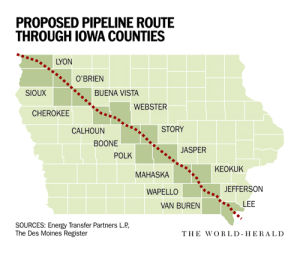
Blog for Iowa caught up with Ed Fallon in Iowa City at a March 11 fundraiser for his Iowa Pipeline Walk along the proposed route of the Dakota Access oil pipeline from the Bakken shale formation through Iowa to Illinois.
Fallon presented a slide show of his experiences on last year’s Great March for Climate Action across the U.S., and answered questions during an event attended by about 35 supporters.
Discussions ranged over a variety of related topics. Two seemed most important: eminent domain and an environmental study of the Dakota Access pipeline.
Rep. Bobby Kaufmann (R-Wilton) is leading a bipartisan effort to restrict use of eminent domain by private companies like Dakota Access in Iowa.
“I intend to introduce legislation in the Government Oversight Committee,” Kaufmann said in an email to constituents. “My committee is funnel proof and next week I will introduce an Eminent Domain Omnibus bill that will attempt to address the numerous eminent domain abuses going on throughout the state.”
When asked about the legislation, Fallon acknowledged the several bills filed regarding eminent domain had not yet been finalized into one.
“My biggest hope is it defines public use so clearly that you can’t come in and build a pipeline across Iowa and use eminent domain to build that,” Fallon said. “Because it’s not oil that’s being used here, it’s not being produced here, it’s being refined in Texas and shipped for the most part overseas.”
A bipartisan group of legislators sent a letter to the Iowa Utilities Board asking the regulatory body commission an environmental impact study of the proposed Dakota Access oil pipeline.
1. Safety risks and hazards associated with the product(s) to be transported through the pipeline;
2. Potential damage to water, land, soil, water, air and wildlife/wildlife habitat during construction;
3. Threats to the environment, farmland, wildlife and public health as a result of spills or explosions;
4. Spill prevention and clean up provisions;
5. Liability for damages to both public and private property and sufficiency of resources to cover such liability;
6. Adequacy of inspection/monitoring/enforcement mechanisms and resources;
7. Responsibility for planning, training, and equipping for emergency response;
8. Indirect impacts of the oil extraction process facilitated by the pipeline that may affect public health and safety as well as environmental security.
“If studying the environmental impact is something we do before we decide to move forward on this, then that has value,” Fallon said. “But if it’s something we do after the fact, after the damage is done, after the decision is made, then it’s kind of a moot point.”
During the question and answer session, Jack Knight of the Allamakee County Protectors indicated that delaying the IUB approval process through an environmental study was a valuable tactic in preventing the oil pipeline from being built.
Opponents of the Dakota Access oil pipeline have a bigger issue and Fallon touched upon that during our interview.
“Based on what the entire scientific community is telling us, that oil needs to remain in the ground,” he said. “Really this conversation about the pipeline is a sidebar, but a really important one.”
For more information about Fallon’s work, Blog for Iowa recommends, “Hitting the Pavement,” in the March 16 issue of the Newton Daily News, or follow him on FallonForum.com.
State Senator Joe Bolkcom, member of the natural resources and environment committee, spoke last Tuesday at the capitol about environmental issues.
“Is there anything related to the environment you would like to see covered in greater detail?” I asked.
“There are some questions around megadroughts coming mid-century,” he said. “Have we dedicated enough attention and resources to protecting underground water systems?”
Bolkcom pointed to a number of concerns: recent defunding of the Department of Natural Resources underground water monitoring system; gaining an understanding of the water withdrawal rate for ethanol plant operations; a needed review of policy by the Environmental Protection Commission; a review of DNR regulations pertaining to water permitting; the need for a geological survey of water resources, the Silurian and Jordan aquifers specifically; and the impact of water usage by data centers such as Google and Facebook. He had given the matter considerable thought.
“Should we have other thoughts about the Jordan and Silurian aquifers as we head toward 2050?” Bolkcom asked. “Today, once an industrial user secures a permit, they can withdraw as much water as they want.”
There were more questions than answers during my brief time with Bolkcom, but his thrust was that Iowa needs to do more to ensure resiliency during extended drought conditions.
It is difficult to forget the severe drought of 2012. Governor Branstad called a special meeting of agriculture groups in Mount Pleasant that July. (Read my coverage of that meeting here.) Climate change was completely absent from the discussion, even if farmers had to deal with its enhancement of drought conditions. To paraphrase the reaction, farmers planned to plow the crop under, capitalize the loss, and plant again the following year.
What if the drought extended more than a season or two? What if it lasted for decades? According to a study released this month that’s what we can expect.
“Droughts in the U.S. Southwest and Central Plains during the last half of this century could be drier and longer than drought conditions seen in those regions in the last 1,000 years,” according to a Feb. 12 press release issued in conjunction with a new study led by NASA scientists.
“Natural droughts like the 1930s Dust Bowl and the current drought in the Southwest have historically lasted maybe a decade or a little less,” said Ben Cook, climate scientist at NASA’s Goddard Institute for Space Studies and the Lamont-Doherty Earth Observatory at Columbia University in New York City, and lead author of the study. “What these results are saying is we’re going to get a drought similar to those events, but it is probably going to last at least 30 to 35 years.”
When Bolkcom referred to megadroughts, this is what he meant.
The potential exists for megadroughts more severe than any in recent history, according to the study published in Science Advances by Cook, Toby R. Ault and Jason E. Smerdon.
“Future drought risk will likely exceed even the driest centuries of the Medieval Climate Anomaly (1100–1300 CE),” the authors wrote. “The consistency of our results suggests an exceptionally high risk of a multidecadal megadrought occurring over the Central Plains and Southwest regions during the late 21st century, a level of aridity exceeding even the persistent megadroughts that characterized the Medieval era.”
Whether Bolkcom’s questions find answers is uncertain, however he is alone among legislators I spoke with in asking them. He was correct that members of the public haven’t engaged on something the legislature should be taking up during its 86th General Assembly.
There has been a lot of news about the Dakota Access Pipeline (aka Bakken Oil Pipeline) during the last three months. Where does the project stand? Here’s an update based on information gathered this week.
After the petition has been fully reviewed by board staff and is determined to be sufficiently in order, an order will be issued by the board setting the date for a public hearing.
“Due to the size of this project, the petition review process will take considerable time and there is no certain way to predict an exact hearing date,” Tormey said. “When a hearing date is established, it will be posted on the Board’s hearing and meeting calendar on the IUB website.”
During a meeting with state Senator Joe Bolkcom (D-Iowa City) yesterday, he said a bill has been introduced into the legislature to increase the amount of liability insurance for companies seeking to pursue large projects such as the Bakken Oil Pipeline. State Rep. Bobby Kaufmann (R-Wilton) said he is seeking House support for a similar bill.
Wally Taylor and Pam Mackey Taylor, representing the Iowa Chapter of the Sierra Club, were at the capitol soliciting signatures on a letter to the IUB opposing approval of the Dakota Access project. The draft letter cited four reasons for opposition. The pipeline would provide no benefit to Iowans, landowners would be forced to give up their land by eminent domain, pipelines leak, and the pipeline will further enable this country’s addiction to oil.
A new pipeline will delay the U.S. transition to clean and renewable energy and more fuel-efficient vehicles according to the Sierra Club.
The period for filing comments, objections and letters of support is still open according to Tormey. Anyone seeking to file objections, comments, and letters of support in this docket may do so by using the Iowa Utilities Board’s Electronic Filing System (EFS), citing the docket number, and clicking on the “Submit Filing” tab and following all instructions to log-in as a guest. Persons lacking computer access may file written comments by mailing them to the Iowa Utilities Board, Executive Secretary, Docket No. HLP-2014-0001, 1375 E. Court Ave., Rm 69, Des Moines, Iowa 50319-0069
The direct link for electronic submissions is here. To view other filings, click here.
You must be logged in to post a comment.