Text on the postcard: THE GREATEST SHOW ON EARTH is coming your way! To find out when, and much, much more, visit www ringling com MAY ALL YOUR DAYS BE CIRCUS DAYS!
The Ringling Brothers and Barnum and Bailey Circus was a mainstay of my youth. Each year they came to Davenport, usually at the levee of the Mississippi River, to put on the Greatest Show on Earth.
A biography of the Ringling Brothers was one of the first books I checked out from the bookmobile after getting my library card. It was interesting four of the Ringling brothers were born in McGregor, Iowa. They inspired us to put on our own show in the backyard of the American Foursquare my parents bought in 1959.
The circus influenced my decision to be part of the high school stage crew where I could participate in putting on shows.
The days of circuses are ending and Ringling Brothers folded the tents for the last time on May 21, 2017. It was a really big deal when the circus came to town… until they no longer did.
First published on Nov. 7, 2010 on my blog Big Grove Garden.
Pepper Flakes
There is a natural urge to use everything. It gets suppressed by the modern American culture of throwing things away. In our house we often don’t have trash to take to the curb each week, but almost always have recycling to go out. American frugality has been in remission, but expect a comeback.
While working in transportation, I received a gift of some dried peppers in small plastic bags. Two bags have been sitting in the pantry for a while. In addition, I grew a long, thin and red pepper in the garden a few seasons ago. Some of these were dried and stored. In the box store yesterday, in the Mexican food section there were four feet of dried peppers in many different kinds. They were cheap and I bought two bags of the most abundant types. When I got home, I combined all of them and ground about half into pepper flakes. The one jar this produced will last a very long time. When I grind the second batch, it will go into small jars for gifts.
The challenge of American society will be to balance abundance with frugality. Waste not, want not is how it goes. I am afraid that we have not been understanding what we have been wasting, and it’s time we did.
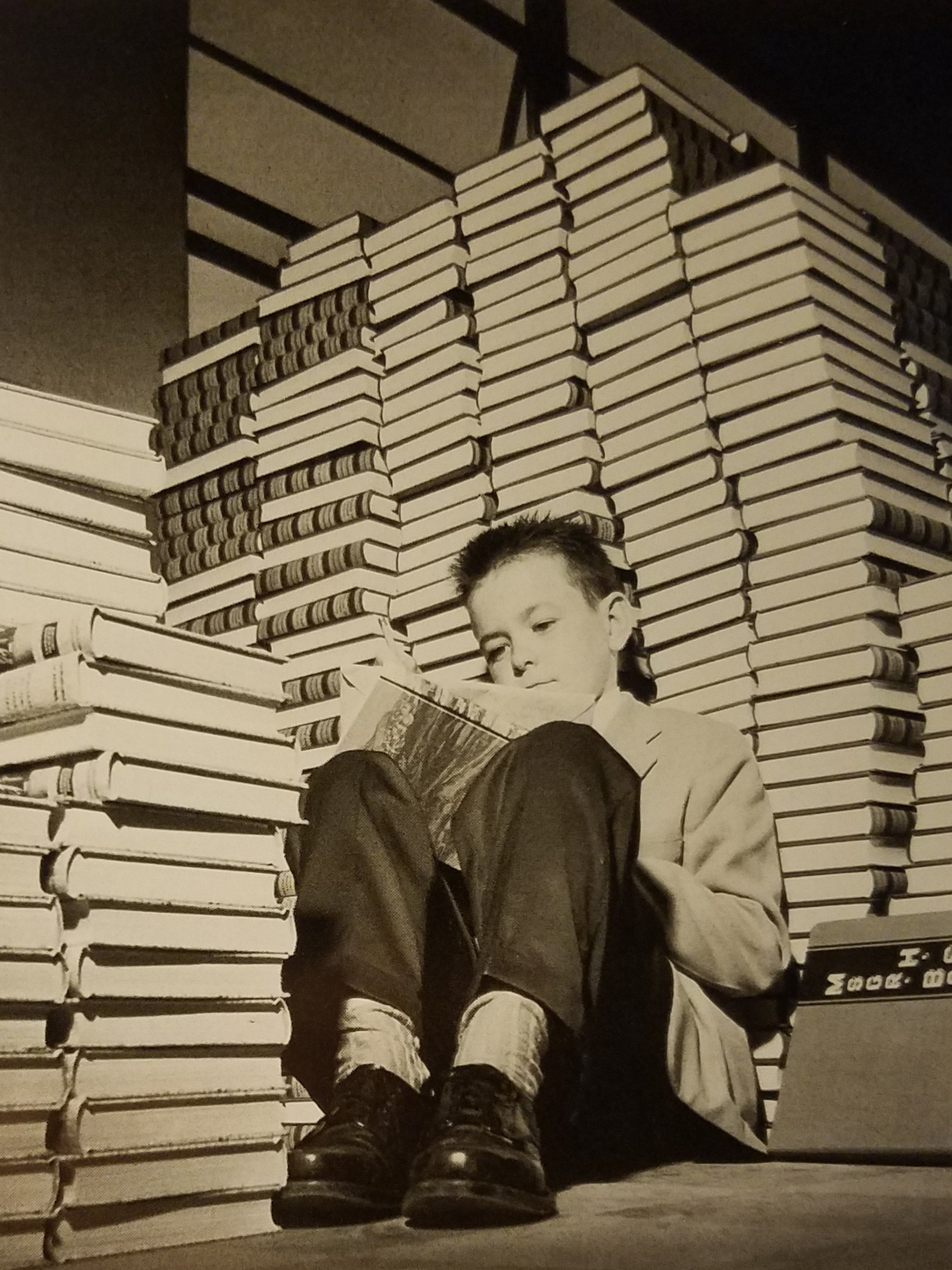
Text on the postcard: “Student, c. 1960. Photographer Unidentified.”
When young our capacity seems limitless. When I got my first library card in 1959 I believed I could read every book on the Bookmobile that stopped each week in our neighborhood. I looked forward to returning books I read and getting new ones. Outside of school, it was a highlight of the week.
Mother got me a subscription to My Weekly Ready, the arrival of which was another highlight. I bought a few children’s books at the local drug store. Keeping up with reading was easy with the energy of youth.
When I lived in Iowa City in my twenties, I started a project to read every book in the public library. It tested my limits. I started at the beginning of the Dewey Decimal system and didn’t make it out of the philosophy section.
I didn’t hear about the Horatio Alger story until I was in college, but that could have been my story, lifting myself up with diligence, honesty and altruism as I read and read and read, waiting for some happy circumstance to present itself and bring me the good things of life. We now know what I was feeling was the privilege of being white and middle class.
I look back to those days, with their libraries full of reading material, and consider my devotion to the act of reading. It was a solitary life and I was mostly okay with that.
What I didn’t realize, that would have helped me if I did, was to get anything significant done in society it takes a context that includes others. I was ready for a life of rugged individualism, in which through my own hard work I could pull myself up by my bootstraps and experience success. I didn’t understand how divisive that could be, pitting my own efforts against others to ensure personal success above all else. Live and learn.
Today I have piles of books I want to read just like the schoolboy on this postcard. However, my intent is different than it was in the 1950s and 1960s. I seek insight to take collective action on things like the climate crisis and more. I provide for my basic existence — food, shelter, clothing, transportation and healthcare — yet that serves only as a platform to do other things with a network of people.
Some days I wish to be that boy sitting next to a stack of books while reading. If I were, there would be things to tell him.
On Tuesday, Aug. 24, 2021 I temporarily deactivated my Twitter and Instagram accounts. Instagram reported I was averaging an hour a day on the site. Twitter was likely two or three times that amount. There are plenty of other things on which to use this time.
As I approach my seventieth birthday I’ve been taking stock and focusing energy on things that matter. While I enjoy social media, a person has to set priorities. The energy formerly used on those platforms can now be devoted to writing and other forms of creative endeavor.
At some point, temporary deactivation will become permanent.
The change was almost immediate. I slept through the night. My blood pressure dropped overnight to within range. I felt like reading a book again. I feel like doing things instead of occupying time with computer screens. Change was unexpected, yet welcome.
I received a phone call from the Iowa Department of Natural Resources yesterday, informing me a recent special test they performed on our public water system indicated a high level of manganese, well above acceptable limits. I spent part of yesterday and will spend much of today determining what we should do to return the amount of manganese in our drinking water to safe levels. For the time being we issued a health advisory, which, this morning we will hand deliver to the 80 or so households that use our system. I went to town and bought ten gallons of bottled drinking water to use in the kitchen while we work through the process. It’s not how I was planning to spend my time.
In the county seat there is a controversy about an MRAP (Mine Resistant Ambush Protected) light tactical vehicle procured by the county sheriff from military surplus. Some call it militarization of the police and object to it being in the table of organization and equipment of the sheriff’s office. The sheriff, who inherited the MRAP from his predecessor, said he’s keeping it and it’s non-negotiable. Like many public debates, this one is off the rails. Critics have evaded the basic question of whether or not the sheriff has authority to operate such a vehicle in the county. There should likely be better guidelines on how to use the MRAP, but neither do we want to tie the hands of the sheriff who needs to be fluid when responding to a crime. The whole debate is a distraction from improving interaction between the sheriff’s office and citizens of the county.
Not sure what I’ll do with the new found time. Maybe I’ll take a nap and rest for what’s next.
Text on the postcard: “Underwood Motel, 1100 Lincoln Highway, Schererville, Indiana 46375. Heated Pool – Air Conditioned – Room Phones – Free TV – Honor Most Credit Cards – Located on U.S. #30 – Just West of U.S. #41 Near Calumet Expressway to Chicago Loop. Phone: 219-865-2451. Handwritten note: $19.80 per night.
When I transferred with work to manage a Schererville, Indiana trucking terminal for a company called Lincoln Sales and Service, I stayed at the Underwood Motel. It took a while to manage our move, maybe six to eight weeks. We ended up buying a house in nearby Merrillville, Indiana.
Our fuel attendant worked at the motel and that plus the low price is why I stayed there.
The six years we lived in Northwest Indiana were busy. It would change my view of work forever. The country was in transition from what it was post World War II, to what it is now. Due to the Reagan revolution, it was hard on workers. I lost track of how many potential drivers I interviewed during this time… more than ten thousand. Theirs was a story of dehumanization of workers laid off by companies that felt they had to to be “competitive,” whatever that meant. It was a time of ubiquitous management consulting firms who restructured businesses to direct more revenue and earnings to owners, share holders, and high-level managers. It was busy because most of the time I worked in uncharted territory with little guidance unless there was a lawsuit or workers compensation claim.
I’m glad for the experience. I hated the experience. In the crucible of manufacturing in transition, thousands of workers were trying to adjust. I was there to listen and heard one hella story. I hired some of them, doing what I could to ease the transition.
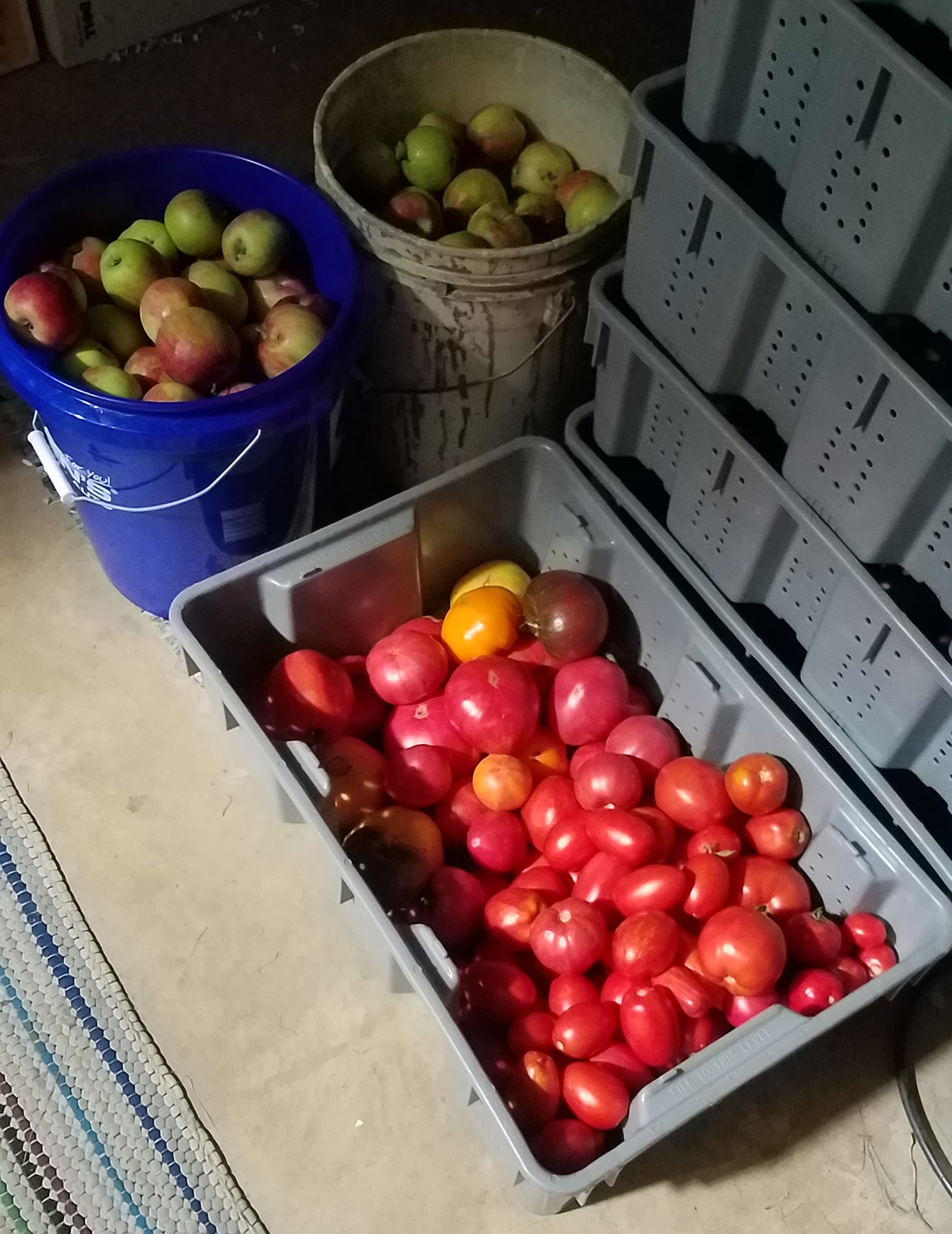
Tomatoes, apples, onions and potatoes waiting to be used.
Signs of summer’s end are everywhere.
We knew fall was arriving last week when someone published the school bus pickup and delivery times on our community Facebook page. K-12 schools start tomorrow in our district.
The Iowa legislature and governor expressed an interest in dictating how schools would approach the ongoing coronavirus pandemic. They issued a written dictum through the Iowa Department of Public Health. Click here to see it. My main takeaway is that everyone should wear a mask and get vaccinated if they can, although neither can be mandated by the local school board. IDPH has adjusted COVID-19 surveillance to follow the influenza model, focusing on outbreaks and vulnerable populations.
We’re ready for fall with four home test kits for COVID-19 resting on the stairs for potential use. We restricted activities outside home during the return of students at a nearby university and the surge in hospital admissions for COVID-19. If there’s one thing we learned during the pandemic it is isolating from others is a good way to prevent respiratory disease, including COVID-19.
Political campaigning takes a holiday during summer. With Iowa Democrats seeking to regain some of the ground lost in 2020, activity is percolating to our attention. There is a U.S. Senate primary coming, with four announced candidates. There is one for governor with two. Yet most political activity remains unseen as summer ends.
As of this writing, our congressional district has neither been adjusted after the U.S. Census, nor identified any candidate for congress. The Iowa Legislative Services Agency is working on a redistricting map after last week’s arrival of U.S. Census data, and a candidate for congress or two make preparations to announce their campaigns for the June 2022 Democratic primary election. There is plenty of time to engage in campaigns. Most voters are loathe to do it and the recent trend is to wait until the last possible moment to evaluate candidates and cast a vote.
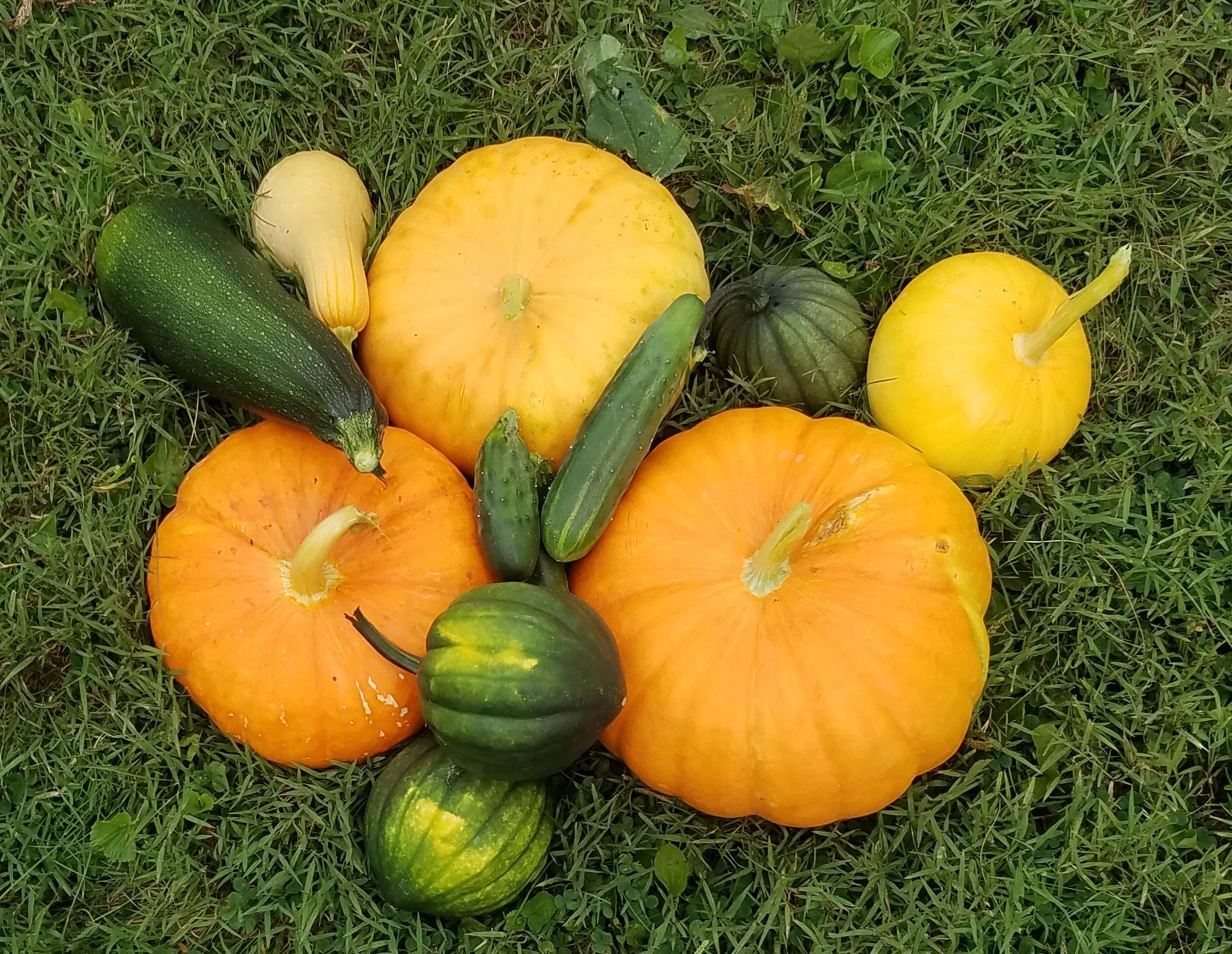
The garden reached the high water mark and the rest of the season is finishing tomatoes, tomatillos and peppers; taking greens as needed in the kitchen; and working toward a couple more crops of lettuce. The season will end with Brussels sprouts and Red Delicious apples in late September or October.
The calendar says autumn begins on Sept. 22 yet we’ve already begun to make the turn. I’m thinking about where to plant garlic, how to deal with apples still on the trees, and how to engage in politics this cycle. Comme d’habitude, I’m taking some time for myself until the Labor Day weekend. It looks to be a busy fall.
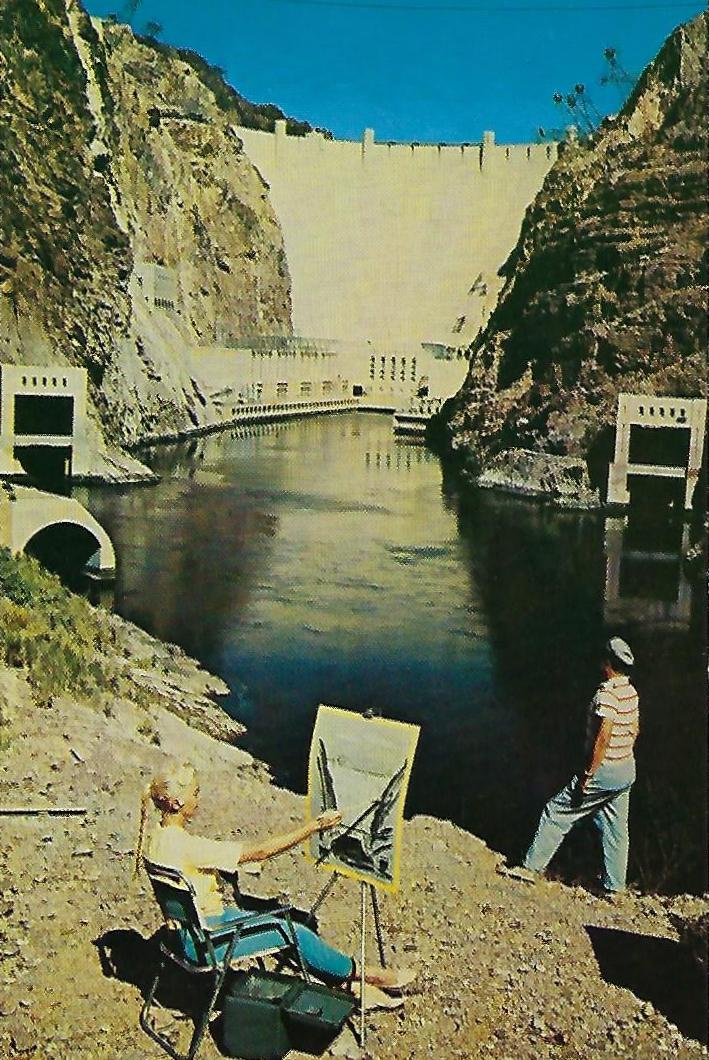
Hoover Dam. Photo credit: Las Vegas News Bureau, undated.
Text on the postcard: “Looking towards the outlet tunnels and huge powerhouse below the world’s highest Dam. This $125,000,000 project is one of man’s greatest engineering achievements. Height 727 feet above bedrock, crest 1,244 feet, and 650 feet thick at the base.”
When I was in high school our family went to California so my parents could attend a union convention. We made a family vacation of it, the last one before Father died. Mother’s two brothers lived in the Los Angeles area so we spent time with each of them. We stopped to see Hoover Dam on the way home.
Today, Lake Mead, the reservoir created by the Hoover Dam, is at its lowest level since it was built. The continuing drought in the West will have a significant impact on people who live there. It’s clear we must act to slow global warming.
Side dish of sliced tomatoes at our picnic lunch on Aug. 13, 2021.
Friday was a travel day during which we visited family in Chicago. It was the first family gathering at their place in a long time. We’d been preparing for the trip for over a month. To maximize visiting time, we packed a picnic lunch and ate at the apartment.
It was a good day.
Children return to school in two weeks, Iowa hospital beds are close to full with COVID-19 patients, and we haven’t had a view of the sun unobstructed by haze from the Western fires since I don’t know when. A flotilla of 14 hot air balloons rose over us near Davenport as we drove home. Their bright colors were muted by the pall over the landscape.
Beyond family, these day are not so good.
Despite difficult times we go on living.
It is becoming a habit. I walked around the neighborhood where they live and ended up browsing in a used bookstore. I bought three books and got three punches in my frequent user card. Yes, I have a frequent user card, and plan to return to get all the punches. We made it home safely before sunset.
After covering at Blog for Iowa in July I’m ready to turn attention back to this space. July was a tough month in a pandemic that won’t go away. Whatever illusions of safety, comfort and autonomy we may have had are torn away by the ugliness modern society manifests these days. We need to get back to a kinder way of living, yet politics, the coronavirus pandemic, climate change, interpersonal rudeness, and economic uncertainty weigh heavily on us.
The extended drought is taking a toll. We need rain, not so much for the crops, but to lift our spirits. To let us know we’ll get through this spell. Yesterday was my first outdoors work shift since high temperatures arrived. It feels normal to work outside for several hours without also feeling like I’ll pass out. There was an air quality advisory because of smoke drift from the Western wildfires, yet temperatures in the 70s were welcome. I made a day of yard and garden work without obvious ill effect.
There are some bright spots. July began with helping our daughter relocate to the Chicago area. In August we plan a visit, something that was difficult when she lived in Florida. We can plan and work on things together again. I hope to bring tomatoes when we visit.
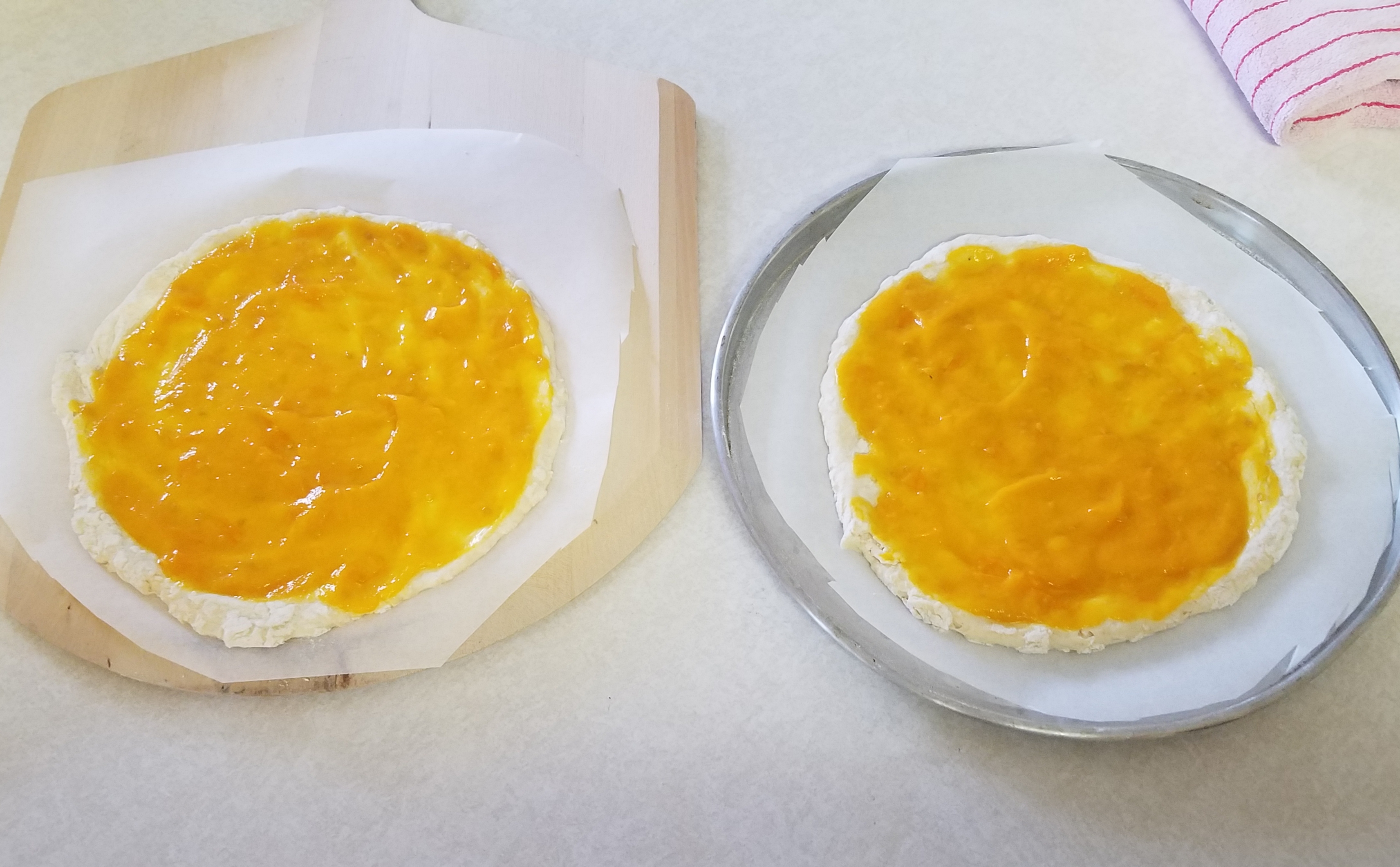
The garden has been the best, producing more food than ever before. My ongoing integration of the garden into the kitchen makes it a useful harvest, both feeding established meal plans and enabling culinary experimentation like this yellow tomato sauce pizza I made for dinner last night.
Yellow tomato pizza sauce reading for toppings.
We are also financially secure due largely to long-range planning and contributions to Social Security during more than 50 years in the workforce. Social Security has enough money to make it through 2034 at the present. I expect to lobby the Congress to fix it in the coming years.
Here’s to August! The time of high summer, sweet corn, tomatoes and vacations. I don’t know about readers, but I’m ready for it.
Once life is separated from the work week everything changes. It’s not that we become unhinged. Days just resemble each other without differentiation.
As denizens of the United States, if we seek continued participation, we need something to tell days apart. The worklife week served as we had one. For me, it fell apart during the coronavirus pandemic and the resulting retirement from paid work.
I developed a morning routine which begins around 3 a.m. and continues until it is done. It is my time to learn about the world and my role in it. I like the routine because, for the most part, I own this time of day, every day. After that things can get muddled.
I want to have a weekend… a Monday and Friday. I need a hump day. I want them to mean something. What I find is without a job, the days blend into each other. Increasingly, I accept it.
I don’t know what to do about it. I feel a need to do something. Today’s Monday. Maybe I’ll start there.





 Journey Home
You must be logged in to post a comment.