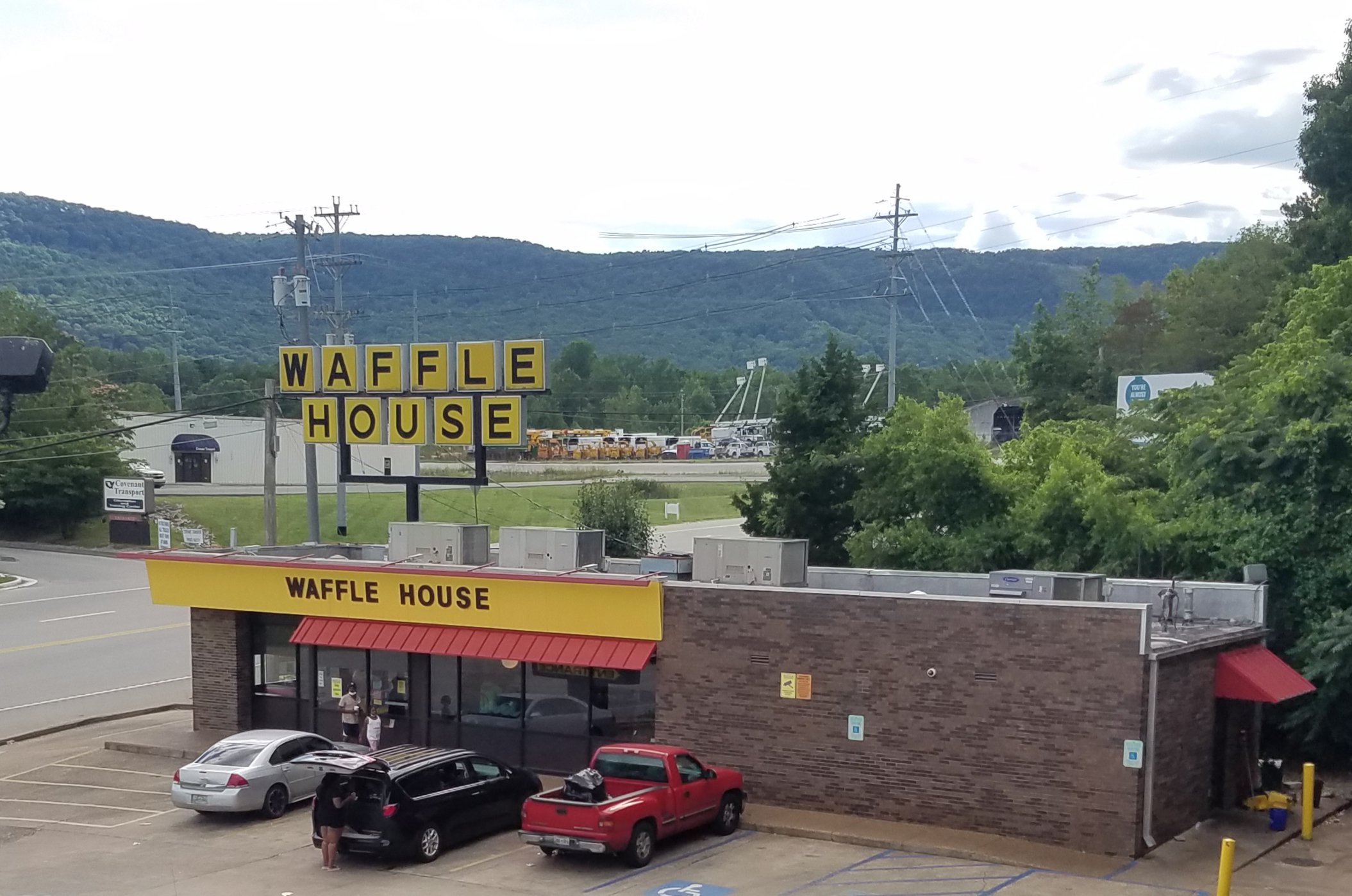
One of multiple Waffle Houses at this exit in Chattanooga
We convoyed from Lake Alfred through Georgia to overnight in Chattanooga. She drove in front with a mobile command center and an application called “waze.” I brought up the rear, keeping my eye on her and the rental between the lines.
We arrived at our lodging and decompressed. That means we parked the vehicles, ordered Italian via Uber Eats, and got on our mobile devices to catch up.
I walked to the side of the building, took this photo, and posted it on Twitter:
No doubt “regulars” have stepped in to prepare orders. There was a lot going on at that exit off the Interstate.
We continued north before sunrise. Coming down the far side of Monteagle, I trailed in the truck full of her stuff from the last ten years. She turned on the windshield washers to see. The over spray hit my windshield a few car lengths back. I turned my wipers on too. That says something about parenting, although I hesitate to say what it is. I’d rather dwell in the complexity a while longer.
It’s been a hectic 36 hours. We have the U-Haul truck loaded and ready for our 1,180-mile trip beginning tomorrow. We all took naps this afternoon now that this part of the work is finished.
There were a lot more swords (props and the kind used in LARPing) than I thought there would be.
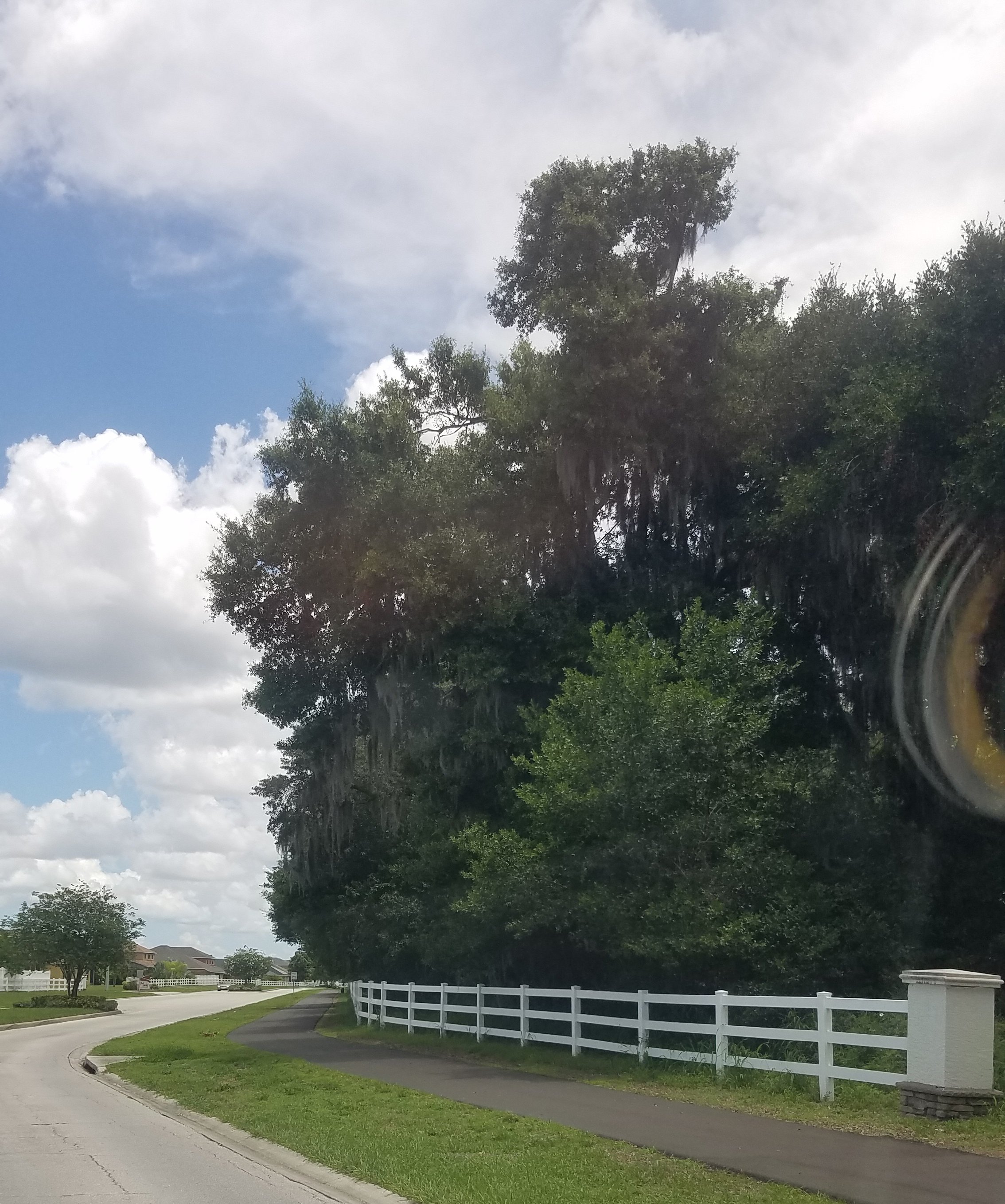
I like visiting Florida. You can’t hardly see the Spanish moss in the picture, yet I remember it in live oak trees on a family auto trip to Tallahassee when I was eight or so. Father graduated from Leon High School there. Spanish moss is everywhere in Central Florida. It is a seminal memory.
Now that our child is leaving the Sunshine State, it’s hard to imagine returning.
We’ve been busy with logistics yet I had time to engage in dialogue with locals: the convenience store cashier and the U-Haul staff. I’ve been cooped up in the house during the pandemic for so long, I forget what it means to be among people. I could talk with locals for more time than we have.
We didn’t say much. There’s a lot I could say when I return to Big Grove. Right now were resting in Lake Alfred and looking forward to tomorrow.
One thing though about tomorrow. I left all my rainbow t-shirts for Pride month at home because I been through Georgia before.
Mariannette Miller-Meeks sounds like she’s having trouble dealing with a narrow win in her 2020 election. On June 22, she said on FOX News, “Democrats want Americans to believe state election laws are broken so they can then sell their ‘Corrupt Politicians Act’ as a means to fix the ‘broken’ system.”
The appeal Rita Hart made to the certified election results is evidence election laws are working as they were designed. I understand neither Miller-Meeks nor prominent Iowa Republicans liked the appeal. They should have let the law play out as it is designed to do and as it ultimately did. Instead they complained and made exaggerated claims like this one on FOX News.
“Corrupt Politicians Act” is the same framing used by the right wing Heritage Foundation to characterize the “For the People Act.” Miller-Meeks likely used the Heritage talking point because it’s curious she rolled out this opinion piece at the same time Heritage used the phrase to activate their followers to oppose S.1.
In her FOX News statement, Miller-Meeks naively admitted the irony in proposing the “For the People Act”: Democrats demonstrated the legislative process is not broken. With a slim majority, Democrats walked through the front door and proposed to stop recent Republican-passed laws that aim to modify the voting process.
Agree or disagree, it is the hallmark of our form of government. Miller-Meeks should spend more time in her district talking to voters from all parties to build on her six-vote margin in 2022.
~ Submitted to several local newspapers. First published in Little Village on June 24, 2021.
The garden did not need watering last night. This morning, after sunrise, the ground was still wet. Thunderstorms and rain are forecast all day, so it looks good for the garden getting plenty of moisture. We need rain.
Wednesday was a punk day of running existential errands. I’m preparing for a special project that will have me mostly off the internet for a while. We need that from time to time.
While I’m gone, I leave you with this image of the full moon setting behind the trees. I don’t know what it means but I could look at the moon for hours. The picture is no substitute, yet with it, maybe we’ll get by.
I just finished reading Mary Karr’s The Art of Memoir and it inspired me to write this introduction to my autobiography. I don’t know if I’ll use it, but I think it works toward identifying my voice in the narrative, as she suggests we should. There will be revisions in the coming months and years as I continue to work on the book. Feedback welcome in the comments.
This memoir was written in the unfinished lower level of the split foyer home we built in 1993. We thought we would have finished our home by now. In a not-specific year I framed a couple of rooms with two by fours and installed drywall and book shelves in what would eventually be my writing place. The county assessor got wind of the improvement and sent someone out to inspect. They decided to wait until I finished before increasing the assessed value. Piles of building materials bought at the time remain stacked around the space. The current lumber shortage has me thinking about selling the two by fours.
I can’t say when finishing the house will be on the agenda. However, finishing this book is front and center.
We have a wireless router that connects everything. Who in my cohort doesn’t? What’s significant about the library table surrounded by book shelves is not the Dell desktop resting on it. This refuge is a chance to get away from the internet and be the person I am with my successes and failures. My non-internet traffic is more valuable than what I write online.
Our arrival in Big Grove Township coincides with broad adoption of internet service providers. Before mobile telephones, I used a pager and stopped at a phone booth to answer a page. It felt a bit risky, especially when I stopped near the Robert Taylor Homes on the South Side of Chicago at a well-lit bank of payphones. It’s what we had and truck drivers who paged me couldn’t wait.
I used a typewriter until we lived in Indiana, when we got a word processor with a dot matrix printer. In Iowa, we got our first home computer in 1996. The accelerated pace of improved personal communications since then was unlike anything we knew. This impacted this memoir.
In the chronological first part of my life I’m dealing with experiences, memories and outside sources to create a narrative. My memory is faulty. The majority of my experience is embedded in me or in boxes of photographs and papers. Growing up during the time of Polaroid and Eastman Kodak, the photographic record is significant. Likewise, the boxes of documents going back to kindergarten have a lot of information in them. Old documents, like my parents’ wedding announcement, may exist online but most of my remembrance of those days is a physical presence not far from me. The act of selection for inclusion in this book had a significant influence on the narrative.
My memory and experiences are subject to interpretation and people’s remembrances of them differ. Like any memoir author, I had to address that before presenting the finished work. This book is an effort to tell the truth and say what I know about my life as best I can.
The story relies less on memory after graduation from university when I started a hand-written journal. The continuous written record since then was enhanced by the adoption of email, social media, and personal blogs. Digital photography was an important aspect of the record beginning in 2007. There is plenty to draw upon and it can be quoted as-is, avoiding the interpretation of others.
My view of the world is flawed. What I see isn’t always what others see, and that’s what could be a reason to read further. Perhaps the most clarifying part was writing the story of my Polish ancestors in Minnesota. Drawing on memory, artifacts, my personal journal, and interviews with local informants, it became clearer than ever the kind of people from whom I rose. It revealed a type of life that could provide meaning in an rapidly changing social environment.
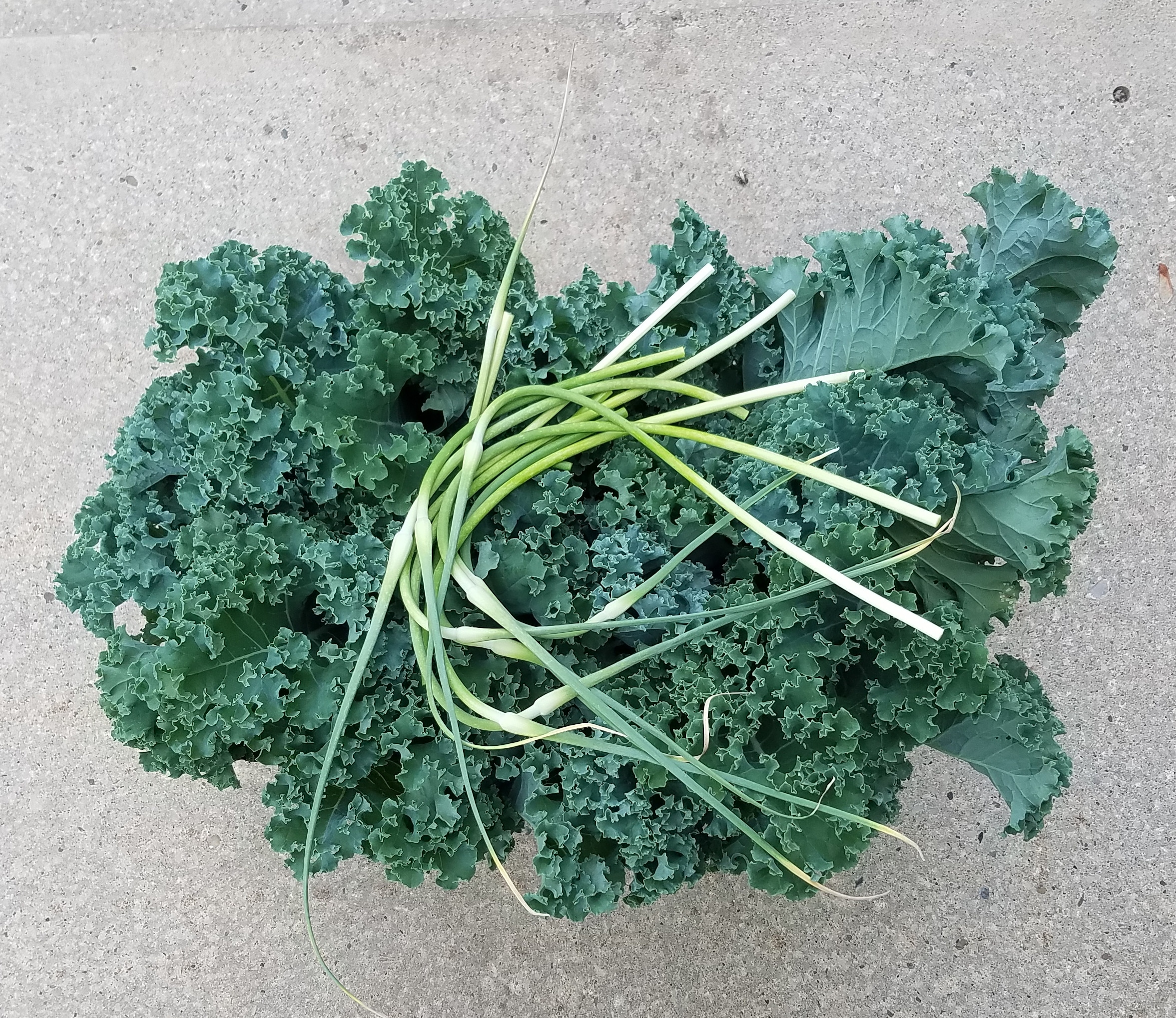
Second food bank donation: Winterbor kale and garlic scapes.
After ending her relationship with a large entertainment company in Florida last November, our daughter decided to move to the Midwest to pursue creative endeavors. Her new apartment rental agreement starts July 1. We plan to make some storage space in our home for extra possessions in case she needs it. Logistics and storage is part of what a parent offers an adult child.
We’ll see if storage space is actually needed. I looked at her new apartment online at a real estate marketplace company website. It appears she will have plenty of room as she is moving from a situation where she rents a single room in a house shared with others to a three-room apartment. She is planning the move and we are standing by to help as we are asked.
The storage space here can likely be created by discarding packing material accumulated over the years. Once finished with that, I’ll consolidate building materials in one spot and use the platform of the loft bed I built for her in college for any new storage items. Prepping the space is likely a one-shift job.
Since we married, we lived in five different places, including the current home since August 1993. The idea of us moving seems like too much work. Our home has become our main financial investment and the majority of our net worth. We are lucky to have a home we own outright. Even if financial conditions get dire, we’ll try to retain ownership.
After years of accumulation — from settling estates, from auctions and tag sales, from failing to dispose of outdated clothing, appliances and the like — we are filling it up. That needs to change as we prepare the home for our aging. For the time being, we can still make more space.
The ditch in front of the house finally dried on June 7, 2021.
Sunday was literally a day of rest. After planting the next rounds of lettuce and spinach, and mulching tomatillos and the second round of radicchio, I drove the Lincoln Highway to Boone to pick up my spouse. When we arrived home, I took a long nap, then stayed up later than normal so I could sleep through the night until morning. The tactic seems to have worked. I feel well-rested this morning.
Last Monday I noticed the ditch in front of the house finally dried. Saturday I mowed it, raked up the clippings, and piled them near the garlic patch. Some years the ditch stays wet until July, yet this year I believe we are entering a drought, and will soon pass the “abnormally dry” stage and get right into it. Moisture management in the garden remains important during drought conditions, and mulch plays a role.
In March I slowed the pace of writing my autobiography. Partly, it was due to increased gardening activity. It was also due to a quandary about approaches. Over the last two months I worked through ideas and am going to shift what I’m doing.
The breaking point was the piece I wrote about my ancestors settling in Minnesota. You can read it here. I’m pretty happy with how this introduction turned out, and the research behind it. Because there is well documented writing about this specific community in Lincoln County, Minnesota, it was possible. The challenge is not all periods of my family history are like that.
My maternal grandmother was the third generation to live in Minnesota. When she moved to a Polish community in Illinois, without her first husband, and with her first two children, the man she married had more obscure origins. The U.S. Census record shows him living at home and working as a coal miner before they met. We know that history and later in life he worked as a coal mining demonstrator at the Chicago Museum of Science and Industry. He also suffered from coal workers’ pneumoconiosis. One of my main childhood memories was of him spending an inordinate amount of time in our bathroom coughing up phlegm from his diseased lungs. Black lung disease eventually contributed to his death and during the Carter administration Grandmother was awarded black lung disease benefits based on his case. I will tell this story, without other written records, yet it seems to miss the mark.
There is no avoiding writing the early parts of my autobiography from scratch, blending memories, photographs, and what documentation exists. Because I have written so much, beginning with my personal journal in 1974, the question, and sticking point, was how to handle that writing, which has been more or less continuous since then. An answer is emerging.
My stylistic lack of discipline over 50 years of writing drives 2021 me crazy. If I could go back in time and talk to the younger me I’d say, “Just tell the story.” It’s too late for that. The written record is what it is, with its changing bad writing habits.
At the same time, I always planned to use this writing in my autobiography. The epiphany while out in the garden this spring was I can tell parts of the story by using text written in real time. In other words, instead of re-writing my history the way I wrote the Minnesota piece, and using journals, newspaper articles, and blogs like a source document, I can assemble existing work in piecework fashion, the way a person makes a quilt. The form would be an autobiography written in real time, beginning after college graduation.
This morning I reached catharsis on approach. There will be four stylistic parts of the autobiography. The historical part like the Minnesota piece, recounting of first memories, a blended recounting of schooling beginning with Kindergarten until college graduation, and then everything after beginning with my written journal in 1974. I like the piecework approach this implies.
It’s only Monday, and something good has come from this week.
This retro post is from July 16, 2012. If the Sisters of Mercy had any influence on me in the late 1960s, it was in the phrase “all for the honor and glory of God,” which, at one time, we were required to write on every school paper. In a world more connected than ever, reaching out beyond the veil of our own humanity with purpose seems as important as ever. It is not enough to believe that God is watching our every move. We must also live in society. I witnessed women making traditional lace in Morbihan. We have to get beyond the appearances of things, as comforting as they might be, as well as they might fit into a traditional world view. Hope you enjoy this recycled post.
We are isolated beings, wrapped in a veil of humanity, closer to God, or its divine essence than we realize. Such veil, metaphorical or not, is woven of delicate threads, like the lace of Morbihan, or silk from China. We could spend a lot of time marveling in its delicate needlework or shimmering surface. Yet we are compelled to reach out beyond the veil. A Cartesian view of life, if there is one.
Some say we should live our lives in the presence of God and perform all works for its honor and glory. The Sisters of Mercy taught us this and had us inscribe on each sheet of school work, words to the effect, “all for the honor and glory of God.” If God is reading this blog, my offerings may not be living up to divine standards.
Yet there is a compulsion to communicate, in manners crafted and on the fly. Verbally and in writing. In the silence of being, writing, especially in e-mail and on the internet, comes as a natural outlet for our need to express ourselves when other people are not around. It is difficult to accept that there is just God and me in the universe, and that I should be satisfied to live in the Presence of the Lord.
This weekend I had a conversation with a friend about everlasting life. We agreed that if the everlasting version is like the current one, the attraction is not enough to tithe and focus on the next life after this one. There is too much inequality, too much trouble today, to relish a state where our worldly problems are solved, the veil of life on earth torn and we visit with our deceased predecessors. It all seems an ill-designed nostrum for ailments that are not really ailments, but the stuff of our lives.
So we write, partly to clarify our thinking, and partly to satisfy our need to reach out to others and express the value of our lives, one life among the billions of people walking on the planet. Whether anyone reads or understands our writing is not the point, although we hope they do. The point is that if it is only me in the Divine Presence, then I am not yet convinced of the connection with the rest of humanity. Something I believe exists, and is more than a mere veil protecting me from the light of society.
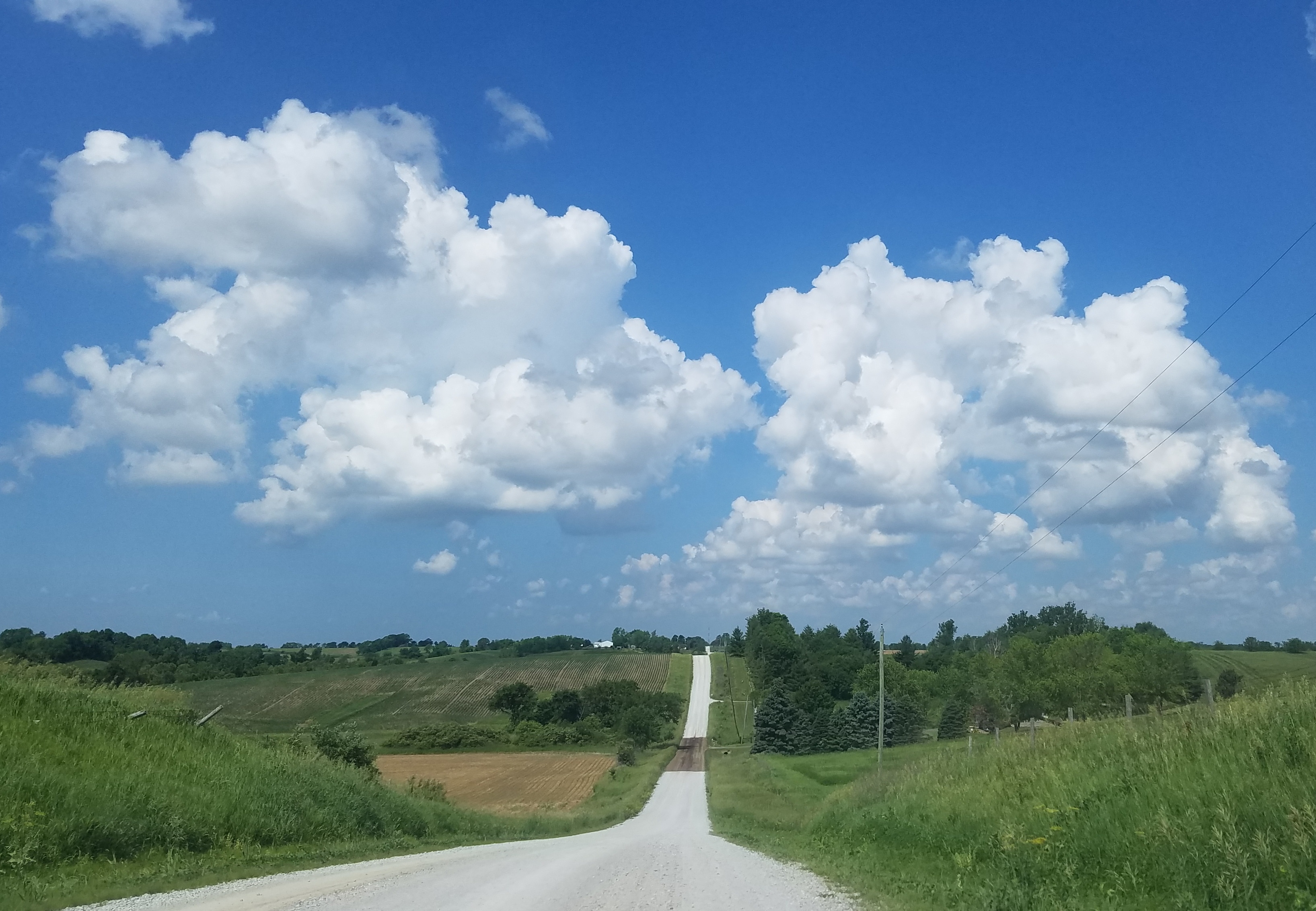
We rely on the county secondary roads department to keep farm-to-market routes in good shape. Each spring, gravel roads need grading and gravel application. While they are not well-traveled, people notice if they are in disrepair. Secondary Roads did a great job on those I use, like the one in the photograph taken after my shift at the farm.
My soil blocking at the CSA is winding down. Yesterday I started early because of mid day heat. I showered afterward and went to the wholesale warehouse to get provisions. That’s my work for the week so the next scheduled trip off property is not until Monday to deliver produce to the food pantry. That is, unless she calls ready to come home.
Having the house to myself is a little weird. I set up a music station on the dining room table. The three-in-one device plays radio, compact disks or audio cassette tapes. We keep things pretty quiet most of the time, so it is evidence of temporarily letting loose. Last night I played my Greg Brown CDs. Brown tells a story I’d like to believe about Iowa.
The menu I wrote for the both of us is out the window. There was leftover rice so I used it with other bits and pieces from the ice box to make a dish: leftover beans, kale, onions, bell pepper, and seasonings. That served as breakfast and dinner on Wednesday.
In addition to drinking a Coca-Cola on Tuesday, last night I drank the first beer since March 13, 2020 at the beginning of the pandemic. I bought a case of Stella Artois at the wholesale warehouse and with temperatures in the upper 80s, I relished the first taste.
There is a big bowl of limes to be used up. I have something mixed with vodka in mind, although I am no mixologist or hard-liquor-drinker for that matter. For complicated reasons I am reluctant to open the bottle of Stolichnaya Russian Vodka purchased at the Me Too grocery store in Cedar Rapids around 1986. I hauled it out to Indiana and then brought it back to Iowa. The label says, “Imported from the USSR” and that’s half the story of its travel. Once I open it it’s a matter of time before it will be gone. I’ll probably hang on to the unopened bottle a while longer. In all this time, only about an ounce has evaporated through the sealed cap. I’m not keen on vodka consumption anyway.
Peas are ready to pick in the garden, so that’s first up when the sun rises. Some kind of stir fry will follow. There will also be soup today. Ambient temperatures are forecast for the 90s this afternoon, so garden work will be finished early, and most of the day will spent indoors.
It seems too hot for early June. The drought in Western states is horrific. The Colorado River basin is disastrously low on water and it seems doubtful rain will come in needed amounts. My worry is the drought is creeping eastward. I lived through the 2012 drought and worked outdoors in it. I don’t want to repeat that experience, yet may have to. Fingers crossed we get back to normal weather before long.
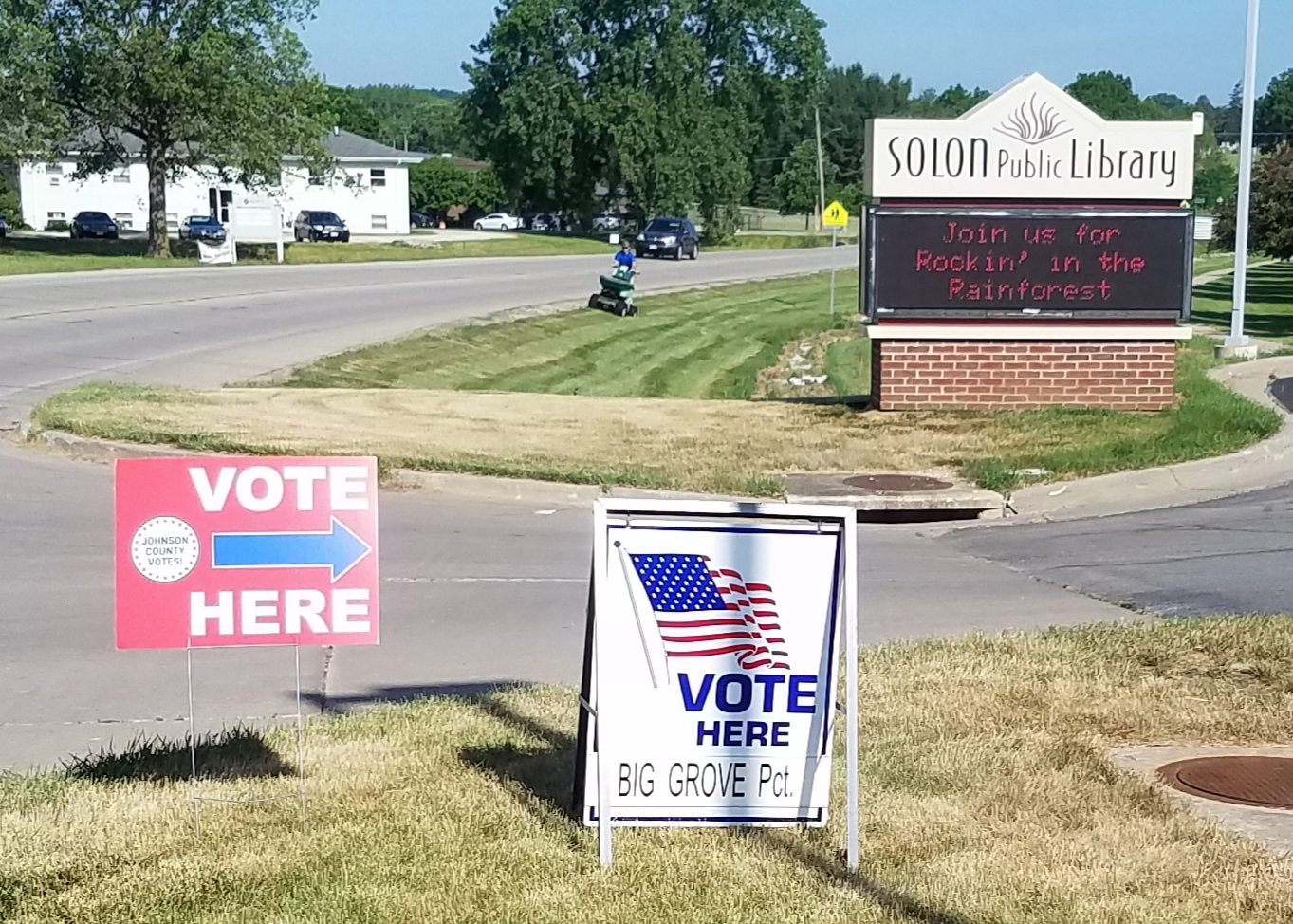
Big Grove Precinct polling place at 9 a.m. on June 8, 2021.
Tuesday was the day to take Jacque to her sister’s home in Boone. We began by voting in the special election for county supervisor. Our candidate, Jon Green – Democrat, won with 66 percent of votes cast. Voting together is an excellent way to start the day. It’s not really a date, but the experience was better than an actual date. After almost 40 years of marriage that’s how we are evolving.
We drove past the Atherton Wetland, up through Ely to Highway 30, which was the first transcontinental road for automobiles, dedicated in 1913. There are historical markers along the way, although I’m not sure the current Highway 30 is the actual Lincoln Highway. In fact, I’m sure it is not in some stretches. I hadn’t been out west on 30 since my in-laws’ estate was settled in the late 1990s.
I used to appreciate the drive, and seeing the patchwork of farms that make up rural Iowa. Yesterday’s weather, mostly clear skies with cumulus clouds, was perfect for travel. My observations were different this time.
The first thing I noticed was how large the acreages had become. There were so few homes, silos and other structures on so much land. It’s reflective of the need for less people to farm in 2021. Grain storage capacity had increased considerably.
As before, the diversity of crops was limited. I noticed corn and beans, and hay bales in abundance. Due to the drought, it is a good time to harvest hay. There was likely oats mixed in the fields, but my eyes aren’t trained well enough to differentiate it.
Maybe they were there 20 years ago, but I noticed a number of concentrated animal feeding operation confinement buildings. In the vast landscape they don’t look like much, yet livestock produces six of ten of Iowa’s top agricultural commodities. I did not see one hog, cow, turkey or chicken during four hours on the road. They were all indoors.
If I once thought the scenery bucolic, I no long do. It is a landscape of extraction, well organized and with purpose. While a natural process produces commodities, it is hardly nature or anything close to it. The lack of diversity among crops and the biome is remarkable once one is acculturated to recognize it. The unseen disaster is the flow of agricultural chemicals, manure and topsoil runoff into Iowa’s watersheds. Farmers say they want good water quality and rely on rain to produce it for corn and beans. However, the industry also relies on disposing of their waste downstream at no cost or responsibility to them. The current landscape and the farm operations on it are unsustainable.
We stopped for a rest break at the Meskwaki Travel Plaza in Tama. They have clean restrooms, clean everything. The signs on the entryway read “masks recommended.” No one, including us, wore a mask. There were no mask monitors and we are fully vaccinated against COVID-19 so are not concerned about contracting the coronavirus. We had our vaccination records with us, but preferred not to show them because of the brouhaha about “vaccine passports.” No one questioned us.
I’ve not been inside the nearby Meskwaki Casino and have no desire to experience it. Later in the day I did buy a Powerball ticket so I’m not a gambling purist. “Loose slots” has little intrinsic appeal.
Noteworthy is the Meskwaki Organix Store inside the travel plaza. It is the first tribal-owned CBD dispensary located on tribal land in the state of Iowa. The Meskwaki Nation set their sights on developing a hemp economy in which they would control the product from seed to shelf. The store is intended to pursue retail markets and will also play a role in market research and product development for CBD. The store opened in November 2020. We didn’t stop there either.
Boone is the birthplace of Mamie Eisenhower. There is signage about her along the main street through downtown. After dropping Jacque, I bought gasoline at a Casey’s store. I went inside and bought a regular Coca-Cola. I don’t recall the last time I drank a Coke, and despite the labeling “original taste,” high fructose corn syrup was used as a sweetener. It was nothing like my memory of going to the corner grocer and buying a 10-ounce bottle of ice-cold Coke after delivering my newspaper route. In Iowa, we are all about appearances, less about substance. We should keep our memories about good times to ourselves.
I will return to Boone to bring her home. I won’t be buying another Coke. It was a mistake to get it, although one that can be quickly forgiven. We’re in Iowa. High fructose corn syrup is what we do.




 Journey Home
You must be logged in to post a comment.