If you do not like the song Heat Wave by Lamont Dozier and brothers Brian and Eddie Holland something may be wrong with you. Few things characterized my youth like listening to the Martha and the Vandellas recording on my hand-held, red transistor radio. It would not seem like summer in 1963 and ’64 without that song. Perhaps things changed.
We have no new songs of summer today. The heat dome that lived over the upper Midwest the last few days was oppressive and steamy: so uncomfortable my 70-year-old frame couldn’t take the heat after a few hours in it. It has been good for the tomatoes, squash, cucumbers and tomatillos in the garden, so there’s that.
At least we are not in a drought the way we have been during the past few years. In 2012, a time when Iowa field crops were substantially impacted by dryness and crushing heat, I couldn’t wait to get indoors to escape. This heat dome is less severe than that, yet summer heat has a wicked resonance after that fateful year.
What can be done about this heat wave? Hunker down and stick it out.
We will make our home here, and in doing so, make the current heat wave the stuff of legends. We’ll develop grand stories, legends, to be told on blogs, on telephone calls, and video conferences. We’ll tell it in Twitch chats, on Discord, and on text-based social media. We’ll make something out of it like the salsa the heat wave is helping produce.
We’ll make our own musical stories, even if it may not be as good as what Martha and the Vandellas sang. It will be our experience. We will own it. That will be enough to survive the heat wave.
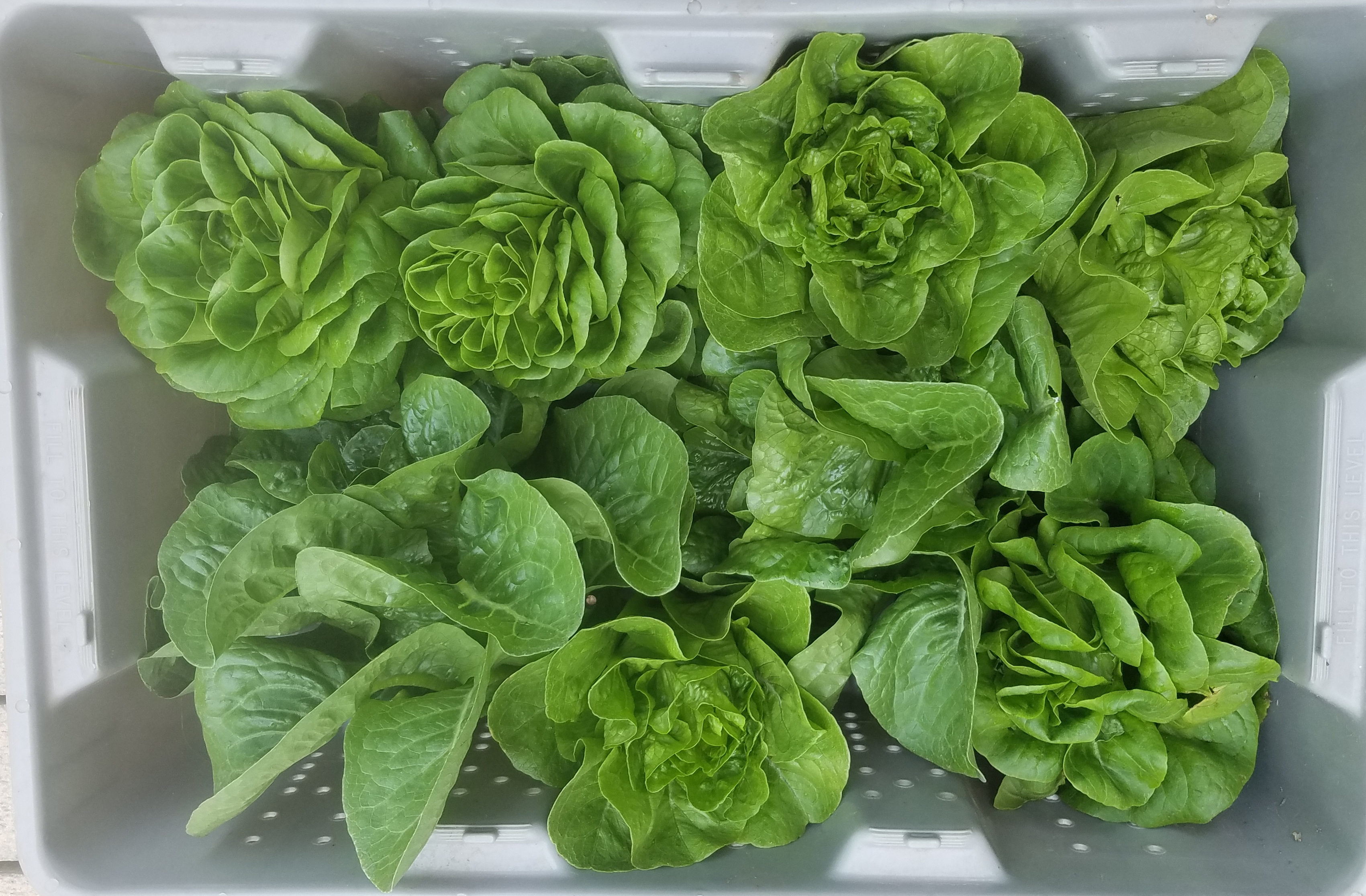
I harvested the rest of the first round of lettuce before it bolted. The last few years, I’ve been growing lettuce under row cover and it has fewer bugs and better growth than when I exposed it directly to the elements. A gardener does what works and this does.
That afternoon I separated leaves and cleaned them in the sink. I lay them out on a large bath towel to dry before putting them away. As the afternoon progressed, it became obvious some of the lettuce should be part of dinner in the form of a big salad. So that is what we did.
Lettuce forms the base, and whatever vegetables and other items are available goes in. For protein we usually use beans, or in this case, we had leftover baked tofu. The mix of textures and flavors is hard to beat for a summer supper. We eat only lettuce that I’ve grown, when it is in season. The rest of the year we do without. There aren’t many dinners that are obvious yet this is one of them.
A characteristic of the state where I live is there is no ocean. That may be the dominant feature of the Hawkeye State. Sure, we have an immense drainage system that leads to the Gulf of Mexico, where we send farmland soil and chemicals at an astounding and deleterious rate. Want of an ocean changes how we grow up, learn, and live.
I grew up in a city near the Mississippi River with a population of 75,000 at the time of my birth. The Grant Wood farm scapes of note were nothing to me in my first two decades. Life consisted of family, church, school studies, commerce, and learning how to work. Farming, like that in Iowa, had little to do with it.
My great aunt Marie lived with her family on a local farm. I remember visiting them a couple of times for large family gatherings. It was a form of exoticism that made Aunt Marie approachable and harked back to when she was born on a Minnesota farm with her brother and many sisters. Farming as I knew it was a form of nostalgia. Aunt Marie was able to attend the wedding reception Mother hosted for us at her home, along with a couple of her sisters. It seemed at the time just something people did in a city.
The connection of the Mississippi River with the ocean was understood. In my early years I spend time by the river bank. I looked past the refuse of crumpled paper cups, abandoned fishing tackle, spent condoms, and such scattered on the shoreline. I looked across the one mile of water toward Rock Island. While Father’s family emigrated from Florida to Rock Island after World War II, that city seemed exotic, not unlike the way Aunt Marie’s farm did. I preferred the city where I was raised.
We took a childhood family trip to Florida and swam in the ocean. I tasted the water to see if it truly was salty and found it was. The ocean was an exotic place of its own. A place for special trips and limited, controlled experiences. This exoticism prevented understanding of much that was written about living near the ocean. It was as if a whole set of literary metaphors had been removed from the intellectual environment and was inaccessible to me. It made some verse and stories incomprehensible and there seemed to be no good alternative.
With high school friends I visited Assateague Island in the Atlantic Ocean. We were visiting classmates at Georgetown University in Washington, D.C. and wanted to escape the city. It wasn’t the city. I don’t know what it represented other than youthful ambition to connect with nature. Most of the memories I brought home from that trip have nothing to do with the ocean.
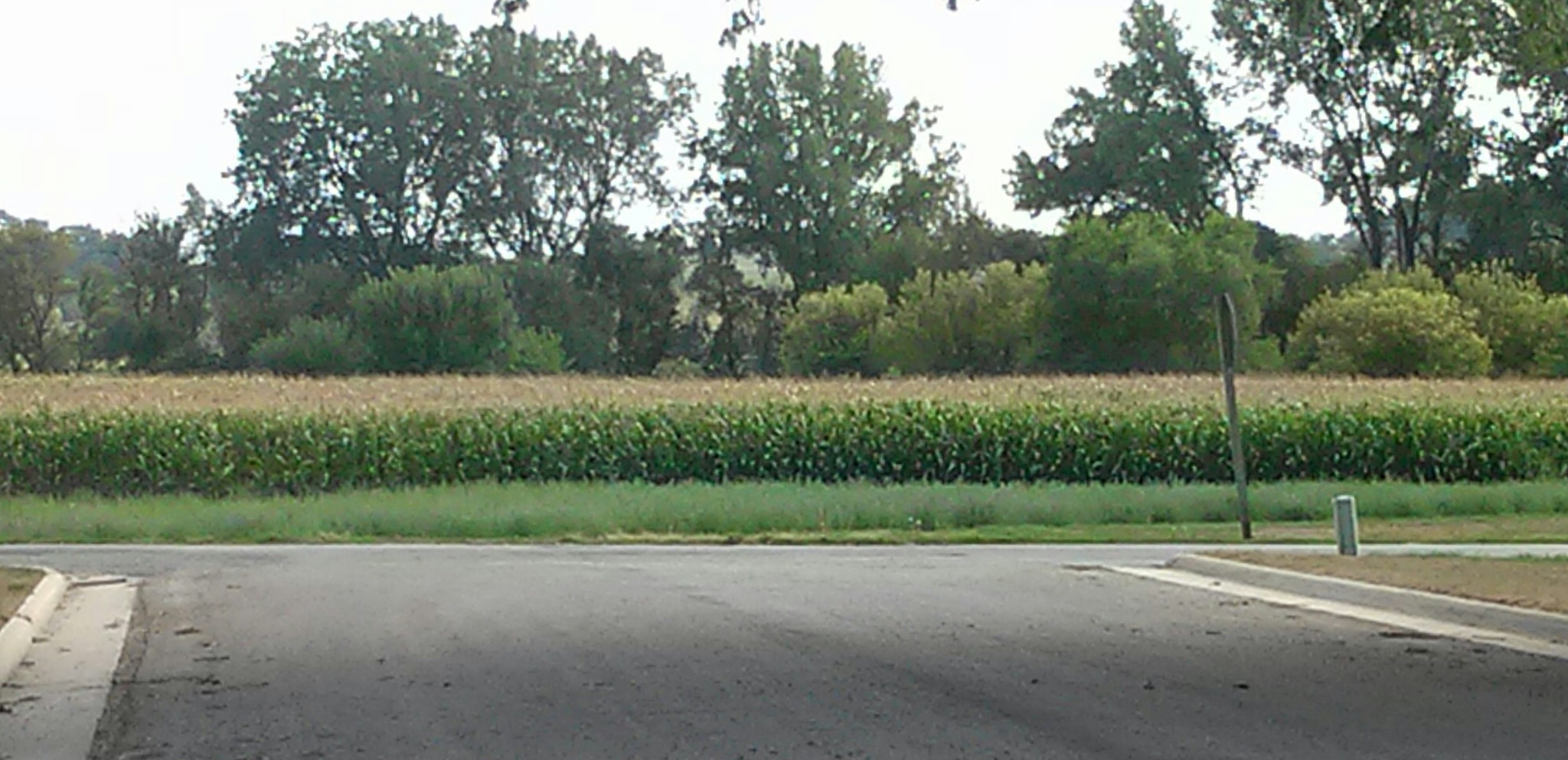
We live in Big Grove Township where most of the big groves of trees were cut down and made into lumber. From the time Black Hawk ceded land after the Black Hawk War, settlers ripped up the prairie for farmland at a rapid pace. Today there is very little public land in Iowa and comparatively few state parks. There is almost no remaining prairie, just bits and pieces here and there. Instead we have fence row to fence row corn and soybeans throughout the state. People refer to Iowa fields as an ocean of corn, yet the description falls flat when compared to an actual ocean. Instead, we are a sleepy place having nothing to do with any ocean. We are the worse for want of a nearby ocean.
We adjust to other metaphors while lacking an ocean. The trap has been to consider industrial farm scapes as something valuable, some kind of alternative. They don’t reflect who we are as a people. They reflect the wealth of land owners. In the long run of a life, who indeed cares about that?
John Haines poem, “Whatever is here is native” is pinned on a bulletin board in the garage. Haines found inspiration in the peaks of the Alaskan range he could see from the cabin he built himself, in the butterfly he held in his hands, in the moose he shot and butchered. He told of stones waiting for God to remember their names, according to his obituary. Such may be our life for want of an ocean. We must accept what is here as who we are.
This week was one of existential errands: meeting a technician at home for washing machine repairs, getting the automobile oil changed, a planning meeting for our upcoming high school class reunion, grocery shopping at the wholesale club, and chauffeuring my spouse to an appointment. It is the stuff that keeps our operation going.
I spent time in the garden to finish the tomato patch. There are squash and cucumber blossoms in rows I planted. What I managed to plant seems to be taking as expected. Nothing very exciting happened this week in the garden or elsewhere in my life.
Working with My Cohort
Two meetings remain for the planning committee of our 50th-ish high school class reunion. The six people on our regular video call are no-malarkey do-gooders committed to bringing this thing in on time and on budget. I’ve known them all since high school which ended in 1970. Our long, if intermittent acquaintance makes working together easy and enjoyable. Among the topics I raised:
Polish fathers of the bride counting dinner plates and instructing reception attendees to use the same plate for seconds.
The craziness of feeding 78 billion farm animals but not being able to feed 7.8 billion humans.
Explaining how vegetarians seek to be identified as people versus adherents to a cult.
Part of aging in America is sorting these things out. Then you just have to tell someone!
The reunion happens in a month.
Gardening Reached Apogee
This year I couldn’t get caught up with the garden. A few days remain before summer begins, and at least two plots will lie fallow this year. That’s not all bad, yet I envision a future with a much smaller garden. It’s complicated, yet it’s not. We simply don’t eat as much food as I can grow. I made a very large plot by combining two of the older plots. It has been impossible to keep critters who enjoy the garden as much as I do out of that growing space.
Once I clear out the greenhouse, I will prepare the two plots to lie fallow the rest of this year. Last year’s garden is likely as good as it gets and an apogee in the arc of a gardener’s life.
Quick Bean Soup
I made a “quick bean” soup for dinner of all organic ingredients. That means I used canned beans — a prepared 3-bean mix plus canellini — medium dice of carrot, celery and Vidalia onion, bay leaf, Herbes de Provence, salt, and sliced pac choi, stem and all. For liquid I used home made vegetable broth. When the vegetables were tender, I blitzed about a third with a stick blender, stirred, and there was supper.
I’ve been feeling kind of punk the last few days. My blood pressure has been elevated above normal and I’m having trouble sleeping. I spent much of Saturday in bed. I’m reading Annie Jacobsen’s Nuclear War: A Scenario which is likely contributing to difficulties in sleeping. I have been free of headaches, chest pain and difficulty breathing, so I’ll ride it out for a few more days and hope for the best. If I didn’t take my blood pressure at home, I may not have noticed anything different. Information can be both a blessing and a curse. (Update: My blood pressure returned to normal range by Monday morning. The spell passed).
Is the Supreme Court calling balls and strikes in this decision? No, they are not.
Politico journalist Alice Miranda Ollstein identified four anti-abortion wins buried in the Supreme Court’s unanimous ruling against them. Read Ollstein’s entire article on Politico’s free website here and give her a follow. My short summary of the pitfalls she identified is as follows:
The SCOTUS decision was based entirely on procedures grounds, i.e. the plaintiff did not have standing. The decision avoided discussion of merits of the case.
What rights do physicians have to refuse to perform abortions or other health services that they feel conflict with their moral or religious beliefs? Historically, said University of Texas law professor Liz Sepper, a federal law called the Church Amendment gave doctors the right to refuse to participate only in abortion or sterilization, but the new ruling expands the scope to “the full range of medical care.” This could be a major departure from precedent.
Justice Clarence Thomas’s separate concurrence with the unanimous decision contained suggestions for other ways abortion opponents could bring legal challenges or pursue restrictions on the pills in Congress or through the executive branch. Such road maps are certainly not necessary and some would say inappropriate.
Thomas’s concurrence suggested the sword should cut both ways. This is a flashing warning light for abortion-rights proponents who have long relied on what’s known as third-party standing to challenge abortion restrictions in court. Essentially, many courts have allowed doctors to bring lawsuits on behalf of their pregnant patients because the time-sensitive nature of pregnancy makes it impossible for patients to sue, and because most anti-abortion laws target doctors rather than patients with criminal and civil penalties. Thomas wrote, using loaded language favored by the anti-abortion movement, that the court’s decision denying standing to the doctors in the Alliance for Hippocratic Medicine should cut both ways. “Just as abortionists lack standing to assert the rights of their clients, doctors who oppose abortion cannot vicariously assert the rights of their patients,” he said.
What may seem like a clean win for proponents of use of the drug mifepristone for ending pregnancies is not clean at all. I recommend reading Ollstein’s entire article here. It seems easy to predict this issue will return to the Supreme Court soon.
I was selected as a delegate to the Iowa Democratic Party state convention which convenes at 10 a.m. today. There weren’t enough volunteer delegates nominated at the county convention, so I threw my hat in the ring knowing I might not attend. By the time readers see this, I will have decided. I don’t believe a political convention is needed to fairly and effectively organize a political party. Our current habits go way back to before the state’s founding.
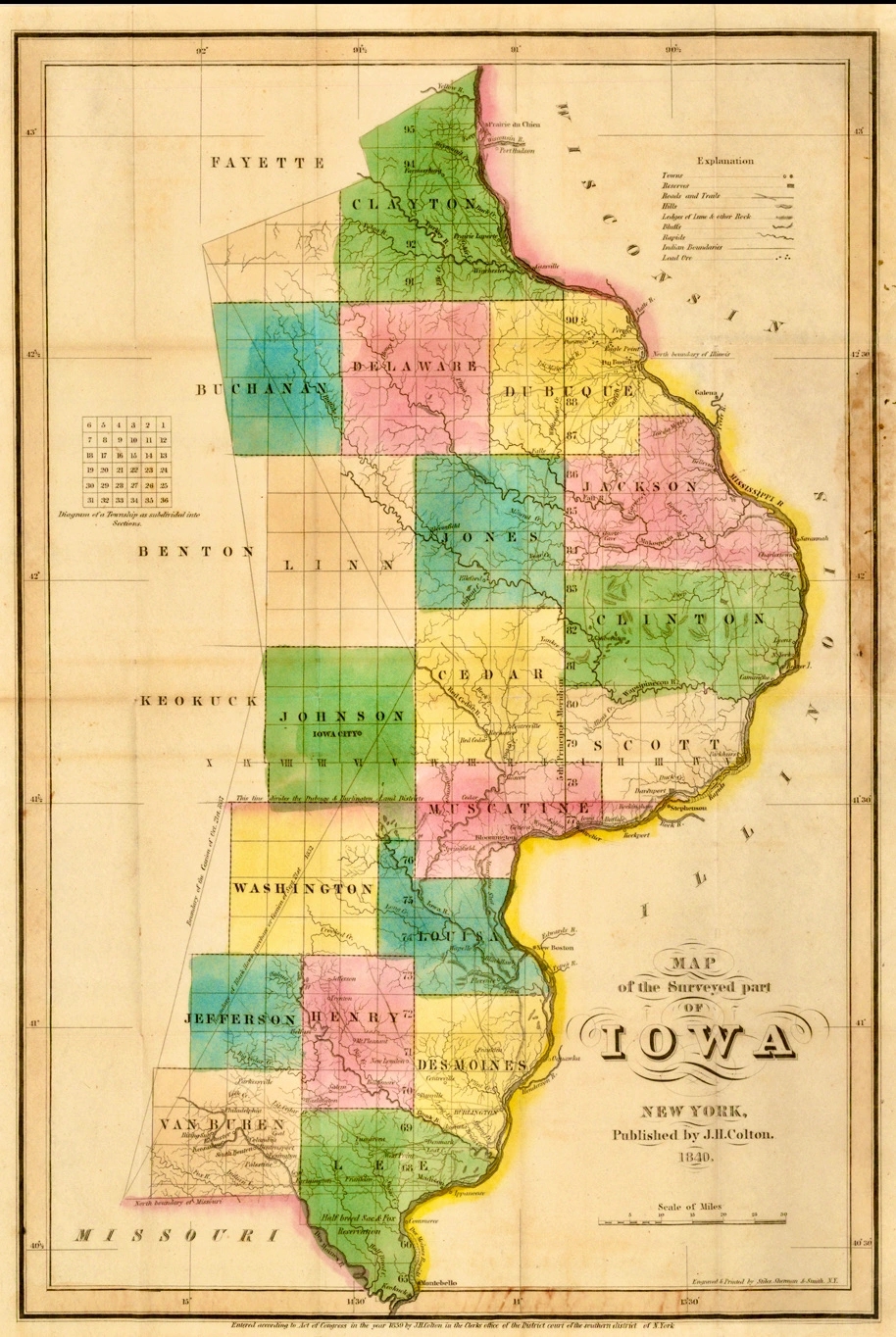
During the early 1830s, Iowa didn’t have much of a government. Decisions of consequence were made by businessmen such as George Davenport, Antoine LeClaire, and others. A concern for having clear title to sell lots in the fledgling city of Davenport was real, but not always a main concern for speculators. There was also the sticky issue that the Sac and Fox indigenous tribes believed they had not ceded land for early settlers. The resulting 1832 Black Hawk War settled the matter, as far as that goes, in Eastern Iowa and Southwestern Minnesota. When Davenport, LeClaire and others decided to invest in land speculation, as they did when in 1835 some of the initial platting of city blocks occurred in Davenport, there was little government to restrain them.
On July 9, 1840, in what was then called Bloomington (now Muscatine), Democrats held the first territorial convention in Iowa. Delegates from 16 counties adopted a “non-interference with slavery” platform. The convention elected Augustus C. Dodge as delegate to the national congress and approved a brief platform with multiple resolutions for Dodge to take with him to Washington. Read more about early Iowa political conventions in David C. Mott’s Annals of Iowa article titled “Iowa Political Conventions and Platforms.”
The Democratic Party’s first convention after Iowa achieved statehood on Dec. 28, 1846 was held April 24, 1884 in Burlington. Its purpose was to elect delegates to the national convention of 1884. Resolutions adopted at the convention include granting 160 acres to former Union soldiers in perpetuity, reducing taxes and tariffs, and eliminating laws that infringed on the freedom of Iowans. Delegates approved a state central committee of 13 members. In short, these are the sorts of things Democrats do at current state conventions. If all this sounds familiar, it’s because a lot hasn’t changed.
The most significant change that impacts party politics has been decentralization of information through the internet. We no longer need a group of “special” state delegates to represent our interests. What we do need is a way to be more inclusive in our politics, a way that enables us to participate directly if we so choose.
The Iowa precinct caucuses that chose presidential delegates to the state and national convention was an organizing method that engaged people in Democratic politics. More people attended caucus during presidential years, while in the background the same small group of people ran the party. This year, as part of my convention registration, I had to declare I was a Biden delegate. The meaning of that is much less than if I had joined my colleagues at the Biden table during the 2020 precinct caucuses.
With the demise of presidential preference caucuses, the Iowa Democratic Party must change how we operate. Party Chair Rita Hart is well aware of this and has stated as much in public. I am not hopeful the state party as represented by today’s delegates realizes this as well as Hart does. It seems to me, from emails I received in the run up to the convention, there are too many insiders protecting turf through seldom read resolutions and initiatives. Iowa Democrats, and I’m not talking about the small cadre of leadership, must stop tinkering around the edges of having a party, and devote more energy into electing Democrats where we can and across the board. If the state party doesn’t help us do that in tangible ways, we should ditch it.
I don’t believe the national party will let us do away with a state convention. That said, I’m not sure of the value of meaningless rituals like participating in the convention. Presidential preference used to hold our interest. It is likely a good thing that went away so we can focus more on local races. Whether we will is an open question.
What will we humans do when we’ve found everything we once lost? If Sir John Franklin’s 1845 voyage of HMS Erebus and Terror to find a Northwest Passage is an indication, we will continue singing the same songs events raised up, even as more of the actual history becomes known. Lord Franklin is a classic folk song and hard to release from repertories. John Renbourn discussed new discoveries about the fate of Franklin’s crew found in 2014 and 2016. He said it ruined the song forever. When he sings it, Renbourn does not change the lyrics. Click here to hear the whole story and listen to his version of Lord Franklin.
Enter the June 9, 2024 discovery by the Royal Canadian Geographical Society of the last vessel of Antarctic explorer Sir Ernest Shackleton found in the Labrador Sea. The wreck of Quest lay upright and intact on the seabed at a depth of 390 meters. Rediscovery occurred this week and next steps, I feel certain, will be forthcoming.
My point is we are going to run out of historical artifacts to find. What then?
As the Bill Anders photograph from Apollo 8 confirms, Earth is a finite place. Humans are polluting our air, water, and land at an unprecedented pace. The population of humans is growing. What we haven’t found is a way to live without dire consequences for our planet and the people and other wildlife who inhabit it. Isn’t it time we made that discovery?
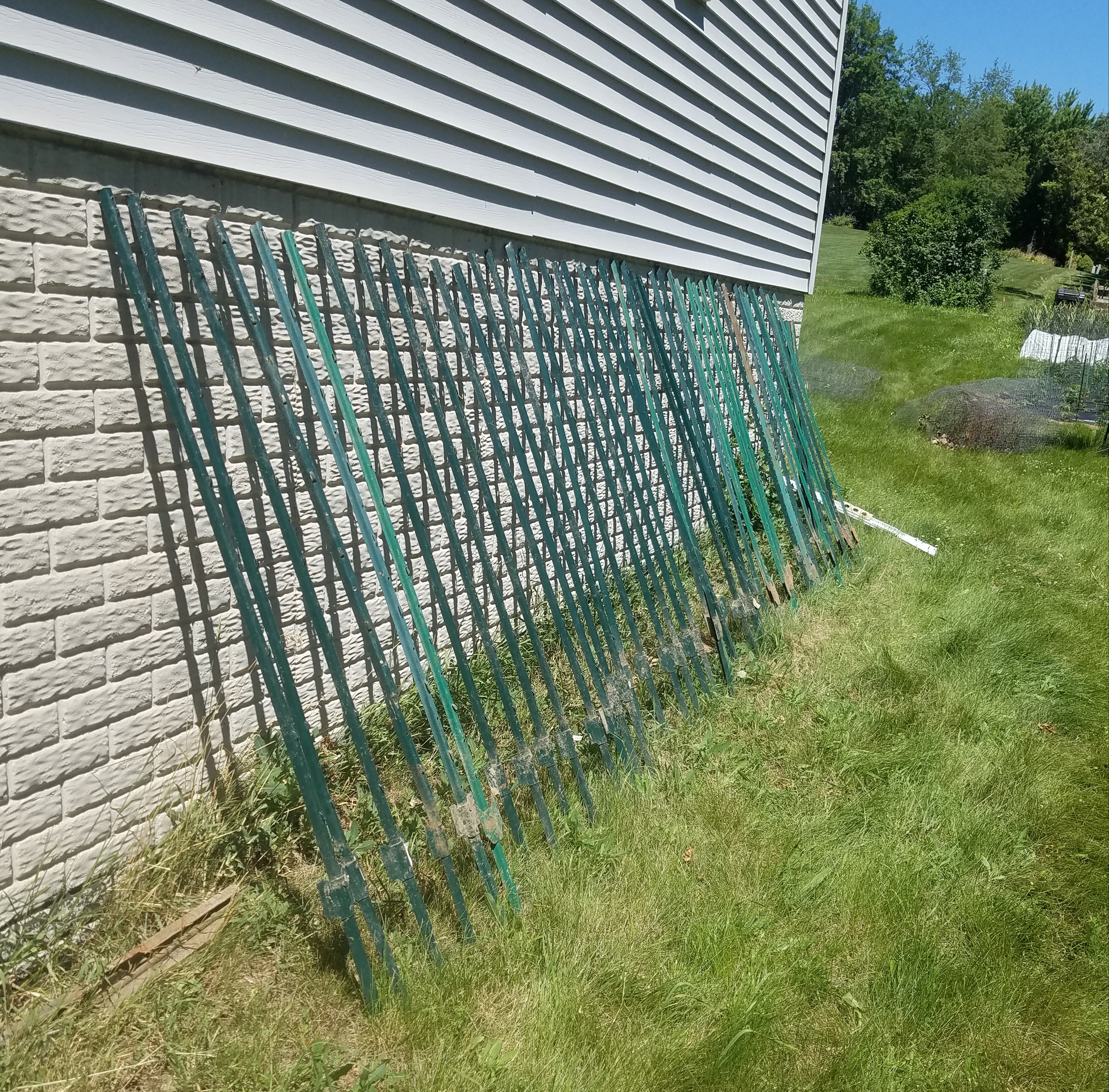
I spent my Wednesday outdoor time repairing pallets and re-building my garden compost bin. I’m not sure how many more years these boards will last. In many cases, they are so deteriorated they wouldn’t take a nail. It is literally held together with bailing wire rescued from hay bales used to mulch garlic. Anyway it is back up and will quickly fill up with weeds and vegetation from the garden. I won’t harvest compost from this bin for two years. As regular readers may recall, I’m running way behind in the garden. I usually put this bin together in mid April.
Ambient temperatures were at 86 degrees by 11 a.m. when it was too hot to continue working outdoors. A younger me would have persisted all day. I am able to recognize the signs that heat is affecting me and can call it quits.
Soil around garden plants was still wet at 11 a.m. Once the worst of the heat is over, I’ll shut off the soft water and water them again. I encountered the small rabbit that has been dining on the garden. The cayenne pepper deterred it somewhat, yet not enough. Something broke into the covered row and ate a head of lettuce. It looks like the work of a deer. I had another piece of fabric and did a make shift repair. It held over night.
I’m having doubts about attending the state Democratic convention on Saturday. I’m receiving the usual emails regarding the convention, including one from someone wanting to be elected as a delegate to the national convention, and one from the rural caucus. The rural caucus made this request:
There are three amendments we’d like to share our thoughts on; we encourage delegates to vote with us in support of rural Democrats:
We support the amendment requiring a 3 delegate minimum per county.
We oppose the amendment removing term limits for members of the State Central Committee.
We oppose the amendment adding the State Central Committee Steering Committee to the constitution, making the Committee a permanent decision-making body of the Iowa Democratic Party.
If these are things most important to Democrats who live in rural areas, then it is a sign the state party has lost its way. While these three issues may be important to some, they indicate a kind of tinkering around the edges of party structure that will hobble us from regaining control of the legislature and statewide offices. This is not a strong case to attend the convention.
I’m undecided. If they were having the convention in downtown Des Moines, I would have used it as an opportunity to drop off my spouse to visit her sister while I was at the convention. Instead, we are in Altoona, which while not a terrible distance, would add another hour of driving to my day should we do a sister-in-law visit. Another check mark in the no column of decision-making.
Thing is, there weren’t enough people to fill the state convention slots at the county convention. The pool of alternates to pass on these responsibilities is pretty shallow. Democrats can likely do good on this without me. There remain two days to decide.
There are better things to do than get moody about politics. I think I’ll schedule this post and get after them. Thanks for reading!
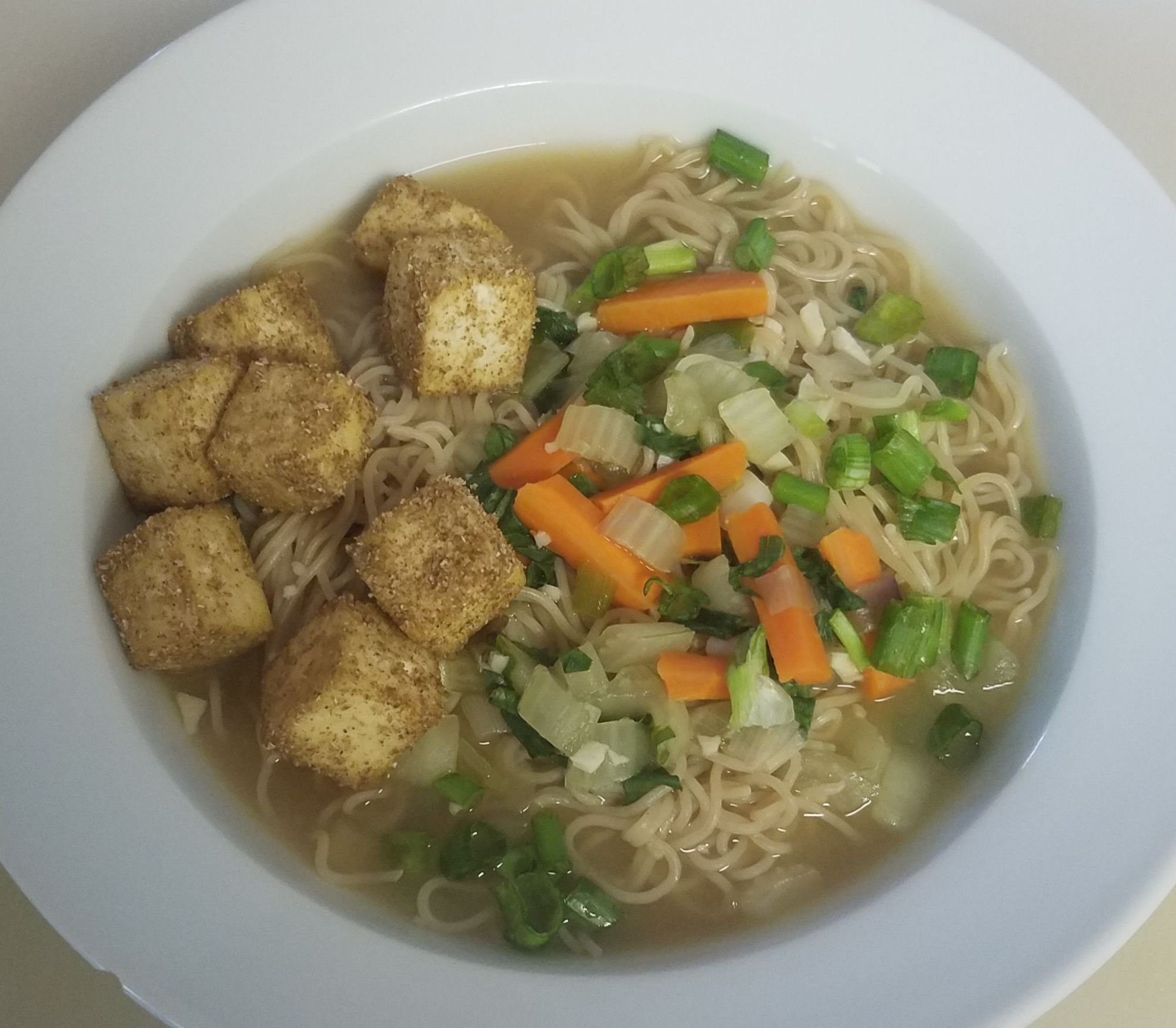
The building blocks of our kitchen came into play at dinner time Monday. Canned home made vegetable broth, tofu from Iowa City, brown rice flour ramen and white miso paste from China, organic carrots from California, and spring onions, garlic, and pac choi from the garden. This is the American vegetarian kitchen garden at work.
It’s not really local food, is it? The ramen was suitable for vegans, and the flavor of the pac choi really came through. No wheat in this dish, and it is the first time in a while I used tofu for something other than stir fry. It is unlikely 20-year-old me would have prepared something like this.
I reserved some of the pac choi leaves, yet in retrospect should have added them all. The dish didn’t suffer from lack of greens yet there is no sense being frugal about leafy green vegetables. The world is full of them and in general Americans don’t eat enough of them.
There is no recipe for this dish. It was a product of that moment, my experience as a cook, and available ingredients. Mainly, I had to do something with the abundance of pac choi from the garden. We should cook like this more often.
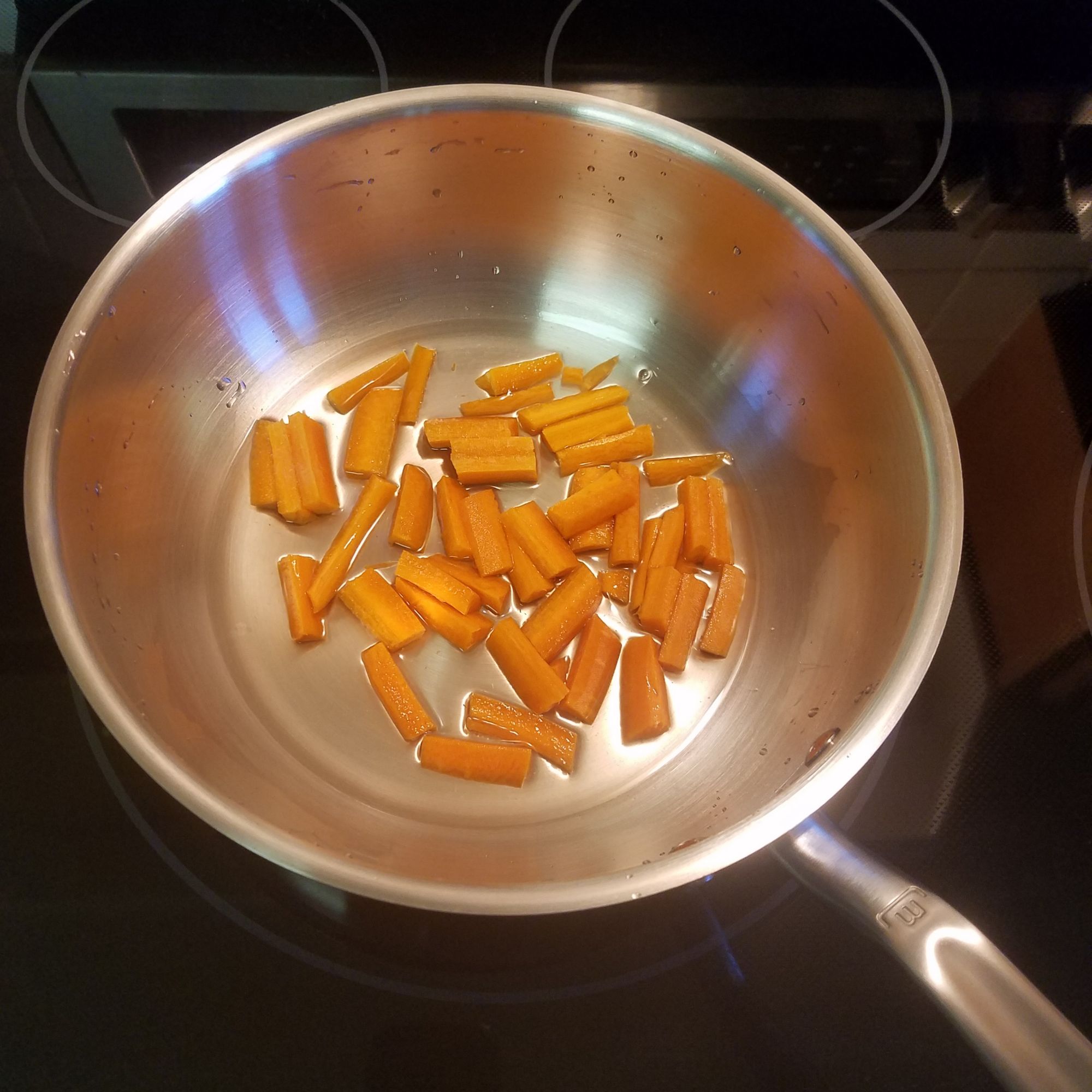
Cooking carrots first in my saucier.
The ramen was satisfying on multiple levels.
This was the first use of my new saucier, and I was happy cooking with it. At three quarts it is of a size to make dinner for four. I hope there will be many more uses of the pan.
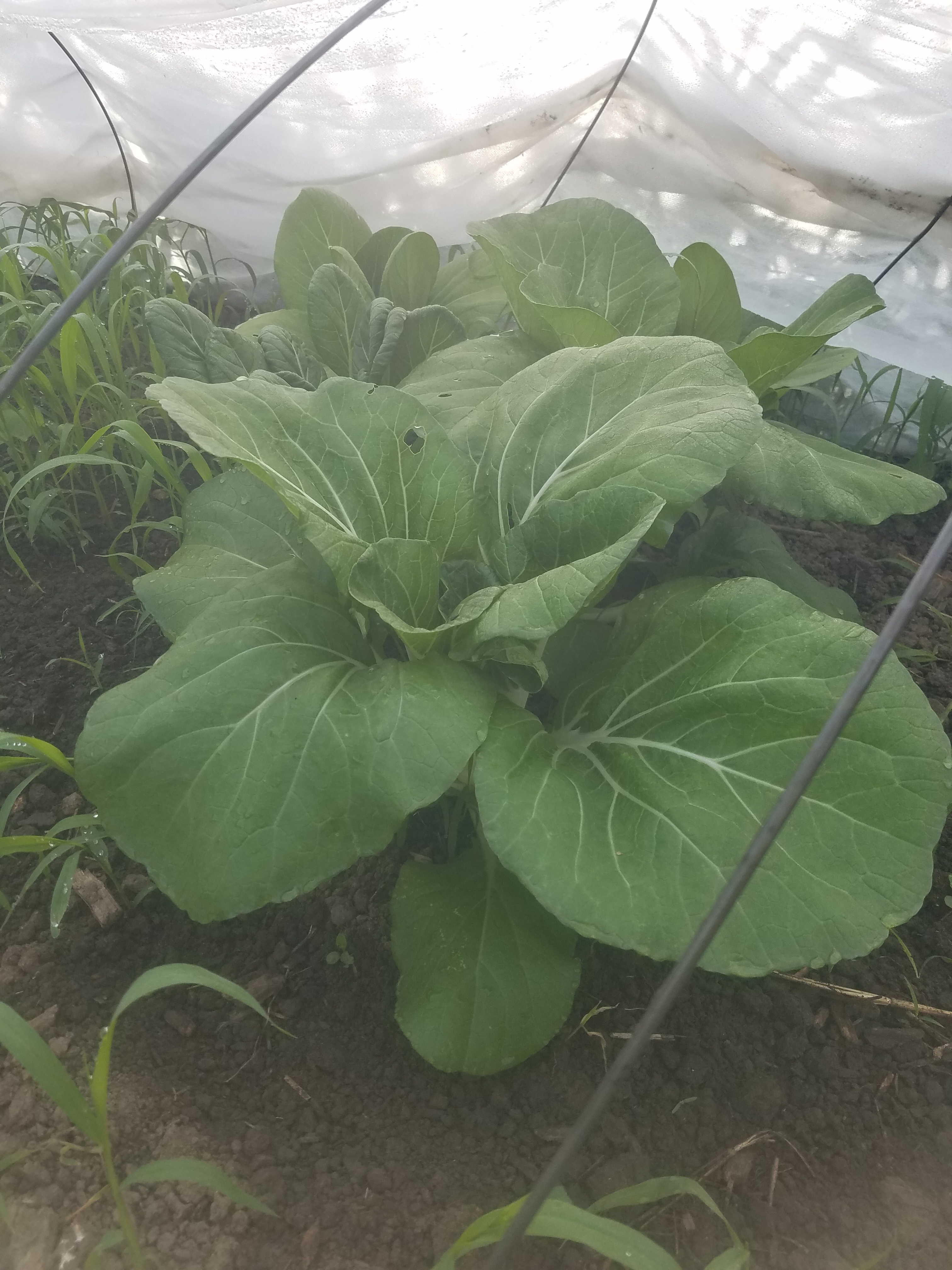
It is easy to get behind using leafy green vegetables. The garden produces so many, and certain ones, like pac choi, are best used fresh. One more giant pac choi in the refrigerator then on to the smaller ones.
I’ve written about making vegetable broth before. Baked tofu has become our standard preparation. What set this dish apart was flavoring. Salt and white miso, highlighted the flavor of the pac choi. Likewise, there was enough garlic, but not so much to be overpowering. Making food that tastes good can be done. It is not as simple as it may seem.
Would I make this dish again. Probably something like it in the never ending meal that comes from a kitchen garden.
Instead of getting the garden in by Memorial Day, I moved the date to June 20 when summer begins. I have five plots laid out, plan to skip one this year, and may skip part or all of another. Large amounts of rain kept me out of the spring garden. The shelves in the greenhouse are slowly emptying, and soon initial planting will be finished.
We’ve been cleaning to make room for technicians to repair our washing machine. It generated a code which I couldn’t resolve, so I made an appointment. The service company telephoned and said I should contact Maytag about covering the repair under warranty. I did and they will. The code first appeared at almost exactly at the end of the initial warranty period.
It is surprising how much a modern household depends upon getting laundry done. I can’t imagine what it would be like to return to laundromats. The one in our small city closed years ago, so it would be a big to-do of traveling to the county seat or further to launder clothes. There is only so much time in a life. The less spent on laundry the better.
I opened the covered row and an abundance of pac choi, lettuce, and basil was ready. I brought the haul indoors, cleaned it, and put it away in the refrigerator. I made a sandwich with a generous amount of fresh lettuce for lunch. I don’t often buy lettuce at the grocer, so when I have it in the garden, I make the most of it.
There will be pac choi ramen. In January I bought a 24-pack of Maruchan ramen. When I make it, I throw out the flavor packet that comes with it and make my own broth. This time, I’ll make a vegetable broth using white miso, then saute onions, garlic and pac choi, mix them together, and cook the noodles in the resulting liquid. The abundance of fresh leafy greens is wonderful.
Also in the kitchen garden mix is pasta sauce using last year’s tomato sauce, onions, fresh basil and garlic. This first of the season sauce is also a chance to try out my new saucier. Basil doesn’t keep long, so by the time this posts, I may already have made it.
There is one head of romaine lettuce which I’ll roughly chop for a salad. Not sure what to do for dressing, but it will inevitably use extra virgin olive oil and home made apple cider vinegar. I can’t wait.
While I had to move the goal posts for finishing planting the garden, the harvest already begins. These are the good days for which we live during the long winter. It’s life, as good as it gets.




 Journey Home
You must be logged in to post a comment.