Categories
Environment

Climate Disruption and Farming

Following are prepared remarks for my talk at the Iowa United Nations Association event, “Speaking of… The Environment!” held at Prairie Lights Bookstore in Iowa City, Iowa on Tuesday, Nov. 12.

Thank you Iowa United Nations Association for organizing this event, and to Prairie Lights Bookstore for hosting us tonight.

Climate change is real. It’s happening now. Just ask a farmer. There are few people as close to the intersection between the natural world and human activities as they are. Any conversation I have had with a farmer, included discussion of long term changes in our climate, and how they dealt with them.

Recently, I had a conversation with farmers about this year’s crazy weather: a wet spring that delayed planting, followed by drought conditions in July through September. It was bad, but the worse news was that we can expect more of the same during the next several years.

What does this mean? For one thing, this year’s soybean crop is in and reports from the field are that pods formed on the plants, but didn’t fill out with beans because of the lack of rain. What could have been a great year for soybeans turned into an average one because of drought conditions related to our changing climate.

According to a group of Iowa climate scientists and academicians, the consequences of climate change on farmers are easy to understand. “As Iowa farmers continue to adjust to more intense rain events, they must also manage the negative effects of hot and dry weather. The increase in hot nights that accompanies hot, dry periods reduces dairy and egg production, weight gain of meat animals, and conception rates in breeding stock. Warmer winters and earlier springs allow disease-causing agents and parasites to proliferate, and these then require greater use of agricultural pesticides.” In addition, changes in our hydrological cycle cause increased soil and water runoff, and complications with manure applications. There is also pressure on crop yields.

Everything I mentioned puts pressure on our food system. We can expect more of the same going forward.

There is overwhelming evidence that climate change is anthropogenic, or caused by humans, yet most farmers don’t accept it, even as they deal with its effects.

Scientists don’t know where the tipping point lies, but the effects of climate change on farm operations are clear, and getting worse. Yet, even as we adapt, and farmers do adapt, we can do something about the causes of global warming and climate change without changing our way of life or hurting our economy.

We could start by dealing with the fact that globally, each day we dump 90 million tons of CO2 pollution into the atmosphere as if it were an open sewer. That has to change.

I’m not alone when I say we can do something about the causes of global warming and climate change to protect our food system before it’s too late. We should. Thank you.


Categories
Writing

Technology in the Present

GUI Search
GUI Search

LAKE MACBRIDE— To support a couple of significant projects, more computing capacity is needed in our home on the lake. It seems unlikely any funds will be disbursed to support the projects. Rather, old computers and equipment will be located, resurrected and deployed in a way to create a couple of new work stations and bring focus to these new intentions. What does that mean?

Like many who have been on-line since the mid-1990s, we bought, sold, donated, gave away and recycled a significant number of computers. I lost count, but over the years, at least 20, with a number of them still in the house. At first, the trouble was finding a way to dispose of them without tossing them in the landfill. Some were given to a local political activist for potential use in campaigns. Too, for a while we donated old equipment to Goodwill, and now, they have a local specialty store called Reboot that will take old computer hardware and recycle it. In the case of those remaining at home, ample storage space and entropy have accumulated ten CPUs or so. There are plenty of working processors for new projects.

What are the projects? Two are most important. First, there is the persistent need of consultants to focus on business development. Determining how we will pay the bills and seek fulfillment at the same time requires a minimum number of distractions. For this, I chose an old laptop the battery charging function of which ceased to work and is too expensive to repair. It works fine while plugged into an electrical socket. Whatever work is not backed up may be at risk, but that can be addressed with good backup habits.

Secondly is a big writing project that requires a focus on words on a screen. For this project, no Internet access is needed or wanted. Regardless of the information available on the web, the craft of writing is done a word or phrase at a time, and distractions of any kind are unwelcome. For this work station, I picked a CPU returned from a family member with a monitor returned from another. The main challenge will be getting the same version of Microsoft Word installed on all three CPUs without feeling guilty about using the same license on more computers than the software package allows. There is also the issue of finding the disk, which eludes me at present and will eventually show up (I hope).

Operating systems? The desktop CPU has Windows XP, and the two laptops have Windows 7. XP is on the writing CPU, so that will take me into a different world when I boot up, and that may be okay. Regrettably, it has a 2002 version of Microsoft Word on it, and that’s too different from the 2007 version on the other two.

All of this is minor accommodation to a person who continues to recall the MS-DOS command prompts, and using computers before the introduction of the graphical user interface. One suspects people don’t even recall what is a GUI, but they have gotten much better.

Just about done with the setup, so now, let the working begin, he said hopefully.

Categories
Sustainability

Veterans Day 2013

Maternal Grandfather Marker

LAKE MACBRIDE— From Nov. 11, 1919 until June 1, 1954, we commemorated Armistice Day with a moment of silence to recognize the 20 million who died during World War I. A second moment of silence was dedicated to those left behind. Beginning in 1954, All Veterans Day replaced Armistice Day as an official U.S. holiday to honor all veterans, and has become a time to pay tribute to our perpetual wars.

I appreciate the thank yous for my service, however, the better effort would be to work to reduce the number of military veterans being produced through adjusted national policy. On days like today that is heard almost nowhere.

I’ll head to town to participate in the Armistice Day observance organized by Veterans for Peace, and work toward that end. That will have to do for today.

Categories
Environment

On Typhoon Haiyan

Typhoon Haiyan 2013 Photo Credit: EUMETSAT

LAKE MACBRIDE— The news about Typhoon Haiyan is horrifying. For the moment, it is hard to determine the exact damage, but these quotes from the corporate media provide preliminary estimates.

CNN: “No building in this coastal city of 200,000 residents (Tacloban, Philippines) appears to have escaped damage from Super Typhoon Haiyan.”

USA TODAY: “As many as 10,000 people are feared dead in one city alone after Super Typhoon Haiyan— one of the most powerful storms ever recorded— slammed into the central islands of the Philippines, officials said.”

CBS NEWS: “The central Philippine city of Tacloban was in ruins Saturday, a day after being ravaged by one of the strongest typhoons on record, as horrified residents spoke of storm surges as high as trees and authorities said they were expecting a ‘very high number of fatalities.'”

REUTERS: “The death toll is expected to rise sharply from the fast-moving storm, whose circumference eclipsed the whole country and which late on Saturday was heading for Vietnam.”

LOS ANGELES TIMES: “What may be the fiercest typhoon in recorded history smashed into the Philippines early Friday morning, carrying winds that make Superstorm Sandy look like a weak relative. Even Hurricane Katrina, the modern measure of nature’s disastrous force on the United States, pales when compared to the punch and expected devastation from Typhoon Haiyan.”

Typhoon Haiyan was the second category 5 typhoon in the Pacific Ocean this year. While we consider the damage, and what it means, it’s time for a moment of prayer for the dead, and for the survivors.

Categories
Writing

Leaving Colorado

Tejon at Bijou
Tejon at Bijou

Writing on Tejon at Bijou (This post was first published on Feb. 3, 2012).

Unexpectedly delayed by the snowstorm, I have time on my hands. All of the big stuff at the apartment was hauled away or packed for the trip back to Big Grove. Near the door are the boxes we finished packing last night, waiting to load, hopefully tomorrow. There is time for writing.

I drove to the Arc Thrift Shop and made a donation of unwanted items found during the apartment cleaning. On the way back, I stopped at Starbucks at the intersection of Tejon and Bijou in downtown Colorado Springs. I ordered a grande brewed dark roast, sat at a table and connected to the free WiFi for a session. It is the table and chair that is lacking at the apartment, not the WiFi.

Of the places in Colorado Springs, the downtown area on Tejon is a favorite. Constantly strolling people make downtown seem alive and vibrant. The coffee shop is not busy, what with the snowstorm and all, so I don’t feel bad about renting a table for an hour or so at $2.09. Checking email, and other applications is actually nicer using a table and chair.

This may be the last trip to the Springs, but I have fond memories of visiting here over the last two years. It doesn’t feel like home, but I feel comfortable here. The mountain view is exhilarating. A constant reminder that humanity is but a brief blip on the radar screen of eternity. But there is something more.

I have been exposed to a different social environment. First in a neighborhood near Colorado College where the broad boulevard that is Cascade has large, old homes mixed in with college students and drug users. Next at the Knolls off Uintah where up-scale apartments housed what looked to be a transient but affluent population, based on the vehicle license plates. And finally in an apartment complex where working poor and lower middle class people try to make it. The observations and conversations could fill volumes, but what I heard in the parking lot a couple of nights ago says a lot, “Not ever in your life…don’t you think you are better than me.” Evidence that living life is about respect; giving it, wanting it and earning it.

Categories
Home Life

Random Notes on a Saturday Morning

Last Fresh Garden Tomatoes

LAKE MACBRIDE— Politicians glom on to veterans like there is no tomorrow. Veterans vote, we live in society, and most of us served and left the military behind without comment or regret. Politicians should work to reduce the number of veterans we are creating as a society, rather than glomming onto our service for political reasons. That could be their service, and the nation would be grateful.

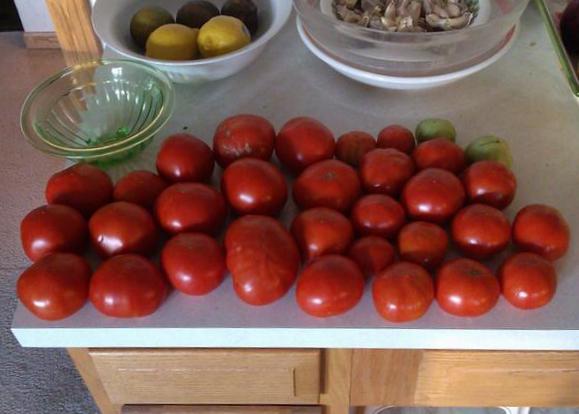
The newspaper work is finished for today. The focus will be on home work. The atmosphere is calm, so the brush pile can be burned, preparing a space for planting garlic tomorrow or next week. There are lots of apples for processing into applesauce, apple crisp and maybe some dehydrated apples. That is, once the dried herbs in the dehydrator are removed and cleaned. The last of the fresh tomatoes will be turned into a pot of chili for supper. There are more turnip greens for soup stock, and a drawer full of root vegetables in the refrigerator— plus whatever else is harvested today. There is a whole afternoon of kitchen work.

Having gone to town this morning I hope to remain on the property, or within walking distance. Maybe once the brush is burned, I’ll take a walk on the lake trail, but no further. It’s what’s called living, and we don’t do enough of it. And it’s time to get on with it.

Categories
Kitchen Garden Work Life

Being a Farm Hand

Wilson's Orchard
Wilson’s Orchard

LAKE MACBRIDE— While we were washing root vegetables, the ambient temperature started at 34 degrees and made it to 51 by the end of our shift. A cold, wet day that yielded the soundest sleep I’ve had in a long time. My hands are chapped, and application of lotion and salve to re-moisturize them has had no effect. The repetitive motion of grasping a carrot and squeezing the water nozzle to wash it would be problematic if continued. Once the carrots are washed, it’s done for 2013.

As a paid farm hand, my view of local foods production is different from the farm owners and managers. Where there is inefficiency, or extra production, there is an opportunity to perform paid work.

Part of local food production is a constant discussion about how to improve efficiencies, and my participation is welcome. However, each planting, at each step of the process, is surrounded with a complex mix of issues, challenges, techniques and possible courses of action. In order to answer a question, broad experience is needed, and usually, I don’t have much to add.

The season is winding down, and eventually the crops will be harvested, prepared and distributed, hopefully by Thanksgiving.  It will be time to move on, richer in knowledge and experience if not in money. That matters in our life on the Iowa prairie.

Categories
Writing

Cleaning Onions

Trimming Onions
Cleaning Onions

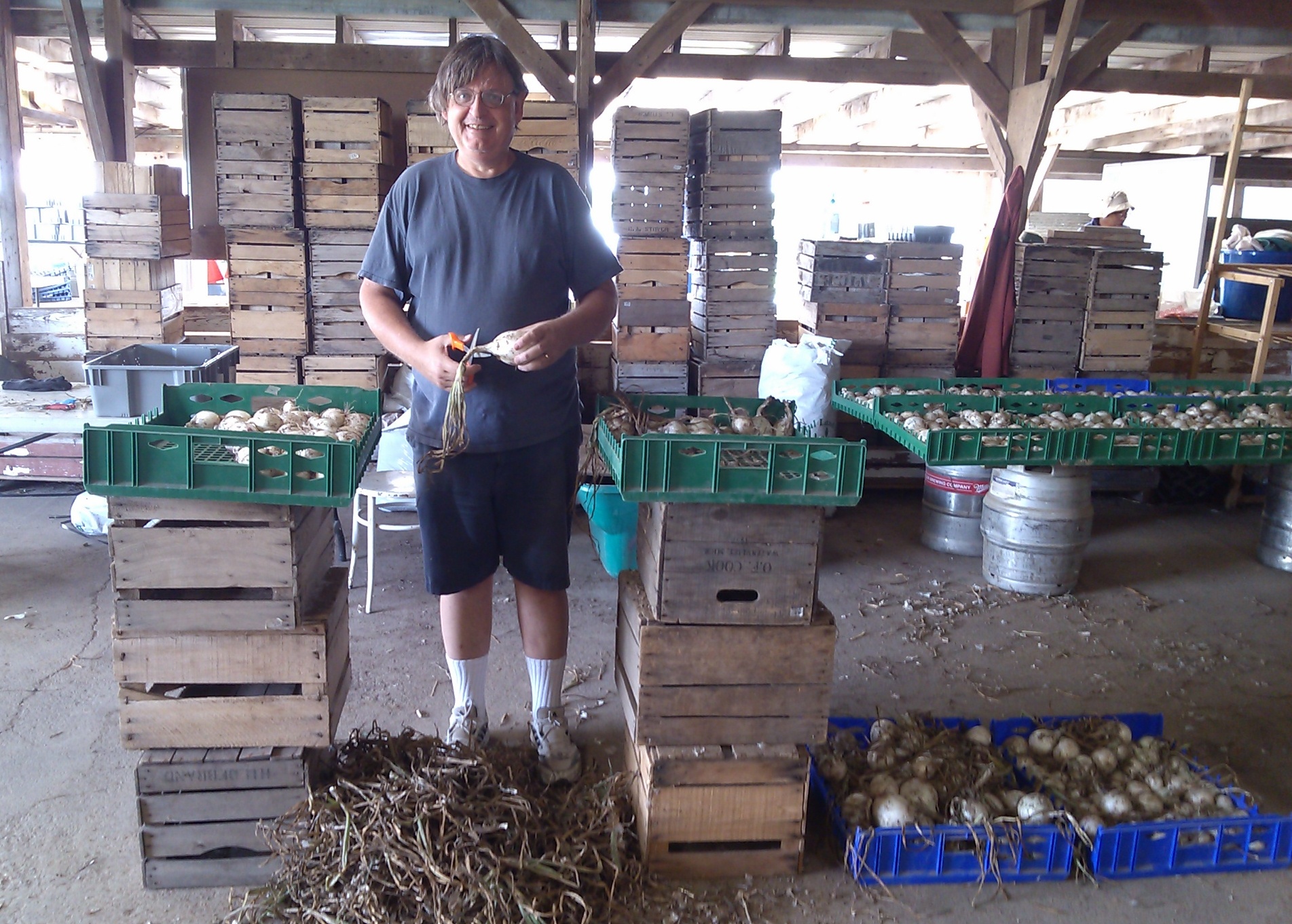
LAKE MACBRIDE— Napping when the email arrived, an hour later I woke, read it and made it over to the farm at a quarter to noon to clean onions. It was solitary work removing the tops and roots, and sorting them into crates. It took five hours. While I worked, one person was at a meeting in town, two sorted and cleaned potatoes, and another sorted spaghetti squash. Silent, but communal work in support of our local food system. Around 1 p.m. everyone else had finished and was gone, leaving me with my thoughts and work.

One of the ironies of this year has been that while working a lot of hours in local food production, my time in the kitchen has been limited. I prepared a number of seasonal dishes, but there was little experimentation or cooking for pleasure. Most of the kitchen time was spent preserving food, rather than preparing meals, converting that part of our home to a temporary mini-factory.

Rendering fresh produce into a shelf-stable product is a vital part of summer abundance. This year there are some new items: dill pickles, sweet pepper sauce, and grape and raspberry jam. As fresh cooking turns to pantry cooking, the household is ready.

In the declining light of the barn, something enveloped me. It was as if the world had been shut out as my pile of onions leaves mounted. I returned briefly to youth, and the holiday time. When there were trips to the drug store to see what seasonal offerings were made. There were trips to used book stores, to secure a supply of winter reading material, even though there was plenty to read already in the house. An trip to the liquor store to buy some wine made of German Riesling grapes, or distilled French spirits: Armagnac, cognac and Calvados. The luxuries of plain living all.

When the onion cleaning was done, the sun was setting and I headed home along the gravel back roads littered with fall foliage and deer crossings. For dinner I cooked veggie burgers and served them on buns bought from the day old rack at $1.40 for eight. Condiments were ketchup and a slice of onion, sides of coleslaw and baked beans. Comfort food for a hearty meal.

What did my onion day dreams mean? It’s hard to say, but the actuality of that feeling took me back to a time of less worry, and living in each moment. A time when our potential seemed unlimited as we left home to see what the world had to offer. In some ways, that journey was never completed. Who knew it would end up in a quiet barn cleaning onions?

Categories
Social Commentary

United Nations Comes to Iowa

Jim Leach Remarks
Jim Leach Remarks

IOWA CITY— My World came to Iowa on Tuesday, Nov. 5. It is the United Nations survey to collect grassroots input to the post-2015 Millennium Development Goals (MDG), and one of only 11 U.S. consultations. One of the criticisms of the 2000 MDG process was the lack of grassroots input, and the survey and consultations are intended to address that deficiency post-2015. The goal is to get at least one million U.S. survey responses (if readers would like to participate online, click here).

I was asked to facilitate a small group discussion on access to clean water and sanitation, and was provided a copy of a nine-page handout on the subject.  At our table, we had eight people, including some students at the nearby University of Iowa and one person each from China and India, two countries where along with Bangladesh a majority of people in extreme poverty live.

We had an engaging conversation and took notes for submission in the final report to the United Nations. As University of Iowa law professor Jim Leach said, we should support the United Nations, “and take on those that don’t.” We did our part last night.

The publicity, organization and event itself seemed well executed. The attendees I knew had the experiences and credentials to add value to the discussion as the United Nations prepares its next set of millennium development goals. Still,  something was lacking. On the drive home, it occurred to me that what was missing was any substantial discussion of business concerns that impact global society so pervasively.

When Shuanghui International, China’s largest pork producer, bought Smithfield Foods, the largest U.S. pork producer, what were they after besides the pork? Because China is so polluted, they were after access to U.S. land and relatively clean water to meet their burgeoning demand for protein. In a free-market way, they would co-opt U.S. land and water rights to benefit China. Americans may not see it this way, but it is the same kind of free-market colonialism the Chinese are engaged with in Africa and South America. The implications for the millennium development goals seem clear.

While a focus on human rights and individual needs may be appropriate for the United Nations, the world has become an open shop where corporations ply their trades freely and collect their tithe, accruing it to the wealthiest people on the planet. The role of corporatism, and keeping it in check as human rights are addressed must be part of the formula for the U.N. I don’t see how that would be possible today.

A very vocal minority, whose members are pro-life, anti-U.N. and anti-taxes will stand as a roadblock to the U.S. governance it takes to keep corporations in check. Until now, the our country has been a beacon of hope for good governance, but the 113th U.S. Congress seems incompetent to pass any bill of significance, let alone one that will reign in corporations as they plunder our world.

As I drove north after the meeting, on a highway not much removed from when Dillon plowed his furrow in the 19th century Iowa wilderness, it seemed clear our civilization has not come as far as we might think. That has to change to make the progress needed to sustain our lives in a turbulent world.

Categories
Kitchen Garden

Root Vegetables in November

Farm Greeting
Farm Greeting

LAKE MACBRIDE— As the sun set on Monday I was washing 75 pounds of spinach at a friend’s farm. The two acres is a community supported agriculture project, and that morning, a lot of food remained in the field. The day’s work was to get as much of it harvested as five of us could. During a nine hour shift, we harvested spinach, carrots, daikon radishes, rutabaga, turnips and beets, loading up a 1973 Econoline van until we tested the limits of its capacity. A second vehicle was needed to transport the produce to off-site storage.

We left three rows of daikon radishes in the field because 600 was all we needed for member shares. Farm workers took home seconds of carrot and daikon, so today at home will be cleaning them and preparing a few dishes.

The season’s farm work is winding down, and as it does, thoughts turn to what’s next. It’s not clear right now. Maybe clarity will come with keeping my hands busy in the kitchen where there is a full refrigerator and all the root vegetables in canvas bags, waiting to become what’s next. Better soup than compost. If choices in life were as simple as making soup from the bounty of November’s root vegetables wouldn’t that be the top?