Categories
Living in Society

Why I Like Dave Loebsack

Congressman Dave Loebsack

LAKE MACBRIDE— Unlike many in my cohort of grade school classmates, I stay in touch with my elected officials and have written them on important issues. Dave Loebsack is my U.S. Congressman, I like him, and it’s no secret. Loebsack receives his share of criticism, but I have stuck by him and will for three simple reasons: who he is not, who he is, and who he could be.

Dave Loebsack is not a Republican. His predecessor, Jim Leach was. I had a long constituent relationship with Rep. Leach. He was elected while I was in the military, and my first letter to him in 1980 was about disposal of radioactive nuclear waste during the nuclear freeze movement. Our views met on a lot of issues over the years. Two things turned me against Leach: his participation in the Kenneth Starr investigations during the Clinton administration, and his authorship of the Gramm-Leach-Bliley Act that repealed part of the Glass Steagall Act. Leach’s role as chairman of the House Banking Committee during Whitewater was the turning point, with repeal of Glass Steagall being the topper.

According to Bill Clinton, “in the House Banking Committee, Chairman Jim Leach… trumpeted every bogus charge against Hillary and me, alleging that we had made, not lost, money on Whitewater, had used Madison Guaranty funds for personal and political expenses, and had engineered David Hale’s SBA fraud. He promised ‘blockbuster’ revelations, but they never materialized.”

I thought it was a ridiculous waste of time that Leach participated in this political witch hunt, and told him so in a letter. By the time I got active in politics again, I felt Leach had to go, and thankfully wasn’t the only one.

Who is Dave Loebsack? His biography is readily available, but from the beginning of my relationship with him, he has been concerned, humble, appreciative and direct in his approach to me and to the political world. This passage from a March 25, 2005 email from Loebsack in response to my questions about raising money for the campaign and gaining support of the political establishment depicts what I mean:

“At the moment, I am quite honestly not sure that I can raise tons of money. However, I think my extensive contacts in the area, the state, and beyond give me a much better chance to do so than many past candidates. Therefore, I am trying even now to raise funds in this ‘exploratory’ stage. And I am not afraid to ask for help. Indeed, you may write me a check (to Loebsack Exploratory Committee) and I will deposit it in an account specifically set up for ‘testing the waters.’

I am sure I have not fully eased your mind on these matters, Paul, but I hope this is a good start.”

I don’t receive personal emails from Loebsack anymore, and I’m okay with that because I see him several times a year in a variety of settings. I have a type of accessibility to my congressman that is part and parcel of why we get involved in politics. As one out of 762,000 constituents, that is pretty good.

The third reason I like Dave Loebsack is the most important, what he could be. I don’t know how he got his initial committee assignments, but as far as I’m concerned, his membership on Armed Services and Education and the Workforce made the effort to elect him worth it.

Over the years, I haven’t agreed with all of Loebsack’s votes, especially on Armed Services. At the same time, ordinary citizens like me understand that we do not elect drones to the U.S. Congress, nor do we want to. It is precisely his outlook and process in the congress, combined with his committee assignments, that make him a strong legislator, one who will hopefully serve for many more years. As time goes by, Dave Loebsack will gain seniority on two committees that are critical to the future direction of our country. Committees whose work is important to the lives of everyday citizens where I live.

As we enter the 2014 election cycle, it’s time to stand up and get to work. I know what I’ll be doing— working to re-elect Dave Loebsack to the U.S. Congress.

Categories
Reviews

Baxa’s Sutliff Store and Tavern

Sutliff Bridge at Night

SUTLIFF— Baxa’s Sutliff Store and Tavern in rural Johnson County, Iowa is a place to hang out after outdoor activities. It is tucked away in the sparsely traveled recesses of the Cedar River Valley, next to a restored Parker truss bridge that is on the National Register of Historic Places. It is accessible by automobile, although a main attraction is as a stopoff on a snowmobile, motorcycle, bicycle or hiking trip around the area. The tavern is frequented by hunters, and trophies and pelts are mounted on the walls. “There really is no town called Sutliff anymore but there still is a great small town bar. When you come inside the bar you will find a ceiling that has ‘who knows’ how many dollar bills with names and messages written on them,” according to a restaurant brochure/menu.

Interior of Sutliff Tavern
Interior of Baxa’s Tavern

Baxa’s Tavern is part of a destination attraction that includes the historic bridge and miles of rural, less traveled roads. The food is typical bar food, or “pub grub” as some locals affectionately call it. There is a full page of appetizers on the menu, including familiar items like chicken wings, mozzarella sticks, onion rings and French fries. There are also local specialties of gizzards, fried green beans, fried pickles and corn nuggets— breaded and deep fried just about anything. Prices for appetizers range from $2.25 for fried potatoes to $5 for 12 chicken wings.

There is a selection of sandwiches, featuring the signature Baxa Burger or the Sutliff Philly Steak. Prices ranged from $2.25 for grilled cheese up to $5.50 for the Baxa Burger. “Everything includes ketchup, mustard, pickle and onion,” according to the menu, reflective of the basic bar food fare. There is a limited selection of salads, including potato salad, macaroni salad, coleslaw, cottage cheese and a lettuce salad. I asked some patrons for their review, and every comment about the food was positive.

Dollar Bills
Dollar Bills

Beverages include bottled and canned domestic beer and soda, along with a couple of wine selections. Beverages were served in their bottle or can, providing the ambiance of hanging out at a friend or neighbor’s house during the 1960s.

For a while, time can stand still at Baxa’s Sutliff Store and Tavern. While the food and beverages are industrial food service specials, the venue is very popular and worth a try if you are in the area seeking traditional pub grub.  Here is some basic info.

Baxa’s Sutliff Store and Tavern
5546 130th Street NE
Lisbon, Iowa 52243
(319) 624-2204

Bar hours (Closed Monday)
Sunday 10 a.m. until 11 p.m.
Tuesday – Thursday 10 a.m. until 10 p.m.
Friday and Saturday 10 a.m. until ?

Grill hours
Sunday – Thursday 11 a.m. until 9 p.m.
Friday and Saturday 11 a.m. until 10 p.m.

Categories
Social Commentary

Snow Fell in Town

Newspaper Office
Newspaper Office

SOLON— An inch of snow had accumulated while I was inside working on next week’s newspaper. When one is the proof reader for a small weekly paper, he gets a preview of what’s happening. There is some action, but not much.

The second session of the 85th Iowa General Assembly began last week, as evidenced by the multitude of newsletters from our state representatives and senators. Our circulation spans two senate districts, so there were a total of four in my folder. As a recovering political junkie, I had already read the four at home, and then some. There was little news, except to say it’s open season in the Iowa legislature. My state representative was holding two listening posts today in Bennett and Lowden. Had the weather been better, I would have driven over.

What was in the news was that J.C. Penney is closing 33 stores and laying off 2,000 employees. On Thursday I accepted a part time job requiring white shirts, and I didn’t have any decent ones. I went to Penney’s yesterday morning to buy them. (Note to self: throw the rags in the closet away, as they are not shirts any more).

Upon arrival, I was one of a small number of customers in the store. A gent greeted me close to the door, offering his assistance. My shirt is an oxford-style, buttoned down collar with long sleeves. The gent attempted to compliment me by suggesting a size smaller than I required, but the photo of the tag from my old shirt clarified the matter. He helped me find what was wanted in short order.

I am baffled by the pricing scheme at large box stores. The tag on the shirt said $30. There was no other price posted. The gent told the cashier to make sure I received the 25 percent unadvertised discount. When she rang it up, the computer/cash register gave me a 50 percent discount. While discussing payment terms, she asked if I had a J.C. Penney credit card. I explained that I do, but prefer to keep all my charges on a single card, so I would use my MasterCard. Another discount. My final cost was $12.75 plus tax per shirt or 42.5 percent of the listed price.

Keep in mind there was no visible price advertising in the store and when I mentioned the discrepancy to the cashier she said the amount was correct. Price was dependent upon the cashier’s entries, the bar code and the computer database. The personal shopping experience was compelling because the price seemed to get lower every step taken toward payment. How do they make money that way? They’ve taken logic out of the process, and one supposes they have their reasons.

I pointed out to the cashier that our store wasn’t on the list to close. She said they were rated number one in the U.S. for sales by size. She asked if I had ever been to the Muscatine store scheduled to close. She had been, and wasn’t surprised because they had so little merchandise in it. We had a nice conversation.

The whole shopping experience was engaging on many levels, but I don’t see how this store could be making any money with so few customers and the vagaries of pricing. If they stay open, I’ll be back if I need additional shirts.

When I got home from the mall, I ordered garden seeds— 26 varieties costing $122.75 including shipping. That plus herb seedlings to be bought at one of the farms and I should be ready for planting. As soon as the snow lets up, I’ll be ready to get outside and prepare the soil.

For now there is snow, and I’m okay with that.

Categories
Kitchen Garden

Garden Planning 2014

Garden Planning
Garden Planning

LAKE MACBRIDE— In January, the vision of the future is a weed-free and abundant garden. Beginning with a stack of blank pages, through several iterations, vegetables are considered and a plan is made. The change in 2014 is that I am ordering some of the seeds online from Johnny’s Selected Seeds, an employee-owned company used by some of the local growers. It’s time to get the order in and make a schedule for the work of soil preparation and planting.

In past years, some seed catalog companies took my order and money, then blew off sending me the seeds. Heck of a way to run a business, but that is what happened. After that, I bought seeds locally at the grocery store or the discount house. The varietal options are much better at Johnny’s, so I am going to give it a try. I am particularly interested in pelleted seeds which make some of them easier to plant. Fingers crossed.

The garden plan includes the idea that we are part of a local food system and bartering labor for food. I struck two deals similar to last year, to process farm seconds and share the results; and to exchange a fixed number of hours of labor for a share in a CSA. What this means is certain vegetables will be plentiful from the farms and my garden can contain less tomatoes, eggplant, garlic, onions and peppers. That frees up space to plant more carrots, broccoli, cucumbers and other vegetables of which we can’t get enough. We can experiment with new items, like I plan to do with celery and Daikon radishes. In a local food system, produce used in the kitchen comes from a network of suppliers, and my garden will be an example of how that will work. In some ways, being part of a local food system is the opposite of “growing your own food.” It is about community and shared labor more than about what’s in it for me.

The rest of the year’s planning will be about how to fund cash flow through our household. When I re-directed in 2009, it was unclear how things would shake out. Now I realize the importance of budgeting income and expenses, and am working to generate enough income to live, and add to our net worth. The year is off to a good start as I start a second part-time job next week. Outside the bartered positions, I have four paid gigs lined up in 2014. I would like more, and the prospects for finding them seem pretty good. What I don’t want is to rely upon a single job as the main source of financial income.

Being optimistic about life comes with the turf of home gardening. I am hopeful 2014 will be another good year in a garden situated in a turbulent world.

Categories
Kitchen Garden

Making Soup

Root Vegetable Soup
Root Vegetable Soup

LAKE MACBRIDE— It’s hard to go wrong making soup. The dish is tolerant of variation, and is as diverse as can be. Soup is a pantry-based dish, good to use vegetables up, and has been the basis for meals since forever. It’s a never ending experiment in living. Here is how I made it today.

There were five components to this batch of soup: roots, soup base, canned soup, barley and frozen corn and peas.

I picked five different types of root vegetables from the refrigerator drawer and counter: hakurei and purple top turnips, rutabaga, kohlrabi and potato. The point was to use what was on hand. These roots were grown in my garden, and on three different farms, so I know them well. I peeled and diced them into small, uniformly sized pieces, then covered them with cold water in a Dutch oven, and cooked until tender. I poured the whole lot into a strainer placed inside a stainless steel bowl to separate the roots and save the cooking water. The roots went back into the Dutch oven, reserving the liquid.

Soup base is a form of local frugality. In our kitchen, I make and use a lot of vegetable stock. What I call soup base is the remains of vegetables after straining away the cooked stock. I process the cooked vegetables through a food mill and can the result in a water bath. Soup base adds both flavor and texture to soups, and helps thicken them. At this point, I added a quart to the roots.

A farmer friend had a lot of kale at the end of the 2012 season. She typically mows everything down and plants a cover crop, but called me the day before to ask if I wanted any kale. I took a bushel and made soup from the pantry and canned it. The quart jars can be eaten as-is, but lately I prefer to use them as an ingredient. I added a quart of vegetable soup to the pot.

After stirring the mixture, I added enough of the root cooking liquid to cover, along with a quarter cup of pearled barley.

The mixture simmered the better part of four hours— until it was soup. At the end, I added a cup each of frozen peas and cut corn.

The next step to making a meal is flexible. The old way was to lay a plank of thick, coarse bread in the bottom of a bowl and ladle soup on it. It could be topped with bits of browned meat for omnivores, or seitan or fried or baked tofu for vegetarians. Salt and pepper and you’re ready for a hearty winter meal made from local ingredients, one that stands up to the test of time.

Categories
Environment Living in Society

Defending Obama’s Climate Action Plan

Analysis of Peer Reviewed Scientific Articles

On Thursday, Jan. 16, the U.S. Senate Committee on Environment and Public Works will hold a hearing entitled, “Review of the President’s Climate Action Plan,” begging the question, if a tree falls in a forest and no one is around to hear it, does it make a sound?

A well credentialed panel is scheduled to appear, including administrator of the U.S. Environmental Protection Agency Gina McCarthy. The hearing is important mostly to generate interest in a conversation about climate change that is on life support on Capitol Hill. (For more information about the hearing, click here). Who will be listening?

There aren’t enough votes in the 113th U.S. Congress to put a price on carbon emissions, something that is essential to slowing them. Recently, U.S. Senators Barbara Boxer (D-Calif.) and Sheldon Whitehouse (D-R.I.) announced formation of a task force to revive talk about climate change in the Congress, and to defend President Obama’s Climate Action Plan.

The goals of the task force are modest— introducing some small-scale bills intended to “use the bully pulpit of our senate offices to achieve (a) wakeup call,” Boxer said. She added, “we believe that climate change is a catastrophe that’s unfolding before our eyes and we want Congress to take off the blindfolds.” What will come of this year’s task force is unclear, but anyone paying attention can see the disruptive effects of changing climate on our society. However, as a writer on Daily Kos pointed out, it is another task force in another year, and legislation mitigating the causes of climate change, or dealing with its effects, is expected to be dead on arrival because the votes aren’t there.

Boxer has it right that people on the hill, and in the public, are asleep about climate change. The reason is the money spent by climate deniers. In December, Drexel University released a study of 140 different foundations funding an effort to delay action on climate change. The so-called Climate Change Counter Movement (CCCM) spent more than $900 million from 2003 through 2010. Author Robert J. Brulle wrote that the study was, “an analysis of the funding dynamics of the organized effort to prevent the initiation of policies designed to limit the carbon emissions that are driving anthropogenic climate change. The efforts of the CCCM span a wide range of activities, including political lobbying, contributions to political candidates, and a large number of communication and media efforts that aim at undermining climate science.” The efforts of CCCM have been successful, insofar as “only 45 percent of the U.S. public accurately reported the near unanimity of the scientific community about anthropogenic climate change,” according to the study.

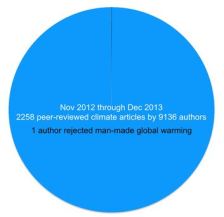
What does “near unanimity” mean? James Powell recently evaluated 2,258 peer-reviewed scientific articles about climate change written by 9,136 authors between November 2012 and December 2013. Only one article rejected anthropogenic global warming. This may not represent a consensus, but consensus is not the purpose of science. Science is to explain the world to us, and we don’t need to strike the word “near” to understand climate change is real, it’s happening now, human activity is causing it, and scientists believe that is the case.

I am not sure whether a group of rich politicians posturing in the Congress will make a difference. However, it’s the only game in town. They are willing to take positive action to support the president’s climate action plan, which doesn’t rely on new legislation that isn’t in the cards anyway. While not hopeful of meaningful action, fingers are crossed, and the game is on.

Following is this afternoon’s press release from the League of Conservation Voters:

WASHINGTON, D.C.– League of Conservation Voters (LCV) president Gene Karpinski released this statement on the creation of the Senate Climate Action Task Force, a group chaired by Senators Boxer and Whitehouse that includes more than a dozen senators committed to pushing for action on climate change:

“Big Oil and corporate polluters have worked with their allies in Congress to prevent action on climate change for far too long. This task force is the latest sign that environmental allies in Congress are fighting back, standing up for basic science and pushing for action on climate change. This is the type of strong leadership we need if Congress is finally going to get serious about addressing the climate crisis and meeting our moral obligation to future generations. We thank Senators Boxer, Whitehouse, Cardin, Sanders, Klobuchar, Merkley, Franken, Blumenthal, Schatz, Murphy, Heinrich, King, Markey, and Booker for speaking out on climate change today and look forward to continuing to work with them to address this vitally important issue.”

~ Written for Blog for Iowa

Categories
Writing

Passports — Part I

Passport and Notebook

LAKE MACBRIDE— The U.S. Passport issued on April 26, 1973 is on my desk, waiting to be put away. During the 1972 to 1973 academic year at the University of Iowa, I lived with a friend in a mobile home his parents owned next to Interstate 80 in Iowa City.

We thought to travel to Europe together during the summer of 1973, to see the continent and visit his relatives in Bruges. I got my passport, and in the end, he went that summer and I didn’t, ending up playing in a band in Davenport until returning to finish my senior year in the fall. I traveled to Europe the following summer, after graduation, by myself.

It was what used to be described as “the Grand Tour.” Although my adventures were much less than grand, I did manage to visit Paris, Madrid, Venice, Rome, Vienna and other traditional destinations. Stamps in the passport provide five milestones for the trip. I arrived at London Heathrow on Aug. 15, 1974, departed England at Ramsgate on Sept. 2, left Madrid on Sept. 16, arrived in Arnhem, Holland on Oct. 25, and arrived back in Montreal on Oct. 31. There is more to the story than these stamps.

I kept a journal during my trip, although the first volume was stolen in Calais where someone pinched my backpack from the youth hostel my first night in France. I remember two women making café au lait in the kitchen the next morning and reporting the theft in my hopeless French at the nearby police station.

Last night I skimmed the remaining volume wondering what I was thinking when I kept track of the trip. Well, I know what it was— that the persistence of memory would be better than it is. My trip to Madrid explains the point.

Unlike today, I hardly kept track of day-to-day activities. For example, I wrote an entry on Sept. 10, 1974 at the Hotel Sabina in Madrid, with additional entries on Sept. 11, 13 and 15. In none of those entries was mention of the Sept. 13 Cafe Rolando bombing in Calle del Correo near the hotel. Conversations afterward at the hotel, and the bombing itself, were the reasons I left Spain when I did.

My passport was stamped by Spanish authorities on the train from Madrid to Irun as I left for France. Security had been tightened as I stopped in San Sebastián, in the Basque area that was home of the ETA, a separatist group said to be responsible for the bombing. There were military and police everywhere. When attempting to make it to the beach, an armed officer stopped me, waved his rifle at me and indicated the area was restricted. There is no mention of the police state Franco’s Spain seemed to be in my journal. However, I did write that the Prado seemed, “one of the richest museums of the ones I have seen.”

Memory does persist, although the story may have changed in the telling. It was a trip of language, art and experiences that moved me away from the intellectual world of art history classes, and study of the works of René Descartes and John Locke. What I found was a legion of people my age traveling the continent, and the experience changed me in ways that continue to seem astounding, although I hadn’t realized it at the time.

~ This is one of a series of posts based upon writing in my journal.

Categories
Home Life Living in Society

Saturday Swagger

Garden in the Morning

LAKE MACBRIDE— When the drunken arctic air finished its swagger through the upper Midwest, patches of brown grass reappeared in the white landscape. Pools of water formed on the driveway like dammed up dreams, ready to be cut loose when the rest of the snow melts— a false hope of Spring. Feeling restless, I went to town.

Partly, to proofread the newspaper comme d’habitude on Saturday morning. More than that, one of the county supervisors was holding a community discussion at the public library. If life is anything here, it is partly about politics. Several friends were there, and it was good to break winter for a while. It was a campaign stop for the June primary, and also a chance for conversation with friends and acquaintances.

Topics included drug testing, marijuana decriminalization, ever changing synthetic drugs, the overcrowded jail, trails, the para transit service, loss of services in the new mental health regions, and roads— lots of talk about roads. One who lived west of the Ely blacktop mentioned his road specifically. “When will the county address Curtis Bridge Road?” he asked. I listened mostly, and raised an issue or two. It was all good.

Toward the end a woman came in and talked about geoengineering, wanting the county to take action. She had a confusing message. She asked the county to do something about it, but couldn’t say what “it” was. She had a handout with a website which could be the subject of another post… or not. There’s only so much mental capacity and too little time to consider everything.

But allow me to end my drunken swagger. Time has come to be less distracted. Before we accept it and focus, however, the super bowl is coming, marking the last feasible (albeit lame) excuse to delay and celebrate the holidays. What’s the rush? The needs of the growing season will soon be here, catching us unaware. “Just one more thing, that’s all I ask,”  he said to himself.

Whatever the human capacity for wonder, the hydrant of behavior must be articulated so we can focus on one thing at a time. Engaging as hanging with friends may be, and good for the soul, if we don’t focus, our lives will be no different than the recent polar vector— chilling us for a few days only to leave without stunting the disruptive vectors approaching our lives.

When I worked for the oil company, we had employees in about 100 countries. On staff was an expert in addictions. He worked not only on drugs, alcohol and tobacco, but on almost everything that could trap people and diminish productivity. When I spent time with him as part of my training, I learned more about distraction and its relationship to addiction than I thought possible. Admitting we have a problem is first step. My addiction is to following life’s many ideas to wherever they lead. I admit it, and don’t really want to do much about it. There it is.

It will freeze again this month, at least I hope it will. There’s pruning to do, a garden to plan, and income to be generated. A season to be made. Things don’t happen without our engagement. All the while, Saturday turned to Sunday. The proof reading is finished, the auto fueled, and the groceries were bought. It’s time to set things aside and focus on one thing at a time, and maybe get some of them done.

Categories
Writing

Changing Trains in Paris

June 4, 1977
Paris, France

Gare de l'Est
Gare de l’Est

Departed Mainz June 3, 1977 at 2322 hours in a sleeping car for Vannes. The journey was quite nice. In such luxury I seldom indulge, but this trip I didn’t really think much about it. The little compartment had all the niceties of any fine hotel, and although I was concerned mostly with getting a good night’s sleep, the indulgence will be memorable. Especially the numerous buttons for summoning the waiter and turning the lights on and off. In an earlier time I would have experimented with all these buttons to discover their functions. But now I have changed.

As I exited the train at Gare de l’ Est, I struggled with my bags for 50 meters or so. An older man with a Polish-sounding name spoke with me and offered a ride for my cumbersome duffel bag and clothing sac. He asked the usual niceties— where are you from? Iowa, of course. It seems he is good friends with Mauricio Lasansky‘s son. Small world— so he said.

We shook hands and he guided me to a taxi where I stowed my bags, heading for the connection at Montparnasse.

The ride through Paris made me recall my last trip here.

~ This is the first of a series of posts based upon writing in my journal.

Categories
Environment

Climate Change in 200 Words

the-climate-reality-project-logoPeople seeking scientific proof of anthropogenic global climate change are barking up the wrong tree. The goal of science is not to prove, but to explain aspects of the natural world. Following is a brief explanation of climate change.

Around 1850, physicist John Tyndall discovered that carbon dioxide traps heat in our atmosphere, producing the greenhouse effect, which enables all of creation as we know it to live on Earth.

Carbon dioxide increased as a percentage of our atmosphere since Tyndall’s time at the beginning of the Industrial Revolution. As a result, Earth’s average temperature increased by 1.5 degrees Fahrenheit.

The disturbance of the global carbon cycle and related increase in carbon dioxide concentrations in the atmosphere is identifiably anthropogenic because of the isotope signature of atmospheric carbon dioxide.

We can also observe the effects of global warming in worldwide glacier retreat, declining Arctic ice sheets, sea level rise, warming oceans, ocean acidification, and increased intensity of weather events.

It is no wonder 97 percent of climate scientists and all of the national academies of science in the world agree climate change is real, it is happening now, it’s caused by humans, and is cause for immediate action before it is too late.