Categories
Environment

Are Property Rights a Climate Action Tool?

WHY-WHY-NOT-MELBOURNE2-4_0For many, protecting property rights is high on the list of priorities. It’s the American way, shouldn’t it be so? A related and perhaps better question is whether climate advocates should use eminent domain as a tool to advocate against energy related projects.

Answers are elusive.

When the U.S. Supreme Court decided in Kelo v. City of New London that the general benefits a community enjoyed from economic growth qualified private redevelopment plans as a permissible public use under the Takings Clause of the Fifth Amendment, property rights advocates were up in arms. There is a role for eminent domain when governments initiate the process, but private developers should have no such rights, they said.

Kelo may mean that when U.S. infrastructure projects are developed by foreign corporations (TransCanada Corporation’s Keystone XL Pipeline) or by U.S. corporations (Energy Transfer Partner’s Dakota Access Pipeline or Clean Line Energy Partners’ Rock Island Clean Line), foreign or private domestic entities have the right to initiate condemnation process and take easements and other property to build their projects.

In a March 2 article in the Des Moines Register, William Petroski reported, “a majority of Iowans support plans for a crude oil pipeline in Iowa and a wind electricity transmission line project, but they overwhelmingly oppose the use of eminent domain for both projects.”

Politicians have argued that these projects create jobs, decidedly temporary ones, and in today’s economy people should accept such jobs, implying they should also cede eminent domain rights to U.S. or foreign corporations. This couldn’t have been clearer than the Keystone XL Pipeline bill passed in the U.S. Congress, vetoed by President Obama.

Kelo is not without emerging challenges.

On Feb. 18, the Iowa Supreme Court heard oral arguments in Clarke County Reservoir Commission v. Edwin D. and Deloris A. Robins Revocable Trust. The case is an appeal of an April 8, 2014 lower court decision wherein “Judge Sherman W. Phipps of the Fifth Judicial District of Iowa ruled in favor of CCRC’s ongoing Squaw Creek Watershed project, confirming it is for a public use, public purpose or public improvement as defined in the Iowa Code,” according to Amy Hansen of the Osceola Sentinel-Tribune. Developers seek to make a recreational lake much larger than the size required to serve water needs for the community to enhance property values as they sell adjacent lots.

Whatever the outcome of challenges to the Kelo decision, climate advocates are damned if they do and damned if they don’t regarding use of eminent domain as a tool. The contrast between the Rock Island Clean Line and the Dakota Access Pipeline exemplifies the problem.

On Aug. 20, 2014 while on the Great March for Climate Action, David Osterberg of the Iowa Policy Project said Iowa needed a way to get wind-generated electricity out of western Iowa to markets. His view is not unique among climate action advocates. The Rock Island Clean Line offers one such solution, but some property owners along the proposed route won’t allow an easement voluntarily. Osterberg said the Rock Island Clean Line wasn’t perfect, but it did offer a solution to shipping electricity to markets. The implication is that eminent domain may have to be used by a Texas company to build the project, although Osterberg did not say that specifically.

Use of eminent domain to stop the Dakota Access Pipeline is favored by climate action advocates. Because Bakken Oil is dirty, advocates seek to obstruct access to market through Iowa. Eminent domain has made unlikely partners in the Iowa legislature, where Senator Rob Hogg, who has given more than 100 presentations for The Climate Reality Project founded by Al Gore and is author of America’s Climate Century, began partnering with Rep. Bobby Kaufmann, a crop and livestock farmer and small business operator who is also a member of the Farm Bureau and National Rifle Association, to oppose the Keystone XL Pipeline on eminent domain grounds.

As the Iowa Utilities Board evaluates the proposal for the Dakota Access pipeline, eminent domain has more traction than the argument that fossil fuels should be left in the ground because of their contribution to anthropogenic climate change. Climate action advocates favor the latter argument, but will support the former.

Property rights advocates like Kaufmann are unlikely to go both ways on the eminent domain issue.

“The Bakken (Dakota Access) Pipeline and the Rock Island Clean Line should pick out baby names and choose a honeymoon destination, because the two issues just got married,” said Kaufmann in a Jan. 31 interview with the Solon Economist. “You’ve got two different companies that want to ship two versions of energy. They’re both private Texas companies and both want to ship a product out of our state without allowing anyone in our state to tap into it.”

Use of eminent domain hinges upon “public use.” Set aside creation of a number of temporary jobs and the public use of conveyances for energy related products is elusive, especially with the Dakota Access Pipeline. In any case, corporations benefit more than people in both Iowa projects and with the Keystone XL Pipeline.

Property rights can be a tool for climate action advocates, but it has been an imperfect one at best.


Categories
Kitchen Garden

Belgian Lettuce and Garden Update

Garden
Garden

Today is the day to plant Belgian lettuce according to my late maternal grandmother. Not a specific variety, any lettuce seed will do. March 2 planting makes it “Belgian” in a way someone who grew up in a Minnesota-Polish farming community would understand.

It’s not happening this year, as the ground is frozen and covered with snow like last year. I’m not ready to give up on tradition, but this year’s weather is forcing my hand. As soon as the ground can be worked, lettuce seeds will be broadcast belatedly.

The Old Farmer’s Almanac indicates the average growing season in this area is 163 days, with an average last spring frost date of April 25. I’m calling bullshit on that right now and planning this year’s indoor planting to coincide with a last frost day of May 15. God willing and the creek don’t rise, some seeds will be planted in trays this week, with seedlings ready to go into the ground in May.

Starbor hybrid kale seeds arrived by U.S. postal service on Friday. The back order was finally filled, so this season there will be three kinds of kale, including the Blue Curled Scotch and Scarlet varieties already on hand. If everything proceeds as expected, there will be plenty of kale.

Seed-wise, I’m ready to plant the garden as soon as conditions permit.

The apple trees produced an abundance of new growth last growing season. While temperatures are below zero is the time to get out and prune new growth and make shaping decisions. That work is planned for this week.

Heavy snows took a toll on our lilac bushes, and I’ve not been to the back of the lot to check that clump. They are maturing, and may be due for a radical cutting back to enable new growth. Some research is needed, but the one next to our front door shaped up nicely when I cut the old branches away. These were planted from rootstock when we arrived in Big Grove, so it’s hard to see them mature, even if it’s a part of nature.

No deal is finalized with the CSA this spring, although the farmer may not know what she wants yet. There is an opportunity for some spring work until her supervisor arrives in May. If that doesn’t materialize, the time will be spent improving our garden—which is definitely needed.

The pantry is being worked down, but plenty of tomatoes, soup stock, apple sauce and apple butter remain on the shelves. Jars of canned dill pickles, hot sauce, salsa and Serrano peppers remain. There are even a few jars of kale soup starter on the shelves. Enough to tide us over until the first harvest.

Absent Belgian lettuce, there is hope for an abundant gardening season.

Categories
Environment Writing

Snow Fell

Snowstorm
Snowstorm

Snow fell as I drove home on Mehaffey Bridge Road through the lakes—a crystalline, sparkling snow. The wind blew as the sky darkened with imminent nightfall. I had turned the radio off.

I passed a frozen pond where a herd of deer and a flock of wild turkeys browsed—for what I couldn’t discern. A bald eagle flew overhead while entering the lane to our house. What other wildlife existed in the winter landscape went unnoticed, obscured by three historic species.

It is a time of change. This morning there is no Iowa City Press Citizen as the newspaper returned to a Monday through Saturday issue. They had been doing a brief cover, then inserting another Gannett Company paper, Des Moines Register, inside. Today the county seat is again without a daily newspaper.

That’s not to say there isn’t news. It’s just that people get news from a lot of other sources, including talking with neighbors and friends in person and over electronic media. Since I began writing for newspapers, I have read ours more. Despite the informative stories found inside each issue, news and news writing are not what they were, and the Monday issue is frequently quite thin. I predict newspapers will survive, but they compete for eyeballs in a way that has changed and continues to change. The economics of competition has led to less news coverage in newspapers and everywhere as we focus on the obvious.

I arrived home and turned the radio on to A Prairie Home Companion. That has changed too. One wonders how long it will continue once Garrison Keillor moves on.

Thinking about the mango-orange spread I bought last week, I put two tablespoons in a dish, added four tablespoons of home made salsa, mixed them together, and opened a bag of organic tortilla chips for a welcome home snack. Jacque was at work and not expected for a couple of hours.

The sweet taste of the mango came first, then the heat of capsaicin. It was crunchy, sweet, salty and spicy all at once. A perfect example of what living in these times means. We want it all at once.

We don’t often linger in falling snow to see what else is there. I’m certain it’s more than deer, turkeys and eagles.

Categories
Juke Box

Juke Box – Soul Sacrifice

Categories
Environment

Why Bakken Oil is Dirty

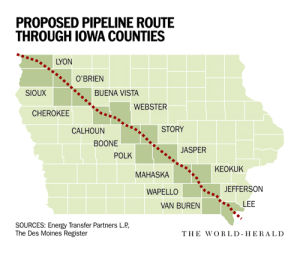
Bakken-Pipeline-Proposed-RoutePeople who care about hydraulic fracturing say the oil coming from the Bakken formation in North Dakota, Montana and Saskatchewan is dirty. It is. All oil is dirty, and my two cents is we should leave what’s there in the ground. That won’t go over well in North Dakota where discovery of the Parshall Oil Field in 2006 created an oil boom.

What makes Bakken crude oil problematic is that it contains more volatile organic compounds (VOCs) than oil shipped from wells in other regions of the country. This makes the oil more flammable, so when there is a train derailment, as there was in Lac-Mégantic, Quebec in 2013, the oil easily ignites and creates hell on Earth. (Read Adam Federman’s article in Earth Island Journal here).

Because so little public study has been conducted on Bakken crude oil and the operations that produce it, scientists don’t fully understand why the oil is so flammable. There are suspected causes.

The Bakken formation shale oil boom developed from almost nothing to more than a million barrels of crude oil daily in a short period of time. According to Federman, the infrastructure doesn’t exist in the Bakken to fraction off the VOCs as is done with other oil production facilities. The oil is shipped with the VOCs in it, making Bakken crude oil more flammable. There’s more Bakken crude oil today, it poses a real threat to public safety, and the transportation modes used are not regulated well enough for the commodity’s characteristics.

One of the frequent concerns in the Bakken is there are not enough suitable rail cars available to meet shipping needs. Lack of transportation capacity to get the oil to market is an issue. This created a business opportunity, and that’s what the Dakota Access pipeline is about.

Debate over trucks vs. rail vs. pipeline to transport Bakken crude oil is wasted time. Each mode of transportation has its own issues, and most transportation experts agree pipeline is the safest of the modes of transportation. Regardless of transportation mode, if there is a spill, first responders will be required to deal with a commodity on which they have in most cases received inadequate training. That problem could conceivably be fixed, but awareness of the issue hasn’t adequately emerged as we wait for the Iowa Utilities Board’s public healing on the Dakota Access oil pipeline.

Combine the increased flammability of Bakken crude oil with lack of proper shipping regulations and capacity, and we know why it is called dirty oil.

Categories
Environment

Road to Paris Comes Through Iowa

WHY-WHY-NOT-MELBOURNE2-4_0On Tuesday, The Climate Reality Project announced three North American trainings, one of which will take place within a short commute from my home. Here is the announcement email I received from colleague Mario Molina:

Dear Paul,

Our New Delhi, India training is coming to a close, and we have some important news to share with you as we continue along the Road to Paris.

We’re hosting three trainings in North America this coming year — and we’re going to need your help to grow the Climate Reality Leadership Corps! Below are the upcoming training locations and dates:

Cedar Rapids, Iowa: May 5-7
Toronto, Canada: July 9-10
Miami, Florida: September 28-30

Will you share this exciting information with your networks today? We know some of our best new Climate Leaders will be sent to us from you, and we trust your judgment. As a matter of fact, our training in New Delhi boasted the highest ever referral rate from existing Climate Reality Leaders.

Each one of these trainings is a key stop along The Road to Paris, and it’s extremely important that by the time COP21 descends on Paris, we have a strong, loud, and dedicated group of leaders to demand climate action.

Training applications are now open, so don’t let these future leaders wait. Their opportunity to make a difference in this crucial fight for a safe climate could be waiting in Cedar Rapids, Toronto, or Miami.

Thank you for your unwavering commitment to climate action, and for inspiring your friends, family, and colleagues to join you.

Warm Regards,

Mario E. Molina
Climate Reality Leadership Corps Director
The Climate Reality Project

Categories
Work Life

It’s Not About Minimum Wage

Garden After Snowfall

Two bits of news related to minimum wage emerged last week, and neither of them represents a solution for low wage workers.

The Iowa Legislature advanced Senate Study Bill 1151 from a subcommittee to increase the minimum wage to $8.75 per hour by July 2016, with a $0.75 increase July 1 and another $0.75 a year later. The bill is expected to be debated this week by the full Senate Labor and Business Relations Committee. Rod Boshart covered the story for the Cedar Rapids Gazette here. He indicated there is bipartisan support for increasing the minimum wage in both legislative chambers.

On Thursday, Doug McMillon, president and CEO, Walmart, announced a detailed plan to increase wages for its associates. Notably, current employees will receive at least $9 per hour beginning in April, with positions expected to pay at least $10 per hour beginning next year.

“Today, we’re announcing a package of changes in Walmart U.S. that will kick off a new approach to our jobs,” McMillon said in a letter to employees. “We’re pursuing comprehensive changes to our hiring, training, compensation, and scheduling programs, as well as to our store structure, and these changes will be sustainable over the long term.”

As Vauhini Vara pointed out in her Feb. 20 New Yorker article, “working at Walmart has long been a kind of proxy, in conversations about labor practices, for low-wage toil.”

“Such conversations have received more attention in the past couple of years, partly because they speak to a problem—stagnant wages—that has been acknowledged, even by conservative economists and policymakers, as a serious one,” Vara wrote. “When the recession ended, the unemployment rate began falling to pre-recession levels, and economists predicted that a tighter supply of workers would soon send wages up, too, as has historically happened. But, puzzlingly to some observers, that didn’t happen.”

Walmart, like any business, realizes the value of associates, and adjusted its pay and benefits when it had to.

While in Des Moines last week, I spotted Mike Owen and David Osterberg of the Iowa Policy Project at the capitol. They were working on the wage issue according to Owen.

The Iowa Policy Project is a nonprofit, nonpartisan organization founded in 2001 to produce research and analysis to engage Iowans in state policy decisions, according to their web site. One of their topics is minimum wage.

IPP noted the Iowa minimum wage increased to its current $7.25 level on Jan. 1, 2008 in a February position summary. They pointed out that while Iowa was once a leader in minimum wage, it is now a laggard.

$8.75 would be something, but it is not enough.

“Minimum wage doesn’t come close to supporting a family’s basic needs budget at Iowa’s current cost of living,” said the IPP report.

Walmart’s $10 per hour is better but doesn’t get families there either.

What’s missing from this discussion is that few minimum wage earners support a family alone. According to IPP, minimum wage earners contribute 46 percent of their family’s income on average. Which begs the question, how do low-wage earners get by?

We can’t be distracted by the two minimum wage rate developments.

Any low-wage earner today knows there are plenty of opportunities to earn $9 per hour or more if one can do the work. The minimum wage has not been the problem for a long time as companies pay more to attract a viable workforce. Walmart is a large employer and receives a lot of attention. My progressive friends and I debate whether Walmart is or isn’t the problem, and I land closer to Vara—they are a proxy for another argument.

That argument has to do with the changing nature of our society. We have become a place where fairness and equal treatment has given way to pursuit of financial success at any cost. It includes business models that drive out costs, human costs particularly. Our society, through our neglect, and perhaps intent, has led us to a very harsh place. I recall Thomas Merton:

“If I had a message to my contemporaries it is surely this: Be anything you like, be madmen, drunks and bastards of every shape and form, but at all costs avoid one thing: success… If you are too obsessed with success, you will forget to live.”

All this talk about minimum wage has made us forget something important. Work is not wasted whether it’s paid or not. We must go on living and wages have little to do with that.

~Written for Blog for Iowa

Categories
Environment Living in Society

Is Iowa Prepared for a Megadrought?

State Senator Joe Bolkcom (D-Iowa City)

State Senator Joe Bolkcom, member of the natural resources and environment committee, spoke last Tuesday at the capitol about environmental issues.

“Is there anything related to the environment you would like to see covered in greater detail?” I asked.

“There are some questions around megadroughts coming mid-century,” he said. “Have we dedicated enough attention and resources to protecting underground water systems?”

Bolkcom pointed to a number of concerns: recent defunding of the Department of Natural Resources underground water monitoring system; gaining an understanding of the water withdrawal rate for ethanol plant operations; a needed review of policy by the  Environmental Protection Commission; a review of DNR regulations pertaining to water permitting; the need for a geological survey of water resources, the Silurian and Jordan aquifers specifically; and the impact of water usage by data centers such as Google and Facebook. He had given the matter considerable thought.

“Should we have other thoughts about the Jordan and Silurian aquifers as we head toward 2050?” Bolkcom asked. “Today, once an industrial user secures a permit, they can withdraw as much water as they want.”

There were more questions than answers during my brief time with Bolkcom, but his thrust was that Iowa needs to do more to ensure resiliency during extended drought conditions.

It is difficult to forget the severe drought of 2012. Governor Branstad called a special meeting of agriculture groups in Mount Pleasant that July. (Read my coverage of that meeting here.) Climate change was completely absent from the discussion, even if farmers had to deal with its enhancement of drought conditions. To paraphrase the reaction, farmers planned to plow the crop under, capitalize the loss, and plant again the following year.

What if the drought extended more than a season or two? What if it lasted for decades? According to a study released this month that’s what we can expect.

“Droughts in the U.S. Southwest and Central Plains during the last half of this century could be drier and longer than drought conditions seen in those regions in the last 1,000 years,” according to a Feb. 12 press release issued in conjunction with a new study led by NASA scientists.

“Natural droughts like the 1930s Dust Bowl and the current drought in the Southwest have historically lasted maybe a decade or a little less,” said Ben Cook, climate scientist at NASA’s Goddard Institute for Space Studies and the Lamont-Doherty Earth Observatory at Columbia University in New York City, and lead author of the study. “What these results are saying is we’re going to get a drought similar to those events, but it is probably going to last at least 30 to 35 years.”

When Bolkcom referred to megadroughts, this is what he meant.

The potential exists for megadroughts more severe than any in recent history, according to the study published in Science Advances by Cook, Toby R. Ault and Jason E. Smerdon.

“Future drought risk will likely exceed even the driest centuries of the Medieval Climate Anomaly (1100–1300 CE),” the authors wrote. “The consistency of our results suggests an exceptionally high risk of a multidecadal megadrought occurring over the Central Plains and Southwest regions during the late 21st century, a level of aridity exceeding even the persistent megadroughts that characterized the Medieval era.”

Whether Bolkcom’s questions find answers is uncertain, however he is alone among legislators I spoke with in asking them. He was correct that members of the public haven’t engaged on something the legislature should be taking up during its 86th General Assembly.

~ Written for Blog for Iowa

Categories
Living in Society Social Commentary

Movies and Me

Poster_-_Gone_With_the_Wind_01In an unexpected development, Christmas in Connecticut and Frozen are the only two movies I viewed since January 2014. I have yet to view a motion picture in a theater or on a computer or television screen in 2015. That is so not me as I remember myself.

While YouTube videos make it to one of my screens, they are mostly bits of snark from the Internet, music clips, and an occasional segment of spoken word—footnotes to an argument or line of thinking.

Recent YouTube faves include Elvis Presley’s Return to Sender, Michael McIntyre’s standup bit on Condiments, and a clip from the Poster Central blog about Les Bell’s 1968 Jimi Hendrix Concert Poster. I digress.

One couldn’t help but notice that last night the Academy of Motion Picture Arts and Sciences presented their annual awards. I spent my evening with the computer off and the television dark, reading a book. Cultural residue from the event was everywhere this morning. Even if no one I knew made the least mention of the Academy Awards during the last week, there it was. (To prepare for this post I did read an article about Oscar picks in the newspaper).

I don’t watch very many movies these days when I used to take in three to five per week when in graduate school. What happened?

Movies have become indistinguishable from anything big business produces. Whether it is soap, paper products, electronic devices, vehicles, food, clothing, gasoline, whatever, Hollywood and the rest have been unable to escape the mechanized automation that generates “culture” and “products” for mass markets. Cognizant of that, why spend the time?

It may have seemed that wasn’t the case to a then young graduate student in the 1970s and 1980s. Since the 1929 winner Wings, return on investment has been a key Hollywood producer’s concern. One could argue that financial return has been part of the movies since W. K. L. Dickson first produced an Edison Kinetoscope Record of a Sneeze in 1894.

Frozen generated $1.280 billion as of last September, making it the highest grossing animated film of all time, and fifth highest overall. I watched it because I didn’t understand the constant references to it in the media. I felt I had to to keep up.

People with whom I spend my time just don’t talk about motion pictures—at all. The woodshop of society has sanded off the burr of cinematic interest. I don’t think that’s what Hollywood moguls had in mind when they built the gigantic economic engine Hollywood has become.

Over the years I collected VHS and DVD format movies and they sit on shelves and in boxes waiting for ultimate disposition. The ones I expect to watch have some personal connection. The movie my wife and I saw on our first outing; our stash of Christmas movies on VHS; perennial favorites Out of Africa, The Matrix and The Lord of the Rings trilogy; and movies related to my writing like The Power of Community.

Perhaps I grew out of movie watching. Maybe I learned the requisite lessons about Hollywood and moved on.

As with sporting events, movies have little attraction. In some ways I’d like to join others to view a film and discuss. Mostly, I’d rather films stand on their own without commentary, at the ready to view when there is utilitarian reason to do so. How boring of me.

People need useful work to provide meaning in their lives. Those involved with the movies aren’t that different even with their designer attire and well-catered parties on this special night.

As we search for truth and meaning there are better ways to experience life than by letting corporate entities tweak our intellect and emotions. Willing suspension of disbelief is a good thing. Helping us forget who we are and can be is the unforgivable part of cinema today.

Categories
Living in Society Social Commentary

Filling the Tank

Sunrise
Sunrise

I looked at a live image of the inside of my large intestine on the monitor. It originated from a camera in the tip of a a colonoscope being operated by the physician who performed my first colonoscopy 11 or 12 years ago. It is a humbling and fascinating experience. No polyps, so I’m good for another ten years.

Medical practitioners recommend a colonoscopy for people aged 50 and older as a screening for colorectal cancer, the third most common cancer diagnosed in both men and women in the U.S. With the changes initiated by the Patient Protection and Affordable Care Act, insurance companies are required to provide the procedure without any charge, co-pays or incidental expenses.

The worst part of the procedure is clearing the bowels the day prior to the office visit. As the anesthesia wore off, we were ready for a meal and stopped at Salt Fork Kitchen for breakfast on our way home.

Check that off this year’s to-do list. Now the work begins anew.

I called into the warehouse and got a shift for Saturday. Three days off in a row would have been too much, and we can use the income. I’m also writing three stories for the newspaper and contemplating what else can be done to generate income to pay bills and reduce our debt.

Caesura came between the weary past and tomorrow’s promise with the colonoscopy.

When I get to the warehouse, I’d better fill the tank because we’re not off fossil fuels yet and my Subaru has a few miles left in it before heading to a scrap heap.

Once again, a new day dawns.