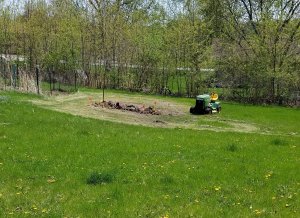
Some garden plots need weeding, others need digging and planting. The lawn needs mowing for the mulch grass clippings and ground up leaves will make.
I took two days vacation from the home, farm and auto supply store to get some of this done. There are seven full days between now and when I return to tackle spring planting and yard work. Rain is forecast Wednesday. I know what to do today.
This is also the first day of early voting in the June 5 primary. My voting plans are flexible. Voting at the polls on election day is my preference, however, if I happen to be in the county seat I’ll head over to the auditor’s office and vote early. My mind is made up.
Once I mow the front yard, I’ll place political signs for candidates I support near the road for neighbors to see. According to a Des Moines Register article, Iowans don’t mind political signs in a neighbor’s yard.
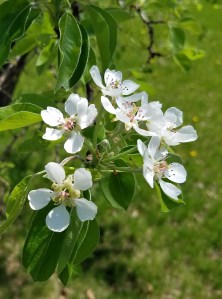
It doesn’t look like there will be apple blossoms this year. Last year was a big year for apples and recovery often takes two seasons. Will have to make the most of the pear tree which is currently in bloom, and leverage my work at the orchard for fruit.
Sauteed Bok Choy with Lemon
Last night I split bok choy lengthwise and sauteed it in butter and olive oil for a vegetable course. At the end I added lemon juice — too much lemon juice. We puckered up and ate them anyway.
Each year’s trace is unique, and the same. Bok choy is a reminder of spring we get from Carmen’s farm. She grows it in the high tunnel which we leverage when we buy a spring share. Once spring bok choy is finished, we move on to what’s next as Earth orbits the sun.
In the vast expanse of space we make a life six inches from our nose… with dinners at home and days in the garden in a sense of belonging. What else are we to do but live in concert with family, farmers, neighbors and distant energies of governance?
Answering that question is a life’s work — a way of sustaining our lives in a turbulent world.
There is a better way to change our politics and it has nothing to do with wave elections.
“The 87th General Assembly of Iowa will be remembered as one that made life more difficult for many Iowans, made their work worth less, and guaranteed their freedoms only if they agreed with those in power,” Rep. Chris Hall (D-Sioux City) posted on social media.
A number of legislators took to social media after adjournment sine die yesterday afternoon. My favorite was from State Senator Joe Bolkcom.
“The nightmare of the 2018 legislative session has adjourned!” he posted. “Time for an election!”
Democrats should set aside the idea of a blue wave breaking against the State of Iowa to remedy what ails us about our politics. In a time of atmospheric global warming a blue wave may well be hard to differentiate from the warmer atmosphere driving increased frequency and intensity of hurricanes, typhoons and other extreme weather events responsible for damaging our only home. A real tsunami damages communities and so it has been with the Republican wave election of 2016. A Democratic wave election would present the same sorts of issues.
Electoral politics is less about Republicans and Democrats than it is about building a coalition of voters representing 50 percent plus one of the electorate. According to the Iowa Secretary of State, current active voter registrations are 1,960,006. Democratic registrations are 590,035 (30 percent), Republican registrations 638,565 (33 percent), and everyone else 731,406 (37 percent). No one political party has a majority.
The better question than how to activate Democrats to win the 2018 midterm elections in a blue wave is how do we take our politics to a place where communities can work toward solutions to common problems? If Democrats (or Republicans for that matter) can do that, we will bring people together and win the midterms, setting the stage for a long period of governance. It seems clear from the last general assembly Republicans have no interest in that. It’s up to the rest of us.
Community organizing is the better way. While the Iowa Senate and House debated the tax bill I did things with neighbors where politics didn’t come into view. We trimmed trees, planted shrubbery and repaired a retaining wall in our common areas. Others took trash bags and walked community roads inspecting the roadway and policing up trash. (Roads are going to require work this year). While attendance was light the action of doing something together was appealing and accomplished something positive. Because I’m active in politics, I knew the voter registrations of everyone there, Republicans and Democrats. It brought us together as a community.
In every community organization with which I have been associated, people of all political strips have been involved. Whether it is recruiting someone into the organization, maintaining a budget, working on a campaign or project, political party affiliation has not been as important as the willingness to lend a hand. We need more of that in our politics.
If Democratic values will prevail during the midterm elections registered Democratic voters can’t do it alone. It is a faulty assumption to make that because we believe we are right, others will go along with us. We require a foundational relationship with others in the electorate to advance our common goals, no different from the group of retirees mending the wall in our commons, or gardeners donating produce to the local food bank.
Why don’t we do more of that? Democrats particularly, and Republicans increasingly, are driven by the intensity and excitement of political campaigns. We want to win. It’s a zero sum gain and I don’t know about you, but I’m tired of losers in a society we all share.
A community has shared problems requiring work and our politics in recent years moved to break down our willingness to work on them together. It used to be as easy as falling off a log. Today no one’s there to catch us and we’ve been the worse for it.
Let’s forget about the blue wave and work toward community with neighbors to repair what ails us as a society. Republican elected officials have abdicated that role. It’s up to the rest of us to step up.
Friday is my day to work with Farmer Kate near Iowa City.
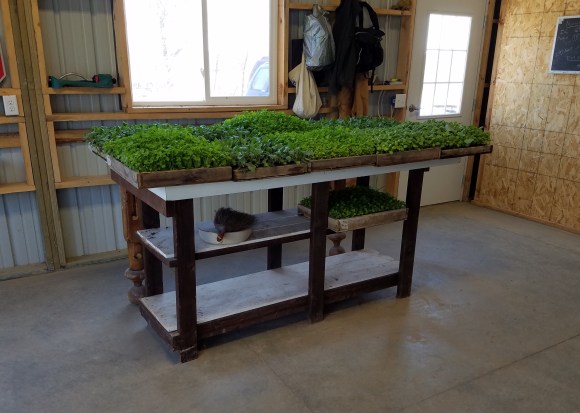
I made 30,288 soil blocks for plants at Wild Woods Farm this season. Add in additional work at Sundog Farm and my total production was 59,688 soil blocks since Feb. 25. That’s a lot of vegetable seedlings.
We’re planting lettuce, squash, cucumbers and zucchini which indicates we are more than halfway through spring production. Last year I finished at both farms on June 25 to get ready for the apple season beginning in August.
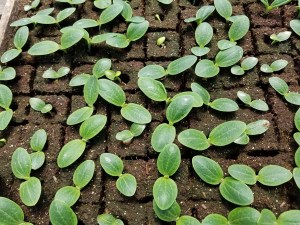
Cucumber Seedlings
Soil blocking is specialized. I use unique tools and soil to make the 72 and 120 block trays. This is my sixth year and I’ve incorporated soil blocked seedlings into our kitchen garden. Better propagation through this process makes a difference. Soil blocked seedlings are a part of growing better plants which produce great tasting vegetables. With retirement, healthy seedlings combined with additional weeding and better cultivation should result in higher yields. Importantly, it is all about freshness and flavor.
I receive fair compensation for my farm work. Over a few years we arranged a part barter – part cash settlement that works out for both parties. Each season has been a little different. This year I exchange labor for standard CSA shares in the spring and fall, then secure crates of tomatoes, potatoes, peppers and onions for preservation and storage. If my labor is more than that, I get a cash settlement. It is probably unnecessary to place a monetary value on these arrangements. Vegetable shares supplement our kitchen garden which produces much of what we need along with some specialty crops not grown on the farms. In turn, sourcing some crops from the farms reduces work in my garden. The arrangement is part of an ecology of food our household developed over time.
Over the course of spring, soil blocking at the farms has become part of our culture. I intend to continue as long as I can and the farmers are willing.
My next shift at the home, farm and auto supply store is May 16. That schedule provides a solid block of time at home to work in the yard and garden.
If it rains, I’ll work inside. There is no shortage of work, although I’m not concerned with that now.
The 87th Iowa General Assembly has been a pisser.
When Republicans won control of the Iowa Senate during the 2016 general election everything changed. It wasn’t small changes. They had a vision of Iowa and executed their legislative agenda in support of it. They took a broadsword to almost everything that matters. They reduced taxes beyond belief and hobbled the state’s ability to generate sufficient revenue to balance the budget. Then, because of the revenue shortfall, they drastically cut services. In Iowa that means cutting education, health and human services, public safety, and governmental compliance. Tomorrow the legislature is expected to pass more tax cuts and a budget that as of this writing isn’t finalized.
The state sought to get more involved in people’s lives under Republican governance, seeking to control how counties manage the minimum wage, how residents protest, how communities work with the federal government, and managing reproductive rights under established law.
Almost none of this legislation during the last two sessions was bipartisan.
The legislative changes impact everyone, including our family. We are not better off for it now and the prospects for the future are dim. The Republican vision for Iowa is not widely shared, especially among the 30 percent of Iowa voters who register as Democrats.
That doesn’t mean we have given up, we haven’t. Participation in the four Iowa Democratic district conventions was the highest anyone can remember during a midterm election cycle. A number of groups rose in resistance to Republican governance immediately after the election. The Iowa Democratic Party fielded the largest number of house candidates this year in most people’s memory.
However, the obstacles to convincing Iowans that Republican governance leaves much to be desired are daunting. 800,983 Iowa voters, or 51 percent of the electorate, chose Donald Trump as president. The votes are there to flip the state Democratic if we can find them. When everyone is running for cover by registering no preference or retreating into small family networks, that is no small task.
Proverbs 16:29 informs us here, “A violent man enticeth his neighbour, and leadeth him into the way that is not good.” Republicans may have been successful in accomplishing much of their agenda in the 87th Iowa General Assembly. We don’t plan to let them get away with it for long.
A relationship with food in American society is complicated.
Some don’t have enough. Others are awash in calories. We each have a human need for nourishment and the ways we go about meeting it are as different as the families which engendered us.
A favorite childhood memory is when Mother went to work in the school cafeteria after the Catholic Church built a new grade school near our home. With other women like her, she took a list of ingredients based partly on government programs (including lots of cheese) and partly on a limited budget, and made meals that included such dishes as porcupine meatballs (hamburger and rice) and grilled cheese sandwiches with tomato soup. Father worked at the meat packing plant which had an employee butcher shop where he could buy beef, pork and meat products at a discount, and did. The idea of stretching hamburger by mixing it with cooked rice was a novelty in our household and eventually we implored Mother to make porcupine meatballs for us at home, just like the ones at school. She did.
This story of external culinary practices coming into our home is essential to understanding the rise of a diverse diet in American society. We see things out there, they look good, and we want them. Most people, including low-wage workers, have or find the means to get them.
Many books, careers and lives have been based on food in society. We are an individualized rather than generalized culture with regard to food acquisition, preparation and consumption. To a large extent, the rise of the modern mega grocery store has shaped our eating habits in ways no one would have expected. Much ink has been spilled about that and I’m less interested in regurgitating my slice of it.
What I do know is local food farmers work hard for the sparse income they garner. All farmers do. The local food movement of which they are a part is based on the hope more people will bring locally produced, raw ingredients produced in a sustainable manner into their kitchens, ice boxes and pantries. Enough people do for a small group of farmers to make a living.
In many ways the increased interest in local food is the same type of behavior that took place in our home in the 1960s. We experience surprise when our CSA share includes Broccoli Raab, Koji or Bok Choy. We learn how to eat and cook them and want more. It’s not that our home nourishment plan is boring. We want and enjoy the experience of creation as it relates to cooking and eating. We want that experience to be personal and shared with family. That is very American.
I concede promotion of local food is a form of consumerism no different from a tomato catsup purveyor who spends dollars on an advertising campaign to enhance sales. The same behavioral forces are at work. I’m okay with that.
Just so you know, I’m not bewitched by the allure of eating a kale salad, at least not yet. Suffice it to say the diversity and behavior regarding food in our household with its kitchen garden, farm sourcing and grocery shopping has some unique qualities that may not be of interest to the authors of the Michelin Guide, but make our lives a little better. That too is very American. That’s part of who I am, who we Americans all are.
I woke up dizzy on Tuesday and it delayed the start of my day for about six hours. By that I mean I didn’t get going until ten o’clock and had limited activity outside the house.
I feel better today, but sleep was broken around midnight by following the Iowa House debate on Senate File 359, “a bill for an act prohibiting certain actions regarding fetal body parts and providing penalties.”
Rep. Mary Mascher of Iowa City objected to the bill’s title after the final vote, saying it wasn’t the bill they debated. Nonetheless it passed with 51 votes after wheeling and dealing among Republicans and was immediately messaged to the Iowa Senate. Changes to the bill are reflected in S-5288. The play-by-play with role call votes on amendments and final passage is here.
What’s confusing to a lay person reading the day after House Journal is news coverage framed this debate as on the “fetal heart beat” bill which restricts abortion once a heart beat is detected in a fetus. There is much more to the bill than that.
Republican intent was to make the bill language just vague enough for the law to be challenged in the court system, hopefully taking the issue to the U.S. Supreme Court in an effort to overturn Roe vs. Wade. Whether that happened or will happen is foggy at best and beyond my pay grade.
My state representative is a “pro-life candidate” and voted for the bill. When we called him out on this position during the 2012 campaign our efforts did not move the needle in the final vote tally. At least it didn’t move it enough to win a majority of voters.
There is a lesson here about politics. The Republican Party of Iowa just passed the most extreme anti-abortion legislation in the country. There was no bipartisanship in the House vote. There was no middle ground. There was no moderate position here. Either a voter believes a woman has a right to choose an abortion in compliance with current law or they do not.
While I may have been dizzy yesterday I am not today. Last night’s vote, anticipated early in the session, brought clarity physical ailment can’t obscure. On this and many issues Democrats can run if they set aside hyperbole and focus on the fact this law was brought to us by Republicans. If we are able to do it we can flip the legislature and bring common sense and decency back to Iowa.
I planted onions and cilantro in the garden, transplanted some seedlings to larger pots, but that’s about it. The septic tank service arrived and pumped our solids tank while I trimmed the lilac sprouts from the space in front of our house.
Constant wind beating against me took its toll.
The first of five spring shares was ready yesterday afternoon from our CSA: Bok Choy, Koji and Broccoli Raab.
Both CSAs where I work are running behind due to weird spring weather. Carmen Black’s newsletter summed up where we are nicely:
First of all I want to thank all of you for your patience and understanding in starting a week later than planned! As I’m sure all of you can guess this weather has been very difficult to deal with on the farm. Two weeks ago it snowed, and today it’s eighty degrees! In addition to the swings in temperature its been the driest April on record, which means that everything we’ve finally been able to plant has needed to be watered immediately. Through all of this weather stress I’ve been very grateful to know that you all are so supportive of this farm, and will understand the challenges we’re facing in organically growing local veggies this spring.
First Seasonal Salad
Dinner was a salad to go along with pasta last night. Three kinds of greens and this year’s spring onions along with odds and ends of cold storage vegetables. It’s why we invest our time and resources in a food ecology.
The words “local food” mean less today than they did, and not what we thought they meant. I discuss local food with farmers and gardeners and I’ve heard the usage it is a form of green washing. Is “local food” a form of green washing? Maybe.
I know the produce harvested in our back yard is local food. With each passing season I see less significance. We want food we serve at home to be fresh, tasty and pleasurable. When we take a dish to a potluck, using garden produce gives a personal touch to a classic casserole. A kitchen garden like ours serves those things well.
“Local government can make policy that makes it easier to grow and consume #LocalFood,” Johnson County Supervisor Kurt Michael Friese posted on twitter.
If anyone is familiar with the local food system, Friese, a long-time restaurateur and food writer is. He is well positioned to make and implement policy that supports local food. But what exactly is that?
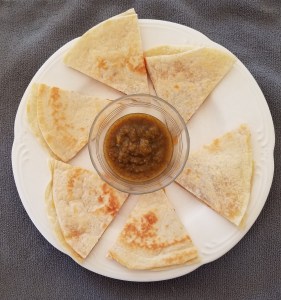
Breakfast Quesadilla with Homemade Salsa
Early on, local food referred to how and where food was sourced. There was talk about mitigating “food miles.” As I explained in a 2013 post, “Food distribution and related costs are a social construct that makes transportation seem inexpensive, or irrelevant to what we find in grocery store aisles.”
Where advocates of local food may have gone wrong is using the idea of food miles as a place holder for complex, flawed arguments. Costs are costs, and a producer has to recover his or her financial production costs when the consumer buys an item. Using any complex argument, including food miles, as a place holder seems a diversion. Such talk belongs more appropriately in a sales and marketing context as a form of puffery.
The better framing for “local food” is to know the face of the farmer. Two years ago I wrote at length about what it means to know your farmer and practices they use. Here is the salient point related to green washing:
Driven in part by mass media, consumers are concerned about a wide range of food issues that include contamination with harmful bacteria; dietary concern about consumption of carbohydrates, fat and sugar; the way in which plant genetics are modified to improve them; and more. Partly in response to media campaigns, annual sales of organic food exceed $30 billion in the U.S. (USDA). The increase in organic market share from national advertising campaigns is significant. If you get to know your local food farmer, what you may find is they benefit from this marketing, but their customers come and stay with them because of a personal relationship with the farmer.
Local food is not exactly green washing, which is defined as “disinformation disseminated by an organization so as to present an environmentally responsible public image.” However, there is a lot of conflicting and sometimes contradictory information related to food. Plant genetics alone set off a firestorm of media and organizational controversy and spawned a new food labeling process under the aegis of the Non-GMO Project. Simply said, it’s complicated.
If a definition of “local food” is elusive, how our county defined a local food system may be as good as it gets:
In Johnson County we see the need to localize our food system – and we are working to create a healthy, intact system that lessens resource inputs, promotes worker’s rights and preserves the natural environment.
Yesterday’s wind blew a single-use plastic bag into our Ash tree where it got stuck and is flailing in the wind. Part of me is tempted to leave it there as a symbol of all that is wrong with our society. Then again, if I want it fixed, I’d better do something about it. So it is with the local food system.
No food is more local than a kitchen garden. I’ve got to get moving on mine after a late spring.
Everyone was in a good mood at the farms when I soil blocked Friday and Sunday. My farmer friends caught up last week by finishing onion and potato planting. Trays of seedlings are moving to wagons and then into the ground, thus clearing the greenhouse for what will be June and July crops. I started zucchini and cucumbers Sunday in the greenhouse.
The first spring share is today and in honor of it I’m composting my over-wintered lettuce.
A neighbor and I had a conversation about spinach and how it grows. She is changing her garden around as last year the zucchini they love developed powdery mildew. Her tactic is to plant the whole garden in corn to give the soil a break and let the fungus dissipate. Here’s hoping that works.
As for me, Monday is mine to do what I want. This week that will include getting our septic tank pumped, writing off line, gardening and yard care. It’s time to put winter behind us.
For the first time in years, the four Iowa Democratic District Conventions had a full compliment of delegates in attendance during a midterm election cycle according to party chair Troy Price.
Several dozen alternate delegates were not needed in Fairfield where the second, Congressman Dave Loebsack’s district, met. The routine business of the convention carried on without incident.
During the next re-districting process, after the 2020 U.S. Census, Iowa is likely to retain four congressional seats. We expect few changes in district maps when the non-partisan commission meets to adjust them to match population.
What you see is what you get — WYSIWYG.
Monitors throughout the convention hall played a continuous loop of gubernatorial campaign commercials. I skipped lunch so I could stay awake during the afternoon. Mostly I sat next to or chatted with friends with whom I’ve worked on previous political campaigns, catching up on family, and talking Iowa politics. My cohort among delegates is seasoned political veterans. Mostly they wanted to take care of business and exit toward home as soon as voting was finished. More than half of delegates were attending a district convention for the first time.
To say there was excitement in the room would not be accurate. Delegates seemed duty-bound to elect good people to the state central committee and to various state convention planning committees. There was not much appetite for a platform discussion by the time I left after the raffle drawing. Speeches by candidates and their surrogates were okay but not inspiring. Gubernatorial candidate Fred Hubbell squandered his opportunity to address delegates with an uneven, desultory performance after lunch. A sign of the times — Democrats have to win in 2018 or remain out of power for a long, long time. Everyone present seemed to know it and is ready for a long slog toward victory.
Dave Loebsack gave a speech in which he called for party unity after the June 5 primary. He gave a shout out to organizations that rose up in the wake of the 2016 general election — to Flip-It and Indivisible specifically. While such groups are positive, they are not enough. The next step is Democratic unity, although Loebsack didn’t say that specifically. It’s obvious. Without it Democratic chances in November are diminished.
Groups like Flip-It, Indivisible, Our Revolution and others are like a bandage on a wounded body politic. They have not stopped hemorrhaging of party loyalty in the wake of the divisive run-up to the 2016 general election. Democrats can’t win this cycle by only pointing out flaws in Republican governance. What do we stand for? We have to get together on that and the convention moved the needle among activists present.
Both Troy Price and IDP executive director Kevin Geiken argued the party had listened during the aftermath of 2016 and would not be a top down organization this cycle. The state party would stand in support of a grassroots effort to elect Democrats, they both said. The party recruited a record number of legislative candidates and in my view is doing the right things to correct our course as we move toward 2020. They deserve credit for that.
A labor leader called a caucus of delegates who belonged to a union and about 50 attended. The last time Democrats held the governor’s office and both chambers of the legislature, union issues did not advance. Notably Governor Chet Culver vetoed the fair share legislation passed by the legislature, ostensibly because the two largest public sector unions couldn’t agree on percent of dues non-union employees in government jobs should pay. Unions divided support between Cathy Glasson and Nate Boulton this cycle. To win in November, and advance a labor agenda, they can’t afford a repeat of 2006. They too seem to know it.
I car pooled to the convention and rode with a different group on the way home. We talked politics, farming, family, and more politics. I couldn’t help but think of work waiting for me at home as we drove past houses, farms and fields. Political work has become more important in a time of Republican governance. We must take care of ourselves and part of that is participating in the broader society where we can. The district convention served as a vehicle for that.
Hearing the laughter of children; seeing wildlife in the backyard; digging dirt turned to soil by one’s hands; feeling a breeze, getting frostbite, dancing in the rain, watering a garden with our own sweat.
They make a place if we are lucky enough to understand.
Among the lakes, creeks, forests, farms, cemeteries and subdivisions there is something. Something imperceptible but there.
To know it is a sense of place. It is not natural but has its rewards.
Hearing the laughter of children; seeing wildlife in the backyard; digging dirt turned to soil by one’s hands; feeling a breeze, getting frostbite, dancing in the rain, watering a garden with our own sweat.

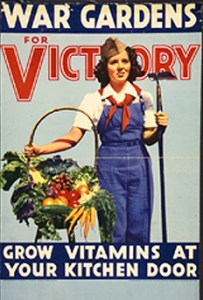 My next shift at the home, farm and auto supply store is May 16. That schedule provides a solid block of time at home to work in the yard and garden.



 For the first time in years, the four Iowa Democratic District Conventions had a full compliment of delegates in attendance during a midterm election cycle according to party chair Troy Price.
 Journey Home
You must be logged in to post a comment.