Categories
Environment

Climate Reality: It’s a Crisis

Scarlet Kale in My Garden

On Feb. 19 I submitted a vacation request for today and tomorrow at the home, farm and auto supply store so I could finish planting the garden if I hadn’t already.

Paid vacation is one of several perquisites of working for a mid-sized retail company. Such perks are a reason I linger there, even though I’d rather spend more time at home in my garden and kitchen.

As we now know, planting is behind during what may become the wettest Iowa spring in recorded history. People aren’t freaking out yet. Many I know, including all the farmers, are on edge. A lot is at stake when one’s livelihood is built around planting and growing foodstuffs. Non-farming people feel the oppressive weather as well. The continuing rain is not normal for east-central Iowa. I’m not sure my garden will get planted the way I expected in February when I submitted my vacation request.

Yesterday at Kate’s farm a thunderstorm rolled in and we moved the seeding operation into the barn. One doesn’t want to be inside a metal-framed greenhouse during a lightning strike. At home I left my trays of seedlings outside when I went to work and they survived the storm in good shape. I moved them into the garage as rain started again. There have been a lot of thunderstorms locally, which when combined with the recent polar vortex, heavy snowfall, rapid snow melt and wild temperature swings, indicate this isn’t a one-off weather event.

Around 1850, physicist John Tyndall discovered carbon dioxide traps heat in our atmosphere, producing the greenhouse effect, which enables all of creation as we know it to live on Earth. This and other scientific facts about physics, chemistry and biology are the foundation of analytical models that predict future behavior of the climate and its consequences for humans. As Katharine Hayhoe, an atmospheric scientist and professor of political science at Texas Tech University, posted yesterday in social media, “climate models are (not) some type of statistical random number generator.” The science of the climate crisis is the same science that explains why airplanes fly and stoves heat food. It’s science.

Consider the displeasure with which the administration greeted the Fourth U.S. National Climate Assessment which predicted dire consequences for sentient beings in coming years if greenhouse gas emissions continue the way they have been going. The president’s advisors now seek to change how the assessment is done, arbitrarily shortening the window of concern to a near horizon of 20 years. I’ve never seen an ostrich stick its head in the sand, but this is what it would look like. There is no scientific reason to shorten the horizon for considering the effects of the climate crisis in climate models.

I didn’t know what to expect in 2013 when I attended Al Gore’s training to join the Climate Reality Leadership Corps in Chicago. Among the benefits was by understanding the basic science of global warming it became easier to cope with the crisis unfolding in front of us now.

The reality is climate change is real if we have the education and awareness to understand what we are seeing. It is not only about science. As Carlos Castaneda suggested when a reporter questioned him about discrepancies in his personal history, “To ask me to verify my life by giving you my statistics … is like using science to validate sorcery.” So it is with our politics. Scientific facts do not address the politicization of science to serve interests that are indefensible in light of our commonality.

Mother Nature has been the victim of humans living on Earth, of that there is no question. Brutalized and violated, who can mend her broken body? I don’t know if it’s possible, there is no Denis Mukwege for her unless it can be all of us together. Who am I kidding?

The sun is rising after the latest thunderstorm moved on toward the Great Lakes. I’ll put seedlings outside again and hope for a break in the weather long enough to work the soil. While farmers need a good week of dry weather to get crops in the ground, I can make do with less.

I feel good about today but then I am human. Most of us can’t see but six inches beyond our nose, try though we might. To sustain our lives we must do a better job of living now while working toward a better future — despite the setbacks of our politics. What choice do we have?

Categories
Kitchen Garden

Gardening in a Wet Spring

Western Sky at Sunrise – Sundog Farm

Whether or not we get a garden in this year the stakes are not high.

Much as I enjoy produce resulting from my labor, I could get along without it a for a year, or two, if I had to. We are part of a strong food ecology and unlikely to go hungry or want for fresh vegetables.

Eventually the ground will dry enough for planting and what has become a dozen trays of waiting seedlings will find a home. There have already been some successes: the kale looks great, radishes have been good, and the sugar snap peas will produce an abundance. I’ll do what I can, when I can, reflecting the position of most gardeners in my area.

The marker for end of spring is moving my vehicle back inside the garage. We are weeks away from that.

On Sunday I planted what will be the last tray of seedlings at the greenhouse. My work there wraps up at the end of June and already I am on every other week duties. Where did the first five months of 2019 go?

I planted,

Cilantro, Ferry — Morse, 45-75 days.
Imperial Broccoli, Johnny’s Selected Seeds, 71 days.
Genovese Basil, Johnny’s Selected Seeds, 68 days.

The Blue Wind broccoli planted earlier has been a disappointment with less than half of the seedlings planted now growing well. Blue Wind plays a role in larger operations as an early broccoli. We’ll see what it produces, but unless the heads are spectacular, it will be the last of this experiment. Late planting of Imperial will better serve our needs.

In other failures, tomatillos have done little. I may get one plant from the starts. Heirloom tomato starts were iffy, with a couple producing only one or two plants. Rosemary germinated, but growth hasn’t taken off. These failures combined with late, iffy planting take a toll. In the end it’s part of being a gardener.

I pulled apart last year’s tomato patch and mowed it flat. The plan is for cucumbers, peppers, squash, eggplant and sundry crops to go in there. The soil isn’t turned yet and won’t be until I get the previous plot planted.

While I’m struggling to get a garden in, larger scale conventional farmers are having a time of it. Spring rain has gone on so long some are debating whether to put in a crop at all. I posted a link to a story about the issue by Thomas Geyer in the Quad-City Times. My post made over 3,500 impressions on Twitter. Find the article here.

People who rely on their farms for a living have had a struggle of a spring. My friend Carmen at Sundog Farm wrote the following to her CSA members:

As I’m sure you’ve noticed there have not been very many windows of sunshine in between rainstorms over the past month and half, so we’ve been seizing every opportunity when its dry enough to get in the field to plant. Despite the limited opportunities and that planting sometime ends up looking more like wallowing in the mud, we’ve actually been pretty happy with our progress! We’ve also been grateful to have hoop houses where we’ve been producing most of the spring crops, and where we can plant even when it’s wet outside. We are a little behind in getting plants in the ground, but so far we are pretty close to where we want to be and hoping for the best!

Some seasons hoping for the best is what is possible.

Categories
Living in Society

Biden 3.0

Vice President Joe Biden in the Rope Line in Cedar Rapids, Iowa, May 19, 2010

As a registered Democrat with substantial political experience, former Vice President Joe Biden is welcome to run for president. The question in my precinct is whether he can find enough supporters to achieve viability in the February 2020 precinct caucuses.

In 2008, Biden was not viable on his own, or when his supporters formed a coalition with Chris Dodd and Bill Richardson supporters. He dropped out of the race in January.

During that cycle, we had ample opportunity to meet members of the Biden clan.

I met Jill Biden in nearby Solon during a 2007 non-partisan, multiple candidate event held by the Solon Senior Advocates. She was campaigning for her husband. I met Beau Biden at Old Brick in Iowa City that cycle after he gave a speech. I finally met Joe in Cedar Rapids while he was serving as vice president after a 2010 campaign event for Chet Culver. Joe Biden stayed long after his speech and shook hands with anyone who cared to. His campaigns seemed about what is referred to as the “Biden clan.” Appearances in person, or through a surrogate, were part of the same energy. If you supported him, you became part of that energy, a de facto member of the Biden clan. Some viewed that as a positive.

I recently read Jill Biden’s memoir, Where the Light Enters: Building a Family, Discovering Myself, which effectively lays out the meaning of the Biden clan. I didn’t know what to expect when I bought the book, just that I found her personable when I met her. What I found is a well-crafted narrative of a type of American family that when I was younger, I wanted to be part of. That type of family is now fading from our collective imagination. With Biden 3.0 the same energies emanate from their home in Delaware. They don’t seem that spell-binding today.

Evaluating Biden 3.0 involves specific queries.

Do you believe Joe Biden is a fake politician or is he genuine?

When I worked in transportation my supervisor was an active Republican who unexpectedly criticized Biden for his hair transplants. “He’s fake,” he said to me on several occasions, referring to the hair plugs and Biden’s vanity for getting them. That seemed a superficial analysis, even though he had encountered Biden at an airport and confirmed up close the hair looked bad. When I met Biden, I didn’t look at his hairline, but felt the warm handshake and attention he gave me. That’s similar to what other Democrats have mentioned when talking about Biden. I know few Democrats who doubt the genuine nature of Joe Biden’s personality. Nonetheless, it’s a question to answer. He’s the real deal.

Is Biden in it to win it?

On his third attempt to win the Democratic nomination for president, at age 76, life is too short to enter the race to make a point. There is no doubt Biden wants to win. National media reported on Biden clan deliberations about the 2020 opportunity. When he announced, national media gave him good coverage. Because of his near-universal name recognition among Democratic primary voters and caucus-goers, he is running a different type of campaign. Yesterday the Washington Post ran an article titled, “Joe Biden’s campaign of limited exposure: How long can he keep it up?” They summarized the campaign strategy as follows,

With near universal name recognition and high favorability ratings among Democrats, the former vice president does not need to introduce himself to voters like nearly every other candidate. And as the leader in early polls, he can attract media attention without splashy events.

Focused on fundraising instead of early state local events, Biden can appear above the fray. He’s been criticized for this approach, but if the focus is to win, it may be a solid strategy — maybe good enough to see him through Iowa, New Hampshire, South Carolina and Nevada, and if he wins there, through Super Tuesday.

What about Biden’s record in the U.S. Senate?

People criticize Biden’s work as Senate Judiciary Committee chair during President George H.W. Bush’s nomination of Clarence Thomas as associate justice of the U.S. Supreme Court. The criticism is specifically of Biden’s handling of Anita Hill’s testimony. Such criticism seems justified from a 2019 perspective. What is forgotten is Biden was judiciary chair during President Ronald Reagan’s nomination of Robert Bork as an associate justice. The Bork nomination became famous for Massachusetts Senator Ted Kennedy’s floor speech within 45 minutes of the nomination, in which he said,

Robert Bork’s America is a land in which women would be forced into back-alley abortions, blacks would sit at segregated lunch counters, rogue police could break down citizens’ doors in midnight raids, and schoolchildren could not be taught about evolution, writers and artists could be censored at the whim of the Government, and the doors of the Federal courts would be shut on the fingers of millions of citizens.

Biden did an effective job shepherding rejection of that nomination and should get appropriate credit. As much as the Bork nomination and Kennedy’s speech reflects our politics in 2019, I believe voters and caucus-goers must take Biden’s entire political history into consideration, including his vote for the Iraq War.

Is Joe Biden the same person who stepped on the stage with Barack Obama in Chicago’s Grant Park on Nov. 7, 2008 in front of an estimated million people?

I don’t know. I hope not. He’s gotten older, has eight years of the Obama administration on his resume, and hasn’t spent much time in his third campaign to be president defining policy. He stands out in Iowa for those things.

He hasn’t been a part of the campaign grind we see played out in local media hardly at all. While Elizabeth Warren, Cory Booker and others have 50 or more organizers on the ground in Iowa, Biden 3.0 appears to be banking on his prior work to gain him the viability he couldn’t find in 2008.

It is fair to ask the question Jill Filipovic did in a May 17 New York Times op-ed, “Does anyone actually want Joe Biden to be President?” It is equally fair to feel badly about asking it after coming into contact with the Biden clan’s energy over so many years.

I like Joe Biden. I don’t like him for president. If he’s nominated, I’ll support him, like I would any of the 24 potential nominees. That’s a feeling many in my political circle of friends have expressed. It will override the tit for tat niggling over candidates when it comes to the general election. At least I hope it does.

Categories
Kitchen Garden Living in Society Social Commentary Writing

On a Holiday Weekend

Lake Macbride Trail May 24, 2019

A brilliant, partly-cloudy sky hung over the landscape as I made my way east on Interstate 80.

Rain broke long enough to allow a trip to Davenport to visit Mom and a friend I met in grade school.

Mother insisted on making coffee and it was the best I’ve had in a while. It took her longer than it would have me, but I stood with her and helped as best I could. At age 89 she wanted to do it so who was I to object?

She’s joined the cohort of octogenarians who dread the thought of going into a nursing home when staying at home no longer works. This dread is almost universal among Americans and with good reason. Almost everyone I know who had experiences with a relative checking into a nursing home has a horror story or two about neglect and mistreatment.

I believe the problem with nursing homes is, like with other modern social phenomena, mostly because of the decline in K-12 education, the rise in private and home schooling, and the dominance of FOX News and right-wing radio among people who continue to be radio listeners or view television broadcasts and cable. People have been dumbed down and will swallow almost anything they hear repeated often enough.

Nursing homes don’t have to be as bad as they are, but education and social learning haven’t prepared us as well as they could for getting help with aging relatives. Most people can’t afford an in-home nurse when someone requires 24/7 attention. A nursing home has become the best opportunity to enable a loved one to live their final time on Earth with dignity. Indignities regularly imposed on residents become exceptionally objectionable because of this.

I met my friend for lunch at an Italian-style restaurant. Italian restaurants usually have fresh salad offerings and this one was no exception. They offered some “Chicago-style” dishes which apparently are gaining popularity in my home town. Like with Mother, my friend and I had an engaging visit.

I got sleepy and stopped at the rest area halfway home to walk around. A great thing about Iowa rest areas is they have clean rest rooms and drinking fountains with free, chilled, filtered water. Refreshed, I made it home okay, passing presidential candidate Tulsi Gabbard’s advertising billboard outside Iowa City. One may try to get away from it, but politics never takes a holiday.

At home, I mowed the lawn as best I could, breaking a sweat. The ambient temperature was moderate and the sky remained bright. As I mowed around the garden, the grove of fruit trees, and lilacs, I was reminded of how much yard work remains to be done to get the property in suitable shape. My solace can be found in the Meriam Bellina song,

One day at a time sweet Jesus
That’s all I’m asking from you
Just give me the strength
To do everyday what I have to do.

Yesterday’s gone sweet Jesus
And tomorrow may never be mine
Lord help me today, show me the way
One day at a time.

I need to make another pass to pick up the grass clippings for the garden.

The garden patch has standing water in divots dug last week. When I mowed near the ditch the sound of running water informed me it hadn’t dried out and might not this year. Gardeners on social media are getting their vegetables planted, and this is the latest start they can remember. The wet spring has been problematic, although all is not lost… yet.

Soon corn farmers will have to turn to beans if the ground doesn’t dry out enough for planting. With China no longer wanting corn and soybeans because of U.S. tariffs, the prospect of plummeting soybean prices is real, and farmers will take it on the chin… again.

All in all Saturday was a positive day in a turbulent world. Hopefully I’ll get some garden time in when I return from the farm this afternoon.

Categories
Living in Society

Memorial Day 2019

Flags at Oakland Cemetery

The president is said to be considering pardons for convicted war criminals as we go into the Memorial Day weekend.

Jamelle Bouie names some of the criminals under consideration in a New York Times article.

Last year, a federal jury in Washington convicted Nicholas Slatten, a former security contractor, of first-degree murder for his role in killing one of 14 Iraqi civilians who died in 2007 in a shooting that also injured more than a dozen others. Matthew Golsteyn, an Army Green Beret, was charged late last year with the murder of an unarmed Afghan man during a 2010 deployment. Edward Gallagher, a Navy SEAL who served in Iraq, was reported to authorities by his own men, who witnessed him “stabbing a defenseless teenage captive to death,” “picking off a school-age girl and an old man from a sniper’s roost” and “indiscriminately spraying neighborhoods with rockets and machine-gun fire.”

It is the president’s prerogative to grant pardons. What does it say about our country that he picked these men?

It says nothing positive on a day set aside to recognize those who gave their lives for our country.

Categories
Living in Society

A Veil of Reasonable

Tom Miller Photo Credit – Iowa Attorney General’s Office

On Wednesday, May 22, Iowa Governor Kim Reynolds line-item vetoed HF 615, the justice system appropriations bill, to remove sections 24 and 28 pertaining to the role of the attorney general.

The law would have “required the approval of the Governor, Executive Council, or Legislature to prosecute any action or proceeding, including signing onto or authoring amicus briefs or letters of support, in any court or tribunal other than an Iowa state court,” according to the press release.

While she vetoed that part of the bill, Reynolds said the law had brought Attorney General Tom Miller into discussions about their respective roles. In the transmittal letter accompanying the bill, Reynolds wrote,

As a result of the Legislature’s leadership on this issue, Attorney General Miller and I have had the opportunity to engage in a thoughtful discussion about the appropriate balance of authority between the Governor and the Attorney General with respect to Iowa’s involvement in litigation. And ultimately, Attorney General Miller agreed to my proposal to adjust our litigation practices in a manner that I believe addresses my core concerns without amending Iowa’s current statutes.

Attorney General Tom Miller said his agreement with the governor was made in good faith,

This agreement allows my office to continue to protect Iowans through consumer enforcement actions, which are primarily filed in Iowa courts. It also allows me to express my opinion on matters affecting Iowans before federal agencies and Congress.

Republicans got the leash out but avoided collaring the popular Miller.

In part, the ability to reasonably negotiate differences between state-wide elected officials is part of what makes Iowa different from nearby states like Wisconsin and Kansas. We look at them and say to ourselves as Iowans, “Dear God! Let’s not be like them.” That Reynolds and Miller were even able to discuss and negotiate a better solution to Republican dislike of his activities is something. It is also something else.

While Miller, first elected in 1978, is the longest serving attorney general in the United States, he will eventually retire or die in office. That he is a Democrat is less important to his longevity than the way he looks after the interests of Iowans. When Miller’s seat becomes an open race to replace him, electing a Democrat is not assured. If anything, the office of attorney general will lean in the direction of state government’s majority party.

There are one-offs like Democratic Auditor Rob Sand, who won statewide election despite Republican dominance in other offices. If Reynolds has the same longevity as Terry Branstad, Democrats holding statewide office may well be sanded off in the woodshed of Republican re-making of the state. By vetoing sections of the HF 615 pertaining to the attorney general, Reynolds is playing the long game in politics, looking after her own interests as much as settling an immediate political dispute.

We live in an open society and Republicans have been working to shape it according to their image. In many ways they have been successful. The longer it is before Democrats win a majority in the legislature and re-take the governor’s office the more permanently Republican initiatives penetrate our culture and become the background against which we live our lives. Democrats failed to stop Republicans in 2018. 2020 remains our last best hope to do so. Flipping the Iowa House of Representatives to Democratic is both doable and a primary goal for Democrats this cycle.

A veil of reasonable envelopes the judiciary budget bill and the settlement between Reynolds and Miller. One hopes the outcome is indeed reasonable, and not the vapid dealings of a Republican party looking out for their own long-term self-interest.

Categories
Writing

2019 Summer Reading

Summer Reading

The myth of relaxing on a towel at a beach, sunglasses and sunscreen on, reading a book may not exist for most of us in Iowa. The beach nearest us has been closed in recent seasons because of the risk of exposure to microcystin and E. coli bacteria, both harmful to human health.

Nevertheless, reading is an important part of summer activities, and essential for people engaged in society. Our home owners association has a monthly meeting at the public library where staff politely boots us out in June and July because it falls on the same night as the summer reading program. Summer reading is one of the most important programs at a public library.

When I write “reading,” I mean books. A lot of our time is spent reading news articles which, while important, does not involve the kind of commitment as reading a book cover-to-cover. I started the Goodreads Reading Challenge last year and it helped me stay focused on reading. I’ve read 16 books this year and you can see which ones on my Reading List page.

Here, in no particular order, is a list of ten books on my bedside table for reading this summer:

Where the Light Enters: Building a Family, Discovering Myself by Jill Biden.

The Tallgrass Prairie: An Introduction by Cindy Crosby.

The Radium Girls: The Dark Story of America’s Shining Women by Kate Moore.

The Overstory by Richard Powers.

Pacific by Simon Winchester.

Milkman by Anna Burns.

The Wizard and the Prophet: Two Remarkable Scientists and Their Dueling Visions to Shape Tomorrow’s World by Charles C. Mann.

The Uninhabitable Earth: Life after Warming by David Wallace-Wells.

Janesville: An American Story by Amy Goldstein.

Energy: A Human Story by Richard Rhodes.

While beaches may be closed due to environmental pollution, I plan to find a shady spot on our property or a comfortable chair inside to crack open a book from time to time this summer. Please do leave a comment with what you are reading this summer below.

Happy summer reading!

Categories
Kitchen Garden

Mud-suctioning the Garden

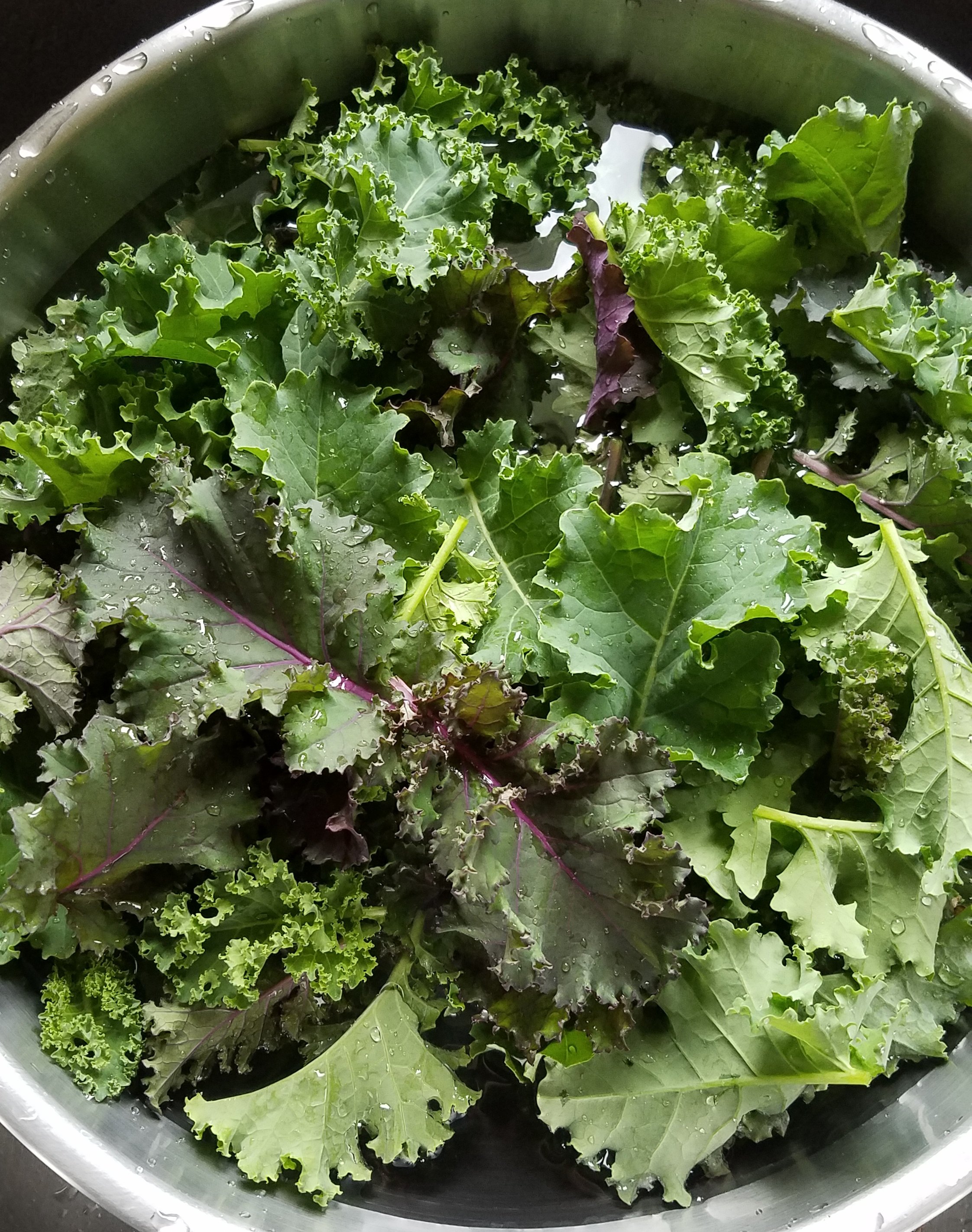
First Pick of Kale, May 20, 2019

Spring rain continues and I must decide whether to put seedlings outside while I’m at the farm this morning.

The first wave is in the ground, but the second is delayed so long I worry about them getting root bound. I discussed this with a farmer friend and she said not to worry. I don’t know. The basil is looking dire.

Greenhouse seedlings are coming in faster than I can get them in the ground. Yesterday I processed two trays of tomatoes, moving soil blocks to larger containers while I wait for the ground to dry. I expect they will develop more root structure before I get them in.

There are so many seedlings I grabbed another pallet from the garden to hold them all outside the garage. Moving them back and forth is getting to be a production.

I finished turning over the plot for the second wave. I broke a sweat, the work felt good. The process should be called “mud-suctioning” because with every spade of dirt the sound of suction-release was evident. Water stood in the bottom of the divots dug previously. Rain had beaten down the divots dug last week, making breaking them into soil suitable for planting easier. That is, if the ground ever dries.

May has been a month of tension for this gardener, made worse by climate change. Wet springs combined with not enough time to garden has delayed planting and weeding. Even with May troubles we manage to harvest something.

The first wave of plantings is beginning to produce. We had kale and radishes, and harvested from the long-standing, ever-producing plot of garlic planted years ago. There is plenty for our kitchen.

Fresh kale, radishes and spring garlic in our salad of local farm-grown lettuce was welcome for dinner last night. Our spring share included lemon balm, of which I made tea to reduce anxiety and restlessness. I think it’s working. There is some left in the ice box if it isn’t.

Categories
Home Life Kitchen Garden

Cleaning the Gutters

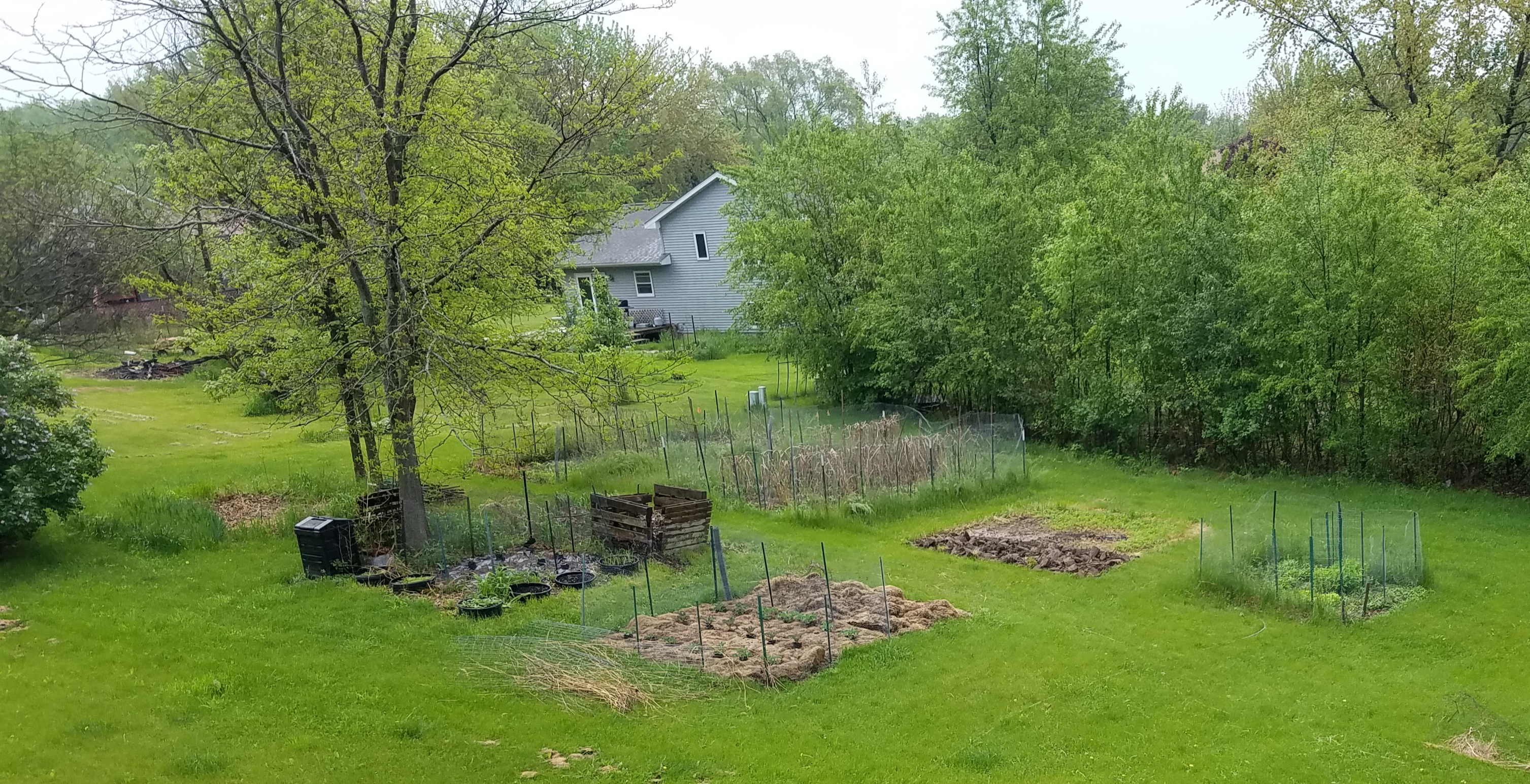
Garden Viewed from the Roof

During Saturday morning rain gutters overflowed on both sides of the house. As soon as it stopped, I climbed up a ladder and cleaned them out.

The blockage was mostly leaves from the pin oak tree which sheds them with new spring growth.

At 67 years my roof-walking days are numbered. I’m thinking of my octogenarian uncle who died from a fall from his roof in Alabama. I’m somewhere in between roof-walking and having someone else do it.

Garden ground continues to be too wet for tillage, the next task on my spring to-do list. I went through the lettuce seedlings in the garage, transplanting the best ones into larger containers, and turning the rest into dinner salad. I got my hands dirty with soil, just barely. This wet spring is getting old.

It was another light day at the farm with only 20 seedling trays to prepare. I had seven trays left in the greenhouse and brought the three with tomatoes home. More planting backlog.

At some point the rain will break and the ground will dry out. When exactly that is is uncertain.

Categories
Living in Society

Where’s the Beef Mayor Pete?

Pete Buttigieg Arrives at Wildwood Smokehouse and Saloon May 18, 2019

JOHNSON COUNTY, Iowa — If I ranked Mayor Pete Buttigieg of South Bend, Indiana in the third tier of presidential candidates, why did I attend his town hall meeting five miles west of the Herbert Hoover birthplace in West Branch?

In a field of two dozen Democratic candidates one voter’s personal choice of a candidate is not as important as supporting the eventual nominee. What matters more in Iowa is the senate and congressional races because without a Democratic majority in both chambers of the legislature any Democratic president won’t get much done.

I went to learn about the electorate and who is active this cycle to better serve my campaign work for whoever are the Democratic nominees for Second District congressperson and U.S. Senate. The good news is a lot of people I’d never seen before were in the crowd of several hundred. Everyone was glad to be there despite the body heat in the over-crowded room.

The attraction people have to Buttigieg is palpable. We’re looking for something different and in some ways Mayor Pete is that. He’s young, living in his home town, a Rhodes scholar, a military veteran, goes to church, and is well known in the Democratic party. That’s part of the allure.

He’s also a good orator and handles audience questions with due consideration and aplomb. As I mentioned in my review of his memoir, “he illuminates the example of South Bend and what’s possible in creating a more sustainable life in urban centers.”

Emblematic of today’s town hall meeting was the five panel mural of a bull hanging over the stage, combined with the penetrating aroma of freshly smoked meat and barbecue sauce. If a person enjoyed barbecue one might stick around for dinner service. It had me asking, “where’s the beef?”

It was a pretty skinny cow. Pete Buttigieg has skilled elocution. His ideas are not very deep. He touted newly released policy pages on his website and said his policy roll out was as good as any of his competitors. I’ve never heard any of the women who are presidential candidates refer to others as “competitors.” I suppose we might give that male-ism a pass, but Hillary taught us we are stronger together. The caucus process doesn’t have to be similar to a sports event. A lot more is at stake than the horse race, even if it does generate clicks and serve egos.

The only news out of the town hall meeting was Buttigieg embraced the Citizens Climate Lobby position of adopting a Carbon Fee and Dividend. No matter how dire the environment gets, a president Buttigieg will need a house majority and a filibuster-proof senate majority for a fee and dividend bill to pass. Look at the ability Senator Mitch McConnell developed to block progress when he was minority leader during Obama’s first term.

The real action at the town hall meeting happened outside the main stage and venue. People in line talked about expectations, others thanked a friend for inviting them, families rushed to their vehicles to make the day’s next event. The strength of those relationships is what gives Democrats hope. That combined with what we hope will be an ability to pull together.

I’m glad I had a chance to attend today’s event. In Iowa we don’t know how lucky we are to have a presidential candidate within 15 miles of our home. Based on today, my faith is strong that Democrats will pick an excellent candidate to face off with the incumbent president. I believe we will soon find the wind at our backs lifting our sails toward a better tomorrow. The idea and a lot of hard work will get us there.

~ For conventional coverage of the event read James Q. Lynch here. To view video of the entire event, Robin Kash of Neighborhood Network News posted it here.