Categories
Living in Society Social Commentary

Modernity of Social Distancing

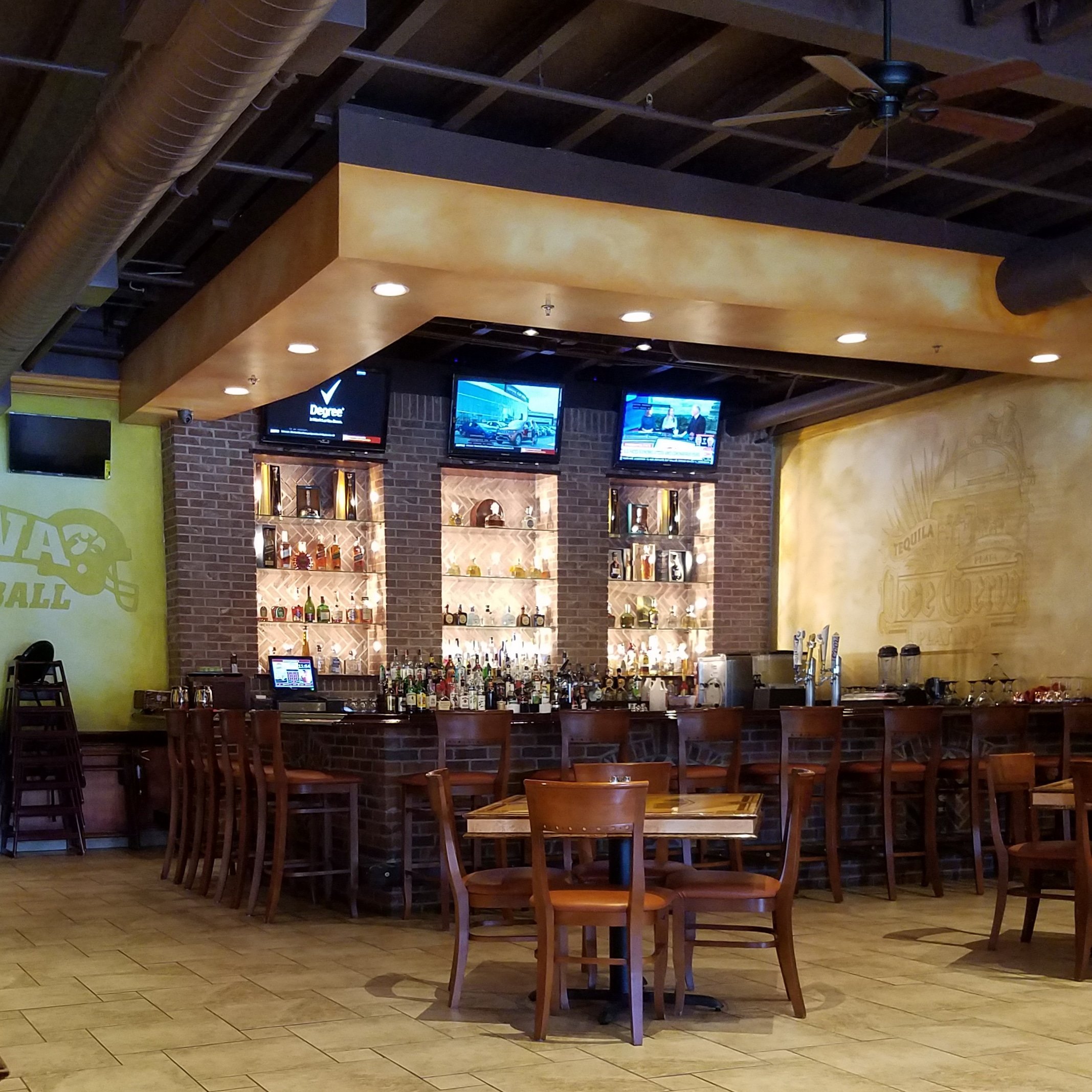
Los Agaves Mexican Grill, Iowa City, Iowa at lunch time on Friday, March 13, 2020.

When it comes to “social distancing” Iowans know what to do. We tweak our normal behavior. Many of us are not socially close by nature so it’s not a big step.

Epidemiologists are using the term “social distancing” to refer to a conscious effort to reduce close contact between people and hopefully slow community transmission and spread of the coronavirus.

A grade school friend and I met in the county seat on Friday. His nonagenarian mother lives in an assisted care facility which was quarantined after he arrived in Iowa to visit her. He spoke to her on the phone, but couldn’t pay an in-person visit.

It was a tweak.

More tweaks are coming.

Last night Governor Kim Reynolds’ office issued a press release which said, “The Iowa Department of Public Health has determined, based on the new COVID-19 case and the announcement this evening of community spread in Omaha, Neb., there is now community spread in our state.”

The release continued to explain:

Community spread occurs when individuals have been infected with the virus in an area and cannot specifically identify the source of the infection, or do not know how or where they became infected.

Due to the detection of community spread, there are new recommendations for individuals with underlying conditions, and all Iowans should be prepared for cancellations and disruptions in routine activities.

Mitigation measures should be implemented immediately to have the most significant impact on slowing the spread of the virus.
Leaders of institutions and organizers of events should begin to act on their contingency plans related to large gatherings, including church services. Iowans should not hold or attend large gatherings of more than 250 people, and consider making adjustments for smaller gatherings with high risk groups.

It appears the governor is following Centers for Disease Control and Prevention guidelines which include monitoring the progress of community spread and under certain conditions, making recommendations for social behavior. For now, school can continue, but not church where there are large congregations.

There is a political aspect to the coronavirus pandemic and it appears our state is taking reasonable actions if the federal government is lacking in its response. Regular communication and compliance with CDC guidelines should reflect positively on Reynold’s handling of the global pandemic’s mitigation in Iowa. As a former six-year member of our county board of health I don’t see a benefit to criticizing the governor as the state works to understand the progress of the disease and take appropriate action.

For our small family, it doesn’t take much to be socially distant. Yesterday I decided not to attend a legislative forum 10 miles from our home. I went to town to mail a package. On the way home I stopped at the pharmacy to see if I could buy a bottle of 90 percent isopropyl alcohol. They we sold out of all alcohol and sanitizing items. We’ll make do with what we have. Today I’ll go to the farm for our weekly seeding session.

A late winter snow fell, covering everything except the driveway and roads, which were too warm in this meteorological spring. For a day it was still winter by the calendar and by the weather.

There is never a problem staying busy at home. I completed the U.S. Census on my mobile device after reading in social media our state senator did his. It took ten minutes even after I had to re-do it. Between reading, writing, cooking, laundry, and preparing for planting, there was plenty to do. I put some bird seed out on the front door landing but they hadn’t found it by sunrise this morning.

While we were isolated, it didn’t feel that way. Iowans are used to working in isolation and with modern communications it is easy to stay in contact with friends and neighbors.

The news about the coronavirus from Europe, the Middle East and China is pretty startling. We really don’t know how many people are infected, although public health officials seem to be tracking the number of deaths.

Estimates of the impact of the 1918 influenza pandemic range widely yet are relevant. Global population was between 1.8 and 1.9 billion people at the time. The estimated number of deaths ranges between 17 and 50 million, maybe more. In the United States, the death rate was between 0.48 to 0.64 percent of the population or toward 650,000 deaths at the high end.

If we use the lower number in the range (0.48 percent) to determine how many deaths the 1918 pandemic would cause in the 2020 U.S. population, it would be more than 15.8 million. We are nowhere near that and likely to see only a fraction of that number with coronavirus. There is a modernity today that didn’t exist in 1918, with advanced public health and research organizations, better communications, and a resulting ability to coordinate between government and non-governmental agencies.

The phenomenon of social distancing looks to create a positive result. People will die of Covid-19 and the loss will hurt families. It will hurt us all. At the local level, we do our best to understand the pandemic and live our lives accordingly. We not freaking out. We are learning.

We’re sustaining our lives in a turbulent world that’s becoming infected by coronavirus. This may not be the last pandemic in my lifetime, so I hope we learn from it.
Categories
Living in Society Social Commentary

Food Hoarders All

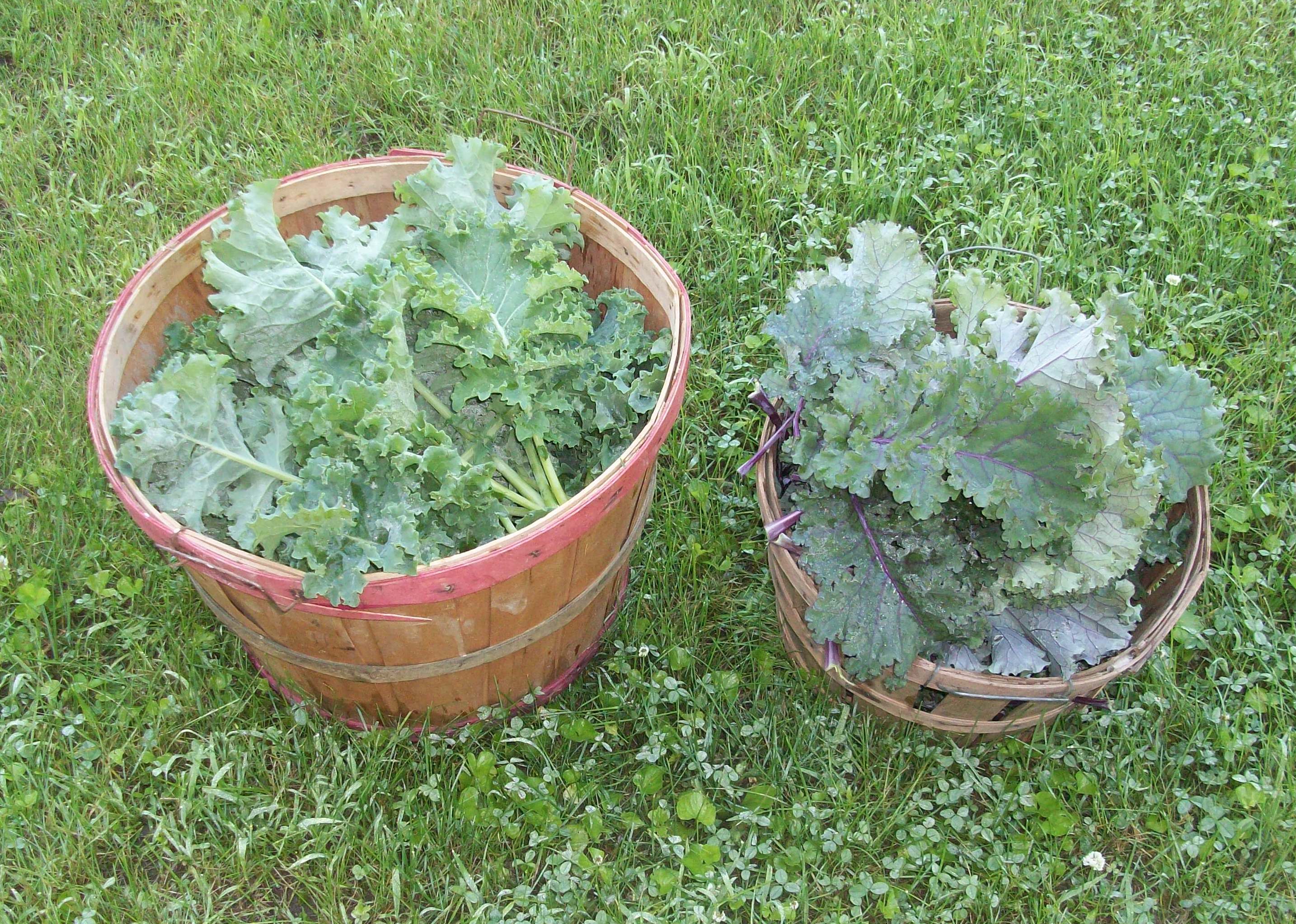
Morning Kale Harvest, June 2015

Because of the coronavirus, people are stocking up on food and sundries in case they are quarantined. Local retail business is up compared to last year. The wholesale club has been rationing specific items.

The retail outlet where I work twice a week has a large table in the employee break room where we pass the time talking, looking at our mobile devices or yesterday’s newspaper, and eating snacks and lunches. The consensus among this group of employed yet low-wage workers was we could survive a month or more of quarantine without stocking up. It’s how we do.

When my uncle died, Mother found a large number of one-pound boxes of dried pasta in his pantry. A person is in the store, it’s cheap, so why not pick up a package? Years of accumulation like that reflects a certain type of affluence. For those of us with a stable home life the amounts build up. A person has to work at it to use up the pantry and freezer. It’s a form of food security.

If we were quarantined and had no access to new food, the first thing to go would be dairy products. Fresh milk and eggs would be most missed, although cheese and butter would not make it a month. This discussion is hypothetical since there is an ability to receive home-delivery of most grocery items in our community. My next door neighbor owns the grocery store in town so I’m not worried about running out of food if quarantined.

We have plenty of fresh onions, canned tomatoes, dried basil and olive oil to make it through a month of pasta dishes. There is plenty of applesauce and pickles. We have enough apple butter to last more than a year. Kale? there is plenty in the freezer along with other frozen vegetables from the garden.

We’d test how far ten pounds of flour goes. We’d see if the yeast in the ice box is still active. If the yeast isn’t active, there would be biscuits and corn bread made with baking powder as leavening. There would be a big batch of soup made from celery, carrots, onions and potatoes. We have five cases of prepared beans, a large bag of garbanzo beans, and plenty of rice. The freezer has frozen raspberries, aronia berries and blueberries. We’d find out what we have.

As indicated above, this is theoretical as the community would support us on quarantine. As we settle into a weekend spent mostly at home we have no worries about food security. Sustaining our lives on the Iowa prairie is what we do.

Categories
Living in Society Social Commentary

Getting Through a Pandemic

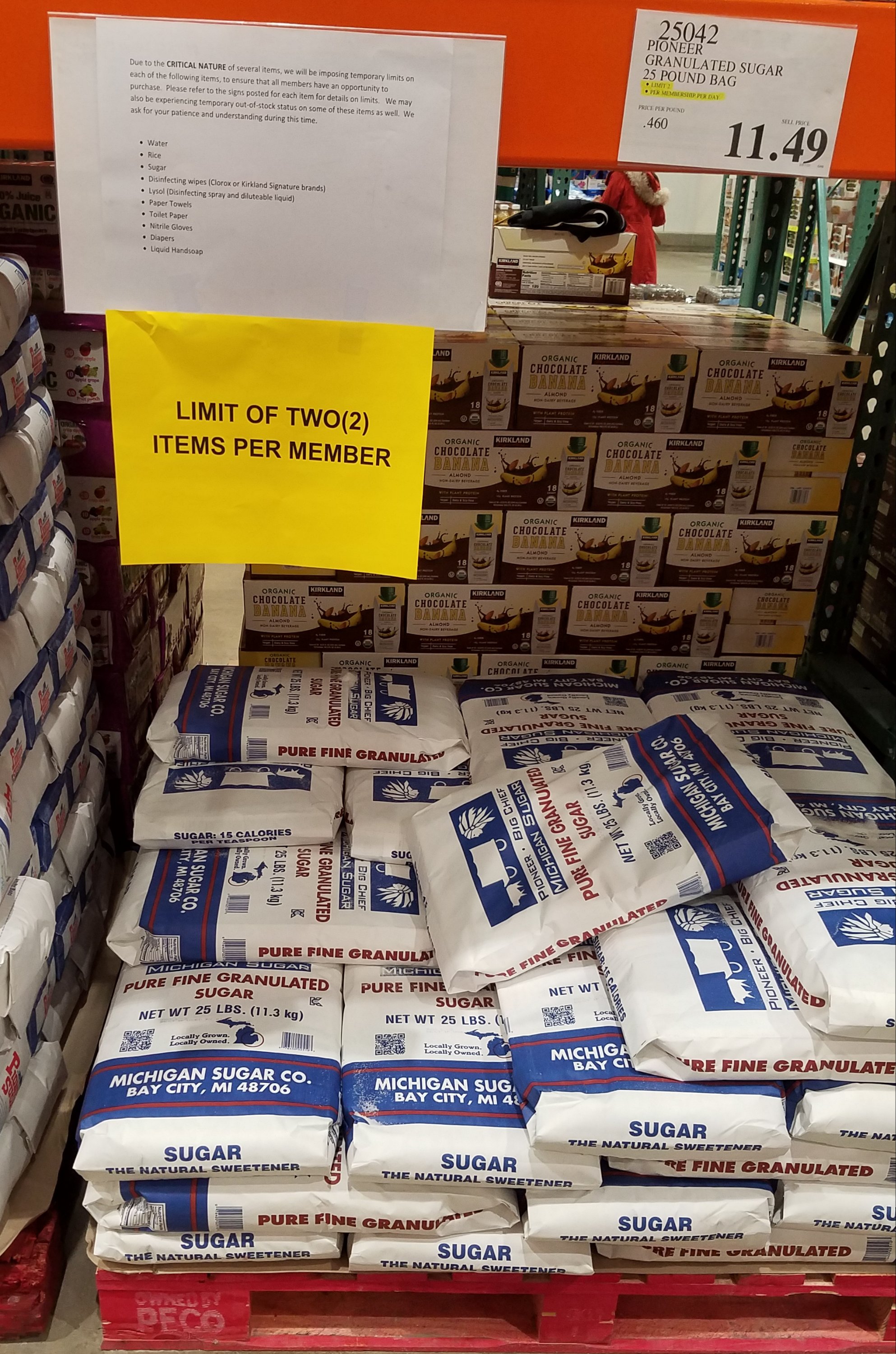
Sugar rationing at Costco Wholesale, Coralville, Iowa, March 11, 2020.

We have a Costco Wholesale Club near the home, farm and auto supply store where I work two days per week.

Wednesday is my day to pick up provisions there on the way home after work. Costco sells a lot of what we use in our kitchen but especially organic frozen vegetables, milk, butter, cheese, eggs, jarred olives, tomato paste, prepared black beans, raw tortillas, flour, sugar and the like. They are a good fit for our semi-veg cuisine and we like the USDA Organic shield on much of what we buy.

Costco was rationing provisions yesterday because of the coronavirus. Rationed items included water, rice, sugar, diapers, paper towels, toilet paper, disinfecting wipes, nitrile gloves and liquid handsoap.

While waiting in the checkout line, the woman behind me commented that I had no water or toilet paper in my cart, referring to a common social media meme about “Costco panic buying.” I replied we manage our own well so we don’t buy bottled water. The person in front of me asked the cashier if this would be a record sales day for the store. The cashier replied decidedly not. One has to wonder if those rationing signs on certain items increase sales more than the social phenomenon of “panic buying.”

A crew inside the entry offered to wipe down carts with hand sanitizer. A few members wore the kind of masks I keep in the garage to prevent breathing sawdust. More than anywhere else I go, Costco is a petri dish of international human interaction, mostly because of the nearby university hospitals and clinics. I declined the sanitizer and kept a comfortable social distance from fellow shoppers. If I die of COVID-19 you’ll know it was a bad call.

News this morning is the president twiddled his thumbs while addressing the pandemic to the nation from the Oval Office last night. Pandemic response seems outside his wheelhouse. The World Health Organization identified the coronavirus as a pandemic about the same time the president was preparing his speech. Also in that time window, actor Tom Hanks and his spouse were diagnosed with COVID-19 in Australia. At least the rich and famous can get a test kit and have results reported.

At the end of the day it was a regular experience, one among many. Our best chance to survive is to listen to health professionals and work to follow their guidance. That can be done. It’s all part of sustaining a life in a turbulent world.

Categories
Kitchen Garden

Spring Song

Spring on Lake Macbride

The surface of the ground crunched as I walked the compost bucket out to the bin. The ground was frozen.

Grass has been greening up with the recent rain and ambient temperatures above 70 degrees. The frosty morning wasn’t a permanent setback as green grass was visible through the glaze of frozen rain.

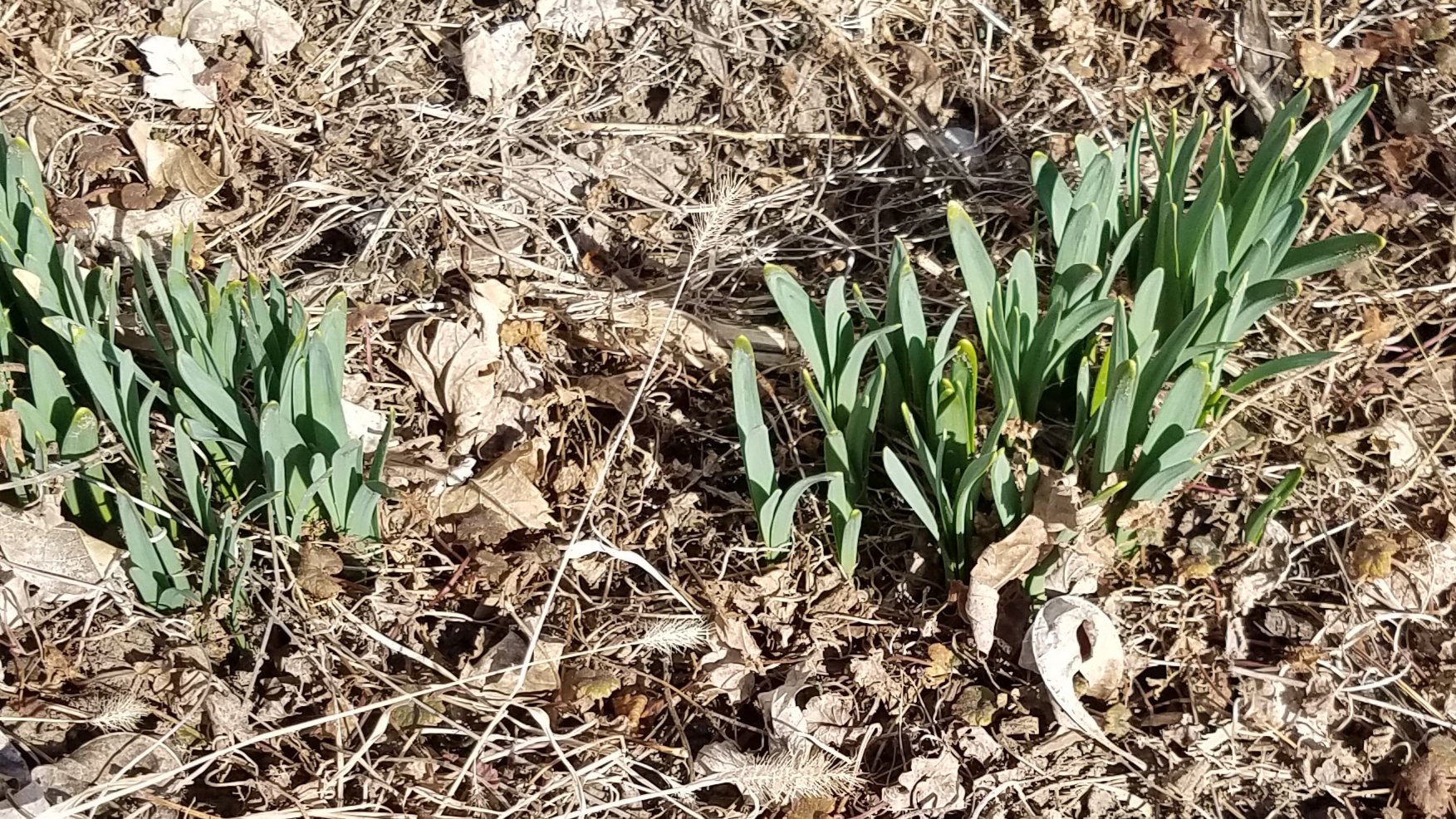
Farmers have produced first batches of maple syrup, so it’s undeniable spring is close by. This in-between time on the margin of winter is unsettling. I want to get going on the garden… but not yet.

The sound of bird songs returned. Voices of children playing outdoors are evident. The trickle of water in the downspout informs us of the spring melt, that despite crunching under my boots it won’t be long.

This is my spring song.

Categories
Kitchen Garden

Refilling the Seed Gaps

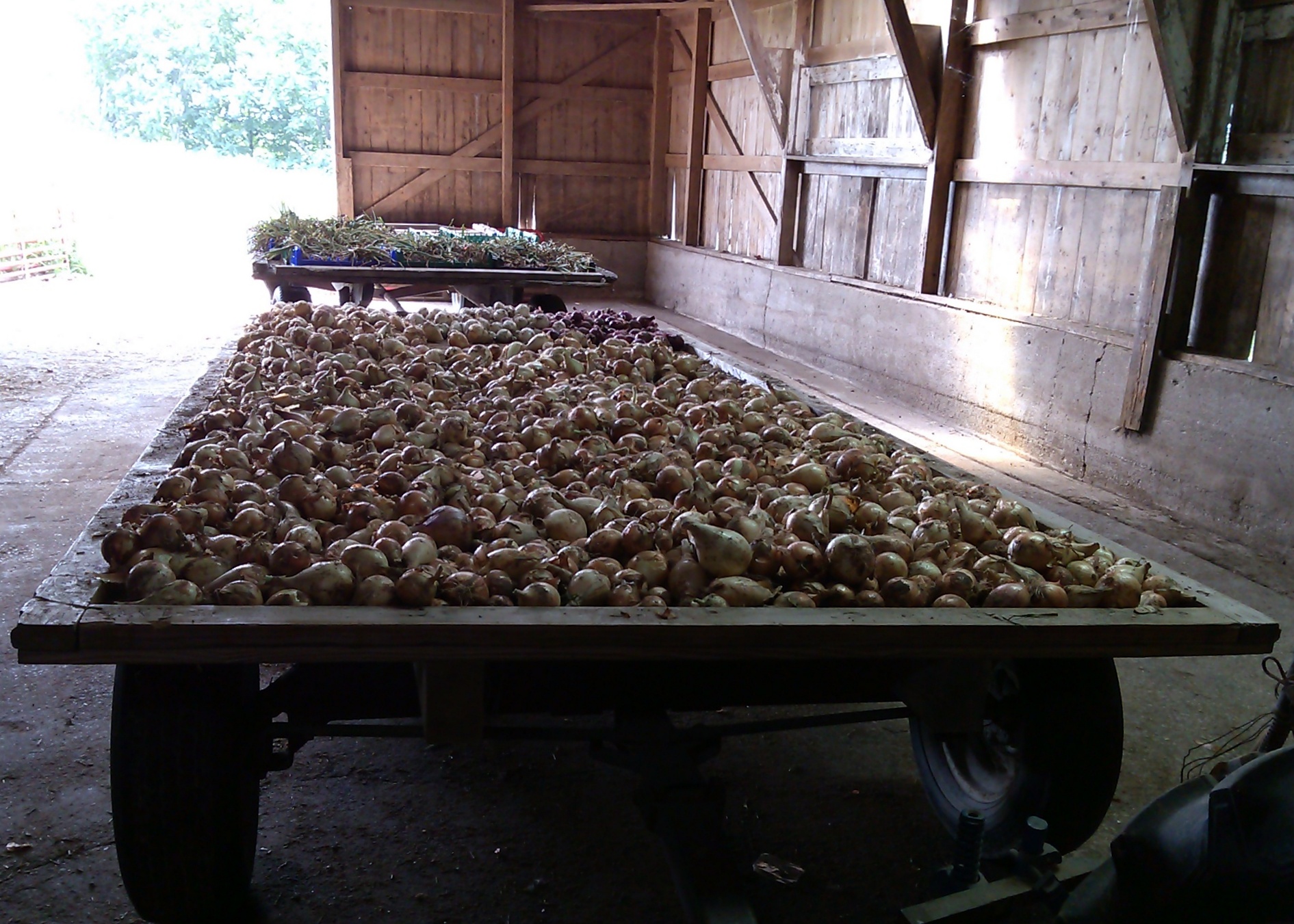
Onions Drying

One batch of onion seeds germinated poorly so I seeded the failed blocks with Cilantro, Parsley and Dill.

Cilantro, Ferry-Morse, 28 days.
Parsley, Ferry-Morse, 70-90 days.
Dill, Ferry-Morse, 70 days.

This is my first attempt to grow onions at home and there’s a lot to learn. Once the seeds germinated, I moved them upstairs into sunlight. They grew long and spindly, laying down over each other in the tray. Carefully, I trimmed the tops to about two inches and they sprung up. The expectation is they will start to right themselves and grow more vertically.  The backup plan is to buy and beg some onion starts in case these don’t mature. For the time being I’m not giving up on them.

Categories
Living in Society Social Commentary

Wheels Coming Off

Two Wagon Loads of Onions

This weekend was unsettling beginning with Friday’s news that OPEC couldn’t reach consensus on reducing crude oil supply. Russia dissented. In response, Saudi Arabia decided to slash prices and increase production by as many as 2 million barrels per day.

“This OPEC summit was among the worst meetings I have ever seen during the history of this organization,” Bijan Zanegneh, Iranian petroleum minister told reporters on Friday.

Oil prices fell so far, one could purchase two barrels of crude for less than the cost of a liter of Purell hand sanitizer in Manhattan.

Futures trading in the 10-year U.S. Treasury note yield dipped below 0.50 percent for the first time ever last night. It should be hella day when markets open this morning. One aspect of our being in debt is we own no stocks and therefore are insulated from daily market peaks and valleys, but still…

Speaking of hand sanitizer, Iowa Governor Kim Reynolds announced last night the first three cases of coronavirus have been diagnosed in Iowa. The individuals live in our county seat and have been quarantined at home. I’m weighing whether or not to attend meetings in town this evening because of it. National leadership on identifying the emerging risks of coronavirus, and doing something to prevent a national crisis over the pandemic, has been absent. Our local warehouse club was rationing basic food stuffs, even though few Iowans seem likely to starve if they have to stay home for a while to avoid contact with the disease.

Also Sunday night, Yonhap News Agency of South Korea reported North Korea launched three projectiles toward the East Sea. The projectiles are believed to be missiles being developed as a result of stalled talks over denuclearizing the Korean peninsula. The U.S. is not leading efforts to rid the north of nuclear weapons, but rather seeking to distract us from our own nuclear complex modernization and testing of new nuclear weapons. American leadership is absent in compliance with Article 6 of the Nuclear Non-proliferation Treaty.

Changes announced this weekend include the orchard where I worked the last seven seasons. On Friday they posted job openings for my manager and the bakery manager, who have worked there since before the current owners bought it in 2009. There have been discussions about extending the season to include other activities and produce for a couple of years. It looks like plans are coming to fruition (yes, that’s an apple joke), which means changes in staffing to accommodate new demands.

We’ll see if I’m invited back for the fall season, and if I am, whether I would work for a new manager in a new retail environment. Our personal situation has changed since 2013 when I first applied for a job there. The changes at the orchard are evidence of the shifting sand of a small business trying to survive in a competitive marketplace. If the job ceases to be fun, I won’t return.

Why all this now? It may be the beginning of all the wheels coming off the wagon of society. Whatever the causes, it is going to be a rough ride at least through this year, and maybe for a lot longer.

When I returned from my Sunday shift at the farm I walked the garden. It’s still pretty barren, garlic hasn’t begun to emerge. The plot where I sowed lettuce was dry with a few deer footprints in it. I went to bed worried about late winter drought. When I woke there was rain against the bedroom window. Welcome relief from the dry spell and a sign that all hope is not lost.

Categories
Kitchen Garden

Celery – In!

Spring Plants from Indiana

It was another busy day at the farm for seeding session #4.

I planted one tray of

Conquistador Celery, Johnny’s Selected Seeds, 80 days.

and one tray with

Georgia Southern Collard, Ferry-Morse, 75 days.
Pak Choy Toy Choy, Ferry-Morse, 30 days.
Teton Hybrid Spinach, Ferry-Morse, 45 days.
Cilantro, Ferry-Morse, 28 days.

Space is beginning to fill with trays.

I delivered a box of flower seeds for the farm’s coming garden class at a local food pantry.

We talked, a lot, about everything. We were chatty.

I enjoy my time with eight people talking and seeding trays of soil mix. I don’t say a lot, just do my work and bask in the sounds of another day on the farm.

The lamb count is now 40 and there are five new goats.

Categories
Writing

2012 and New Beginnings

Journal Entry, Jan. 8, 2013.

The 2012 general election marked the end of a personal era.

Working on campaigns drained our financial reserves and we would need income to meet our obligations going forward.

The following winter was a time of reflection and adjustment.

2013 began a work period where writing occupied more of my time. That, combined with low wage work, became a way to get along. We never made enough money as I worked those jobs. They bridged the time between leaving my career and beginning Medicare at age 65 and Social Security at age 66. What made our survival possible was a foundation created by my 25 years in transportation combined with Jacque’s income from the public library. It was tough going during the transition but we made it.

Our move to Big Grove Township was predicated on a few things: we needed a place to live, my job in Cedar Rapids, being centrally located near other job opportunities, schools for our daughter, two working automobiles, and being a distance from the office. Over time, and by 2013, those things changed, raising new questions:

  • Do we want to move to town?
  • What kind of work will be next for us?
  • Is there a way we can work without a commute?
  • Is this home right for us as we age?
  • Will we be able to afford living here?

We decided the best approach was to stabilize our lives here and we did. Working at home was difficult but straight forward. I wrote about it in a Dec. 29, 2012 journal entry:

Part of work is forcing myself to come into my work area and sit. The kind of discipline that Norman Mailer wrote about. Not being distracted, or leaving the work area. Just working to the detriment of all other activities.

It is not always easy to do this, but do it I must, and for more than an hour at a time.

I felt an urge to go to town. It is similar to the urge I felt when living in Mainz. That often led me to shopping or walking into the downtown area. I resisted it today, even though it was complicated by the new $50 bill my mother sent — itching to be spent. It was a major accomplishment to resist the urge to go “elsewhere.”

The low wage work I pursued was readily available in the area. My criteria was to work for a company with a professional payroll department where I could count on wages being paid accurately and in a timely manner. I didn’t give much thought to the physical requirements of the jobs, although they mostly required standing on concrete or other hard-surfaced floors. I worked as a temporary laborer, as a product demonstrator, and in 2015 wound up at the home, farm and auto supply store which offered full time work, health insurance and a reasonable work load. I also worked as a proof reader and freelance correspondent for local newspapers.

Most significant among these jobs was a chance to work with people much different from those during my transportation career. If I didn’t bring home much money, I met many new people.

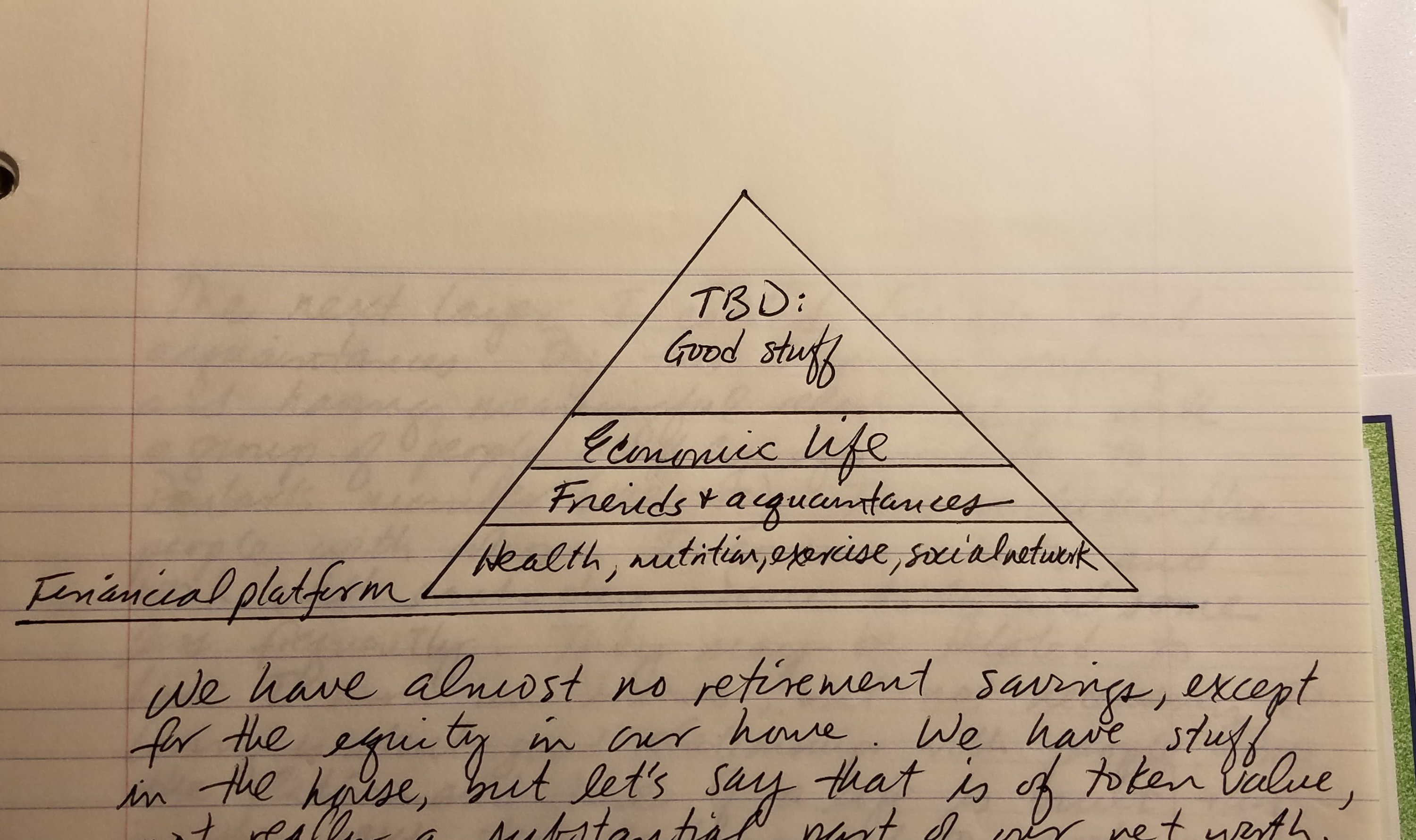
Weathering the last seven years was the kind of accomplishment few people point out as a highlight of life. We did what was needed to survive. Now that it’s over there are other things to do, including the “good stuff” in the diagram from my journal. We now have a chance to figure out what that means.

Categories
Writing

The Work of Writing

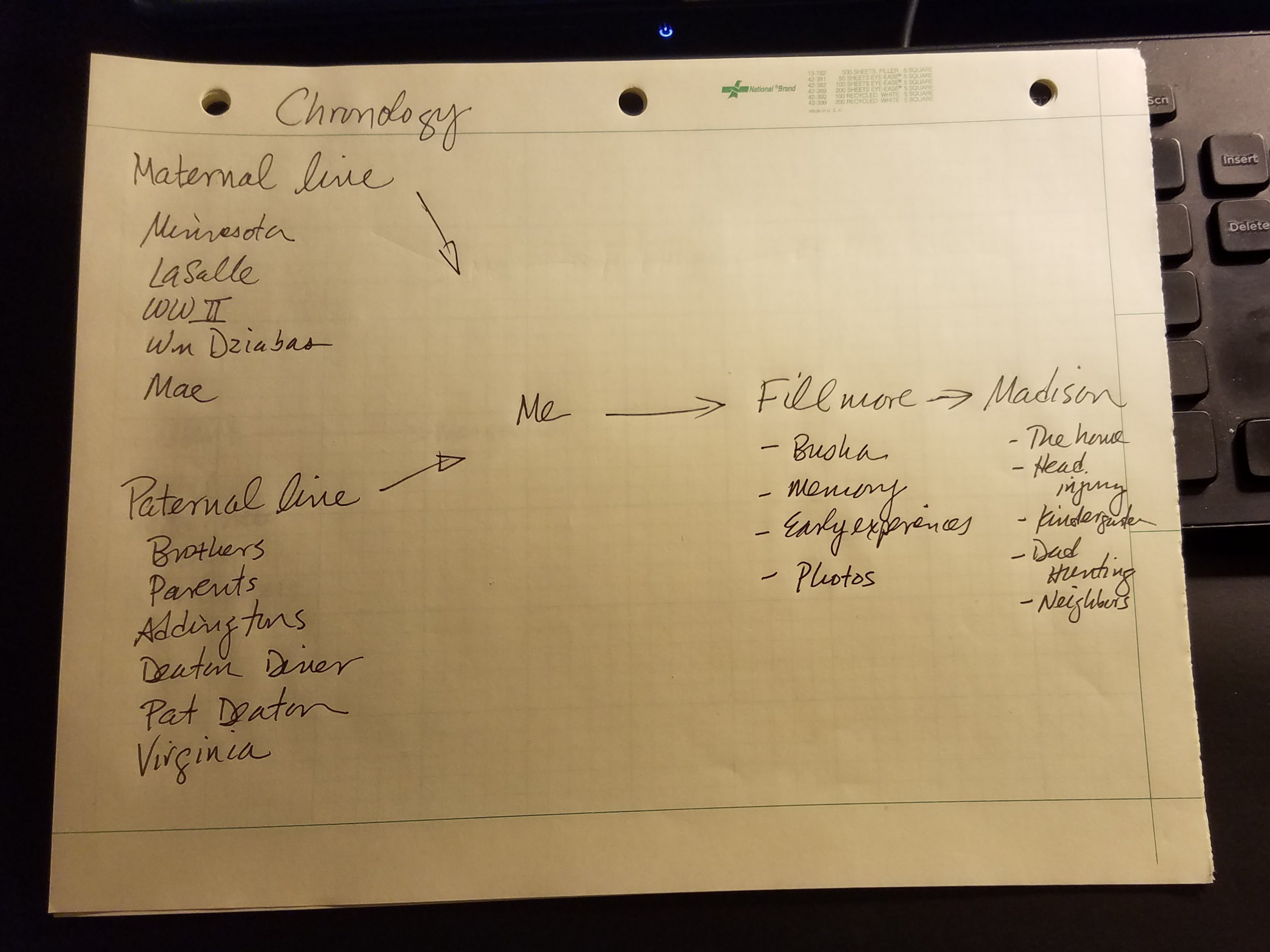
Draft Autobiography Outline

My ancestors first landed in North America in what today are the states of Virginia and Minnesota. I don’t know of any other connections but those two states.

My Virginia origins have obscure beginnings in the 17th Century. My Minnesota origins are tied to specific immigration from Poland in the 19th Century after the Civil War. I know a lot about these lines, but not as much as I may think.

Genealogy has been faddish for me. For a while a rush of interest. Then research halts and things sit for months or years. I enjoy discovering new artifacts, like the recent discovery of my parents’ wedding announcement in the newspaper. Such joy is insufficient to turn me into a consistent miner of artifacts and information. It’s been a hodge-podge endeavor from the get-go.

I hope to sustain an effort with the current memoir project. That means getting organized, developing a writing plan and sticking with it.

It is hard to determine a timeline, but necessary. Equally difficult will be choosing which parts to write about and in which order. I need to be in a place where the outline is finished and broken down into 1,000-word bites for drafting. I don’t know how long it will take to draft, edit and proof 170,000 words. Longer than expected, for sure.

The general rule is to write 1,000 words per day. By write, I mean draft because editing will take multiple amounts of the time drafting will. I expect as many as a dozen revisions, probably more. Likewise proof reading is important and time consuming. One has to get outside the narrative to a place where the literal words on the page mean nothing except for their correct spelling, grammar and elimination of redundancy and extra words. These things take time.

A couple of hours can produce 1,000 draft words with this type of work. That assumes a proper outline and work plan that puts the research into a semblance of order. It’s possible to do that.

So five steps: organize documents and artifacts, prepare an outline, create a first draft, edit and revise the draft, and proof read.

This spring is shaping up to be busy with the part time job at the home, farm and auto supply store, gardening, farm work, political work, community work, and the Food Policy Council. Somehow the memoir project needs to find a space. (I always forget to mention family. Why is that?)

I plan to continue writing this blog most days, but need to add a period of daily time to organize for writing the memoir. The photo above is a first attempt to get something on paper. There will be revisions as work continues to sustain this project.

Categories
Living in Society

Back to the Senate

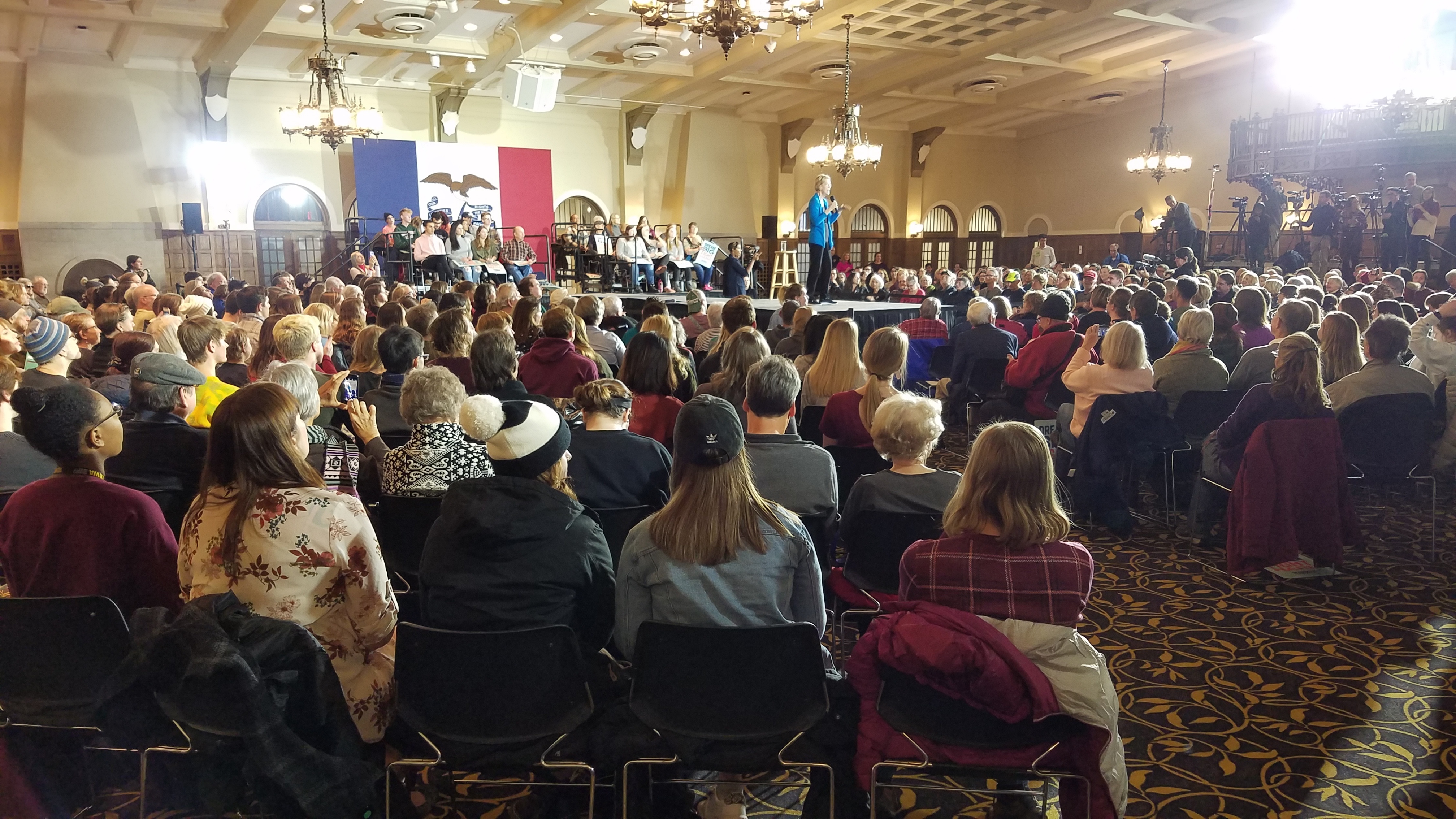
Elizabeth Warren at the Iowa Memorial Union, Iowa City, Iowa, Dec. 2, 2019.

U.S. Senator Elizabeth Warren suspended her campaign to become the Democratic nominee for president yesterday.

I will support the party’s nominee as he emerges from the summer convention. It chokes me up a bit to use the pronoun “he,” but I will support him.

More to the point, it became tiring to say the same thing over and over again during the last six months: “If Democrats don’t nominate a woman for president, we’ll never have a female president.”

While the statement is true — I don’t see Republicans nominating a women this cycle or for the foreseeable future — inherent misogyny among women and men prevented any of the highly skilled and credentialed female U.S. Senators from garnering the nomination.

To refresh our memories, they were (in the order in which they dropped out) Kirsten Gillibrand, Kamala Harris, Amy Klobuchar and Elizabeth Warren. I had issues with each of them, and that’s to be expected. The good news is they all returned to the senate, and their senate seats were never in jeopardy in their current terms.

There were and are good reasons to consider the men in the race for the presidential nomination. There are also reasons why two men advanced beyond Super Tuesday unrelated to misogyny. There is something there though. An attitude, belief, outlook, or whatever, that informed people this cycle was not a woman’s turn to get the nomination. Maybe I have some of that inside me and just can’t recognize it.

So we go on.

Here’s the email Warren sent to me and countless others yesterday morning. I felt sad as I read this in the break room at the home, farm and auto supply store. I was sad enough to recognize the feeling. Elizabeth Warren won’t be president in 2020, or probably ever. It is reassuring she will be in the U.S. Senate and has never stopped working for us.

Paul,

I’m going to start with the news. I wanted you to hear it straight from me: today, I’m suspending our campaign for president.

From the bottom of my heart, thank you for everything you have poured into this campaign.

I know that when we set out, this was not the news you ever wanted to hear. It is not the news I ever wanted to share. But I refuse to let disappointment blind me — or you — to what we’ve accomplished. We didn’t reach our goal, but what we have done together — what you have done — has made a lasting difference. It’s not the scale of the difference we wanted to make, but it matters — and the changes will have ripples for years to come.

What we have done — and the ideas we have launched into the world, the way we have fought this fight, the relationships we have built — will carry through for the rest of this election, and the one after that, and the one after that.

So think about it:

We have shown that it is possible to build a grassroots movement that is accountable to supporters and activists and not to wealthy donors — and to do it fast enough for a first-time candidate to build a viable campaign. Never again can anyone say that the only way that a newcomer can get a chance to be a plausible candidate is to take money from corporate executives and billionaires. That’s done.

We have shown that it is possible to inspire people with big ideas, possible to call out what’s wrong and to lay out a path to make this country live up to its promise.

We have shown that race and justice — economic justice, social justice, environmental justice, criminal justice — are not an afterthought, but are at the heart of everything that we do.

We have shown that a woman can stand up, hold her ground, and stay true to herself — no matter what.

We have shown that we can build plans in collaboration with the people who are most affected.

This campaign became something special, and it wasn’t because of me. It was because of you. I am so proud of how you fought this fight alongside me: you fought it with empathy and kindness and generosity — and of course, with enormous passion and grit.

Some of you may remember that long before I got into electoral politics, I was asked if I would accept a Consumer Financial Protection Bureau that was weak and toothless. And I replied that my first choice was a consumer agency that could get real stuff done, and my second choice was no agency and lots of blood and teeth left on the floor. In this campaign, we have been willing to fight, and, when necessary, we left plenty of blood and teeth on the floor. I can think of one billionaire who has been denied the chance to buy this election.

And we did all of this without selling access for money. Together, you and 1,250,000 people gave more than $112 million dollars to support this campaign. And we did it without selling one minute of my time to the highest bidder. People said that would be impossible. But you did that.

Together, we built a grassroots campaign that had some of the most ambitious organizing targets ever — and then we turned around and surpassed them.

Our staff and volunteers on the ground knocked on over 22 million doors across the country. We made 20 million phone calls and sent more than 42 million texts to voters. That’s truly astonishing. It is.

We also advocated for fixing our rigged system in a way that will make it work better for everyone.

A year ago, people weren’t talking about a two-cent wealth tax, Universal Child Care, cancelling student loan debt for 43 million Americans while reducing the racial wealth gap, breaking up big tech, or expanding Social Security. And now they are. And because we did the work of building broad support for all of those ideas across this country, these changes could actually be implemented by the next president.

A year ago, people weren’t talking about corruption, and they still aren’t talking about it enough — but we’ve moved the needle, and a hunk of our anti-corruption plan is already embedded in a House bill that is ready to go when we get a Democratic Senate.

And we also did it by having fun and by staying true to ourselves. We ran from the heart. We ran on our values. We ran on treating everyone with respect and dignity. But it was so much more. Four-hour selfie lines and pinky promises with little girls. A wedding at one of our town halls. And we were joyful and positive through all of it. We ran a campaign not to put people down, but to lift them up — and I loved pretty much every minute of it.

I may not be in the race for president in 2020, but this fight — our fight — is not over. And our place in this fight has not ended.

Because for every young person who is drowning in student debt, for every family struggling to pay the bills on two incomes, for every mom worried about paying for prescriptions or putting food on the table, this fight goes on.

For every immigrant and African American and Muslim and Jewish person and Latinx and transwoman who sees the rise in attacks on people who look or sound or worship like them, this fight goes on.

For every person alarmed by the speed with which climate change is bearing down upon us, this fight goes on.

And for every American who desperately wants to see our nation healed and some decency and honor restored to our government, this fight goes on.

When I voted on Tuesday at the elementary school down the street, a mom came up to me. She said she has two small children, and they have a nightly ritual. After the kids have brushed teeth and read books and gotten that last sip of water and done all the other bedtime routines, they do one last thing before the two little ones go to sleep: Mama leans over them and whispers, “Dream big.” And the children together reply, “Fight hard.”

So if you leave with only one thing, it must be this: Choose to fight only righteous fights, because then when things get tough — and they will — you will know that there is only option ahead of you: nevertheless, you must persist.

You should be so proud of what we’ve done together — what you have done over this past year.

Our work continues, the fight goes on, and big dreams never die.

Thanks for being a part of this,

Elizabeth