Ambient temperatures were in the low 60s on Sunday, creating a suitable environment for a yard walkabout. The report is in: Spring is coming.
The flowering bulbs were the first sign of it. Along with apple trees beginning to bud, garlic is up under the layer of straw, and lilac bushes show new growth. Most of the grass is brown and matted from recently melted snow, yet there is a bit of green scattered around the yard. The signs are unmistakable.
I assembled the portable greenhouse and moved four trays of seedlings outside. It was warm enough overnight to leave them there. I planted a flat of spinach, celery, parsley and cilantro, using up last year’s bag of soil mix. This flat went on the heating pad for germination. There remains indoor work, yet our focus can turn outdoors.
As snow continues to melt in the garden I considered where to plant early lettuce. The ground is not workable, yet soon will be. When it is the seeds can go down and there will be a lot to do.
The calendar shows 13 days until Spring. I’m already there.
A challenge of writing memoirs is conjuring memory. It’s not as simple as booting a computer.
Yesterday I wrote about a trip to Vannes, France. There is more to write. There are photographs, a trip journal, and souvenirs to aid my memory. The exchange officer trip will describe more generally what it was like working with allied troops in Europe during the late 1970s. I spent more time with the French because I studied French language and literature in high school and college. When this type of opportunity arose, there weren’t many American officers who could speak French. If there were armed conflict with the Soviet Union, my destiny would likely have been to become a liaison officer between U.S. forces and the French as part of NATO combined operations.
Clear memories of that period come to mind but they need prompting. It was a process of reading my trip journal then beginning to tell the story. After I wrote the post, I slept on it and added details this morning. I may add other things by the time those passages make it into the book. The mind retains a surprising amount of detail about our past experiences. It is a literal memory, as if one is re-living it. Part of the challenge of writing about memories is to remember the who, what, where, when and why of an experience. Our natural capacity to do this is high.
Once a memory is recalled, as it is being recalled, editing begins. Memories often seem too many, prompting the questions, what should be included? What left out? I don’t ask these actual questions, but proceed to certain details to make a point. Our mind works toward survival, and to an extent, confirming the biases of what we currently think or believe. A memoir-writer must resist that tendency. It is often hard enough just to remember what happened.
Memories don’t exist in a book or narrative for their own sake. One invokes them to serve the broader purpose in the narrative of the piece. In that there is an ideology being supported. While there is an emotional engagement in evoking memories, for a memoir writer there is a reason a specific memory appears in the text. It must serve the point of the book. Unlike the younger me in yesterday’s post, one has to learn to control the amount of pastis consumed as your hosts line up drinks in front of you. Otherwise you’ll get drunk on the memories and become unable to write anything worth reading.
I continue to be at the point of determining what I can remember of my life. The next step is setting priorities and tying memories to the themes of the book. My inclination is to use the strongest memories, most of which I have written about previously, because that is what has become important to me. At the same time, I am finding new meaning in what I remember. That, too is important for consideration. In some ways, it is the point of writing a memoir at all. If we aren’t willing and able to transcend what we already believe about our lives in society, then it hardly seems worth the effort.
Dealing with memory in a practical way is another reason the editing of drafts takes so long. I believe the effort and time spent will be worth it.
In the isolation of the coronavirus pandemic, weekends are less of a thing. Days go by. Without a calendar, one day can’t be distinguished from another. Even before the pandemic, when I worked full time, the idea of a Monday through Friday work week followed by a weekend was seldom reality.
Perhaps the best expression of weekend culture I experienced was in June 1977, while on temporary duty with the French Infantry Marines in Brittany. I arrived on a Friday and was whisked away to a small cafe where at once we began putting away cognac while introducing ourselves. After checking into lodging and changing clothes, there was an afternoon meet up at the officers’ club with more pastis than I can remember as officers kept buying rounds. This was followed by an evening dinner with Chinese-style food, champagne and wine at the home of a field grade officer.
Saturday morning was free time. I walked from my room to downtown Vannes where I observed women making lace near the sea as had been done for generations. Rejoining my host and a friend, we dined that evening at a restaurant serving oysters of Locmariaquer. Although I’d never eaten oysters, we ordered the signature, regional dish and chatted over the meal. After dinner we went to a dance with a live band and were out late.
I began Sunday with a run. It became a day of eating and drinking again with an afternoon meal at a private home, followed by a dinner of snacks from the ice box and pantry at my host’s apartment. By Monday I felt somewhat “poisoned in my veins” from all the food and drink of the weekend. Maybe one needs to drink alcohol for a weekend to exist. Given the popularity of beer with televised sports, I’m not wrong.
In retirement, even without the pandemic, the weekend is a bit challenging. Since we’re mostly at home and have no relatives living close, there’s little to distinguish it from the rest of the week. In a usual scenario the weekend is centered around meals with home made pizza Friday night, home made soup on Saturday, and Sunday night open as we prepare to begin the next week.
When young, attending church services was part of the weekend. I remember the change of Vatican II when we could attend Mass Saturday afternoon instead of Sunday. In some ways, attending church framed the weekend when I still lived at home. The churches near Big Grove don’t really fit. Instead of church, I read on Sunday afternoons and often take a nap.
Our daughter began streaming last year. She streams a crafting program Sunday afternoons in which I usually participate. With this, meals, and a life to live, we’ll eventually assemble some kind of weekend normalcy. The pandemic has been sobering to the detriment of how I remember the weekend. The good news is there is a chance to re-invent it for the better.
Like with anything we must make the most of what opportunities present themselves.
Getting a late start today, and no, I didn’t stay up late to hear the full U.S. Senate reading of the American Rescue Plan. Here’s one of my favorites songs. Make it a great Friday!
For the longest time I planned to write about the year 1969. That is, until I adjusted to Father’s death. It’s likely best I let go of the research and accumulation of books about the year. They got in the way of so much living. Yet I wrote this post in August 2010. It captures something I’m likely to forget after moving on. Something that seems missing.
The last memory I have of my father while he was living escapes me. His death in February of 1969 was a hard pill to swallow and it occupied my awareness for a number of years after the funeral. I remember discussing my application to the University of Iowa with him and what I should do with my life. He had no input really. I had adolescent doubts about what I should make of myself. At school we were taught to take the decisions we made regarding career and education seriously. My memory is that advanced education was beyond the ken of what he could comment upon, although he seemed supportive of the idea of my leaving home to attend the university.
I remember riding in our car with him, listening to Mason Williams’ song “Classical Gas.” In explaining why I believed the song to represent an important coalition between classical and popular music, he kept on driving. With my savings from working at the discount store, I purchased a record player and we listened to Glenn Campbell’s rendition of “Wichita Lineman” while he adjusted the settings on the phonograph. He aspired to learn how to play the guitar, but it was an idea that he did not execute upon. He would finger the strings of the Kay guitar that I got with King Korn stamps redeemed the winter after the Beatles appeared on the Ed Sullivan Show. That was it.
Toward the end, his life was one of trying to get out of the slaughterhouse. First he tried working for the labor union, but that did not fit. He decided to finish college to become a chiropractor and during those years, we did not see much of him. In the end, he didn’t pass his board exams, but he was considering joining our church so that he could expand his client list.
I once hoped to write about life in 1969, but not any more. The regenerative aspect of vegetable growing and the opportunity to process and cook the produce in our kitchen is my calling. I missed having a father all these years and have adjusted. I should work on regenerating some of the missing memories this year.
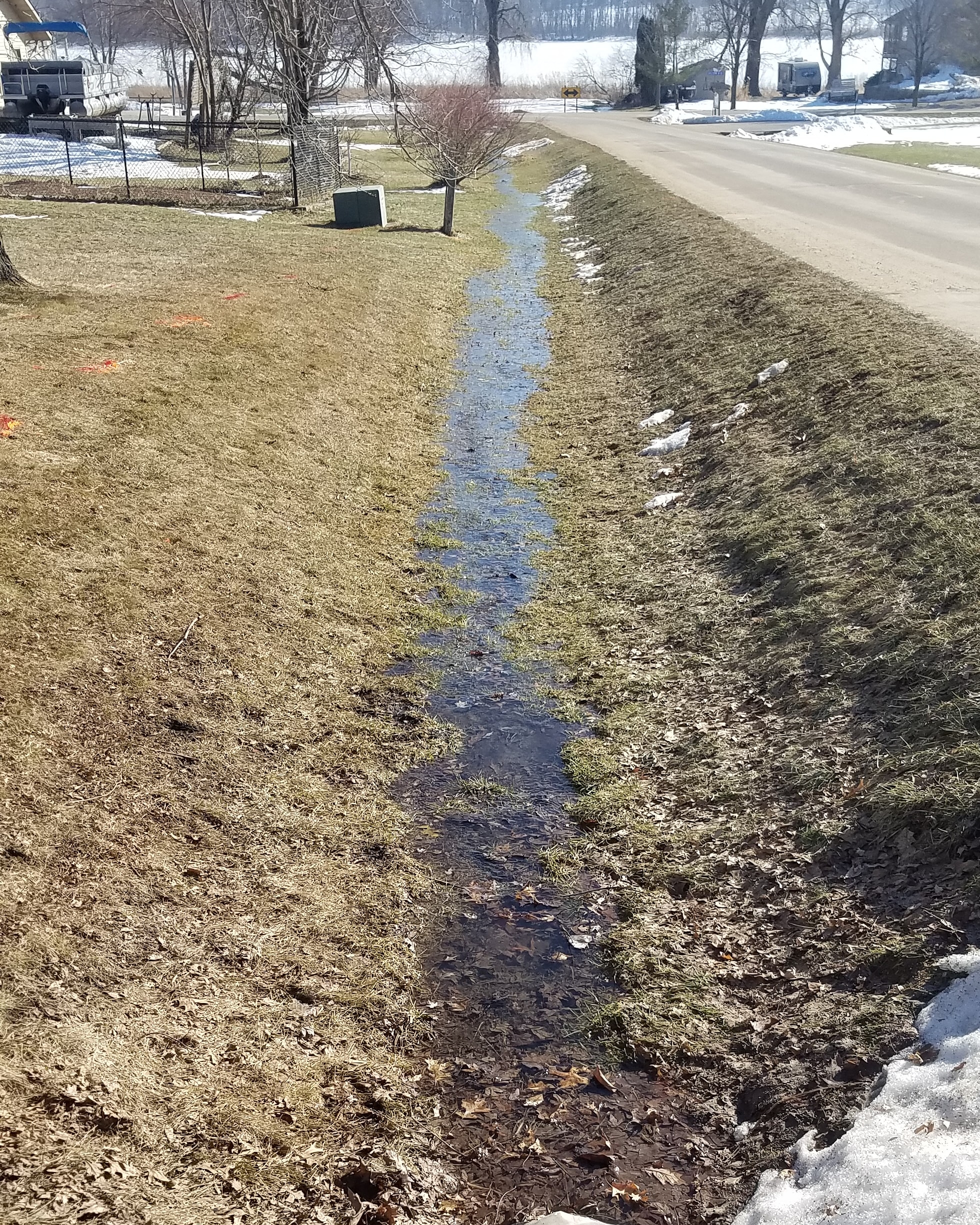
Snow melt began running in the ditch yesterday as late winter progresses in Big Grove. I doubt we will get more snow. It’s been pretty dry for the last nine days. The dry, cold weather combined with a substantial snow melt is a cause for concern.
What fraction of the snow melt leaves our property is bound for the state park lake a little more than a hundred yards away, then to the Iowa River which is a tributary to the Mississippi River.
The Mississippi River’s drainage basin is the third largest in the world, exceeded in area only by the Amazon’s and the Congo’s. It stretches over 1.2 million square miles and encompasses 31 states and slices of two Canadian provinces.
Under a White Sky: The Nature of the Future by Elizabeth Kolbert.
In 1966 I kept a scrapbook of newspaper clippings as an eighth grade project. Late winter, beginning in February that year, an ice jam hit the Quad-Cities area, resulting in flooding.
Unprecedented in size and steadily growing larger, a seven-mile-long “glacier” of ice is, like a giant cork, plugging the main channel of the Mississippi River from Credit Island to Buffalo.
Quad-City Times, Feb. 20, 1966.
My comparison of the ice jam was with the 1965 Mississippi River flood, one of the worst in Iowa history.
The great flood of 1965 on the Mississippi River, along the eastern border of the State, exceeded any flood known in 139 years. It caused damages probably in excess of ten millions of dollars in the State of Iowa. … The underlying cause of the flood was an abnormally cold winter which prevented the melting of an excessive snow cover in the upper reaches of the basin. Heavy rains late in March followed by rapid melting triggered the runoff which caused the floods.
The 1965 Mississippi River Flood in Iowa by Harlan H. Schwob and Richard E. Myers, United States Geological Survey, October 1965,
We are in that scenario — a cold winter which prevented snow melt the first two months of the year — at least until now. If the weather remains dry, the Mississippi may not flood downstream. If we get rain, there could be record flooding. Here’s hoping rain holds off until the snow melts. I say this despite the drought parts of Iowa have experienced this winter.
The 1965 and 1966 flooding formed my outlook about floods and how they happen. It is important to note the City of Davenport chose to do nothing to prevent the levee from flooding after these floods. City officials said it was to preserve the look of the levee, which later became the home of a jazz festival celebrating native son Bix Beiderbecke. Annual flooding and the damage it caused was acceptable in favor of aesthetics. At the time of the decision, the Quad-Cities was under economic pressure because businesses were curtailing manufacturing there. The economic boost of Bix made a difference, they said.
I visited the confluence of the Missouri and Mississippi Rivers near Saint Louis with an eighth grade classmate some years ago. It’s a lot of water, as far as one can see. The idea there is an engineering solution to tame the Mississippi basin seemed preposterous when standing at water level and seeing the vast mixing of the two differently colored rivers. I doubt it can be done, especially with the unpredictable nature of climate change and how it is changing the hydrology of the Mississippi basin. The massive engineering projects to control the river in the Mississippi delta have made it a kind of hybrid human-nature phenomenon as Kolbert describes in her book.
A lot has happened (since 1989) to complicate the meaning of “control,” not to mention “nature.” The Louisiana delta is now referred to by hydrologists as a “coupled human and natural system,” or for short, CHANS. It’s an ugly term — another nomenclature hairball — but there’s no simple way to talk about the tangle we’ve created.
Under a White Sky: The Nature of the Future by Elizabeth Kolbert
The river will eventual prevail in the Mississippi delta, despite humans’ best efforts, it’s easy to predict.
Each spring I think of our connection to the river and our place in the Mississippi basin. Ours may be a small role, yet it serves as another way we are connected to the rest of the world. As I contemplate working outdoors today, it is difficult to forget how powerless humans are against what’s left of the natural world.
The specificity of the garden project is comforting. There is a clear beginning and end. The work product will be useful. It is eminently do-able in a single work shift. I crave more of that over the complicated and grand-scale projects lingering on my to-do list. I yearn for resolution of the vagaries of living in the coronavirus pandemic.
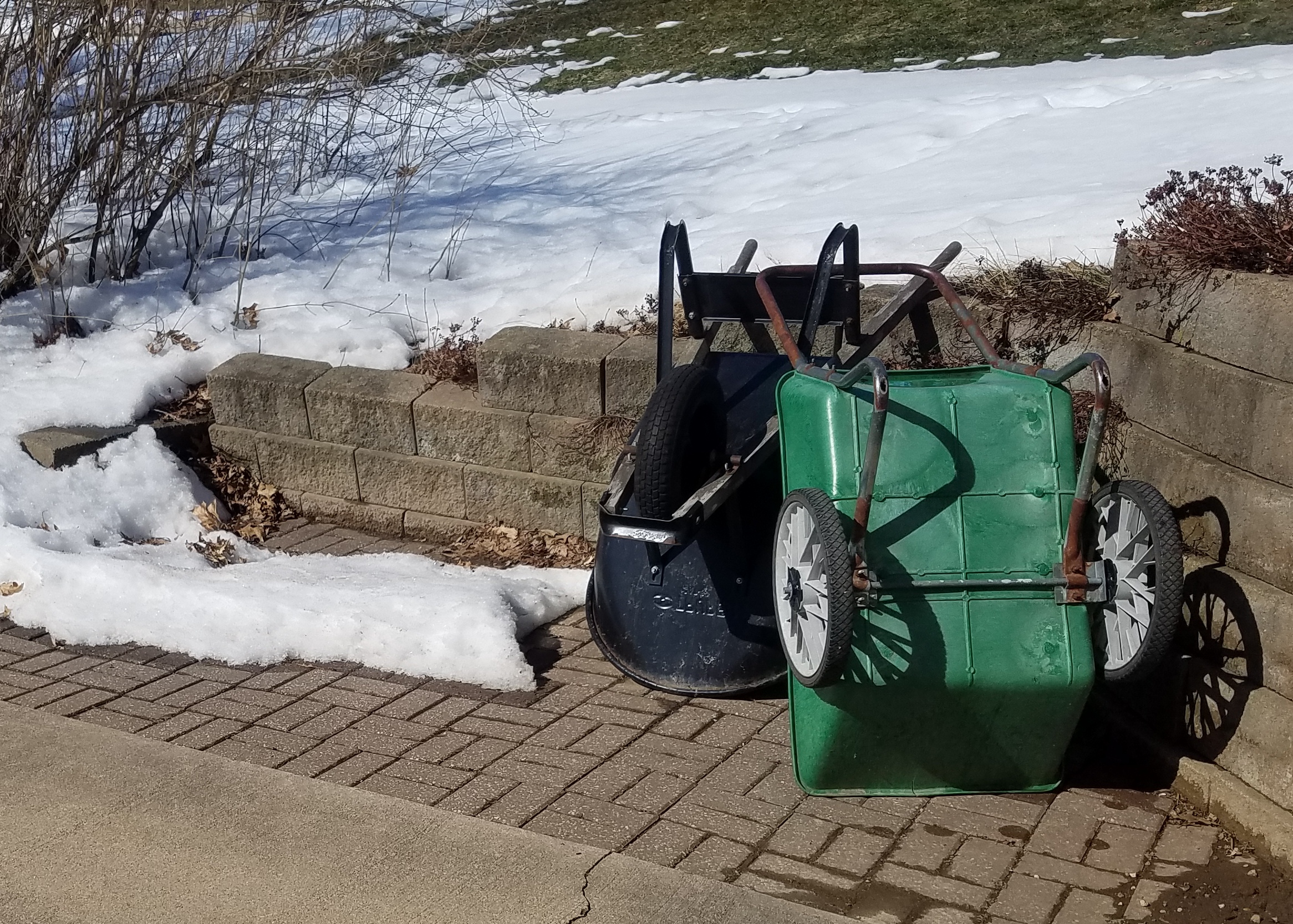
When the Aug. 10, 2020 derecho shook loose buckets of sand anchoring the portable greenhouse to the bricked pad, its time had come. The wind lifted the greenhouse straight up in the air and tumbled it into the next door neighbor’s yard, destroying it.
I bought a replacement as I’ve come to rely on having my own greenhouse to start seeds and store garden seedlings.
Snow cover melted enough to shovel the rest of the pad and install the new greenhouse. The road in front of our house is dry so I can sweep road sand into buckets to hold this one down. It will be the first outdoors project other than snow removal this year.
The coronavirus pandemic created vagaries that plague us in daily life. The governor’s most recent proclamation found me in the “vulnerable Iowan” category because I’m over 65 years of age. She encourages me to continue to limit my activities outside home, and encourages others to stay away from me. Fine. I’ve done that by provisioning in town every other week. Provisioning trips were the only time I left the property since the proclamation was released Feb. 5. Everything else we need, which isn’t much, we get delivered to home. This part is easy.
We are scheduled for a booster of the Pfizer COVID-19 vaccine on March 19. The pharmacy sent a confirmation email yesterday. What happens after that is unclear. Epidemiologists say we are waiting until presence of the coronavirus in the community is limited. Not sure what that means. There is no reasonable indication of what social behavior in the post-pandemic world looks like. I’m thinking of getting rid of the personal-sized pizza pans I use for entertaining. Should I?
I look forward to sweeping up the road sand and clearing the space for the portable greenhouse. It’s something to latch onto and call finished in a day. Yet I yearn for more, for resolution of the uncertainty of our current lives. It’s not existential angst. It’s simple things like how many gallons of skim milk should I buy at the warehouse club. If things were normal, the number would be one.
I need the greenhouse space soon andplan to work on the project as winter snow melts in Iowa. After that, I’ll pick another, then another, until a sense of normalcy returns.
Snow covers much of the ground as March begins. Last year I planted kale in the greenhouse on March 1. This year the seedlings have four leaves on them today thanks to a heating pad and grow light downstairs.
The farm posted photos of their onion starts and mine look similar. That’s a good thing, bringing hope onion planting and harvest will go well. It’s going to be a great gardening year, I can feel it.
The word count on my writing stalled around 150,000 words. Mostly, it’s because of the larger than expected need for editing. It’s also attributable to a lack of organized research materials combined with the reworking of written passages as new information returns to mind. If I plan to finish this book by the end of the year — and I do — I need to clear the Spring ice jam.
I’m reasonably consistent at producing a daily blog post, yet the longer project has distinct challenges. I spent the last two months mostly indoors, considering my life, and producing a lot of words. What I didn’t know before, and do now, is I can’t go into the same detail as I may want to get the book done by December. Also, there is more editing time than writing a first draft, a lot more.
The press of March is also a factor. More of my time will be spent outdoors, making the early morning writing shift more valuable. I don’t know what that means presently, except more of that time should be reserved for book writing. I do want to finish something by 2022.
This week’s planting schedule is for collards, spinach, and more celery and herbs. Each week there will be more gardening tasks to include until by April, gardening will dominate my days. I knew that going in. On March 1, I’m there.
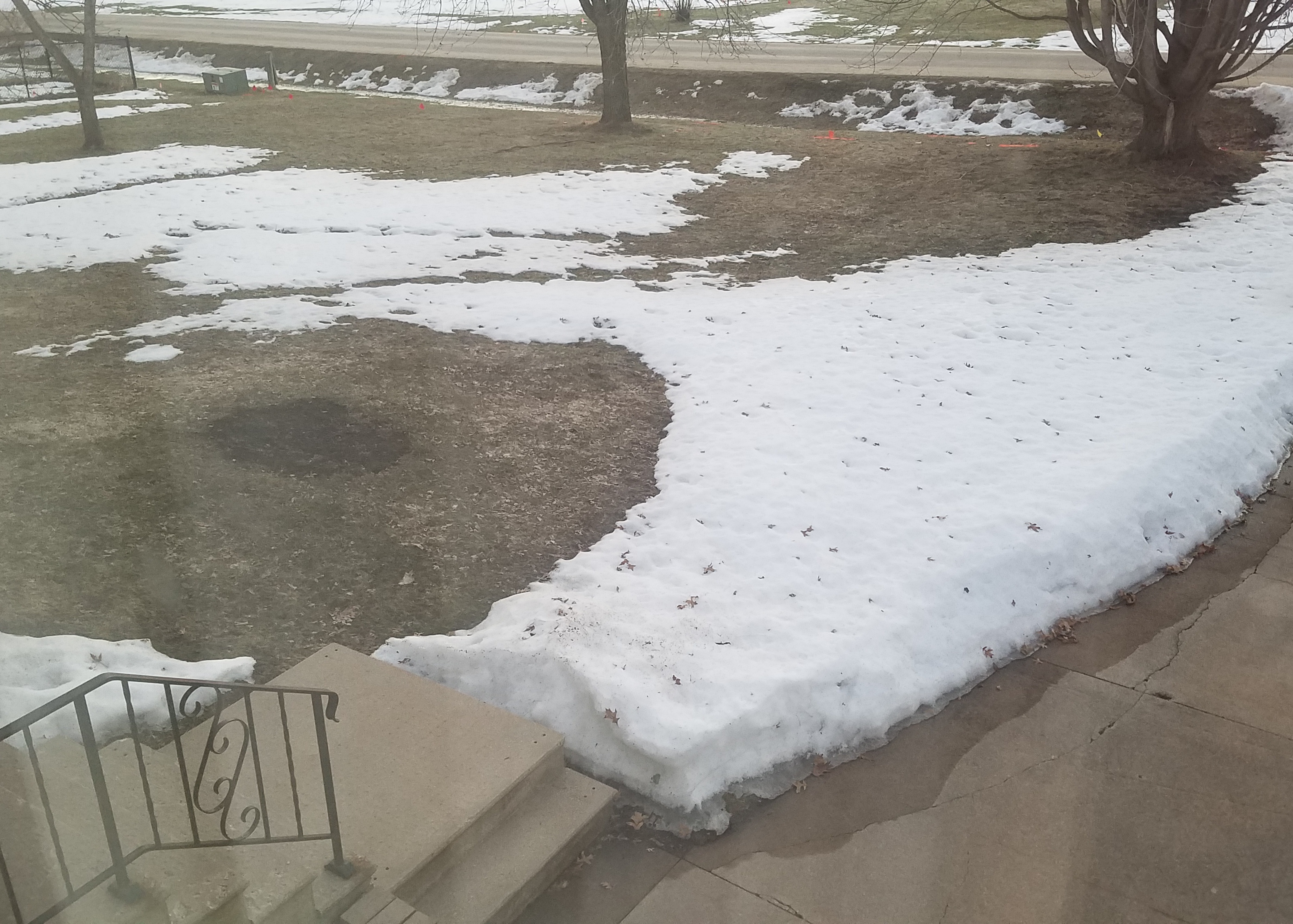
The thaw began and there is no stopping it. The ground remained covered with snow for most of February, yet no more. Snow cover is slowly melting and will soon be gone. Above the septic tank was first to go.
36 hours after the COVID-19 vaccination I still feel normal. Even the soreness around the injection spot feels better. I emailed the farm to see if we can make arrangements for my return after the booster shot in a couple of weeks. The farmers are all twenty and thirty somethings so their priority group has not been approved for vaccination yet. There are protocols to negotiate before making my way back to farm work.
I applied to be a mentor in the Climate Reality Leadership Corps U.S. Virtual Training beginning on Earth Day. There are three virtual trainings this year, one in the U.S., one for Latin America, and one global training. To find out more, follow this link. If I’m accepted, this would be my third time attending, the second as a mentor. I’m feeling bullish about reengaging in society after getting the first dose of vaccine.
Democrats got solidly beaten in the 2020 Iowa general election. I’m not sure what I want to do to help rebuild the party. I’m also not sure the party can be rebuilt in a way to win elections anytime soon. In any case, it’s time for the next generation to take the reins. While I will remain supportive, I’m stepping back. Politics won’t be a priority as we slowly exit the coronavirus pandemic.
Getting out of the pandemic is a first priority. We are doing our part to follow the governor’s guidelines and hope others will too. What’s certain is I’m getting spring fever and can’t wait to get outside and do normal things again. It’s only three weeks until Spring!
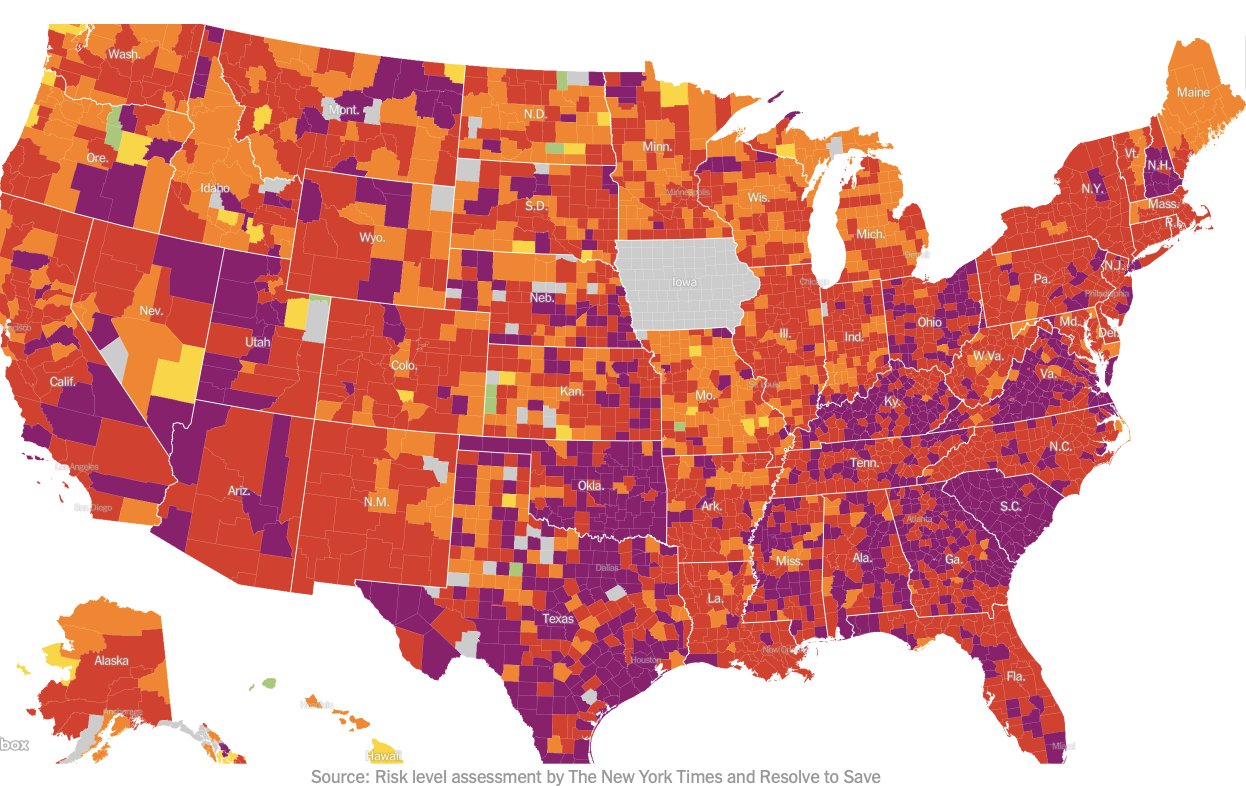
New York Times COVID-19 Tracking Map Feb. 26, 2021. Iowa ceased reporting by-county statistics last week.
The science of inoculation for infectious disease has long roots. “Inoculation against smallpox is believed to have been practiced in China as far back as 1000 BC, and is reported to have been common in India, Africa, and Turkey prior to its introduction into western societies in the 18th century,” Matthew Niederhuber wrote while at Harvard University.
There continues to be debate in he United States about inoculation and its cousin vaccination. That is, if by debate one means people jabbering at each other without knowing what the heck they are talking about.
I got the first of two doses of the Pfizer COVID-19 vaccine the first opportunity I had at 2:15 Central Time on Feb. 26, 2021. I was chair of the county board of health. What would you expect me to do but get it? A vast majority of people should get vaccinated if they have the chance, close to 100% of the population. It is up to government to make sure they have the chance. Whether enough will is an open question.
The program that brought a vaccination clinic to our community — with dozens of volunteers and a sophisticated level of logistical organization and expertise — was part of the Biden-Harris administration’s effort to speed up vaccination by distributing the vaccine through commercial pharmacies. The time line is short and simple. On Feb. 2 — 13 days after inauguration — the White House announced the First Phase of the Federal Retail Pharmacy Program for COVID-19 Vaccination. Three days later, on Feb 5, I received the first of several organizing phone calls to create a mass clinic, a partnership between the local pharmacy, the Solon Senior Advocates and a community church. Yesterday and today is the clinic for which all appointments are taken. The action was swift and effective. It was the result of a president who knows what he is doing in a public health emergency.
The State of Iowa is not that well organized. A Republican lawmaker asserted this week at the State House the pandemic was over. The Iowa Department of Public Health ceased reporting a by-county breakdown of key statistics related to the pandemic. Republicans literally pretend the state is ready to get back to normal even if the coronavirus doesn’t care about that. Surviving a pandemic is one of the reasons we need a strong federal government: states like ours can’t get needed things done.
Our city’s only pharmacy coordinated arrival of the vaccine and the event. They hoped to vaccinate 500 people using Iowa Department of Public Health criteria, including people like me who are more than 65 years old. The clinic is a 65+ only event organized by groups that work with senior citizens constantly.
If we are lucky, and that’s a big if, things will resemble normal again come the end of year holidays or in the first half of 2022. That is a conservative estimate based on input from the scientific community that works with infectious disease.
Let me go back to the first paragraph about the introduction of inoculation to prevent infectious disease in Western societies.
On a November day in 1721, a small bomb was hurled through the window of a local Boston Reverend named Cotton Mather. Attached to the explosive, which fortunately did not detonate, was the message: “Cotton Mather, you dog, dam you! I’ll inoculate you with this; with a pox to you.’’ This was not a religiously motivated act of terrorism, but a violent response to Reverend Mather’s active promotion of smallpox inoculation. The smallpox epidemic that struck Boston in 1721 was one of the most deadly of the century in colonial America, but was also the catalyst for the first major application of preventative inoculation in the colonies. The use of inoculation laid the foundation for the modern techniques of infectious diseases prevention, and the contentious public debate that accompanied the introduction of this poorly understood medical technology has surprising similarities to contemporary misunderstandings over vaccination.
This was the same Cotton Mather involved with the 1692 witchcraft episode in Salem Village. Mather and his father, Increase Mather, are often blamed for a fanning the flames of public hysteria and delusion born of ignorance and superstition of the time regarding witchcraft. Not so fast, wrote historian Stow Persons in American Minds. Witchcraft is more complicated than that. So it is with inoculation and vaccination. Cotton Mather’s redeeming grace, even to the most skeptical modern readers, was related to introduction of inoculation to prevent smallpox. Here’s what you might not know.
Cotton Mather is largely credited with introducing inoculation to the colonies and doing a great deal to promote the use of this method as standard for smallpox prevention during the 1721 epidemic. Mather is believed to have first learned about inoculation from his West African slave Onesimus, writing, “he told me that he had undergone the operation which had given something of the smallpox and would forever preserve him from it, adding that was often used in West Africa.’’
During Black History Week I’m highlighting the source of the idea of inoculation and vaccination in Cotton Mather’s African slave. The lessons to take from this weekend’s clinic in Solon are cultures other than American made significant contributions to the science of infectious disease, the federal government must be involved in mitigating a pandemic like the coronavirus, and sticking one’s head in the sand of ignorance won’t get us back to normal in a post pandemic society.
We must act positively in our communities and in conjunction with scientific experts. If such experts are not available at the state level, then we do what we can ourselves, including local coordination of federal programs.





 Journey Home
You must be logged in to post a comment.