I just finished reading Mary Karr’s The Art of Memoir and it inspired me to write this introduction to my autobiography. I don’t know if I’ll use it, but I think it works toward identifying my voice in the narrative, as she suggests we should. There will be revisions in the coming months and years as I continue to work on the book. Feedback welcome in the comments.
This memoir was written in the unfinished lower level of the split foyer home we built in 1993. We thought we would have finished our home by now. In a not-specific year I framed a couple of rooms with two by fours and installed drywall and book shelves in what would eventually be my writing place. The county assessor got wind of the improvement and sent someone out to inspect. They decided to wait until I finished before increasing the assessed value. Piles of building materials bought at the time remain stacked around the space. The current lumber shortage has me thinking about selling the two by fours.
I can’t say when finishing the house will be on the agenda. However, finishing this book is front and center.
We have a wireless router that connects everything. Who in my cohort doesn’t? What’s significant about the library table surrounded by book shelves is not the Dell desktop resting on it. This refuge is a chance to get away from the internet and be the person I am with my successes and failures. My non-internet traffic is more valuable than what I write online.
Our arrival in Big Grove Township coincides with broad adoption of internet service providers. Before mobile telephones, I used a pager and stopped at a phone booth to answer a page. It felt a bit risky, especially when I stopped near the Robert Taylor Homes on the South Side of Chicago at a well-lit bank of payphones. It’s what we had and truck drivers who paged me couldn’t wait.
I used a typewriter until we lived in Indiana, when we got a word processor with a dot matrix printer. In Iowa, we got our first home computer in 1996. The accelerated pace of improved personal communications since then was unlike anything we knew. This impacted this memoir.
In the chronological first part of my life I’m dealing with experiences, memories and outside sources to create a narrative. My memory is faulty. The majority of my experience is embedded in me or in boxes of photographs and papers. Growing up during the time of Polaroid and Eastman Kodak, the photographic record is significant. Likewise, the boxes of documents going back to kindergarten have a lot of information in them. Old documents, like my parents’ wedding announcement, may exist online but most of my remembrance of those days is a physical presence not far from me. The act of selection for inclusion in this book had a significant influence on the narrative.
My memory and experiences are subject to interpretation and people’s remembrances of them differ. Like any memoir author, I had to address that before presenting the finished work. This book is an effort to tell the truth and say what I know about my life as best I can.
The story relies less on memory after graduation from university when I started a hand-written journal. The continuous written record since then was enhanced by the adoption of email, social media, and personal blogs. Digital photography was an important aspect of the record beginning in 2007. There is plenty to draw upon and it can be quoted as-is, avoiding the interpretation of others.
My view of the world is flawed. What I see isn’t always what others see, and that’s what could be a reason to read further. Perhaps the most clarifying part was writing the story of my Polish ancestors in Minnesota. Drawing on memory, artifacts, my personal journal, and interviews with local informants, it became clearer than ever the kind of people from whom I rose. It revealed a type of life that could provide meaning in an rapidly changing social environment.
It is abnormally dry in our part of Iowa. Just as we are needing rain, we are not getting it. A home gardener can irrigate new trees, fruits and vegetables, but the massive scale required to hydrate Iowa’s main commodity crops and livestock is not available. Creating the infrastructure to pump water from ancient aquifers is doable, yet an unsustainable practice. It seems like we are heading into a drought. (The map is from the state climatology website which provides data about precipitation, temperature and other aspects of the climate).
Iowans are familiar with drought. In the 2012 drought corn yield per harvested acre was 123.1 bushels compared to the average of the seven following years at 170.4 bushels. The drought decreased corn production by 27.8 percent according to USDA numbers.
There is a relatively finite amount of water on Earth which cycles through the atmosphere, on land, and in the oceans. Some of it rests in deep underground aquifers where it has been since prehistoric times. An increasingly warm climate impacts how water cycles and it is getting hotter. “Earth’s global average surface temperature in 2020 tied with 2016 as the warmest year on record,” according to an analysis by NASA. The oceans are getting warmer too.
Rising air and water temperatures and changes in precipitation are intensifying droughts, increasing heavy downpours, reducing snowpack, and causing declines in surface water quality, with varying impacts across regions. Future warming will add to the stress on water supplies and adversely impact the availability of water in parts of the United States.
The problem goes beyond Iowa. The Hoover Dam, located on the Colorado River near the Nevada-Arizona border, is suffering the consequences of drought. Lake Mead, the artificial lake created by the dam, is at a lower water level than was when it was built. The water shortage will impact 25 million people including in the cities of Los Angeles, San Diego, Phoenix, Tucson and Las Vegas.
Farmers are abandoning crops, Nevada is banning the watering of about one-third of the lawn in the Las Vegas area, and the governor of Utah is literally asking people to pray for rain.
Firefighters are facing worsening conditions this summer — after nearly 10,000 fires in California alone during the last wildfire season burned 4.2 million acres (1.7 million hectares), an area nearly as large as Kuwait.
Water in California’s Lake Oroville will fall so low this summer that its hydroelectric power plant may be forced to shut down for the first time.
We must do something more than pray for rain. It begins with recognition.
The Lakota phrase “Mní wičhóni” (“Water is life”) was the protest anthem from Standing Rock heard around the world, but it also has a spiritual meaning rooted in Indigenous world views. For Native Americans, water does not only sustain life, it is sacred.
Action to prevent drought must include acknowledging that climate change is real, something Senators Chuck Grassley and Joni Ernst have both done. The next step is addressing the climate crisis through policy and legislation and that’s been the rub. The climate crisis is more complicated than any single policy or law.
Peter Rolnick of Citizen’s Climate Lobby wrote a guest opinion in the Cedar Rapids Gazette on June 15, 2021. He commended the Iowa senators and Rep. Cindy Axne for supporting the bipartisan Growing Climate Solutions Act. If passed, the law would engage farmers in storing more carbon in our soil instead of emitting it into the air in the form of carbon dioxide or methane. The relationship to drought is clear. A molecule of CO2 or methane sequestered in the ground is one that does not get into the atmosphere and increase warming. Even the American Farm Bureau is in favor of this bill, which on its own raises red flags. One bill is not enough.
We need much more in the way of policy and legislation. The Biden administration’s approach of embedding work on climate change in each of the executive branch departments is important. It is up to each of us to encourage those in government to work toward viable climate solutions. There are personal actions we can take to reduce our carbon footprint, yet the most effective action is in the government arena. If constituents don’t remind members of our governing bodies to act on the climate crisis, they seem likely to forget.
We’ll know it when we hit the drought this year. News media has been forthright in reporting it because so many Iowa livelihoods depend upon the weather. When will we wake up to take action to address what is causing the drought? Not soon enough.
Advertisement for the sale of President Thomas Jefferson’s slaves.
The president’s remarks on signing a law to make Juneteenth a federal holiday.
East Room – 3:51 P.M. EDT
THE PRESIDENT: Thank you, thank you, thank you.
Well, thank you, Madam Vice President.
One hundred and fifty-six years ago — one hundred and fifty-six years — June 19th, 1865 — John, thanks for being here — a major general of the Union Army arrived in Galveston, Texas, to enforce the Emancipation Proclamation and free the last enslaved Americans in Texas from bondage. A day, as you all know — I’m going to repeat some of what was said — that became known as Juneteenth. You all know that. A day that reflects what the Psalm tell us: “Weeping may endure for a night, but joy cometh in the morning.”
Juneteenth marks both the long, hard night of slavery and subjugation, and a promise of a brighter morning to come. This is a day of profound — in my view — profound weight and profound power.
A day in which we remember the moral stain, the terrible toll that slavery took on the country and continues to take — what I’ve long called “America’s original sin.”
At the same time, I also remember the extraordinary capacity to heal, and to hope, and to emerge from the most painful moments and a bitter, bitter version of ourselves, but to make a better version of ourselves.
You know, today, we consecrate Juneteenth for what it ought to be, what it must be: a national holiday. As the Vice President noted, a holiday that will join the others of our national celebrations: our independence, our laborers who built this nation, our servicemen and women who served and died in its defense. And the first new national holiday since the creation of Martin Luther King Holiday nearly four decades ago.
I am grateful to the members of Congress here today — in particular, the Congressional Black Caucus, who did so much to make this day possible.
I’m especially pleased that we showed the nation that we can come together as Democrats and Republicans to commemorate this day with the overwhelming bipartisan support of the Congress. I hope this is the beginning of a change in the way we deal with one another.
And we’re blessed — we’re blessed to mark the day in the presence of Ms. Opal Lee. As my mother would say, “God love her.” (Applause.)
I had the honor of meeting her in Nevada more than a year ago. She told me she loved me, and I believed it. (Laughter.) I wanted to believe it. (Laughs.) Ms. Opal, you’re incredible. A daughter of Texas. Grandmother of the movement to make Juneteenth a federal holiday.
And Ms. Opal is — you won’t believe it — she’s 49 years old. (Laughter.) Or 94 years old, but I — (laughter). You are an incredible woman, Ms. Opal. You really are.
As a child growing up in Texas, she and her family would celebrate Juneteenth. On Juneteenth, 1939, when she was 12 years old, the white — a white mob torched her family home. But such hate never stopped her any more than it stopped the vast majority of you I’m looking at from this podium.
Over the course of decades, she’s made it her mission to see that this day came. It was almost a singular mission. She’s walked for miles and miles, literally and figuratively, to bring attention to Juneteenth, to make this day possible.
I ask, once again, we all stand and give her a warm welcome to the White House. (Applause.)
As they still say in the Senate and I said for 36 years, “if you excuse me there for a point of personal privilege,” as I was walking down, I regret that my grandchildren aren’t here because this is a really, really, really important moment in our history.
By making Juneteenth a federal holiday, all Americans can feel the power of this day, and learn from our history, and celebrate progress, and grapple with the distance we’ve come but the distance we have to travel, Jim.
You know, I said a few weeks ago, marking the 100th anniversary of the Tulsa Race Massacre, great nations don’t ignore their most painful moments. Great nations don’t ignore their most painful moments. They don’t ignore those moments of the past. They embrace them. Great nations don’t walk away. We come to terms with the mistakes we made. And in remembering those moments, we begin to heal and grow stronger.
The truth is, it’s not — simply not enough just to commemorate Juneteenth. After all, the emancipation of enslaved Black Americans didn’t mark the end of America’s work to deliver on the promise of equality; it only marked the beginning.
To honor the true meaning of Juneteenth, we have to continue toward that promise because we’ve not gotten there yet. The Vice President and I and our entire administration and all of you in this room are committed to doing just that.
That’s why we’ve launched an aggressive effort to combat racial discrimination in housing — finally address the cruel fact that a home owned, to this day, by a Black American family is usually appraised at a lower rate for a similar home owned by a white family in a similar area.
That’s why we committed to increasing Black home ownership, one of the biggest drivers of generational wealth.
That’s why we’re making it possible for more Black entrepreneurs to access — to access capital, because their ideas are as good; they lack the capital to get their fair — and get their fair share of federal contracts so they can begin to build wealth.
That’s why we’re working to give each and every child, three and four years of age, not daycare, but school — in a school. (Applause.)
That’s why — that’s why we’re unlocking the incredibly creative and innovation — innovation of the history — of our Historical Black Colleges and Universities, providing them with the resources to invest in research centers and laboratories to help HBCU graduates prepare and compete for good-paying jobs in the industries of the future.
Folks, the promise of equality is not going to be fulfilled until we become real — it becomes real in our schools and on our Main Streets and in our neighborhoods — our healthcare system and ensuring that equity is at the heart of our fight against the pandemic; in the water that comes out of our faucets and the air that we breathe in our communities; in our justice system — so that we can fulfill the promise of America for all people. All of our people.
And it’s not going to be fulfilled so long as the sacred right to vote remains under attack. (Applause.)
We see this assault from restrictive laws, threats of intimidation, voter purges, and more — an assault that offends the very democracy — our very democracy.
We can’t rest until the promise of equality is fulfilled for every one of us in every corner of this nation. That, to me, is the meaning of Juneteenth. That’s what it’s about.
So let’s make this June- — this very Juneteenth, tomorrow — the first that our nation will celebrate all together, as one nation — a Juneteenth of action on many fronts.
One of those is vaccinations. Tomorrow, the Vice President will be in Atlanta on a bus tour, helping to spread the word, like all of you have been doing, on lifesaving vaccines.
And across the country this weekend, including here in Washington, people will be canvassing and hosting events in their communities, going door-to-door, encouraging vaccinations.
We’ve built equity into the heart of the vaccination program from day one, but we still have more work to do to close the racial gap in vaccination rates. The more we can do that, the more we can save lives.
Today also marks the sixth anniversary of the tragic deaths of — at Mother Emanuel Church in Charleston, South Carolina. A killer motivated by hate, intending to start a race war in South Carolina. He joined his victims in a Bible study class, then he took their lives in the house of worship.
It’s a reminder that our work to root out hate never ends — because hate only hides, it never fully goes away. It hides. And when you breathe oxygen under that rock, it comes out.
And that’s why we must understand that Juneteenth represents not only the commemoration of the end of slavery in America more than 150 years ago, but the ongoing work to have to bring true equity and racial justice into American society, which we can do.
In short, this day doesn’t just celebrate the past; it calls for action today.
I wish all Americans a happy Juneteenth. I am shortly going to — in a moment, going to sign into law, making it a federal holiday.
And I have to say to you, I’ve only been President for several months, but I think this will go down, for me, as one of the greatest honors I will have had as President, not because I did it; you did it — Democrats and Republicans. But it’s an enormous, enormous honor.
Thank you for what you’ve done. And, by the way, typical of most of us in Congress and the Senate, I went down to the other end of the hall first and thanked your staffs because I know who does the hard work. (Laughter and applause.) They’re down there. They’re at the other end, but I thanked them as well.
May God bless you all. And may God protect our troops. Thank you. (Applause.)
Now, I’d like to invite up, while I sign, Senator Tina Smith, Senator Ed Markey, Senator Raphael Warnock, Senator John Cornyn, Whip John [Jim] Clyburn, Representative Barbara Lee, Representative Danny Davis, Chair Joyce Beatty, and Sheila Jackson Lee, and Ms. Opal.
On Tuesday the number of U.S. deaths due to COVID-19 surpassed 600,000. If the pace of COVID-19-related deaths in Iowa continues as it is today, it will continue to be one of the leading causes of death in the state. While the Biden administration’s plan to address the coronavirus pandemic is showing positive results, there is a steady grind of cases and deaths that won’t go away.
COVID-19 vaccine is available at no cost everywhere, mostly on a walk-in basis at pharmacies and medical clinics. There is no vaccine for young children yet, but there will be. About half of Iowans have been vaccinated and the goal is to reach 70 percent of the population. Vaccine hesitancy is a thing here. It will be difficult to get enough people vaccinated. The consequence of failure to vaccinate enough is the virus will continue to spread among unprotected people, and variants of the virus can be propagated, potentially requiring a booster shot to defend against them.
While trail-walking yesterday I met a neighbor I’ve known since we moved here. He pulled his recumbent bicycle to the side of the trail and we chatted for a bit. When you’ve known someone going on thirty years there is a lot to discuss. We are both glad the pandemic restrictions on social interaction have begun to ease. It has been a heck of a year, we agreed.
My personal work docket is filling again, although life is not like it was before the coronavirus pandemic. There are new priorities. Things we used to do without much consideration are called into question. The world shifted and the feeling is palpable. Combined with abnormally dry weather conditions and looming drought, the feeling is unpleasant.
Life goes on. The garden is full of blooms — tomatoes, zucchini, squash, peppers, beans and tomatillos. There are insects, yet I fret about whether pollination will occur in time. I’m doing what I can to encourage bees by letting the clover in the lawn grow, letting mustard and arugula plants to go to flower, and advising the bees there are great blooms just yards way. Well that last may be a bit crazy, but that’s where we are.
The good news is the apple bloom set resulted in almost perfect spacing of the fruit, the best I’ve seen in years. It looks to be a great crop. The mulberry tree is full of ripe fruit sweeter than I remember. There is hope nature will do its work for another season.
I don’t know the meaning of the coronavirus pandemic going forward. It is a shared experience many of us won’t forget. Like so many new things involving humans, we’ll just have to live with it and hope we do better when the next contagious disease outbreak occurs. Those of us that have worked in public health expect another outbreak.
Farfalle with arugula, sugar snap peas and Parmesan cheese.
I searched this website for arugula and found I’ve written about farfalle with arugula several times. It is my go-to spring dish, and now that one of us is vegan, I moved it to the breakfast rotation instead of supper. Properly made it is a taste sensation.
I haven’t written about the dish the same way over the years. That is, the “recipe” keeps changing. This iteration was pretty good, so at the risk of being repetitive, here goes:
Put water on the stove to boil. Measure one and a half cups dried farfalle and put it in the water once it is at a rolling boil. Set the timer for 12 minutes.
On the cutting board, tear up a good handful of arugula and remove the thick stems. De-vein 10-12 sugar snap peas and cut them in half across the length. Measure half a cup of grated Parmesan cheese.
Put a generous tablespoon of extra virgin olive oil in a mixing bowl. Add a teaspoon of ground, black pepper and a couple of grinds of sea salt.
When the timer goes off, add the sugar snap peas to the boiling pasta and let it go for another 60 seconds or so. Collect a quarter cup of pasta water and drain the pasta and peas.
Pour the pasta and peas into the mixing bowl and begin gently mixing. Add the pasta water and continue to mix. Finally, add the arugula and mix until incorporated. While I used the word “mix” a couple of times in a row, don’t mix it to death. You want the arugula leaves to look like what they are.
Serve immediately. If a person is going to garden, they have to have recipes to use up the produce. This is one of my ever-changing favorites and a Spring classic.
View of tomatoes from the oak tree stump, June 15, 2021.
Three separate times I sat on the oak tree stump in the garden to watch insect life. I walked around each of the plots observing activity. I spent a decent amount of time doing this. It is not natural to see insects, one has to train to look for them, bring them into focus. The biome of my garden is more diverse that the row crops I saw driving the Lincoln Highway last week, although it’s something to which I had paid little attention.
Tomato plants look healthy, many of them are in bloom, and a few fruit have formed. There wasn’t an abundance of pollinators, maybe enough to get the job done. I spotted one regular honeybee, although maybe that one will bring their buddies today. This is planned to be a big tomato year to get caught up on canned tomatoes. So far, so good.
The humidity was lower making outdoors pleasant even with ambient temperatures in the mid-80s. What we need is rain. According to the state climatology website, our part of the state received about four inches of accumulated precipitation less than average this spring. I don’t believe rain will come in quantities to get us back to average. I irrigate the garden and two new apple trees daily.
Otherwise, Tuesday was a day of preparing for and being in meetings. I was part of a group of Iowans in a conference call with our U.S. Senator Joni Ernst about addressing climate change, and I conducted the annual meeting of our home owners association.
I finished reading Turning Pointe: How a New Generation of Dancers is Saving Ballet from Itself by Chloe Angyal. I met the author at an event in Iowa City while she was writing it. Dance was not available when I was a grader, and I’ve attended a ballet performance only once or twice, notably the Alvin Ailey company when they were in residence in Iowa City. Like many, I watched Gelsey Kirkland and Mikhail Baryshnikov dance The Nutcracker on television. I also read Kirkland’s memoir Dancing on My Grave.
After reading Angyal’s book, I wouldn’t encourage preteens participate in ballet, and if they did, to avoid going on pointe until their bodies finish growing. To understand the physical stress, I tried doing turnout in the kitchen. My left hip was sore the rest of the day.
While we wait for pollination, we also wait for rain. There is none in the forecast.
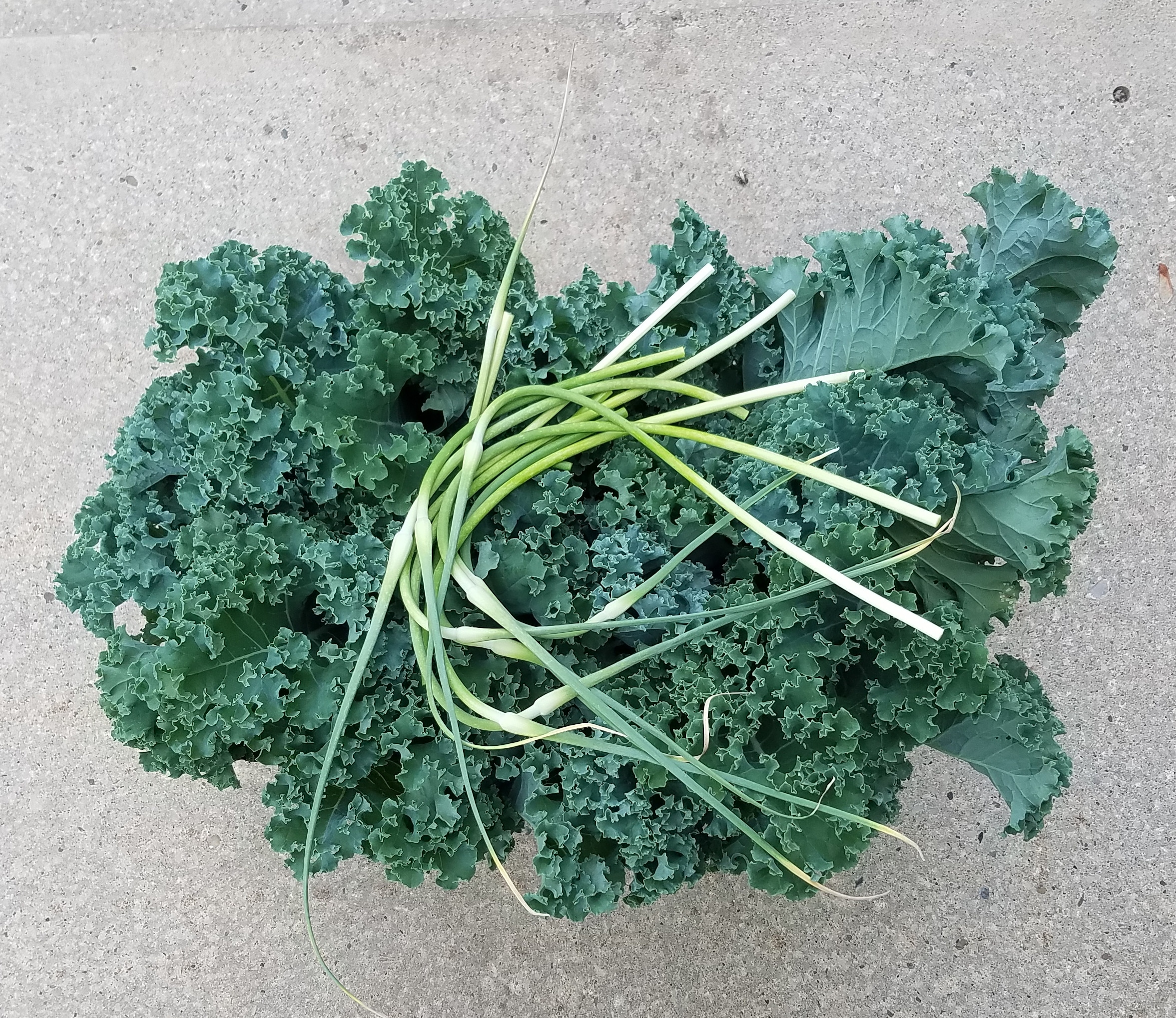
Second food bank donation: Winterbor kale and garlic scapes.
After ending her relationship with a large entertainment company in Florida last November, our daughter decided to move to the Midwest to pursue creative endeavors. Her new apartment rental agreement starts July 1. We plan to make some storage space in our home for extra possessions in case she needs it. Logistics and storage is part of what a parent offers an adult child.
We’ll see if storage space is actually needed. I looked at her new apartment online at a real estate marketplace company website. It appears she will have plenty of room as she is moving from a situation where she rents a single room in a house shared with others to a three-room apartment. She is planning the move and we are standing by to help as we are asked.
The storage space here can likely be created by discarding packing material accumulated over the years. Once finished with that, I’ll consolidate building materials in one spot and use the platform of the loft bed I built for her in college for any new storage items. Prepping the space is likely a one-shift job.
Since we married, we lived in five different places, including the current home since August 1993. The idea of us moving seems like too much work. Our home has become our main financial investment and the majority of our net worth. We are lucky to have a home we own outright. Even if financial conditions get dire, we’ll try to retain ownership.
After years of accumulation — from settling estates, from auctions and tag sales, from failing to dispose of outdated clothing, appliances and the like — we are filling it up. That needs to change as we prepare the home for our aging. For the time being, we can still make more space.
The ditch in front of the house finally dried on June 7, 2021.
Sunday was literally a day of rest. After planting the next rounds of lettuce and spinach, and mulching tomatillos and the second round of radicchio, I drove the Lincoln Highway to Boone to pick up my spouse. When we arrived home, I took a long nap, then stayed up later than normal so I could sleep through the night until morning. The tactic seems to have worked. I feel well-rested this morning.
Last Monday I noticed the ditch in front of the house finally dried. Saturday I mowed it, raked up the clippings, and piled them near the garlic patch. Some years the ditch stays wet until July, yet this year I believe we are entering a drought, and will soon pass the “abnormally dry” stage and get right into it. Moisture management in the garden remains important during drought conditions, and mulch plays a role.
In March I slowed the pace of writing my autobiography. Partly, it was due to increased gardening activity. It was also due to a quandary about approaches. Over the last two months I worked through ideas and am going to shift what I’m doing.
The breaking point was the piece I wrote about my ancestors settling in Minnesota. You can read it here. I’m pretty happy with how this introduction turned out, and the research behind it. Because there is well documented writing about this specific community in Lincoln County, Minnesota, it was possible. The challenge is not all periods of my family history are like that.
My maternal grandmother was the third generation to live in Minnesota. When she moved to a Polish community in Illinois, without her first husband, and with her first two children, the man she married had more obscure origins. The U.S. Census record shows him living at home and working as a coal miner before they met. We know that history and later in life he worked as a coal mining demonstrator at the Chicago Museum of Science and Industry. He also suffered from coal workers’ pneumoconiosis. One of my main childhood memories was of him spending an inordinate amount of time in our bathroom coughing up phlegm from his diseased lungs. Black lung disease eventually contributed to his death and during the Carter administration Grandmother was awarded black lung disease benefits based on his case. I will tell this story, without other written records, yet it seems to miss the mark.
There is no avoiding writing the early parts of my autobiography from scratch, blending memories, photographs, and what documentation exists. Because I have written so much, beginning with my personal journal in 1974, the question, and sticking point, was how to handle that writing, which has been more or less continuous since then. An answer is emerging.
My stylistic lack of discipline over 50 years of writing drives 2021 me crazy. If I could go back in time and talk to the younger me I’d say, “Just tell the story.” It’s too late for that. The written record is what it is, with its changing bad writing habits.
At the same time, I always planned to use this writing in my autobiography. The epiphany while out in the garden this spring was I can tell parts of the story by using text written in real time. In other words, instead of re-writing my history the way I wrote the Minnesota piece, and using journals, newspaper articles, and blogs like a source document, I can assemble existing work in piecework fashion, the way a person makes a quilt. The form would be an autobiography written in real time, beginning after college graduation.
This morning I reached catharsis on approach. There will be four stylistic parts of the autobiography. The historical part like the Minnesota piece, recounting of first memories, a blended recounting of schooling beginning with Kindergarten until college graduation, and then everything after beginning with my written journal in 1974. I like the piecework approach this implies.
It’s only Monday, and something good has come from this week.
These late spring days of gardening are among the best of the year. Produce is coming in with variety and quantity, the ice box is filling faster than we can eat and preserve everything. It’s why we garden.
There was a time when I didn’t consider leafy green vegetables important in a garden-based meal. I hoped to grow spinach and lettuce, and maybe that’s it. That changed and now I have an entire plot devoted to different kinds of greens. Greens I used to compost now go into vegetable broth or main courses.
This year I successfully grew mustard, chard, kale, collards, turnips, kohlrabi, beets, arugula, lettuce and spinach for leafy greens. I am also experimenting with radicchio.
Radicchio is a bitter green. Based on my research it can be eaten at any stage of the plant. Ideally one gets good sized heads, and I may yet do so. I didn’t understand how big the plant grows, and thinned some to make room for a couple with heads. That produced an opportunity to try some things.
The first leaves I picked went into a fresh salad. Next, I separated and sorted the culled leaves and pickled the larger ones in a brine made with malt vinegar mixed with my own apple cider vinegar. The pickled leaves will be ready in seven days. Like with any pickle in this household, a little goes a long way. What else?
We have not eaten much arborio rice yet have a couple of bags on hand. I thought to use some of it in a radicchio risotto. I searched my main cookbook library and found radicchio recipes in Molto Italiano by Mario Batali, Fields of Greens: New Vegetarian Recipes from the Celebrated Greens Restaurant by Annie Somerville, Lidia’s Italian-American Kitchen by Lidia Matticchio Bastianich, Classic Italian Cooking for the Vegetarian Gourmet by Beverly Cox with Dale Whitesell, and Local Flavors: Cooking and Eating from America’s Farmer’s Markets by Deborah Madison. There were a couple of recipes for risotto and other interesting options. What surprised me was how many cookbooks did not mention radicchio.
Next step is to read all these recipes, pick a risotto plus one other dish to try with the leaves depicted above. The next couple of days are already busy, yet I hope to work this in. Radicchio was comparatively easy to grow, although some refinement is needed in my future cultivation of the plant. I can likely start another crop for fall harvest.
With the garden in and weeded, I can work on other projects in the yard and house. Broccoli heads are beginning to form and cauliflower won’t be far behind. I monitor for predatory pests, as insect life in the garden is vibrant and hopeful. There are likely some cabbage eaters coming, maybe some squash beetles, Colorado potato beetles, and others. I’ll pick them off as I’ve always done without insecticides. My post-pandemic schedule enables me to keep watch over the garden.
I’m planning two main garden harvests per week. One Monday morning for the food bank, and another toward the end of the week for preservation and cooking. This year’s garden has been satisfying on many levels. So much so, I hung a sign on it.
This retro post is from July 16, 2012. If the Sisters of Mercy had any influence on me in the late 1960s, it was in the phrase “all for the honor and glory of God,” which, at one time, we were required to write on every school paper. In a world more connected than ever, reaching out beyond the veil of our own humanity with purpose seems as important as ever. It is not enough to believe that God is watching our every move. We must also live in society. I witnessed women making traditional lace in Morbihan. We have to get beyond the appearances of things, as comforting as they might be, as well as they might fit into a traditional world view. Hope you enjoy this recycled post.
We are isolated beings, wrapped in a veil of humanity, closer to God, or its divine essence than we realize. Such veil, metaphorical or not, is woven of delicate threads, like the lace of Morbihan, or silk from China. We could spend a lot of time marveling in its delicate needlework or shimmering surface. Yet we are compelled to reach out beyond the veil. A Cartesian view of life, if there is one.
Some say we should live our lives in the presence of God and perform all works for its honor and glory. The Sisters of Mercy taught us this and had us inscribe on each sheet of school work, words to the effect, “all for the honor and glory of God.” If God is reading this blog, my offerings may not be living up to divine standards.
Yet there is a compulsion to communicate, in manners crafted and on the fly. Verbally and in writing. In the silence of being, writing, especially in e-mail and on the internet, comes as a natural outlet for our need to express ourselves when other people are not around. It is difficult to accept that there is just God and me in the universe, and that I should be satisfied to live in the Presence of the Lord.
This weekend I had a conversation with a friend about everlasting life. We agreed that if the everlasting version is like the current one, the attraction is not enough to tithe and focus on the next life after this one. There is too much inequality, too much trouble today, to relish a state where our worldly problems are solved, the veil of life on earth torn and we visit with our deceased predecessors. It all seems an ill-designed nostrum for ailments that are not really ailments, but the stuff of our lives.
So we write, partly to clarify our thinking, and partly to satisfy our need to reach out to others and express the value of our lives, one life among the billions of people walking on the planet. Whether anyone reads or understands our writing is not the point, although we hope they do. The point is that if it is only me in the Divine Presence, then I am not yet convinced of the connection with the rest of humanity. Something I believe exists, and is more than a mere veil protecting me from the light of society.




 Journey Home
You must be logged in to post a comment.