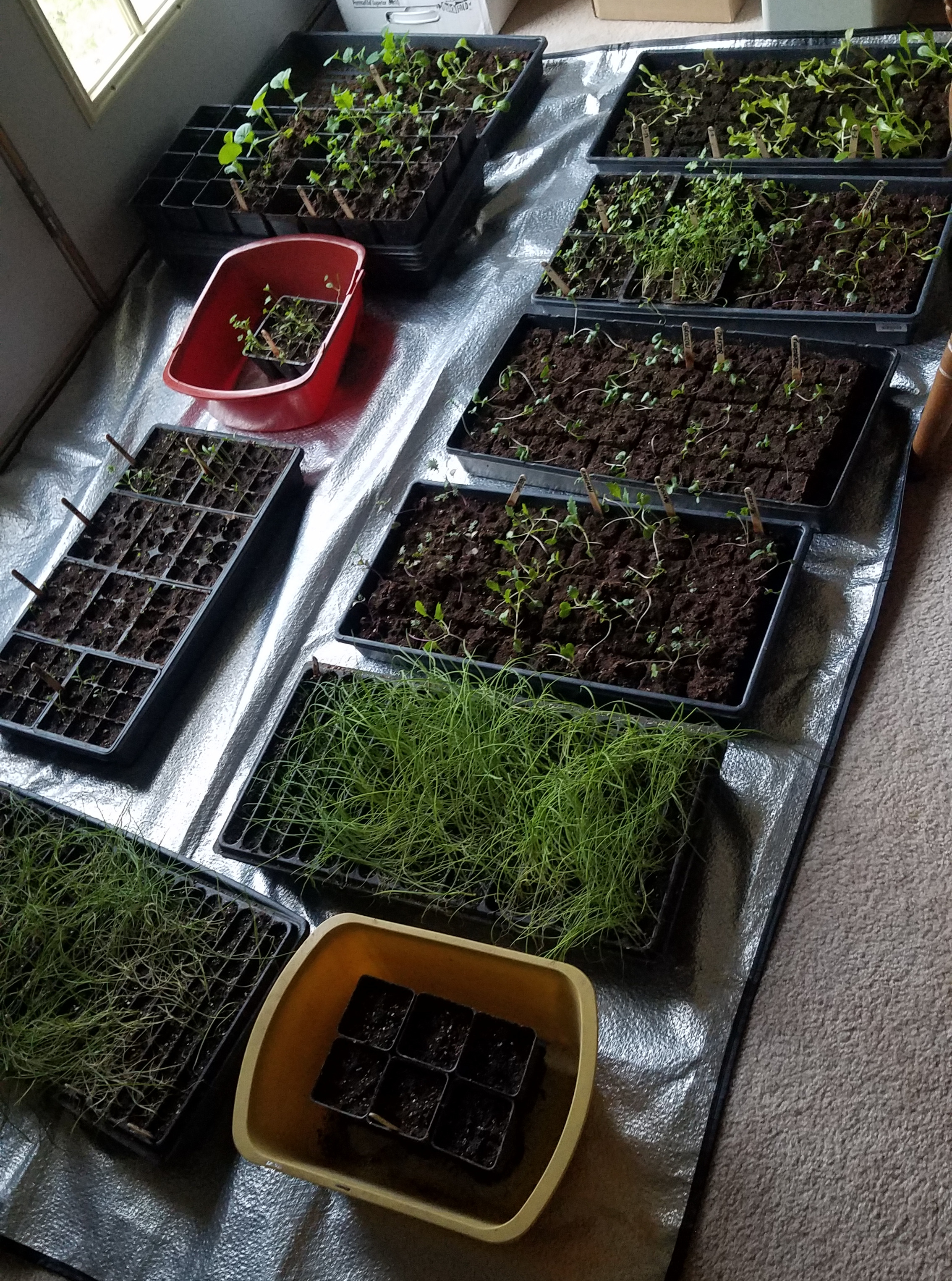
Seedlings back inside the house while it has been cold.
Ambient temperatures are expected to rise by 20 degrees during the next two hours. Winds are down and skies clear. It is time to turn the first spade in the garden.
This is the latest I’ve begun gardening and there is a long to-do list. Once indoors chores are finished, I’ll get after it.
If the ground is frost-free the order of business is set up the first plot with row cover and plant seeds and seedlings for early harvest. Once that is finished, preparation for potato planting is next. I’m keeping the buried containers, although moving them. Also on the list is transplanting kale and other leafy greens to a bigger pot to help them grow before going into the ground closer to last frost. Any tear-down of fences and ground cloth from last year’s garden will be a bonus. I scheduled a five-hour shift and hope to work all of it.
Society is getting busy again. As the coronavirus pandemic appears to be normalized, my hope is people can be reasonable in preventing the spread of infectious disease. COVID-19 vaccination should be rolled into vaccine schedules that already govern our health.
Spring has sprung and people are anxious to get busy doing things they couldn’t during the pandemic.
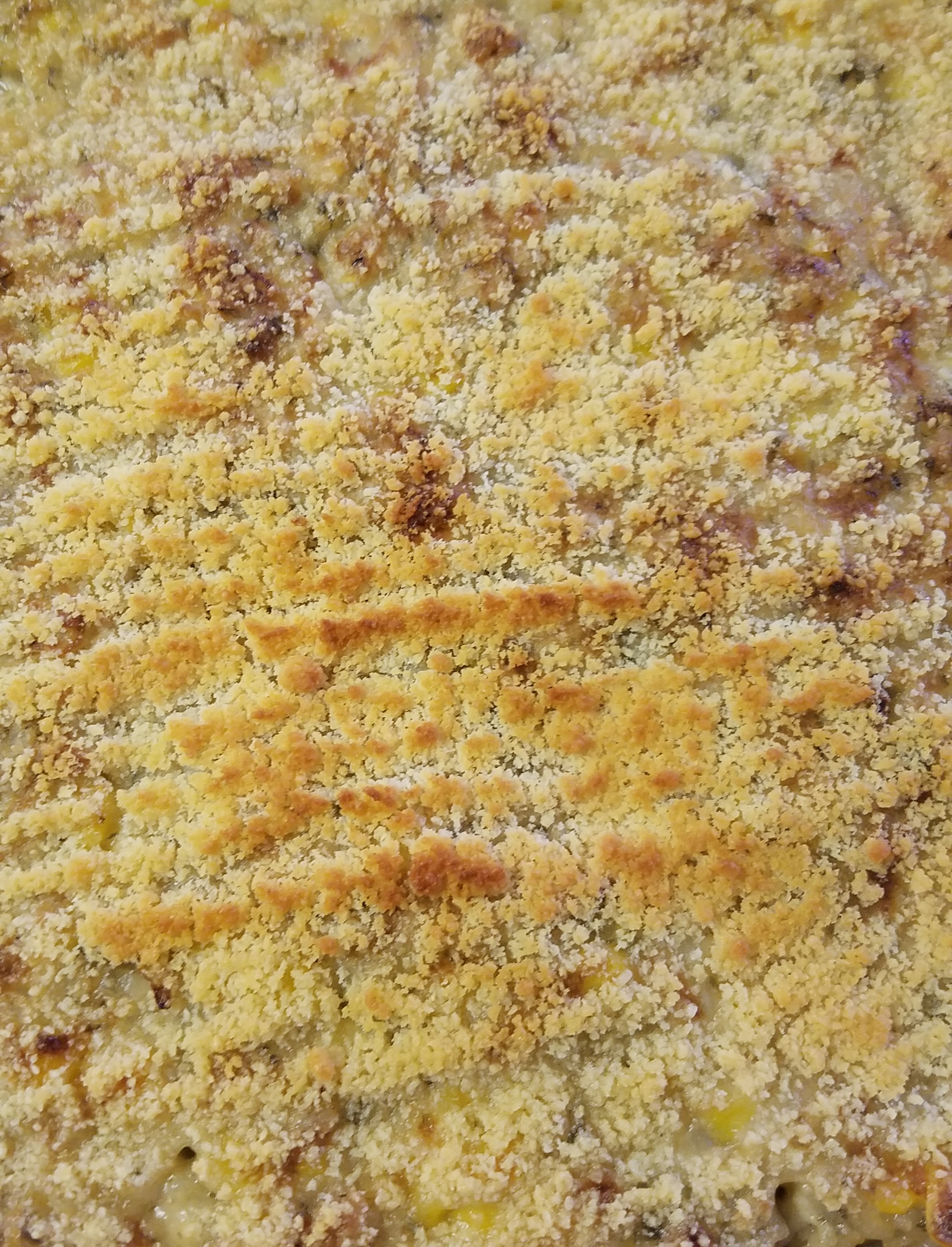
Dinner on April 6, 2022: Casserole with eggs, onions, celery, garlic, Parmesan, thyme and leftover rice, served with peas and carrots.
On Wednesday I loaded the automobile with obsolete and not working electronics to recycle at the county landfill. Three televisions, a wall-mount telephone, a non-working videocassette player, a laptop computer, and miscellaneous small items fell into bins there after I paid a $66 fee. There were also two computer towers, one of which was the one my spouse bought in 1996 when we dialed up the internet for the first time as a family. The other was a locally made machine built in the last millennium. I scrubbed the hard drives clean before recycling them.
Last week I took three big bags of clothing to Goodwill. One was scraps for recycling. The other two could be tagged and resold. I didn’t ask for a receipt. It felt good to be rid of some of the detritus of a modern life in Iowa. There will be more purging of unused stuff from our home this year.
Temperatures returned to near freezing so I have to bring seedlings indoors again. I don’t know what’s up with the lingering cold, rain and snow making it impossible to get into the garden. My onion starts are to arrive next week and I haven’t turned a spade in the garden yet. I find other things to do yet there is a certain stress lingering in the background because of the delayed season.
My impression of the political scene after candidates filed to get on the ballot is Democrats are teed up to take a shellacking in November. We have good people running for office yet there is a distinct lack of enthusiasm for politics. Likewise, a certain laziness permeates recent events in which I participated. I’m not seeing any fire in the belly to win an election among regular Democrats like me. Republicans in control of the state legislature and governor’s office are driving the narrative and making their points. They are highly motivated to tear down the long-standing culture of the state and replace it with something I don’t recognize. Democrats have been forced to play defense.
At a Zoom political event last night, I changed my political donation strategy while listening to Christina Bohannan and Elle Wyant speak. I budgeted $100 per month in donations and switched them around to candidates I believe will have the best prospects of being elected in November. In the big races, U.S. House, U.S. Senate and governor my $100 per month split three or four ways will be of negligible impact. Even my state senator’s race will be a big money campaign. The only political fund raising phone calls I received this cycle were from Iowa Democratic Party Chair Ross Wilburn, U.S. Senate candidate Michael Franken, and county attorney candidate Rachel Zimmermann Smith. Even with the small number of requests, my $100 per month doesn’t go far. I’ll revisit the strategy after the June 7 primary.
I’ve been keeping the thermostat at 58 degrees while my spouse is away helping her sister. This morning I donned three layers to retain body heat. I have also been making non-vegan vegetarian dishes while she is away. It’s not fancy food, just simple fare in an Iowa life.
Veterans for Peace and PEACE Iowa, along with the University of Iowa Lecture Series, present Kathy Kelly speaking on “Why War is Never the Answer.”
The event is scheduled for 5 p.m. on Tuesday, April 19, 2022 in the Old Capitol Senate Chamber on the University of Iowa Pentacrest.
Kathy Kelly is an American peace activist, pacifist and author, one of the founding members of Voices in the Wilderness. Until the campaign closed in 2020, Kelly was a co-coordinator of Voices for Creative Nonviolence. As part of peace team work in several countries, she has traveled to Iraq twenty-six times, notably remaining in combat zones during the early days of both US–Iraq wars.
Tickets are free to the public; first come, first seated. We hope too see you all there! For more details go to lectures.uiowa.edu.
Open Road on the Lincoln Highway in Iowa, Sept. 8, 2012.
Sunday morning the road was clear and dry with little other traffic. While my spouse slept in the passenger seat, people attended church, and commercial traffic took a break, my mind raced with ideas about what should go next in my life. As we pressed toward our destination, there were no easy answers. The same is true for the return trip. It was a great day for driving and that had to be satisfaction enough.
During her move, my sister-in-law found an extra television and gave it to us. Its age is uncertain yet it is an early flat panel television, at least 12 years old. I brought it home and began configuring it. It will be an improvement over the tube set we had. The reason we keep cable television service is to view the weather in case of severe storms. We can’t pull in a signal with an antenna.
I discovered we have access to 119 channels. Who has time for 119 channels? I quickly learned how to control what shows up with the channel selector. The first hidden was FOX News, followed by religious ones. Next call is to the cable company to see if there is a plan that would cost less while providing access to local weather. Ten years away from television has me hating any time spent with the medium today.
We have three banker’s boxes full of movies on VHS. While connecting our Emerson VHS player to the new television I found it is on the fritz, as in it’s dead. That could be a problem. The movie industry made the last VHS cassette in 2006 and player manufacturers have moved on to other products. Walmart sold them recently, but even that source has dried up. Used and refurbished players are available on line. If I want to spend a couple hundred dollars, new ones are available combined with technology I don’t need like an additional DVD player. The world changed to online streaming and while I don’t like the idea of paying again for the same movie, technological obsolescence may force my hand.
I connected our SONY DVD player to the television and it works like new. The screen quality is good, as is sound. Over two days, to try it out, I viewed the Martin Scorsese picture No Direction Home Bob Dylan. We have a couple dozen movies on DVD, although outside our cult-like ones, like The Matrix, Blade Runner and The Lord of the Rings, I don’t envision watching most of them. I have a copy of Finding Nemo, in the unlikely event we have a person of an appropriate age over for an extended period of time. The movies our daughter watched when young are on VHS.
It is difficult to envision a return to television viewing. The next step is to turn in our tube televisions to the electronics recycling bin at the landfill. There is no going back.
It started to rain about half way home. Not enough to loosen dust on the road, and barely enough to turn on the windshield wipers. We need rain. Televisions, however, remain optional.
Delicious food can be part of a normal life. It seems important to enjoy food we eat as it results in sustaining our lives in a turbulent world. There is little point in living a Dickensian food culture of gruel three times a day when so much food is abundantly available and recipes to prepare it are ubiquitous.
At the same time, as Raj Patel points out in his 2012 book Stuffed and Starved: The Hidden Battle for the World Food System, there are more than a billion people on Earth that don’t have enough to eat each day, and another group of even more that are overweight. Along the way, we became disconnected from the flavor of our food, and its purpose to nourish us. Patel argues that being food insecure and overweight are related conditions caused by the system which delivers our food. I recommend the book.
According to the U.S. Department of Agriculture, roughly 10.5 percent of U.S. households were food insecure for part of 2020, or about 13.8 million of them. This seems like a lot for one of the richest nations on the planet, given the relatively low cost of food calories. Our household has never been food insecure and we spent time and energy creating a food system that works for us. Part of it is growing some of our own food. It also includes shopping for the right things versus for everything. Food insecurity is a real problem, something to which most affected in the U.S. appear to adjust.
Joining a Community Supported Agriculture project was a way to know the face of the farmer and how food on our plate was grown. I joined for these reasons rather than any economic advantage, embrace of organics, or lifestyle change. Most CSA farms donate part of their share to local food banks, yet I never sought this form of generosity.
What is revolutionary about the CSA model is they cut out the middleman in agricultural sales, selling directly to consumers. Crops grown on a CSA farm are, for the most part, not fungible, thus avoiding issues related to the advent of middlemen and processors such as one finds in corn, soybean, dairy, cattle and hog farming. By selling direct to consumers, certain marketplace factors and dynamics can be avoided. CSA farmers secure a premium price for their products and their customers don’t mind that more of the cost of food goes directly to the farmer.
The CSA financial model avoids cyclical, seasonal debt for farm operations. Consumers finance farm operations by paying for a share of production at the beginning of the season. The farmer can avoid taking a loan for seeds, fertilizer and other inputs. Debt avoidance is significant and stands in sharp contrast to how a typical Iowa farmer funds operations.
CSA farmers have a working, if tenuous labor process. Wages are low for permanent workers and offset in some cases by providing food and lodging as part of the arrangement. There is a culture of volunteerism around CSA farms that further reduces labor costs. When I worked at a farm in 2013, my labor was shared with other CSA farms in a complicated process of barter and financial settlement. Most seasons I bartered my labor for a share in the farm, equipment, greenhouse space, or specific types of produce, reducing the farmer’s cash outlay. CSA farmers are creative in controlling and reducing labor costs. They have to be.
This returns me to the idea of delicious food. For the longest time I did not taste what I prepared in the kitchen while making it. I made dishes based on habit, recipes, and what was available in the ice box, pantry and garden. I didn’t give much thought to flavor and that was a mistake.
My outlook is changing. As I more closely integrate my garden with the kitchen flavor has become more important. Each small plate prepared is a multilayered work of creative expression. Some days the food is better than others and I’m beginning to appreciate the variation and what it means. Being part of a CSA brought me from being a consumer to something else, to being a person who relies less on the processing and distribution of food by middlemen. That is the true food system revolution.
Open Letter From Nobel Peace Prize Laureates and Citizens of the World Against War and Nuclear Weapons:
We reject war and nuclear weapons. We call on all our fellow citizens of the world to join us in protecting our planet, home for all of us, from those who threaten to destroy it.
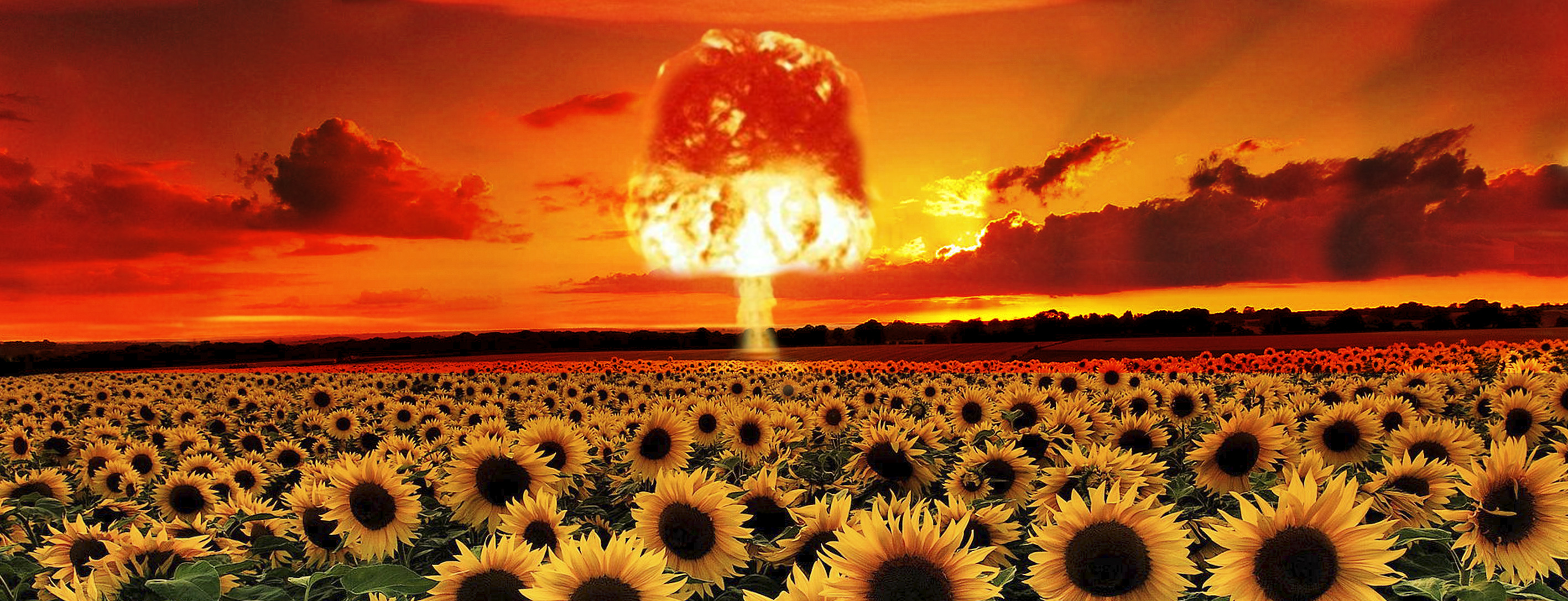
The invasion of Ukraine has created a humanitarian disaster for its people. The entire world is facing the greatest threat in history: a large-scale nuclear war, capable of destroying our civilization and causing vast ecological damage across the Earth.
We call for an immediate ceasefire and the withdrawal of all Russian military forces from Ukraine, and for all possible efforts at dialogue to prevent this ultimate disaster.
We call on Russia and NATO to explicitly renounce any use of nuclear weapons in this conflict, and we call on all countries to support the Treaty on the Prohibition of Nuclear Weapons to ensure that we never again face a similar moment of nuclear danger.
The time to ban and eliminate nuclear weapons is now. It is the only way to guarantee that the inhabitants of the planet will be safe from this existential threat.
It is either the end of nuclear weapons, or the end of us.
We reject governance through imposition and threats, and we advocate for dialogue, coexistence and justice.
A world without nuclear weapons is necessary and possible, and together we will build it. It is urgent that we give peace a chance.
Signatories list of Nobel Peace Prize Laureates:
His Holiness The Dalai Lama (1989) International Physicians for the Prevention of Nuclear War (1985) International Campaign to Abolish Nuclear Weapons (2017) Juan Manuel Santos (2016) Kailash Satyarthi (2014) Leymah Gbowee (2011) Tawakkul Karman (2011) Muhammad Yunus (2006) David Trimble (1998) Jody Williams (1997) Jose Ramos-Horta (1996) Pugwash Conference on Science and World Affairs (1995) Óscar Arias Sánchez (1987) Lech Walesa (1983) American Friends Service Committee (1947) International Peace Bureau (1910)
If you would like to join more than 780,000 other citizens of the world in signing this open letter, which will be presented to the leadership of NATO and Russia, click here.
“Extreme (weather) events are becoming more numerous in every season, so Iowans should anticipate more floods, droughts and heat waves,” Iowa State Climatologist Justin Glisan recently said.
Farmers and gardeners recognize this. What I didn’t realize is a third of the major natural disasters hitting Iowa since 1980 have occurred in the last five years. Tornadoes, derechos, severe thunderstorms, heat waves and drought have become commonplace. While adaptation in small garden plots like mine is possible, the scale of the problem is much bigger than any one person’s experience or ability to cope.
The last few days have been colder that usual. By that, I mean the historical average high has been 52.5 degrees and today the forecast is ten degrees colder than that. There is expected variation year over year, so it’s not time to wig out about extreme weather just yet. All the same, by now I’d have something in the ground besides garlic planted last fall if ambient temperatures were closer to normal. Adaptation serves gardeners as there is a wide range of suitable conditions for growth.
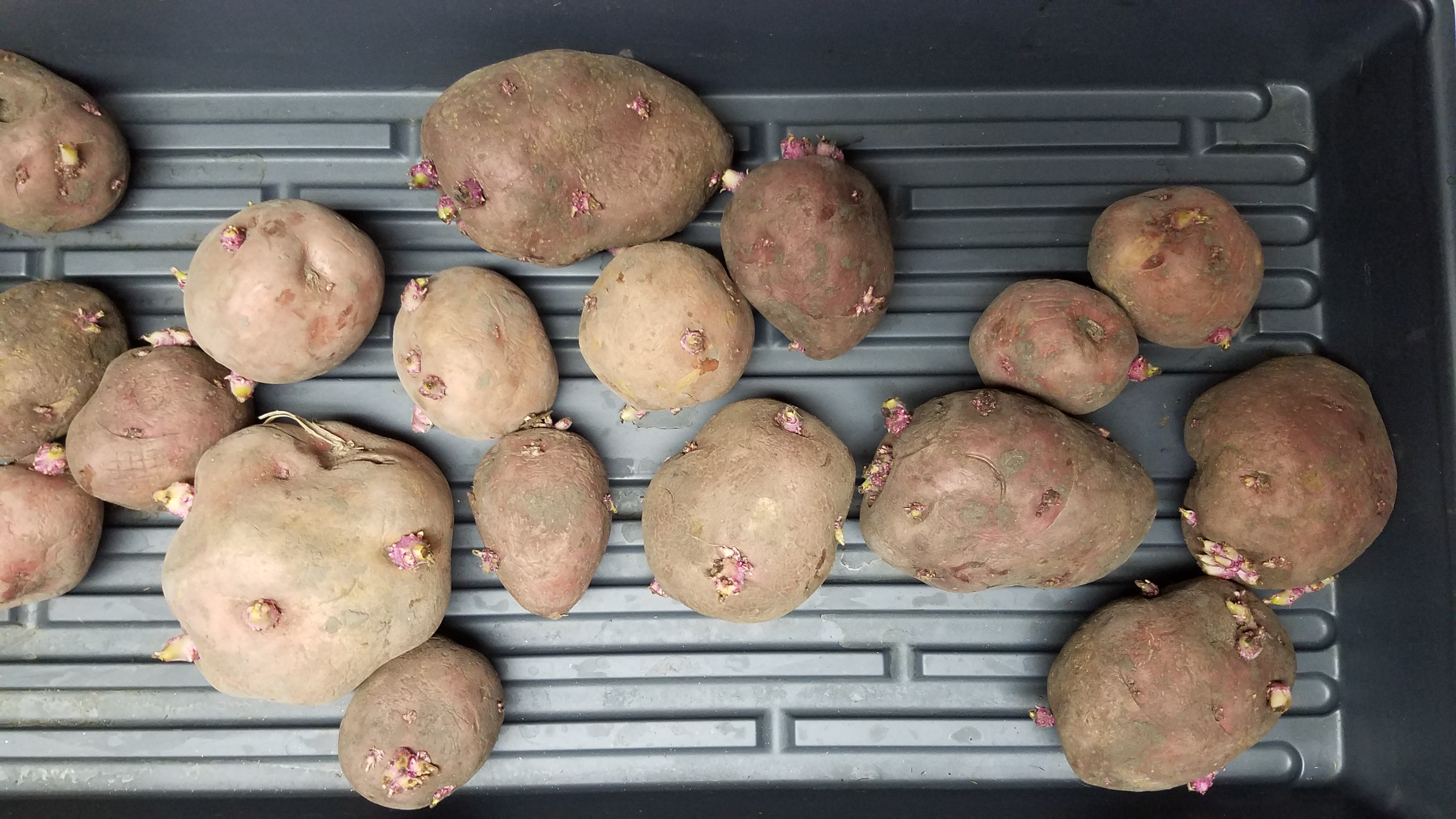
Ten days before Good Friday, I’ll cut seed potatoes for seasoning before planting. I have a notebook of previous gardening years that serves as an indoor planting guide. It is time to start Brussels sprouts, tomatoes, peppers and eggplant, according to last year. Following the agenda is the kind of activity gardeners relish. It creates a sense of understanding that helps us get by in a turbulent society.
When I was working full time, there was no time to work through seasonal climatic variation in the garden. Vegetables either made it or they didn’t. Attention to earning an income in a career blinded me to what was going on around me. We each avoid unpleasantness in order to preserve the secure bubble we create and in which we live most of our lives. This type of insularity is a main reason governments take inadequate action on climate change: people are caught up in their personal world construct. The real world is too ugly to contemplate so we avoid thinking about it and in some cases enable disaster.
Even with climate change and increased frequency of extreme weather events, garden cycles remain. We work through them each year and recognize variations. Producing a harvest is always rewarding. A garden can give us grounding in reality. It’s something sorely needed in this household and in society more broadly. At present, most are oblivious to garden cycles as Earth continues to orbit the sun, grocery stores have food on shelves, and our nest seems protected from the ravages we see on media coming into our devices.
It is easy to turn away from garden cycles, yet we shouldn’t.
Home alone, I made a spicy dish for dinner: red beans and rice. There is no recipe, yet it was everything to which decades of kitchen and garden work led me. Supper was life, as good as it gets. The process of anticipation, planning, and pulling items from the freezer, ice box and pantry culminated in deliciousness. The meal was why we pay attention to flavor rather than the names of dishes or ingredients.
I didn’t know I needed spring break, yet here we are. The combination of my spouse helping her sister move to a new home, 45 mile per hour winds and cold temperatures for two days, and a form of isolated winter exhaustion led me here. Break will continue until I see my doctor later this week. I already have my blood test results and the key numbers improved from six months ago. I noted Earth Hour last night and feel rested and ready to get into the garden and yard. The winds subsided overnight.
Saturday I spent five hours participating in the county Democratic convention via Zoom. I don’t like virtual events, yet they are efficient. I’d rather be talking to political friends and acquaintances in person. The upside of a virtual convention is when it is over, there is no need to use an automobile to get home. A couple of notes.
1984 was my first Johnson County Democratic convention. Most people were nice, although I was frustrated with the process. The county convention revisited decisions made at the precinct caucuses and walked away from what voters said they wanted in favor of special interests. That burned me on politics for a while. Since then we spent six years in Indiana. When we returned to Iowa, I was not active in politics for ten years, until 2004. The virtual event was reasonably organized, yet kinda sucked. What’s a person to do? An old Polish proverb applies, “Not my circus, not my monkeys.”
Age is not treating some of my long-term cohorts well, at least from the images presented on Zoom. There are a number of new people, likely more than half. I’d rather step back from organized politics. I volunteered to be a delegate to the district and state conventions to make sure enough people were available to fill 74 slots. The district convention is at a nearby high school across the lakes. When it was time to ratify the slate, all slots weren’t filled. People don’t seem that engaged in politics this year, even if they should be. That may be bias created by the virtual format, yet I’m seeing the same thing in every segment of local culture.
There were ten platform amendments submitted at the convention. The platform is irrelevant, mostly because Democratic candidates for office don’t support every plank, even if they acknowledge a platform exists. Why does the county party spend time on it? The answer, I guess, is it is a way of life for party members who want a shared experience in articulating their beliefs. As a writer, I get plenty of that from elsewhere. As long as we keep the platform’s irrelevance to formal policy in mind, and don’t expect candidates to fully support it, let platformers platform.
I’m preparing to write about my senior year in college when I lived in a small house on Gilbert Court in Iowa City. Artist Pat Dooley rented it from a local businessman and managed the many residents who came and went during that six month period. It was a small, decrepit three-bedroom structure built on a stone foundation. According to Google maps, it has now been demolished.
Dooley was part of a group of writers and artists loosely referred to as “Actualists.” He did the cover art for The Actualist Anthology edited by Morty Sklar and Darrell Gray. Gray overnighted with us for a brief period before leaving Iowa for California. Many Actualists visited our house at Dooley’s invitation, where we socialized in the common room. Alan and Cinda Kornblum, Jim Mulac, Dave Morice, Sheila Heldenbrand, John Sjoberg and Steve Toth stopped by more than once, as best I can recall.
By 1974, I finished required coursework for a major in English and needed to fill out the total number of required hours. My coursework during that final undergraduate semester included French conversation, separate classes in ancient and modern art, Harry Oster’s American Folk Literature, and early modern philosophy. I hadn’t prepared for a career during university, although the Oscar Mayer Company, for whom I worked two summers, called to offer me a job as a foreman in the Davenport meat packing plant. I declined.
There are a couple of additional days before I must get to work in earnest. Spring break, while unexpected, is not over.
Last night the Iowa Legislature considered and passed a bill to cut unemployment benefits in the state. Both the House and Senate approved a measure, although the chambers differ on whether there will be a one week waiting period before benefits commence. A version of the bill will pass before adjournment sine die.
I was fortunate to make it through 54 years in the workforce without filing unemployment. My work life can be characterized as stable, although I changed jobs a lot, mostly because I wanted or needed to for various reasons. Work life radically changed since the 1970s, especially after the election of Ronald Reagan as president. What Iowa Republicans are doing is wrong.
Iowa Capitol Dispatch reported last night:
If signed into law, House File 2355 will make several immediate changes for Iowans on unemployment.
Unemployment benefits will last only 16 weeks, rather than the current maximum of 26 weeks. Iowans will also have a one-week waiting period before they receive their first payment under the Senate’s version of the bill.
Unemployed Iowans may need to accept a lower-paying job sooner in the process to continue receiving unemployment benefits. Under current law, an individual would not be required to take a lower-paying job offer for the first five weeks of employment. The bill would change that, ratcheting down the definition of “acceptable” job beginning in the second week of unemployment.
My decisions about filing for unemployment were a recognition of the privilege in which I came up. If I was eligible for benefits, I took pride in finding my own way without them. There was never fear of falling behind financially. When I left a job on my own, I carefully considered the consequences and made a financial plan which worked in every case. Not everyone is so lucky.
With Republican majorities in both chambers of the legislature, they can pass whatever laws they want. The Republican governor is unlikely to veto. If there is a single pattern, it is their desire to re-create what living in Iowa means. I know what it means to me. It is treating working people with respect that is anyone’s due. Obviously, Republicans don’t feel the same.
On walkabout, garlic poked through the mulch. It is spring.
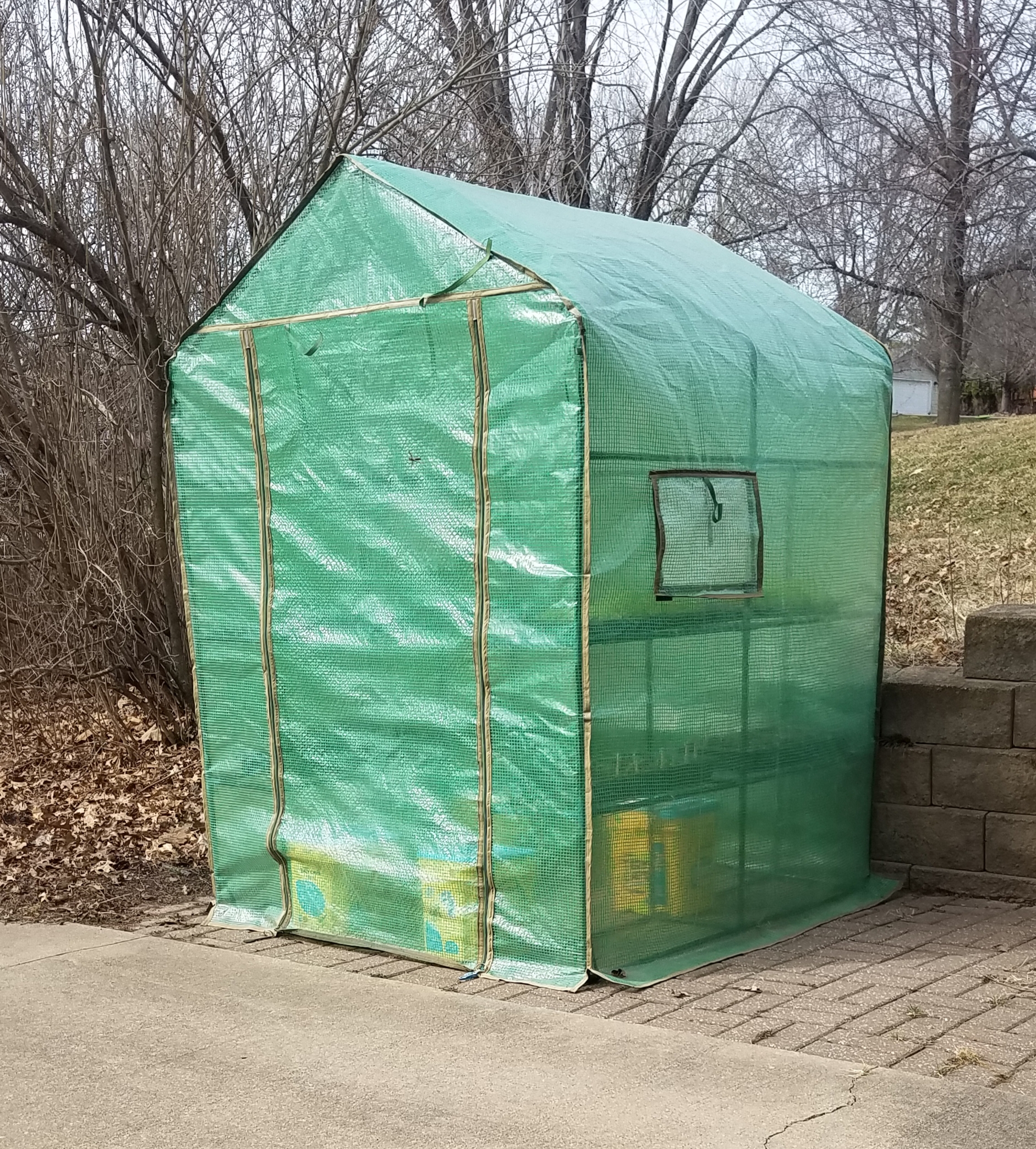
I assembled the portable greenhouse yesterday afternoon. The extra space and light will make a difference, another step toward planting the garden.
A big batch of vegetable soup simmered on the stove most of the day. We ate it for dinner and filled five quart jars. Three of them are to take as my spouse returns to her sister’s to finish packing.
My daily routine is disrupted by spring. That’s good. Like grass greening in the lawn, it is a sign of renewal. Without it, sustainability is elusive.
Opening statements at Ketanji Brown Jackson’s Supreme Court confirmation hearings with the U.S. Senate Judiciary Committee were yesterday. It was as if I wandered into a retirement home occupied by committee members. My conclusion, after listening to most of them? We need younger senators. Thankfully, in Iowa we have three suitable candidates to replace Senator Chuck Grassley during the November election.
War in Ukraine continues. The Ukrainian government refused to surrender even though most of Mariupol has been bombed to ruins. The Russian war machine will rapidly wear down, yet not before more destruction. Somehow Ukrainian farmers will get a crop in the ground this spring.
This week, António Guterres, the United Nations secretary general, pointed out what most should know: we are sleepwalking to climate catastrophe. The upshot is there is time to act on climate, although not for long.




 Journey Home
You must be logged in to post a comment.