The kitchen and garden composters are in position for the 2022 growing season. The pace of my garden work slowed in recent years yet I keep at it. Yesterday I made progress in the plot to be used for leafy green vegetables. Plot prep work has become straightforward, routine. I work for a while and then take a rest. Quickly the work is done and the soil ready for planting.
Rain is forecast today, beginning around 9 a.m. and continuing most of the day. I hope to get an hour or two of spading done before it begins. After that I’ll go to the grocery store for provisions.
I made a second burn pile and ignited it. The intent was to clean up the area around the plot. I burned deteriorating pallets and brush. While I was working the fire, an ember got caught in my jeans and burned a hole through them. I didn’t notice until it began to burn me. No harm done, though. My clothing became imbued with smoke.
Eventually, I will make a commitment about what vegetables and herbs go where. Thursday is forecast to be a great day for gardening and I set aside a full six-hour shift. If all goes well, by the end of it, the next plot will be finished.
There is a lot going on in society right now. So much there is inadequate time for reflection. For the time being, I’ll write about gardening while I consider the rest.
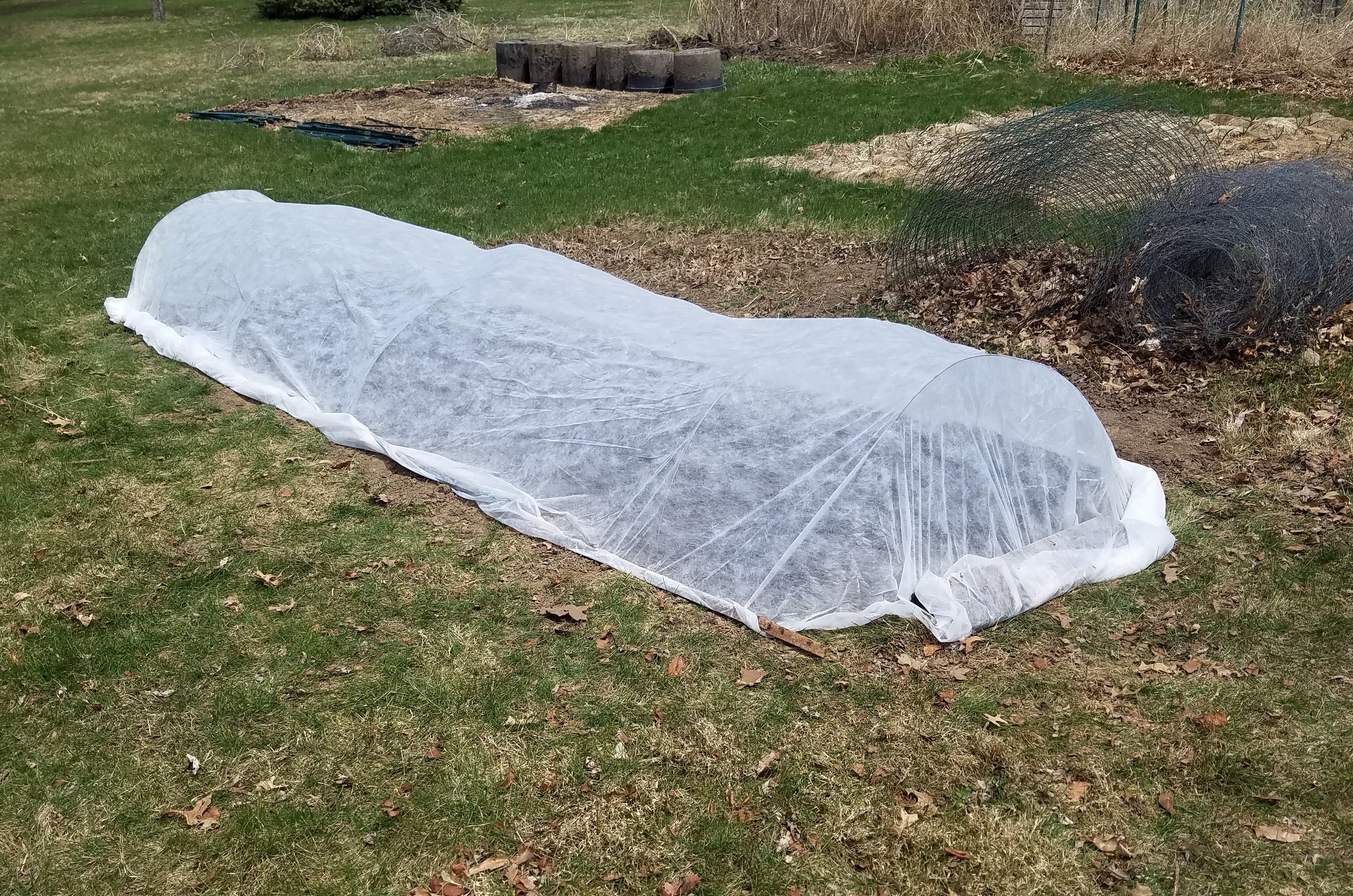
High winds blew the row cover off the frame multiple times on Monday. I went outdoors and fixed it. I ended up using landscaping stakes to secure it in 40+ miles per hour wind. By sundown, the wind slowed. It was too late to get back to the garden.
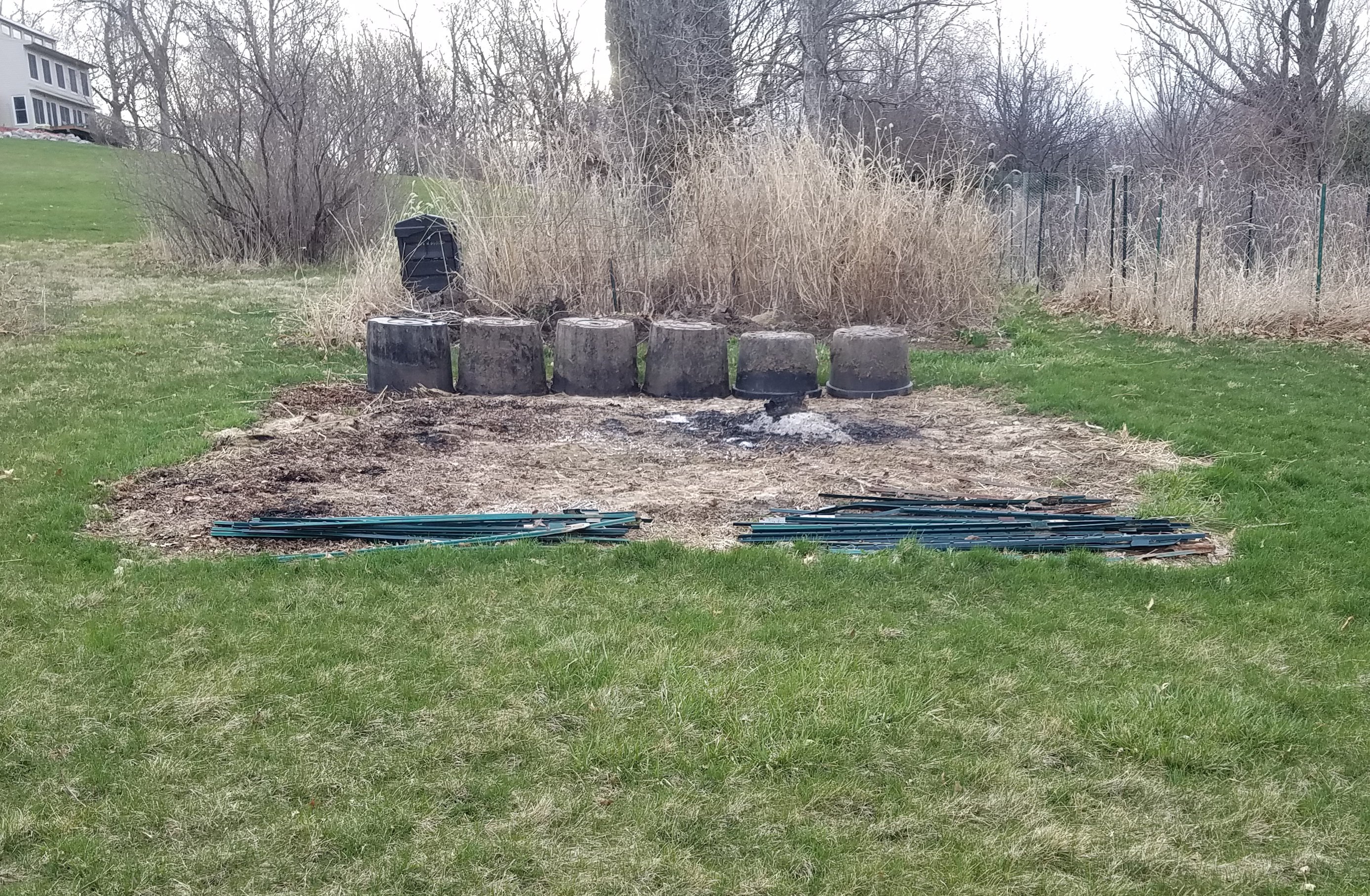
By the time I return home after a morning appointment in Cedar Rapids, it should be warm enough to try gardening again. The good part about the delay is I had ample time to evaluate how to rearrange the next plot for planting. I decided to move the large composter over the remaining roots of the now gone locust tree to assist in its decomposition. I plan to get rid of the pallets that have been on the plot for a few years and store fence posts in the garage. This will increase the planting area, something sorely needed this year.
If I can get seeds in the ground, tomorrow’s rain will be good for them.
Seedlings are indoors. These trays plus four more under the grow light make 17. Half of them should already be in the ground.
The forecast is cold and windy today: marginal for working in the garden. As temperatures climb to around 40 degrees, the wind is forecast to pick up, resulting in a wind advisory beginning after lunch with gusts up to 45 miles per hour. Once the sun rises, I’ll go out and see what can be done before that starts. I’m not hopeful. Both seeds and seedlings need to get into the ground. Like with everything about gardening, it is culture rather than an exact science. There is flexibility.
I spent part of Sunday transferring germinated tomato seeds from the channel tray into full-sized soil blocks. I made 150 seedlings (bottom right of the photo) and plan to make another tray of slicers once I move some of the plants into the garden and greenhouse. The replacement greenhouse is not expected until next week so space is restricted. Tomatoes are an important garden crop and getting the right number at the right stage is important.
This year, I’m planting tomatoes in three plots. There will be a large space for slicers, one for plums, and another for cherries. The slicers are a mix of colors and will mostly be used fresh. Roma are for canning and I am trying San Marzano tomatoes for the first time. I’m also planting more Amish Paste along with Speckled Roman and Granadero. Cherry tomatoes are a basic and produce for a long season.
I’m hopeful for another great year of tomatoes. With 19 varieties the prospects are good.
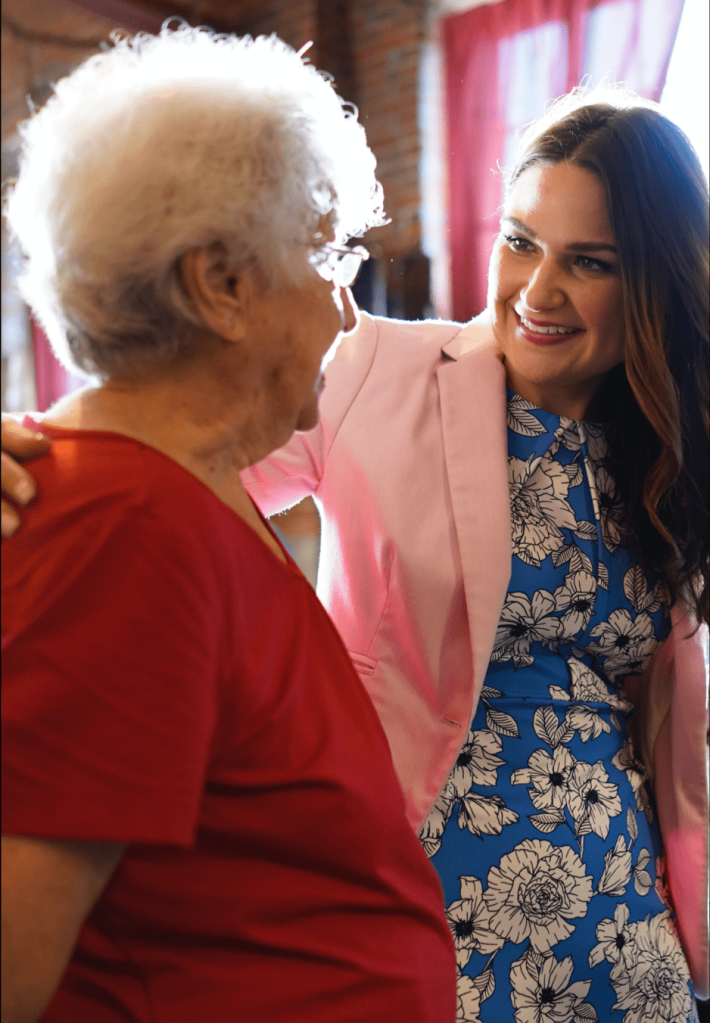
On Friday, April 15, the Iowa Supreme Court overturned a lower court decision to remove U.S. Senate Candidate Abby Finkenauer from the June 7 Democratic primary ballot. The court was concerned with three signatures on Finkenauer’s nominating papers. There is plenty of news coverage about the 7-0 decision to put her back on the ballot so I won’t go into those details. I’m getting tired of the courts having to be involved in close calls regarding our elections.
Partly, my upbringing brought me to this place. My father worked hard to elect John F. Kennedy president in 1960. We discussed his neighborhood canvassing at the family dinner table. When he finished our neighborhood, the meat cutters union gave him another geography to canvass. It was my first awareness of elections and although Richard Nixon won Iowa that year, JFK won the presidency and I felt we benefited from having a Democrat in the White House.
When JFK was assassinated, and Lyndon Baines Johnson assumed the presidency, it was a shock. LBJ decided to run for reelection in 1964 and won in a landslide the likes of which have not been repeated. They didn’t need courts to decide diddly squat in 1964 because the margin of victory was so large. LBJ went on to pass a stunning amount of significant legislation. I assumed voters had seen the light and every presidential election would be like the one in 1964. I was young.
There have been recent close races. The 2000 election stands out as the one in which the U.S. Supreme Court got involved, stopped vote-counting in Florida, and effectively gave the win to George W. Bush. Those of us in Iowa’s Second Congressional District still feel the burn from the 2020 election in which Mariannette Miller-Meeks won by six votes over Rita Hart. Hart wisely decided to give up her appeals once it became clear the U.S. House of Representatives did not have the votes to pursue every legal recourse in her case. In retrospect, Hart had the votes to win, although she couldn’t get them recognized in time for state certification of the election, which prevailed. It rots when the vote is so close and the courts get involved.
I came of political age at a time when the basic tenant of elections was a campaign needed 50 percent of votes cast plus one to win. A win is a win, after all. I didn’t recognize it at the time, yet that was a turn for the worse. We became acculturated in the numbers and techniques of campaigning rather than standing for things as a first priority. My reeducation in this process began in 2004 and it has been a downward spiral ever since. That is, until I realized that Republicans had developed a better ground game and that Democrats couldn’t continue the way we were going and win.
Some progressives couldn’t believe Finkenauer had so few signatures on her petition that challenging three of them would get her thrown off the ballot. If 19 counties with at least 100 signatures in each is the bar, get 25 counties with 150 signatures in each, some opined. What else were Democrats doing in the weeks before the filing deadline?
I am neutral about Republicans challenging some of the petition filings. Was it political? Of course it was. Shame on the party that doesn’t review the opposition’s work for compliance. Finkenauer’s campaign took an unfortunate hit because of the incident. Can she recover and win the primary? She’s been leading in the polls and rank and file primary voters will likely take the lawsuit with a grain of salt and not change their voting plans. We’ll know for sure on June 8. If I were Finkenauer, I’d be working now to make sure she gets enough votes to win the primary outright and avoid a convention.
To be of any use to the electorate, Democrats should win every election outright, without needing courts to get involved. Finkenauer’s case highlights we are not there yet.
I planted seed potatoes on Good Friday as is tradition. It was unclear they would make it into the ground on the designated day, but they did.
We enjoy a few potatoes fresh from the ground in July. Our annual consumption is about 100 pounds for two of us, so potatoes are not a dietary mainstay. The reason I plant them at all is for crop and menu diversity. I use raised containers because one year rodents got more than we did.
I emptied the containers and refilled them with soil from around them. I added compost from the kitchen composter along with some fertilizer. I planted nine or ten seeds in each container and hope for the best. Potatoes can be a staple food. Organic potatoes are widely available in our area if we run out.
It’s another cold day in Big Grove. The sun is out, wind is down, so once it warms above 40 degrees, I’ll resume work on the plot with newly planted potatoes. If everything goes well, I’ll direct seed peas, beets, turnips and carrots. My farmer friends already have theirs in the ground. When the fencing is up, kohlrabi, collards and some kale seedlings are ready for planting. If good weather holds it will be a busy time until Memorial Day.
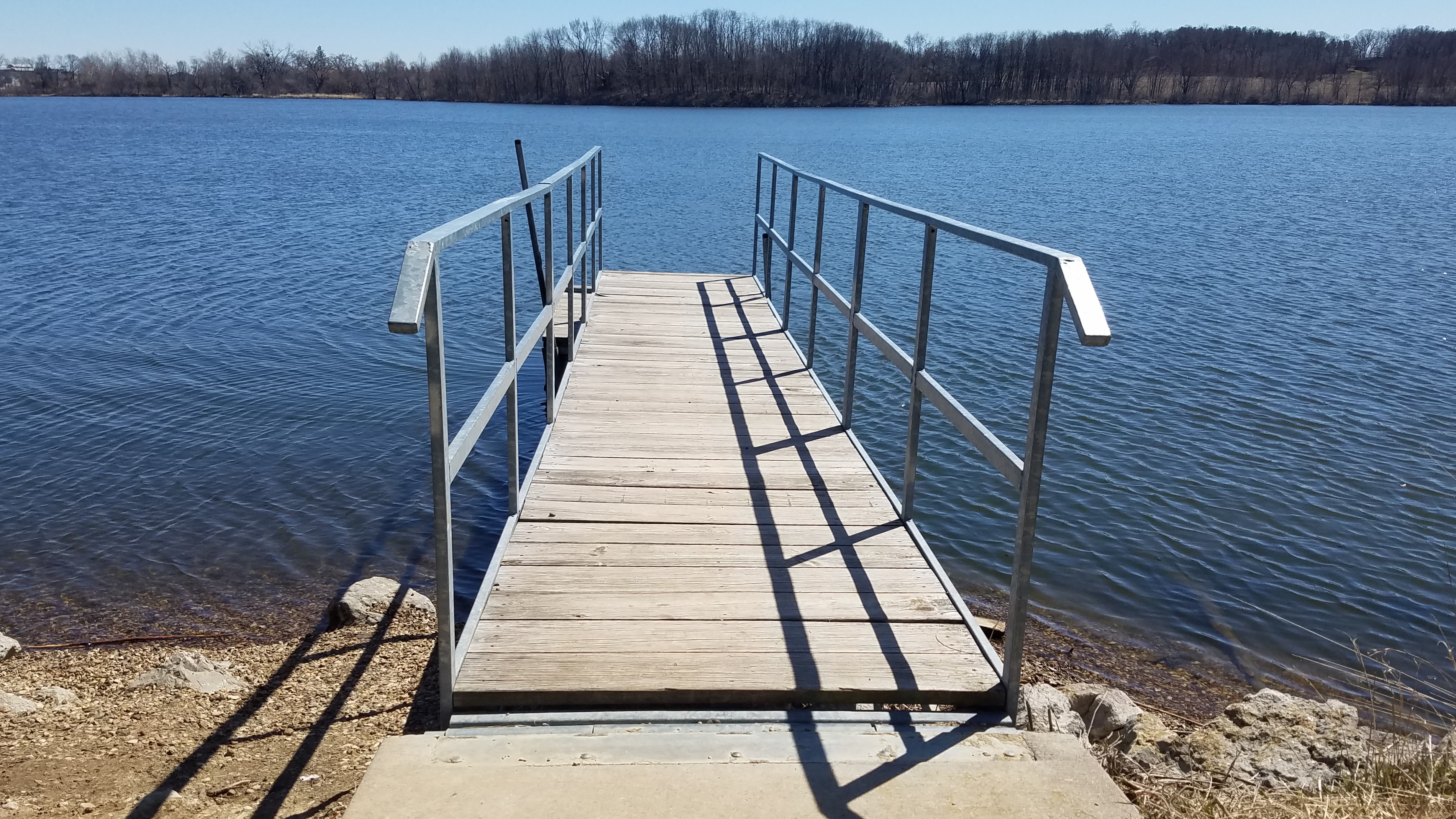
Waiting for better weather to install the boat docks on the lake.
Some parts of the county reported wind gusts of 60 miles per hour yesterday. The National Weather Service counted eight tornadoes in Iowa. The wind lifted my greenhouse from its base and rolled it along behind my neighbor’s home. The main outdoors work was dealing with the wind.
Wind is expected to die down today. After my conference call I should be able to work in the garden. I plan to continue deconstructing a plot for peas and greens. I’ll transplant tomato seedlings from the channel tray where they germinated to soil blocks. This is Good Friday, the traditional day to plant potatoes. The potato seeds are cut, seasoned and ready to go into the ground. Four packets of seeds arrived from the seed company which need to get planted in blocks and placed on the heating pad to germinate. It will be a busy day.
In addition to dealing with wind, I had my annual diabetes screening with my ophthalmologist. The good news is there is no evidence of diabetes in images of my retina. Cataracts are progressing toward needing surgery in five or more years. For now I can see clearly and if I use the new eyeglasses prescription things will be in focus. He dilated my pupils and I was disorientated most of the day. Not wanting to drive home immediately after dilation, I went to a nearby retail store and walked around until my eyesight recovered enough to drive. I brought home a load of mostly organic fruit and vegetables.
I’m reading The Wizard and the Prophet by Charles C. Mann. I had not known much about either of its main subjects, Norman Borlaug and William Vogt. This is a good time to take up this study because how civilization interacts with the environment is a key modern consideration. The book outlines two main approaches. I lean toward Vogt’s “carrying capacity” approach, with some caution. While Borlaug won a Nobel Prize for his work with plant genetics, hybrid seeds and industrial-scale agriculture are part of our current environmental problems.
I’d like to get back to normal yet I don’t know what that means any longer. Spring, while blustery, has sprung.
During yesterday’s drive to Des Moines precipitation was a mix of sleet, snow and rain. We are supposed to be finished with winter, so instead of a “wintry mix” let’s call it a “springery mix.” High winds were freezing cold when I made a rest stop.
The garden is behind and getting further behind each day. Ambient temperatures today are forecast at 30 degrees the next few hours with wind gusts up to 45 miles per hour during the day. I pulled trays of seedlings out of the greenhouse and brought them indoors again. They are progressing, yet slowly.
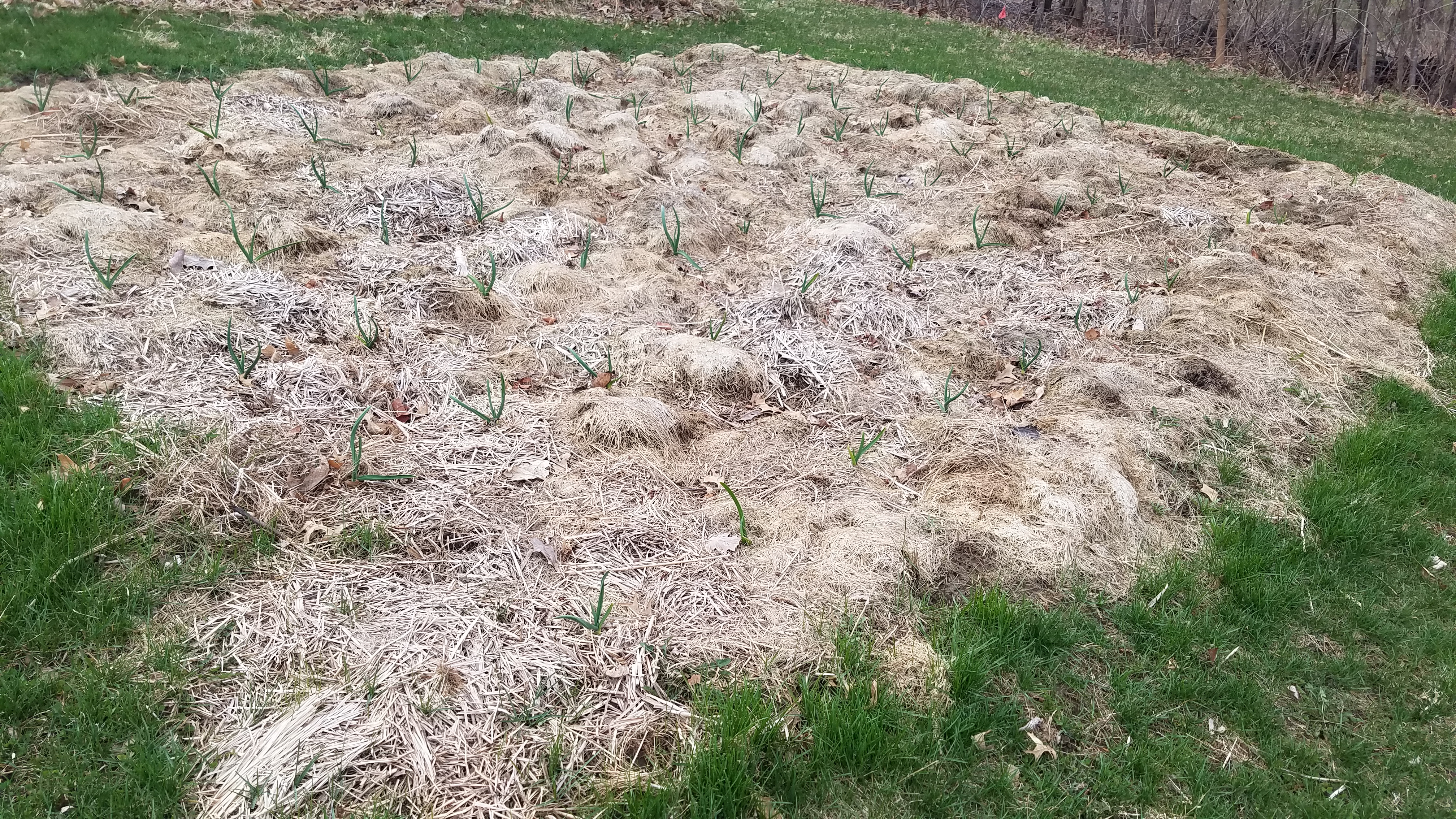
At least the garlic looks good, with only a couple of dead spots. Garlic is great yet a person can’t live on it.
Onion starts are to arrive from the seed provider this week. They will sit on the workbench until the soil dries and I can get into the garden to prepare the bed. The onions and shallots I started from seed need planting as the starter soil appears to be exhausted of nutrients. We are not in a good place.
This morning I have an appointment across the lakes after which we’ll see if any gardening can be done today. I may be relegated to transplanting tomatoes to larger soil blocks and seeding the next wave of vegetables. Will take it one day at a time.
At the junior high school track meet on April 13, 2022.
I woke to the sound of rain falling on the roof. The furnace was off with its quiet mechanicals accentuating the gentle sound. After a restless Monday night, I slept straight through to Wednesday.
Weather was sub-optimal for gardening yesterday. Wind gusts up to 45 miles per hour drove me to abandon tear-down of the garden plot planned for cruciferous vegetables, peas and greens. I managed to move the kitchen composter to a new location and tear down weed infested fencing. A lot of work remains.
This plot was the first dug after moving to Big Grove in 1993. I remember that initial work like it was yesterday. Our lot is 0.62 acres and I envisioned a big garden even if my work in transportation kept me away from the daily work of planting, weeding and managing crops. I became a better gardener by sticking with it. The plot became filled with sunken potato tubs, two composters, and pallets of miscellaneous stakes and other essential garden junk. It was a hodge-podge. I plan to clear all of it to gain planting space. I don’t know to where I’ll move the garden composter yet.
In late afternoon I drove to town and met with our candidate for state house, Elle Wyant. Her seventh grader was participating in a track meet at the high school. It provided an opportunity to talk about politics.We had more in common than I knew.
I don’t understand track and field. There were 400 people at the stadium, mostly milling about between events from what I could determine. It is the stuff of modern society: boring most of the time, injected with deep engagement in brief flashes. How did we come to that as a way to live?
Sunday’s high winds, with gusts up to 45 miles per hour, did their job. The wet soil turned over on Saturday has dried enough to till. Today’s list includes plant a row of early vegetables to be protected by row cover, dig a spot for the tubs in the photo, and continue the deconstruction of last year’s garden plots with an eye toward planting more early vegetables. Garlic is up. I chose the plot for tomatoes. Much planning remains.
I’d like to move the seedlings back into the greenhouse. The forecast later in the week is for ambient temperatures to fall below freezing again. I’ll think about that as I’m tilling the first row. I’m scheduling a five-hour shift, planning to use it all.
The main news since my last writing post is the 1950 U.S. Census was released. In it I found new information and as a result, need to re-write the chapter about Davenport in 1951. This is a positive development. The census provided the first specific evidence of family members living in Rock Island, something I’ve known, but with little detail. I found my Uncle Gene also lived there, separate from his father, working at a dairy where he “helps with milk.” He was seventeen years old. The census also clarified the status of the home to which I was brought from the hospital after being born. My grandmother was head of household with the three children from her second husband living with her. There is a lot to track down and the new census release makes it easier than it was. It also confirmed some things I knew with another, definitive source.
I scanned the 313 pages of double spaced manuscript. Boy, there is a lot more writing, editing, and proof reading to do! Some things seem solid. The outline I created this year will continue to serve as a coat rack upon which to hang things I write or discover. That will be followed by a re-write using the new information. The work I did before the coronavirus pandemic does not fit neatly into the new outline structure and needs a major re-write. Likewise there is much to accomplish to write through the period of time before I kept a journal, got married, and started working in transportation. Depending on my choices, there could be two volumes. The first through the birth of our daughter, the second covering everything else through the coronavirus pandemic. Reducing it down, last winter was a period of progress.
The unavoidable task ahead is going through all of my past writing and paper archives to distill something usable. Thus far, the writing has been fun adventures of me sitting in front of a computer screen making up the story. Once I tackle the physical record, writing will be real work. I’m looking forward to writing the whole thing so it may be time to put it in low gear and start climbing that hill.
Right now, all I can think about is getting to my shift in the garden.
Congresswoman Mariannette Miller-Meeks’ recent statement about common sense would make sense if she demonstrated it in her votes.
She said she was “fighting for Iowan common sense values.” Instead of common sense, Miller-Meeks adopted right-wing policies of her Washington, D.C. colleagues.
The lack of common sense shows in her no votes on the American Rescue Plan Act, Build Back Better Act, Invest in America Act, Infrastructure and Jobs Act, and on raising the minimum wage. The votes are a total disconnect from Iowans she represents.
If Miller-Meeks is interested in common sense, here are a few suggestions:
Tax the rich. Folks who have money to spare are able to contribute to reducing the deficit and paying down our national debt. The tax reductions of Republican administrations made no sense. Our history has been to tax the rich at a much higher rate than we do now. Corporations should be taxed as well.
Public funding of Congressional campaigns. Corporations are not people. Take the money out of politics by passing legislation to do so. It’s common sense that corporations and their lobbyists should not be able to buy elections.
Audit Defense Department Spending. The 117th Congress passed an annual defense budget valued at over $768 billion. Isn’t it time we looked to see how effectively the Pentagon is managing one of the biggest budget line items? Why haven’t we already taken this commonsense accountability step?
Eliminate nuclear weapons. Nuclear weapons can never be used without dramatically altering life on Earth. They could literally end life as we know it on Earth. It makes no sense to spend money on nuclear weapons that should never be used.
Stop polluting. Earth has limited capacity to absorb the detritus of civilization. School children are taught to reduce, reuse and recycle. Our national policy should be to do the same and scale it up. It is common sense.
There are plenty of additional suggestions. Miller-Meeks’ votes demonstrate a different meaning of “common sense.” It’s not the commonsense approach we need. I will vote for Christina Bohannan for Congress this November. You should too.
~ An edited version of this post was submitted to several newspapers and was first published by The Little Village on April 12, 2022.




 Journey Home
You must be logged in to post a comment.