Part of yesterday was spent outside — in the garden, working compost, cleaning buckets, collecting the bits of drainage tile used to support celery plants, tending the garlic, planting turnips and radishes.
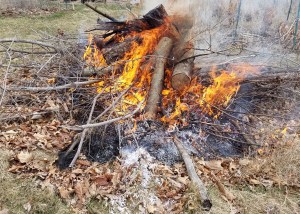
Using a bag of shredded office paper and a match, I started the burn pile created in the aftermath of an unusual wind storm last year. An arborist cut down the big branches and I sawed them into smaller logs and branches. The wood was dry and burned quickly even though it was covered with snow a couple days ago.
The first spring burn pile marks the beginning of gardening season.
I didn’t connect the garden hose as we are expecting freezing temperatures again this weekend. There is plenty of moisture in the ground to give the seeds a start.
A week ago I got a haircut. Partly it was too shaggy and in my eyes while working outside at the home, farm and auto supply store. Partly it was about casting aside the experience it represents for a new start.
My retirement March 16 has been something of a crash landing. Long anticipated, I know the major themes — writing, gardening, farm work, home maintenance and community organizing. I’ve had to add a need to deal with my aging frame and life systems. I made an appointment to see a medical doctor for a physical next week.
Even though I have more time, there never seems like enough to get what I want accomplished. With that in mind, I’ve come to believe what I said in February, that low income workers and retirees can’t afford social media. I posted this on Facebook this morning:
I’ve decided to end my relationship with the Facebook application on or about April 30. I joined in 2008 to follow our daughter and she deleted her account a couple of years ago. It’s not you fair reader, it’s me.
I listened to Mark Zuckerberg testify to Congress yesterday and his plans for dealing with public issues here. I have no interest in artificial intelligence reading my every post to determine if it is worthy according to Facebook criteria.
That said, I will miss the exchanges, likes and shares and appreciate your interest in what I’ve been doing. Facebook has been a creative outlet for me and I plan to channel those impulses elsewhere.
You are invited to continue to follow me elsewhere. I plan to keep my twitter account @PaulDeaton_IA and my WordPress account pauldeaton.com. If you are on WordPress click the button on my home page to add me to your reader, or click on the Follow Via Email button if you are not.
So that’s it. Hope to see you around… literally.
The burn pile was hot and I had to keep my distance while using a hoe to move partly burned branches to the top of it. By supper time it was a pile of white ashes with minerals returned to the ground and carbon released into the atmosphere. I plan to add another garden plot where the burn pile was.
We don’t know what tomorrow will bring. A burn pile reminds us all of the natural world is in transition. In a burn pile there’s no judgment, just the heat of released energy and beautiful, ever changing orange-yellow-blue flames.
In this moment that’s all we require to sustain ourselves.
The high tunnel is fully planted. The ground is too cold for transplants. Cooler temperatures retard growth of fledgling vegetable sprouts. There is no place to go with the trays of lettuce, kale and greens coming along. The greenhouses are full.
It made an easy weekend of farm work for me with 24 trays of soil blocks on Friday and 20 on Sunday, about half the usual volume.
My good news was after about four weeks, the celery seeds germinated! The depth of flavor of home-grown celery has become essential to our kitchen. Because I had given up on the first planting, ordered new seeds, and re-planted I was thrilled. I delayed planting pepper seeds as it is clearly not too late to get them started. Several inches of snow fell last night and dampened any prospect of gardening today.
What’s different this year is weather and work kept me out of the garden completely in late winter and early spring. In past years I’ve planted lettuce, potatoes, radishes, turnips and spinach by now. I’m past ready to get started. The cold temperatures look to break for a brief planting window tomorrow or Wednesday. I’m hitting the reset button on Spring.
Friends conversed about Facebook this weekend. So many want to delete their accounts. At the same time, we manage information and pages that make it seem important. We long for personal information posts and can’t give them up — a form of craving or confirmation bias. Our presence on the popular social media platform persists… for now.
24 days into retirement I’m not fully healed, but have bottomed out. I cleared the last hurdle of winter by filing our federal and state tax returns this morning. A path to creativity cleared of nagging concerns. Now for a slow, methodical climb to the light. A fall could be fatal. Hope springs if the season has not.
Daily writing is important. It provides a chance to work through wicked problems and understand, if not resolve them. It is also a chance to consider experience deeply. If this blog is a way of dashing off notes in the form of an electronic journal, I’m okay with that. I appreciate my regular followers and readers. There is something more. I’ve dedicated part of this new life to determining what it is.
On another day of waiting for Spring to break I’ll work at home and contemplate where I’m bound. Along with any view of the future is the baggage of a life lived. I’m not sure I need all that baggage any more.
At retirement plus 19 days I thought I’d be more productive.
Yesterday, after a shift at my desk and an hour-long visit with a neighbor and a team of surveyors, I took a nap… with long, deep sleep. Groggy when I woke, the better part of the day had escaped me.
It’s not like the main spring work of gardening was doable. Rain and ambient temperatures in the twenties and lower thirties gave me a chill most of the day. My farmer friends take advantage of every micro dry spell to plant a row of seeds or plow a field. A home gardener needs an ample period of dry ground and time to get in seed potatoes, early lettuce, radishes, turnips, peas and the like. Thus far the burn pile remains and the ground is unbroken, indicating there was a garden but little else. On the other hand, when the weather breaks, I’m ready.
Boxes of canning jars pile up as we draw down the pantry.
Last night Jacque and I went separate ways for dinner. She prepared a pasta dish with pasta made from lentil flour accompanied with a side salad. I prefer pasta made with semolina flour. These days a salad is organic greens from a specialty grocer, carrots, celery and home made dressing. When she finished in the kitchen I made a dish I had been thinking about for a week.
Mother made a simple gravy with bacon grease, flour and milk. My supper was a variation of that.
The gravy recipe is easy: three tablespoons fat, three tablespoons flour to make a roux then two cups milk simmered on low heat until thickened. We cook vegetarian at home so I substituted salted butter for the bacon grease. Mother added cooked hamburger to the gravy but I wanted more.
Dinner preparation began with diced storage onions, bell pepper from the freezer and a four ounce can of sliced mushrooms from the Netherlands sauteed in extra virgin olive oil, seasoned with salt and pepper. When the onions began to soften I added two finely diced cloves of garlic from Kate’s farm and incorporated them into the vegetables.
Next was two cups of Morningstar Farms recipe crumbles stirred in until thoroughly thawed and mixed. When the ingredients reached the proper stage I made a well in the center of the frying pan and added three tablespoons of salted butter to melt. I added an equal amount of flour to make a roux. When the roux had cooked for a couple minutes I added two cups skim milk and stirred the mixture until everything was incorporated. I brought it to a boil and turned down the heat to a simmer for about ten minutes until the liquid thickened.
I toasted a slice of sourdough bread, diced it, and spooned the mixture on top in a big bowl. That and a couple of raw carrots was dinner… with leftovers. Comfort food from memories of Mother.
In the annals of human history yesterday wasn’t much. Two people getting along in a place where we’ve lived for 25 years.
“I feel as if I’m fixin’ come out of hibernation and need to work with friends on something meaningful,” I emailed a friend. “What that is will eventually manifest itself… I hope we can recognize it when it does.”
For now I wait for the weather to break, rest and heal.
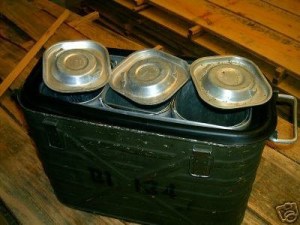
I first drank coffee in the Army… on top of a hill… during the dead of winter… from a mermite can.
Steam rising from the lid proved irresistible when ambient temperatures were below zero and we had just slept on the ground. What else were we going to do but drink coffee? It was there.
We each have a personal history of drinking coffee. I asked one of the greenhouse seeding crews if they remembered their first cup. Some had specific memories, others did not. For me, it was the windy hill in Germany back in 1976.
Coffee was first discovered in Ethiopia in the 11th Century and spread throughout the temperate zones of the planet. It is currently being grown in more than 60 countries. Brazil, Vietnam, Columbia, Indonesia and Ethiopia are the largest coffee producers by annual export weight. Coffee has become ubiquitous as any foodstuff can be.
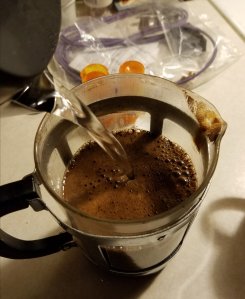
Making Coffee
The sources of our coffee are under pressure because of climate change. Yields are declining in part because a warmer atmosphere holds more water vapor, creating unseasonable and extreme weather events. Likewise, warmer temperatures expanded the range of the coffee berry borer. Coffee rust is a detrimental fungus increasing its range as the planet warms and winters no longer kill it off in mountainous regions where coffee grows. The impact of global warming caused climate change is not trivial.
We would like to drink a cup of Joe without worry. When we go to the warehouse club there is a long, abundant aisle of coffee produced all over the world. A cup of coffee continues to be affordable at restaurants. It hardly seems like a problem. It isn’t… at least not now.
The science of global warming is virtually undisputed. What seems less certain is how it will impact our personal lives going forward. The Earth’s ecosystem is complex and specific regions have had different issues. We’ve had our share of droughts in Iowa, but there has also been enough rainfall to produce crops. Some days it seems the only persistent idea about Iowa’s climate is that rain remains. When it comes to coffee, what happens six inches in front of our noses is not as important as the global environment in which humans live.
There’s the rub.
With the 2016 election of a Republican to the White House, all eyes are diverted from our most pressing problems. Challenges to the study of climate change is one of those pressing problems and not only because I may be deprived of my daily cup of coffee.
The administration walked away from policy decisions we’ve made to reduce greenhouse gas emissions. It is cutting funding for climate research. It is censoring and targeting government scientists. One could reasonably say the government under Republicans has abandoned science as a consideration in policy-making.
As Americans, we know what to do. We must repudiate the direction Republicans are taking our society by voting them out in the 2018 and 2020 elections. I’d rather linger over my morning coffee than get involved in politics again. However, personal political engagement is the price of a livable future.
A thick, wet snow blanketed the landscape overnight. Being a lifelong Iowan, driving on snowy roads across the lakes to today’s political convention shouldn’t be an issue if I take it slowly.
I am on the arrangements committee and have to be there at 6 a.m.
My mind is not on that, or the myriad other activities that filled my days since entering retirement a week ago.
After 50 years of work a person needs healing. That’s going to take longer than I thought.
On Monday I dropped my car for repairs in town and walked the three miles home along the Lake Macbride trail. The trail was pretty beat up with deep ruts from construction equipment along the entryway from town. Iowa Department of Natural Resources must be up to something. It looked like hell. Walking home was a mistake.
My plantar fasciitis has been in abeyance but the day after the walk, my heels started to hurt. It was exacerbated by standing to soil block at the farm yesterday, reminding me there is no such thing as “good as new” for a sixty-something.
More than physical ailments I need to heal my mind. When I entered the low-wage workforce back in 2013 it was hard to focus on bigger issues. Perspective was reduced to a few inches beyond my nose. Interaction with newly met people was framed by the idea I didn’t really want to be there. It tainted my perception, hopefully not permanently. It too will take time to heal.
There is a lot to get done during our brief time on earth. Sometimes we need to stop and just breathe. If we can manage that, perhaps our bodies and minds will heal.
(Editor’s Note: This article was written July 3, 2009, shortly after my first retirement. It has been lightly edited to remove misspellings and grammatical errors I can’t bear to promulgate).
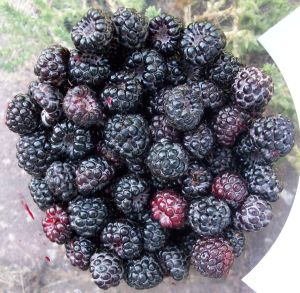
It begins by foraging for wild blackberries in Lake Macbride State Park.
Between a twenty five year career in transportation, and Independence Day 2009, gathering berries in the forest seemed a natural and appropriate way to mark my retirement at age 57. I knew that my work life would continue even if my employment for Iowa’s largest transportation firm was over. On this first day of what’s next, I hoped to wander the forest with my bag and gather what blackberries I may, an archetype of my life as an American salary man turned loose.
To say I lacked the commitment of a career in transportation misses the fact that I devoted much of my waking time and personal energy to being a successful transportation manager. At the same time, it was a bargain of time for money with what I now realize as little chance to get ahead. Transportation is not a traditional career as are medicine, the law, retailing, carpentry and plumbing. At the highest levels of transportation’s hierarchy executives are few in number and part of a clearly defined and relatively small social network. It was never my world, nor was there opportunity to make it my world, even if I was successful in delivering the business results my employers expected.
I figured this out late in the game, and it drove me to leave the business, not just recently, but in 1998 and 2003 as well. Finally, after a job as Director of Operations for CRST Logistics, Inc., my team achieved remarkable results, one last time, and I left the business.
Why did I sacrifice so much? I hoped to establish a home, meet the basic needs of our family, support our daughter’s start in life and leave time to enjoy ours. It was, among other things, for the ability to forage for wild blackberries.
And as the sun rises in the security of my partially finished study, I have concerns. I am most concerned that I will use the talents I have been given, the experiences I have had and the meager resources we have been able to accumulate, to contribute to life in society.
This means more than paying taxes and getting along with neighbors. It means considering life from my unique perspective and create an endeavor that brings peace and prosperity to a larger segment of society. The sacrifice we made resulted in a life that is economically better than many families. Our current life is a foundation upon which to build what is next. It has never been about the money or economic gain. It is about fulfilling life’s promise, and the moment I realized this and it sunk in, my so-called career in transportation was destined to end.
To start an autobiography at my age is not unusual. What is different is I want to cover the middle of life, beginning when I was married and age 32. There is another autobiography of the earlier period to be written. If I am lucky, I will get an opportunity to write that part as well.
I sense a pressing urgency to understand how I spent the middle years. If I hope to inform others of the perils of working for wages, this story should be told now, with certainty and the energy of a life lived for others. I want the story out so our daughter can benefit from it. This book will pull in parts of my whole life, but the focus will be living with a family, the meaning of labor, the consequences of delayed gratification and subservience, and the possibilities of living a life as a manager in a large company. It is a story I do not see others aware of or writing today.
My feeling about work is as old as the colonial days in Virginia. I suspect it is derived from the intellectual history passed down in my family through the generations. People indentured themselves to pay for their passage and get a start in the new world. They might indenture themselves for another contract period to pay for the passage of their family. It was a tough bargain and as many as half of the white emigrants are said to have come to the New World as indentured servants. I suspect my ancestors were among these people whose contracts were sold upon arrival in Virginia.
Henry David Thoreau wrote of the trade off we make in taking employment in Walden,
“…men labor under a mistake. The better part of the man is soon ploughed into the soil for compost. By a seeming fate, commonly called necessity, they are employed, as it says in an old book, laying up treasures which moth and rust will corrupt and thieves break through and steal. It is a fools life, as they will find when they get to the end of it, if not before.”
I am lucky to have figured this out while having a life expectancy of another quarter century. As I look through boxes of artifacts and papers I laid up before and during my working life, the papers are yellowing and dusty, diminished in importance. While I do not seek to be like Thoreau, I would learn from his writings.
I have worked for large and small businesses. I was in the military and worked for the University of Iowa. I worked brief periods of my time as an independent contractor. I belonged to a union, voted against unionization and managed union employees. I negotiated union contracts, the modern successor to the indentured servitude of the colonial days. I worked through 25 years in transportation to yield a nest egg insufficient to retire in the traditional meaning of that word. If I had stayed on, until age 65 or 68, I would not then have accumulated enough money upon which I could finish life, work free.
I seek to inform, not complain.
In a varied work life I gained experience in many facets of life, both in and outside my career. Reflections on a thousand meetings and experiences inform how lives devoted to labor can be improved. My hope and intention is that as I consider the detritus of a life in transportation my view will become more informed and I can help others, our daughter particularly, avoid the pitfalls of which Thoreau and others warn us.
On my last day of employment I had parked at a distance from the employee entrance, as usual. As I settled into my blue Chevrolet Colorado, I stopped to look at the building. I sat for a couple of minutes trying to remember entering for the first time.
A woman named Jean King took my application and gave me the Wonderlic test. There was a sign made from a 4 x 8 foot sheet of plywood that said “A Company on the Grow.” I worked most of my 25 years for CRST and saw it grow from a $60 million company to more than $820 million in revenue. I am pleased to have been a part of that.
The growth and success expanded the property, and while the main building was the entire company when I started in 1984, we acquired land from Wiley all the way to Edgewood Road along 16th Avenue. A grocery store was converted to CRST Van Expedited Headquarters and we built a training center for the asset divisions. There are major facilities in Birmingham, Alabama, Carlisle, Pennsylvania, Fontana, California and dozens of agent and sales offices dotted across the country.
What attracted me to the company was that it was owned by Herald Smith’s family and of a size where I could get to know everyone in the company. For most of my time there, I did. On my last day of work, Herald’s son, John called to wish me well.
These were things going through my mind as I sat in my pickup truck getting ready to go home. I started the engine and instead of driving to 16th Avenue to turn right and take Wiley to Edgewood, I exited the parking lot north and drove 12th Avenue east to Edgewood, seeking to have a different view of the drive home. I did not look into the rear view mirror.
Our life has been good by any standard. We have a roof over our head, clothes to wear and food to eat. There is plenty to occupy our time and we have hope that our daughter will experience success. We were able to send her to Cornell College in Mount Vernon and support her through her beginnings after college. I am not complaining about our quality of life, nor would I. We have had a good life, to a large degree because we have lived in the United States and in Iowa for most of our time.
Journal entry from July 2, 2009:
Lake MacBride. It is 20 minutes before I leave for the last day of work at CRST Logistics and I am ready for the change. There will be uncertainty but we have to have courage to get through each day’s challenges. I am not sure how much this means, but hope the new path leads to a brighter day.”
Post on Big Grove Garden July 3, 2009:
“Each year I walk to the state park and search for wild blackberries. They are typically ripe around Independence Day, and after walking to town and searching for them I gathered about a pint. The berries on the south side of the trail were more abundant and on the north, were almost finished. The variation in sunlight seems to matter, although not by much. From the looks of the plants, we are about a week into the season.
After a few years we learn how to look for the plants and some places there are a lot to be picked and others one or two. We build expectations based on remembrance of where the best spots were previously. To write these locations down is unthinkable as the knowledge resides within us, and we don’t want to reveal our best areas to others. This is a natural human behavior.
One of the best places in previous years is replaced with a natural gas substation. The town and the youth recreational complex adjacent to the elementary school continue to encroach upon the wild places. The odor of natural gas came from the pipes, reminding me of West Texas. It was disappointing to see the berry patch gone.
Once I had more than a pint, I looked at other things along the trail. The flowers are in bloom and abundant as home construction peeps into the once isolated trail.
I made it home and made oatmeal topped with a handful of the wild blackberries picked this morning.”
Perhaps the encroachment on the wild blackberries is evidence of the corruption and thievery of which Thoreau wrote.
E-mail to Mike Fouts, President of CRST Logistics, Inc. on July 5, 2009:
Mike:
Please let everyone know how much I appreciated the many goodbyes and best wishes last week.
The cards and gifts were more than a person should expect, and will be useful in my life in Big Grove and beyond. I wore the hat at the Coralville parade on Independence Day and young women wanted to hug me: surprising and happily accepted.
Two bits of news since Thursday are 1). My uncle sold his coffee shop last week, so that idea is out. 2). our daughter is talking about returning to Iowa in 2010, so it looks like we will be staying here for the present.
Thanks again for the thoughtfulness in celebrating my tenure with CRST Logistics. I found CRST Logistics to be, every day, without exception, a great place to work.
Best Regards, Paul
Paul Deaton
Solon, Iowa
I made wild blackberry jam with the day’s findings and we enjoyed it through the Christmas and New Year’s Holidays. What may have been on the periphery of our life became a main event. However, that is another story. Let’s dial back the clock to March of 1984 when we made the decisions that led me to a career in transportation.
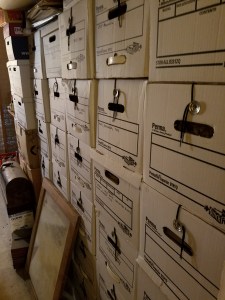
What caught my attention was downloading my Facebook and Twitter archives and seeing how how much information existed there. I reviewed my Gmail account and its 183,194 emails since March 2006, remembering I have another seven years worth from multiple email accounts on another drive. There are thousands of blog posts. That’s not to mention close to 100 bankers boxes, trunks, desks and the like filled with documents, recordings, images, mementos and other artifacts to be rediscovered. There are also thousands of books… and the garage… and people… and you get the picture. There are hundreds of everything to “help” my research.
What was I thinking?
I’m not famous or well known outside my local community, so who cares? I’m hoping our daughter would find such a work to be of interest — maybe a few others.
I’m old school in that when preparing for a life of writing, an autobiography is a first step. Right or wrong, I learned that in high school. I’m already at retirement age, so I better make this part of my life brief.
Before writing a major work, one must follow the Delphic maxim to “know thyself” and its later Socratic expansion, “the unexamined life is not worth living.” We have to take a look. Going through my archives will help me assess who I was and who I might be. I can also use the experience to downsize the amount of stuff accumulated over the years.
Finally, I don’t know a topic that is not complex and subject to context and multiple interpretations. A brief 500 words per chapter forces me to consider what’s most important and stick with it by condensing the raw material into a succinct and hopefully brilliant couple paragraphs.
If I fail to reach brilliance or even get it done, what will I have lost? Nothing.
First Day of Soil Blocking 2018 Photo Credit – Maja Black
As one makes one’s bed, so one finds it. ~ French Proverb ca. 1590
Today is my last day as a full-time employee at the home, farm and auto supply store. Reducing my schedule from five to two days a week should free time to work on other projects. At least that’s the hope.
We built a home in Big Grove and made it ours. I walked the lot lines before we broke ground and sat on the dirt high wall after the lower level was dug. We hooked up utilities, installed a door between the garage and residence, and moved in all on the same day in August 1993. No regrets.
Almost 25 years later our home needs updating and some maintenance. We’ve been spending our time living more than working here. Today’s transition will change that and I’m looking forward to it.
Fifty years ago I began working part time after high school at a department store. Despite how American business evolved since then, I made it across the finish line. I’m still here. We’re still here.
Now comes the downsizing, reducing and recycling — a frugality characterized by the fact we haven’t generated enough trash to set out our curb side receptacle in three weeks.
There will be industry as I’ve mentioned previously in these posts. However, one focal point is rebuilding stamina needed to work more hours each day. It’s not really retirement.
We never know what will happen to us. We make plans. We stay busy as best we are able. We contribute to a greater good if we can. We hope.
As I head through the door this morning I don’t know what today will bring. I’ll sleep tonight and wake up to a tomorrow that begins like so many others have.
“Good navigators are always skeptical, not of the presences of things, but of what they see and understand. Good navigators are almost always lost.” ~Robert Finley
Green up has begun and everything seems ready to pop — even if it isn’t.
My usage of “green up” comes from the 1936 film The Trail of the Lonesome Pine,” in which June Tolliver said, “I ain’t marrying till green up,” delaying pending nuptials between her and cousin Dave Tolliver until after hog killing time. Waiting until green up is cause to delay not only weddings, but needed chores, engagement in society, and anything and everything until ambient temperatures warm and spring is in the air. It’s a lame excuse but we keep hoping it will work out after green up.
Demands on my time increased as tenure as a full-time employee at the home, farm and auto supply store draws to a close in seven days. If I’m lucky, and only partly as a result of planning, the most important things will fall into place. There’s also a lot not planned.
I hope to transform how to look at the world. Beginning March 18, my worklife will devote 56 hours each week to writing, food ecology and paid work. It’s a lot but I hope to increase that to 80 hours or more. Will determine if that’s possible in the process.
What I know is there’s much left to accomplish. That said, I don’t keep a bucket list. When young I meticulously kept a to-do list which helped my rise to a middle level of performance and productivity. The to-do list was always there, and rarely did I remove something without addressing it. I use no such device any more. I eschew lists. I abhor them. I can live my life without them and will.
What I hope is to continue to evaluate what and how I see in the world. It’s an imperfect process, one that requires attention and energy. Like green up it’s a path toward life’s potential. As June Tolliver found in the film, the unexpected can come into view. We must break the cycles of tradition and habit in order to see it.
Asian Greens in Scrambled Eggs with Vermont Cheese and Pickled Bits and Pieces
After tangling with a schedule to reduce hours at the home, farm and auto supply store I concluded there were only three immutable weekly activities: writing (26 hours), paid work (16 hours), and farm work (12 hours).
Add an hour of prep time before work outside the home and these three activities fill 69 percent of available weekly hours. Everything else must fall in place behind these priorities. It is a rigid frame on which to hang everything else.
It’s already a 54-hour work week.
What’s missing is community organizing, the rest of food ecology, and home maintenance, all of which need to be squeezed into the remaining hours each week. Developing capacity to be more productive is part of this. It necessarily means doing better than using artificial stimulants or shoddy work in any activity area. It’s a plan.


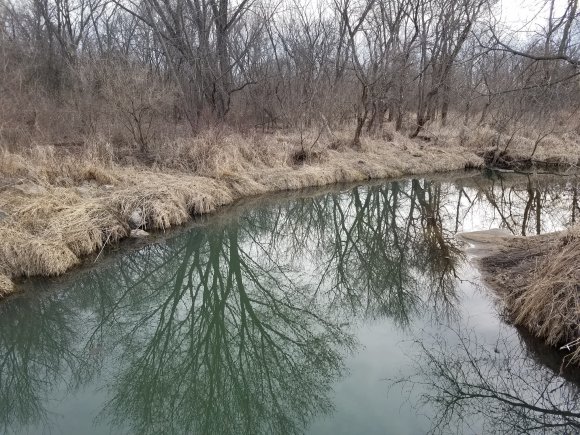

 Journey Home
You must be logged in to post a comment.