The holiday season is over and today I return for a shift at the home, farm and auto supply store. I’m fine… I’ll be fine.
Since the orchard closed for the season it has been two months of reading, writing and cooking in the kitchen. Existential errands have been run. There was a special election Dec. 18. I eschewed the company of anyone but those closest to me plus people I encountered in the world of commerce.
My daily journal of meetings with family, friends and acquaintances is the emptiest it’s been since I began keeping it. It has been the kind of holiday isolation a writer needs and appreciates. I’m ready for the holidays to be over, even as winter has just begun.
It was quiet on New Year’s Day. Using the rest of a jug of sweet cider and a packet of spices from the orchard, I mulled cider which was warm and comforting. The flavor of spices combined with local apples tasted just right.
I curled up with a book, a cup of mulled cider, and dwelt in the narrative that is Bruce Springsteen’s memoir. It was great escape. I wasn’t that familiar with him or his music. It was day to forget about the outside world before the 2019 maelstrom begins.
Seven or eight weeks remain until soil blocking begins at the farms. With time on my hands one would think I’d have a better plan for the coming year. It’s sketchy at best. Time isn’t waiting for me to catch up.
So it begins, my 67th trip around the sun. Ready or not, here we go.
When I left full time work March 16 I had no expectations.
After all, there was work at two farms in spring and early summer, and fall weekend shifts at the orchard, all to keep me busy. That’s along with two days a week at the home, farm and auto supply store.
Once the farm work ended in October, my outside work schedule left me with five days a week at home. I didn’t know what to do.
I continued my habit of reading and writing in early morning. I read more full length books than I have in years. With my Social Security pension our household income rebounded to a livable amount. Our garden was the best ever and the extras from barter arrangements made a reduction in grocery expense possible. We cooked more meals at home and ate better quality food. The sum was that if I continued that direction, I could get by, and live well, but it wouldn’t be very good for my life in society. I’m not ready to settle into an easy chair and kick back during my remaining days.
I’m okay with slowing down and taking stock. It’s a luxury many people don’t have. It is time to overcome the inertia that’s settled in since October and get to work. The challenge is picking a couple of meaningful goals and bringing a reasonable level of focus to them. That’s where I’ve been stuck for a couple of months.
If I were to get a legal pad and write down tasks needing done it wouldn’t take long to fill several pages. Filling time and making lists is not the point. Finding meaningful work is the goal, work meaningful not only to me but to those around me. That is a harder planning session.
That’s where I land after 50 years of applying my driven personality to society in the workforce. What I do next is more optional than it has been since I was a teen. It will be work and I want to make sure it is the right kind of work for a sixty-something.
The remaining December days are a perfect time to set course for 2019 and beyond, and so I shall.
In May 1972, in the English Philosophy Building of the University of Iowa, professor David Morrell held up a copy of the book he published the previous year and asserted it represented the future of modern American fiction.
My high school friend Dennis was also in the class and we were skeptical. Morrell wasn’t wrong.
The book was titled First Blood and has been in continuous publication ever since. In 1982 it was made into a movie starring Sylvester Stallone. There were sequels. A student of Hemingway and John Barth, Morrell wrote First Blood while at Iowa where he taught English until 1986 when he gave up tenure to write full time. Last count he had written 32 books.
Morrell is the only undergraduate professor I continue to follow. That’s because when social media rose in the culture he adapted to it and is a constant presence on Twitter and Facebook. He’s easy to follow. Yesterday he posted a link to a video about writing which arrived as I’m figuring out what to write next year.
“The point is to have the passion and the drive to see in a book that it can make you a better person,” he said. “So that even if the book is not published you haven’t wasted your time because you wrote something that is truly important to you.”
That’s good advice. Write to make yourself a better person.
If I took any lesson from Morrell it was his practice of taking a deep dive into techniques he would depict in his fiction. Over the years he learned mountain survival skills, firearms handling, how to drive in emergency situations, and how to fly an aircraft. All of this training served his thriller writing. The take away for me was that writing must be grounded in experience. Not only so it reads well, but so we understand and can communicate life experiences faithfully.
During end of year holidays Big Grove and the lake district gets quiet as people settle into home, family and community. It is respite from the increasing turbulence we see in our politics and in society. I use this time to gain perspective on what I’ve done and written. Today the days start getting longer — an embarkation point for what’s next. Not sure what I want except forgiveness and redemption.
Midst gardening, farming and living there will be writing. I hope to improve my skills and stay grounded in reality… and to become a better person.
On early morning walkabout the moon and stars were out, casting silvery light on me and everything.
Yesterday a thin layer of ice rested on the lakes, its mirrored surface perfect for skating if it thickens. Based on the forecast, we’ll see more open water soon.
When our daughter was a grader and the lake froze we’d don ice skates and cut a path all the way to the other shore. When snowmobiles plowed by we could feel the ice moving up and down taking us with it. We keep the skates on a shelf in our garage.
We live in a cold middle place where it’s not quite winter and not warm enough to work long outside. Our attention turns inward and to the possibilities of next year.
The best part of the coming holidays is people engage in things. A calm quiet falls over the Johnson County Lake District. If it were snowing one could hear flakes fall.
It’s a time for planning and writing here in Big Grove. What few fresh vegetables are left in the ice box will soon be eaten up… well, except maybe the turnips. I’ve been watching videos of Indian street vendors making gigantic woks of chicken fried rice. There’s a tub of leftover rice and plenty of eggs so I’ll try that for lunch or supper. I forget eggs are chickens.
And so it goes. Vonnegut taught us death can be absurd, tragic and predictable. It seems mostly random and will eventually take us all. I’d like to get back out on the ice and cut its clear, smooth surface in long figure eights. I’d watch fish swim through the ice and hope the crazing wouldn’t result in my going to live with them. Not yet anyway.
The hope of this holiday season is we can do positive things next year. Isn’t that always the case? So it goes, and here we go. Gliding along the surface until we take a plunge, hoping for a resurgence of living each moment as best we can.
That’s optimistic. Increasingly, that’s who I want to be, who I am.
Protesters on the Champs-Elysees. Photo Credit – NBC News
We see a lot of customers wearing yellow safety jackets at the home, farm and auto supply store. Mostly they seek something to complete a project.
Road crews, construction workers, and tradesmen of every kind stop in wearing the bright, reflective safety gear. It is mostly men. Usually, they are in a hurry to get back to work.
The similarities between these Iowans and the French citizens protesting an increased fuel tax seem mostly external. The French are required to carry yellow jackets in their vehicles in case of a mechanical breakdown on public streets and roads. Before I began working at the home, farm and auto supply store I thought only fire fighters wore such reflective clothing.
What makes our yellow jacketed citizens different is the Trump administration is creating massive changes in financial matters that impact them and who cares? Where are the protests? For the most part Americans play the hand dealt in subservience.
Take interest rates. On our last statement before the president was inaugurated, our annual variable interest rate was 3.00 percent on our home equity loan, indexed to the Wall Street Journal published rate. Our current rate is 4.75 percent, an increase of 58.33 percent. Where is the outrage?
Take gasoline and diesel prices. On Dec. 10, the average U.S. price of gasoline for all grades was $2.511 per gallon with diesel at $3.161. During the same week in 2016, gasoline was $2.347 and diesel $2.493. The price of gasoline increased 6.99 percent and diesel 26.80 percent under this administration. With U.S. oil production hitting record high levels last month, why aren’t gasoline and diesel prices coming down?
I don’t really expect answers because I know them. Interest rates and oil prices are just not on the financial radar for most people. They are an assumed background noise. Something that has to be dealt with, but not very often. Importantly, American businesses have learned how to change things in their favor without precipitating the kinds of protests we see in France. It is a basic part of corporate pricing policies.
The protest in France is about fuel prices. During the first Gulf War I worked for Amoco Oil Company, where we were acutely aware of the global political situation as it related to discovery, development, refining and selling our products. I managed a small trucking fleet and fuel price volatility during the war led us to implement a fuel surcharge in our contracts with customers. We weren’t the first to implement a fuel surcharge but today they are a hidden part of almost every type of delivery service. Depending on a customer’s savvy, fuel surcharges can be negotiated to produce an additional margin for operations through various pricing schemes. As suggested, it’s just not on the radar for American yellow jackets. Interest rates? You gotta be kidding me.
It’s been a long time since I was in France. I’ve never understood their politics the way I do ours. Is Macron good or bad, or just another president in a series of controversial figures? What I do know is Americans rarely make the news for our protests. That is more newsworthy than what the yellow jackets are doing in France.
On Aug. 10, 2016, Donald Trump appeared at a campaign event about 50 miles from my father’s home place in southwestern Virginia. He asserted coal miners would have one “last shot” in the election, cautioning that the coal industry would be nonexistent if Hillary Clinton won the election.
“Their jobs have been taken away, and we’re going to bring them back, folks. If I get in, this is what it is,” Trump said.
How do you tell if the president is lying? Check to see if his lips are moving.
It is easy to dismiss his comments as campaign bluster. However, real lives are at stake and young couples are leaving Appalachia to find work in other professions and make a life. We are all driven by the need to make a living. Despite strong personal history and traditions in a place, the economics of living there may cause us to leave as it is doing in coal country where mining jobs continue to be in decline.
U.S. coal consumption is projected to decline by nearly four percent in 2018 to the lowest level since 1979, the U.S. Energy Information Administration said on Tuesday. At year-end, appetite for coal will be a staggering 44 percent below 2007 levels according to NBC News.
The cost per kilowatt hour of electricity generated by new solar arrays is less than those generated in existing coal-fired power plants. Cheap natural gas extracted by hydraulic fracturing has taken new coal-fired power plants off the drawing board. Right or wrong, the power industry is switching to gas. India, one of the top ten global carbon dioxide emitters, has cancelled plans to build nearly 14 gigawatts of coal-fired power plants with the price for solar electricity “free falling” to levels once considered impossible, according to Ian Johnston at the Independent.
There are no easy answers for people impacted by our changing energy economy. Families that relied on coal extraction to make a life will have to revisit their choices regardless of what the president does or says.
When I was coming up the home where I spent ten formative years had recently been heated by coal. When my parents bought it the large gravity furnace in the basement had been converted to natural gas. It was an inefficient way to heat our home, but it was very reliable, and natural gas was less expensive and more convenient than coal trucks plying the alley behind our house to deliver. There is no going back to coal in home heating, or anywhere else.
The sooner we generate our electricity from renewable sources, the better we reduce greenhouse gas pollution in the atmosphere. No amount of presidential bluster can save the old energy economy, nor would we want to. Our politics isn’t there yet, but we will act on climate change. There is an existential urgency that we do.
A technician arrived Friday morning and replaced the idler pulley that had been making noise. Although long ago replaced, a washer and dryer was one of the first gifts my in-laws gave us after our wedding. A working home washer and dryer is neccessary in an American household.
I’m glad the local company from which we bought the dryer provides service. The repair was completed well before 9 a.m., leaving the rest of the day free to occupy as I would… sort of.
After the repairman left, a neighbor who is on our well committee called to ask me to help a local well service price an upgrade to the mechanicals in our well house. He was in a nearby town and wanted to stop by enroute home to the county south of us. I said yes.
Our public water system has been using more water than anticipated when we upgraded the well about 12 years ago. Time and usage are taking a toll on the mechanicals — the pump will eventually need replacing. He secured the information needed for a proposal on a replacement pump. It was an unexpected but useful and informative interruption of the day.
Discussion of water systems with a well-known operator is a way of tracking what’s going on in the county. I enjoy this part of the work. He said he was picking up business as well service operators like the one who renovated our well exit the business.
As I showed him around the well house, we discussed the new line a subdivision west of us is running from the city to resolve the high level of arsenic in their drinking water. A couple of other subdivisions requested stubs on the line, but no one else requested service. From Thursday’s newspaper article, it’s unclear whether the city would be willing to provide water to customers beyond the initial scope of their agreement.
We also discussed the new well at the orchard where I work. The tricky part was figuring out how to drill the new well around a seven-day-a-week operation that includes a retail barn and a restaurant. They figured it out and the new well is in service.
When I returned home I sent out the notice of our regular association meeting next week along with a call for agenda items. There were other association matters to tend to which occupied my attention most of the rest of the day. The slate wasn’t really clear when I went to the kitchen to make dinner.
Working two days a week at the home, farm and auto supply store leaves me time to work in our small community. I’ve been on the association board three different times since 1995 and will finish out my term and maybe go for one more. I find the work interesting and there is plenty of it. At some point I’ll step back and let someone else lead the effort. A lot depends on how successful we are in transitioning from work to retirement during the next couple of years.
Even without a part time job there is plenty to occupy a pensioner. Staying engaged in the community is not only important to longevity, someone has to do the work. For now, I’ll be on the board to help sustain our progress and plan for the future. However, it would be great if I could leave those chores to someone else and focus solely on writing. For now, I’ll make do with early morning sessions and posting the results on this blog. However, there is a bigger project in the background, one which will occupy my time with intensity once begun. I’m looking forward to it once I finish all these existential errands.
The second half of 2018 has been weird. A burden was lifted when Social Security checks began to arrive a year ago. With them came a view that new undertakings were possible, unlike at any time since I returned from Germany in 1979.
The next big thing isn’t as obvious in 2018 as it was in years past.
Maybe removing economic worry became the impetus for a new way of seeing the world — a complete segregation between who I am and work I do in society. I’m less worried about society and the focus is now on me. It’s new territory for someone who has been steadily busy since high school. What will this next act in life be?
I think of the famous speech from As You Like It although I’m not sure William Shakespeare’s seven ages of man still apply. When life expectancy was shorter they may have been relevant (in British Society), but with a longer span our lives are more diverse and such notion of ages antique.
There have been breaks in the continuum of my life. The time before school, then schooling through high school, leaving home for university and adventure, settling in with marriage and a career, followed by a long semi-retirement leading to this year when I applied for my Social Security pension and stepped back from working except when it interested me. By that reckoning I am beginning a sixth period although it doesn’t seem so clear cut. It seems downright foggy, the path vague.
After first retirement in July 2009, I had hope of starting a new career or my own business. That didn’t happen the way I expected. The question these days is how will I spend them? Each day is an open book, often isolated from the ones before and after. It is no way for a human to live.
This all came home after apple season when I reduced my work schedule to two eight-hour shifts at the home, farm and auto supply store each week. I’m hopeful to make a positive contribution during the sixth age of Paul. Already I’m autonomously getting started with next year’s garden, more writing and reading, and plenty of cooking. However, these things are a baseline in who I am, rather than the full result — a framework the contents of which aren’t visible in the chiaroscuro of mist-filled days and cloudy afternoons. Like a batter as the baseball is pitched from a mound, what to do next will become clear as I stand at the plate and consider the sphere and its rotations as it hurls toward the catcher’s mitt.
I expect I will write my way out of this. Not today, but soon. Once I do, Katy bar the door.
The 2018 Midterm elections are over and I’m happy about the outcome.
I live in Big Grove Precinct, nestled around Lake Macbride, and here Fred Hubbell beat Kim Reynolds by two votes of 1,107 cast in the governor’s race. Why am I happy if Hubbell lost statewide?
Compare 2018 to 2014 election results in Big Grove when Terry Branstad won the precinct with 558 votes to Jack Hatch’s 367 (951 votes cast). Overall voter turnout increased by 16 percent in 2018, and almost all of the increase favored the Democratic governor. In a precinct where Donald Trump won by 54 votes, I’m glad to see we flipped back to Democratic in the governor’s race, even if only by two votes.
My opinion on these facts: the 2018 midterms were a fair election.
People are already gearing up for the 2020 election. At stake will be something that gets to the core of what makes for fair elections, a fair way to draw maps of congressional and legislative districts.
Iowa’s process where an independent, temporary commission recommends a district map to the legislature, which votes on it, is a fair one. Iowa has avoided gerrymandered districts (like Pennsylvania and North Carolina drew to favor a particular political party) largely because of our process.
No matter who wins the legislature in 2020 we should keep our statutory redistricting process to ensure fair elections, that is, if we want to strengthen our democracy. I want that and hope you do too.
~ Published in the Nov. 29, 2018 edition of the Solon Economist
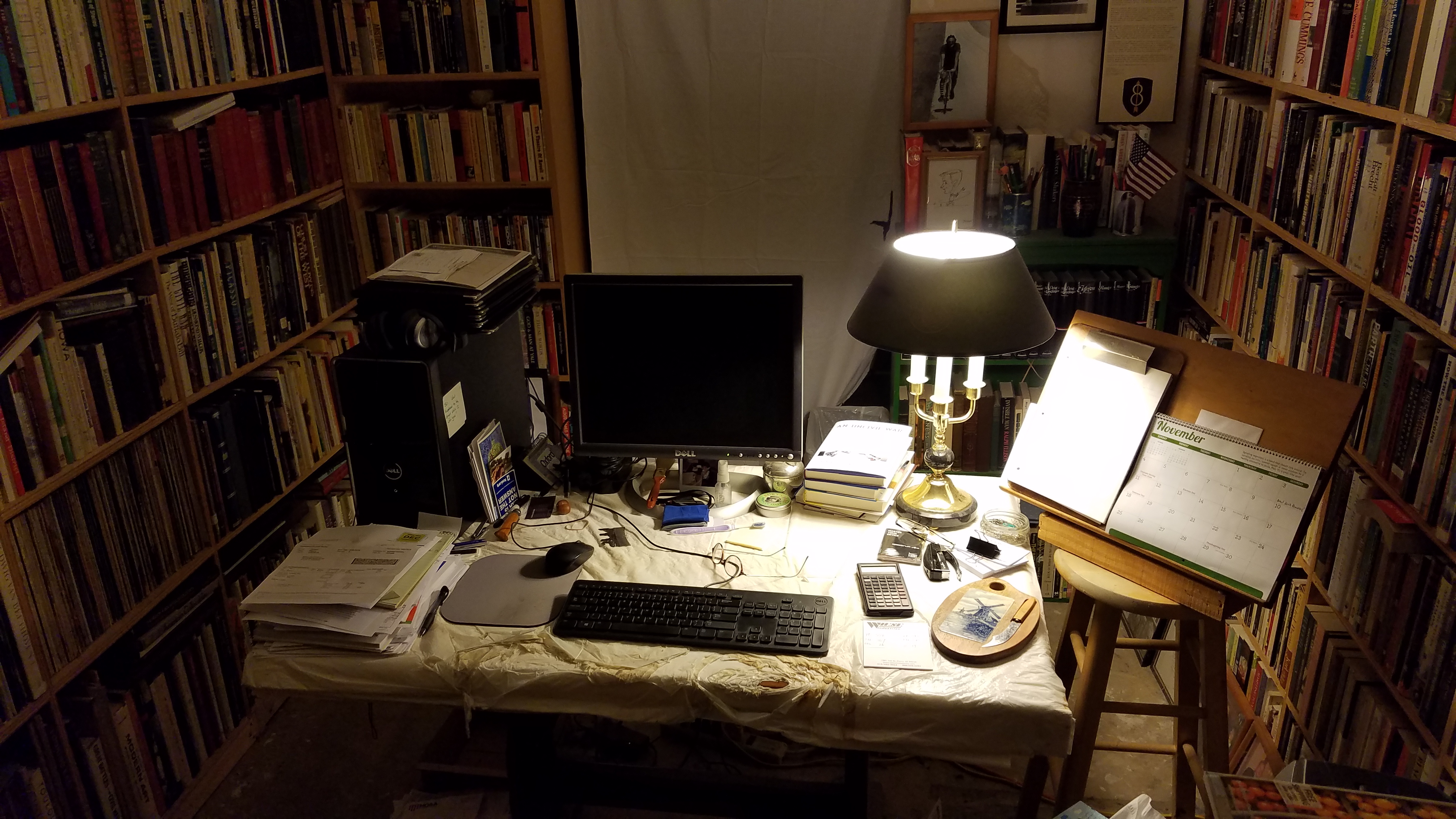
When we moved to Big Grove in 1993, the lower level of our split foyer home was unfinished. It remains so and may never be other than a storage area for extras from lives past — ours and our deceased relatives. As we age, we make a life in the upper level and cobwebs form over the boxes and piles filling the space below.
At some point, I don’t remember when, I took a nine by 12 corner of the lower level, installed a wall, a doorway and bookshelves on all four walls. In the middle of the room is a library table that came from my father-in-law’s estate. That is where I write. I don’t know if it is a productive place, but I’m used to it. I’ve produced a lot of words here.
My writing table is quiet, temperature controlled, and mostly dry. One time the gutters and downspout were blocked by leaves. Water came pouring down outside my window, seeping into my space. My design of having everything elevated off the cement floor proved its efficacy. It is presently a comfortable, safe place.
I used to carry a laptop around the house with me for writing. I’m over that. I’ve found it’s helpful to use a desktop in a stationary location.
What do I want to write about? That’s the better question after a place to write has been established. I’m not sure.
Whatever it is, I’ll do some tweaking of my workspace this holiday season and come out writing January first. What else am I going to do?
 The holiday season is over and today I return for a shift at the home, farm and auto supply store. I’m fine… I’ll be fine.



 Journey Home
You must be logged in to post a comment.