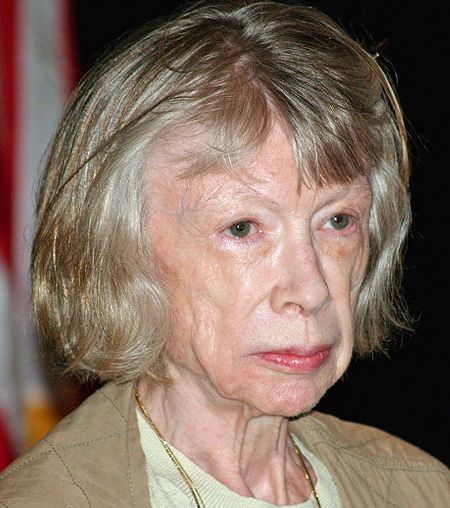
When I write my best I think of Joan Didion. She died of Parkinson’s Disease on Dec. 23, 2021 in Manhattan at age 87.
I will continue to think of her while I’m writing.
The reason her writing has such influence is she has been in and on my mind since high school. I thought, if I could write like Didion it would be the pinnacle. I won’t ever be as good as she was at her worst.
I was thrilled when I found South and West: From a Notebook and Let Me Tell You What I Mean this year. I wolfed them down, starved for what she brings to writing. While she studied Hemingway and Conrad, she did not write like them. She had her own lean, assertive simplicity to make her points. I was enraptured.
I didn’t understand California after a half dozen trips there. While Didion’s stories are her unique, single perspective, they are believable and seem probable. They informed my understanding that California was more than what we witnessed through media combined with ocean, desert, farmland, and what seemed like an unlimited number of highways. She exposed a side of it I wouldn’t have known. There is value in that.
In college I struggled to find a path. I was on a trajectory supercharged by the death of Father in 1969. Didion’s writing was something I could look to and see myself. Although being a successful writer wasn’t meant to be my career, Didion gave me hope in dark times.
We’ve known the end was coming for a while. Now that she passed there are no surprises, just a feeling of desolation, restlessness and sensibility characteristic of her work.
Her writing will persist, as will memories of her frail frame on talk shows as she headed home.
The Mill on Burlington Street, Iowa City, Iowa. Photo Credit: Wikimedia Commons
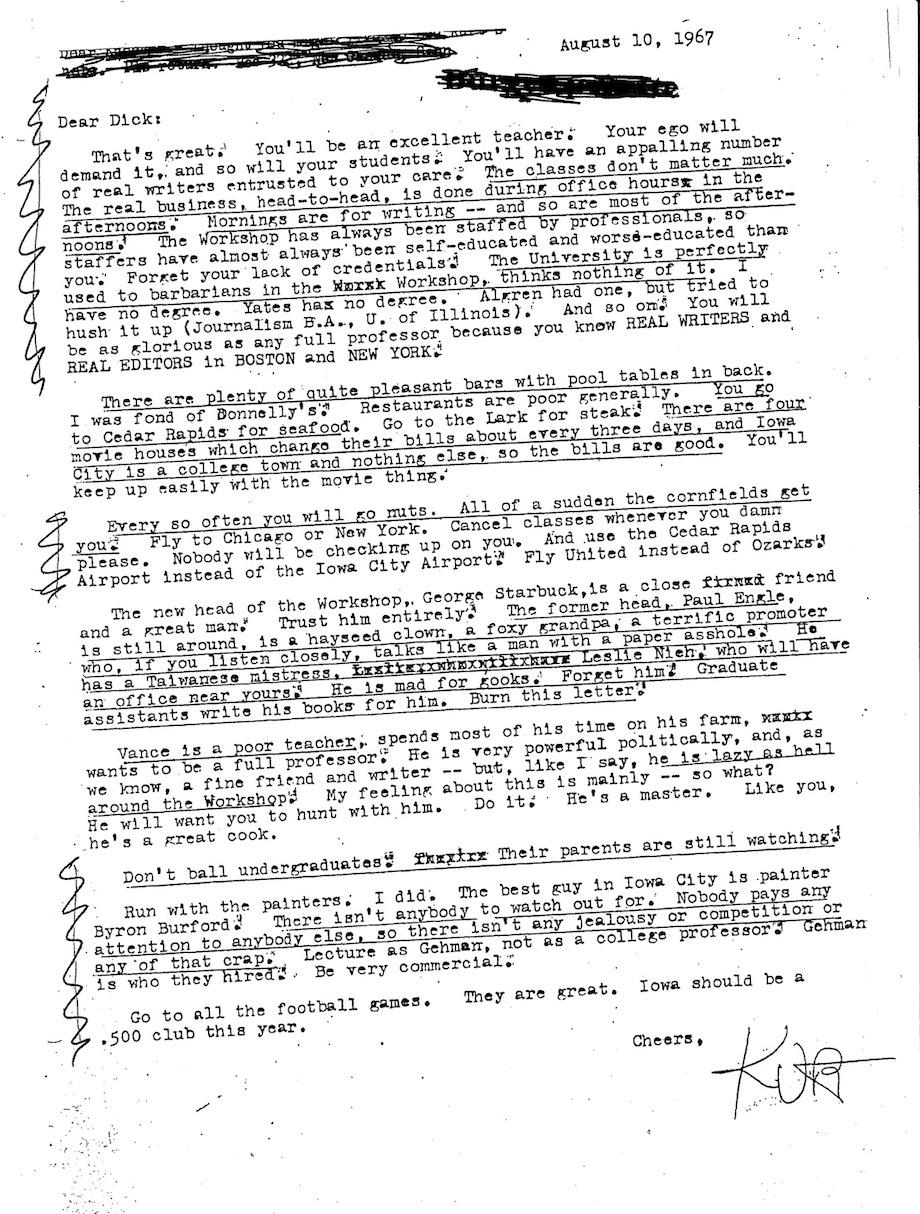
Someone posted a notice on social media that a demolition permit was issued to tear down the building where The Mill operated. They had been in business since 1962. I’ve forgotten more than I remember about The Mill. Time for demolition? So it goes, Kurt Vonnegut may have said. He wrote Slaughterhouse-Five after he moved to Iowa City in 1965.
Who knows if Vonnegut drank at The Mill during his two-year stay in the future UNESCO City of Literature? We do know he was fond of Donnelly’s. There were only so many bars within walking distance of his home at 800 North Van Buren. Given random associations between Vonnegut’s two years in Iowa City and a finite set of bars, it seems likely he did.
So it goes.
What I recall of The Mill is spending time with friends in graduate school. I listened to Joe Pratt, who dragged his new wife with him to Iowa from California for the American Studies Program. He played Stan Rogers songs on Open Mike nights at The Mill. Our writers for Blog for Iowa met up there for beverages and food. When I was more active in the Johnson County Democrats there were events at The Mill, or we’d just go to hang out after an event finished elsewhere downtown. It was a serviceable bar, which by the 2000s showed its age.
The Iowa City I knew upon arrival in 1970 is long gone. One more non-historical landmark demolished is no big deal. It would be best if the corporation razing the property built another high rise. More people of means could live near the city center. I don’t know what residents might do with their automobiles yet that never seems to be an issue. Downtown should be built up while there is interest among wealthy people and contractors to do so.
To me the death knell for downtown Iowa City was when Things, Things, Things closed. The department store came out of the turbulent 1960s and found commercial success into the 21st Century. It was administratively dissolved by the Iowa Secretary of State on Aug. 9, 2012 for failure to file a biennial report.
Two corporations plan to install Carbon Capture and Sequestration technology to collect CO2 emissions at about 40 ethanol and fertilizer plants spread across Iowa. Next, they plan to permanently bury the resulting liquefied CO2 in deep rock formations in North Dakota and Illinois. I don’t know who is swallowing this malarkey. Almost no one is.
The CO2 pipeline is planned to cross Karmen McShane’s family land in Linn County.
“It’s heartbreaking,” McShane told Gannett’s Donnelle Eller for a story. “My dad is 77. My mom needs care. And he feels powerless (to fight the pipeline).”
There is a lot of that going around.
The pace of news articles on CCS is increasing. Eller wrote about it in Monday’s Iowa City Press Citizen and followed it with another article in Tuesday’s newspaper. Erin Jordan of the Cedar Rapids Gazette has been covering CCS as well. When the regular news coverage is frequent, we should read what paid media writers have to say. That’s what I’ll be doing to see how the process unfolds over the end of year holidays. This is my seventh post on CCS.
The Iowa oligarchy of agriculture decided to do this thing, so resistance may be futile unless more people than have become engaged. If McShane is typical, the train left the station and once ground is broken for the pipeline, there will be no stopping it.
As long as Iowa focuses on ethanol, industrial agriculture using manufactured fertilizers, and monoculture row crops and livestock, the environment will get worse. It is pretty bad already if one looks at water and air quality. Implementing CCS does not address any of this and is a distraction from needed action to address Iowa’s water and air quality.
CCS is premised on a vague statement that we must decarbonize the economy. People have written books on this, and just because two companies are spending big bucks on the project, the one-off process in Iowa does not address broader concerns about reducing the amount of greenhouse gases being released into the atmosphere as if it were an open sewer. As far as I can tell, the sole reason for the project is to protect agricultural oligarchs’ two children: corn ethanol production and fertilizer manufacturing.
To read the rest of my coverage of carbon capture and sequestration in Iowa, click here.
Every village has a well. I began helping manage ours in 1995 when I joined the association board for our village of 85 homes. It has been an interesting project. We don’t really call it a village, yet the size is right.
I used this morning’s walkabout to head up the hill to meet with a contractor about a maintenance job. Ever since our main contractor died it has been a challenge to find technicians to work on our specialized equipment.
We met and they explored the well house, took photographs and asked questions. Like those before them they would not commit to bidding on the job. Fingers crossed they do bid.
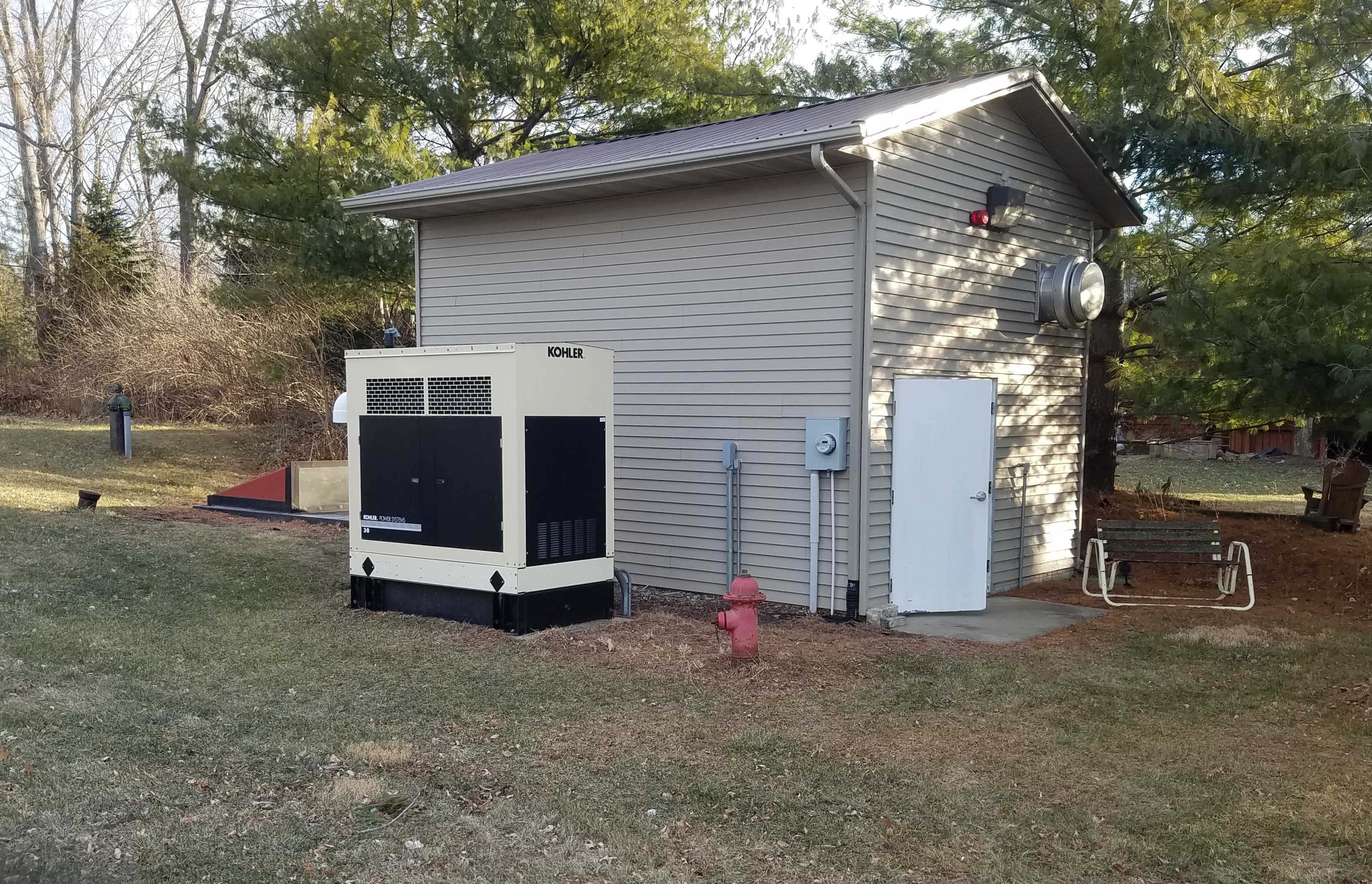
We have had issues with our mostly volunteer managed well. At one point we bought the generator in the photo so an outage wouldn’t cause us to lose water pressure. When we lose pressure for a period of time the Iowa Department of Natural Resources requires a testing protocol, which is a bit of a pain. We have enough volunteers so whenever electrical power is lost, someone runs up the hill and starts the generator so it’s back on line before running out of water.
Water is life. Every village has a well. While mostly unseen behind the tall pine trees the village well is at the center of our lives.
The coronavirus pandemic continues during a second holiday season. I had hoped to be done writing about that by now. The omicron variant of the virus informed me, “No, you are not done.”
Dr. Anthony Fauci, the nation’s leading infectious-disease specialist, said yesterday on CNN, “Unfortunately, I think that (record numbers of coronavirus cases and hospitalizations are) going to happen. We are going to see a significant stress in some regions of the country on the hospital system, particularly in those areas where you have a low level of vaccination.”
We had already cancelled a Christmas trip to be with our child and their close friends, because of increased incidence of COVID-19. Today I’m making a list for a trip to the grocery store to provision up with fresh vegetables so I don’t have to leave the property until the new year. I seek to minimize our exposure to the new, highly contagious variant of the coronavirus.
“It is going to be a tough few weeks, months, as we get deeper into the winter,” Fauci said.
Merry f*cking Christmas, y’all.
The Christmas Holidays in my childhood home were mostly a product of my maternal grandmother’s imagination. She was born and grew up on a remote farm in rural Minnesota. At a young age, she moved to Minneapolis where she worked as a servant. She and a man got together (and presumably married) and had two children. Her plain, difficult life was punctuated by the special occasions of weddings, baptisms, first communions, and religious holidays, especially Easter, yet Christmas too.
Part of her Christmas holiday culture was creating a tableau of the nativity, with a manger and ceramic figurines she molded, glazed and fired herself. My inheritance from her includes this sort of creating something from the dross of daily life, something in which we could participate and enjoy. She recognized the fleeting moments of those special days and the work that went into making them. Without her, the Christmas holiday would have been much different.
End of year holidays have been secularized. Instead of making tableaux from home made things as a celebration of religious culture, we insert figurines that came down from grandmother in what has become a hollowed out, personalized family tradition. These are essentially habits repeated for lack of something better to be doing. Am I cynical? No, not really. When we put out decorations, we enjoy the time remembering where special artifacts originated. With the decline in participation in formal religion, people now craft their own end of year holiday occasions which may or may not include such traditions.
Americans’ membership in houses of worship continues to decline, dropping below 50 percent for the first time in 2020, according to the Gallup organization’s eight-decade polling trend. That year, 47 percent of Americans said they belonged to a church, synagogue or mosque, down from 50 percent in 2018 and 70 percent in 1999.
In our household a number of special occasions mark the end of the calendar year. First is our wedding anniversary on Dec. 18, followed by the winter solstice, this year on Dec. 21. Christmas Eve is a time to make chili and cornbread, and on Christmas Day we make a special meal. If others are in the house, we may exchange gifts. My birthday follows on Dec. 28 which leads into New Year’s Eve. Dec. 31 involves a weak effort to stay up until midnight to ring it in. I usually have a drink. New Year’s Day is another special meal and by then all the leftovers from Christmas have been eaten. This year I plan to start a new tradition of starting onion seeds indoors on New Year’s Day.
As I age, there is a sense of loneliness and sadness as I survive more people I knew with each passing year. Coping with aging is increasingly present during the holidays. There are holiday phone calls, video chats, texts and emails. If we weren’t in the worst of the pandemic, I could engage with a local organization to help others. Such communication helps us cope.
Staying busy also helps. Garden planning is a natural undertaking for the holidays. I placed my first three seed orders and will work on another. In addition, I began a project in the garage to organize everything. Yesterday I discovered a drawer that was crammed full of telephone wire and connectors brought back from my father-in-law’s home in the late 1990s. He owned and operated a rural telephone company and I don’t recognize half of the tools and supplies. Land line telephones are in decline, so a lot of it will be sold at a yard sale or pitched. There is also plenty of reading and writing to be done to cope with loneliness.
The end of year holidays are much different from what I recall from childhood. I no longer believe there is a Santa Claus, even though I remember seeing him and the reindeer flying in the sky when I was in first grade. As we discover the new, electronic globe in which we find ourselves, there will be other changes. I predict end of year celebrations will continue. I expect to note the annual rites for many years to come.
There is no getting around it: writers write about writing from time to time. Because of the coronavirus pandemic, writing and related tasks like reading, exercise, gardening and cooking have become my sole occupation. As I consider what is possible in 2022, writing and all that surrounds it will be a main part of my daily routine.
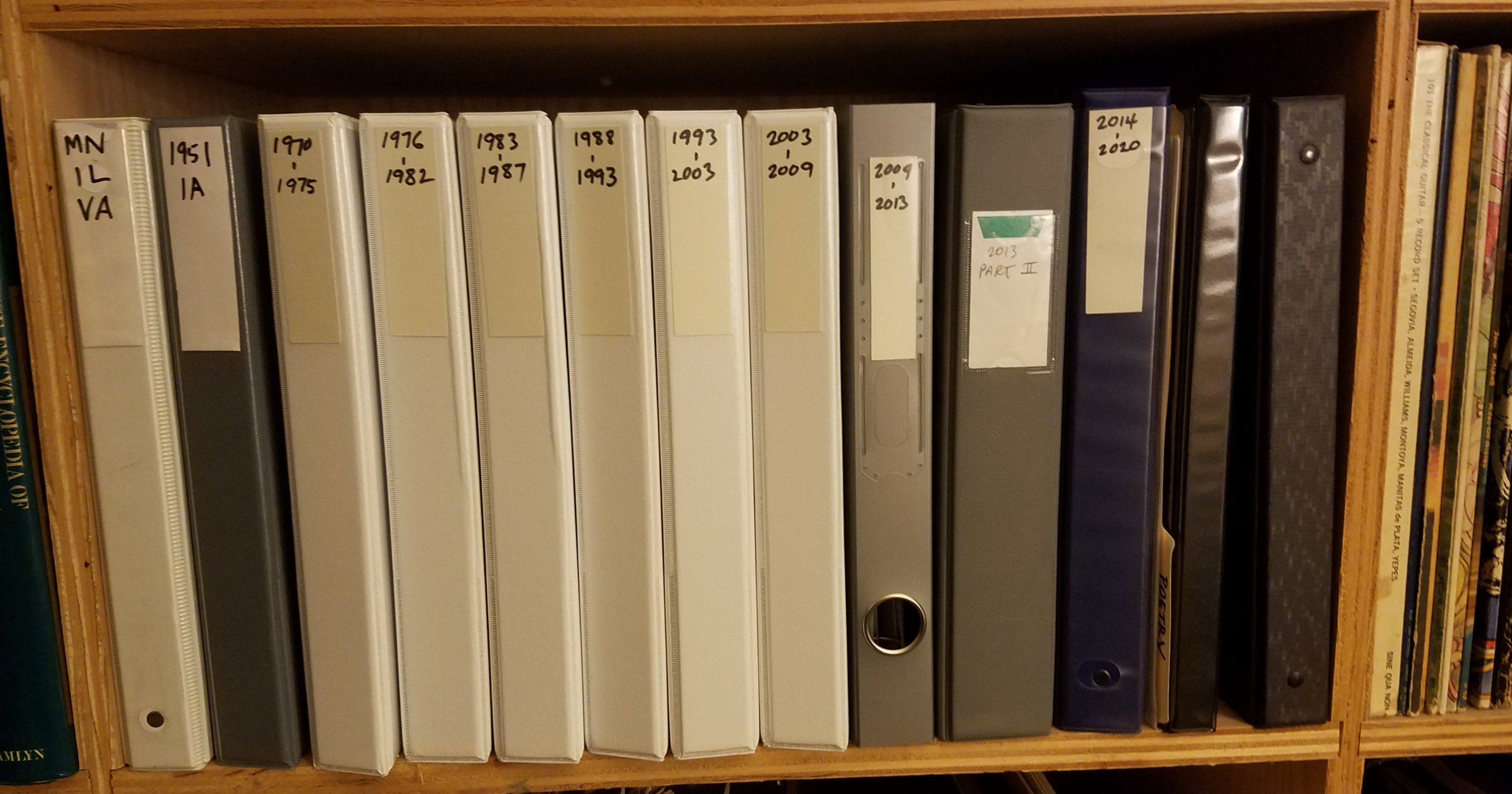
Work continues on the multi-year project that is my autobiography. The 13 three-ring binders in the photo are the containers for the first rough draft. The main 2022 project is filling them with a narrative. A key challenge is reviewing the source material in the form of files, journals, public writing, and internet searches. There is a lot of source material and a lot of reading ahead. Last year I wrote at least 1,000 words per day until April, then slowed down. Next year I hope to continue my progress almost every day until the first draft is completed. That may be in 2023 depending upon how 2022 goes.
For now I continue to write blog posts which are published here, on Blog for Iowa, and on a couple of other sites. The subjects have been varied yet they are comprised of two main topics: stories dovetailed into my autobiographical work and current affairs with an Iowa focus. I will have written about 350 posts in 2021, although I expect to slow down next year to focus on autobiographical writing.
At least once a month I plan to write a letter to the editor of the local newspapers. I may branch out with submissions to other papers in Iowa’s new First Congressional District, yet the best impact is closer to home. My primary topics are nuclear disarmament, the climate crisis, and current affairs. When I write to our local newspaper, the Solon Economist, the topics expand to more local issues like the fire station or recognizing local activities. All of my letters are cross-posted on this blog.
I am an email writer and occasional letter writer. I adopted email when I worked for the oil company beginning in 1989. From the beginning I saw it as a valuable medium. It really took off when we bought our first home computer in 1996. While I don’t have copies of most of my work emails, there is a trove of emails relevant to my autobiography dating to 1999. I will continue to write emails as a creative outlet, in addition to taking care of quotidian affairs.
I continue to maintain the journal started after college graduation. With the exception of the bound journal stolen from me in Calais, France, I have them all. I use it to record personal things that aren’t suitable for public consumption. Increasingly I monitor my health there.
Lastly, social media is a form of writing although we tend to view it as throw-away texts of little significance after posting. I expect to continue to post on Instagram, Facebook and Twitter. According to Twitch TV, in 2021 I posted 8,075 chat messages on the platform. My main goals for social media posting are to be kind, honest and thoughtful. I will also endeavor to re-read every post before hitting send.
I am lucky to have stable, adequate pension income after more than 50 years in the workforce. When the pandemic slowed everything down and raised a real risk of contracting COVID-19, stepping back from paid work was possible. For the coming year, I don’t foresee an initiative to take paid work as the coronavirus is still with us. That will enable me to focus on writing.
The forecast is fair writing weather ahead, depending upon what weather in real life does.
Eight of the top ten new posts on Journey Home were about the Solon School Board election. It demonstrates that when a blogger covers something in which people have interest, there will be views. I’m thankful for people who follow all of my writing.
To get a fairer picture of which blog posts garnered views, I include my work at Blog for Iowa. If I mix the two together, here are my top posts for 2021.
10. Book Review: Equity. Aug. 30, 2021, Journey Home. A book review of Equity: How to Design Organizations Where Everyone Thrives by Minal Bopaiah.
9.2021 School Board Candidate Forum. Oct. 21, 2021, Journey Home. This post was coverage of the only school board candidate forum prior to the election. It includes a link to video of the forum.
8. Solon School Board Election. Sept. 19, 2021, Journey Home. My first post about the Solon School Board election.
7. Here Comes Carbon Capture Technology. Nov. 24, 2021, Blog for Iowa. One of a series of posts about Carbon Capture and Sequestration plans of Summit Carbon Solutions and Navigator CO2 Ventures in Iowa.
6. The Climate Crisis is Accelerating – Now What? July 6, 2021, Blog for Iowa. Encouragement to act on the climate crisis. “While we need to do everything possible to avert the worst effects of the climate crisis, the longest, most complicated journey begins with a single step.”
4. Is Jessica Reznicek a Terrorist? July 15, 2021, Blog for Iowa. “Jessica Reznicek, a 39-year-old environmental activist and Catholic Worker from Des Moines, Iowa, was sentenced in federal court June 30 to eight years in prison for her efforts to sabotage construction of the Dakota Access pipeline.”
3. SSB Candidates Respond. Oct. 9, 2021, Journey Home. A verbatim reprinting of Solon School Board candidate responses to my questions via email.
2. Book Review: The Hidden History of American Oligarchy. Jan. 19, 2021, Blog for Iowa. “In The Hidden History of American Oligarchy: Reclaiming Our Democracy from the Ruling Class, Thom Hartmann recounts three periods of increased hegemony of oligarchs in American society.”
1. A Nonpartisan School Board. Sept. 25, 2021, Journey Home. A look at the Solon School Board election through a partisan lens. Disclosure of party registration of the seven candidates.
Thanks for reading. Hope you will continue in 2022.
When we took the land after the 1832 Black Hawk Purchase, it was decimated to make neatly cut rectangles of farmland. People are used to that now. Today Iowa farmland is used mostly as a production landscape for hogs, cattle, corn and beans. For too long, Iowa’s air, water and land have been used like an open sewer to support these operations. Farmers are used to what they know and don’t want to change. That’s true for people besides farmers.
Iowa is not an empty place where someone can do what they want with the land. A utility should not be able to build pipelines and transmission lines, or construct large-scale wind farms and solar arrays with impunity. The current crop of Iowa farmers is possessive of the right to their land and to use it as they see fit. They believe they know better than government what works here and what doesn’t. They don’t want infringement on their rights. The myth of farmers as the original environmentalists persists despite evidence to the contrary.
When solutions to the climate crisis require cooperation between large corporations and Iowa farmers there is resistance.
The new carbon capture and sequestration proposals of Summit Carbon Solutions and Navigator CO2 Ventures will confront these well-established beliefs. Even though a prominent farmer, Bruce Rastetter, is behind Summit, the rollout will follow a path familiar to anyone who knows the history of electricity transmission lines and oil pipelines here. Farmers will push back.
Donnelle Eller of Gannett stated the obvious about Summit in Monday’s Iowa City Press Citizen, “The company, a spinoff of Bruce Rastetter’s Alden-based Summit Agricultural Group, says the project would help ethanol and other energy-intensive ag industries remain viable as the nation seeks to cut greenhouse gas emissions in half by 2030 to address climate change.” The Iowa governor spoke about a low carbon economy, but failed to mention climate change or how CCS fits in such a framework. This underscores a key problem with CCS. They are just out there and bottom line, it’s backers don’t give a hoot about climate change. It’s another opportunity for capital investment which could yield big profits.
The sides are already lining up for this fight.
Opponents of CO2 pipelines have also been opponents of the Rock Island Clean Line and the Dakota Access Pipeline. Rural Iowans do not speak of one mind on this yet a common theme is big money, not farmers, are behind these transmission schemes. They claim the voices of farmers are not being heard. They also claim climate change is a lie.
What is the purpose of CCS if not to address climate change? That’s the wrong question. These projects are about investing capital to get a return on investment. If the government is a source of start-up capital, more’s the better for investors. The words “climate change” aren’t needed in this transaction.
“The world must reach net-zero CO2 emissions by 2050 in order to achieve the 1.5 degree Celsius global average temperature increase limit,” according to Summit’s website. “A dramatic increase in carbon capture and storage (CCS) is crucial to achieving net-zero CO2 emissions.”
The second sentence is unlikely to be accurate. The problem is Summit and Navigator seek to change nothing about industrial use of fossil fuels. They seek a profit from ethanol plants and other CO2 emitters who keep on doing what they are doing now. CCS has become a gigantic boondoggle instead of a solution to climate change.
“Climate and other environmental and public safety concerns about CO2 pipelines are important,” Ed Fallon wrote in a Nov. 11 email. “But as with Dakota Access Pipeline, in terms of mobilizing the broadest possible coalition of opponents, the strongest argument is the abuse of eminent domain.”
In a filing with the Iowa Utilities Board, Janna Swanson, whose land the Summit pipeline would cross, had this to say about the project and climate change:
There are a whole bunch of plans to mine our tax money for revenue and the excuse is Climate Change. When using that as an excuse then any action against humans is justified.
Summit Carbon Solutions will want the right of eminent domain. They will say that because of Climate Change that their business model is for public use.
When one paints with that wide of a brush then no one’s property is off limits for anything. No one has rights.
Let’s be clear. Summit and Navigator are in the CCS business to make money, as much of it as they can. Comments like Swanson’s are setting up climate change as a talking point instead of the reality of extreme weather it is and that must be dealt with.
It is early in the process yet already many comments have been made to the Iowa Utilities Board regarding the potential CCS proposals of Summit and Navigator. If you’d like to make a comment, here’s the information.
Written comments or objections to the proposed pipeline can be filed electronically using the IUB’s Open Docket Comment Form, by email to customer@iub.iowa.gov, or by postal mail to the Iowa Utilities Board, Attn: Docket No. HLP-2021-0003 (Navigator) and/or Docket No. HLP-2021-0001 (Summit) , 1375 E. Court Ave., Des Moines, IA 50319.
The downside of the CCS approval process is it turns rural Iowans against a second science-based phenomenon. Only 56.5 percent of Iowans are fully vaccinated against the coronavirus. There is no inoculation against extreme weather made worse by climate change that Iowans already experience.
Beginning today, I’m spending less writing time here and more on other projects. Due to the coronavirus pandemic, I’ve gone long stretches of posting every day. The uninterrupted string of posts may end soon, even if the pandemic doesn’t.
I’ll continue to cross post from other platforms, although my main work lies elsewhere, at least until spring.
Now that the end of year holidays kicked off with Thanksgiving, I’m ready to go. However you celebrate year’s end, have a good one.
Thank you for reading Journey Home. Hope to see you on the other side.
In between kitchen duties of helping prepare our Thanksgiving meal, I spent time finalizing a seed order for the 2022 garden. Between Johnny’s Selected Seeds and Totally Tomatoes, I found most of what I needed to adjust the seed inventory before next year’s planting.
When our daughter left Iowa we lost our way during the holidays. Old habits fell away and Christmas decorations we displayed each year after Thanksgiving remain in storage as they have for the past several years. Given the changes, it is hard to determine the meaning of the end of year holidays. What they meant isn’t any longer. For the most part we embrace the change… and plan the next year’s garden, and other activities.
Behind these blog posts, a lot is happening related to my writing. Last winter’s work was one of getting words down on a page, an average of 1,218 per day during the first half of this year. This winter I’m putting together the structure and plugging drafts into slots on the narrative frame. I cleared a shelf which now contains a dozen empty three-ring binders. Inside them will go the draft book, along with key reference material. I hope to fill those binders during the coming months. I will have a better idea of what progress is possible after the first pass.
The days after Thanksgiving are a quiet time. We all need a break and thrive in peacefulness. On April 21, 1996 we bought our first home computer. During the last 25 years, we learned how to spend long periods of time in front of a computer screen. Most of that time is dull, yet occasionally we find something of interest. Something engaging is always a click away, or so we believe. The information comes at us so quickly on line. One story after another piles up, invoking rage, happiness, and joy, but seldom denouement or catharsis. When we are sitting, looking at a screen, we often get tense or anxious. Sometimes we are outraged, which causes us to stand up and converse with others, to let off steam, to slow things back down to a normal pace. We appreciate the relative quiet in between times.
This Thanksgiving weekend is an in between time. Now that seed orders are placed, the next main event will come along soon enough. It’s getting so I no longer look forward to “main events.” I would much rather be in between.




 Journey Home

.jpg)
You must be logged in to post a comment.