Categories
Living in Society

Back to the Senate

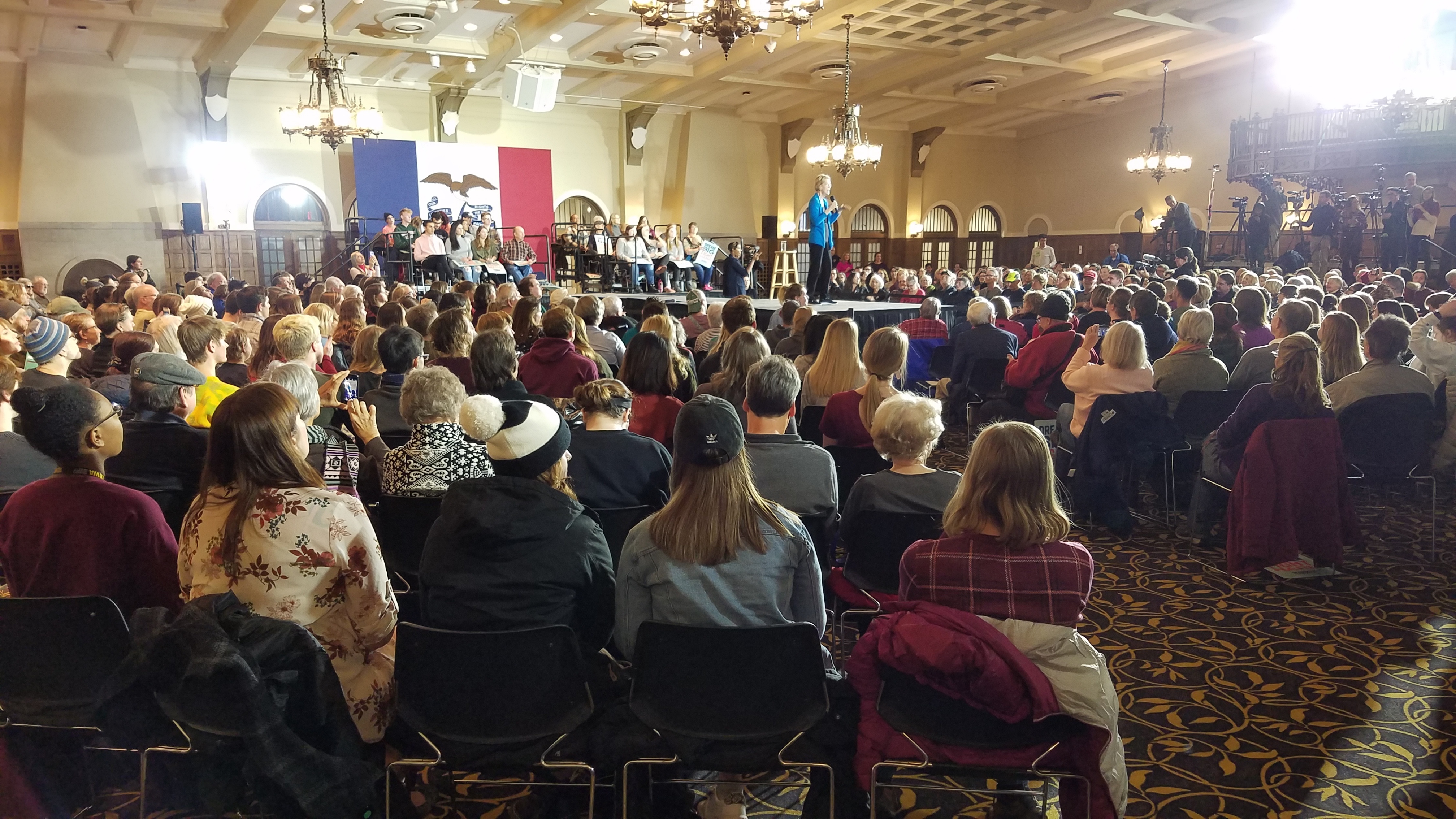
Elizabeth Warren at the Iowa Memorial Union, Iowa City, Iowa, Dec. 2, 2019.

U.S. Senator Elizabeth Warren suspended her campaign to become the Democratic nominee for president yesterday.

I will support the party’s nominee as he emerges from the summer convention. It chokes me up a bit to use the pronoun “he,” but I will support him.

More to the point, it became tiring to say the same thing over and over again during the last six months: “If Democrats don’t nominate a woman for president, we’ll never have a female president.”

While the statement is true — I don’t see Republicans nominating a women this cycle or for the foreseeable future — inherent misogyny among women and men prevented any of the highly skilled and credentialed female U.S. Senators from garnering the nomination.

To refresh our memories, they were (in the order in which they dropped out) Kirsten Gillibrand, Kamala Harris, Amy Klobuchar and Elizabeth Warren. I had issues with each of them, and that’s to be expected. The good news is they all returned to the senate, and their senate seats were never in jeopardy in their current terms.

There were and are good reasons to consider the men in the race for the presidential nomination. There are also reasons why two men advanced beyond Super Tuesday unrelated to misogyny. There is something there though. An attitude, belief, outlook, or whatever, that informed people this cycle was not a woman’s turn to get the nomination. Maybe I have some of that inside me and just can’t recognize it.

So we go on.

Here’s the email Warren sent to me and countless others yesterday morning. I felt sad as I read this in the break room at the home, farm and auto supply store. I was sad enough to recognize the feeling. Elizabeth Warren won’t be president in 2020, or probably ever. It is reassuring she will be in the U.S. Senate and has never stopped working for us.

Paul,

I’m going to start with the news. I wanted you to hear it straight from me: today, I’m suspending our campaign for president.

From the bottom of my heart, thank you for everything you have poured into this campaign.

I know that when we set out, this was not the news you ever wanted to hear. It is not the news I ever wanted to share. But I refuse to let disappointment blind me — or you — to what we’ve accomplished. We didn’t reach our goal, but what we have done together — what you have done — has made a lasting difference. It’s not the scale of the difference we wanted to make, but it matters — and the changes will have ripples for years to come.

What we have done — and the ideas we have launched into the world, the way we have fought this fight, the relationships we have built — will carry through for the rest of this election, and the one after that, and the one after that.

So think about it:

We have shown that it is possible to build a grassroots movement that is accountable to supporters and activists and not to wealthy donors — and to do it fast enough for a first-time candidate to build a viable campaign. Never again can anyone say that the only way that a newcomer can get a chance to be a plausible candidate is to take money from corporate executives and billionaires. That’s done.

We have shown that it is possible to inspire people with big ideas, possible to call out what’s wrong and to lay out a path to make this country live up to its promise.

We have shown that race and justice — economic justice, social justice, environmental justice, criminal justice — are not an afterthought, but are at the heart of everything that we do.

We have shown that a woman can stand up, hold her ground, and stay true to herself — no matter what.

We have shown that we can build plans in collaboration with the people who are most affected.

This campaign became something special, and it wasn’t because of me. It was because of you. I am so proud of how you fought this fight alongside me: you fought it with empathy and kindness and generosity — and of course, with enormous passion and grit.

Some of you may remember that long before I got into electoral politics, I was asked if I would accept a Consumer Financial Protection Bureau that was weak and toothless. And I replied that my first choice was a consumer agency that could get real stuff done, and my second choice was no agency and lots of blood and teeth left on the floor. In this campaign, we have been willing to fight, and, when necessary, we left plenty of blood and teeth on the floor. I can think of one billionaire who has been denied the chance to buy this election.

And we did all of this without selling access for money. Together, you and 1,250,000 people gave more than $112 million dollars to support this campaign. And we did it without selling one minute of my time to the highest bidder. People said that would be impossible. But you did that.

Together, we built a grassroots campaign that had some of the most ambitious organizing targets ever — and then we turned around and surpassed them.

Our staff and volunteers on the ground knocked on over 22 million doors across the country. We made 20 million phone calls and sent more than 42 million texts to voters. That’s truly astonishing. It is.

We also advocated for fixing our rigged system in a way that will make it work better for everyone.

A year ago, people weren’t talking about a two-cent wealth tax, Universal Child Care, cancelling student loan debt for 43 million Americans while reducing the racial wealth gap, breaking up big tech, or expanding Social Security. And now they are. And because we did the work of building broad support for all of those ideas across this country, these changes could actually be implemented by the next president.

A year ago, people weren’t talking about corruption, and they still aren’t talking about it enough — but we’ve moved the needle, and a hunk of our anti-corruption plan is already embedded in a House bill that is ready to go when we get a Democratic Senate.

And we also did it by having fun and by staying true to ourselves. We ran from the heart. We ran on our values. We ran on treating everyone with respect and dignity. But it was so much more. Four-hour selfie lines and pinky promises with little girls. A wedding at one of our town halls. And we were joyful and positive through all of it. We ran a campaign not to put people down, but to lift them up — and I loved pretty much every minute of it.

I may not be in the race for president in 2020, but this fight — our fight — is not over. And our place in this fight has not ended.

Because for every young person who is drowning in student debt, for every family struggling to pay the bills on two incomes, for every mom worried about paying for prescriptions or putting food on the table, this fight goes on.

For every immigrant and African American and Muslim and Jewish person and Latinx and transwoman who sees the rise in attacks on people who look or sound or worship like them, this fight goes on.

For every person alarmed by the speed with which climate change is bearing down upon us, this fight goes on.

And for every American who desperately wants to see our nation healed and some decency and honor restored to our government, this fight goes on.

When I voted on Tuesday at the elementary school down the street, a mom came up to me. She said she has two small children, and they have a nightly ritual. After the kids have brushed teeth and read books and gotten that last sip of water and done all the other bedtime routines, they do one last thing before the two little ones go to sleep: Mama leans over them and whispers, “Dream big.” And the children together reply, “Fight hard.”

So if you leave with only one thing, it must be this: Choose to fight only righteous fights, because then when things get tough — and they will — you will know that there is only option ahead of you: nevertheless, you must persist.

You should be so proud of what we’ve done together — what you have done over this past year.

Our work continues, the fight goes on, and big dreams never die.

Thanks for being a part of this,

Elizabeth
Categories
Living in Society

Freak Out Monday by the Lake

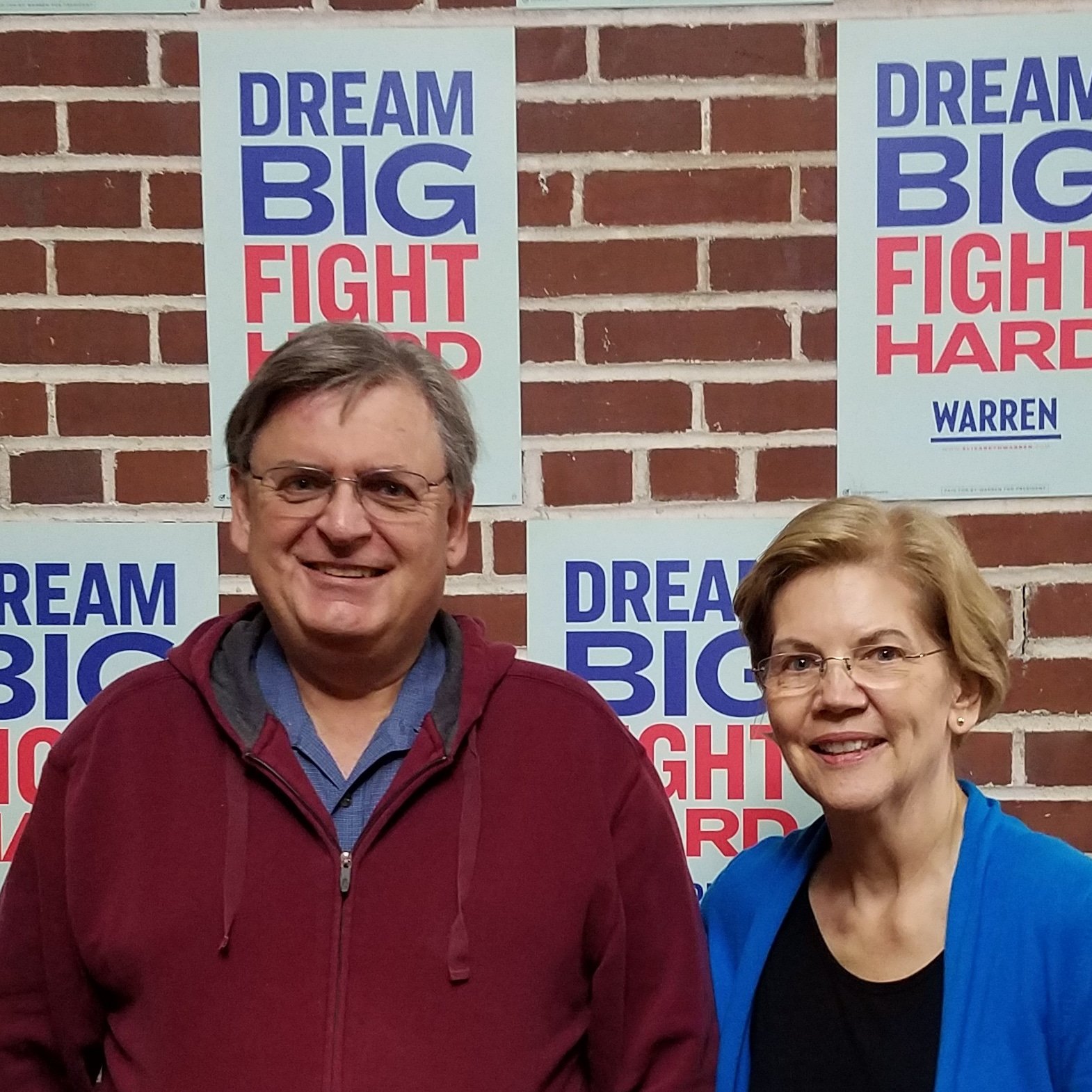
With Elizabeth Warren at the Iowa Memorial Union, Iowa City, Iowa.

I’ve been saying for some time that Super Tuesday — the day 14 states, American Samoa, and Democrats Abroad hold presidential primary elections and caucuses — is the decider for who is viable and who is not in the Democratic presidential primary race.

After mixed results in four early states, the field is down to four main contenders: Joe Biden, Michael Bloomberg, Bernie Sanders and Elizabeth Warren. After today’s voting we’ll see if Bloomberg and Warren remain viable. We’ll see if Bloomberg’s late entry coupled with spending hundreds of millions of dollars of his own money will get him in the game. We’ll also see if Warren’s ground game of political organizers is relevant to our modern politics. The expectation from national media and polling is the race will sort into a confrontation between so-called establishment or moderate Democrats backing Joe Biden, and the non-Democrat progressive Bernie Sanders. I suppose readers know all of that by 4:20 a.m. on Super Tuesday when I’m writing this. I hope there is a clear winner after votes are tabulated.

My plan for Monday did not include dealing with friends and neighbors freaking out over the possibility of a Sanders nomination. What I’m hearing in Big Grove Township is mostly fear that if nominated, Sanders would lose the general election, that he wouldn’t gain the support needed to prevail. Folks were urging support for Joe Biden, who is an equally flawed candidate. My chips were all on the table long before yesterday. The Iowa Caucuses are over and I stood with Elizabeth Warren with no regrets. I made another financial contribution to Warren’s campaign last night and drank a shot of whisky over ice cubes made from the Silurian Aquifer. What a day!

If we review who’s left in the Democratic primary, the top tier is comprised of septuagenarians I ruled out early in the process. I felt we needed new faces to breathe fresh air into the meandering beast the Democratic Party had become. Regretfully, none of the new faces who entered the race had staying power. Some of them, Pete Buttigieg, Amy Klobuchar and Beto O’Rourke, rallied around Biden last night in Dallas, Texas.

In addition to it being freak out Monday by the lake, a number of high profile Biden endorsements were released in advance of today’s voting, including Harry Reid, Barbara Boxer and Susan Rice. Biden is winning the endorsement game with eight current U.S. Senators, 21 former senators, and more than 50 current U.S. Representatives. A question we have to ask ourselves is how much do endorsements matter in 2020? They certainly contributed to the freak out phenomenon going on around here.

When asked, my friends said they would support and work for whoever is the Democratic nominee at the national convention this summer. If it’s Biden or Sanders, they are concerned about losing the general election. Nontheless, to a person they will support our nominee. I don’t know if I talked any of them off the ceiling yesterday because this freak out is not about reason or logic.

What was disappointing was the statement one person made that this was not the year for a woman to win the presidency. If not now, then when, I asked. If we don’t nominate a female for president, there will never be a female president. Their arguments, based on fear of losing the general election, did not hold water.

Maybe Trump was right to focus on Biden in the first place. If that’s who we choose over reasonable and serious objections, Republicans have a well developed plan to win against him. That’s not a case for nominating someone else, I’m just saying.

Today voters will decide who moves forward. It’s now or never for Bloomberg and Warren, assuming Sanders and Biden have reasonable showings. The worst that could happen is the electorate is not of a single mind about who should be the nominee. That would drag the process out for the rest of March when we could be consolidating around a candidate. That’s a flaw in Iowa going first: in 2016 and 2020 we did not produce a clear winner.

I’m ready to get beyond Super Tuesday as soon as the votes are counted. There’s a lot to be done in the coming months and we need to get after it. Hopefully the freak out will abate and we’ll know where we stand. Perhaps that’s too reasonable a wish in the new era of politics.

Categories
Environment Living in Society Social Commentary

Reducing Chloride in the Wastewater Stream

Kinetico Water Softener

One of the roles I play in society is secretary of the Macbride Sanitary Sewer District, a public entity that manages wastewater treatment for our group of  about 84 homes. I recently spent time writing a questionnaire about water softener usage and tabulating the results from a user survey. The report I sent to members this month has broader application so I’m publishing it here for my WordPress community. Your feedback would be welcome.

Thanks to the 66 home owners who submitted a survey on home water softener use. Before discussing the survey results, you may be wondering why we are working to reduce chloride in our wastewater. Short answer: the rules changed after our previous NPDES permit expired. Our new one, issued May 1, 2017, has new requirements for chloride and other elements. Here is some information about the new standard from the Iowa Department of Natural Resources which manages NPDES permits for the U.S. Environmental Protection Agency:

Iowa adopted water quality standards for chloride and sulfate in November 2009. These two new standards replaced the previous water quality standard for total dissolved solids. “Total dissolved solids” is a measure of all chemical elements that have become dissolved in water. It includes chloride, sulfate, nitrate, sodium, potassium, and magnesium, among other chemicals. The total dissolved solids standard was designed to protect aquatic life from toxic conditions caused by these chemicals. However, research by DNR showed that in Iowa waters, chloride and sulfate are more accurate predictors of toxicity to aquatic life than the combined measurement of total dissolved solids. DNR thus undertook to replace the water quality standard for total dissolved solids with specific standards for chloride and sulfate.

Of the people who responded to our survey, 31 use a timed-cycle water softener, 30 use on demand-initiated cycling, and 5 didn’t know.

Reported annual salt usage ranged from zero to 2,000 pounds. 20 homes used less than 250 pounds, 21 between 251 and 480, 15 used more than 480 pounds, and ten didn’t know.

A couple of things are clear from the data: 1. Many people don’t think much about their water softener or keep records about how much salt they use. One 40-pound bag per month is 480 per year and several people used that as an estimate; 2. We use a wide variety of brands of water softeners. Kinetico was most popular. There are a half dozen others; 3. Most families installed their softener and seldom had maintenance done on it; 4. The three most popular plumbers were Water Conditioning Systems (Kinetico), Affordable Soft Water, and Neal’s Water Conditioning; and 5. Most homes have a separate line to run untreated water outside for lawn, garden and cleaning.

What should home owners do regarding salt use?

  1. Contact a plumber to have your water tested for hardness and your water softener checked for proper functioning and adjustment. Have the plumber program your softener to a low-salt setting appropriate for the water hardness in your home.
  2. If you plan to replace your water softener, get one that cycles based on demand rather than on a timer. This will ensure all the water used is properly softened and save salt if your usage is lower.
  3. Install high-efficiency water fixtures, like low-flow shower heads, to reduce your home’s soft water use.
  4. Have a plumber disconnect water that doesn’t need to be soft, like toilets and lines to outdoors, from the water softener.
  5. If your household is using more than 480 pounds of salt annually look at replacing your water softener to take advantage of new technology and use less salt. A new Kinetico softener will use about 250 pounds of salt annually for a household with two people.
  6. Water is not an unlimited resource so develop creative ways to conserve water at home, such as taking shorter showers, running only full loads in the dishwasher and clothes washer, and turn the faucet off when taking care of personal hygiene or doing dishes — break the bad habit of letting it run. Consider getting EPA WaterSense-certified toilets which use less water for flushing.

At this time the Macbride Sanitary Sewer District is not considering a mandated salt reduction program. We are to be in compliance with the new chloride standard by April 1, 2022, and if voluntary efforts produce the desired results, that will be that. If we don’t meet standards, the board of trustees will revisit the issue of more specific requirements.

Categories
Environment Living in Society

Mining the Jordan Aquifer

State Senator Liz Mathis (L) and State Representative Molly Donahue at the Ely Public Library, Ely, Iowa. Feb. 29, 2020.

It should be no shocker that I attended a political event on Saturday. How could I miss it? It was six miles from our house.

State Senator Liz Mathis represents the 34th Senate District in the Iowa legislature. Alongside State Representative Molly Donahue, who represents House District 68, they hosted a legislative listening post at the Ely Public Library.

The closer one gets to Cedar Rapids, the more likely we are to encounter kolaches, a traditional semi-sweet roll originating in the Czech heritage of Iowa’s second largest city. Mathis pointed out the box of kolaches in the back of the meeting room soon after my arrival. About 16 people attended.

I was in graduate school in Iowa City when Mathis began her broadcast news career at KWWL at their then new Cedar Rapids bureau. She has been a broadcast anchor, television producer, college professor, and is currently an executive at the non-profit organization Four Oaks Family and Children Services. Donahue has been a teacher for 30 years with a current focus on secondary students in special education or those who have behavior disorders that can affect their learning. They were well qualified to discuss Iowa’s mental health system, school safety, the K-12 education budget, the school bus driver shortage, and related topics. I listened and tried to learn.

News on Friday was Pattison Sand Company of Clayton sought to extract 34 million gallons of water per year over a ten-year period from the Jordan Aquifer, according to Perry Beeman of Iowa Capitol Dispatch. The water would be shipped by rail to arid regions in the American west, potentially to New Mexico, Colorado, Wyoming, Nevada, Utah, Arizona or California. The Jordan Aquifer is also the source of municipal water for the city of Marion which lies within Mathis’ senate district.

Earlier this month Pattison proposed to extract 2 billion gallons per year from the Jordan Aquifer using wells they drilled to support their frack sand mining operation. This proposal was rejected by the Iowa Department of Natural Resources.

The problem with tapping the Jordan Aquifer is it is prehistoric water, in other words, it has been there a long time. The aquifer does not recharge at the same rate as the Silurian Aquifer which lies on top of it. Once the Jordan Aquifer is drained, the water will be gone and communities that currently rely upon it could be left without a reliable water source.

The climate crisis is evident in the American west. Demand for water exceeds the region’s capacity to produce it through rainfall, snow melt, and underground aquifers. Something’s got to give for people who settled there to survive. Mining and shipping water from Eastern Iowa is not a good idea because what may be abundant to meet our current needs will be diminished by the extraction proposed by Pattison and others. It is easy to see how a discussion over water rights could escalate into regional conflict over this basic human need.

If we look at history, humans have continued to exploit natural resources until they are gone, in many cases leading to the collapse of societies. Our brains are not wired to perceive the threat shipping billions of gallons of water from Iowa to the west could have. We have to pay attention, and the role of government is to look out for the common good.

It is hard to image an overall plan to resolve the climate crisis at its root causes. Further exploitation of natural resources doesn’t solve anything and could potentially make matters worse. At least we were discussing it and in doing so raising awareness on a sunny morning in Ely over kolaches.

Categories
Environment Living in Society Social Commentary Writing

Spring Is Late, But Coming

Garden in Winter

The driver delivering pallets of yard and landscaping stone, peat moss, and dirt said his spring deliveries are running about two weeks behind last year.

We just finished our annual inventory at the home, farm and auto supply store and are ready for incoming freight of garden supplies, utility trailers, wheelbarrows, fertilizer, three-point farm equipment, and the like. I unloaded a pallet of 50-pound bags of seed potatoes. The greenhouse will be installed in the parking lot next week. Spring seemed late to our suppliers but it’s almost here.

It’s more like we didn’t have a winter.

In a retail warehouse we notice the seasonality of commerce. Shelves fill with mowers, trimmers, blowers, chain saws and tillers. We received two tall pallets of box fans. Large ceramic pots were shipped in crates from Mexico. We have a delightful collection of ceramic and metal rooster art. This entire post could be a repetition of inbound inventory processed during my two days per week part time job. I have something else in mind.

The intersection of commerce, private lives, spirituality and society is where we spend most of our lives. In time, if we are lucky and talented, we create a process of living that ensures our survival. In Eastern Iowa it is pretty straightforward how one secures food, shelter and clothing: seek training and then work as a skilled professional, an entrepreneur, or for someone else. There is no guarantee of success but most people in my circle make it, including those who are forced to live in their cars because they are poor, or who sleep on someone’s couch for a while due to physical abuse at home. We live a privileged life despite the real problems people have.

There is a sense our process of living, for lack of a better description, is built by us, for us, and there is separation from what others do. That’s okay. If we have more in common than we believe, the articulation of a life can be a conscious effort with variations in the use of materials from a mass society. We make something of our selves. Such a process may seem individualistic, bordering on taking care of “me only,” but it is intertwined with the fate of the society which provides context.

I may subscribe to the local newspaper, but so do a thousand other people, our subscriptions and advertising giving life to the enterprise. In a few brilliant moments I find my life has not been consciously nurtured, nor has it been self made. It has been a collaborative undertaking in a social network from which I emerged and in which I remain rooted… kind of like the newspaper.

I read an article about the high cost of prescription drugs. The Congress is working to lower the cost of such medicine, yet to date their work has been an utter failure. People are skipping medically necessary prescriptions because of the cost, Megan Leonhardt of CNBC reported. There is another side to this issue.

Over the years I’ve had several conversations with physicians, and now my nurse practitioner, about taking prescription medicine. Just like finding a good auto mechanic or a reliable technician to work on my yard tractor, it is part of a process for living. Every time a medical practitioner suggested a prescription — either to control cholesterol or prevent Type II diabetes — I pushed back.

I have been able to address each diagnosis through behavioral changes coupled with regular visits to the clinic. These physiological conditions may persist, and at some point I may have to accede to medication. Last year I took a small step and began taking a low-dose aspirin in addition to my daily vitamin B-12 tablet. We’ll see how things go during my follow up appointment later this year. My point is when we focus on the failure of our government to properly regulate the pharmaceutical industry we neglect focus on a process for living. Having a process for living is more important than what our government does or doesn’t do.

I feel life in society all around me. Maybe that is a Cartesian outlook, one rooted in my earliest memories of reading at home before breakfast, after being an altar boy for Catholic Mass at the convent. Despite whatever separation I feel in intellectual outlook our future is inseparable from its context. The fate of our society is complexly intertwined. To separate a single strand of it in the form of an individual life, from the broader organism, would be to our mutual detriment.

I don’t understand how we will manage the many challenges we face — environmental degradation, climate change, economic inequality, the threat of conflict, and diminished natural resources. I do know that without a process for living that recognizes the web of life that engendered us, that brought us to this moment, we may not be up to the challenge. Humanity’s well-being will predictably decline. I’m not ready to say it is inevitable. I don’t believe it is.

Yet so much depends on the observations of truck drivers who pay attention to the variability in our lives — and together try to make them better.

Categories
Living in Society

Theresa Greenfield – Jobs To Get Done

Theresa Greenfield

On Saturday, Feb. 22, I met with U.S. Senate candidate Theresa Greenfield at a coffee shop in Coralville, immediately after her appearance at the Linn County Phoenix Club. She arrived on time and was thoughtful in her answers to my questions. She got the job done. The following interview is transcribed from an audio recording. Any mistakes are the author’s. Greenfield began with an opening statement.

THERESA GREENFIELD: I worked my entire career in small business from being a community planner for about fourteen years with neighborhood groups, planning commissions and city councils — helping in that local government office.

I worked for a civil engineering company and was a consultant for either a township that didn’t have staff, or maybe a city that had extra projects they just didn’t have enough staff to get that work done. I loved it.

From there I went into home building and eventually became the president of a small home building company in Iowa. That was fun through the recession, until it wasn’t any more fun. We sold the assets at the end of 2011.

I became unemployed like a lot of people in the recession, then hired on with a commercial real estate company. I most recently was their president. I recently resigned to focus full time on this U.S. Senate race.

I’m pretty excited we just kicked off two things, beginning with our “Hear it from the heartland tour.”

We have been intentional about going places. The number one topic I hear about is health care. We began at Boone County Hospital which is an independent hospital, not part of a big system. We just learned a lot about their challenges, the cool things they are doing too, and how they are integrated into their community. Health care is the number one issue that I hear about and they just reiterated all of that.

We also then just put out the first of what I call our “jobs to get done” agenda. Because I grew up on a farm, and that’s what my parents always said, “No boy jobs, no girl jobs, just jobs to get done.” I think we need to think about some of this work in those kinds of terms.

The first job that needs to get done, for me kind of the root of what’s wrong with Washington and the difference between Senator Ernst and myself, is big money in politics. Our first job to get done is end political corruption and end dark money in politics. Bring some transparency to it, end Citizens United, stop the revolving door of lobbyists. If you’re a senator you can’t sit on a corporate board at the same time. It might seem like natural things that we should be doing as pubic servants, but codify it and try to bring an end to that.

BLOG FOR IOWA: How do you view your prospects for beating Joni Ernst?

GREENFIELD: I view them as really good.

BFIA: Why is that?

GREENFIELD: First off, I grew up rural and I think Iowans want Washington to work like our home towns work. You know, we come together and get something done. There’s a lot of frustration.

Senator Ernst ran to be independent, and different, and she was going to make ‘em squeal, and she’s just taken a real hard turn to the right and votes 90-plus percent of the time with Mitch McConnell and party leaders, really leaving Iowans behind on issues that we care about whether you have an R or a D behind your name, or an N, or you don’t vote.

Things like health care. Voting to end and take away your protections for preexisting conditions. Prescription drug costs haven’t come down. Voting to end the ACA which by the way, allowed Medicaid expansion, which we did here in the state… and that has kept so many of our hospital lights on.

Now I grew up rural and with my parents, we got caught up in the farm crisis. My parents had to sell their hogs and their crop dusting business and never farm again. After that the school closed, grocery store closed, these are stories that we hear around the Midwest, and they drive 20-30 minutes to a grocery store, faith community, hospital, health care. If their little hospital closes they’re going to be going 50 miles, who knows? Or they won’t get the health care they need. These are real issues. You need health care? It doesn’t matter if you’re a Republican or Democrat.

BFIA: Would you say that’s your sharpest contrast with Ernst, on health care? I mean would you really make a difference?

GREENFIELD: Yeah. I will go back to the reason about winning. Her favorable rating is now down to about 39 percent in the state. So for me that just says Iowans aren’t loyal to her, and they are going to take a look at a good, strong Democratic candidate. That tells me Iowans are very open and this race is wide open. She does not have a lock on the race.

You know our differences definitely will (make a difference). I’m a “get ‘er done” person who has gotten things done. I want to focus on the things that most Iowans worry about. Health care is number one. Education. Folks worry about the economy and jobs here in Iowa. With net farm income being down 75 percent since 2013, I’ll tell you what, as I travel around this state, people have concerns. And you put on top of that the 85 ethanol wavers. Our farm economy, our manufacturing, our main street folks are very worried and I hear about that.

BFIA: What is your reaction to the president’s recent announcement that he would create additional subsidies for farmers hurt by trade policy? What are you hearing on the campaign trail from farmers who may have gotten some of that money?

GREENFIELD: Farmers I talk to want their markets back, that’s what they want. They want the future. They don’t want to leave a legacy of liability for their family with high debt. They want to leave a legacy of prosperity. They see continuing to get the markets back and grow those markets is what they want to do, and I get it. I grew up hard-working on the farm and that’s what farmers like to do: get up early, stay late, get the job done, and they want to earn a fair profit to do that.

BFIA: So you don’t see the impact, you see a different picture. What you see is the guarantee by the administration not having the desired effect because people want their markets back, people want to do the work, get paid for the work. Did I get that right?

GREENFIELD: Yes they do. But I’ll tell you what, the situation we’re in: bankruptcy rates are at an eight year high right now. It’s personal for me. When my parents had to sell the crop-dusting business, their hogs, and get out of farming, I went to auctions where families’ contents of the farm were put in boxes on hay racks and auctioned off for a buck or two, and no farm family should have to go through that again. Particularly when we can make a difference. That’s where I’m at.

BFIA: How did you decide to get into politics?

GREENFIELD: That’s a great question. I grew up in a little town, Bricelyn, Minnesota, right on the Minnesota/Iowa border. My parents were DFLers Democratic Farm Labor members. My Mom was the one who always marched in parades, went to county meetings, we door knocked. We didn’t phone call back then though because we had a party line… no robo calling. So it’s always been in my blood to be active in a certain way.

But then I got busy raising a family. I had some hope-stubbing experiences for sure. As my kids got a little older I was able to spent more time phone calling, door knocking. I’ve been a little active.

Remember I spent about 14 years working in community planning at the local legislative level — so planning commissions, neighborhoods, city council meetings, all of that. I saw potholes that needed to be fixed and filled — they aren’t Republican or Democratic — there was a problem that needed to be solved communities come together to do that. I’ll tell you I just decided we need some new leaders.

People talk to me all the time about wanting to end the divisiveness in Washington. We do it by making decisions like we do in our home towns, you know, where we come together. So it’s motivated me.

I really got into this race for hard work and family. I carry their struggles, their heart, and their effort to earn a living wage and provide for their families and have their American dream. For me it comes from being widowed at the age of 24. My first husband was a lineman for the power company. He was an IBEW member… we’re a union family. I will always stand tall with the unions. That’s for sure. They built the middle class and I don’t forget why my lights come on and who delivers my mail. I know those are union jobs.

When Rod died of a work place accident and I became a single mom — a 13-month old and another one on the way — I wouldn’t be here today without Social Security Survivor Benefits and hard-earned union benefits. I didn’t get here by myself. I certainly had family and friends and my home town and community.

Today people are struggling. They need leaders that know and appreciate what hard-working families are going through. That’s not what Senator Ernst does. She stands up and goes in line with her large corporate donors and leaves Iowans behind. So I got in the race.

She also talks about wanting to privatize Social Security and cut Medicare and Medicaid. The current Republican budget is very hard on those programs. I’ll tell you what. I wouldn’t be here without them. So this feisty farm girl, I’m getting in the fight.

BFIA: What were the lessons learned from your race in Iowa’s Third District?

GREENFIELD: What I already knew, but it became clear to me with the campaign for congress, is that there is a moral element to leadership. Voters and Iowans they want leaders who will do it right and they won’t look away from what’s wrong and they won’t put their own political gains first. And that’s what I did. When my campaign manager came to me a told me he had forged signatures on my petitions to be on the ballot I knew what the right thing was to do and we did it. I didn’t get a chance to be on the ballot at the end of the day but I can hold my head high and live in my community and respect and uphold our Democracy and election system. You continue to learn, and doing what is right is always right.

BFIA: Why does your experience best qualify you to win the primary?

GREENFIELD: Well it’s a combination of experience. It’s also a combination of doing the work and being able to build the team. Nobody wins by themselves; I say that every time I’m asked. I am running to do a job which is to represent people. When you bring them into my campaign with me and listen to them, that’s how we’re going to win. We have built an incredibly strong team in house but then have earned the endorsement of many, many of our unions AFSCME, IBEW, and others representing 65,000 union members in the state. We earned the endorsement and partnership of so many elected leaders around the state, including Christie Vilsack, Sally Pederson, Congressman Loebsack, and Congresswoman Finkenauer.

What I’ve done is really kept my head down and focused on building that team. I do it by going out and telling my story. Because I think Iowans want to vote for somebody, they want to see themselves in that person. They want to trust that you’ll do the right thing for them. May not always agree on a policy decision, but they know my character and they know my integrity, and they’re going to vote accordingly. We’re going to go out and compete in every county, in every precinct for every vote.

BFIA: If you lose the primary or the general would you consider a run against Senator Grassley if he runs again?

GREENFIELD: Oh boy! I haven’t even thought about that. Here’s what I can tell you though. If I lose the primary I will do everything I can to get our candidate elected.

(Editor’s note: The interview covered additional issues, including Greenfield’s approach to the climate crisis, auditing the Pentagon, foreign policy, and the 2020 Nuclear Non-Proliferation Treaty Conference. For more information about Greenfield’s views on issues, click here).

Categories
Home Life Kitchen Garden

First Big Grove Garden Plot

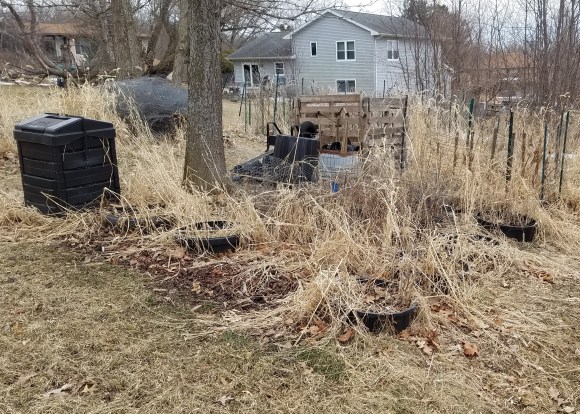
First Garden Plot, Feb. 24, 2020.

I planted our first Big Grove Township garden in Spring 1994. What I grew is lost in memory.

Yesterday the original plot looked a wreck with desiccated weeds and a hodge-podge of sunken containers, fencing, two composters, a wheel barrow, an old wash tub, six-inch pieces of drainage tile resting on a couple of pallets, and a locust tree. The locust tree was intended for transplant but it got away from me.

I don’t know if the locust tree will recover from last winter’s extremely cold temperatures. The tips of branches in the crown did not leaf out last spring. If it doesn’t recover I’ll take the tree out even though the shade it provides protects plants and conserves moisture during our increasingly hot, dry summers. The plot was not meant to be a permanent residence for trees.

A friend in Cedar County gave me black plastic tubs in which feed for their animals was delivered. I cut large holes in the bottom for drainage and buried them to grow potatoes, radishes, lettuce, basil and sundry root crops. Mostly it was for potatoes which when planted in the ground fed small rodents who thrive with us in the garden. The containers worked to keep them away from the roots.

Composters are necessary for a garden to turn organic matter into fertilizer. One is an open air composter made from pallets retrieved from the home, farm and auto supply store. Garden waste goes in there. The other is a sealed, black plastic container for organic household waste such as peelings, fruit cores, and other fruit and vegetable matter generated from the kitchen. That is, it used to be sealed. Over the years something got inside and has been pushing stuff out of the entry point chewed into the plastic. I should fix or replace it. Until I do it remains a place to dump the kitchen compost bucket and produces some usable compost. The next time I move it there will be compost.

If I had a garden shed I would not use the plot for storage. I continue to think about building a shed, but that’s as far as it has gotten. It won’t be this year, or probably next.

Despite all the useful clutter, the plot continues to be productive. Last year I grew broccoli, eggplant, radishes, basil and beets there. The year before I grew cucumbers. The containers are always busy with multiple crops each year. As I plan this year’s garden I see better utilization of this plot.

Ideas about 2020 in plot #1: Belgian lettuce on or about March 2; potatoes in containers on Good Friday; radishes in a container; a crop of something, cucumbers, eggplant, or maybe hot peppers to change from cruciferous vegetables planted here last year. These are ideas, and the beginning of planning. We’ll see how it unfolds, although Belgian lettuce seems certain a week ahead of the date.

I remember digging this plot in 1994, measuring the distance from the property line, a memory of nothing growing in the yard except grasses and a mulberry tree in the Northeast corner. I barely knew how to garden then. In the interim, my views of how to garden have changed for the better.

Based on the 15-day weather forecast, winter is finished. As temperatures climb and the remaining snow melts we had just better accept it we won’t have had much of a winter. It is time to lean into the growing season as soon as Mother Natures enables us. Soon it will be Spring.

Categories
Work Life

Becoming an Asset

At Sunset

Career guidance for many workers is to become an asset to their employer or organization rather than a commodity. Each plays its role in life and on the job, and has for me.

A commodity worker is someone who plays a specific, interchangeable role in a business or organization. For example, a dishwasher is an essential part of restaurant operations yet the people who play that role are completely fungible. The restaurant is the less if the dishwasher doesn’t do their job. If they don’t do their job they can easily be replaced. We rarely know the names of dishwashers.

Becoming an asset to an organization means bringing a special skill and value. I worked as director of legal affairs for a logistics company. My knowledge of existing contracts and contract law enabled me to evaluate new agreements as we grew our business. I knew when to consult with our attorneys and when it wasn’t necessary. I interacted with sales staff, operations, and the president of the company. The expense savings over having a lawyer on staff were considerable, and my contribution during negotiations with customers was tangible and effective. It helped close new business and retain business where the contract was reaching the end of its term. It wasn’t a plug and play role and was important when growing new business.

After my first retirement in 2009, I sought commodity roles to generate income. It’s a tough row to hoe. Pay is low, there are physical risks in the form of a changing work environment, and almost no job security. I will be forever grateful for this part of my life because it provided first-hand insight to the lives of low wage workers.

Extended periods of standing on concrete floors led to foot problems after which I gave up running for exercise. Commodity jobs externalize the costs on worker lives, seeking the lowest possible cost to make assembly line kits, serve food, or provide retail sales customer service. The underlying assumption by workers and management is these jobs won’t persist and people will come and go in them. With short tenure, companies avoid long-term costs of maintaining a workforce, including workers compensation claims, retirement contributions, and health insurance. When employee costs are externalized, other, more controlled aspects of an expense ledger receive focus. It works great for companies who outsource labor particularly, and for any business with low gross margins.

In my transportation and logistics career I became an asset although I didn’t understand it at the time. While we lived in Indiana I became dissatisfied with work managing a trucking terminal with 600 drivers, a maintenance facility, and a driver recruiting team. I sought to leverage my assets somewhere else. The result was taking a job with a Fortune 10 oil company that had an irregular route truckload fleet which was bleeding expenses. The salary was good, although a daily commute from Northwest Indiana to the Chicago Loop was challenging.

I hoped to get into the oil side of the business after I proved myself as an asset for the fledgling business unit. It didn’t take long to realize that wasn’t a viable career expectation. I was hired for my specific knowledge of truckload transportation operations as an asset, and while I was uniquely qualified, a path to something else materialized only after I resigned from the job to return to my trucking terminal in Indiana. The business unit folded shortly after I left it.

In a time of professional human resources consultants large companies develop methods to control costs with elaborate pay schedules and organization charts. People perceived as assets command a higher salary than commodity workers, even if the HR consultants have defined a market rate for such positions. One’s value to a large company comes to light if a person can transcend the position for which they were hired. I found that challenging in my career with more failures than successes. On the positive side, I was in a position to leave the business at an early age to pursue other interests.

The difference between asset and commodity workers is a useful paradigm. The business environment in the United States has few guarantees for longevity in employment. If one wants longevity, they should find work owning a small business or in commodity work as a specialist with professional skills. With a growing population, society will need more medical professionals, plumbers, auto technicians, social workers, insurance and car sales people, government office workers and the like.

If the conventional wisdom is to become an asset in an organization, I disagree. The best option is to become your own best asset and live that life at work and at home. It’s something I work at everyday.

Categories
Juke Box

Juke Box – Crossroads

Cream: Eric Clapton, Jack Bruce and Ginger Baker. This group came together and dissolved while I was in high school, before I knew it. Few bands were as good as this one was.

Taking a couple days to work on other projects, in the meanwhile…

Categories
Home Life

Saturday Errands

Turn-Style Department Store, Davenport, Iowa. Photo Credit – Davenport Iowa History Facebook Page

I yearn to live a normal life. I’m not the only one.

Raised in a community of a hundred thousand people, I found something new was always going on. I didn’t discover the half of it. My craving for discovery continued with our move to a rural community in 1993.

In the context of yearning and discovery I ran errands on Saturday.

I had a list. Citirizine from the pharmacy, organic celery from the supermarket, a cup of coffee from the coffee shop, writing supplies from the office supply store, furnace filters, canning jar lids, 4-ounce canning jars, and a big tub for soil mix from the home, farm and auto supply store… milk and eggs from the warehouse club so I wouldn’t have to shop there next Wednesday. I also got a much needed haircut before heading home across Coralville Lake.

Two things I had to do were pick up the keys to the meeting room for a Sunday political event, and post flyers about the Food Policy Council’s event next week on community bulletin boards in the grocery store, the library, the coffee shop, a restaurant, the home, farm and auto supply store, the gas station, and the pharmacy. These bulletin boards are ubiquitous, and are seen in the community. Not everyone has one but those who do know why they exist.

The trouble started at the food cooperative where my spouse has had an account since before we were married. They remodeled, and according to a cashier, “couldn’t find a place” for the community bulletin board which was now gone. Seriously? I get that the cooperative has changed since the days of bulgar wheat piled in burlap bags, ready for distribution. However, one hoped some sense of community would persist as the shelves filled with organic versions of processed food.

As long as I was there, I found the Tofurky brand Italian sausages I use when making red beans and rice.

Nearby I encountered “Beyond Burgers.” O.M.G. Two quarter pound “fresh” patties of the meat substitute cost $8.99. The ingredients? “pea protein isolate,” “methyl cellulose,” “bamboo cellulose,” and 19 others. I knew the product came from a lab, but Z.O.M.G. To make matters worse they were heavily packaged.

The packaging appeared to be foam and I looked it up. “Beyond Burger packaging is made up of almost five different types of substrates, including low density polyethylene, polypropylene, cardboard, paper, and wood products.” Not only is the packaging diversely made, how would a recycling company sort it if it even made it there?

Understood that a growing number of people don’t want to eat animals… but not like this.

I am mostly veg., that is, most of the time our diet is ovo-lacto-vegetarian. I’ll have the aforementioned Tofurky a couple of times a year to make a dish filled with memories of how I learned to cook. A staple in our household is Morningstar Farms soy-based burgers and recipe crumbles. At $1.25 each they are more affordable than Beyond Burger. They seem less processed, less engineered as well. We have fallen off the tofu bandwagon and carefully consider how we get our protein. The end game is I don’t see how highly engineered and processed food is an adequate replacement for beef cattle, hogs or chicken in our diet. Somewhere there is a middle ground and if red meat makes me feel queasy, I need to find something else to balance nutrition with a yearning for cooking the way Mom did. Beyond Burger is too special for that.

I don’t run errands that often any more. We get by on less. When I lived in Germany I had scant leisure time but when I was off duty I yearned to go shopping at the rail station, the post exchange, and across the Rhine River at the box stores in Wiesbaden. Today shopping trips like Saturday are a couple times a year thing. I wish it engendered less outrage. I don’t want to be that cranky old man of which one hears tell.

All the same, running errands is a way of engaging in society. I’m grateful for conversation with cashiers, sales associates and hairdressers because it breaks up the isolation of aging. I like getting away from society, yet have the same basic need to join with others… even if that means complaining about stuff that doesn’t make sense.

It’s all part of sustaining our lives in a turbulent world.